
Easy
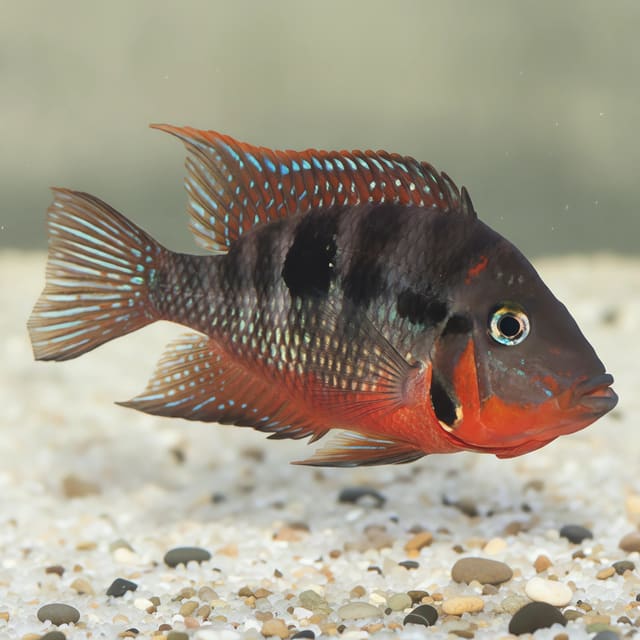
Firemouth Cichlid (Thorichthys meeki)
23–30°C · pH 6.5–8 · 200L
£4.99

A heavily pearled Herichthys carpintis from northeastern Mexico for an experienced keeper with a mature, spacious cichlid aquarium. One unsexed fish per selected 3-4 cm, 5-6 cm, 6-7 cm or supplier-labelled XL grade; not a pair.
Herichthys carpintis
A heavily pearled Herichthys carpintis from northeastern Mexico for an experienced keeper with a mature, spacious cichlid aquarium. One unsexed fish per selected 3-4 cm, 5-6 cm, 6-7 cm or supplier-labelled XL grade; not a pair.
Cichlids are a family of roughly 1,800 accepted species, not one care type. Before buying, identify the exact species and source, then compare adult measurement, usable tank dimensions, social system, territory, tested water, diet and an exit plan. No family-wide minimum tank, water range or tank-mate list is safe.
Maintain these water conditions for optimal health and vibrant colors
Pearlscale Texas Cichlid is an established aquarium-trade name for Herichthys carpintis, a deep-bodied, heavily pearled cichlid from northeastern Mexico. It is also sold as Pearlscale Cichlid, Carpintis Cichlid, Green Texas Cichlid and Lowland Cichlid. Those names help customers find the fish, but the scientific identity matters: H. carpintis is not the same species as the true Texas or Rio Grande Cichlid, Herichthys cyanoguttatus.
Each selected quantity supplies one unsexed live fish in the chosen approximate 3-4 cm, 5-6 cm, 6-7 cm or supplier-labelled XL grade. It is not a male, female, sexed pair or bonded pair. A size option describes the commercial dispatch grade; it does not certify age, maturity, adult length, sex or final colour.
FishBase records 17 cm maximum standard length for Herichthys carpintis. Standard length stops at the base of the tail, so plan for around 20 cm total length and leave margin for a larger individual. The supplier's broader commercial field says 20-30 cm. This page keeps those sources separate and uses a conservative adult aquarium plan rather than turning either maximum into a promise about the fish delivered.
This is a territorial, strong-bodied cichlid for a mature aquarium with secure hardscape, substantial filtration and a ready separation plan. It is not a peaceful general community fish and should not be bought for a temporary juvenile tank. The safest starting plan is one adult-planned fish in at least a 150 x 50 cm footprint and roughly 400 litres; two fish or a mixed large-cichlid display require substantially more usable territory.
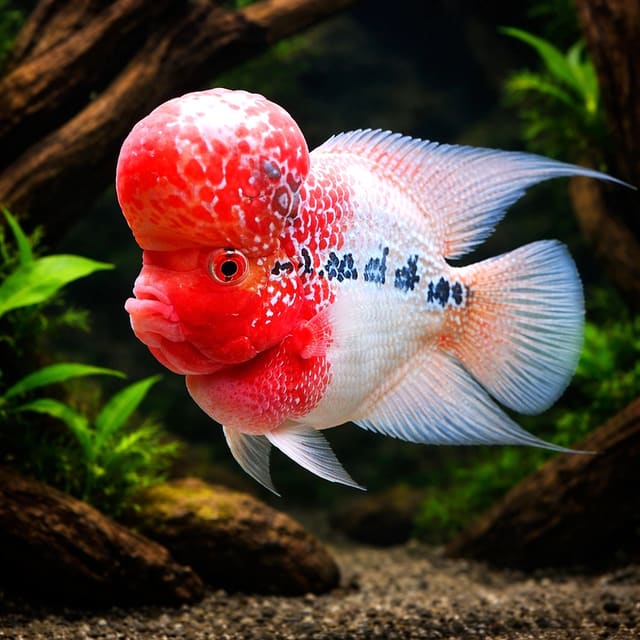
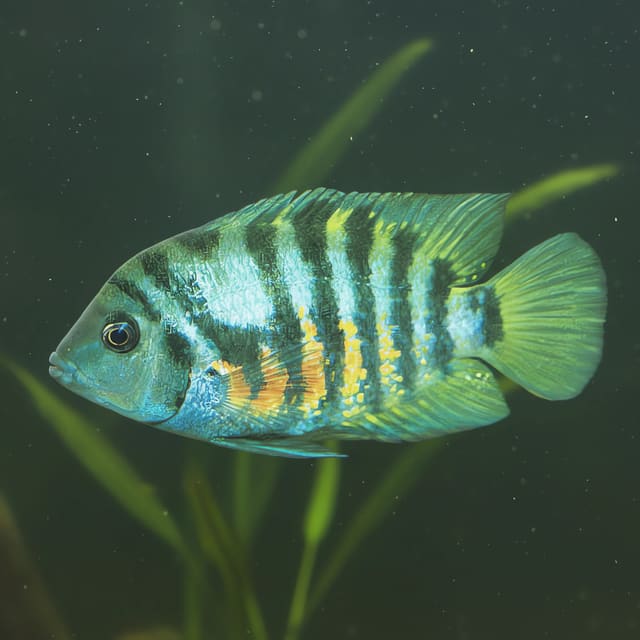
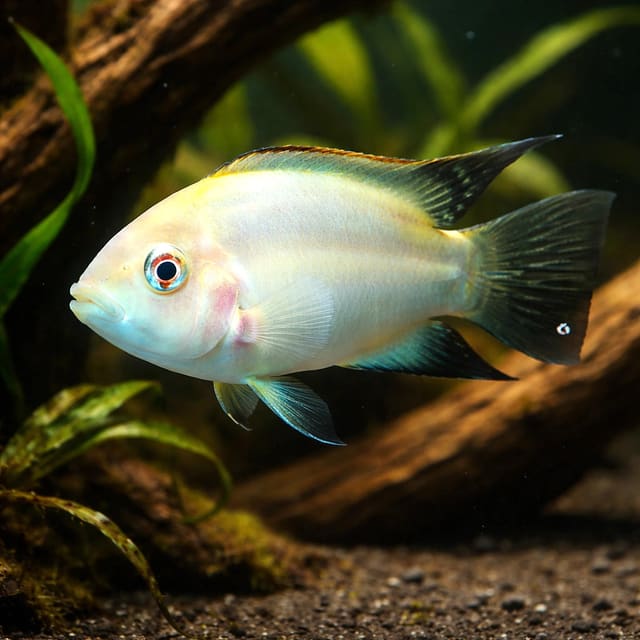
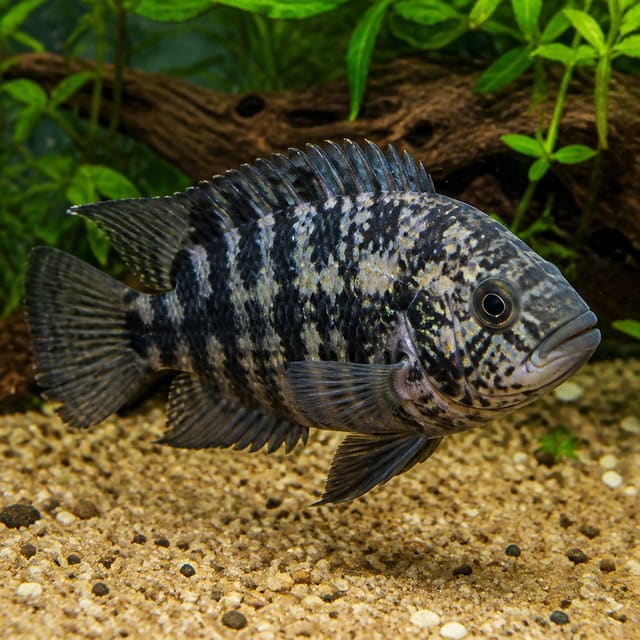
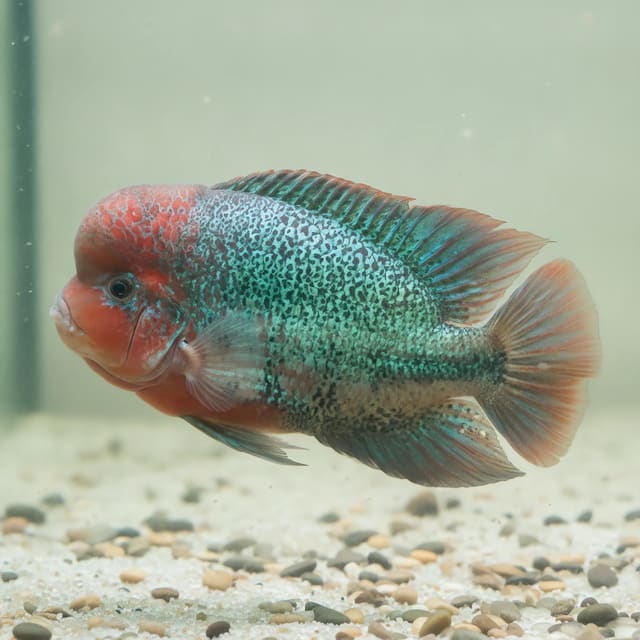
The four gallery images are representatives, not current batch photographs. They cannot guarantee the exact fish, selected grade, sex, adult colour, locality or pair status. This disclosure is important because the pictures show an idealised bright-blue form that differs visibly from the reference photo retained for provenance.
| Listing point | What is supplied | What is not promised |
|---|---|---|
| Sale unit | One live fish per selected quantity | A pair, group or breeding project |
| Sex | Unsexed | Male, female or requested ratio |
| Size choice | Approximate 3-4 cm, 5-6 cm, 6-7 cm or supplier-labelled XL grade | Exact millimetres, age or maturity |
| Identity | Trade-listed Pearlscale Cichlid; accepted entity Herichthys carpintis | Genetic testing, named wild locality or breeder-line certificate |
| Appearance | A living fish whose pattern changes with growth and condition | The exact bright-blue colour in an image |
The selector is the source for current stock, price and offered grades. Those details can change independently of this care guide, so they are not frozen into searchable prose or structured data.
Every grade needs the same adult plan. A 3-4 cm juvenile is not suitable for a smaller permanent aquarium simply because it occupies little space on arrival. Likewise, choosing two fish does not make them compatible or establish a male-female pair.
Our stock records use Cichlasoma / carpinte. The accepted spelling is Herichthys carpintis; Cichlasoma carpinte is retained only as a historic supplier and search bridge. Correcting that wording does not erase provenance, and preserving it does not make the old name current.
| Name | Use here | Meaning |
|---|---|---|
| Herichthys carpintis | Primary scientific entity | Accepted species name used by FishBase and recent research |
| Pearlscale Cichlid | Primary plain-English name | Refers to the dense reflective spotting; it is not the unrelated goldfish variety |
| Carpintis Cichlid | Natural search bridge | A direct common-name use of the species epithet |
| Green Texas Cichlid | Trade bridge | Widely used for H. carpintis, but not a formal species name |
| True Texas or Rio Grande Cichlid | Comparison only | Usually means the distinct species Herichthys cyanoguttatus |
| Cichlasoma carpinte | Historic supplier wording | Useful for record matching, not the title or current scientific field |
A 2018 phylogeny and species-diversity review treats H. carpintis and H. cyanoguttatus as separate species. FishBase also lists them separately: the former as the Lowland Cichlid from Mexican Atlantic-slope drainages and the latter as the Rio Grande Cichlid. Search volume cannot override that distinction.
Red Texas, Super Red Texas, balloon forms and some electric-blue retail lines may be selected forms or hybrids with different ancestry and body shape. This listing does not claim one of those lines. Keep the scientific name, supplier wording and any later breeder information together in future records rather than relabelling the fish from colour alone.
Herichthys carpintis is native to the Atlantic slope of northeastern Mexico, including the Panuco drainage and Soto la Marina River. FishBase records it from both fast-flowing rivers and still waters. That range suggests environmental flexibility, but it does not mean abrupt changes or poor water are harmless in an aquarium.
Mexico is in North America. The store's protected supplier taxonomy currently places this product under South American Cichlids; that is a catalogue path, not a geographic claim. For biogeographic comparison, the Central American cichlid collection is the more useful browsing context, while the supplier Cichlasoma category explains where this stock sits in the shop navigation.
A good aquarium interpretation provides open patrol water, secure rock or wood boundaries, smooth substrate and several retreat routes. It should not try to recreate one imaginary collection site from a background. Published distribution is broader than a single aquascape.
| Feature | Planning value | Evidence boundary |
|---|---|---|
| Scientific identity | Herichthys carpintis | Commercial batch has no genetic certificate |
| Distribution | Panuco and Soto la Marina drainages, northeastern Mexico | Supplier does not certify a collection locality |
| Published size | 17 cm maximum standard length | Plan around 20 cm total length plus safety margin |
| Published water | 23-33°C, pH 7.0-8.0, 9-20 dGH | The upper temperature is not a routine target |
| Practical retailer range | 24-26°C, pH 7.0-8.0, 9-20 dGH | Stability and oxygen remain more important than one midpoint |
| Temperament | Territorial; intensity changes with individual, maturity and setup | No tank-mate or pair guarantee |
| Breeding context | Biparental clutch care | Retail fish are unsexed and not breeding-ready by promise |
| Conservation | Least Concern in the cited IUCN assessment | Status does not prove captive provenance |
Species references, supplier data and retailer welfare advice answer different questions. Scientific sources describe recorded biology. Supplier fields describe the commercial product. The aquarium recommendation translates both into a cautious plan and states where the evidence ends.
A precise number is not better information when its source cannot be shown.
| Selected grade | Practical meaning | Planning point |
|---|---|---|
| 3-4 cm | Small juvenile commercial band | Protect filter intakes and provide food particles it can swallow |
| 5-6 cm | Developing juvenile band | Still unsexed; appearance and social confidence can change |
| 6-7 cm | Larger developing fish | May establish territory sooner; not proof of adulthood or sex |
| XL | Supplier option label | No fixed centimetre range is promised unless shown in the live selector |
Living fish do not sit on exact manufacturing tolerances. Posture, fasting before transport and measurement method can create small differences around a grade boundary. The selected band is an honest commercial approximation, not a guarantee to the millimetre.
Choose the grade that fits the current residents and feeding plan, but do not use size alone as a compatibility test. A larger new fish can still be attacked by an established resident, and a small resident can still dominate a larger newcomer through territory.
For one adult-planned fish, use at least a 150 x 50 cm footprint and roughly 400 litres as conservative retailer guidance. Footprint matters because this cichlid turns, patrols, digs and defends horizontal space. A tall tank with the same nominal volume may provide far less usable territory.
| Planning question | Why it matters | Ready when |
|---|---|---|
| Is the aquarium at least 150 cm long? | Length creates patrol distance and separated retreat zones | Hardscape can interrupt sight lines without blocking swimming |
| Is the front-to-back depth at least 50 cm? | Deep-bodied fish and stable structures need turning room | Open water and several routes remain after decor is installed |
| Can filtration support adult biomass? | Large cichlids produce more waste than the juvenile suggests | Ammonia and nitrite remain zero under the intended feeding load |
| Is separation accommodation mature? | Temperament can change with growth or pair behaviour | A fish can be moved immediately without starting an emergency cycle |
The tank-volume tool calculates nominal litres, but it cannot judge body shape, line-of-sight breaks or social pressure. Treat 400 litres as the beginning of a one-adult plan, not permission to crowd a standard-shaped tank.
Two fish are not a pair plan. A true two-fish or mixed display generally needs a much larger footprint, multiple independent territories, greater filtration reserve and a divider or second aquarium ready. There is no honest universal litre figure that guarantees two territorial cichlids will coexist.
FishBase records 23-33°C, pH 7.0-8.0 and 9-20 dGH for the species. Our stock records give 24-26°C, pH 6.5-8.0 and 5-20 dGH. For this commercial listing, 24-26°C, pH 7.0-8.0 and 9-20 dGH form a cautious overlap. Do not treat 33°C as a routine aquarium target or use the supplier's lower hardness boundary to justify unstable soft water.
| Measurement | Practical planning range | Management point |
|---|---|---|
| Temperature | 24-26°C | Keep stable and maintain strong oxygen exchange |
| pH | 7.0-8.0 | Interpret with KH; do not chase pH with repeated unmeasured doses |
| GH | 9-20 dGH | Use a repeatable source-water or remineralisation recipe |
| Ammonia | 0 mg/l | Any detectable result needs immediate investigation |
| Nitrite | 0 mg/l | A new fish must never be used to test an unfinished cycle |
| Nitrate | Low and controlled | Track the trend and adjust feeding, stocking and water changes |
Measure tap or source water before selecting buffers. If reverse-osmosis water is used, remineralise it to a repeatable recipe; pure RO is not a stable default for this mineral-tolerant species. The water-matcher can compare broad requirements, but aquarium test results remain the evidence.
A fish can tolerate a range while still being harmed by a rapid move across it. Avoid major pH, hardness or temperature corrections immediately before delivery. Stabilise the aquarium first, then acclimate according to the real difference between source and destination water.
Build the layout before the fish arrives. Use sand or smooth fine gravel, secure rocks or wood, open swimming room and several visual barriers. Place heavy structures on a stable base rather than loose substrate, then add substrate around them so digging cannot undermine a tower.
Create more than one route around major structures. A single cave with one narrow entrance can become a trap if another fish controls the exit. Smooth openings should remain large enough for the adult body, and heaters or intake guards should not create a gap where a frightened fish can wedge itself.
Plants are optional. Sturdy plants attached to hardscape or protected root zones may work, but digging and territorial rearrangement are normal possibilities. The planted gallery scenes are illustrative backgrounds, not proof that a delicate aquascape will remain untouched.
Leave a clear feeding area where every fish can be observed swallowing food. A beautiful wall of decor that hides waste and prevents body-condition checks is not a successful habitat. Accessibility for maintenance is part of the design.
Choose filtration for the adult fish and its diet rather than only the litre rating printed on a box. Mature biological media must keep ammonia and nitrite at zero, while mechanical stages should capture waste before it accumulates behind hardscape. A second filter can add resilience, but only if both units are maintained without removing all mature media at once.
Provide visible surface movement and circulation around structures. Warm water carries less dissolved oxygen, and blocked intakes or dirty media can reduce real flow while a motor still sounds normal. Check output by observation, not noise.
Protect intakes for the smallest grade. Position outlets so the fish has both moving water and calmer resting zones rather than one continuous high-energy jet. During hot weather or a power interruption, a battery air pump is useful contingency equipment.
Rapid breathing, surface gathering or persistent filter-clinging should trigger immediate checks of temperature, oxygen, ammonia, nitrite and aggression. Do not assume infection until environmental causes have been measured.
| Frequency | Observe or test | Useful action |
|---|---|---|
| Daily | Temperature, breathing, posture, appetite, wounds and filter flow | Record any departure from the settled baseline |
| At each feed | Whether the fish actually swallows food | Adjust particle size, portion or delivery point |
| Weekly | Nitrite, nitrate, pH, equipment and visible waste; ammonia when indicated | Complete a measured, matched water change |
| Monthly | Hardscape stability, intake guards, hoses, lid gaps and body condition | Correct slow trends before they become emergencies |
| After any stocking change | Routes, feeding access and social pressure | Use the prepared separation plan when needed |
The exact water-change percentage depends on stocking, food, source water and nitrate trend. Match temperature and chemistry, dechlorinate correctly and avoid exposing biological media to untreated tap water. A fixed weekly number cannot replace measured results.
Vacuum accessible waste without dismantling every territory. Use a torch to inspect behind hardscape and keep circulation routes open. Stagger major jobs so a filter clean, full rescape, large chemistry change and new arrival do not occur together.
The reviewed species summary does not provide a detailed natural food list. This listing therefore uses a cautious captive plan: a complete omnivorous cichlid food as the staple, with measured aquatic invertebrate variety and some plant-containing foods.
| Food type | Role | Caution |
|---|---|---|
| Complete cichlid omnivore pellet | Measured staple with declared vitamins and minerals | Choose particles the selected grade can swallow whole |
| Frozen aquatic invertebrate mix | Controlled texture and feeding variety | Thaw, portion carefully and prevent waste entering hardscape |
| Plant-containing pellet or prepared food | Adds dietary variety and fibre | Use a complete product rather than random kitchen vegetables alone |
| Clean cultured live food | Foraging enrichment for suitable sizes | Use reliable cultures that do not introduce pests or pollution |
| Mammalian or poultry meat | Not recommended | Poor nutritional fit and unnecessary pollution risk |
| Feeder fish | Not required | Can introduce disease and does not create a balanced diet |
Tropical Cichlid Omnivore Small Pellet is a practical option for a grade able to swallow it. Cichlid Mix frozen food can provide occasional variety, but no product replaces label reading, portion control and observation.
Offer modest portions and watch the fish swallow them. Smaller juveniles may benefit from more frequent small feeds; a settled adult may need fewer, depending on body condition and temperature. Reduce the ration if food reaches the substrate uneaten or nitrate rises faster than the maintenance plan can control.
Begging is not proof of hunger. Large cichlids quickly learn that a person near the aquarium predicts food. Judge the ration by body condition, growth, waste and water quality rather than enthusiasm at the glass.
This is an alert, territorial cichlid that may patrol, dig, move substrate and react to activity outside the aquarium. Individual intensity varies. A fish that is manageable as a juvenile can become much more defensive with maturity, a new layout or reproductive behaviour.
Healthy confidence is not the same as continuous aggression. Repeated full-length pursuit, exclusion from food, torn fins, a fish trapped behind equipment or one individual permanently held in a top corner are intervention signs. Waiting for fish to "sort it out" is unsafe when injury or starvation is developing.
Enrichment comes from usable space, changing food delivery within a stable routine, secure objects to inspect and the ability to choose between open and sheltered areas. Repeatedly tapping the glass, chasing the fish for colour or rebuilding its entire territory is disturbance, not enrichment.
One adult-planned fish is the most controlled starting point. Any companion plan must account for adult size, body strength, territory, feeding speed and the ability to remove either fish. Matching temperature and pH does not establish behavioural compatibility.
| Candidate plan | Assessment | Main risk |
|---|---|---|
| Single adult-planned H. carpintis | Most controlled starting plan | Still needs a large mature aquarium and enrichment |
| Two unsexed juveniles | High caution | They may mature as any sex combination and become incompatible |
| Observed compatible pair | Specialist project in a substantially larger system | Pair aggression and spawning defence can change rapidly |
| Robust medium-large cichlids | Conditional comparison, not a recommendation | Dominance, injury and feeding exclusion |
| Oscar | Do not assume compatibility | Different social responses and high combined waste load |
| Small community fish, shrimp or delicate species | Avoid as intended companions | Predation, harassment or chronic stress |
A divider can be useful only if the aquarium remains large enough on both sides and water flow, heater access and retreat space remain safe. A transparent divider may allow constant visual aggression; an opaque section can be needed. A separate mature aquarium is more flexible.
Do not buy several juveniles merely to let a pair emerge unless every surplus or rejected fish has a planned, lawful and humane destination. Retail availability does not create rehoming capacity.
Sex is not guaranteed. Adult males may become larger or develop a heavier head profile, while breeding females can show strong contrast, but juvenile size, fin shape and one photograph cannot provide a dependable retail sex promise. The XL option is not automatically male.
Pearling can change with growth, genetics, lighting, hierarchy, transport and health. A newly arrived juvenile may be darker or less reflective than the gallery. Food and stable husbandry support normal development, but cannot force an unsexed fish to reproduce an idealised blue image.
The source record does not certify the Escondido locality, Rio Hondo line, electric-blue line, wild origin, F-number or named breeder. Do not add those labels later without documentation. Appearance alone is especially unreliable where selected and hybrid Texas-type cichlids circulate in the trade.
| Term | Usual meaning | Why it matters |
|---|---|---|
| Pearlscale or Green Texas Cichlid | Common trade name for H. carpintis | Useful search bridge when the scientific name is shown |
| True Texas or Rio Grande Cichlid | H. cyanoguttatus | A distinct species, not a synonym for this listing |
| Red Texas | Often a hybrid or selected line | Colour name does not prove H. carpintis ancestry |
| Short Body Texas | Compact-body commercial form | Body shape and welfare assessment differ from standard-form stock |
| Electric Blue Carpintis | Trade or selected-line wording | This listing has no such line certificate |
| Pearlscale goldfish | A fancy goldfish variety | Completely different fish despite the shared common word |
The distinction is useful for search results and for animal records. A customer searching a broad Texas term can identify the product correctly, while a future breeder or keeper is less likely to spread uncertain fish under the wrong species or line name.
FishBase records biparental clutch care: the female tends the eggs and the male defends territory. In an aquarium, substrate cleaning, colour change, digging and joint defence may precede spawning. Those behaviours can also greatly increase danger to tank mates.
Species-level breeding information does not mean a selected fish is mature, sexed or fertile. Two purchased juveniles are not a breeding pair. Never force unfamiliar adults together without visual separation, escape options and the ability to remove either fish immediately.
If offspring are produced, retain accurate parental records. Do not label them as a locality, colour line or pure species when parentage is uncertain. Responsible naming protects later keepers and reduces the circulation of incorrectly identified hybrids.
| Observation | Check first | Reason |
|---|---|---|
| Rapid breathing | Temperature, oxygen, ammonia, nitrite and aggression | Environmental stress can resemble infection |
| Refusal of food | Water, hierarchy, mouth condition and recent transport | One symptom has several different causes |
| Torn fins or missing scales | Chasing routes, hardscape edges and tank mates | Medication cannot correct an unsafe layout |
| Swollen abdomen or abnormal waste | Diet, portion, water and qualified diagnosis | Blind treatment can delay the correct response |
| Continuous hiding | Feeding access, cover, light, hierarchy and water | Chronic exclusion may occur without dramatic fighting |
| White spots, ulcers or persistent lesions | Quarantine and aquatic-veterinary advice | Treatment depends on the actual cause |
Never medicate merely because a symptom resembles an online photograph. Confirm water quality, isolate when appropriate and use diagnosis-led treatment compatible with the aquarium. Some products can harm invertebrates, plants or biological filtration.
Body condition, posture, breathing and appetite are better welfare signals than maximum colour. Photograph the settled fish under consistent lighting if a baseline is useful, and record test results whenever behaviour changes.
A separate mature quarantine aquarium is strongly preferred. Match the intended temperature and mineral range, provide inert shelter and use dedicated nets, siphons and other wet equipment. Quarantine supports observation of feeding, breathing, waste and body condition without competition from established residents.
Do not treat a few symptom-free days as proof. The appropriate observation period depends on source, signs and professional advice. If disease is suspected, avoid moving the fish repeatedly between systems or combining several treatments without a diagnosis.
Before introduction to the display, reassess territory. Rearranging selected boundaries may interrupt one resident's claim, but do not destabilise heavy structures or combine the move with a full filter clean and major chemistry change.
Prepare the mature aquarium, tests, dim lighting, quarantine space and transfer equipment before delivery. Inspect the parcel promptly. If there is a genuine arrival concern, follow the current evidence instructions while the fish remains in the sealed bag and keep the packaging until support advises otherwise.
Compare destination temperature and chemistry, then follow the new-fish acclimation guide. The acclimation timer can support the process but cannot measure pH, hardness or fish condition.
Once a transport bag is opened, gas exchange changes its chemistry. Do not leave the fish in warming, opened transport water for an unnecessarily long ritual. Transfer calmly, avoid adding transport water to the aquarium where practical and keep lighting low while the fish recovers.
| Period | Useful observation | Warning sign |
|---|---|---|
| First hours | Upright posture, steady breathing and access to shelter | Rolling, gasping, inability to settle or direct attack |
| First meal | A small suitable particle swallowed after recovery | Repeated spitting, choking or complete exclusion |
| Days 2-3 | Predictable use of open water and retreat routes | Continuous top-corner hiding or filter-clinging |
| Days 4-7 | Stable appetite, body condition and normal waste | Weight loss, lesions, swelling or escalating chasing |
| After any concern | Measured water results and written observations | Several unmeasured treatments applied together |
Offer a modest first meal only after breathing and posture settle. Remove uneaten food. Transport can temporarily reduce colour and appetite, but persistent refusal or deterioration requires investigation rather than larger repeated feeds.
Keep a short record of temperature, water tests, food taken and social position. Trends are easier to recognise when observations are written down.
All four retained storefront images are representatives. The fish are unusually bright blue and visually similar to one another, while the reference photo shows a darker individual with dense pale turquoise pearling. Neither source is the exact animal dispatched.
The two-fish scene is not evidence of a bonded or sexed pair. The clean side view is not a diagnostic specimen, and the detail image cannot certify mature colour. Background plants and wood are illustrative rather than a fixed habitat instruction.
Use the gallery to understand a broad visual theme only. Base the purchase on the written species identity, sale unit, adult footprint, water, diet and social requirements.
| Listing | Useful comparison | Do not assume |
|---|---|---|
| Short Body Texas Cichlid | A commercial compact-body form listed under the same scientific entity | It has the same body shape, stock source or welfare assessment |
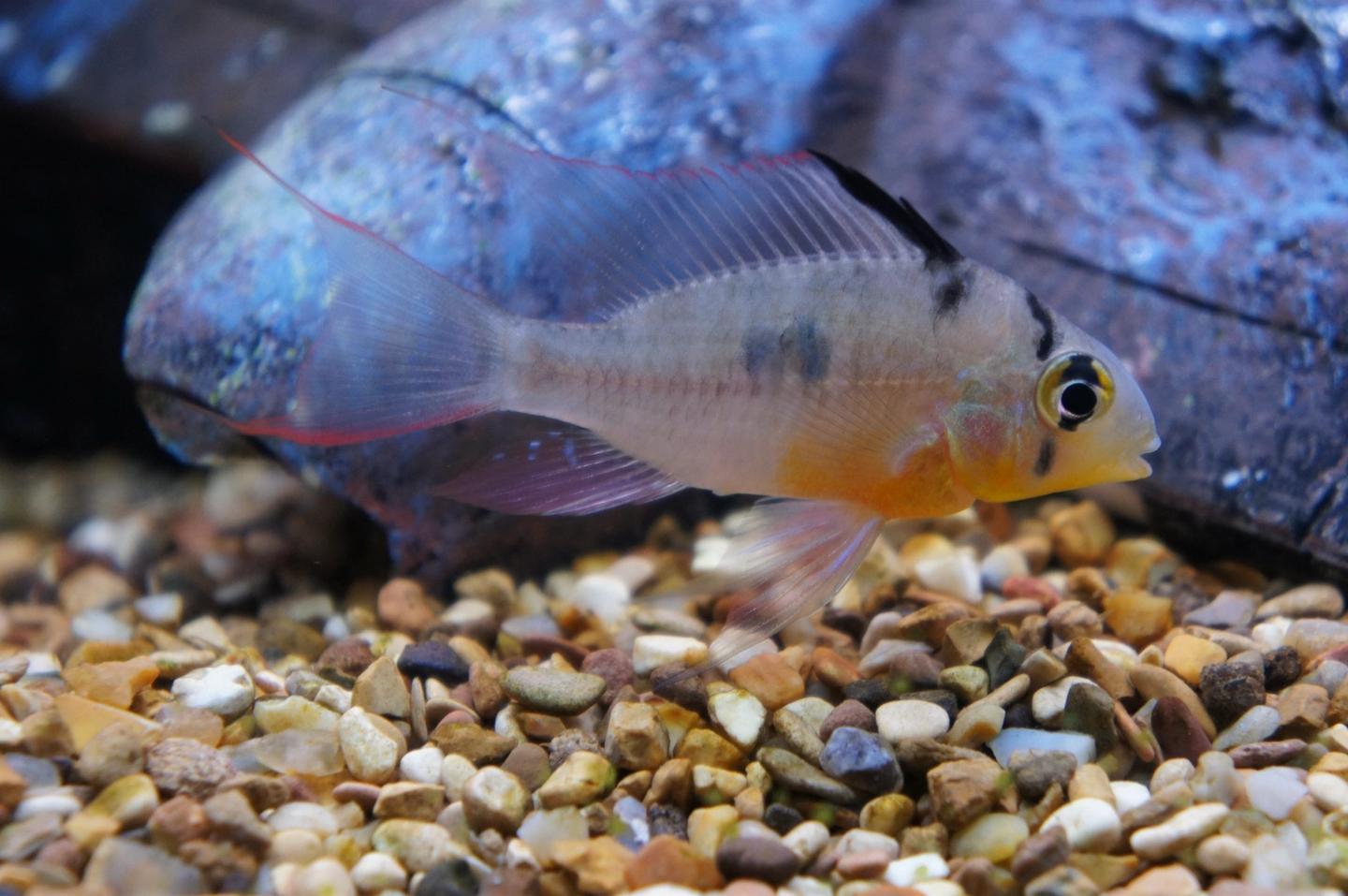
| Firemouth Cichlid | Another Mexican and Central American cichlid context | Shared geography makes it a safe companion |
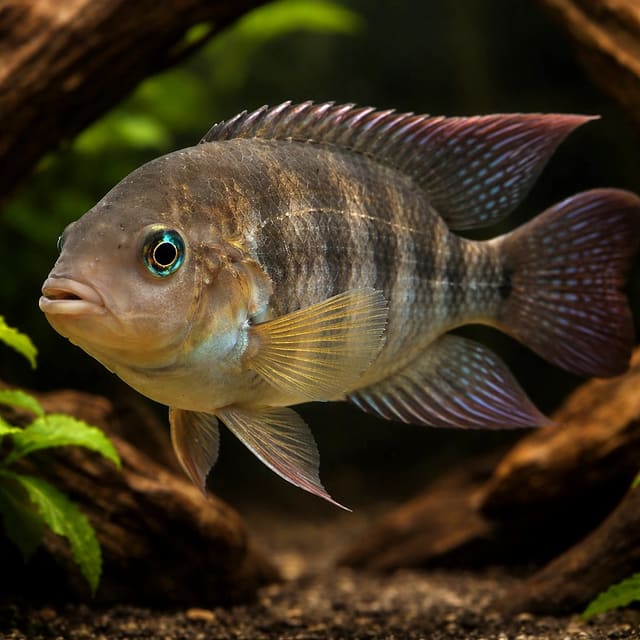
| T-Bar Cichlid | A smaller Central American comparison | Similar category language means equal size or temperament |
| Electric Blue Acara | A different blue-spotted South American cichlid | Similar colour means similar identity or behaviour |
| Rainbow Cichlid | A generally smaller Central American species comparison | It can withstand an adult carpintis in a modest aquarium |
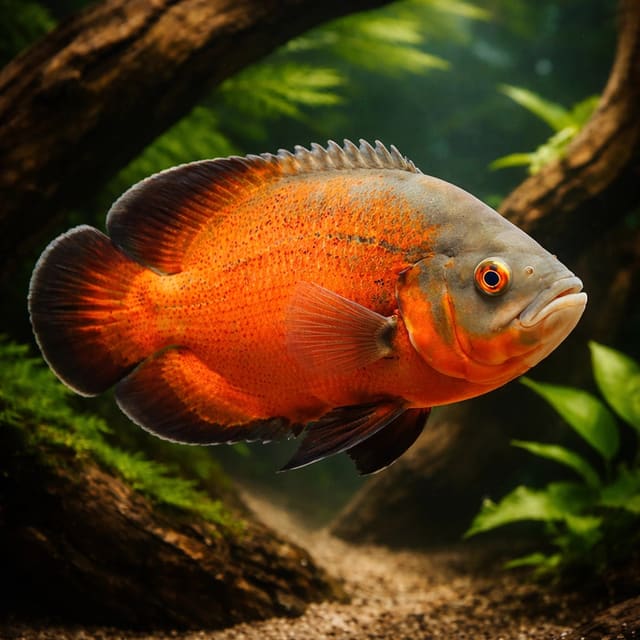
| Red Oscar | A large South American display-fish comparison | Large body size alone establishes compatibility |
These links are for comparison, not a ready-made community. Read each adult-size, diet, water and social profile, then plan the complete aquarium. No product link on this page is a guarantee that the animals can live together.
| Question | Ready answer |
|---|---|
| Is the aquarium mature? | Ammonia and nitrite remain zero under the intended feeding load. |
| Is the adult footprint ready? | At least 150 x 50 cm and roughly 400 litres are prepared for the one-adult plan. |
| Are water values stable? | Temperature, pH, GH, KH and nitrogen-cycle results are measured through maintenance cycles. |
| Is hardscape secure? | Digging cannot undermine structures and no retreat becomes a trap. |
| Is sex uncertainty acceptable? | The purchase does not depend on receiving a male, female or pair. |
| Can conflict be managed? | Mature heated and filtered separation accommodation is ready. |
| Is suitable food available? | A complete staple and measured variety fit the selected grade. |
| Are image limits understood? | The gallery does not show the exact fish. |
| Can delivery be received promptly? | Someone can inspect, document and acclimate the fish under current terms. |
If any answer is no, finish the system before ordering. Readiness is safer and less expensive than rushed rehoming, emergency equipment or treatment after avoidable conflict.
Scientific taxonomy, our stock records and conservation assessments can change.
Select the required grade and quantity from the live options. Each selected quantity remains one unsexed fish. Review the current Live Arrival Guarantee and livestock delivery terms before checkout, arrange prompt receipt and follow the evidence instructions if there is an arrival concern.
Eligible new customers can use WELCOME10 for 10% off their first purchase. Eligibility, live stock, current price and available delivery dates are determined by the storefront and current terms rather than by static wording in this guide.
Matching temperature and pH does not establish behavioural compatibility. Individual temperament can change with growth and breeding behaviour. No linked product is presented as a guaranteed tank mate; mature separation accommodation is required for any multi-fish plan.
Always research specific species before adding them to your tank. Consider:
No reviews for this item yet. Bought one? Honest reviews only, good or bad.
What customers say about ordering from us
I have a small group of long finned mountain minnows. So was delighted to be able to order ten of this variety to increase the genetics in my tank . The ones I recieved are healthy but it’s to early to give a verdict on wether they are of a long finned type since they are small currently.
Gordon Walker · 23 Sept 2026
100% success travel and "installation". Pleased with quality of purchase. The Siamese fighter a bit "shy" so have not yet seen him at his best yet but looking good. Happy customer. GG
George E Garratt · 21 Sept 2026
Reviews of our shop, collected by Judge.me, an independent third-party review collector. Newest first.
23–30°C · pH 6.5–8 · 200L

22–23°C · pH 6.5–8
23–27°C · pH 7–8
20–28°C · pH 6–7.5 · 540L
26–27°C · pH 7–8 · 756L
22–27°C · pH 7–8 · 243L

24–30°C · pH 6.5–8 · 250L

22–27°C · pH 7–8
24–28°C · pH 6.5–7.5 · 300L
22–27°C · pH 6.5–8
22–27°C · pH 6.5–8
24–28°C · pH 6–8
24–28°C · pH 6–8
24–28°C · pH 7–8
23–28°C · pH 7–8 · 250L
24–26°C · pH 7–7 · 205L

22–28°C · pH 7–8 · 41L

21–25°C · pH 5–7
24–29°C

24–27°C · pH 6.5–6.5

22–27°C · pH 6–8 · 72L
24–27°C · pH 6.5–8 · 200L

23–27°C · pH 5.5–7 · 60L

22–27°C · pH 6–8