−14%
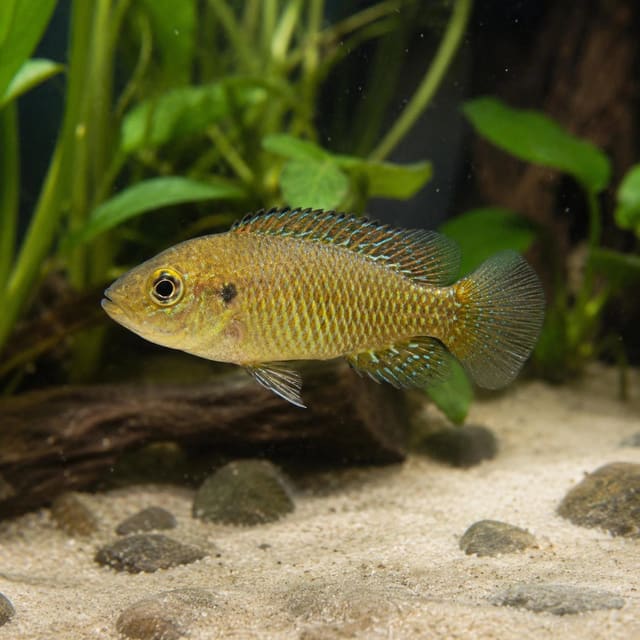
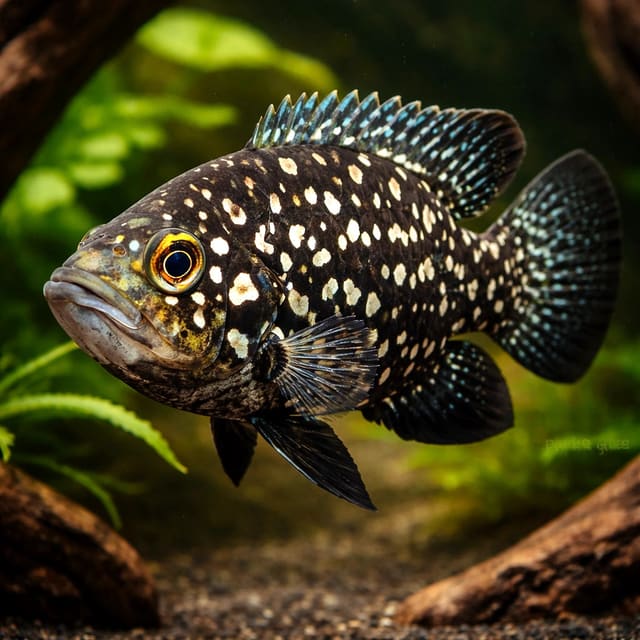
Starry Night Cichlid (Paratilapia polleni)
22.2–26.7°C · pH 6.5–8
£16.33£18.99

One unsexed Short Body Texas Cichlid at approximately 5-7 cm per quantity. An undocumented Texas-type trade morph for a large, mature aquarium; single-specimen housing is the safest default.
Cichlasoma sp. "Texas"
One unsexed Short Body Texas Cichlid at approximately 5-7 cm per quantity. An undocumented Texas-type trade morph for a large, mature aquarium; single-specimen housing is the safest default.

Cichlids are a family of roughly 1,800 accepted species, not one care type. Before buying, identify the exact species and source, then compare adult measurement, usable tank dimensions, social system, territory, tested water, diet and an exit plan. No family-wide minimum tank, water range or tank-mate list is safe.
Maintain these water conditions for optimal health and vibrant colors
Short Body Texas Cichlid is the supplier's trade name for a compact-bodied, heavily pearled aquarium cichlid. This product is a short-body Texas-type trade morph supplied at approximately 5-7 cm. One quantity buys one unsexed fish. It is not a pair, a breeding group or a pack, and a particular colour, pattern or sex cannot be selected.
Our stock records the fish as Cichlasoma sp. "Texas" short body rather than providing a confirmed species or documented parentage. Texas-type cichlids in the aquarium trade may be associated with Herichthys carpintis, Herichthys cyanoguttatus or hybrid red-Texas lines, but the common name and a photograph are not enough to prove which lineage produced an individual fish. The honest sale identity is therefore a short-body Texas-type trade morph rather than one confidently named species.
This is a substantial, territorial cichlid for an experienced keeper. The shortened body does not turn it into a dwarf fish or make a small aquarium suitable. Plan for a powerful adult, strong filtration, a long aquarium footprint and a realistic separation plan. A single-specimen display is the lowest-risk option. Any attempt to add a mate or tank companions needs considerably more room, barriers and a spare established aquarium.
| What one quantity buys | One unsexed short-body Texas-type trade-morph cichlid |
|---|---|
| Dispatch size | Approximately 5-7 cm |
| Supplier identity | Cichlasoma sp. "Texas" short body; exact species and parentage are not documented |
| Adult planning size | Allow for roughly 20-25 cm total length; exact outcome depends on lineage and body form |
| Aquarium planning | Use 300 litres as a conservative starting floor for one adult, with a long footprint; more space may be required |
| Temperature | 24-28 C, kept stable |
| pH | 7.0-8.0 as a practical Texas-type starting range |
| General hardness | Approximately 9-20 dGH |
| Temperament | Territorial and potentially aggressive |
| Diet | Omnivorous: quality cichlid pellets with measured animal- and plant-based variety |
| Best social plan | One fish; pairs and mixed communities are advanced, high-risk projects |
| Image disclosure | One representative trade-morph image and one supporting digital illustration, not photographs of the exact fish dispatched |
Each quantity represents one live fish at approximately 5-7 cm. Selecting a quantity of two means ordering two fish, but it does not create a proven pair. Fish at this size cannot be sexed reliably before sale, and two fish may become incompatible as they mature. Do not order several simply because the checkout permits a larger quantity.
The dispatch measurement describes the fish when prepared for sale, not its adult length. Live animals vary naturally, so a small difference in measured size is normal. Body depth, forehead development, base colour and pearling may also differ between individuals. Stress during transport can temporarily dull the colour or darken the body.
Check the live selector for current availability and price before ordering. Prepare the adult aquarium before purchase. A 5-7 cm fish can appear manageable in a temporary holding tank, but Texas-type cichlids grow into strong, territorial adults and should not be bought on the assumption that an upgrade will somehow become available later.
| Sale detail | Included | Not promised |
|---|---|---|
| Quantity | One fish per quantity | A pair, trio or social group |
| Size | Approximately 5-7 cm at dispatch | An exact millimetre measurement or adult size |
| Sex | Unsexed fish | Male, female or a compatible pair |
| Appearance | A fish from the current short-body Texas trade line | An exact copy of either gallery image |
| Lineage | Supplier trade identity | Pure H. carpintis, pure H. cyanoguttatus or a declared hybrid cross |
The supplier uses the label Cichlasoma sp. "Texas" short body. In aquarium catalogues, Cichlasoma is still used loosely for several large Central and North American cichlids even when modern taxonomy places a wild species in another genus. The abbreviation sp. means that a precise species has not been supplied. It should not be silently converted into a confident species name.
Herichthys carpintis, commonly called the lowland or pearlscale cichlid, is a valid Mexican species often sold as a green Texas cichlid. FishBase records it from the Panuco and Soto La Marina drainages. Herichthys cyanoguttatus is the Rio Grande or Texas cichlid more closely associated with Texas and north-eastern Mexico. Red Texas cichlids are aquarium hybrids rather than a wild species with one scientific name. All three names can appear around similarly pearled fish in the trade.
The words "short body" describe a compact body conformation used in the aquarium trade. They do not identify the parents or prove how the fish was produced. The compact profile can occur in a line marketed as green Texas, red Texas or simply Texas-type. Without breeder records, DNA evidence or a supplier declaration, colour and shape cannot settle that question. The scientifically honest description for this product is therefore a short-body Texas-type trade morph of undocumented lineage.
A scientific name carries claims about wild distribution, adult size, breeding and physiology. Applying it to an undocumented trade morph can make care sound more certain than it is. Use established Texas-type husbandry as conservative comparison guidance while keeping the undocumented lineage in mind.
| Name | What it means | Can it be asserted for this fish? |
|---|---|---|
| Herichthys carpintis | A valid wild Mexican species, often called lowland, pearlscale or green Texas cichlid | No; it is useful comparison context, but supplier parentage is not documented |
| Herichthys cyanoguttatus | The Rio Grande or Texas cichlid, a different valid species | No; the common word "Texas" is not proof |
| Red Texas cichlid | A variable aquarium hybrid line, not one wild species | No; red colour in a representative image cannot establish hybrid ancestry |
| Short-body Texas cichlid | A trade description combining Texas-type appearance with a shortened body form | Yes; this matches the supplier label |
| Cichlasoma sp. "Texas" | The supplier's non-specific catalogue label | Yes, when clearly identified as a trade label rather than accepted species taxonomy |
Keepers wanting a confirmed standard-form comparison can read the separate Pearlscale Texas Cichlid profile. That link is for identity and care comparison, not an automatic recommendation to house the two fish together.
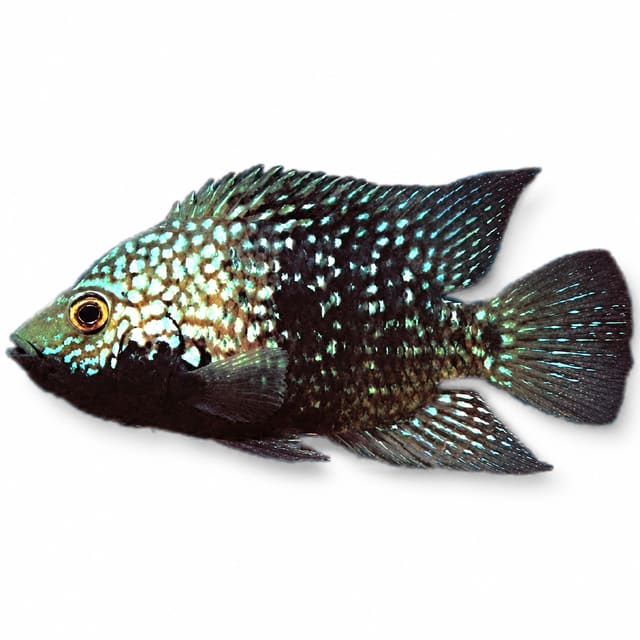
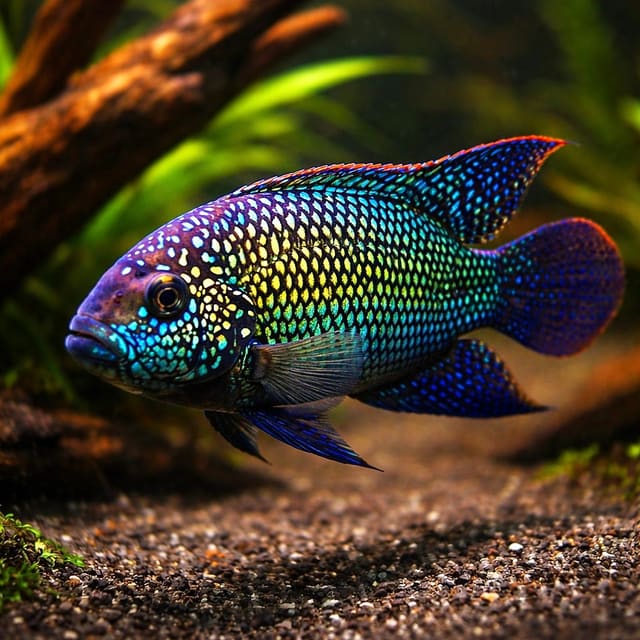
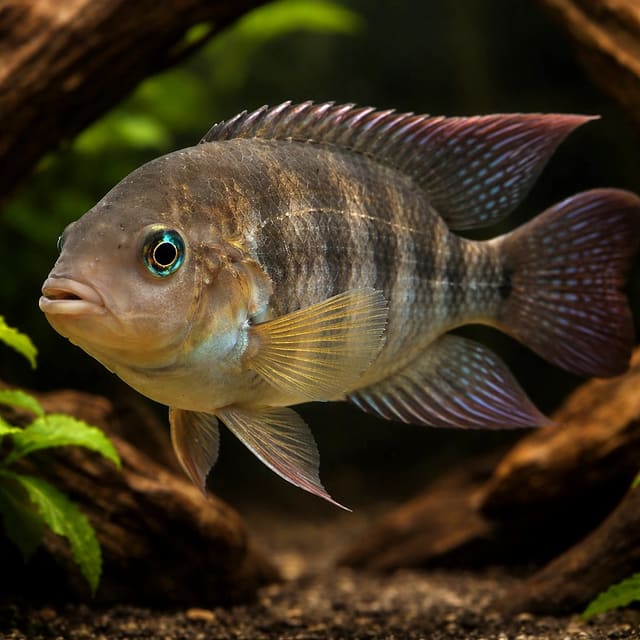
The first gallery image is representative. It shows a compact, deeply bodied cichlid with dense blue-white pearling, a red-purple base and a pronounced forehead. It supports the general short-body trade-morph description, but it is not a photograph of the individual fish selected for your order and it does not prove a pure species or hybrid cross.
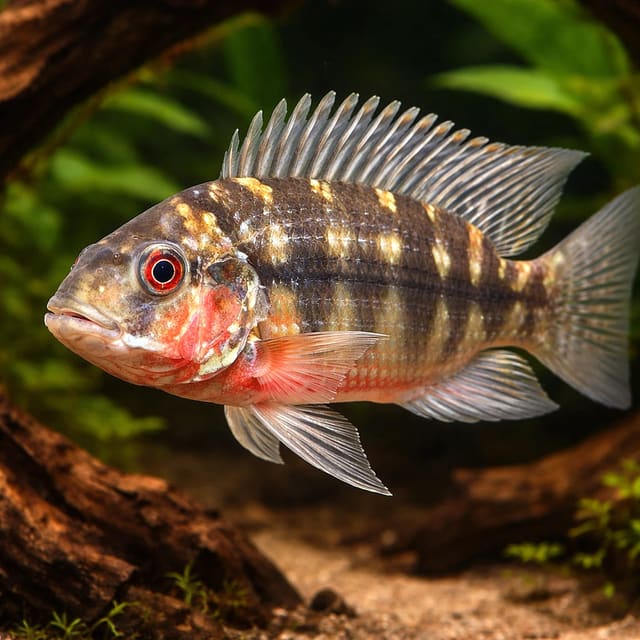
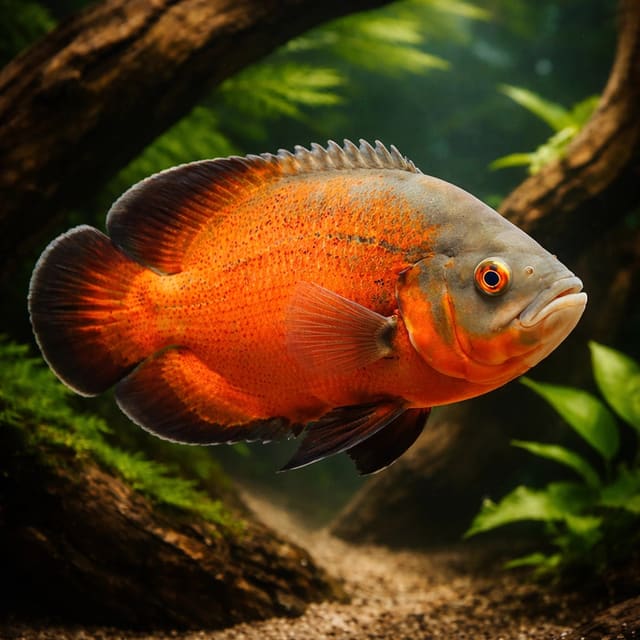
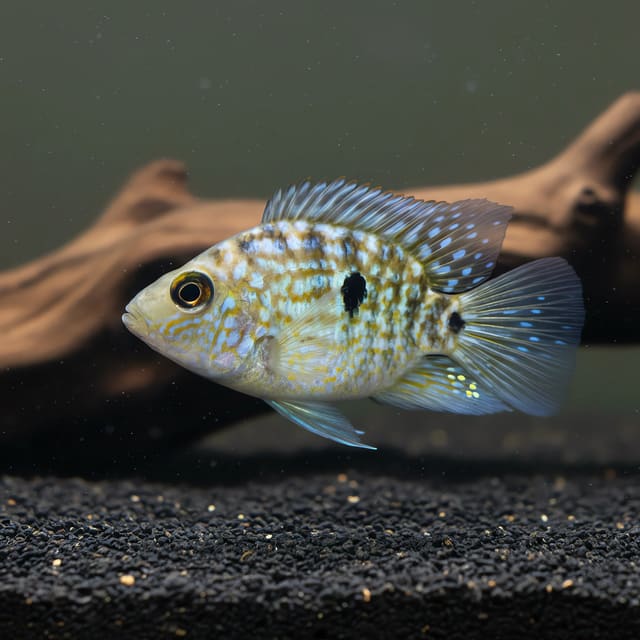
The second image is a supporting digital aquarium illustration. It depicts a greyer, standard-bodied Texas-type cichlid and does not show the short-body trait reliably. Use it only as a general comparison visual, not as a promise of exact body shape, colour or parentage. The live fish may look materially different from this illustration.
Use the written sale description as the buying contract: one unsexed 5-7 cm fish from the short-body Texas trade group. Natural individual variation is expected. Juvenile colour may develop, fade or shift as the fish grows, and the final appearance cannot be selected from a screen.
Texas-type cichlids are known for reflective blue, green or white pearling over a darker body. The exact arrangement can range from small pinpoints to larger irregular plates. Some fish retain a grey or blue-green base, while red-Texas-type lines may develop orange, pink or red tones. Dark blotches can appear along the flank, especially in juveniles, stressed fish or breeding condition.
A short-body fish has a compressed trunk and a deeper outline relative to its length. That shape can make the head look larger and the dorsal and anal fins appear more prominent. It does not mean the fish has the swimming needs or waste output of a dwarf cichlid. A broad adult can still be powerful, active and capable of controlling a large area.
Evaluate a short-body fish by function as well as colour. It should maintain balance, breathe evenly, approach food without repeated difficulty and move without rolling or struggling to turn. The body should look well covered rather than sharply pinched behind the head. Brilliant pearling is attractive, but normal swimming, appetite and respiration are more important indicators of condition.
The supplier gives a 5-7 cm sale size but does not publish a verified adult length or lineage. Pure H. carpintis is recorded by FishBase to 17 cm standard length, which excludes the tail. Aquarium trade descriptions for short-body Texas forms often plan around 20-25 cm total length, but individual outcomes vary. Use that broader figure for space planning rather than promising that every fish stops at one number.
A shortened spine does not proportionally reduce body mass, head size, mouth size, aggression or filtration demand. Adult length alone is therefore a poor stocking measure. Floor area, turning room, territory, waste production and the ability to keep distance from equipment and tank mates all matter.
This purchase should be treated as a multi-year commitment even though no dependable exact lifespan is available for the undocumented trade line. Long-term costs include a large aquarium, secure stand and lid, reliable heating, substantial filtration, water testing, quality food and a spare plan if social behaviour changes.
If the aquarium would become unsuitable at 25 cm, it is not a safe choice for a 5-7 cm juvenile. Do not use the smallest fish currently on sale to justify a temporary setup.
Use 300 litres as a conservative starting floor for one adult. This is a planning recommendation, not a universal guarantee. A larger individual, a bulky aquascape, a narrow tank or any attempted tank mates can require considerably more. Choose a long, wide aquarium that provides turning room and a clear central territory rather than relying on height.
A pair should not be created by placing two unsexed juveniles into a 300-litre display and hoping they bond. Pair formation can include serious aggression, and a compatible pair may become more territorial when breeding. A divided or much larger system, a secure barrier and a separate established aquarium are essential before two adults are allowed direct access.
Mixed-cichlid communities are even less predictable. An aquarium can appear calm while fish are juvenile and then change rapidly as body size and maturity increase. Stocking should be judged by adult territorial behaviour, not by whether several 7 cm fish fit around the decor today.
| Plan | Risk level | Space response |
|---|---|---|
| One short-body Texas cichlid | Lowest | Start at 300 litres with a long footprint and substantial filtration |
| Attempted pair | High | Use a much larger divisible system plus a separate established aquarium |
| Other large cichlids | Very high | Expert-only planning with extensive space, barriers and immediate removal options |
| Small community fish | Unacceptable | Do not combine; they may be chased, injured or eaten |
Size filtration for the adult fish and its feeding routine. A large external filter, sump or similarly capable system should provide strong biological capacity and dependable mechanical capture. Flow must move waste toward the intake without forcing the fish to fight a jet constantly. Use guards where an intake could trap fins.
Surface movement supports oxygen exchange and makes the system more resilient during warm weather. Do not assume that clear water is chemically safe. Ammonia and nitrite should remain at zero, while nitrate trends should be controlled through appropriate feeding, stocking, plant use where practical and regular partial water changes.
Clean mechanical media before it becomes severely clogged, but protect established biological media. Rinse mature media in removed aquarium water where appropriate and avoid replacing all biological material at once. Keep spare aeration available because a large fish can consume oxygen quickly during a pump failure or heat event.
Because the exact lineage is undocumented, no wild-water profile can be assigned with complete confidence. As a practical Texas-type starting range, keep the aquarium at 24-28 C, pH 7.0-8.0 and approximately 9-20 dGH. FishBase places pure H. carpintis within a broader 23-33 C species range and reports pH 7.0-8.0 and 9-20 dH, but the goal in a home aquarium is a stable, well-managed middle range rather than the extremes.
Test the source water as well as the aquarium. A stable value near one end of a suitable range can be safer than repeated chemical adjustments that cause rapid swings. If the supplier water differs from the home aquarium, follow the current acclimation instructions and make changes gradually.
| Reading | Planning range | What matters most |
|---|---|---|
| Temperature | 24-28 C | Avoid rapid change and summer overheating |
| pH | 7.0-8.0 | Stable values and suitable buffering |
| General hardness | About 9-20 dGH | Consistency between aquarium and replacement water |
| Ammonia | 0 | Any confirmed reading requires immediate investigation |
| Nitrite | 0 | Protect mature biological filtration |
| Nitrate | Controlled by the aquarium's trend | Use tests and husbandry rather than one universal schedule |
Use sand or smooth gravel that can be cleaned without trapping large amounts of food. Texas-type cichlids may dig, carry substrate and move loose objects. Place heavy rockwork directly and securely so excavation cannot undermine it. Avoid unstable stacks and sharp gaps that could trap a deep-bodied fish.
Build one clear central swimming and turning zone, with sturdy wood or rock breaking sight lines around the edges. Every heater, pipe and cable should be protected from impact or investigation. A background and side cover can reduce reflections that trigger repeated display behaviour.
Delicate rooted plants may be uprooted. Robust plants attached to wood or rock can sometimes work, but the layout should remain safe if the fish rearranges it. Artificial plants must have smooth edges and a secure base. Leave enough open access to siphon waste and inspect the fish from both sides.
Fit a strong lid around cables and filter pipes. Large cichlids can jump when startled, during maintenance or after a sudden lighting change. A secure cover is part of the livestock enclosure, not an optional cosmetic accessory.
Use a high-quality cichlid pellet of suitable size as the regular foundation. Add measured variety through appropriate frozen or live aquarium foods and some plant-based or spirulina-containing food. The Mexican species commonly associated with the green-Texas name is omnivorous, and a varied diet is more defensible than presenting this trade morph as a strict carnivore.
Feed portions that are consumed promptly and watch the complete action of swallowing, not just the initial strike. The short-body form can alter how an individual approaches food, so choose pieces it can handle comfortably. Spread food where necessary rather than allowing one fish to take a very large mouthful.
Avoid routine use of fatty mammal or bird meat. It is not a balanced substitute for formulated aquatic food. Treat foods should add variety rather than displace the staple. Remove persistent leftovers before they decay under rocks or inside a filter pre-chamber.
| Food | Role | Practical use |
|---|---|---|
| Quality cichlid pellets | Balanced staple | Select a size the 5-7 cm fish can swallow cleanly and increase gradually as it grows |
| Suitable frozen foods | Variety and enrichment | Use measured portions and thaw hygienically |
| Plant-based or spirulina food | Omnivore variety | Rotate with the staple rather than offering an unbalanced vegetable-only diet |
| Live aquarium foods | Occasional enrichment | Use trusted sources to reduce contamination risk |
| Fatty terrestrial meat | Not recommended as routine food | Choose properly formulated aquatic diets instead |
Expect an alert fish that notices movement outside the aquarium and learns the feeding routine. That responsiveness is one reason large cichlids are popular as individual display animals. It should not be confused with a guarantee that the fish is gentle. A cichlid that approaches the glass calmly can still defend its territory vigorously from another fish.
Digging, moving small decor, flaring, charging reflections and guarding a preferred area can all occur. A new juvenile may initially hide or display subdued colour, then become much bolder after settling. Behaviour often changes again at maturity.
Judge welfare by a pattern of observations: balanced swimming, controlled breathing, normal appetite, intact fins, body condition and the ability to rest. Constant glass striking, frantic pacing, repeated hiding, heavy respiration or loss of feeding response warrants investigation of water, reflections, disturbance, illness and enclosure design.
A single-specimen aquarium is the simplest and most predictable arrangement. It avoids pair incompatibility and lets the keeper design one clear territory. Enrichment comes from a varied layout, controlled feeding, maintenance routines and interaction with the environment rather than forcing social contact.
An attempted pair is not automatically better welfare. Two fish can injure one another before, during or after spawning. A compatible relationship today may change as one fish matures, recovers from illness or enters breeding condition. A physical divider must be robust enough to prevent pushing, jumping and biting through gaps.
Mixed communities require even more caution. A large catfish or another cichlid is not suitable merely because it is also described as robust. No common-name compatibility chart can account for individual aggression, adult dimensions, night-time behaviour and the amount of usable territory. The safest plan is to assume that separation may be necessary at any time.
This is not a shoaling fish.
Do not combine this fish with small tetras, rasboras, livebearers, shrimp, dwarf crayfish or delicate bottom dwellers. They may be chased, injured or eaten. Slow long-finned fish can also be damaged or prevented from feeding.
Other large cichlids and robust catfish belong only in expert systems with enough footprint for separate territories. Similar size does not guarantee compatibility. The Green Terror Cichlid, Jack Dempsey Cichlid and Red Oscar pages are useful comparisons for adult-space and behaviour planning, not a ready-made stocking list.
Before any introduction, compare temperature, chemistry, adult size, body shape, feeding speed, daytime and night-time activity, hiding needs and the likely territorial zone. Have a secure second aquarium ready. A plastic box, uncycled spare tank or shop return plan is not an adequate emergency arrangement for a large fish.
| Fish or trade group | Identity certainty | Planning emphasis |
|---|---|---|
| This short-body Texas trade morph | Supplier trade label; exact lineage undocumented | Compact body, territorial behaviour and conservative adult planning |
| Standard-form Pearlscale Texas Cichlid | Sold under a declared H. carpintis identity | Longer standard body and species-specific comparison |
| Green Terror Cichlid | Separate species, Andinoacara rivulatus | Large territorial cichlid with different natural history |
| Jack Dempsey Cichlid | Separate Central American cichlid identity | Territory, adult size and strong filtration |
| Oscar | Separate South American species | Very large waste load, broad adult body and substantial space |
Browse the current cichlid collection to compare available fish by their own care requirements. Similar pearling, colour or body depth does not make two products interchangeable.
Complete the aquarium cycle before delivery day. Confirm zero ammonia and zero nitrite, stable temperature, suitable hardness and pH, normal filter operation and a secure lid. Have water conditioner, test kits and a clean bucket reserved for aquarium use.
Read the current delivery and Live Arrival Guarantee terms before ordering. Make sure somebody can receive the parcel and move it promptly to a stable indoor location. Check the delivery address carefully and avoid scheduling livestock immediately before travel or major aquarium maintenance.
On arrival, inspect the unopened bag and follow the current acclimation instructions supplied with the order. Keep the aquarium light low and avoid crowding the fish. Opening a transport bag changes its gas balance, so do not improvise a prolonged acclimation method that conflicts with the supplied guidance.
Offer a small first meal only after the fish is balanced and settled. A new arrival may refuse food temporarily. Remove uneaten food and observe breathing, posture and swimming over the following days. Quarantine is strongly recommended because a separate mature system makes it easier to assess appetite, waste, fins, skin and respiration.
There is no single water-change percentage that fits every aquarium. Use nitrate trend, feeding, filter performance, source water and actual stocking to set the routine. Large cichlids often need substantial, regular partial changes, but replacement water must be conditioned where required and matched closely for temperature.
Siphon food and waste from around decor without destabilising the fish's entire territory at every service. Clean viewing panes and filter intakes, check the heater guard and inspect the lid. Avoid replacing all filter media or carrying out a major re-scape at the same time as adding a new fish.
Record test readings and maintenance dates. A simple log reveals gradual nitrate rise, pH drift, increased feeding demand and the point at which filter cleaning becomes necessary. It also provides useful evidence if behaviour or appetite changes.
A healthy settled fish is alert, balanced and responsive, with clear eyes, intact fins and regular respiration. Colour alone is not a health test. Lighting, background, stress, age and individual variation can all change the way pearling and base colour appear.
Test water immediately if the fish breathes heavily, clamps its fins, loses balance, refuses several normal feeds, develops excess mucus or changes behaviour suddenly. Several fish becoming distressed together strongly suggests an environmental problem. Medication should not replace checking ammonia, nitrite, temperature, oxygenation and contamination.
The compact body makes functional observation especially important. Watch whether food can be taken and swallowed cleanly, whether the fish can rise and descend in the water, and whether the abdomen expands or contracts normally after feeding. Seek qualified aquatic-veterinary or experienced specialist advice for persistent swelling, repeated buoyancy difficulty, severe injury or progressive weight loss.
Do not release aquarium fish, plants or water into the wild. If the aquarium can no longer house the adult, contact a responsible aquatic retailer or experienced cichlid group before the situation becomes urgent. Rehoming a large territorial fish can take time.
Do not buy two unsexed juveniles as a guaranteed breeding pair. The exact lineage and fertility of this trade morph are not documented. Red-Texas-type hybrid lines can produce variable offspring, while pure H. carpintis is an open-substrate spawner with parental care. Those facts should not be blended into one promised breeding method for this fish.
If two mature fish form a pair, aggression can escalate quickly. A large divisible aquarium, protected divider and separate established system are prerequisites. Spawning does not prove that the pairing is safe long term, and fertility or offspring appearance cannot be predicted from the trade name.
Responsible breeding also requires records. Do not distribute offspring under a pure scientific name unless parentage is verified. Label hybrids and undocumented trade-line offspring accurately so the uncertainty is not passed to future keepers.
A 10% first-order offer is currently available to eligible new customers, subject to the checkout terms and one-use eligibility. The discount does not change the husbandry decision: order only after the adult aquarium and backup plan are ready.
Eligible livestock orders are covered by the current Live Arrival Guarantee when its conditions are followed. Review the returns and livestock-support terms before checkout. Confirm the current delivery date, weather restrictions, price and stock in the live storefront before paying.
Customers new to transported livestock can also read the guide to buying tropical fish online for preparation and arrival context.
This fish suits an experienced keeper who wants one interactive, unusual display cichlid and accepts that the exact trade lineage is not documented. It is a poor choice for somebody seeking a peaceful mixed community, a small "compact" cichlid, a guaranteed pair or a scientifically verified locality fish.
Base the buying decision on adult space, temperament and the documented uncertainty rather than colour alone. The representative images help show the trade type, but they cannot promise exact species, final body shape or adult colour.
Before adding the fish to the basket, confirm the 300-litre starting floor, long footprint, adult filtration, secure lid and backup enclosure. If a smaller or social cichlid is the goal, compare other products before purchasing rather than trying to make this fish fit an unsuitable plan.
One quantity includes one unsexed Short Body Texas Cichlid at approximately 5-7 cm. It is not a pair or group.
No. The supplier identifies it as Cichlasoma sp. "Texas" short body and does not document exact species or parentage. H. carpintis is relevant comparison context, not a confirmed identity claim for this trade morph.
The primary representative image has red-purple colour and strong pearling, but colour cannot prove a hybrid lineage. The product is sold under the broader short-body Texas trade name rather than as a documented Red Texas cross.
Exact adult size depends on the undocumented lineage and body form. Plan conservatively for roughly 20-25 cm total length rather than assuming the 5-7 cm dispatch fish will remain small.
No. Use 300 litres as a starting floor for one adult, with a long, wide footprint and strong filtration. The short-body form remains a substantial territorial cichlid.
Two unsexed fish are not a guaranteed pair. Direct contact can lead to severe aggression. Any pair attempt needs a much larger divisible system, a secure barrier and a separate established aquarium.
Not a normal community. Small, timid or delicate fish are unsuitable. Even robust large fish require expert planning, extensive space and an immediate separation option.
Use 24-28 C, pH 7.0-8.0 and approximately 9-20 dGH as a practical Texas-type starting range. Stability, zero ammonia and zero nitrite are more important than chasing an exact midpoint.
Use a quality cichlid pellet as the staple with measured frozen, live and plant-based variety. Choose food sizes the fish can swallow comfortably and remove leftovers.
No. Fish are sold unsexed, and colour, pearling, forehead development and body proportions vary. Neither gallery image is a photograph of the exact fish dispatched.
The first is a representative trade-morph image. The second is a supporting digital illustration of a general Texas-type cichlid and does not show the short-body trait reliably. Neither image is a photograph of the exact fish dispatched.
No dependable exact lifespan was found for this undocumented short-body trade line. Treat it as a multi-year commitment and plan the adult aquarium from the start.
The sale identity and size follow our stock records and public announcement for the short-body Texas cichlid. Species comparison facts were checked against the FishBase profile for Herichthys carpintis and the California Academy of Sciences' current Eschmeyer's Catalog of Fishes record. Those species sources are used as context and are not treated as proof of this product's undocumented lineage.
Check the live selector and checkout for current stock, price, delivery dates and discount eligibility. These details can change, so confirm them immediately before paying.
Short Body Texas Cichlid is an undocumented Texas-type trade morph supplied at approximately 5-7 cm, one unsexed fish per quantity. Do not treat the common name or images as proof of pure H. carpintis, pure H. cyanoguttatus or a particular Red Texas cross.
Plan for roughly 20-25 cm total length, use 300 litres as a conservative starting floor for one adult, and provide a long footprint, strong mature filtration, secure decor and a tight lid. Keep stable water around 24-28 C, pH 7.0-8.0 and approximately 9-20 dGH. Feed a balanced omnivore diet and monitor how the compact-bodied fish swims, breathes and swallows.
A single specimen is the lowest-risk social plan. Any pair or mixed-cichlid aquarium is an advanced project requiring substantially more space, barriers and a separate established enclosure. Review the current delivery terms and complete the adult setup before ordering.
No reviews for this item yet. Bought one? Honest reviews only, good or bad.
What customers say about ordering from us
I have a small group of long finned mountain minnows. So was delighted to be able to order ten of this variety to increase the genetics in my tank . The ones I recieved are healthy but it’s to early to give a verdict on wether they are of a long finned type since they are small currently.
Gordon Walker · 23 Sept 2026
100% success travel and "installation". Pleased with quality of purchase. The Siamese fighter a bit "shy" so have not yet seen him at his best yet but looking good. Happy customer. GG
George E Garratt · 21 Sept 2026
Reviews of our shop, collected by Judge.me, an independent third-party review collector. Newest first.