−15%
Easy
Electric Blue Acara (Andinoacara pulcher) – Neon Blue, 2–7cm Sizes
22–23°C · pH 6.5–8
£6.79£7.99

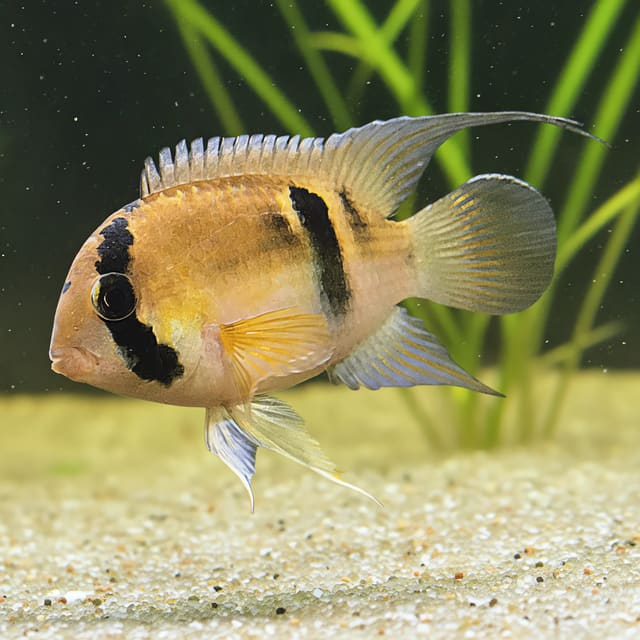
The Rainbow Cichlid (Herotilapia multispinosa) is a Central American freshwater cichlid from Costa Rica and Nicaragua that reaches 17 cm. It suits keepers prepared for territorial pair behaviour; keep it at 22–27°C, pH 7.0–8.0 and 9–12 dGH, the overlap of FishBase, Seriously Fish and OATA’s American-cichlid guidance. Sold individually in 4–5 cm, 5–6 cm and >9 cm dispatch sizes.
Adult size is the maximum length this species reaches at full maturity (scientific sources). The livestock you receive will be younger and smaller — pick a size above for the actual shipping size. Product-photo provenance and any image-specific limitations are stated on the listing.
Save when buying multiple fish. Each quantity is one fish; sex and pair formation are not guaranteed unless the selected variant explicitly states them.
The Rainbow Cichlid (Herotilapia multispinosa) is a Central American freshwater cichlid from Costa Rica and Nicaragua that reaches 17 cm. It suits keepers prepared for territorial pair behaviour; keep it at 22–27°C, pH 7.0–8.0 and 9–12 dGH, the overlap of FishBase, Seriously Fish and OATA’s American-cichlid guidance. Sold individually in 4–5 cm, 5–6 cm and >9 cm dispatch sizes.
Adult size is the maximum length this species reaches at full maturity (scientific sources). The livestock you receive will be younger and smaller — pick a size above for the actual shipping size. Product-photo provenance and any image-specific limitations are stated on the listing.
Cichlids are a family of roughly 1,800 accepted species, not one care type. Before buying, identify the exact species and source, then compare adult measurement, usable tank dimensions, social system, territory, tested water, diet and an exit plan. No family-wide minimum tank, water range or tank-mate list is safe.
Maintain these water conditions for optimal health and vibrant colors
Rainbow Cichlid (Herotilapia multispinosa) is a freshwater member of the cichlid family from Central America, where its native range centres on Costa Rica and Nicaragua. It suits a keeper prepared to provide adult space, stable water and careful management of territorial pair behaviour. This regional identity matters when comparing it with cichlids from softer South American habitats: choose it for the conditions and behaviour described here rather than treating every small cichlid as interchangeable.
FishBase records a maximum length of 17 cm total length. That figure is an adult planning reference, not a promise that every individual will reach precisely 17 cm. It is still the appropriate upper figure for checking turning room, filtration load and compatibility before choosing a smaller dispatch fish.
In nature, this fish inhabits lakes and swampy areas with muddy bottoms. Its feeding includes ooze, detritus and filaments of algae, so it spends much of its time using the lower parts and surfaces of its environment rather than behaving solely as a predator. An aquarium should combine a suitable prepared diet with surfaces and cover that allow normal browsing and retreat.
The species forms pairs, and both sexes are territorial. That does not mean every two fish will accept one another or that a single purchase must be matched immediately. It means the keeper should plan for boundaries, watch how individuals divide the aquarium and be ready to separate fish if one cannot feed or leave a defended area.
FishBase classifies the species as Least Concern and also notes an established population in the warm spring at Hévíz in Hungary. Its ability to tolerate unusually warm natural water is part of its wild biology, not a reason to run a home aquarium at an extreme temperature.
One purchase supplies one animal of the selected size. Use the live selector to choose 4–5 cm, 5–6 cm or >9 cm and set the number of individual fish required.
| Selector label | Planning decision |
|---|---|
| 4–5 cm | Allow substantial growth and use the adult aquarium plan from the beginning. |
| 5–6 cm | Treat this as a larger dispatch fish, not as a different adult form. |
| >9 cm | Prepare full territorial space before introduction; this remains one fish. |
The size you select is the size supplied, not the adult size. A dispatch label does not establish age, sex, temperament or future pair compatibility. The open-ended >9 cm label has a lower boundary rather than a fixed final measurement, so prepare for the species’ full adult planning size.
Sex is guaranteed only when the selected option explicitly states male or female. This Rainbow Cichlid listing has no sex-guaranteed option.
Sexual differences can be difficult to distinguish, although a male may have more pointed dorsal and anal fins. Those tendencies should not be used to promise the sex of an individual. Ordering two fish also does not make them a compatible pair; observe their interactions and retain a separation plan.
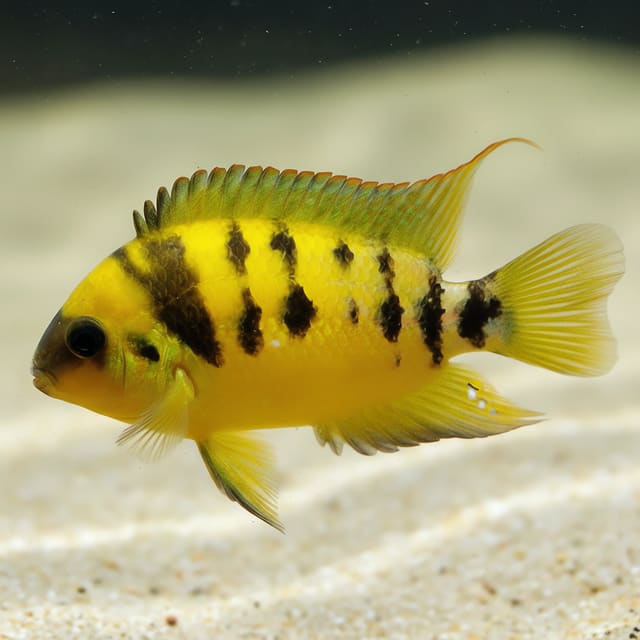
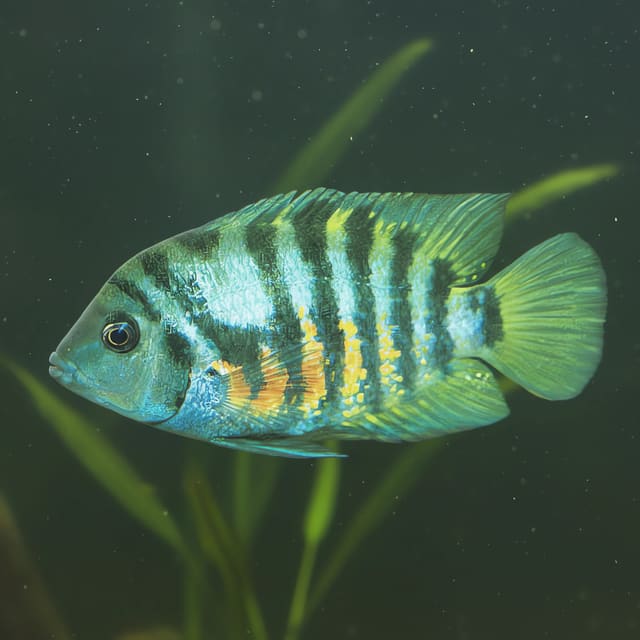
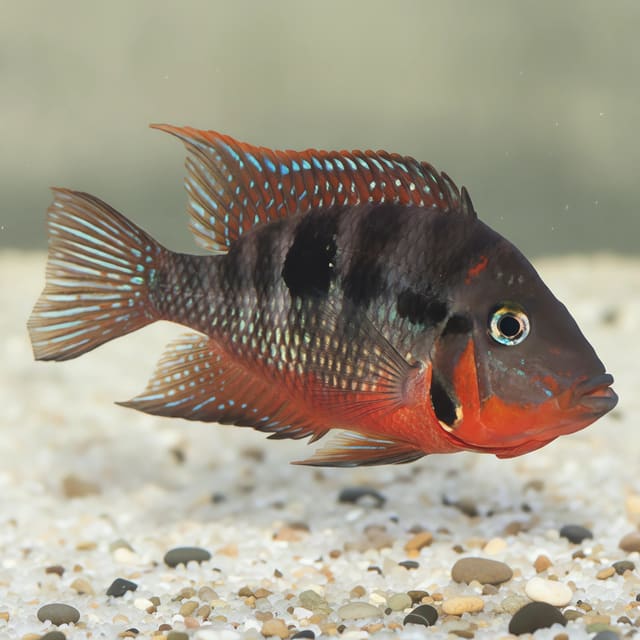
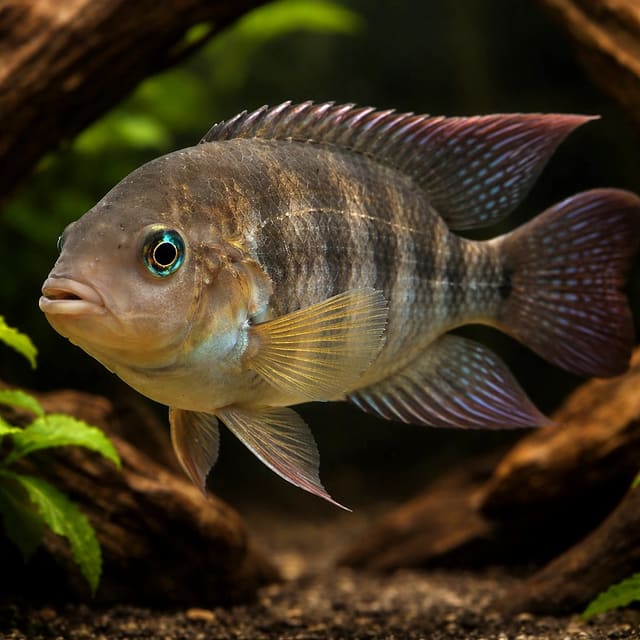
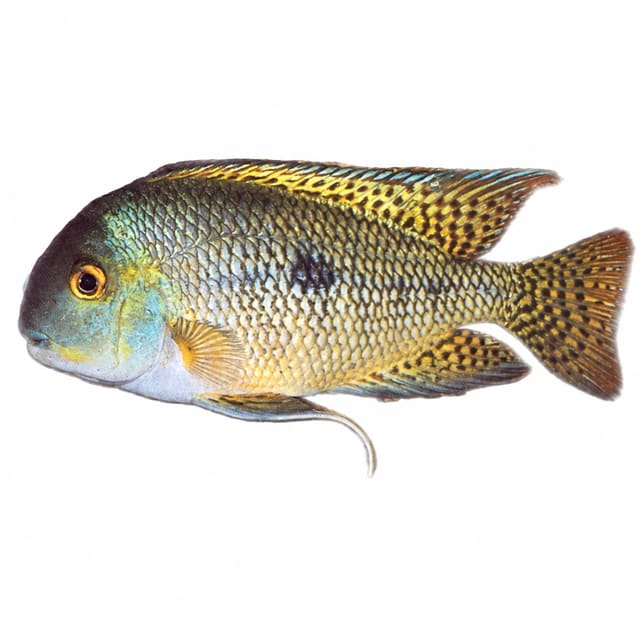
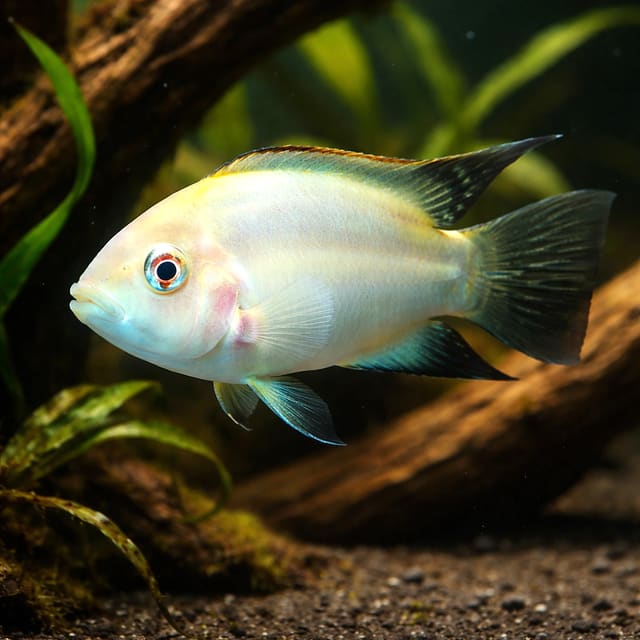
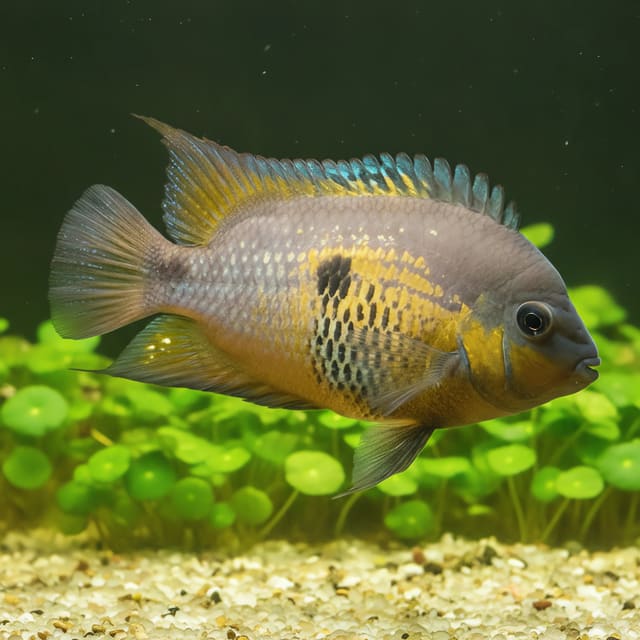
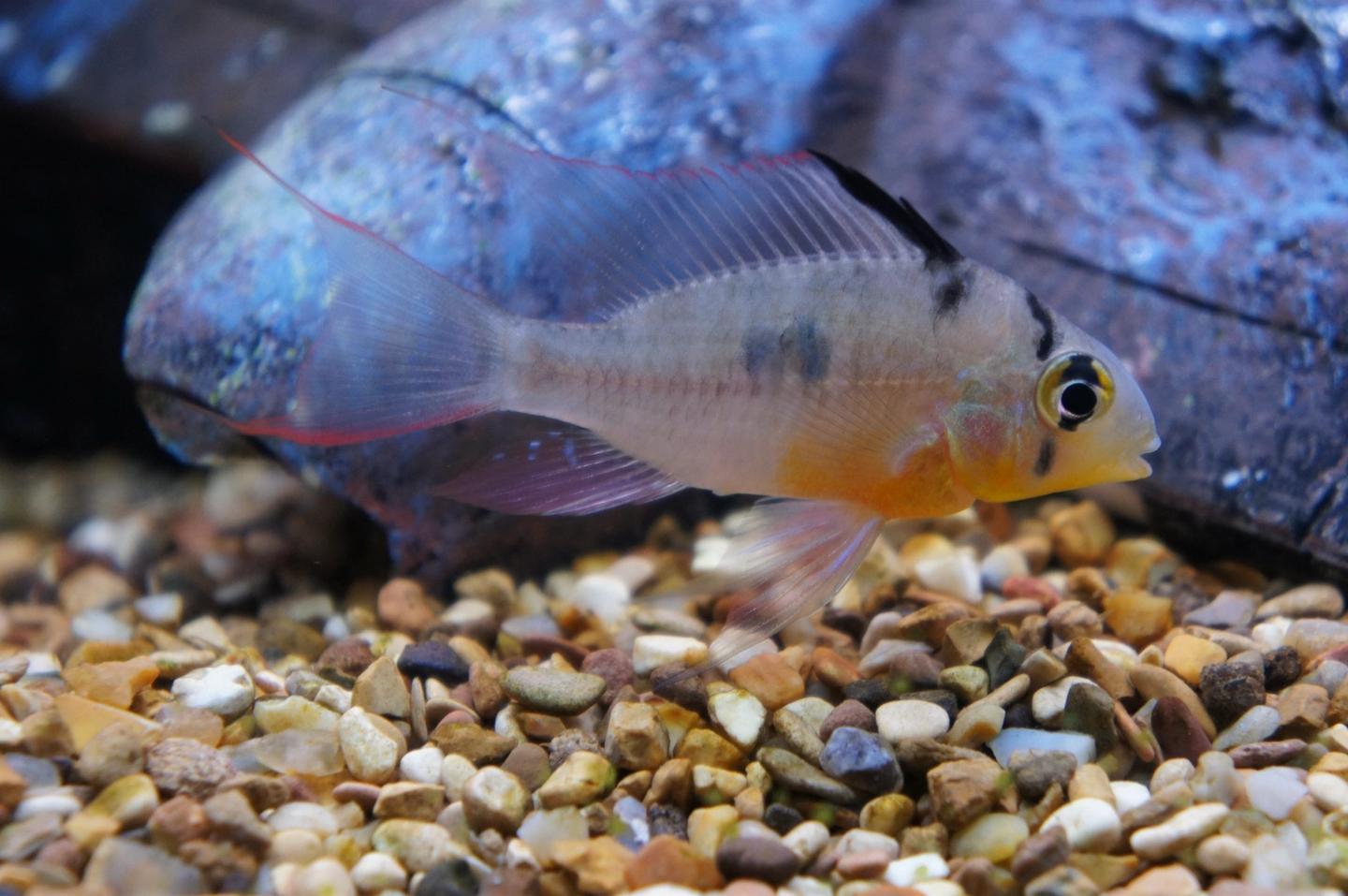
The gallery images are representative, based on reference photographs of this species, so colours can look slightly different from the live animal.
One gallery scene shows two fish, but that scene does not change the purchase unit. The quantity selected controls how many individual fish are ordered, while the chosen size describes the dispatch measurement.
The Seriously Fish species profile uses a 90 × 38 cm aquarium base and approximately 103 litres for a fish assessed at up to 175 mm standard length. Treat both base area and volume as minimum planning dimensions: a similarly sized tall, narrow aquarium does not provide the same usable territory.
OATA’s American-cichlid guidance gives 22–27°C for the group, while the species profile suggests 22–28°C in an aquarium. Use 22–27°C for routine care. Keep pH at 7.0–8.0 and general hardness at 9–12 dGH; these working values are the overlap of FishBase, Seriously Fish and OATA guidance.
| Decision | Working benchmark |
|---|---|
| Recorded adult maximum | 17 cm total length |
| Species aquarium reference | At least a 90 × 38 cm base, approximately 103 litres |
| Routine temperature | 22–27°C |
| pH | 7.0–8.0 |
| General hardness | 9–12 dGH |
| Ammonia and nitrite | 0 mg per litre |
| Suits | Not suited to |
|---|---|
| A keeper prepared to manage a pair-forming, territorial cichlid | A setup with no way to separate incompatible fish |
| An aquarium with at least a 90 × 38 cm base and approximately 103 litres | An aquarium below the species profile’s base and volume reference |
| Stable water at 22–27°C, pH 7.0–8.0 and 9–12 dGH | Water outside the working overlap or subject to repeated swings |
| Sand, planted cover and slow-to-moderate flow | A layout without retreat cover or with continually strong flow |
| A mature biological filter with 0 mg/L ammonia and nitrite | An immature or unfiltered aquarium |
Measure your aquarium rather than relying on its model name. Check the base, subtract space displaced by decor and compare tested water with these values using the aquarium water matcher.
Use sand as the substrate. The species profile notes that a muddy bottom would be closer to the fish’s preference but impractical in an aquarium, making sand the workable choice. OATA also recommends fine aquarium gravel or sand for American cichlids because many members of the group dig or sift while feeding or breeding.
Arrange planting and decor so the fish can move between open areas and cover. Rainbow Cichlids appreciate planted areas in which they can retreat. Several separated patches are more useful for territorial management than one dense clump at a single end, because a subordinate fish needs somewhere to move that is not already controlled by another individual.
Keep enough open base for a fish approaching 17 cm to turn and feed. A 90 × 38 cm base is the species profile benchmark, not a target for filling every centimetre with objects. When keeping a pair or adding tank mates, increase the footprint so each animal can use an area without repeatedly crossing a defended boundary.
Space requirements rise when more territories must fit into the aquarium. OATA uses at least 300 litres as its broad planning reference for American cichlids over 15 cm. Apply that larger benchmark when keeping more than one cichlid, managing uncertain pair dynamics or building a mixed community around the 17 cm maximum.
Lighting should not be overly strong. Plants can provide shaded edges and cover, but American cichlids may disturb or eat live plants. If rooted plants are repeatedly displaced, change the planting arrangement rather than continually returning a stressed fish to an open layout. Artificial plants are another form of cover suggested by OATA for cichlid aquaria.
Keep water movement slow to moderate. The aim is not stagnant water: the filter must still process waste and create effective exchange at the surface. Instead, arrange the return so the whole aquarium is maintained without forcing the fish to spend every moment in a strong current.
Run the aquarium at 22–27°C, pH 7.0–8.0 and 9–12 dGH. Carbonate hardness guidance for American cichlids is 3–10 dKH. These are ranges rather than single target points, so choose stable values that your source water and routine can maintain.
FishBase gives a much wider wild temperature record of 21–36°C, while Seriously Fish suggests 22–28°C for aquarium use. The upper wild figure describes natural occurrence and should not become a routine heater setting. The 22–27°C working range combines the aquarium recommendation with OATA’s narrower range.
| Result | Action |
|---|---|
| Ammonia above 0 mg/L | Stop increasing the livestock or feeding load, test again and restore safe water quality. |
| Nitrite above 0 mg/L | Treat the filter as unable to process the present load and act before adding fish. |
| Nitrate rising each week | Review portions, trapped waste and the effectiveness of water changes. |
| pH moving between tests | Compare replacement water and dKH before adding products intended to alter chemistry. |
| Temperature above the routine range | Increase safe surface movement and watch breathing while bringing conditions back gradually. |
OATA sets nitrate at no more than 20 mg per litre above the normal tap-water level. Record both tap and aquarium results so that this limit can be judged from a real baseline rather than from one isolated reading.
Use our water chemistry guide to understand what each test measures. Avoid making a rapid pH or hardness change simply to reach the middle of a range. A stable result near one boundary is preferable to repeated chemical swings caused by continual adjustment.
Check temperature before each water change and condition replacement tap water before it enters the aquarium. Consistency between the aquarium and replacement water reduces the combined stress of changes in temperature, minerals and pH.
A working biological filter is essential. The RSPCA explains that beneficial bacteria convert toxic ammonia into nitrite and then into safer nitrate. Both ammonia and nitrite remain toxic, so the aquarium should read 0 mg per litre for each before this fish is introduced.
Prepare and mature the aquarium in advance by following our first tropical tank guide. Adding water and switching on equipment is not the same as establishing a biological filter. Use test results to show that the filter can process waste, then increase livestock gradually so the bacterial population can respond to the added feeding load.
For the approximately 103-litre species aquarium reference, Seriously Fish suggests turnover of four to five times the aquarium volume per hour. That corresponds to a filter rated around 410–515 litres per hour. Filter ratings are a starting point: blocked media and the position of decor can reduce effective circulation.
Keep the flow slow to moderate around the fish while maintaining surface movement and preventing large waste deposits. A larger aquarium or heavier stocking plan needs filtration appropriate to its actual volume and adult livestock load rather than the dispatch size of the fish.
Do not clean every part of the filter aggressively at the same time. Chlorine or chloramine can damage its bacterial population, while excessive cleaning removes the organisms needed to process waste. A partial rinse that restores flow while retaining established media is the safer routine.
Wild Rainbow Cichlids consume considerable ooze, detritus and algae filaments. In an aquarium, make a high-quality cichlid pellet the staple and include an algae-based food. Vegetable or spirulina flakes can form part of the rotation, while suitable frozen and live foods add variety.
Brine shrimp is specifically recommended by the species profile. Frozen or live foods should complement rather than replace the dried and algae-based parts of the diet. This balance reflects a fish that takes algae and plant matter as well as other food, rather than one maintained only on rich animal foods.
OATA recommends feeding American cichlids once a day and offering only what they can eat within a few minutes. Begin with a small portion that the fish can collect promptly. If food remains after the feeding period, remove what you can and reduce the next portion.
| Observation | Feeding decision |
|---|---|
| Food remains on the substrate | Reduce the portion and check whether the pellet size is practical. |
| One fish controls the feeding area | Spread the same measured portion across separated areas and reassess compatibility. |
| Interest in food falls suddenly | Test water quality and check for social exclusion before offering more varieties. |
| Waste and nitrate rise | Review the amount eaten within a few minutes and remove trapped food. |
| The fish accepts only one food | Introduce suitable alternatives gradually while keeping a dependable staple. |
Overfeeding creates more faeces and leaves food to break down, releasing waste into the water. A fish’s willingness to continue eating is not a reliable portion guide. Judge the meal by how quickly it is consumed, whether every intended fish feeds and what happens to water quality over the following week.
Browsing on aquarium surfaces does not replace the measured daily meal. Equally, the daily meal should not be so large that it removes all reason to explore or overwhelms the biological filter.
Finish the aquarium before the delivery day. Confirm a steady 22–27°C, ammonia and nitrite at 0 mg per litre, a working filter and cover that allows the new fish to leave the view of established residents. Do not use the fish’s smaller dispatch size as a reason to postpone the adult layout.
Arrange for someone to receive the parcel during the delivery window. The current delivery and Live Arrival Guarantee policy explains the delivery schedule, tracking and guarantee conditions.
Open and inspect the parcel on the day it arrives. Keep the continuous recording from the sealed parcel through opening and inspection, with the fish still visible inside the sealed bag.
A new fish may spend time under plant cover while it assesses the aquarium. Check that it can hold a normal position, move away from other fish and breathe without persistent surface hanging. Keep disturbance low and do not keep moving decor unless an established resident is mounting a sustained attack.
If the fish is immediately confined to a corner, cannot move to cover or is chased every time it changes position, use the separation plan. Waiting for a severely excluded fish to settle in allows territorial pressure to continue.
Offer only a modest meal once the fish is settled enough to respond. Remove food that is ignored and use the next scheduled feed to check whether appetite and access are improving.
Learn the fish’s usual swimming, breathing, feeding and use of cover. Individual behaviour varies, so a change from its own normal pattern is often more useful than comparing it with another fish.
| Change | First response |
|---|---|
| Hanging at the surface | Test temperature, ammonia and nitrite, and check surface movement. |
| Sitting on the bottom | Check water quality and whether another fish controls the open aquarium. |
| Erratic swimming | Reduce disturbance and test the aquarium immediately. |
| Faster or slower gill movement | Check temperature, filtration and water values without delay. |
| Darker or paler colour | Review recent changes, hiding and territorial pressure alongside test results. |
| White spots or fluffy growths | Observe the whole body closely and seek help before choosing a treatment. |
| Damaged fins or missing scales | Check for repeated aggression and separate the affected fish if necessary. |
| Reduced food intake | Test water and confirm that the fish can reach the feeding area. |
Small amounts of ammonia can stress American cichlids, so do not wait for several symptoms to appear before testing. If ammonia or nitrite is detected, restore water quality and reassess the filter’s ability to process the existing load.
When every fish shows unusual breathing or swimming, investigate the shared environment first. When one fish alone hides, loses access to food or shows fresh fin damage, observe territorial interactions as well as water quality. Both checks matter because a good test result does not stop one fish from excluding another.
Do not select medication from colour loss or hiding alone. Those changes can accompany water-quality or compatibility problems that medicine will not correct. If concerning changes persist after immediate environmental checks, contact us for health guidance.
Rainbow Cichlids form pairs, and both sexes can defend territory. OATA notes that most American cichlids do better either singly or in pairs, but pairing is a relationship between compatible individuals rather than a quantity selected at checkout.
A single individual avoids the risk of placing two incompatible fish together, but it still requires the full adult space, filter and structured cover. Do not reduce the aquarium because only one fish is present. The 17 cm recorded maximum and 90 × 38 cm base reference continue to apply.
Two purchases supply two individual fish. They are not guaranteed to be opposite sexes, to accept each other or to form a stable pair. Begin only if the aquarium can provide separate planted areas and cover and if another suitable space or divider is ready before conflict occurs.
Watch whether both fish can use open water, rest in cover and feed. Short displays do not by themselves require intervention, but persistent exclusion does. Separate them if one fish cannot leave cover, is confined to one end or misses meals because the other controls every route.
A compatible pair may clean a smooth surface before spawning. Seriously Fish describes both parents fanning the eggs with their pelvic fins. Territorial defence may intensify around that site, so the new decision is whether every other resident can still move and feed safely.
Do not add extra fish simply to distribute aggression. More fish increase waste and introduce further territorial relationships. Instead, increase the aquarium footprint at the planning stage and act on sustained exclusion when it appears.
| Observed pattern | Decision |
|---|---|
| Both fish feed and use several areas | Continue close observation as the relationship develops. |
| One fish remains hidden and misses food | Separate rather than waiting for visible injury. |
| A pair defends a spawning surface | Check every tank mate’s access to space and food. |
| Territory expands across the full base | Use the prepared divider or second aquarium. |
Seriously Fish describes this as a peaceful cichlid by Central American standards and suggests companions of a similar disposition. Tetras, barbs, other smaller peaceful cichlids, small plecs and doradids can all be considered. These are candidate groups, not automatic matches for every aquarium.
OATA warns that mixing American cichlids can be difficult because temperament differs greatly between species and individuals. More aggressive American cichlids may need to live alone or with equally aggressive fish, which does not make them an appropriate default companion for this relatively calm species.
| Candidate | Conditional assessment |
|---|---|
| Tetras or barbs | Consider peaceful species suited to the same water and give them enough open swimming space. |
| Smaller peaceful cichlids | Consider only where the aquarium provides separate territories and a removal plan. |
| Small plecs or doradids | Consider where bottom cover remains accessible outside any defended spawning site. |
| More aggressive cichlids | Use caution; relative size alone does not resolve incompatible territorial behaviour. |
Compatibility remains conditional because individual temperament, pair formation and layout can change the outcome. A workable combination allows every fish to feed, rest and move normally. If one animal is persistently excluded, separation is the correct response even when the species names appeared reasonable on paper.
For alternatives from a different regional group, browse the South American cichlid collection and compare each fish’s adult size, water range and temperament separately.
A Rainbow Cichlid reaches a recorded maximum of 17 cm total length, so plan its aquarium and filtration around that adult figure.
For its 17 cm recorded adult maximum, use at least the Seriously Fish reference of a 90 × 38 cm base and approximately 103 litres; OATA uses at least 300 litres as group guidance for American cichlids over 15 cm when more territorial space is needed.
Keep one Rainbow Cichlid or a compatible pair. Two fish are not guaranteed to accept one another, so provide separate areas and have a divider or another suitable aquarium ready.
A Rainbow Cichlid can suit a keeper prepared to maintain stable water, provide adult space and respond to territorial pair behaviour; it is described as peaceful by Central American cichlid standards.
Feed a high-quality cichlid pellet as the staple, add an algae-based food or vegetable or spirulina flakes, and vary the diet with frozen or live foods such as brine shrimp. Feed once daily and only what it can eat within a few minutes.
Keep this fish at 22–27°C, pH 7.0–8.0 and 9–12 dGH, the overlap of FishBase, Seriously Fish and OATA’s American-cichlid guidance; keep ammonia and nitrite at 0 mg per litre.
It is peaceful by Central American cichlid standards, but both sexes are territorial and a pair may defend an area. Watch feeding access, movement and fin condition, and separate any fish that is persistently excluded or damaged.
This cichlid can be considered with similarly peaceful tetras, barbs, smaller peaceful cichlids, small plecs or doradids when their water needs overlap and the aquarium provides enough space, cover and feeding access.
Have someone present to receive the parcel and film every delivery continuously from the sealed parcel as it is opened, with the fish still inside the sealed bag. Float the bag for 20–30 minutes, then release the fish and never pour the bag water into the aquarium.
Independently collected by Judge.me from customers who bought this item. All reviews are shown.
Healthy and doing well
Reply from Tropical Fish Co
<p>Thank you Tracey. Rainbow cichlids are one of the more peaceable Central Americans, and the colour really arrives once a pair forms and starts holding a bit of territory - worth watching for. Glad they're doing well. - Tropical Fish Co</p>