Moderate
Geophagus sveni — Rio Parana
22–27°C · pH 6.5–8
£51.99

Demon Eartheater (Satanoperca jurupari) is a peaceful, sand-sifting South American cichlid for a very large aquarium with a soft sand floor and a group of five or more. Each purchase is one live fish, in sizes from 2.5–3 cm to 15–20 cm.
Satanoperca jurupari
Save when buying more.
Confirm your email, then we’ll send an availability message for this exact item if it returns within 180 days.
This request is only for this product—no newsletter or other promotions. A mail-provider retry may very rarely duplicate the same availability message. Unconfirmed addresses are removed after 48 hours. See our privacy policy.
Demon Eartheater (Satanoperca jurupari) is a peaceful, sand-sifting South American cichlid for a very large aquarium with a soft sand floor and a group of five or more. Each purchase is one live fish, in sizes from 2.5–3 cm to 15–20 cm.
Maintain these water conditions for optimal health and vibrant colors
The Demon Eartheater, Satanoperca jurupari, is a sand-sifting South American cichlid from the Amazon River basin. Each purchase is one live fish in the size you choose, from 2.5–3 cm juveniles up to 15–20 cm fish. It is a species for a group of five to eight in a very large aquarium with a soft sand floor, so the first question is space: can you give a group of fish that may pass 20 cm a base of around 210 × 60 cm?
| Suits | Keepers with room for a long aquarium, a soft sand floor and a group of peaceful South American fish |
|---|---|
| Supplied as | One live fish per purchase: 2.5–3 cm, 4–5 cm, 6–7 cm, 7–9 cm or 15–20 cm |
| Largest recorded size | 25 cm total length and 26 cm standard length in FishBase records |
| Aquarium | A base of at least 210 × 60 cm, about 756 litres |
| Water targets | 24–26°C, pH 6.3–7.0, 5–10 dGH |
| Group | Five to eight as a minimum |
| Temperament | Peaceful outside breeding |
The care tab covers the aquarium, the sand bed, water, feeding, group life, arrival and weekly upkeep. The compatibility tab sets out which companions suit a group of eartheaters, and the FAQ gives short answers to the questions buyers ask most.
Demon Eartheater is the name used on this page, but Seriously Fish records that the same fish is known in the hobby as the demon fish, jurupari earth eater, green horse face or simply jurupari, and it is also traded as Geophagus jurupari. FishBase lists it as Satanoperca jurupari in the cichlid family, Cichlidae, and that is the name to rely on when you compare care advice.
According to Seriously Fish's species profile, Satanoperca jurupari is recognised by a combination of features: a relatively small dark eye-spot on the upper base of the tail fin, no well-defined dark blotches on the flanks (although some fish show dark markings when stressed or sleeping), no white spots on the sides of the head (some populations have iridescent head spots instead), no black spots at the base of the dorsal fin, and no dark stripe along the body. It is frequently confused with S. leucosticta, which has prominent white spots or worm-like markings on the sides of its head.
Five sizes are offered: 2.5–3 cm, 4–5 cm, 6–7 cm, 7–9 cm and 15–20 cm, and one purchase supplies one fish of the size you choose. The size you select is the size supplied, not the adult size. Because this species should be kept in a group, most buyers will want several fish; set the quantity to the number of fish you want in the group.
Sex is guaranteed only when the selected option explicitly states male or female. This Demon Eartheater listing has no sex-guaranteed option. Seriously Fish notes that accurate sexing is very difficult, which is one reason it suggests starting with a group of young fish and letting pairs form naturally.
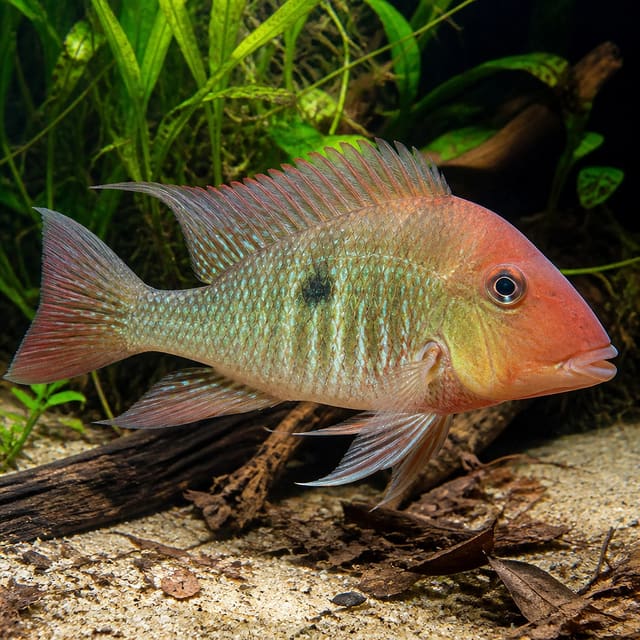
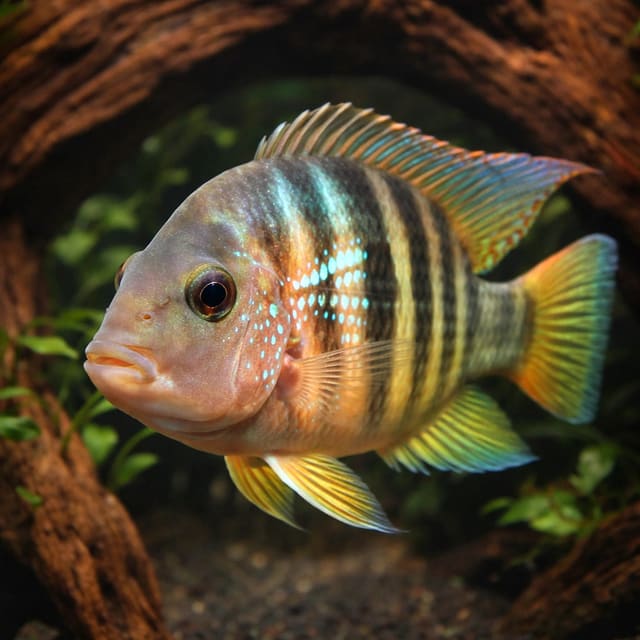
The gallery photograph shows an olive-gold fish with rows of pale spots and a dark mark at the base of the tail, swimming in front of green plant leaves. Gallery images have been digitally enhanced to improve image quality. Natural colour, pattern, size and maturity can vary between live animals. The fish you receive will be an individual of the size you chose and may differ from the photograph in those ways.
The appeal of this fish is its behaviour as much as its looks. A settled group moves across the sand together, each fish taking mouthfuls of the substrate, sifting out anything edible and letting the rest stream back out through its gills and mouth. Seriously Fish describes the species living in loose aggregations, and a well-planned aquarium lets you watch that quiet, constant foraging from the front glass. At feeding time the group will also rise into open water to take food before returning to the bottom.
Seriously Fish states that an aquarium with a base measuring at least 210 × 60 cm, or equivalent, is required, which it puts at around 756 litres. The base is the figure to plan around. A Demon Eartheater spends its day working the bottom, so floor area gives each fish in the group room to feed and to move away from a stronger neighbour; extra height adds little.
That species figure sits well above the general guidance OATA gives for American cichlids, which is at least 300 litres for larger species over 15 cm. OATA also makes the point that a larger aquarium keeps temperature and water quality more stable, which suits a fish as sensitive to water quality as this one.
The 2.5–3 cm and 4–5 cm fish are small when they arrive, but they are the same species as the 15–20 cm fish and are heading for the same size. Plan and build the full-size aquarium from the start rather than relying on moving them on later. The 15–20 cm size needs that space from the day it arrives.
Seriously Fish suggests a turnover of four to five times the aquarium volume an hour. For a tank of around 756 litres, that means two filters rated at roughly 1510–1890 litres per hour each. To hold its 20–28°C range in a room at about 20°C, it estimates 125–200 W of heating spread across three heaters.
Filtration does more than move water. As the RSPCA explains, fish release ammonia, which is toxic; a working biological filter grows bacteria that convert it to nitrite, also toxic, and then to nitrate, which is safer. Those bacteria need time to establish, so the aquarium must be matured before any fish go in. The guide to setting up and maturing a tropical aquarium walks through that process.
Before any fish are added, ammonia and nitrite should both read zero. OATA advises increasing the number of fish slowly, because the filter bacteria must grow each time fish are added and feeding increases. Overstocking, or stocking too quickly, can cause new tank syndrome: ammonia and nitrite rise to unhealthy levels and fish may become ill and die. With a group of large cichlids, that means planning how and when the group goes in, and testing the water between additions.
OATA's advice to stock slowly and Seriously Fish's advice to buy a group both apply here. Mature the filter fully before the eartheaters arrive, make the group of five to eight the main purchase for the aquarium, and hold back on other additions until the readings show the filter is coping. Seriously Fish's breeding notes also favour starting with young fish and letting pairs form naturally, which makes the smaller sizes a sensible starting point for keepers with the full-size aquarium ready.
FishBase records Satanoperca jurupari across the Amazon River basin, from Peru, Ecuador and Colombia to the mouth of the Amazon in Brazil, in Amapá and eastern French Guiana, and in the Bolivian Amazon drainage apart from the Guaporé River. It is typical of quiet water, including the freshwaters of estuaries and coastal swamps, and lives close to a soft, muddy bottom. FishBase lists the species as Least Concern on the IUCN Red List. Gentle flow, a soft floor and clean, soft water are the aquarium version of that setting.
Eartheaters feed by taking mouthfuls of substrate, sifting out anything edible and expelling the rest through the gill openings and mouth. FishBase describes the species digging into muddy substrate for food, and Seriously Fish calls a soft, sandy substrate the most essential item of décor, because it lets the fish browse naturally.
Coarser materials are a real risk. Seriously Fish warns that gravel or small pebbles can inhibit feeding, damage the gill filaments and even be swallowed, with the potential for internal damage or blockages. Use soft sand across all the open areas where the fish forage, and keep it clean.
Beyond the sand, furnishings are largely a matter of taste. The set-ups Seriously Fish describes as most favoured have relatively dim lighting, a few chunks of driftwood and scattered roots or branches. Keep the wood to the edges and back so that a broad area of open sand stays free for feeding. Solid pieces of wood also matter later on, because breeding pairs tend to centre their territories around one.
Leaf litter is typical of the natural habitat but Seriously Fish does not really recommend it in aquaria: the way these fish feed stirs partly decomposed material into suspension, which looks unsightly and can block filters and pumps. OATA's care sheet for American cichlids adds that they may dig up or eat live plants, and suggests plastic plants as a suitable way to provide cover.
Choose a soft, fine sand and rinse it thoroughly before it goes into the aquarium, so that fine dust does not cloud the water. Spread it across the whole floor rather than leaving bare glass or patches of gravel in the areas where the group forages.
Because the fish constantly work the substrate, fine debris is regularly lifted into the water. Siphon the sand surface during water changes to remove solid waste, and keep the filtration generous so that suspended material is cleared rather than left to settle back into the bed.
Water quality is of the utmost importance with this species. Seriously Fish describes these cichlids as extremely susceptible to deteriorating water quality, so clean, stable water matters more than chasing any single number.
| Measure | Target and wider range |
|---|---|
| Temperature | Aim for 24–26°C; Seriously Fish gives 20–28°C |
| pH | Aim for 6.3–7.0; Seriously Fish gives 5.5–7.5 |
| General hardness | Aim for 5–10 dGH; Seriously Fish gives 2–12 dGH |
| Ammonia and nitrite | Zero |
| Nitrate | As low as you can keep it through regular water changes |
FishBase records the species at 24–26°C, pH 6.3–7.0 and 5–10 dH, and each of those sits inside the wider aquarium ranges in the Seriously Fish profile. Aiming for the overlap keeps you comfortably within both. The OATA care sheet for American cichlids gives broader ranges for the whole group (22–27°C, pH 6.5–8.0, 4–12 dGH, with nitrate no more than 20 mg per litre above tap water levels), but those are a general guide across many species. Seriously Fish's advice to avoid companions that need less acidic or more mineral-rich water points this eartheater firmly towards the soft, slightly acidic to neutral end.
OATA recommends testing at least once a week to make sure ammonia and nitrite are not building up. If your tap water sits outside the targets, work out how you will bring it into range before the fish are ordered, and make any change gradually. The water chemistry guide explains what each test measures and why it matters, and the water matcher tool lets you compare your own readings with the values above.
Keep a record of every result. A single test shows where the water is on the day; a series of results shows which way it is moving, which is the earliest warning of a problem in an aquarium this size.
Seriously Fish describes Satanoperca species as benthophagous: they feed from the bottom, sifting sand for food. The stomach contents of wild fish are mostly small aquatic and terrestrial invertebrates, including water fleas, ostracods and insect larvae (particularly midge larvae), along with seeds, organic detritus and sediment. FishBase similarly lists fruit seeds, crustaceans and insects in its diet.
OATA's general rule for American cichlids is to feed only what they can eat within a few minutes, once a day, and to take care not to overfeed, because they can eat large amounts in one sitting. Overfeeding leads to extra waste and uneaten food that breaks down and releases toxic waste into the water, which is the last thing a water-sensitive species needs.
Once settled, Seriously Fish says these fish readily rise into the water column when food goes in, then carry on browsing the sand at other times. Watch that the whole group gets a share, and that faster mid-water companions are not taking most of the food before it reaches the bottom.
Because the group forms a dominance hierarchy, the strongest fish tend to reach food first. Spreading food across more than one part of the sand gives the lower-ranking fish a better chance of a share, and watching each fish at feeding time is one of the easiest ways to notice one that is losing condition.
Satanoperca jurupari is gregarious. Seriously Fish describes it living in loose aggregations unless spawning, with juveniles in particular showing strong grouping instincts, and recommends a group of five to eight as the minimum purchase. Within that group the fish form a noticeable dominance hierarchy. In smaller numbers, weaker individuals can become the target of the others, so a proper group spreads that attention more evenly.
Unless it is breeding, this is a surprisingly peaceful cichlid, and Seriously Fish notes that it will not prey on fish larger than a few millimetres in length. Most of the day is spent in slow, steady foraging across the sand.
Some jostling for position is normal in a group like this. What you do not want is one fish singled out. Look for the changes OATA lists as early warning signs: a fish hiding more than usual, turning darker or paler, losing fins or scales, or eating less. If one individual shows those signs while the rest are fine, check that the group is large enough and that the aquarium gives it room to move away.
The species is a maternal mouthbrooder that has been bred in aquaria. Seriously Fish describes it as ovophilous, meaning the female takes the eggs into her mouth, and says there is no particular spawning trigger: the main requirements are a good diet and a stringent maintenance regime with relatively large weekly water changes.
Breeding is a bonus rather than a goal for most keepers. If it happens, give the pair room and expect the rest of the group to be pushed away from their chosen patch of sand.
Every fish is hand-packed by our team, bagged in pure oxygen and sent in an insulated poly box, with a heat pack when the weather calls for it. A licensed live-animal courier carries the parcel, and we email the tracking number and your confirmed delivery date so that you know when to be in. Someone must be at the delivery address to receive it, because live fish cannot be left unattended.
The day before delivery, test ammonia and nitrite, check that the temperature and pH are on target, and make sure there is room at the surface of the aquarium for the bags to float. Have conditioned water ready for the first water change after arrival, and your phone charged for the unboxing video.
The Live Arrival Guarantee requires someone to receive the parcel, the parcel to be opened and inspected the same day it arrives, and a continuous unboxing video that begins with the parcel still sealed.
The video policy exists to make claims quicker, clearer and fair for genuine customers; our licensed live-animal courier may ask for continuous unboxing evidence when we raise a claim. If anything has gone wrong, contact us the same day, with WhatsApp the fastest route, and send your order number with the unboxing video so that we can arrange a replacement or refund. The full delivery and Live Arrival Guarantee policy sets out every condition.
Give new arrivals time to find their way around the sand and wood, and keep feeding modest while they settle. OATA describes healthy fish as having clear, bright eyes, undamaged fins, intact scales and no ulcers or bumps, so use those signs as your baseline. Test ammonia and nitrite over the following days, because a group of new fish adds a noticeable load to the filter.
OATA strongly recommends a partial water change of 25% at least once every week, with a siphon to remove solid waste from the substrate. Treat the replacement water with tap water conditioner to remove any harmful chlorine or chloramine before it goes in. Check filters for blockages, and if the media needs cleaning, do not run it under the tap: any chlorine or chloramine present may kill the beneficial bacteria. Rinse it lightly in the tank water removed during the water change instead, which keeps the loss of bacteria low.
All fish vary slightly in behaviour and appearance, so get to know your group. OATA suggests watching for changes in these areas, which helps you spot a problem before it becomes a real health issue.
If you are concerned about any fish, test the water first. OATA notes that American cichlids can be stressed by even the smallest amounts of ammonia, and with a species this sensitive to water quality, a reading above zero is the first thing to correct.
Seriously Fish describes suitable tank mates for Satanoperca jurupari as numerous, taking in most peaceful species that enjoy similar environmental conditions. That gives you plenty of choice, as long as every companion is calm, happy in soft, acidic to neutral water and comfortable in a large, sandy aquarium.
OATA's wider advice on American cichlids supports that line: mixing them can be difficult, and the more aggressive species must be kept either alone or with equally aggressive cichlids. A peaceful sand-sifter does not belong in that company.
Size alone is less of a worry than with many cichlids. Outside breeding, Seriously Fish says this species will not prey on fish larger than a few millimetres in length, so small peaceful fish that like the same water are not usually at risk from it.
Some aquarists keep Satanoperca alongside freshwater stingrays of the genus Potamotrygon. Seriously Fish reports that this has often worked, but in some cases the cichlids have disappeared at night, so treat the combination with caution.
Small crustaceans and insect larvae make up much of this eartheater's natural diet, so very small invertebrates such as dwarf shrimps are best treated as potential food rather than companions.
A breeding pair defends its territory and does not tolerate other fish nearby, especially its own species. In a mixed aquarium, generous floor space and plenty of open sand let the rest of the community give that pair room without being trapped.
In most aquariums built for this fish, the eartheater group is the centrepiece and everything else is chosen to fit around it. Start with the group and the sand, then add peaceful companions that share the same soft, acidic to neutral water and use a different part of the aquarium, so the bottom stays free for foraging. Companions that feed fast in mid-water are fine, provided the eartheaters still get their share when food reaches the sand.
When you are building a South American community, the South American cichlids collection shows the species we offer. Each one still needs its own check against the points above; appearing in the same collection does not make two species compatible.
FishBase records a maximum of 25 cm total length and 26 cm standard length, while Seriously Fish gives 18.5 cm standard length. These are maximum records rather than a typical size, but plan the aquarium for a fish that can pass 20 cm, whichever size you start with.
Seriously Fish says an aquarium with a base of at least 210 × 60 cm, or equivalent, is required, which works out at around 756 litres. The length and depth of the base matter most, because this fish lives and feeds on the bottom.
Seriously Fish advises a group of five to eight Satanoperca jurupari as the minimum purchase. The species is gregarious, juveniles in particular group strongly, and in smaller numbers weaker fish can become targets within the group.
It suits an experienced keeper with room for a very large aquarium better than a first-time fishkeeper. It needs soft sand, a group, strong filtration and excellent water, because Seriously Fish describes these cichlids as extremely susceptible to deteriorating water quality.
In the wild it sifts mouthfuls of substrate for small invertebrates, insect larvae, seeds and detritus. In the aquarium, offer a variety of high-quality, fine-grade prepared foods with small frozen or live foods such as daphnia, brine shrimp and bloodworm, and avoid large chunks it cannot swallow properly.
Aim for 24–26°C, pH 6.3–7.0 and 5–10 dGH, where the FishBase record sits inside the wider aquarium ranges Seriously Fish gives (20–28°C, pH 5.5–7.5, 2–12 dGH). Keep ammonia and nitrite at zero and the water consistently clean.
Outside breeding it is surprisingly peaceful and does not prey on fish longer than a few millimetres, according to Seriously Fish. A group forms a noticeable dominance hierarchy, and a breeding pair defends a territory and tolerates few other fish nearby, especially its own species.
Most peaceful species that enjoy similar soft, acidic-to-neutral water make suitable companions. Avoid aggressive or territorial bottom-dwelling species and fish that need harder, more mineral-rich water, and take care with freshwater stingrays.
It is hand-packed in a bag of pure oxygen inside an insulated box, with a heat pack when the weather calls for it, and carried by a licensed live-animal courier. Someone must be in to receive the parcel and open it the same day. Before opening, start one continuous unboxing video that runs from the sealed parcel to the fish in its bag, then float the bag for 20–30 minutes and release the fish without the bag water. For a Live Arrival Guarantee claim, get in touch the same day with your order number and that video.
No reviews for this item yet. Bought one? Honest reviews only, good or bad.
What customers say about ordering from us
I have a small group of long finned mountain minnows. So was delighted to be able to order ten of this variety to increase the genetics in my tank . The ones I recieved are healthy but it’s to early to give a verdict on wether they are of a long finned type since they are small currently.
Gordon Walker · 23 Sept 2026
100% success travel and "installation". Pleased with quality of purchase. The Siamese fighter a bit "shy" so have not yet seen him at his best yet but looking good. Happy customer. GG
George E Garratt · 21 Sept 2026
Reviews of our shop, collected by Judge.me, an independent third-party review collector. Newest first.