Moderate
Flag Acara (Laetacara curviceps)
20–28°C · pH 4.5–7.5
£6.99

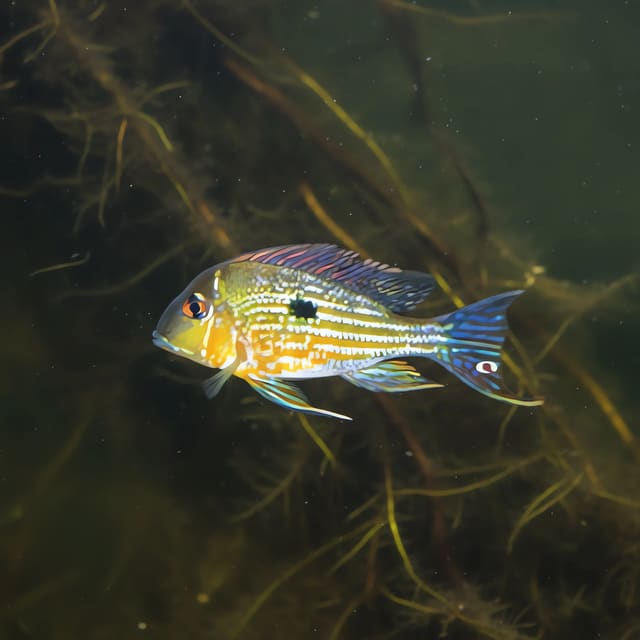
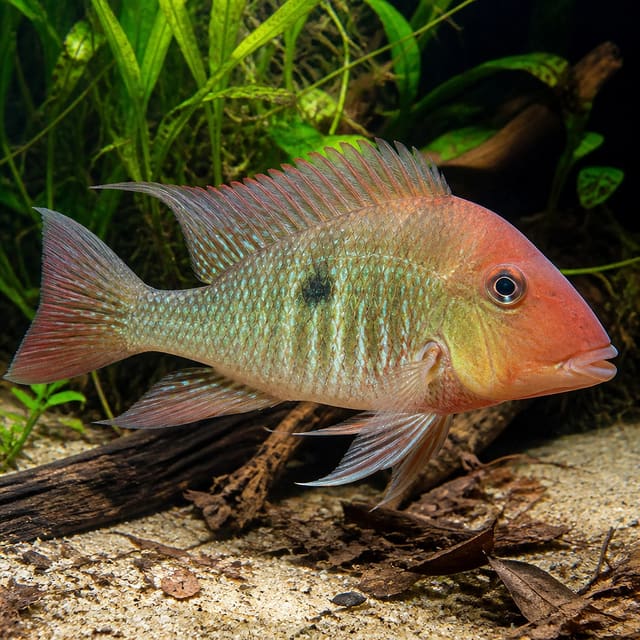
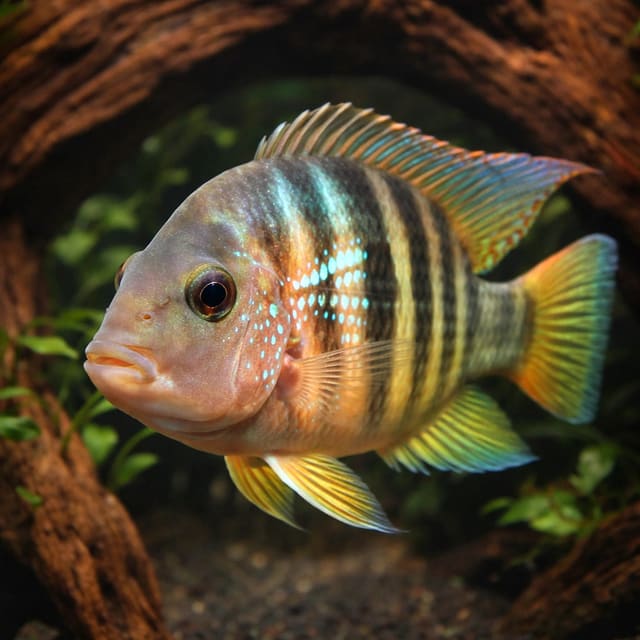
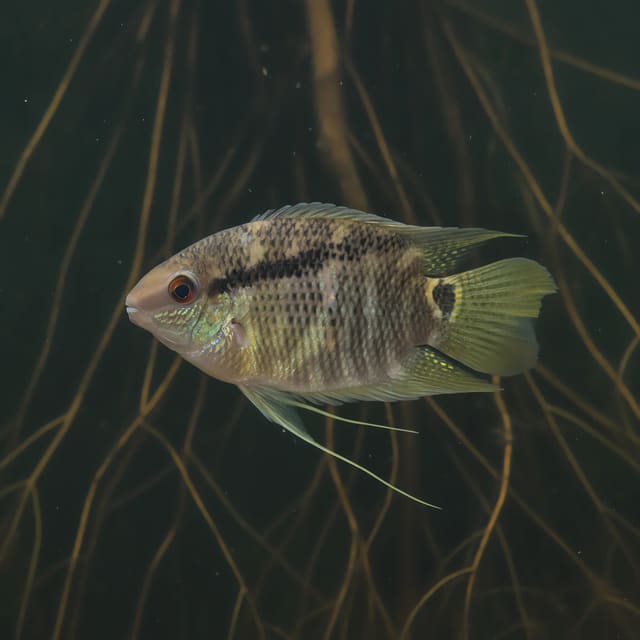
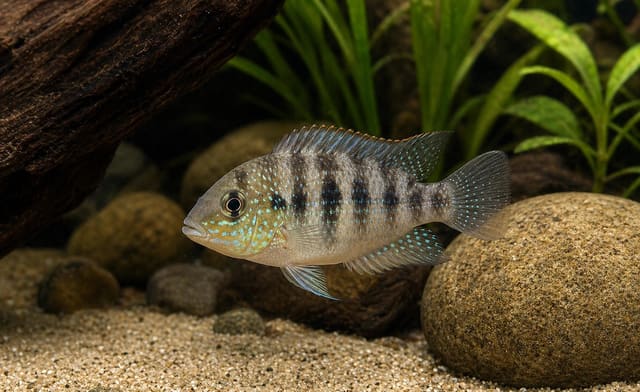
Zebra Acara is a compact Rio Negro cichlid with dark vertical bars, blue spotting and territorial dwarf-cichlid behaviour. One purchase supplies one fish in the selected 3–4, 4–5 or 5–6 cm dispatch grade; it needs a mature soft-water aquarium with gentle filtration, fine substrate, substantial cover and carefully matched companions.
Nannacara adoketa
Save when buying multiple fish. Each quantity is one fish; sex and pair formation are not guaranteed unless the selected variant explicitly states them.
Zebra Acara is a compact Rio Negro cichlid with dark vertical bars, blue spotting and territorial dwarf-cichlid behaviour. One purchase supplies one fish in the selected 3–4, 4–5 or 5–6 cm dispatch grade; it needs a mature soft-water aquarium with gentle filtration, fine substrate, substantial cover and carefully matched companions.
Cichlids are a family of roughly 1,800 accepted species, not one care type. Before buying, identify the exact species and source, then compare adult measurement, usable tank dimensions, social system, territory, tested water, diet and an exit plan. No family-wide minimum tank, water range or tank-mate list is safe.
Maintain these water conditions for optimal health and vibrant colors
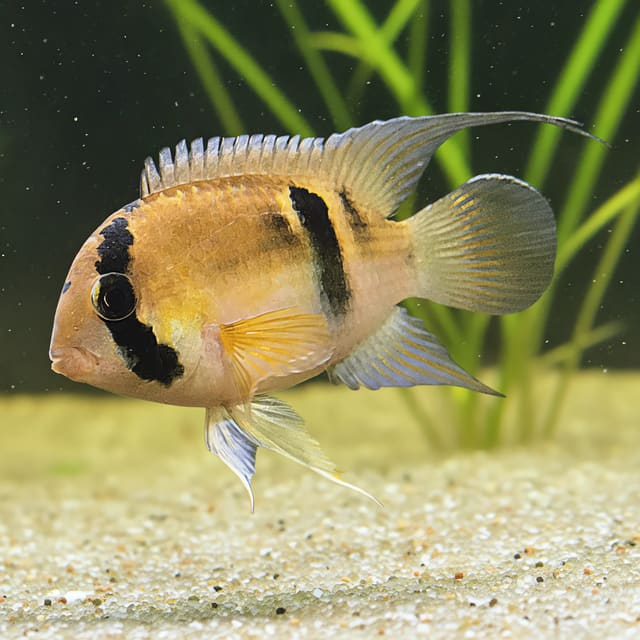
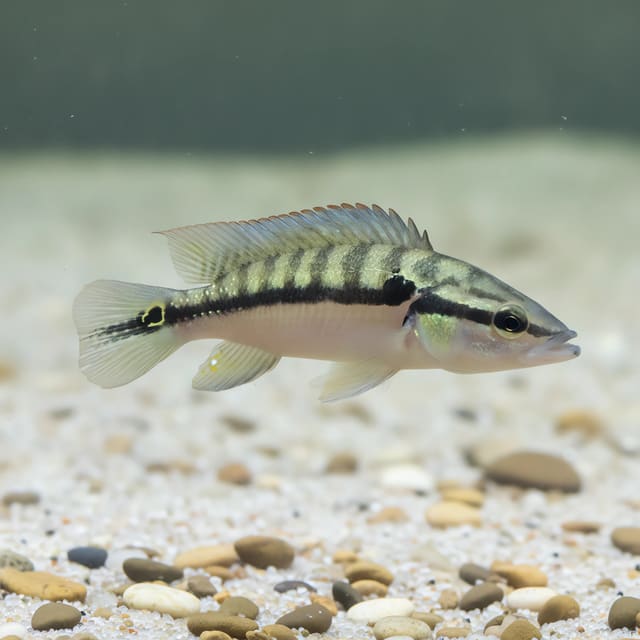
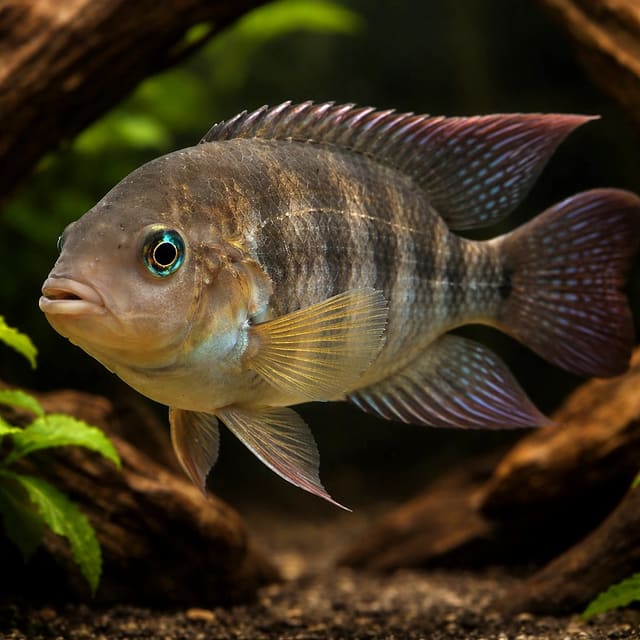
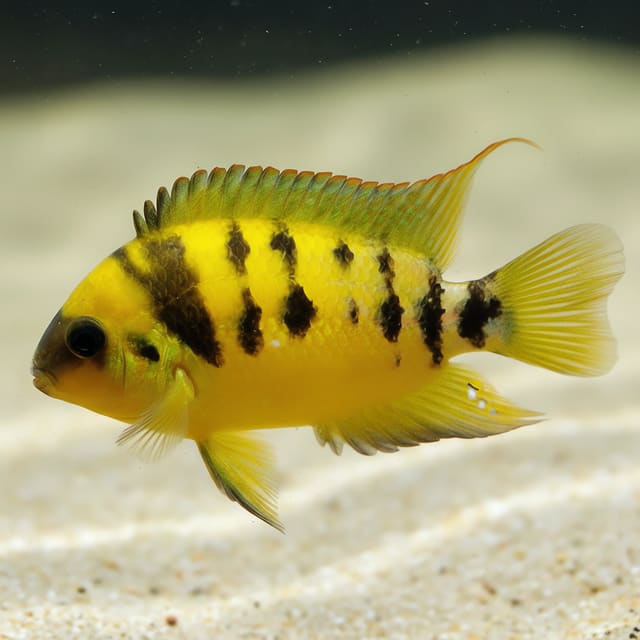
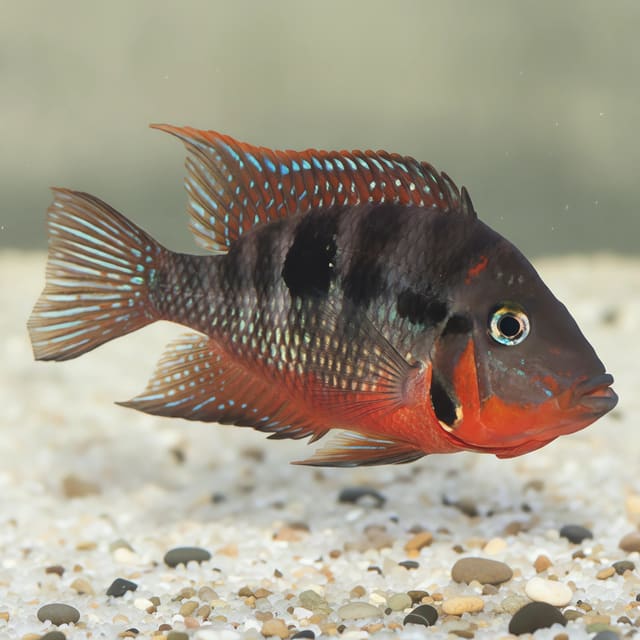
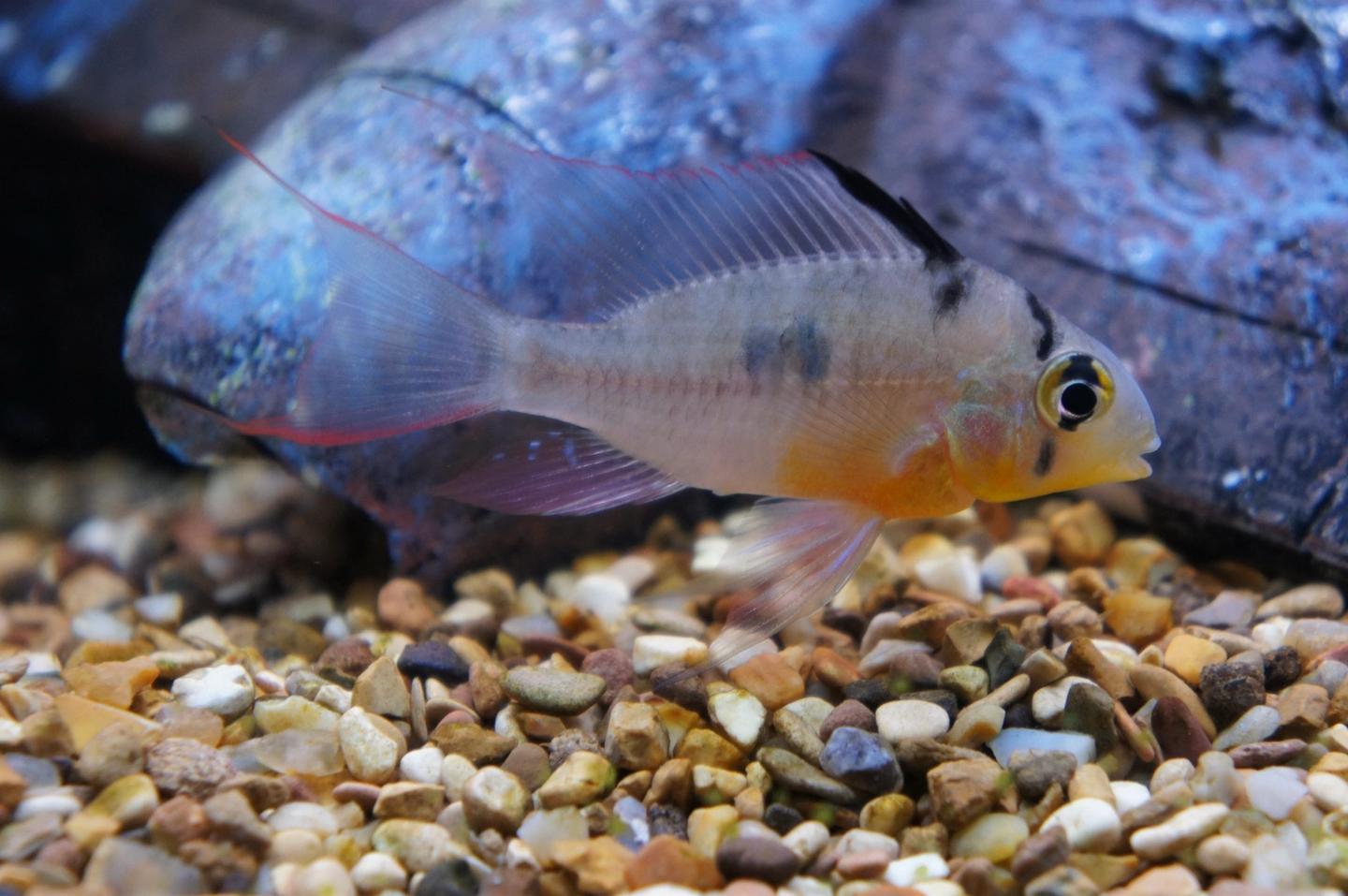
Zebra Acara is a compact South American cichlid from the middle Rio Negro basin. Its deep body carries dark vertical bars and blue-green spotting, while its alert posture and interest in caves give it the unmistakable character of a small cichlid. It is best approached as a soft-water fish with territorial instincts, not as a miniature version of a hard-water African cichlid and not as a guaranteed peaceful companion for every community.
The trade identity for this offer is Nannacara adoketa. FishBase also lists the accepted scientific name as Nannacara adoketa, so there is no genus change to bridge. The common name Zebra Acara belongs outside the scientific parentheses and refers to the barred appearance associated with the species.
One purchase supplies one live fish in the size selected. The recurring dispatch grades are 3–4 cm, 4–5 cm and 5–6 cm, and the live selector shows what can be chosen for an order. The size you select is the size supplied, not the adult size. Sex is guaranteed only when the selected option explicitly states male or female. This Zebra Acara listing has no sex-guaranteed option.
Do not assume that two fish from this listing will be a male and female or will form a compatible pair. Body shape, colour and finnage can vary with size, maturity, mood and condition, and an image cannot guarantee the sex of the fish supplied. Plan territories and escape routes before keeping more than one individual, and keep a separate management plan if aggression develops.
Adult-size records require careful labels. FishBase records a maximum of 10 cm total length and also a maximum of 4.9 cm standard length for a male or unsexed fish. Total length includes the tail, while standard length excludes it. These are different measurement conventions and record scopes; 10 cm TL is not interchangeable with 4.9 cm SL, and no conversion is made here. The dispatch grades describe the fish when supplied and do not replace either adult record.
FishBase records wild environmental values of 22–28°C, pH 4.5–6.0 and 5–10 dH. OATA’s broad dwarf-cichlid care sheet gives 22–27°C, pH 6.0–8.0 and 4–12 dGH for the group. Those ranges describe different scopes. The genuine numerical overlap is 22–27°C for temperature, pH 6.0 at the boundary, and 5–10 degrees for hardness, but a shared number is not proof of a species-specific aquarium optimum. This page keeps the wild species record and broad group guidance separate.
Zebra Acara suits a keeper who is comfortable testing soft water, maintaining a mature biological filter and watching cichlid behaviour closely. It needs cover, more than one sheltered route, appropriately sized food and companions that can share its chemistry without crowding its territory. OATA warns that dwarf cichlids can become territorial, especially when breeding, so a calm appearance in one setting is not a promise of identical behaviour in every aquarium.
| Suits | Think again if |
|---|---|
| A mature soft-water aquarium with stable measured chemistry | The aquarium is uncycled or the tap water is hard and alkaline without a safe long-term plan |
| Fine sand or smooth substrate, wood, plants, caves and broken sight lines | The layout is open and bare with one shelter that can be monopolised |
| A keeper prepared to observe and manage territorial behaviour | Two unsexed fish are expected to form a guaranteed pair |
| Calm companions selected for matching water and enough space | Boisterous, predatory or hard-water fish are already committed to the same tank |
For other South American cichlid shapes and sizes, browse the South American cichlid collection. Treat those products as alternatives to compare, not automatic tank mates. Adult size, chemistry, behaviour and footprint must all be checked for each species.
Gallery images have been digitally enhanced to improve image quality. Natural colour, pattern, size and maturity can vary between live animals.
The RSPCA explains that a biological filter is essential because fish release toxic ammonia. Established filter bacteria convert ammonia to nitrite and then nitrate. A newly filled aquarium does not have that capacity simply because the water is clear. Complete maturation and testing before adding the fish, then increase livestock gradually so the filter can adapt to the additional food and waste.
The first tropical tank guide gives a practical sequence for preparing and maturing an aquarium. For Zebra Acara, that foundation needs to be combined with a soft-water plan and enough physical structure to manage a cichlid territory. Stability is particularly important when mineral content and buffering are low, because poorly managed changes can move pH rapidly.
Choose gentle but dependable filtration. OATA’s dwarf-cichlid guidance requires a filter and recommends an aquarium with shelter, while the wild record describes a shallow forest stream rather than a fast open channel. Use the outlet and hardscape to prevent one strong current from sweeping every resting area. Maintain surface movement and biological capacity while leaving quieter zones around roots, leaves and caves.
FishBase records the species in freshwater at 22–28°C, pH 4.5–6.0 and 5–10 dH. The collection locality described on the FishBase page was a small stream in inundable forest, with surface water at 24°C, dissolved oxygen of 1.8 mg/l and a maximum depth of 28 cm. These are wild records, not a recipe for reproducing low oxygen in an aquarium. A home aquarium still needs reliable filtration, gas exchange and clean water.
OATA gives broad dwarf-cichlid guidance of 22–27°C, pH 6.0–8.0, general hardness of 4–12 dGH and carbonate hardness of 3–10 dKH. OATA explicitly frames those as group values and tells keepers to check species-specific requirements. For Zebra Acara, the FishBase wild pH record ends at 6.0, whereas the OATA group range begins at 6.0. Calling 6.0–8.0 a species range would erase that distinction, while calling 4.5–6.0 a proven routine aquarium optimum would overstate a wild record.
Use the aquarium water-parameter guide to understand what the tests mean, then enter real readings in the water parameter matcher. Test the source water as well as the aquarium. If a soft-water method is required, it must be repeatable for every water change; sudden improvised dilution is not a stable husbandry plan.
Ammonia and nitrite should remain at zero. OATA advises that nitrate should not exceed 20 mg/l above the normal level in the source tap water. Track trends rather than waiting for visible cloudiness or stressed behaviour. In lightly buffered water, measure pH consistently and avoid large unexplained corrections.
OATA recommends at least 60 litres when keeping a pair of dwarf cichlids and at least 80 litres when mixing them with other fish. Those are broad group-planning figures, not species-specific minimums for Nannacara adoketa. They also assume a compatible pair; this listing supplies one unsexed fish per purchase and does not promise that two fish will pair. More floor area and more cover make behaviour easier to manage.
Build the layout around several separated shelters. Caves made from stable aquarium-safe materials, driftwood, plant thickets and leaf litter can create boundaries and break lines of sight. A single prized cave in the centre can become a focus for conflict. Multiple entrances and routes allow a subordinate fish or tank mate to move away without being trapped in a corner.
Fine sand or smooth gravel is appropriate under OATA’s group guidance. Keep the substrate clean enough that food does not rot beneath leaf litter or wood. Leave some open ground for feeding and observation. Live plants can provide shade and cover, but choose species that suit soft water and secure them against normal cichlid investigation.
OATA describes dwarf cichlids broadly as omnivorous and recommends a quality flake or granule, supplemented with small live or frozen foods such as daphnia, brine shrimp or Tubifex. This is group-level aquarium guidance; FishBase’s supplied species record does not provide a home feeding schedule. Use appropriately sized food that the fish can take easily and vary the diet rather than relying on one rich frozen item.
OATA’s broad recommendation is to offer only what the fish can eat within a few minutes, once daily, and to avoid overfeeding. Adjust the portion to the fish’s size, body condition and actual response. Remove persistent leftovers, especially around caves and leaf litter where uneaten food can be missed. A fish that guards a shelter may need food placed where it can feed without leaving cover for long.
Watch the animal eat. Interest in food, ability to take and swallow it, and stable body condition are more informative than food disappearing somewhere in the aquarium. In a community, quicker mid-water fish may intercept every particle. Use more than one feeding location and make sure the Zebra Acara receives an appropriate share without turning the aquarium into a competition.
OATA recommends a weekly partial water change of about 25% and weekly testing as broad guidance. Condition replacement tap water for chlorine or chloramine and match temperature and chemistry closely. Do not run filter media under the tap; rinse it lightly in removed aquarium water when needed. Check the filter for blockages without replacing all mature media at once.
In very soft water, consistency matters. Prepare replacement water by the same measured method each time and verify it before adding it. Avoid large pH corrections, unmeasured mineral additives or sudden changes in botanical load. Leaf litter and wood can be useful parts of the habitat, but they do not remove the need for testing or make every brown-water aquarium chemically suitable.
Siphon accessible waste while retaining enough structure for security. Rotate deeper cleaning across sections rather than dismantling every territory in one session. A complete layout change can alter boundaries and behaviour as well as water quality. After maintenance, observe breathing, posture and whether the fish returns to normal feeding.
Have the aquarium, cover and test results ready before the delivery day. Read the delivery and Live Arrival Guarantee instructions in advance. The long-term aquarium must already suit the fish; acclimation cannot permanently bridge unsuitable chemistry. After introduction, give the animal access to a shelter and confirm that it settles without being trapped or chased.
OATA lists changed swimming, colour, aggression, hiding, breathing, appearance, body condition and feeding as useful warning signs for dwarf cichlids. Any one sign needs context. A fish entering a cave is not automatically ill, and darker colour can accompany mood or surroundings, but persistent loss of appetite, clamped fins, rapid breathing or abnormal balance warrants prompt water testing and closer assessment.
If a problem appears, start with measured water quality, recent additions, feeding and social pressure. A separate mature observation aquarium can make assessment safer, provided it matches the required chemistry and has a cycled filter. Avoid combining medications without a clear reason, and check every treatment against all fish and invertebrates present.
FishBase reports both 10 cm TL and 4.9 cm SL for a male or unsexed fish. Wikipedia repeats the 10 cm TL figure. Total length includes the tail; standard length stops at the base of the tail. The numbers therefore do not describe the same measurement, and the difference should not be interpreted as an error or averaged into a new adult length.
Plan space and compatibility around the larger 10 cm total-length record while retaining the 4.9 cm standard-length record as separate biological context. Do not put one unqualified adult-size number into a card that strips away measurement scope. Individual fish vary, and the 3–6 cm dispatch span only describes recurring supply grades.
A simple written log helps distinguish a pattern from a one-off event. Record tests, water changes, additions and unusual behaviour. If a reading or interaction changes, investigate the cause before altering several parts of the aquarium at once.
Begin with measured source water rather than a target copied from a generic cichlid page. Test pH, general hardness and carbonate hardness and consider how those readings change after the water has stood and circulated. If the source is outside the chosen plan, use a method you understand and can repeat safely. The goal is not to reach a dramatic low reading for one day; it is to provide consistent water at every maintenance session.
Low-mineral water may have less buffering, so small additions can produce larger pH movement than expected. Measure additives and replacement water, and keep records. Botanicals can change appearance and may influence chemistry, but leaves and cones are not a calibrated substitute for testing. Likewise, water that is clear is not necessarily hard, soft, acidic, alkaline or biologically mature.
When preparing a water change, compare the replacement water with the aquarium before it goes in. Temperature, pH and mineral content should not arrive as a surprise to the fish. Avoid changing a large proportion merely to chase one unusual test without first checking the test method and identifying the cause. Where uncertainty remains, smaller controlled corrections with repeat measurements are easier to evaluate than several simultaneous changes.
The three recurring grades allow the keeper to choose a fish that fits an established stocking plan, but none is a separate adult form. A 3–4 cm animal may need smaller food and extra intake protection, while a 5–6 cm animal may claim a shelter more confidently. The same adult records and long-term territory plan apply to every grade.
Consider the size of existing fish as well as their species. A small new arrival can be intimidated by a much larger cichlid even when both are nominally compatible, while a larger arrival can change the balance of a settled aquarium. Use several shelters before introduction and observe how each fish reaches food. Do not add a second unsexed individual simply because its dispatch size appears similar.
Cichlid interactions can change around feeding, cave selection and changes in the room or aquarium. Observe at more than one time of day. Healthy territorial display allows other fish to retreat and resume normal activity; a harmful pattern leaves another animal unable to feed, breathe normally or leave a corner. Torn fins, constant hiding and repeated high-speed pursuit are practical signs that the layout or stocking needs intervention.
Before moving fish, check whether a second refuge and a stronger sight break can redistribute space. If that does not work, separation may be required. Do not repeatedly rearrange the entire aquarium without a plan, because every reset creates new boundaries and may renew conflict. Keep a mature alternative space ready if more than one territorial fish is being trialled together.
OATA notes that dwarf cichlids can live in community aquariums but may become territorial, especially when breeding. For Zebra Acara, that means compatibility is conditional on space, cover, chemistry and the behaviour of the particular fish. It should neither be labelled harmless in every community nor treated as if it will attack everything in sight.
A cave or sheltered patch may become the centre of a territory. Break lines of sight with wood and plants and provide more than one refuge. If two fish are kept, remember that this listing does not guarantee sex or a pair bond. Chasing that prevents feeding or leaves a fish confined to one corner requires action, not simply more time.
OATA describes shoals of “dither fish” as useful companions for dwarf cichlids because their movement can provide a sense of security and they can move away from a defended area. Apply that guidance only to calm shoaling fish that genuinely share the planned soft-water chemistry, temperature and adult-size constraints. The word dither is a role, not a blanket approval for every tetra or rasbora.
Bottom dwellers need extra care. A peaceful catfish may still enter a cave area or compete at feeding time. Provide enough floor space, separate food placement and escape routes. Avoid adding several territory-forming cichlids to a small footprint merely because each species is described as dwarf.
Invertebrate compatibility cannot be guaranteed. An omnivorous cichlid may investigate or eat small young, while some aquarium treatments are unsafe for shrimp or snails. Consider the adult animal, its offspring, the water chemistry and the treatment plan before combining them.
A carefully arranged soft-water community may work well, but the layout must allow behaviour to change. If the aquarium cannot provide distance from a defended shelter, a species-only or differently stocked setup is the safer decision.
The Flag Acara listed in the related-products field is a comparison option within South American cichlids. It is not being recommended as a tank mate for Zebra Acara. Compare the two animals’ adult needs and choose the one that fits the aquarium rather than combining them by default.
Example one: calm shoaling fish in a long, planted soft-water aquarium. This can be a sensible direction when the shoal shares the intended chemistry, has enough open swimming room and can retreat from a defended cave. The cichlid still needs its own shelter and feeding access, and the shoal’s minimum social number must be included in the total stocking plan.
Example two: another dwarf cichlid in a compact aquarium. Similar adult size does not make the match safe. Two cave-centred territories may overlap completely, leaving no neutral zone. In that situation, choose one cichlid species rather than hoping extra ornaments will create enough distance.
Example three: hard-water livebearers already thriving. Even if their temperament appears peaceful, chemistry can make the combination unsuitable. Do not compromise both sides into a middle value without species support. Select livestock that fits the established water or maintain a separate aquarium.
Example four: bottom-dwelling catfish. A calm bottom fish may share soft water but still cross a defended shelter and compete for sinking food. Provide several feeding sites and a clear open route around the cichlid territory, then observe whether both animals can feed and rest normally.
Respond before chronic stress becomes a health problem. Test the water as well as reviewing behaviour, because poor chemistry can reduce tolerance and mimic compatibility problems. If adequate space and boundaries cannot be provided, separate the fish.
FishBase records 10 cm total length and 4.9 cm standard length for a male or unsexed fish; Wikipedia also gives 10 cm total length. Total length includes the tail and standard length excludes it, so the figures are not interchangeable. The selected 3–6 cm grade is the dispatch size, not the adult size.
OATA’s broad dwarf-cichlid guidance recommends at least 60 litres for a compatible pair and at least 80 litres when mixing dwarf cichlids with other fish. These are group-level planning figures, not species-specific limits. This listing sells one unsexed fish per purchase and does not promise a pair.
One purchase supplies one fish and no sex is guaranteed. Do not assume that two fish will be male and female or will form a compatible pair. If keeping more than one, provide separate shelters, broken sight lines and a plan to manage territorial chasing.
This store rates the species intermediate. It best suits a keeper who can maintain a mature biological filter, measure and reproduce soft-water chemistry, and respond to territorial behaviour. It is not a sensible first addition to an uncycled aquarium.
OATA’s broad dwarf-cichlid guidance describes the group as omnivorous. Offer an appropriately sized quality flake or granule and rotate small live or frozen foods such as daphnia, brine shrimp or Tubifex. Feed modestly and remove persistent leftovers.
FishBase records wild environmental values of 22–28°C, pH 4.5–6.0 and 5–10 dH. OATA’s separate broad dwarf-cichlid guidance is 22–27°C, pH 6.0–8.0 and 4–12 dGH. Keep those scopes distinct rather than presenting their overlap as a proven aquarium optimum.
OATA warns that dwarf cichlids can become territorial, especially when breeding. Provide caves, sight breaks and enough room for other fish to move away. Persistent chasing, blocked feeding or fin damage means the combination or layout needs changing.
Consider calm shoaling dither fish that share the planned soft-water chemistry and have room to avoid a defended cave. Avoid large predators, boisterous fish, hard-water specialists and overlapping territorial cichlids. When breeding is intended, avoid fish likely to disturb a spawning site or eat fry.
Tropical Fish Co hand-packs the fish with oxygen in an insulated box and uses a licensed live-animal courier, adding a heat pack when weather calls for one. Be present for the confirmed delivery and inspect the parcel that day. A continuous unboxing video from the sealed parcel to the fish still in its bag is required only as evidence if you need to make a Live Arrival Guarantee claim.
Adult length, dispatch size, wild environmental records and broad dwarf-cichlid guidance remain explicitly separated. This avoids turning a differently measured record or group-level figure into an unqualified species promise.
No reviews for this item yet. Bought one? Honest reviews only, good or bad.
What customers say about ordering from us
I have a small group of long finned mountain minnows. So was delighted to be able to order ten of this variety to increase the genetics in my tank . The ones I recieved are healthy but it’s to early to give a verdict on wether they are of a long finned type since they are small currently.
Gordon Walker · 23 Sept 2026
100% success travel and "installation". Pleased with quality of purchase. The Siamese fighter a bit "shy" so have not yet seen him at his best yet but looking good. Happy customer. GG
George E Garratt · 21 Sept 2026
Reviews of our shop, collected by Judge.me, an independent third-party review collector. Newest first.