Expert
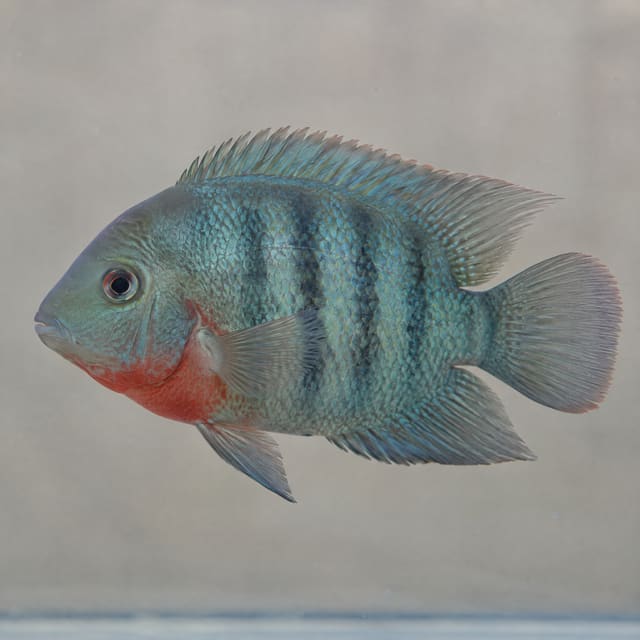
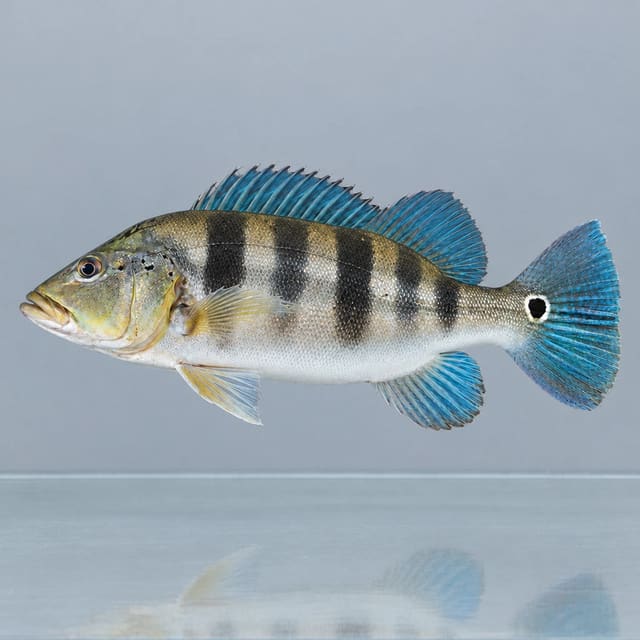
Azul Peacock Bass (Cichla piquiti)
£52.39
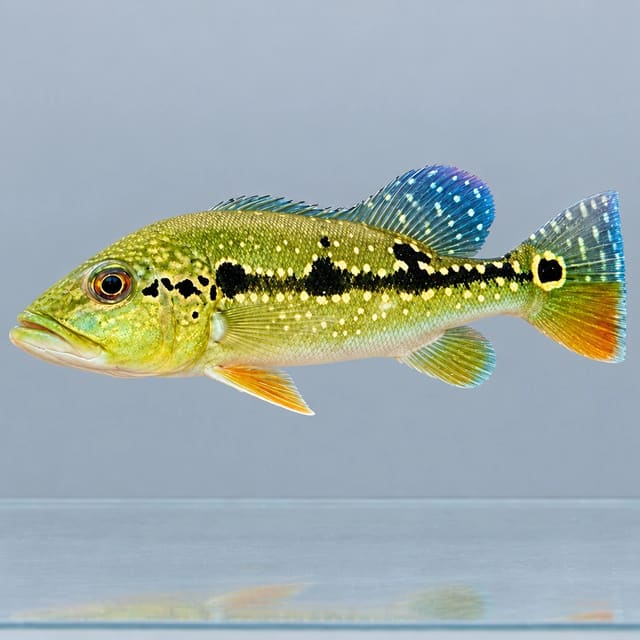
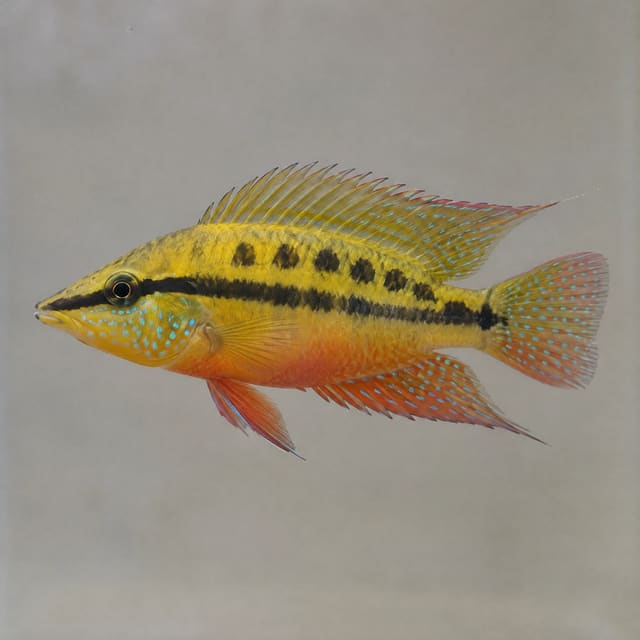
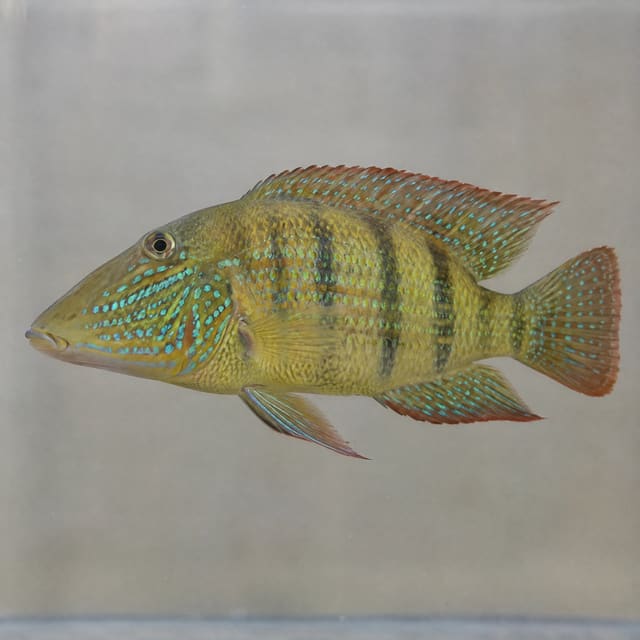
The Golden Peacock Bass (Cichla kelberi), also sold as the kelberi peacock bass, is a large predatory cichlid from the Araguaia and Tocantins rivers of Brazil. Adults turn golden yellow with three black bars and orange-red lower fins covered in pale spots. FishBase records 58.5 cm standard length, so it needs an aquarium of around 2,000 litres. Sold individually as one 5–6 cm juvenile.
Cichla kelberi
The Golden Peacock Bass (Cichla kelberi), also sold as the kelberi peacock bass, is a large predatory cichlid from the Araguaia and Tocantins rivers of Brazil. Adults turn golden yellow with three black bars and orange-red lower fins covered in pale spots. FishBase records 58.5 cm standard length, so it needs an aquarium of around 2,000 litres. Sold individually as one 5–6 cm juvenile.
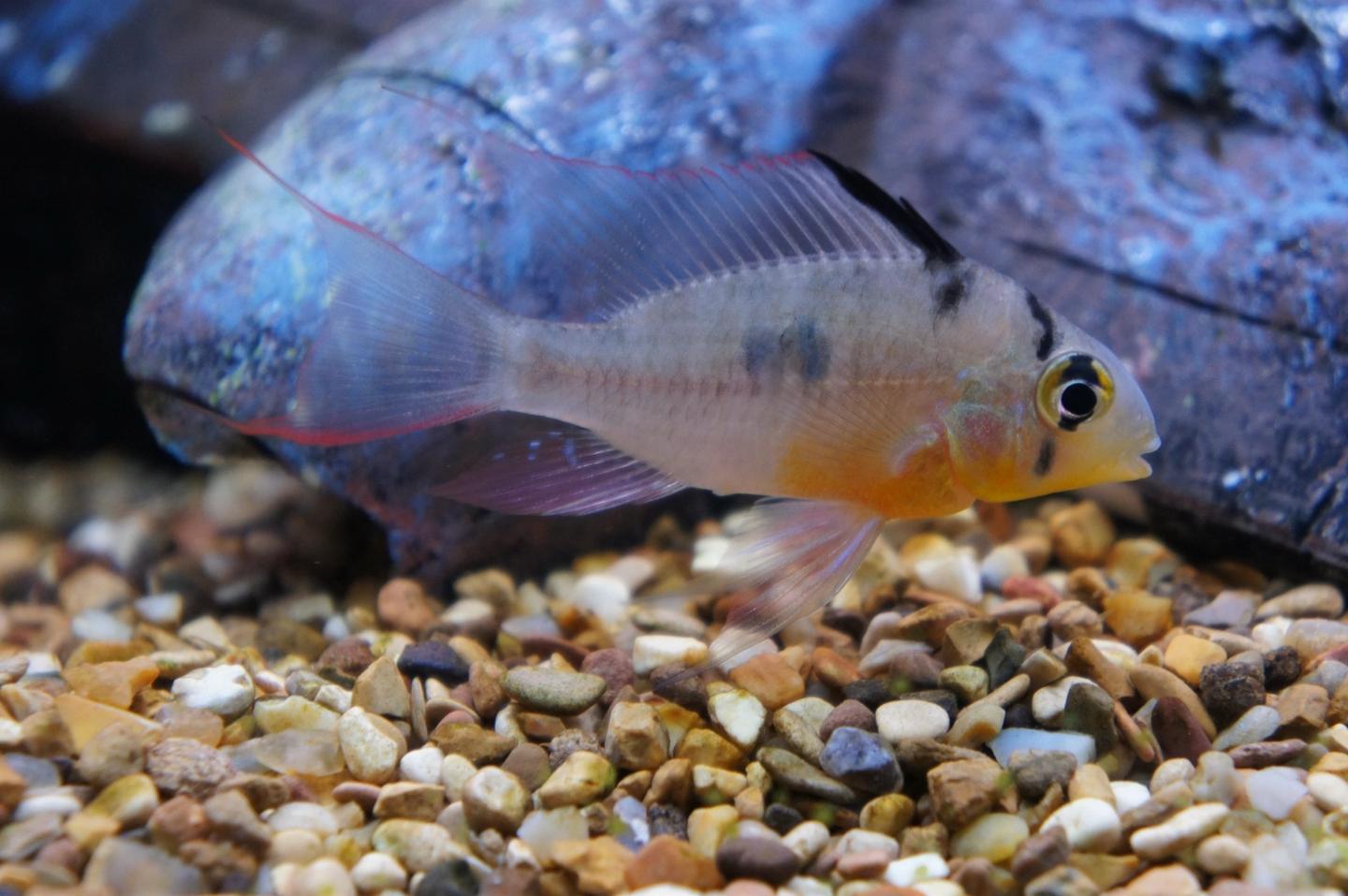
Cichlids are a family of roughly 1,800 accepted species, not one care type. Before buying, identify the exact species and source, then compare adult measurement, usable tank dimensions, social system, territory, tested water, diet and an exit plan. No family-wide minimum tank, water range or tank-mate list is safe.
The Golden Peacock Bass (Cichla kelberi) is the yellow peacock bass of Brazil: a heavy, golden fish with three black bars, a black eye-spot ringed in yellow at the base of the tail, and orange-red lower fins covered in small pale spots. In the trade it is usually called the kelberi peacock bass. It is a true predator that grows past 50 cm, and the juvenile you receive at 5–6 cm will eventually need one of the largest aquariums in the hobby.
Sven Kullander and Efrem Ferreira described the species in 2006 in their review of the genus Cichla. They named it after Dieter Kelber, a recreational angler, in recognition of his promotion of peacock bass as sport fishes and for the photographs he supplied of the tucunaré amarela (this species) and the tucunaré azul. Its native home is the Rio Araguaia drainage and the lower Rio Tocantins in Brazil. FishBase lists it as Least Concern on the IUCN Red List.
| Name | What it means |
|---|---|
| Golden peacock bass, yellow peacock bass | Trade names, from the golden adult colour |
| Kelberi, kelberi peacock bass | The species name, widely used as a trade name |
| Tucunaré amarela, tucunaré comum | Brazilian names in São Paulo and the north-east |
| Cichla kelberi Kullander & Ferreira, 2006 | The scientific name |
| Cichla monoculus, C. ocellaris | Different species under which this fish was long misidentified |
For decades this fish was filed under other names. Kullander and Ferreira write that it had long been confused with C. monoculus, which it resembles in shape and general colour, and that older Brazilian fisheries papers called it C. ocellaris. The only feature they found to separate it from C. monoculus is unique in the genus: adults carry small light spots on the pelvic fins, the anal fin and the lower lobe of the tail. Our Monoculus Peacock Bass is that other species, and comparing the two pages shows the difference.
The Golden Peacock Bass has also been moved far beyond its native rivers. The same review records it in reservoirs in Rio Grande do Norte, Minas Gerais and Ceará, in the Rio Paraíba do Sul and the Rio Paraná, and cites a 1999 angling source that lists thirteen dams in the Brazilian Paraná basin where it occurs. A predator this successful should never be released into any water.
Browse our South American cichlids, the South American cichlid category, our centrepiece fish and our rare and collector fish for related species.
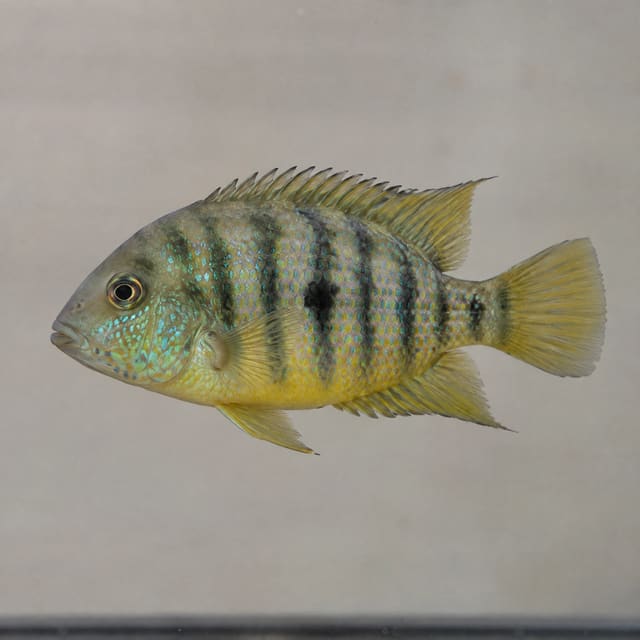
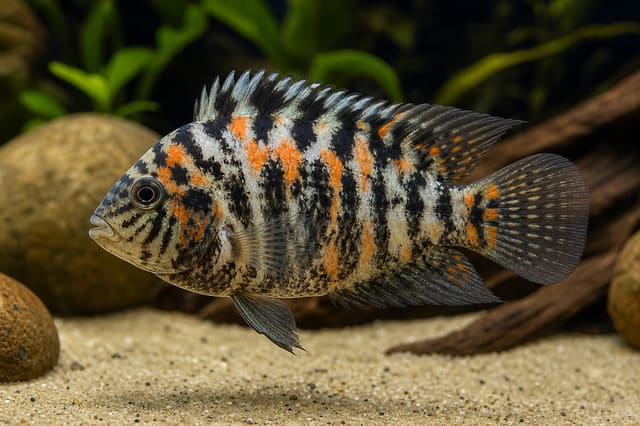
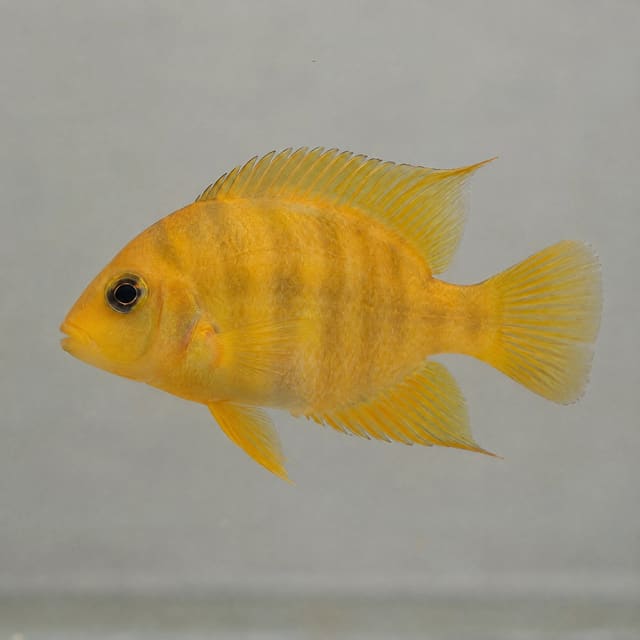
One purchase supplies one live Golden Peacock Bass of about 5–6 cm. At that size it cannot be sexed and it looks nothing like the adult in the photographs. Kullander and Ferreira describe a 48 mm juvenile as pale, with greyish vertical bars each holding a dark brown blotch, the rearmost blotch joined to the tail spot by a narrow dark stripe, and clear fins. Young fish of about 150–195 mm are brownish with three dark bars and the first light spots on the fins.
The golden colour comes with size and maturity. The authors describe breeding males as yellow or golden with a greenish head, a white chest and belly, black bars, small black spots on the back, and white or yellow spots on the dark soft dorsal, anal and pelvic fins, with a prominent dark grey hump on the forehead. Breeding females are yellowish to golden with an orange throat. Large adults outside breeding can be greyish to olive with maroon anal and lower tail fins.
If the answers are yes, read our delivery and Live Arrival Guarantee information and prepare a mature, heated aquarium first.
FishBase records a maximum of 58.5 cm standard length, measured from the snout to the base of the tail, and a published weight of 4.9 kg. It gives 20.7 cm as the length at first maturity, so a fish can breed long before it stops growing. The largest specimen Kullander and Ferreira examined was 276 mm standard length. Plan for a fish of at least 50 cm.
No published aquarium size exists for this species. The nearest guide is Seriously Fish's profile of the Orinoco peacock bass, a species of about 60 cm, which needs a tank of at least 8 × 3 × 3 ft (length × height × width), about 244 × 91 × 91 cm and roughly 2,000 litres. FishBase's maximum for the Golden Peacock Bass is close to that size, so treat 8 × 3 × 3 ft as the minimum for one adult. Seriously Fish's genus page gives 10 × 3 × 4 ft for the bigger species, which is where a pair or a mixed group should start.
Seriously Fish allows smaller aquaria for young fish but says plainly that you should not buy a peacock bass you cannot house long term. A mature grow-out tank is fine for the first months while the final aquarium is built.
A peacock bass needs open water more than décor. Seriously Fish recommends furnishing fairly sparsely, with large pieces of bogwood and robust plants. Fishkeeper, the care library of a UK aquatics chain, suggests soft sand, which is easier to clean than gravel because these fish are messy eaters, or a bare floor, and robust Anubias or Java fern grown on the wood.
| Area | Purpose |
|---|---|
| Front two-thirds of open water | Swimming and turning room for a large, fast fish |
| Bogwood along one side or the back | Shelter and a resting place |
| Hardy plants tied to the wood | Greenery that survives a large fish |
| Sand or bare glass floor | Fast clean-up of scraps after feeding |
| Equipment in a sump, lid on top | Nothing for the fish to break or jump past |
Fishkeeper warns that these fish can move rockwork and recommends bonding any stones with aquarium silicone. It also suggests keeping heaters in a sump, out of the main tank. OATA recommends a secure lid for American cichlids.
No water values are published for C. kelberi itself. For C. monoculus, its look-alike and close relative, Seriously Fish gives 25–28°C, pH 6.5–7.5 and up to 15 dGH. Fishkeeper gives 24–27°C, pH 6.5–7.0 and up to 15 dH for peacock bass in general, and OATA gives 22–27°C and pH 6.5–8.0 for American cichlids. Aim for 25–27°C and pH 6.5–7.5.
| Reading | Target |
|---|---|
| Temperature | 25–27°C |
| pH | 6.5–7.5 |
| General hardness | Up to 15 dGH |
| Ammonia and nitrite | 0 mg/l |
| Nitrate | Kept low; never more than 20 mg/l above your tap water |
Seriously Fish describes peacock bass as hardy fish that adapt to a variety of conditions, so a stable reading inside these ranges matters more than an exact figure. Compare your tap water with the table using our water matcher and read the water chemistry guide.
Big predators eat big meals and produce matching waste. Fishkeeper calls for powerful, oversized filtration and well-oxygenated water, prefers a sump to several huge canister filters, and says frequent partial water changes are absolutely essential because peacock bass will not tolerate raised nitrate. Seriously Fish also recommends external or sump filtration for these large, messy fish.
Seriously Fish sizes filtration at four to five times the tank volume per hour in its species profiles; for 2,000 litres that is roughly 8,000–10,000 litres per hour. Our article on aquarium filtration explained covers sumps and media.
In the wild the Golden Peacock Bass is a fish-eater. Seriously Fish recommends meaty foods for peacock bass such as prawn, mussel, lancefish, whitebait and other white fish. Fishkeeper suggests bloodworm, Mysis and chopped seafood for small fish, then earthworms, prawns, cockles, mussels, crab, crayfish and whole small fish as they grow, and lists cichlid pellets among suitable foods.
Offer a pellet at the start of each meal, while the fish is hungry, and follow with the frozen food it already knows, so the pellet becomes part of the routine from the first weeks. OATA advises feeding American cichlids once a day, only what they eat within a few minutes, because they can eat a large amount at once. Live feeder fish are not needed and bring a disease risk.
The first tank must be fully cycled, with ammonia and nitrite at zero. Our first tropical tank guide and the article on the nitrogen cycle explained show how. Use the floating-bag method OATA describes: lights off, float the sealed bag for about 10 minutes, add small amounts of tank water over up to 20 minutes, then net or pour the fish in with as little bag water as possible. See how to acclimatise new fish.
| Checkpoint | What to do |
|---|---|
| Before arrival | Test the water, set 25–27°C, close the lid |
| Arrival | Acclimatise in dim light and leave it alone |
| Day 2 | Offer a little frozen Mysis |
| Days 3–7 | Watch appetite, breathing and colour daily |
| End of week | Retest and carry out the weekly water change |
Seriously Fish describes peacock bass as territorial and moderately aggressive, able to live with other large fish such as arowana, stingrays, large catfish and other large cichlids only in an extremely large aquarium, and ready to eat any tankmate small enough to be food. Fishkeeper recommends a single fish or a known mated pair and never more than one male in a tank, however spacious.
| Suits | Avoid |
|---|---|
| Large cichlids of similar size, such as oscars | Anything an adult could swallow whole |
| Big armoured catfish, such as sailfin plecos | A second male peacock bass |
| Robust fish too large to swallow even when the bass is adult | Slim, slow or long-finned fish |
| Tank mates that share 25–27°C | Small schooling fish of any kind |
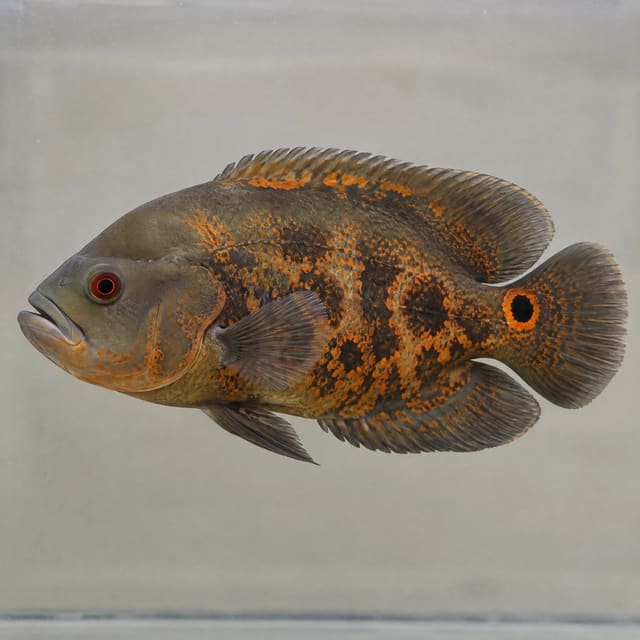
The Oscar Cichlid and the Leopard Sailfin Pleco from our range fit the description of large, sturdy companions. Predatory relatives such as Regan's Pike Cichlid and the rest of our pike cichlids, or the Parachromis guapotes, are better kept as alternatives than as companions. Read our Oscar care guide and cichlid care guide, and check any plan with our tank mates tool.
OATA describes a healthy fish as having clear, bright eyes, undamaged fins, intact scales, no ulcers or bumps, normal swimming and steady breathing. Learn your fish's normal feeding response in the first weeks: a change in appetite is often the first warning.
| If you see | Do this |
|---|---|
| Food refused for more than a day or two | Test the water, then offer a familiar frozen food |
| Gasping or fast gill movement | Test ammonia and nitrite and boost aeration |
| Bloated belly after feeding | Feed less and skip a day |
| Cloudy eye or split fins | Check water quality and remove sharp décor |
| White spots or fluffy patches | Test the water and read our white spot treatment guide before treating |
Seriously Fish notes that males grow larger and develop a hump on the forehead as they mature, and Kullander and Ferreira describe a prominent dark grey hump on breeding males of this species. Aquarium breeding of peacock bass is rarely reported. Fishkeeper describes the genus as biparental substrate spawners that lay their adhesive eggs on a cleaned flat rock, hatch them in about three days and then carry the young in their mouths to a pit in the sand, while Seriously Fish records broods of 700–800 fry for C. monoculus. These accounts are for related species, not this one. Because the species reached many reservoirs through stocking, it is a reminder to keep any fry you raise inside the aquarium hobby.
It is Cichla kelberi Kullander & Ferreira, 2006, often sold as the kelberi peacock bass. It is a large, fish-eating cichlid native to the Araguaia and lower Tocantins rivers of Brazil, where it is called tucunaré amarela, the yellow peacock bass. Adults are golden with three black bars and orange-red lower fins dotted with pale spots.
No, although the two were confused for decades. Kullander and Ferreira separate them by one feature unique in the genus: adult Cichla kelberi have small light spots on the pelvic fins, the anal fin and the lower half of the tail. Our Monoculus Peacock Bass is the other species.
FishBase records a maximum of 58.5 cm standard length (without the tail) and 4.9 kg, and gives 20.7 cm as the length at first maturity. The largest fish Kullander and Ferreira examined measured 276 mm standard length. Plan for a fish of at least 50 cm.
No figure is published for this species. Seriously Fish gives 8 × 3 × 3 ft (about 244 × 91 × 91 cm, roughly 2,000 litres) as the minimum for an adult Orinoco peacock bass of about 60 cm, a similar size. Treat that as the minimum for one adult Golden Peacock Bass.
It is a predator that eats fish in the wild. In the aquarium, feed meaty foods such as prawn, mussel, krill, earthworms and white fish, and train it on to a carnivore pellet. Feed once a day, only what is eaten within a few minutes.
Only with large, robust fish that are too big to swallow, such as oscars and big armoured catfish, in a very large aquarium. Keep only one male peacock bass per tank.
Juveniles are plain and pale with three dark blotches along the side, the last joined to the tail spot by a dark stripe. Kullander and Ferreira describe the golden body, black bars and spotted fins as adult and breeding colours that develop as the fish grows.
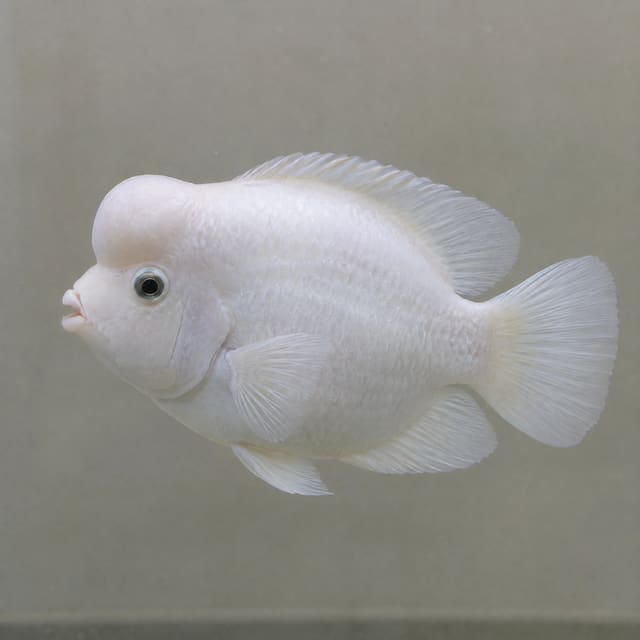
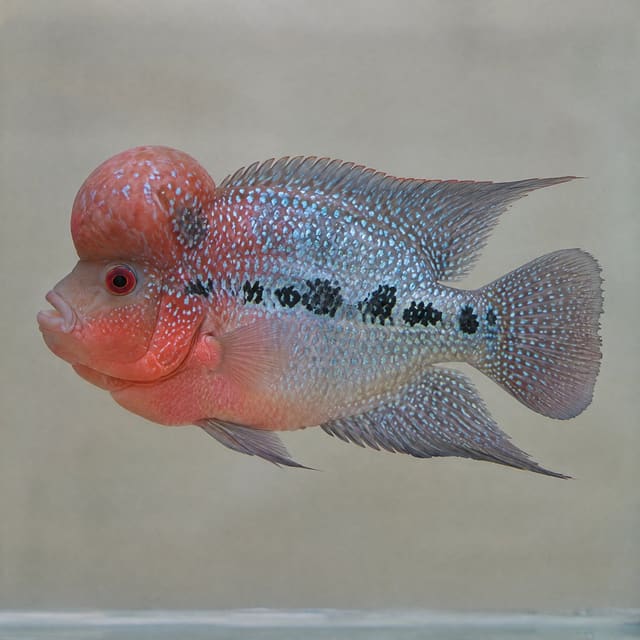
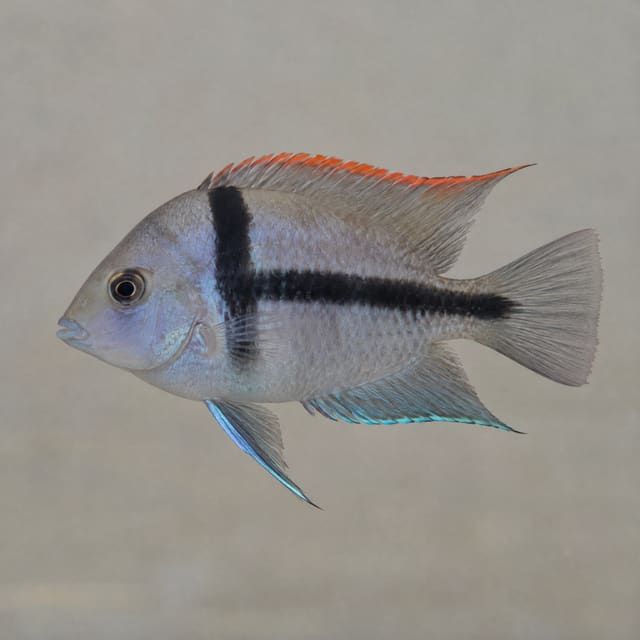
One live Golden Peacock Bass of about 5–6 cm. It is a juvenile, it cannot be sexed, and its colours will differ from the adult in the photographs.
No reviews for this item yet. Bought one? Honest reviews only, good or bad.
What customers say about ordering from us
Easy website plenty of info on fish your buying great to pick a time slot
TRACEY DURRANT · 7 Oct 2026
Got some lovely fish thank you
Kevin Mackie · 7 Oct 2026
Reviews of our shop, collected by Judge.me, an independent third-party review collector. Newest first.
Moved by UK carriers licensed to handle live animals
Hand-packed with oxygen bags, poly box, heat pack
Email photos the same day; an optional unboxing video helps us review problems faster — claim terms apply
Klarna & PayPal Pay in 3 at checkout