Cichlasoma flowerhorn
22–27°C · pH 6.5–8
£24.99

The Flowerhorn Cichlid (Flowerhorn (hybrid)) is an ornamental cichlid hybrid that emerged on Malaysia’s aquarium market in the late 1990s. It suits advanced keepers planning mature filtration, 22–27°C, pH 6.5–8.0 and 4–12°dH under OATA’s American-cichlid group guidance, with a one-fish starting plan. Sold individually in sizes from 7–9 cm to 15–18 cm.
Flowerhorn (hybrid)
The Flowerhorn Cichlid (Flowerhorn (hybrid)) is an ornamental cichlid hybrid that emerged on Malaysia’s aquarium market in the late 1990s. It suits advanced keepers planning mature filtration, 22–27°C, pH 6.5–8.0 and 4–12°dH under OATA’s American-cichlid group guidance, with a one-fish starting plan. Sold individually in sizes from 7–9 cm to 15–18 cm.
Cichlids are a family of roughly 1,800 accepted species, not one care type. Before buying, identify the exact species and source, then compare adult measurement, usable tank dimensions, social system, territory, tested water, diet and an exit plan. No family-wide minimum tank, water range or tank-mate list is safe.
Maintain these water conditions for optimal health and vibrant colors
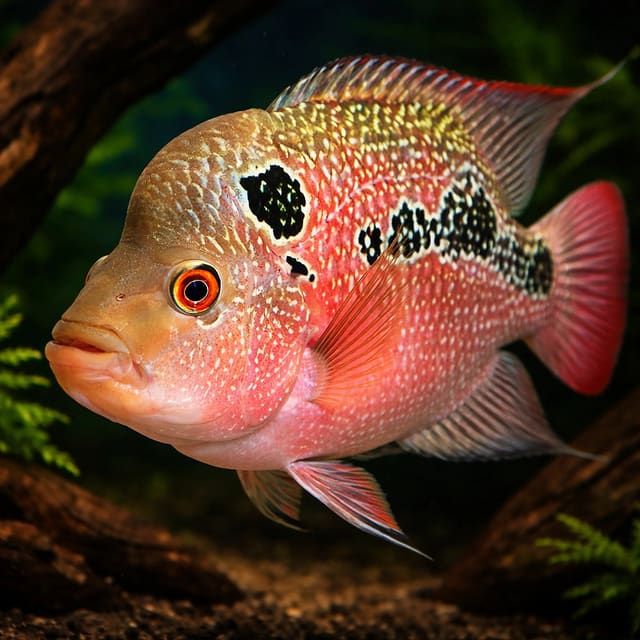
The Flowerhorn Cichlid is an ornamental aquarium-bred cichlid hybrid known for vivid colours and the rounded forehead that gives the fish its name. That forehead growth is formally called a nuchal hump. Big Head Flowerhorn and Flower Horn are also familiar trade names for the same type of hybrid.
It suits an advanced keeper prepared to plan long-term space, mature biological filtration, measured water management and individual compatibility screening. Begin with a one-fish aquarium rather than treating this hybrid as an automatic community choice.
The Flowerhorn Cichlid history summary places its first appearance on the Malaysian aquarium market in the late 1990s. It became a widely kept ornamental fish in Asia, Europe and the United States. Its identity comes from selective aquarium breeding rather than one naturally occurring species or one wild river population.
One purchase supplies one animal in the size selected. Use the live size selector to choose 7–9 cm, 10–15 cm or 15–18 cm. The size you select is the size supplied, not the adult size.
These measurements are practical arrival sizes. They help you judge whether the aquarium, net, transport container, filter protection and existing occupants are appropriate on introduction day. They are not a promise that growth stops at the upper figure shown in the selector. Measure the fish itself after it has settled and review its space as its body length and turning circle increase.
| Size | Planning decision |
|---|---|
| 7–9 cm | Prepare for growth rather than treating a smaller dispatch size as a permanently small fish. |
| 10–15 cm | Check the aquarium has clear turning room and an upgrade plan before the fish passes 15 cm. |
| 15–18 cm | Apply the American-cichlid guidance for fish over 15 cm from the start. |
This is a hybrid rather than a wild species, so the care advice here follows its parent group. Colour, pattern, forehead shape and eventual proportions can vary between individuals, while water and routine decisions follow the wider American-cichlid framework given below.
Sex is guaranteed only when the selected option explicitly states male or female. This Flowerhorn Cichlid listing has no sex-guaranteed option. Colour, forehead size, body shape, dispatch measurement and gallery appearance must not be used as a sex promise.
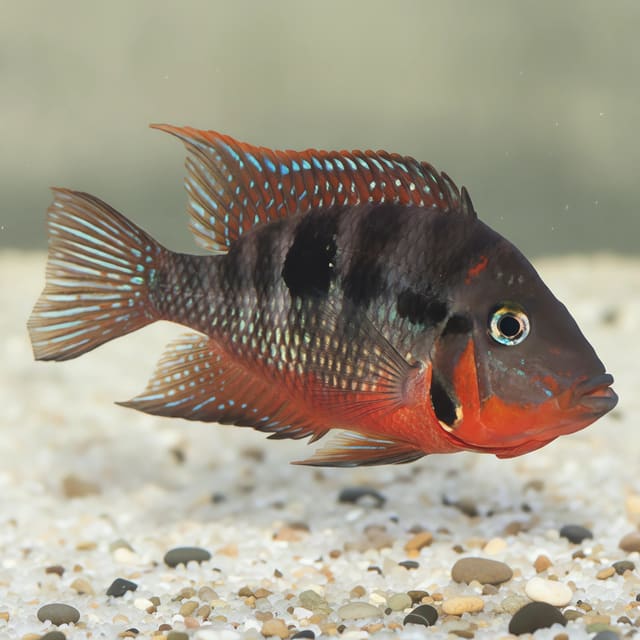
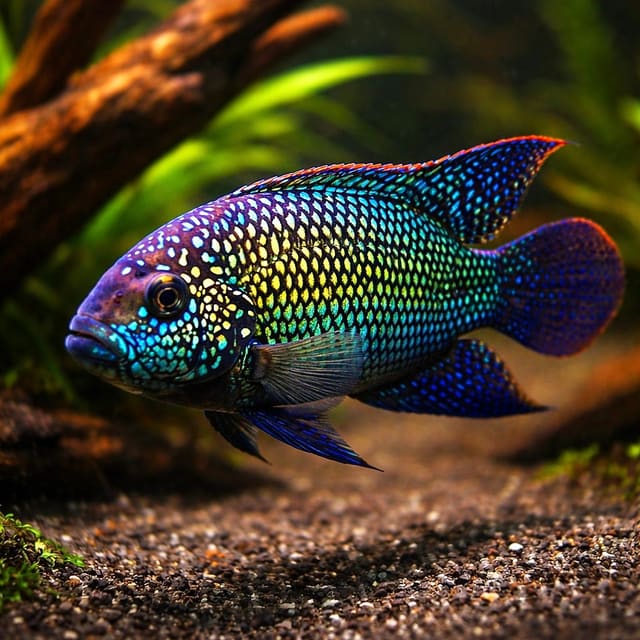
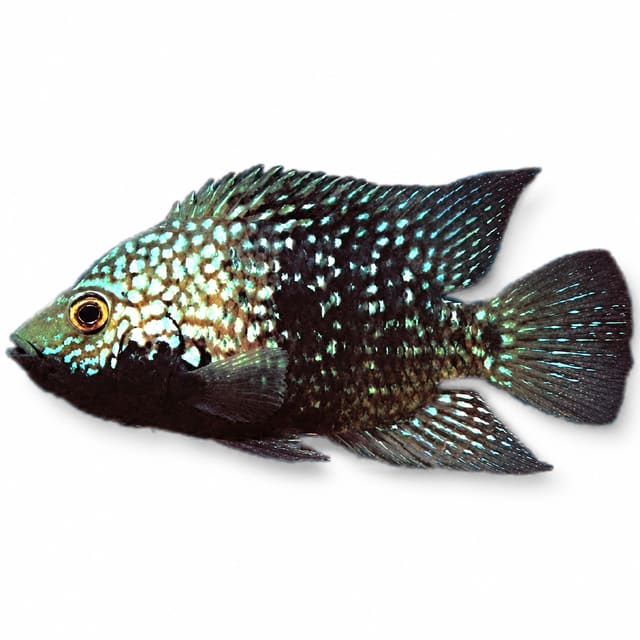
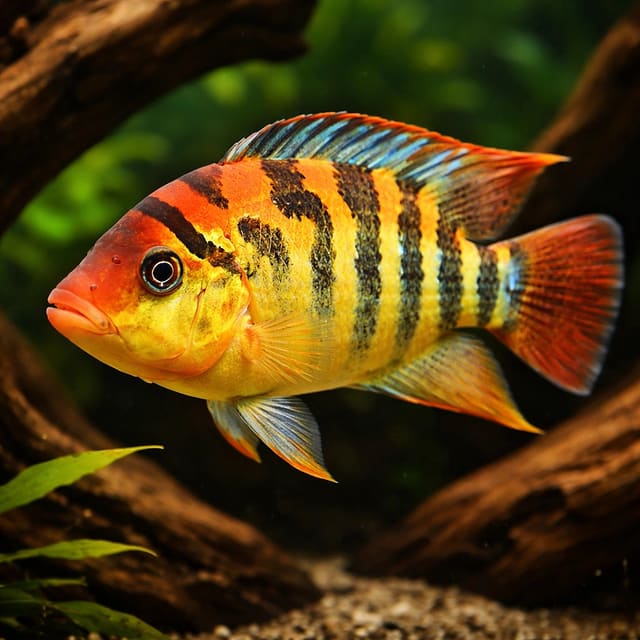
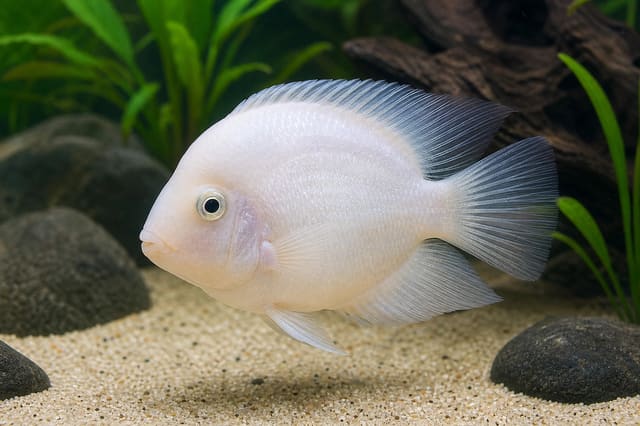
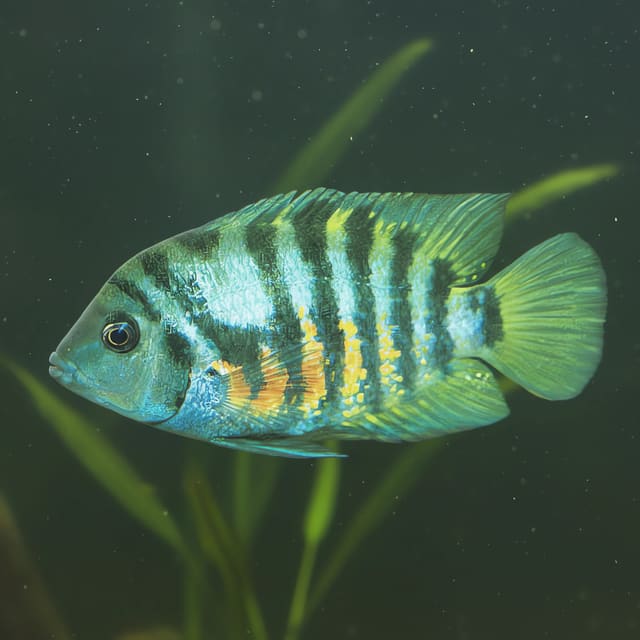
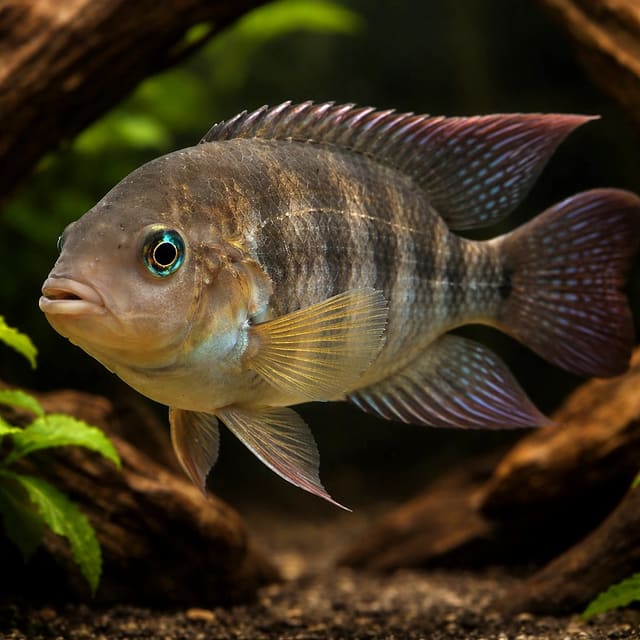
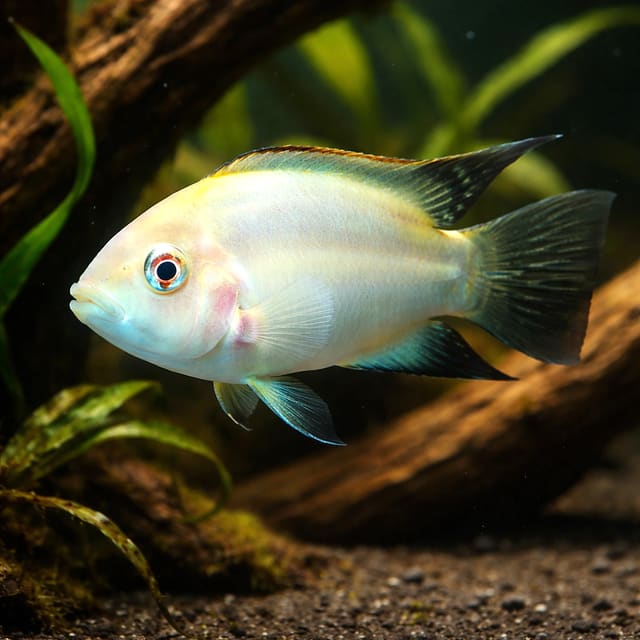
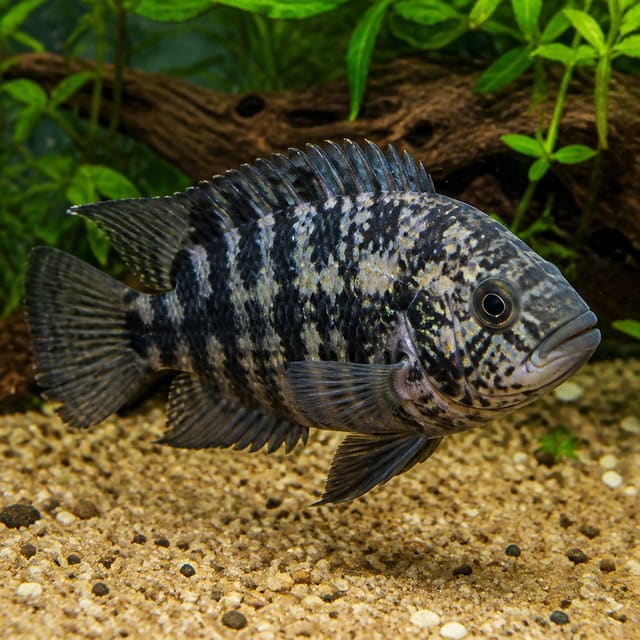
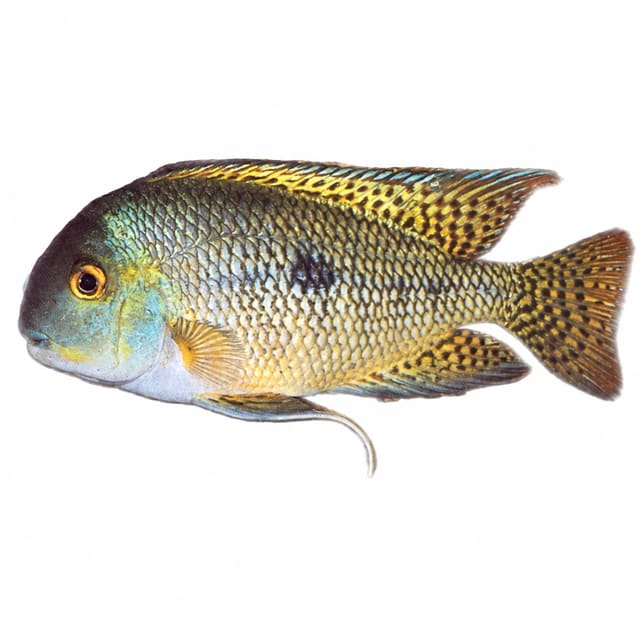
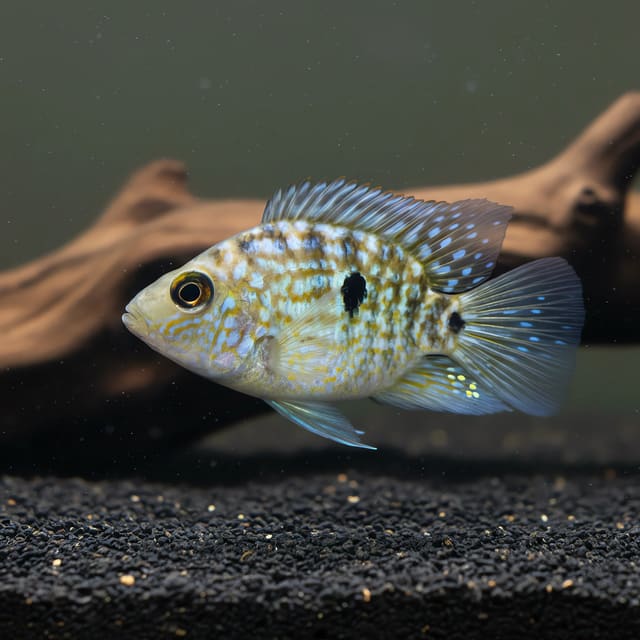
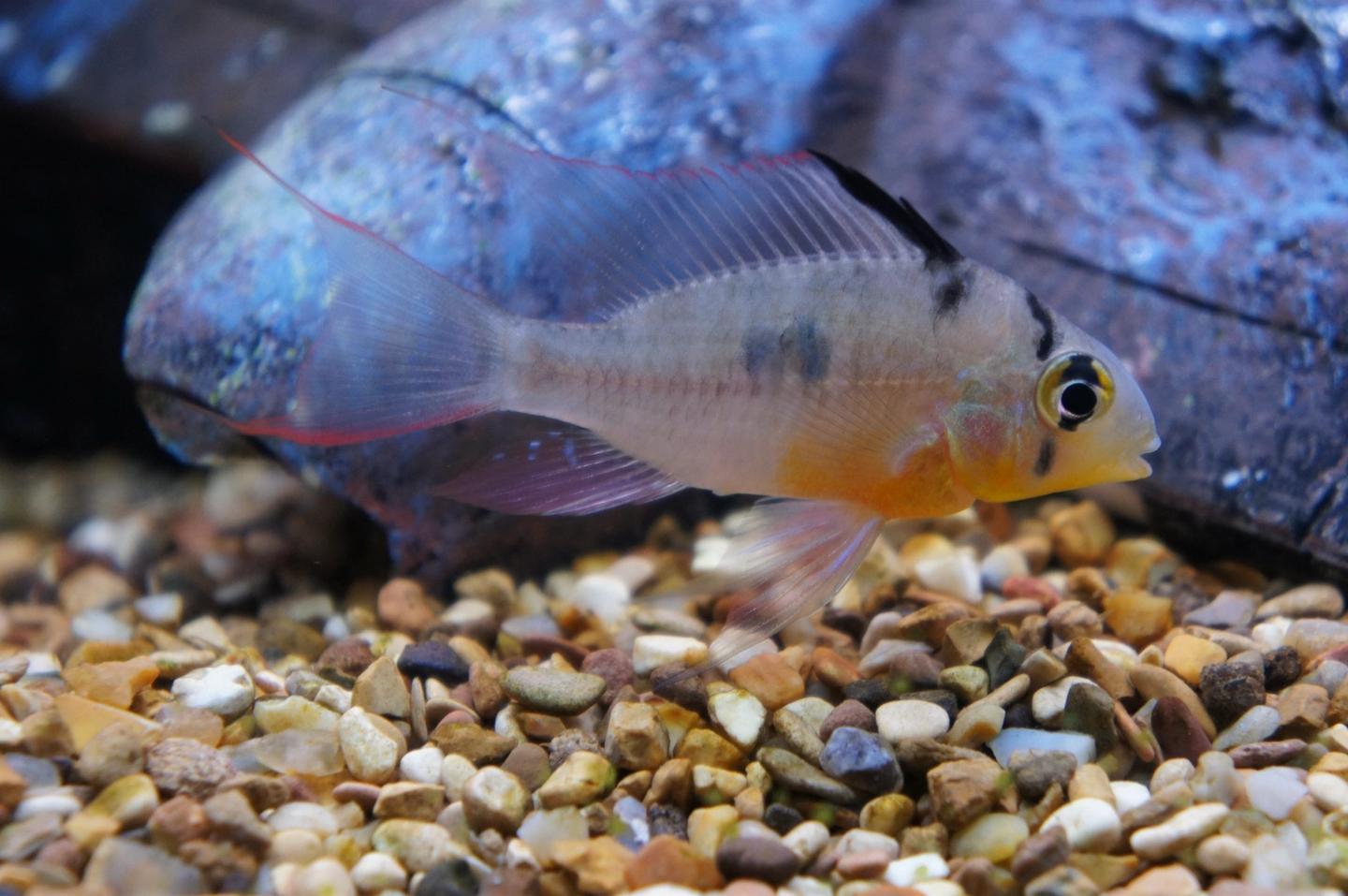
The gallery shows the characteristic deep cichlid body, red-and-white colour, black side markings and pronounced forehead associated with Flowerhorns. The gallery images are representative, based on reference photographs of this kind of animal, so colours can look slightly different from the live animal. Use the images to understand the general body plan and ornamental character, then judge the individual animal after arrival by its own markings, condition and behaviour.
Read the current delivery and Live Arrival Guarantee policy when planning the arrival day. It contains the current schedule, guarantee terms and claim route rather than fixing those changing details in this care description.
We rate this Flowerhorn Cichlid as an advanced choice because the keeper must combine long-term space planning, a mature biological filter, measured water management and individual compatibility screening. The routine itself is clear, but the fish should not be chosen for an unprepared aquarium or added casually to a mixed community.
The decisive water figures come from the American-cichlid parent group: 22–27°C, pH 6.5–8.0 and general hardness of 4–12°dH. Ammonia and nitrite must remain at zero milligrams per litre. Nitrate should stay no more than 20 milligrams per litre above the normal tap-water level. These values belong together with their group context rather than being treated as a uniquely optimised Flowerhorn formula.
Space is equally important. OATA recommends at least 300 litres for larger or more aggressive American cichlids over 15 cm. Apply that threshold immediately to a fish measuring more than 15 cm, and make it the upgrade checkpoint for a smaller selection. A larger aquarium gives the filter more water volume, provides more turning space and makes temperature and waste concentrations more stable.
| Suits | Not suited to |
|---|---|
| An advanced keeper prepared to mature and test a filtered aquarium | An unprepared aquarium with detectable ammonia or nitrite |
| A one-fish starting plan with long-term space available | Casual addition to a mixed community without compatibility screening |
| Water maintained at 22–27°C, pH 6.5–8.0 and 4–12°dH | An aquarium that cannot meet the over-15-cm group planning threshold |
Begin with a one-fish plan. American cichlids vary greatly in temperament, and mixing them can be difficult. A proposed companion must be assessed for its size, temperament, feeding behaviour and ability to use the aquarium without repeated chasing or exclusion. If that level of monitoring and contingency space is not practical, keep the Flowerhorn as the sole fish.
You can also browse the American cichlid collection to compare body sizes and care commitments, but collection placement does not make two fish compatible.
OATA’s American-cichlid guidance recommends at least 300 litres for larger or more aggressive members of the group over 15 cm. Treat this as a planning threshold for the Flowerhorn hybrid, not as a species-specific optimum. An aquarium greater than this threshold may be the more practical choice where body proportions, décor, filtration or behaviour reduce usable space.
Measure from the front of the head to the end of the body without counting assumptions about future growth. The dispatch size gives the starting bracket. Once the fish approaches 15 cm, confirm that its aquarium already meets the 300-litre threshold rather than waiting until movement becomes restricted. A 15–18 cm selection should enter an aquarium planned to that standard immediately.
Watch how the fish turns, feeds and patrols. It should be able to reverse direction without scraping décor or repeatedly folding its fins against the glass. Keep a clear route between resting, feeding and open-water areas. If increasing body depth or turning radius makes that route awkward, move the upgrade forward.
OATA also notes that larger aquariums produce more stable environmental conditions. Extra volume does not replace testing or water changes, but it slows abrupt concentration changes and gives the keeper more time to spot a developing problem. Choose the largest practical aquarium, then maintain it as carefully as a smaller one.
A well-set-up biological filter is essential before the Flowerhorn enters the aquarium. The RSPCA’s aquarium filtration guidance explains why: fish release toxic ammonia, beneficial filter bacteria convert it to nitrite, and another bacterial stage converts nitrite to the safer nitrate. Both ammonia and nitrite must be zero before introduction.
Prepare and mature the aquarium with the first tropical aquarium guide. Maturity refers to the established biological filter and aquarium, never simply to water that has stood for a few days. Test the system rather than judging it by clarity; clear water can still contain ammonia or nitrite.
| Checkpoint | Required action |
|---|---|
| Before the fish arrives | Confirm ammonia and nitrite both read 0 mg/L. |
| After feeding begins | Test at least weekly and respond promptly to any detectable ammonia or nitrite. |
| During maintenance | Check the filter for blockage and preserve its bacterial media. |
| When cleaning media | Rinse it lightly in removed aquarium water, not under the tap. |
Chlorine or chloramine in tap water may kill beneficial bacteria. Treat replacement water with a suitable tap-water conditioner before adding it, and never rinse established filter media directly under the tap. Avoid cleaning every piece of media aggressively at once; the aim is to restore flow while retaining the biological population that processes waste.
Increase the aquarium’s livestock load slowly. Every additional fish and every increase in feeding creates more waste, while the bacterial population needs time to respond. Adding too much too quickly can cause new tank syndrome, with ammonia and nitrite rising beyond what the filter can process.
A larger filter body or strong flow cannot compensate for immature media. Judge filtration by stable test results, unobstructed operation and the fish’s condition rather than by equipment size alone.
Use 22–27°C, pH 6.5–8.0 and 4–12°dH general hardness as the routine American-cichlid range. Carbonate hardness guidance for the group is 3–10°dKH. Stability inside these bands is more useful than repeatedly adjusting the aquarium towards one edge of the range.
Before choosing a target, test the tap water and the established aquarium. The water chemistry guide explains what each measurement means, while the water matcher lets you compare measured aquarium values with the stated range. Use actual test results rather than estimating hardness from postcode or assuming that clear water is suitable.
| Measurement | Action point |
|---|---|
| Ammonia | Keep at 0 mg/L. |
| Nitrite | Keep at 0 mg/L. |
| Nitrate | Keep within 20 mg/L above the normal tap-water level. |
| Temperature | Keep within 22–27°C and investigate unexpected movement. |
Record results at least weekly. A short log makes gradual changes visible and separates a one-off reading from a trend. Include the aquarium temperature, ammonia, nitrite, nitrate, pH and the date of each water change. Recheck hardness when the source water changes or repeated adjustments alter the aquarium’s chemistry.
If a reading moves outside the working range, check the measurement again, inspect the filter for blockage, look for uneaten food and review the recent stocking or feeding change. Correct the cause steadily rather than making an abrupt chemistry swing. Replacement water must be conditioned for chlorine or chloramine before it enters the aquarium.
Temperature equipment should hold the chosen point consistently within the 22–27°C band. Place the thermometer where it gives a useful aquarium reading rather than directly beside the heater, and compare its reading whenever the fish’s breathing, feeding or swimming changes.
OATA recommends fine aquarium gravel or sand for American cichlids because many members of the group dig or sift the substrate while feeding or breeding. Choose an aquarium-grade material with a manageable depth, then include the substrate in every weekly siphoning decision. Waste trapped between grains still contributes to the filter’s workload.
American cichlids may dig up or eat live plants. Treat planting as optional cover rather than essential filtration or a permanent fixed feature. Artificial plants can provide cover without relying on roots remaining buried. Whatever form of cover is used, leave enough clear space for the fish to turn and enough access for a siphon to reach settled waste.
Expect a cichlid to interact with the substrate. If digging repeatedly piles material against equipment or blocks water movement, level the affected area and simplify the arrangement. The layout should make routine correction easy rather than relying on the fish leaving every object untouched.
Do not use decoration to compensate for insufficient aquarium volume. Dense objects reduce real water capacity and divide the floor into spaces the fish may not be able to use. Begin with a simple arrangement, observe the routes the animal chooses, and retain only structures that provide cover without obstructing movement or maintenance.
Inspect fins, scales and swimming after any rearrangement. If the fish begins rubbing against a feature, struggling to turn or remaining confined to one part of the aquarium, remove or reposition the obstacle and reassess the usable space.
American cichlids are generally omnivorous and often prefer meaty foods. Use a specialised cichlid pellet or granule as a practical base, supplemented with suitable frozen or freeze-dried items. This is parent-group feeding guidance for the Flowerhorn hybrid, so portion size should follow the individual fish’s mouth size and feeding response.
OATA lists daphnia, brine shrimp and bloodworm for smaller American cichlids, while larger members of the group may take cockles, lancefish or prawns. Select pieces the Flowerhorn can take cleanly rather than offering oversized food that is mouthed, dropped and left to decay. Alternate appropriate items instead of increasing the total amount merely to create variety.
| Decision | Practical rule |
|---|---|
| Frequency | Feed once a day. |
| Portion | Offer only what is eaten within a few minutes. |
| Leftovers | Remove uneaten food before it breaks down. |
| Adjustment | Reduce the next portion if food repeatedly reaches the substrate. |
A strong feeding response is not permission to continue adding food. American cichlids can consume a large amount in one sitting, and excess food becomes faeces or decomposing waste. That extra load can raise ammonia and nitrite, increase nitrate and make weekly maintenance less effective.
Observe the complete meal. Food should be found, taken and swallowed without prolonged difficulty. A sudden reduction in interest is a health checkpoint, while frantic begging immediately after a suitable portion is not proof that another meal is required. Keep the schedule consistent enough that changes are easy to recognise.
Review feeding against the water log. If nitrate rises faster, debris accumulates between maintenance days or uneaten pieces appear, reduce the portion before adding filtration or increasing water-change volume. The correct portion is the smallest amount that is fully consumed within the few-minute window while the fish maintains appropriate body condition.
Complete a 25% partial water change at least once every week. Use a siphon to remove solid waste from the substrate at the same time, especially around feeding areas, décor edges and other places where debris settles. Test results and visible waste determine whether the aquarium needs an earlier intervention.
Use removed aquarium water when filter media needs a light rinse. Do not run established media under the tap because chlorine or chloramine may damage the bacteria that convert ammonia and nitrite. Filter cleaning should restore reliable flow without stripping away the biological population.
Compare nitrate with the normal tap-water reading rather than viewing the aquarium number alone. The group target is no more than 20 mg/L above the tap-water level. If the difference grows from week to week, check portions, remove trapped organic debris and make sure the filter is unobstructed.
Weekly maintenance works best when the day and process stay consistent. A repeatable routine reveals trends in waste production and fish behaviour. Keep separate equipment for aquarium use, and ensure residues from household cleaning products cannot enter the water.
After refilling, watch the fish and equipment before leaving the aquarium. Confirm normal filter flow, stable heating and ordinary swimming. If a hose, intake or decoration moved during cleaning, restore a clear route and check that the fish cannot become trapped.
A healthy fish should have clear, bright eyes, intact scales, undamaged fins and swimming appropriate to its normal pattern. Learn this individual’s ordinary feeding response, colour, breathing rate, preferred resting places and level of activity. A change from its own baseline is more useful than comparing it with a gallery illustration.
| Change | First response |
|---|---|
| Surface hanging or bottom sitting | Test ammonia, nitrite, nitrate and temperature. |
| Erratic swimming | Check water values and inspect the layout for obstruction. |
| Faster or slower gill movement | Test the water and confirm filter operation. |
| Darker or paler colour | Review recent water, layout and social changes. |
| Reduced food intake | Remove leftovers and compare all weekly readings. |
| White spots, fluffy growths or damaged tissue | Record the signs and seek health guidance promptly. |
Also act on increased hiding, a marked temperament change, loss of fins or scales, ulcerations, bumps, and an increase or decrease in body condition. Do not respond by feeding more until the water and the reason for the change have been assessed.
When a health change concerns you, test the water quality and contact us with the aquarium volume, temperature, ammonia, nitrite, nitrate and pH readings. Include when the change started, whether the fish is eating and what changed recently. Those details support a focused next step without guessing from one symptom.
American cichlids vary widely in size and temperament, and OATA describes mixing them as difficult. Some group members may be very aggressive, while calmer examples can sometimes live in robust communities. That variation makes a single-fish aquarium the clearest starting plan for this Flowerhorn hybrid.
Do not read the two-fish gallery scene as a compatibility promise. It illustrates the general appearance of two Flowerhorns, while one purchase supplies one animal and each real compatibility decision depends on the individuals and aquarium. A pair should never be created merely because two fish fit within the nominal water volume.
| Question | Decision rule |
|---|---|
| Is the aquarium large enough? | Allow for the full usable space, territories, décor displacement and waste load of every fish. |
| How does each fish behave? | Reject assumptions based only on family, colour or a previous individual. |
| Can both fish feed? | Each animal must take an appropriate portion without being displaced. |
| Can they separate? | Repeated pursuit without a usable retreat requires intervention. |
| Is there a fallback aquarium? | Do not trial a combination without a safe separation plan. |
Group advice says more aggressive American cichlids need to be kept alone or considered only with equally aggressive cichlids. That statement is a warning about the difficulty of mixing the group, not a recommendation to combine this fish with any named species. Equal assertiveness can increase injury rather than create balance.
For a stocking and compatibility assessment, contact us when you know the aquarium’s dimensions and volume, the Flowerhorn’s measured size, every proposed companion’s identity and size, and whether a separate established aquarium is ready. Without that complete plan, keep one fish.
Compatibility is an ongoing observation, not a decision completed on introduction day. A combination that appears calm initially may change as feeding patterns, body size or use of territory changes. Check every fish at feeding time and during ordinary movement around the aquarium.
Rearranging décor may alter lines of movement, but it is not a substitute for adequate volume or physical separation. Do not keep repeating introductions when the same pattern of pursuit or exclusion returns. The welfare decision is to provide each fish with an aquarium where it can feed, swim and rest without continuing pressure.
Water quality also changes when another fish is added. Increase livestock slowly so the biological filter can respond to the greater waste and feeding load. Test ammonia and nitrite after the change and keep both at 0 mg/L. A socially calm combination still fails if the filter cannot process its waste.
No named fish is a universal Flowerhorn companion. Body size alone does not establish compatibility, and a bottom-dwelling habit does not prevent conflict. Apply the same screen to another cichlid, a differently shaped fish or an animal that occupied the aquarium first.
If no established fallback aquarium is ready, do not begin a trial. Dividing a tank may reduce usable space and does not automatically create two suitable environments. A one-fish display avoids that uncertainty and lets the aquarium be planned around the Flowerhorn’s measured growth, filtration and maintenance needs.
Plan around measured growth rather than the dispatch size. OATA recommends at least 300 litres for larger or more aggressive American cichlids over 15 cm, so use 15 cm as the checkpoint for that parent-group planning threshold.
Use a mature, biologically filtered aquarium and apply OATA’s threshold of at least 300 litres when the fish is over 15 cm. Choose more space when décor, equipment or the fish’s turning circle reduces the usable area.
Begin with one fish because OATA says American cichlids vary in temperament and can be difficult to mix. Consider another fish only after assessing space, feeding access, both individuals and a ready separation plan.
We rate it as an advanced choice because it needs long-term space planning, a mature biological filter, regular testing and individual compatibility screening. It is not a suitable addition to an unprepared aquarium.
OATA’s American-cichlid guidance recommends an appropriate cichlid pellet or granule with suitable frozen or freeze-dried foods. Feed once daily and offer only what the fish eats within a few minutes.
OATA’s American-cichlid group guidance gives 22–27°C, pH 6.5–8.0 and 4–12°dH general hardness. Keep ammonia and nitrite at 0 mg/L and nitrate no more than 20 mg/L above the normal tap-water level.
American cichlids vary in temperament, and some may be very aggressive. Begin with a one-fish plan, then separate fish if you see sustained chasing, feeding exclusion, repeated hiding, or fin and scale damage.
No named animal is a universal companion. OATA says more aggressive American cichlids must be kept alone or considered only with equally aggressive cichlids, but every proposed combination still needs individual screening and a prepared separation aquarium.
Someone must be present to receive the parcel. Start filming every delivery continuously while the parcel is still sealed, then record it being opened with the fish still inside the sealed bag. Float the bag for 20–30 minutes before releasing the fish, and never pour the bag water into the aquarium.
No reviews for this item yet. Bought one? Honest reviews only, good or bad.
What customers say about ordering from us
I have a small group of long finned mountain minnows. So was delighted to be able to order ten of this variety to increase the genetics in my tank . The ones I recieved are healthy but it’s to early to give a verdict on wether they are of a long finned type since they are small currently.
Gordon Walker · 23 Sept 2026
100% success travel and "installation". Pleased with quality of purchase. The Siamese fighter a bit "shy" so have not yet seen him at his best yet but looking good. Happy customer. GG
George E Garratt · 21 Sept 2026
Reviews of our shop, collected by Judge.me, an independent third-party review collector. Newest first.