Easy
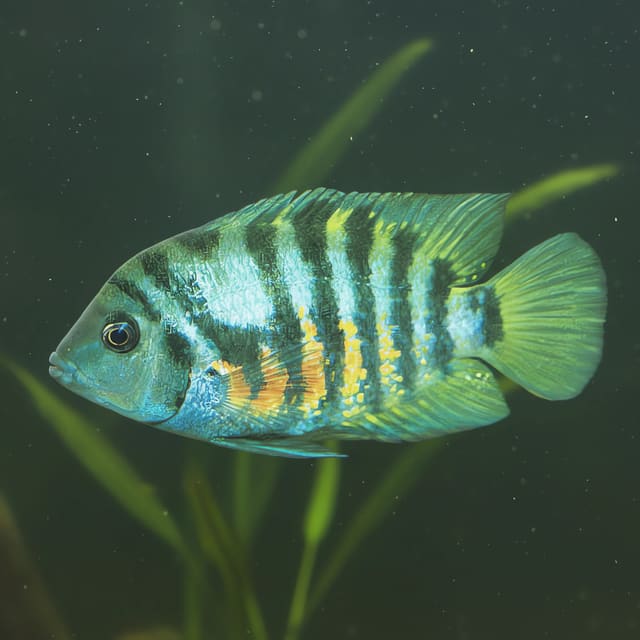
Electric Blue Acara (Andinoacara pulcher) – Neon Blue, 2–7cm Sizes
22–23°C · pH 6.5–8
£6.19
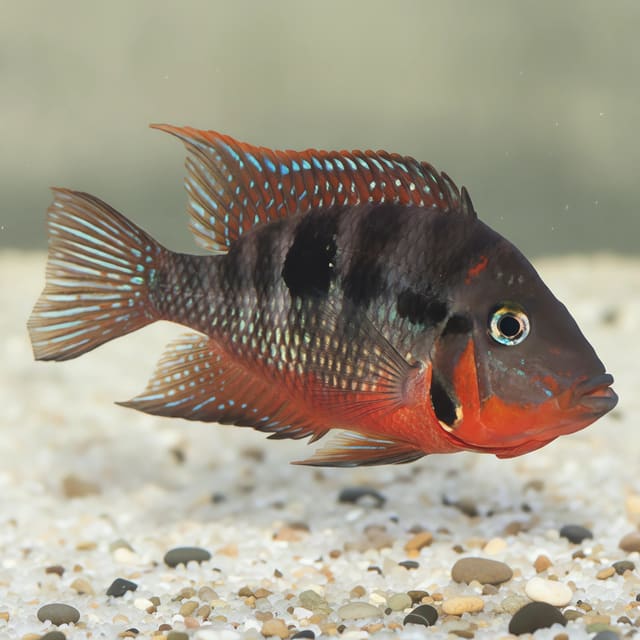
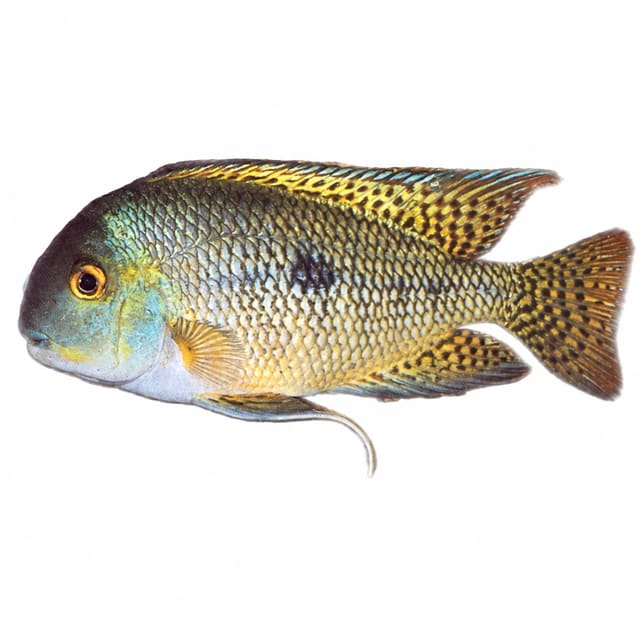
The Red Terror Cichlid, Festa's (Cichlasoma festae), is a freshwater cichlid from Pacific drainages of Ecuador and Peru that reaches 50.8 cm. It suits advanced keepers planning solitary housing or carefully screened robust companions, with 26–27°C, pH 7.0–8.0 and 4–12 dGH. Sold individually in sizes from 3–4 cm to over 15 cm.
Adult size is the maximum length this species reaches at full maturity (scientific sources). The livestock you receive will be younger and smaller — pick a size above for the actual shipping size. Product-photo provenance and any image-specific limitations are stated on the listing.
Cichlasoma festae
Save when buying multiple fish. Each quantity is one fish; sex and pair formation are not guaranteed unless the selected variant explicitly states them.
The Red Terror Cichlid, Festa's (Cichlasoma festae), is a freshwater cichlid from Pacific drainages of Ecuador and Peru that reaches 50.8 cm. It suits advanced keepers planning solitary housing or carefully screened robust companions, with 26–27°C, pH 7.0–8.0 and 4–12 dGH. Sold individually in sizes from 3–4 cm to over 15 cm.
Adult size is the maximum length this species reaches at full maturity (scientific sources). The livestock you receive will be younger and smaller — pick a size above for the actual shipping size. Product-photo provenance and any image-specific limitations are stated on the listing.

Cichlids are a family of roughly 1,800 accepted species, not one care type. Before buying, identify the exact species and source, then compare adult measurement, usable tank dimensions, social system, territory, tested water, diet and an exit plan. No family-wide minimum tank, water range or tank-mate list is safe.
Maintain these water conditions for optimal health and vibrant colors
The Red Terror Cichlid, Festa's (Cichlasoma festae), is a large freshwater member of the cichlid family, Cichlidae. It comes from Pacific drainages between the Esmeraldas River in Ecuador and the Tumbes River in Peru. FishBase records a maximum length of 25 cm. This is an advanced-keeper fish for a spacious, deliberately planned aquarium rather than a peaceful mixed community.
FishBase now lists it as Mesoheros festae. Adults inhabit varied natural biotopes in small to medium-sized rivers and feed on bottom-dwelling organisms such as small shrimps. That benthic feeding behaviour helps explain why the aquarium diet should centre on substantial meaty foods instead of being chosen only by the animal's bright trade name.
Temperament is the decisive consideration. Seriously Fish describes the Red Terror as very territorial and sometimes downright aggressive. Permanent housing must therefore account for the fish's territory, swimming room, digging and ability to treat animals that fit in its mouth as food. Browse our South American cichlid collection if you are comparing this demanding fish with other cichlids, but assess every species on its own adult requirements.
| Suits | Not suited to |
|---|---|
| Advanced keepers planning about 756 litres | Small or lightly built aquariums |
| Deliberate solitary or robust-fish planning | Peaceful community stocking |
| Secure rock and wood cover with swimming room | Delicate rooted planting |
| Keepers prepared for territorial behaviour | Animals that can fit in its mouth |
One purchase supplies one Red Terror Cichlid in the size chosen from the live selector. The selector includes 3-4 cm, 4 - 5 cm, 5 - 6 cm and > 15 cm. These labels describe the fish's dispatch length; they do not change the permanent aquarium plan.
The size you select is the size supplied, not the adult size. For example, selecting 5 - 6 cm means one fish in that dispatch grade, while its aquarium must still be planned around a maximum recorded length of 25 cm and the species' substantial space requirement. Do not use a smaller dispatch grade as a reason to postpone suitable filtration, stable water or long-term accommodation.
Sex is guaranteed only when the selected option explicitly states male or female. This Red Terror Cichlid, Festa's listing has no sex-guaranteed option.
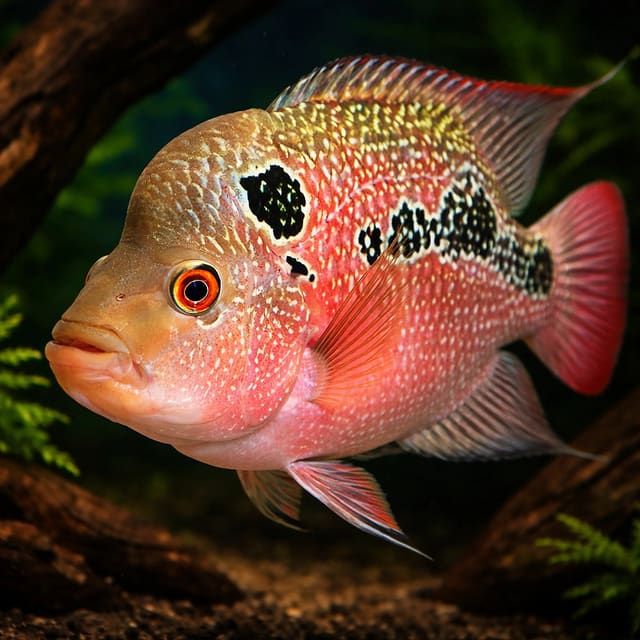
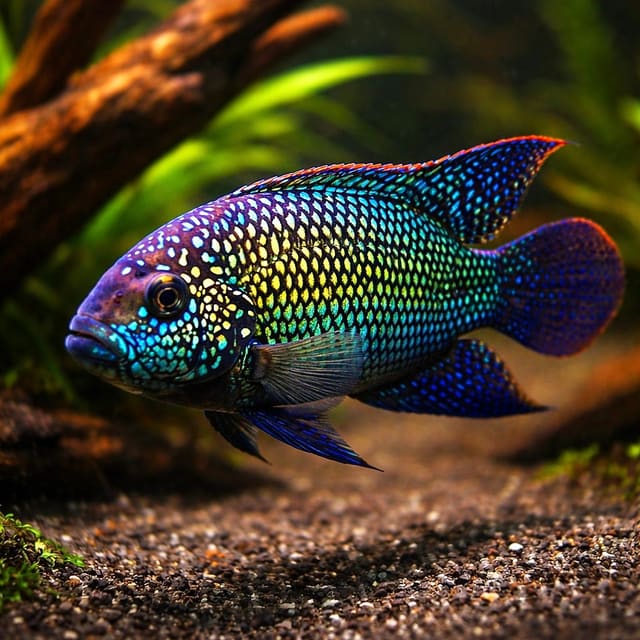
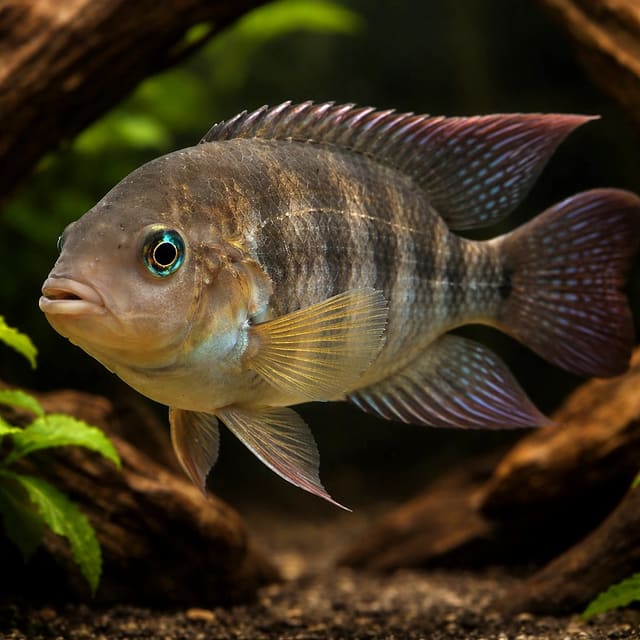
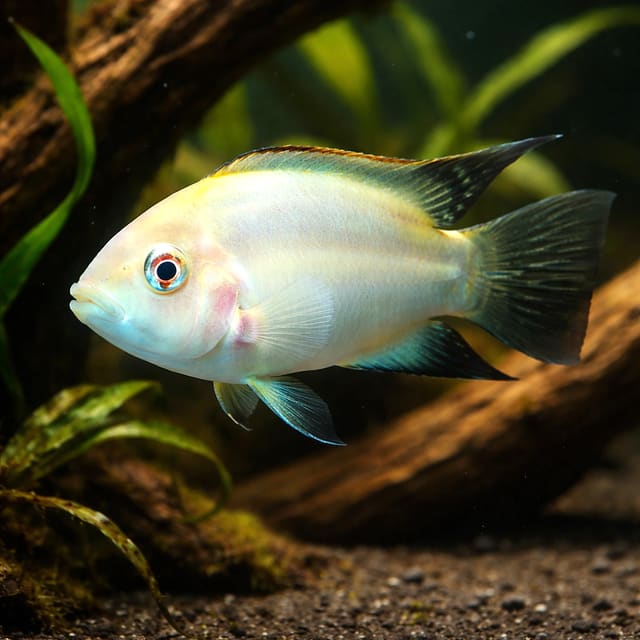
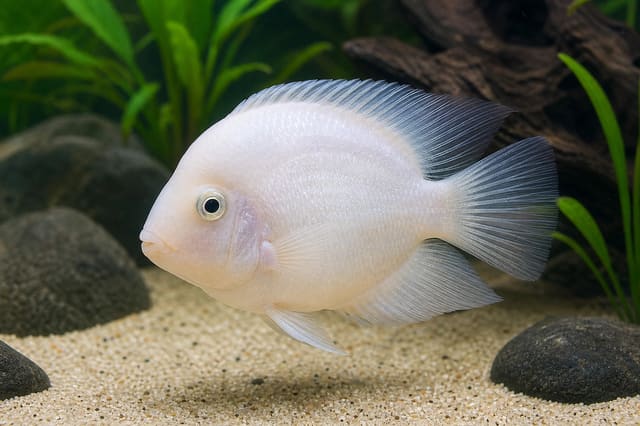
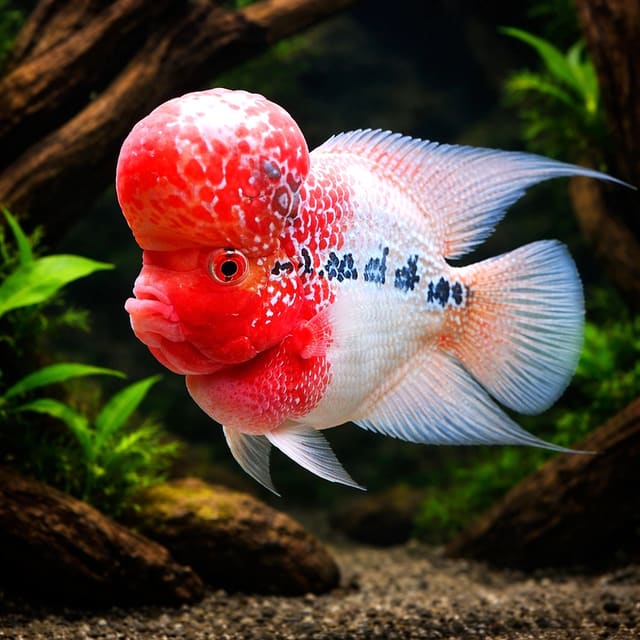
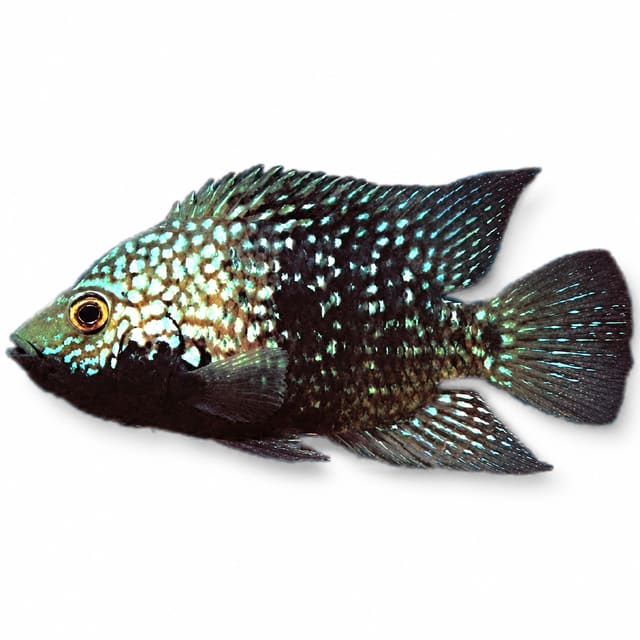
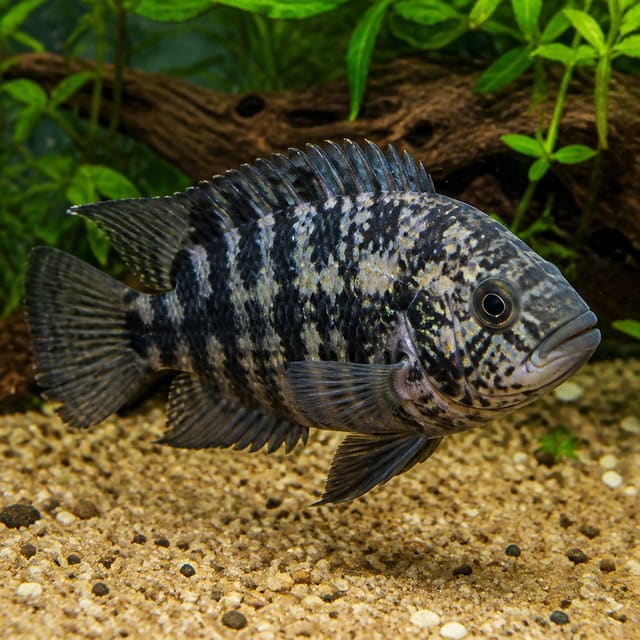
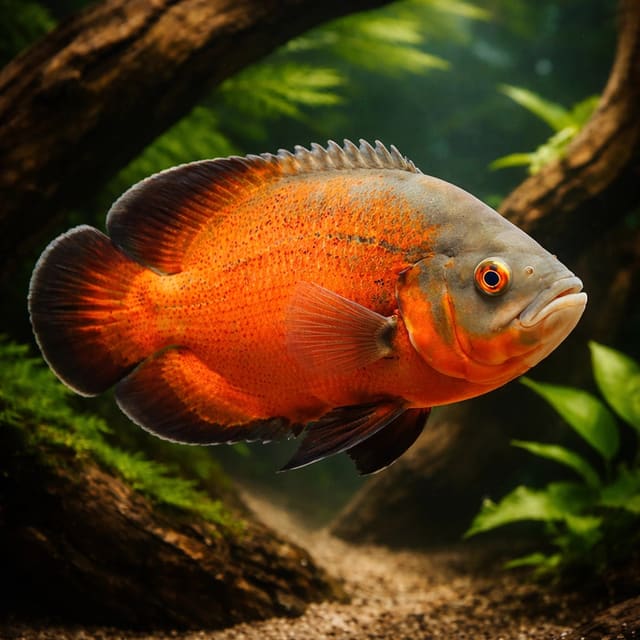
Some gallery images have been digitally enhanced to improve image quality. They show the listed type of animal rather than guaranteeing the exact markings of the individual supplied, so natural colour and pattern can vary.
A dispatch length is not a life-stage or origin statement. Choose it as a practical size measurement, while applying the same adult space, water and compatibility decisions to every grade.
Keep this fish at 26–27°C, pH 7.0–8.0 and 4–12 dGH. These routine values are the overlap of FishBase's environmental record, Seriously Fish's aquarium range and OATA's American-cichlid guidance. OATA's narrower figures are group guidance, not a species-specific optimum.
Plan an aquarium with a base of 210 × 60 cm and a volume of about 756 litres. Space is needed for swimming, stable rocks and wood, while the fish's digging means delicate rooted planting is a poor fit. Aquarium dimensions matter as much as nominal volume: the stated base gives a practical territory and swimming footprint instead of concentrating the volume in a tall, narrow shape.
Use a mature biological filter and keep ammonia and nitrite at zero mg/l. OATA advises nitrate should not exceed 20 mg/l above the normal level in the tap water. Test at least weekly and carry out a 25% partial water change at least once a week, treating replacement tap water before it enters the aquarium.
The main diet should be a large, high-quality meaty cichlid pellet, supplemented regularly with suitable substantial live or frozen foods. Feed only what the fish consumes within a few minutes, once a day. This supports feeding without allowing excess food to decay and add toxic waste to a heavily stocked biological system.
Provide about 756 litres with a base measuring 210 × 60 cm. Seriously Fish associates those dimensions with its long-term aquarium plan, making both footprint and volume important. A tank with the same volume but a much smaller base does not reproduce that swimming and territorial area.
Plan around the FishBase maximum of 25 cm total length. Seriously Fish uses 50.8 cm standard length in its aquarium planning profile, so its larger 210 × 60 cm footprint and approximately 756-litre recommendation provide the prudent housing reference. Do not reduce the permanent aquarium simply because the selected fish is dispatched at a smaller length.
Larger aquariums provide more stable environmental conditions, including temperature and water quality. That stability does not turn the Red Terror into a peaceful community fish; it simply gives you a better physical system in which to meet its care requirements.
The aquarium must be ready for the permanent fish from the beginning. Moving a territorial cichlid repeatedly between temporary tanks creates extra handling and does not remove the need for its final accommodation. Position the aquarium where its full filled weight and service requirements can be managed, then establish the filter and water conditions before arranging delivery.
Assess usable space after rocks, wood, substrate and equipment have been installed. The quoted tank volume is the aquarium plan, while bulky décor can take away swimming room. Favour a few stable, purposeful structures over a dense display of movable objects.
Maintain 26–27°C, pH 7.0–8.0 and general hardness of 4–12 dGH. Hold these values steadily rather than chasing rapid corrections. Test the source water and mature aquarium first; our water chemistry guide explains the values to measure, while the water matcher helps compare measured aquarium water with this range.
Ammonia and nitrite must each remain at zero mg/l. Keep nitrate no more than 20 mg/l above its normal tap-water level. These measurements provide an immediate check on whether biological filtration and routine maintenance are keeping pace with waste production.
The RSPCA explains that a working biological filter supports bacteria that convert toxic ammonia into nitrite and then into safer nitrate. Prepare and mature the system before livestock arrives; our first tropical aquarium guide provides a practical route through that preparation.
For an aquarium of about 756 litres, Seriously Fish uses a turnover of four to five times the volume per hour and describes two filters rated at 1,510–1,890 litres per hour each. Two appropriately rated units also spread circulation and filtration capacity across a long aquarium.
Its heating example uses roughly 175–275 W across four heaters for 25–29°C when the room is around 20°C. The routine target here is the narrower 26–27°C range. Check actual temperature with a thermometer and position equipment so the aquarium holds that range consistently.
Use stable rocks and pieces of wood to create cover while retaining plenty of swimming area. The Red Terror is a digger, so every heavy item must remain secure if substrate is moved from around its base. Place structural décor for stability rather than balancing it loosely on sand or gravel.
Fine aquarium gravel or sand suits the digging and sifting behaviour described for American cichlids. Keep enough open substrate for routine siphoning because solid waste and uneaten food can collect around rockwork. A visually dense arrangement is less useful than a layout that combines shelter, open movement and safe maintenance access.
Rooted plants are likely to be disturbed and may not last. Seriously Fish suggests floating plants or plants attached to wood or rock as alternatives. These choices keep roots away from the substrate and allow the main structures to be lifted or serviced only when necessary.
| Use | Avoid relying on |
|---|---|
| Stable rocks | Loose rock piles |
| Substantial pieces of wood | Delicate movable ornaments |
| Open swimming routes | Décor filling the entire base |
| Floating or attached plants | Delicate rooted planting |
Inspect the layout from the fish's level. A useful arrangement provides open passage around the aquarium, cover that does not collapse when the substrate is excavated, and clear access for removing waste. If a structure shifts during maintenance, make it secure before the fish is returned to that area.
Expect the aquarium's appearance to change as the fish digs. Build around that behaviour instead of repeatedly restoring a delicate aquascape. The safest layout accepts substrate movement while protecting equipment, structural décor and the usable swimming footprint.
Use a large, high-quality meaty cichlid pellet as the staple. Seriously Fish classifies the species as omnivorous but notes that scientific diet information points mainly to benthic aquatic crustaceans and other invertebrates, with fish fry, fruits and seeds also likely to be eaten. FishBase likewise records bottom-dwelling organisms such as small shrimps in the natural diet.
Offer substantial live or frozen foods regularly for variety. Seriously Fish names earthworms and mealworms, while OATA's guidance for larger American cichlids includes cockles, lance fish and prawns. Choose food pieces the individual fish can take cleanly and remove anything left uneaten.
Feed once a day and offer only what the fish consumes within a few minutes. Do not judge a portion by the cichlid's willingness to continue feeding: OATA warns that American cichlids can consume large amounts in one sitting and should not be overfed.
Uneaten food and excess faeces break down and release toxic waste. Portion control therefore protects the filter as well as the fish. A varied diet means using the supported meaty foods around a reliable staple, not feeding every item at every meal.
Match food size to the fish's present mouth while retaining the same nutritional direction as it grows. A smaller dispatch grade may require physically smaller pieces, but its recorded feeding biology does not become a different diet. Increase food size and quantity by observing consumption and body condition rather than by using the dispatch label as a fixed ration.
Carry out a 25% partial water change at least once every week. Use a siphon to remove solid waste from the substrate, especially around rocks and wood where debris settles. Treat replacement tap water with conditioner to remove chlorine or chloramine before adding it to the aquarium.
Test ammonia, nitrite and nitrate at least weekly. Ammonia and nitrite must remain at zero mg/l, while nitrate should not exceed 20 mg/l above the normal tap-water level. Record results consistently so a change is noticed before it becomes a persistent water-quality problem.
Check filters for blockages. If filter media needs cleaning, do not run it under the tap. Rinse it lightly in aquarium water removed during the partial water change, which reduces the loss of established beneficial bacteria.
A weekly change is the baseline frequency, not a reason to ignore a poor reading between scheduled maintenance days. If ammonia or nitrite rises above zero, or waste is collecting unusually quickly, investigate feeding, filtration and the aquarium load immediately.
Keep the swimming route clear when working. A large territorial fish requires deliberate maintenance movements and stable structures. Prepare the siphon, containers, conditioner and test equipment before reaching into the aquarium so the work can be completed without repeated disturbance.
Use changes in the results to guide investigation rather than adding products without identifying the problem. A blocked filter, excess food or accumulated debris calls for a direct correction to that cause. Stability comes from a mature filter, controlled feeding, regular testing and consistent partial water changes working together.
Prepare the aquarium, confirm 26–27°C and make sure ammonia and nitrite are zero before the parcel arrives. Keep the permanent stocking plan settled before introduction; adding several fish quickly can outpace the beneficial bacteria in a mature filter as feeding and waste increase.
The fish is hand-bagged in pure oxygen and packed in an insulated box, with a heat pack when the weather calls for it. A licensed live-animal courier carries the parcel. Read the current delivery and Live Arrival Guarantee policy before the delivery date so the receipt, filming and claim requirements are clear.
If anything has gone wrong, contact us the same day with the order number and the continuous unboxing video. The video must begin with the sealed parcel, show it being opened and show the fish inside the sealed bag before release.
Introduce the Red Terror only to the aquarium prepared for its permanent care. Do not combine its arrival with several additional fish. OATA warns that stocking too quickly can cause new tank syndrome when nitrifying bacteria cannot process the increased waste.
After release, observe swimming, breathing and posture without adding food merely to prompt activity. Use the fish's normal pattern over the following days as the comparison point for future checks. Keep the established water, filtration and compatibility plan steady while it settles.
Observe this fish every day and treat a change from its normal pattern as a reason to check the aquarium. OATA recommends watching swimming, colour, temperament, breathing, physical appearance, body condition and feeding. These signs are most useful when you already know how the individual normally behaves.
Start with measurements because even small amounts of ammonia can stress American cichlids. A zero result for ammonia and nitrite is the required condition, not merely a desirable target. Check the filter for blockages and confirm the maintenance routine has not been interrupted.
Do not interpret territorial activity as proof that water quality is good. Behaviour, appetite and appearance must be considered alongside test results. Equally, one quiet period should be compared with the fish's established routine before assumptions are made.
If you are concerned about a health change, test the water and contact us for further guidance. Provide the measured temperature, pH, ammonia, nitrite and nitrate, together with a clear description of swimming, breathing, feeding and visible changes. Concrete observations make the next decision more useful than a general statement that the fish looks unwell.
Plan solitary housing as the straightforward starting point. The Red Terror is very territorial and can sometimes be downright aggressive. OATA says aggressive American cichlids must be kept either alone or with equally aggressive cichlids, while Seriously Fish permits only similarly sized, similarly aggressive, robust fish.
Those words form a strict screening rule, not a general community recommendation. A candidate must match the Red Terror in size, aggression and physical robustness, share the stated water conditions and fit within the 210 × 60 cm base and approximately 756-litre plan after décor has been installed.
Anything the Red Terror can fit in its large mouth will be seen as food. At full size, Seriously Fish warns that this can include a 6-inch fish. Avoid any fish or invertebrate small enough to fit in its mouth; the same rule applies even when the animal is quick, brightly coloured or already established in the aquarium.
| Decision | Rule |
|---|---|
| Solitary housing | Preferred starting plan for territorial risk |
| Possible companion | Similarly sized, similarly aggressive and robust |
| Food risk | Avoid any animal that fits in its mouth |
| Another Red Terror | Treat as a high-risk pairing project |
Do not use a broad label such as “large cichlid” as the whole assessment. Species vary in aggression, body strength and behaviour, and individual cichlids can still be incompatible. A large aquarium provides necessary space but does not guarantee acceptance.
Before adding any companion, ask us for a stocking and compatibility assessment using the aquarium dimensions, current occupants and measured water. The honest decision may still be solitary housing. Never buy a proposed companion on the assumption that it can simply be removed later; permanent suitable accommodation is needed for every fish involved.
Treat another Red Terror as a high-risk pairing decision, not an automatic companion. Seriously Fish warns that if a pair is incompatible and housed together for any length of time, the weaker fish is likely to be killed. A shared species name does not establish compatibility between two individuals.
The species is a cave brooder and becomes highly territorial around reproduction. Sheltered areas, stable rocks and spawning pits can become defended locations. These behaviours increase the importance of space and observation, but décor cannot make an incompatible pair safe.
Do not transfer a condition from one pairing to the whole species. One apparently settled pair does not make other Red Terrors compatible, and one robust companion does not establish a universal tank-mate list. Screen each proposed combination against the same size, aggression, robustness, water and space rules.
Breeding plans require more than adding a second fish. Seriously Fish describes pairing problems as a major challenge and notes that the animal's size makes a suitable aquarium and breeding surfaces difficult to provide. Plan safe alternative accommodation before any attempt, because the weaker fish may need to be removed immediately.
For a display aquarium, one Red Terror avoids the specific danger of an incompatible same-species pair. It does not remove the need for the full 756-litre plan, stable cover, strong filtration and regular maintenance. Solitary describes the stocking choice, not a reduced standard of care.
FishBase records a maximum of 25 cm total length. Plan permanent housing around 25 cm; the dispatch length is not the mature length.
The Red Terror Cichlid, Festa's needs a base of 210 × 60 cm and about 756 litres, following the Seriously Fish aquarium plan.
Plan for one fish. The Red Terror Cichlid, Festa's is very territorial; OATA says aggressive American cichlids must be kept alone or with equally aggressive cichlids, and incompatible pairs may be fatal.
No. This is an advanced-keeper fish requiring about 756 litres, secure décor, controlled water quality and careful management of territorial aggression.
Feed a large, high-quality meaty cichlid pellet as the staple, with substantial live or frozen foods regularly. Offer only what it eats within a few minutes, once daily.
Keep it at 26–27°C, pH 7.0–8.0 and 4–12 dGH—the overlap of FishBase's environmental record, Seriously Fish's aquarium range and OATA's American-cichlid guidance.
It is very territorial and can sometimes be downright aggressive. Manage it as an aggression risk and do not place it in a peaceful community.
Only consider similarly sized, similarly aggressive, robust fish. Avoid any fish or invertebrate it can fit in its mouth, and treat another Red Terror as a high-risk pairing.
Start filming the sealed parcel before opening it or floating the bag. It is hand-bagged in pure oxygen, packed in an insulated box with a heat pack when weather calls for it, and carried by a licensed live-animal courier; receive it in person, inspect it that day, then float the bag for 20–30 minutes before releasing.
No reviews for this item yet. Bought one? Honest reviews only, good or bad.
What customers say about ordering from us
Easy website plenty of info on fish your buying great to pick a time slot
TRACEY DURRANT · 7 Oct 2026
Got some lovely fish thank you
Kevin Mackie · 7 Oct 2026
Reviews of our shop, collected by Judge.me, an independent third-party review collector. Newest first.