Expert
Azul Peacock Bass (Cichla piquiti)
£52.39
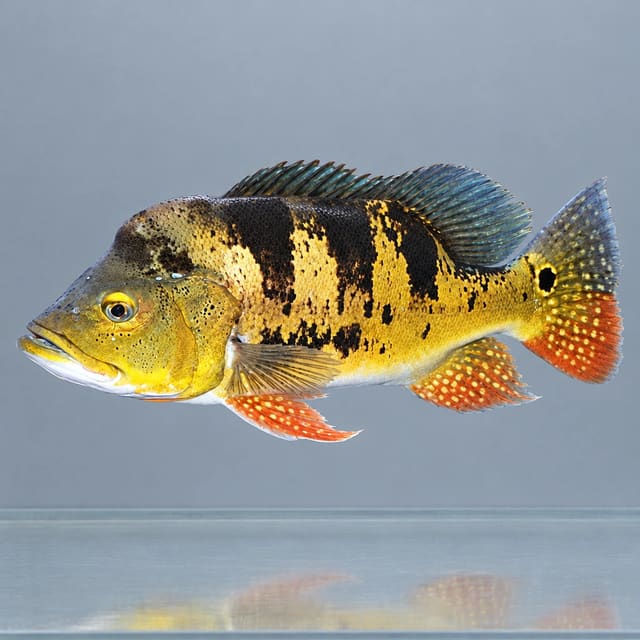
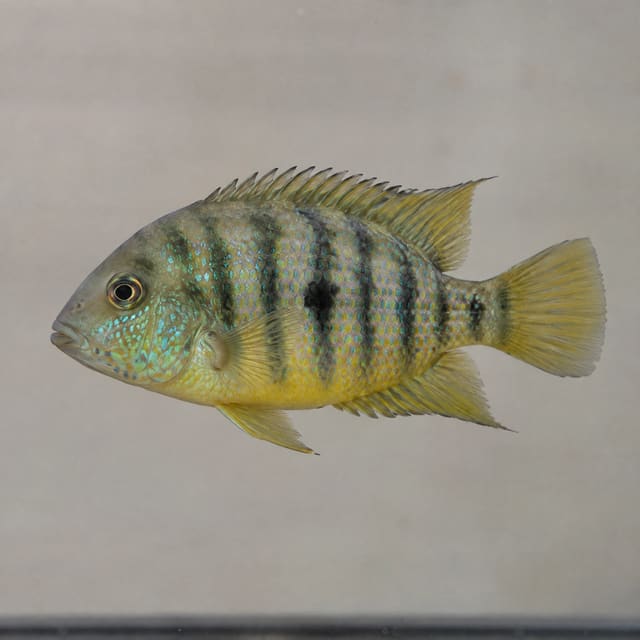
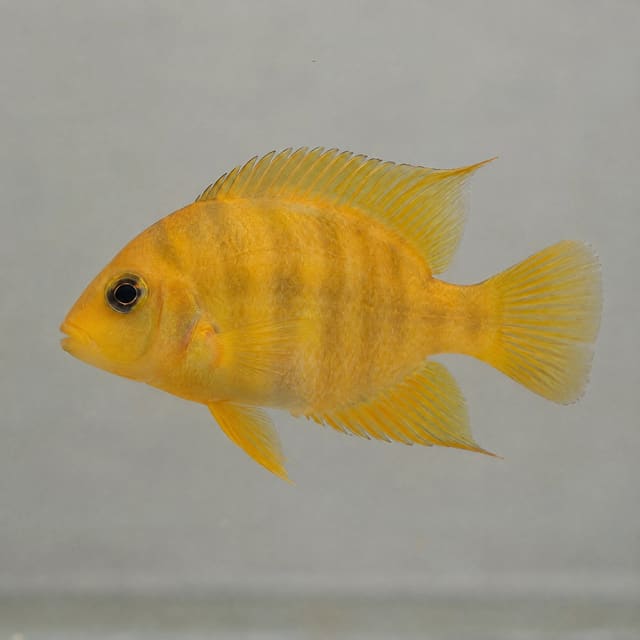
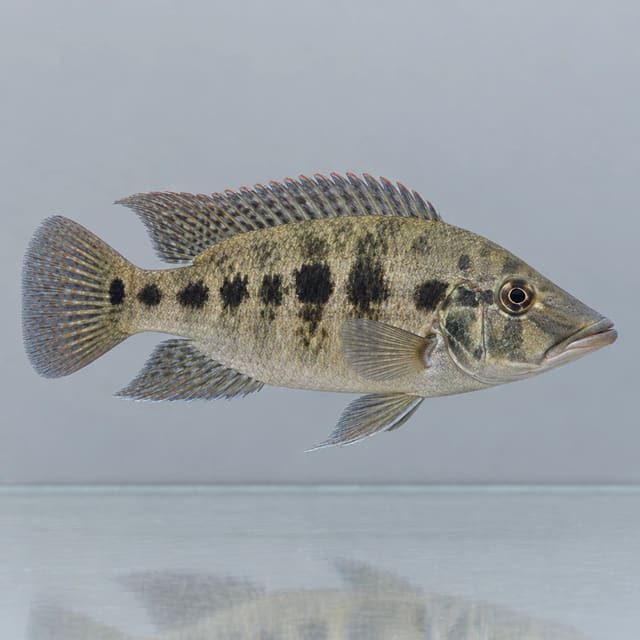
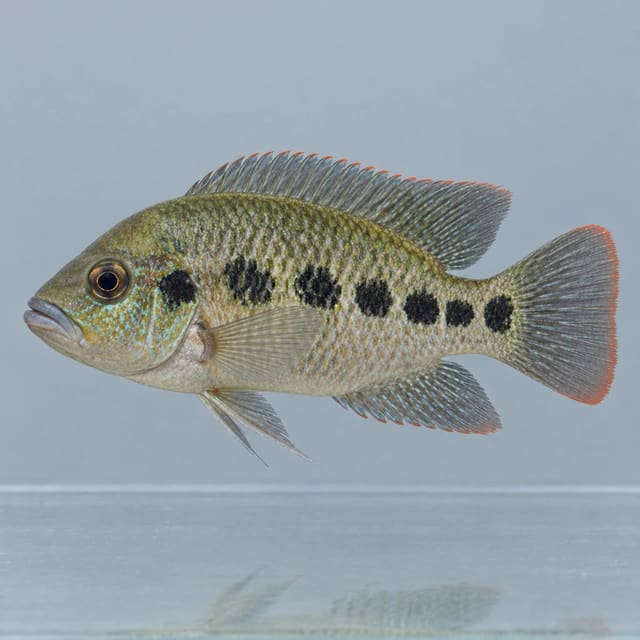
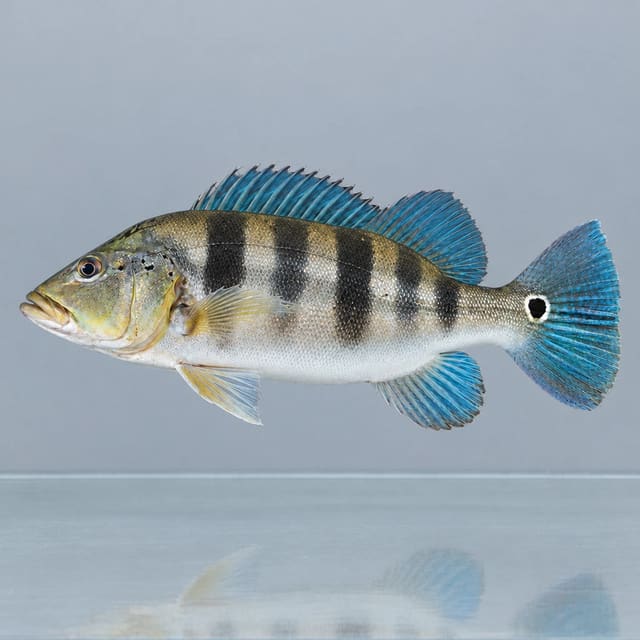
The Pinima Peacock Bass (Cichla pinima) is a large predatory cichlid from the lower Tapajós, Xingu, Tocantins and neighbouring rivers of Brazil. Young fish carry a dark stripe and rows of white spots; adults develop black, light-ringed blotches and bars. FishBase records 52 cm standard length, so it needs an aquarium of around 2,000 litres. Sold individually as one 5–6 cm juvenile.
Cichla pinima
The Pinima Peacock Bass (Cichla pinima) is a large predatory cichlid from the lower Tapajós, Xingu, Tocantins and neighbouring rivers of Brazil. Young fish carry a dark stripe and rows of white spots; adults develop black, light-ringed blotches and bars. FishBase records 52 cm standard length, so it needs an aquarium of around 2,000 litres. Sold individually as one 5–6 cm juvenile.
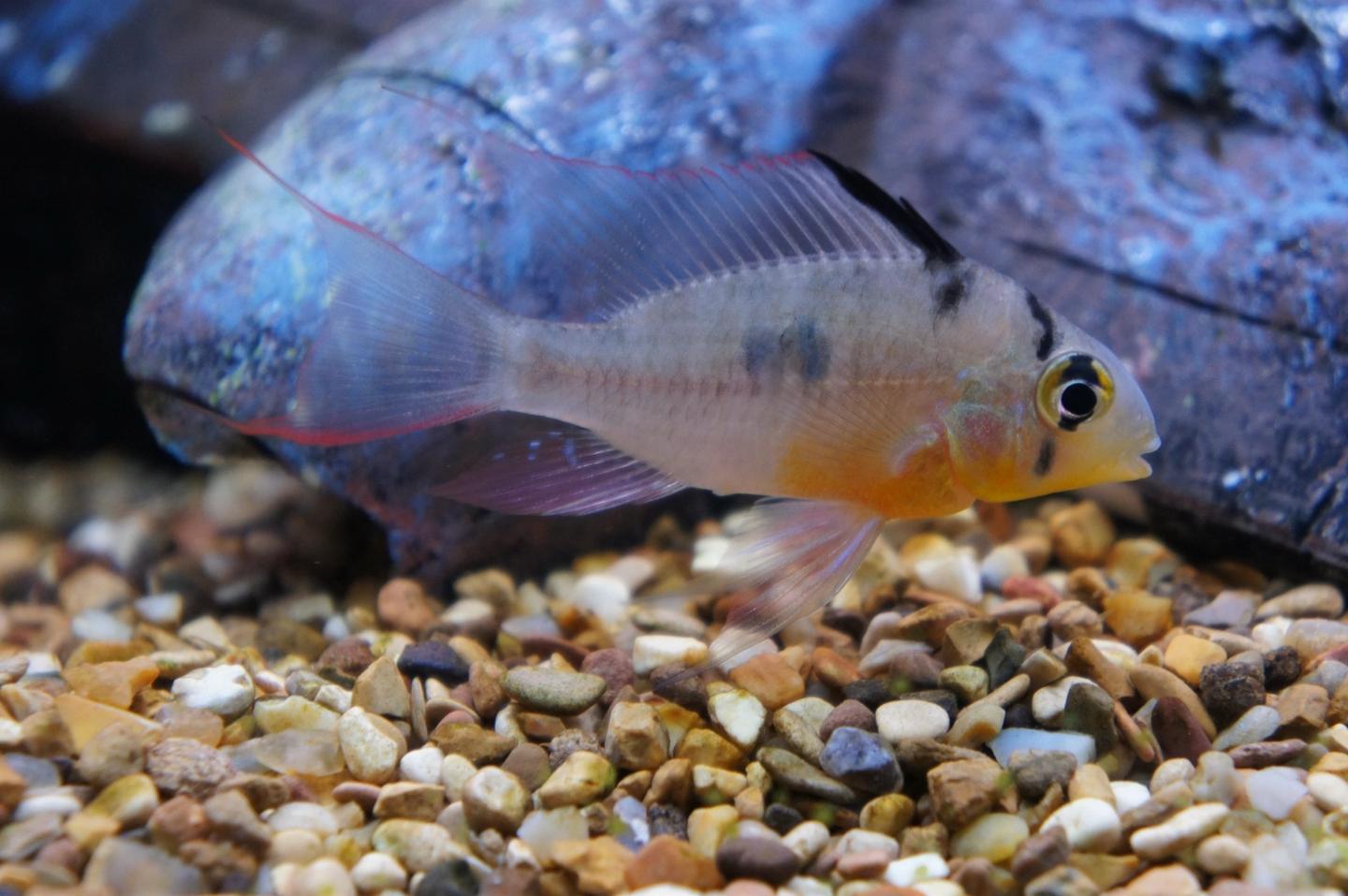
Cichlids are a family of roughly 1,800 accepted species, not one care type. Before buying, identify the exact species and source, then compare adult measurement, usable tank dimensions, social system, territory, tested water, diet and an exit plan. No family-wide minimum tank, water range or tank-mate list is safe.
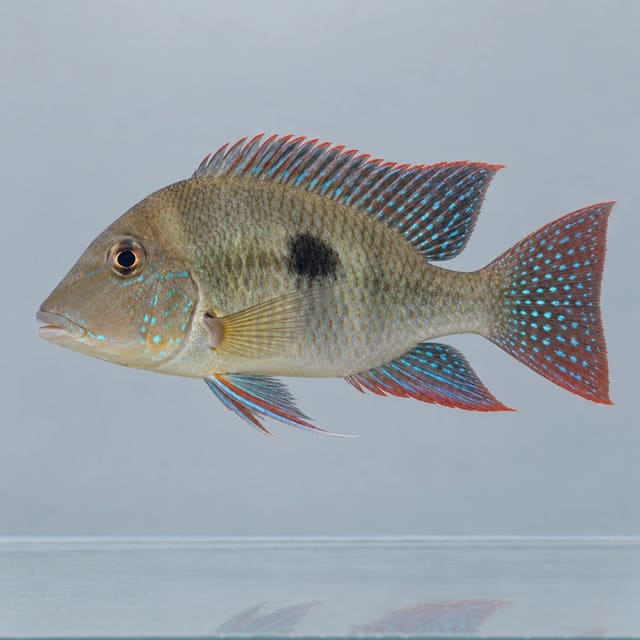
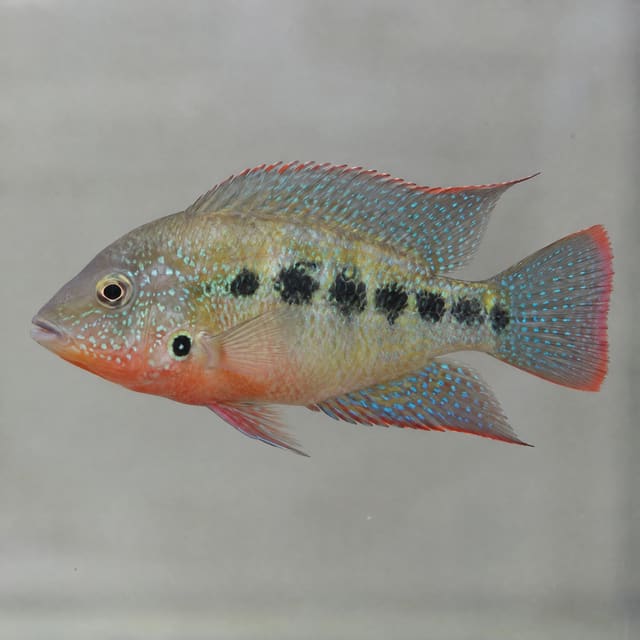
The Pinima Peacock Bass (Cichla pinima) is a large, fish-eating cichlid from the rivers that flow north into the lower Amazon in Brazil. Young fish are slim and greenish with a dark stripe and rows of small white spots; adults become yellow-green with black bars and black blotches ringed in white, including one high on the back that identifies the species. It grows to more than 50 cm, so this is a fish for keepers who already run, or are building, a very large aquarium.
Sven Kullander and Efrem Ferreira described the species in 2006 in their review of the genus Cichla. The name is a Tupi-Guarani adjective meaning "spotted with white", and the authors adopted tucunaré pinima, a name already used in Brazil, as its common name. They record it from the lower Rio Tapajós, the Rio Curuá-Una, where the type specimen was collected, the lower Rio Xingu, the lower Rio Tocantins and the Rio Capim. FishBase lists it as Least Concern on the IUCN Red List.
| Name | What it means |
|---|---|
| Pinima peacock bass | The trade name, from the species name |
| Tucunaré pinima | The Brazilian name, "spotted with white" |
| Cichla pinima Kullander & Ferreira, 2006 | The scientific name |
| Cichla temensis, C. ocellaris | Names under which this fish was recorded in older Brazilian literature |
Before 2006 this fish was usually lumped with other species. Kullander and Ferreira found that the peacock bass introduced into reservoirs of north-east Brazil in the 1940s, and studied there as C. temensis, was in fact C. pinima, which now forms self-sustaining stocks there. They place it in a group of closely related, white-spotted species with C. temensis, C. thyrorus, C. jariina and C. vazzoleri. That history of successful introductions is one more reason never to release an aquarium fish.
See our Monoculus Peacock Bass for a different Cichla, and browse our South American cichlids, the South American cichlid category, our centrepiece fish and our rare and collector fish.
One purchase supplies one live Pinima Peacock Bass of about 5–6 cm. It is a juvenile and cannot be sexed. The pinima changes more with age than most fish, so it helps to know the sequence Kullander and Ferreira describe:
| Size (standard length) | Typical pattern |
|---|---|
| About 20 mm | Yellowish white with a dark band from head to tail containing three round black blotches |
| About 40–60 mm | Faint vertical bars appear; a dark stripe crosses the soft dorsal fin |
| Below 100 mm | A blackish, ringed blotch appears high in the third bar, close to the dorsal fin |
| 100–200 mm | The side band stays distinct; rows of round white spots run along the body |
| 200–300 mm | Narrow dark bars, the ringed blotch in bar 3 and many white spots |
| From about 250 mm | Large black, white-ringed blotches and bars on the side in both sexes |
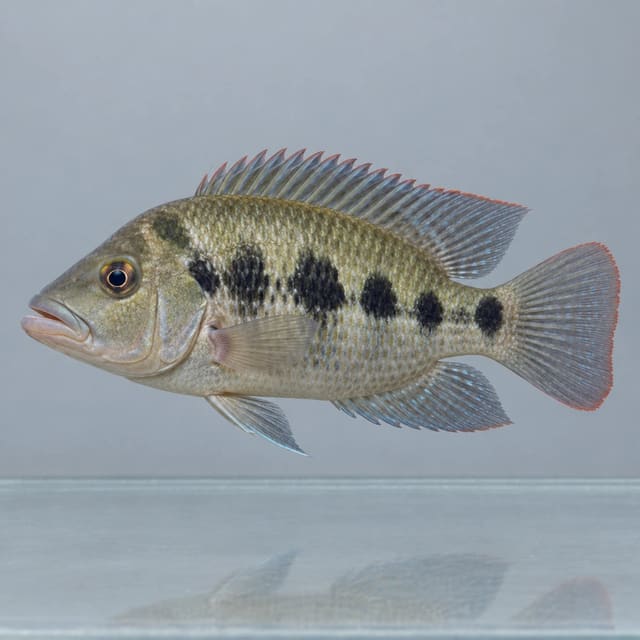
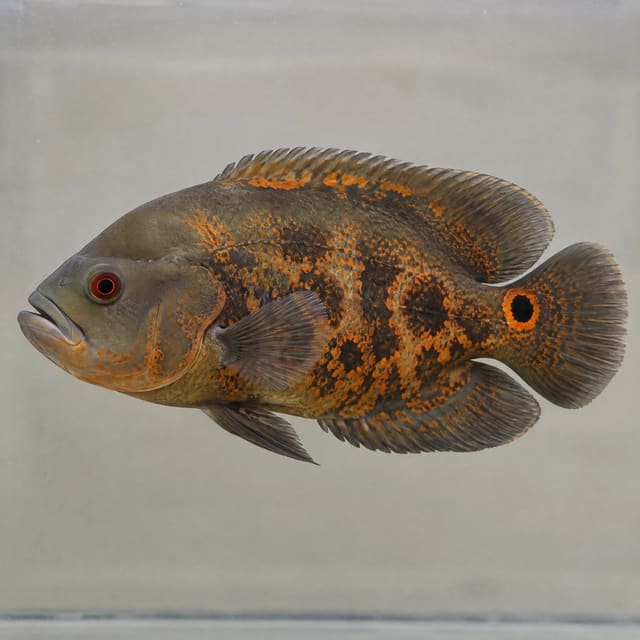
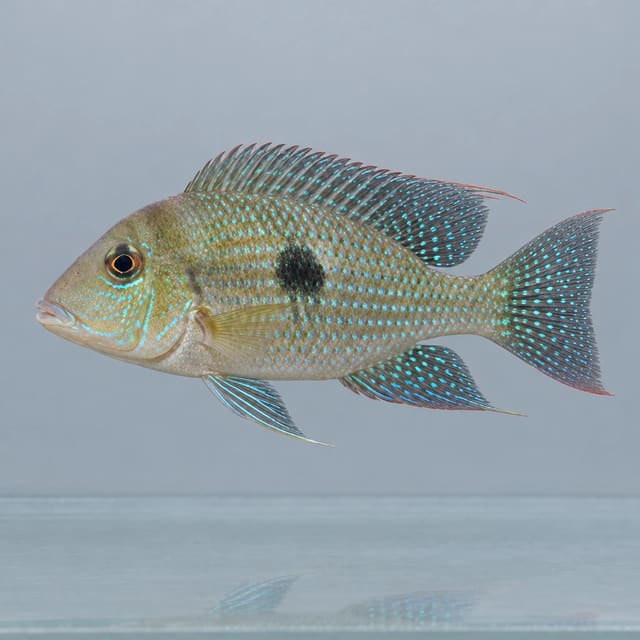
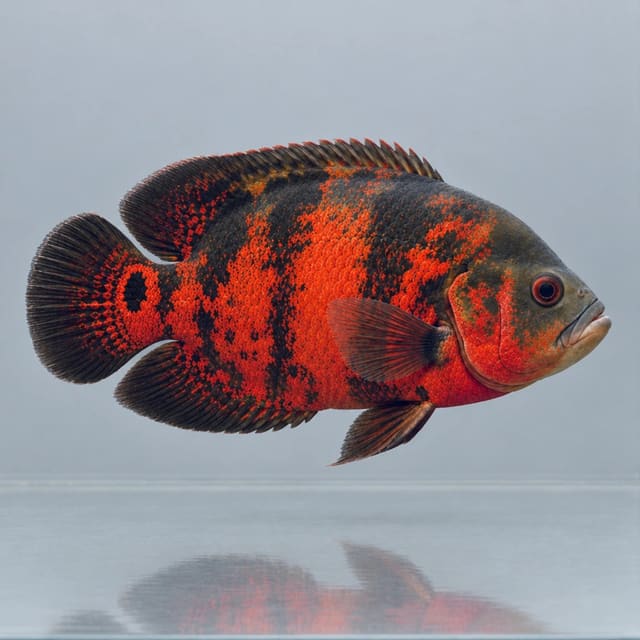
The adult photographs therefore show where your fish is heading, not how it will look on arrival. The authors describe live fish in the ringed pattern as yellow, strongest on the lower head, turning greenish on the back and tail base, with white underparts and sometimes an orange throat and yellowish lower fins. Young fish from the blackwater Rio Arapiuns, which the authors list as a tentative locality, were much darker than those from the Tapajós.
Before ordering, be sure an aquarium of about 2,000 litres is within reach, and read our delivery and Live Arrival Guarantee information.
FishBase records a maximum of 52.0 cm standard length, measured from the snout to the base of the tail; with the tail the fish is longer again. Kullander and Ferreira examined specimens up to 430 mm standard length and recorded the forehead hump in three fish of 260, 307 and 430 mm. Plan for an adult of 50 cm or more.
There is no published tank size for C. pinima. Seriously Fish says the Orinoco peacock bass, at about 60 cm the smallest species it profiles, needs at least 8 × 3 × 3 ft (length × height × width) as an adult: about 244 × 91 × 91 cm, roughly 2,000 litres. For C. ocellaris and the larger species it gives 10 × 3 × 4 ft. The Pinima falls between the two, so treat 8 × 3 × 3 ft as the floor for one adult and aim higher if you can.
Seriously Fish allows smaller tanks for young fish, but warns that peacock bass are often sold as small juveniles that tempt people into buying a fish they cannot keep long term. Grow it on in a mature tank only while the final system is on its way.
Seriously Fish recommends a sparse layout with plenty of swimming space, large pieces of bogwood and robust plants. Fishkeeper, a UK retailer's care library, suggests soft sand or a bare floor for easy cleaning, Anubias or Java fern grown on the wood, and stable rockwork bonded with aquarium silicone, because these fish can rearrange loose stones.
| Area | Purpose |
|---|---|
| Wide, uncluttered centre | Swimming and hunting space |
| Driftwood branches at the back | A retreat that breaks up the view |
| Robust plants on wood | Greenery that will not be uprooted |
| Sand or bare floor | Scraps are easy to see and remove |
| Sump-mounted heaters and a secure lid | Equipment out of harm's way |
Fishkeeper suggests keeping heaters in a sump, where a large fish cannot break them, and OATA recommends a secure lid for American cichlids.
No water values have been published for this species. The closest guides are other peacock bass: Seriously Fish gives 25–28°C and pH 6.5–7.5 for C. monoculus and 24–27°C with pH 6.5–7.0 for C. ocellaris, both with hardness up to 15 dGH; Fishkeeper gives 24–27°C, pH 6.5–7.0 and up to 15 dH; OATA's American cichlid range is 22–27°C and pH 6.5–8.0. We suggest 25–27°C and pH 6.5–7.5.
| Reading | Target |
|---|---|
| Temperature | 25–27°C |
| pH | 6.5–7.5 |
| General hardness | Up to 15 dGH |
| Ammonia | 0 mg/l |
| Nitrite | 0 mg/l |
| Nitrate | Low, and no more than 20 mg/l above your tap water |
Peacock bass are described by Seriously Fish as hardy and adaptable, so steadiness is the goal. Check your local tap water in our water matcher, and read our water chemistry guide and the article on tropical fish water pH. With several heaters in a big system, the guide to tropical fish tank temperature helps keep the reading even.
Fishkeeper calls peacock bass voracious eaters that produce a lot of waste and need continuously excellent water, powerful oversized filtration and good oxygen, ideally from a sump. It stresses that a frequent partial water change regime is absolutely essential, because these river fish will not tolerate raised nitrate. Seriously Fish likewise recommends external or sump filtration.
Seriously Fish's species profiles size filters at four to five times the tank volume every hour, which for 2,000 litres means about 8,000–10,000 litres per hour. Our article on understanding aquarium filtration explains sump design.
Seriously Fish describes peacock bass as piscivorous and recommends meaty foods such as prawn, mussel, lancefish, whitebait and other white fish. Fishkeeper suggests bloodworm, Mysis and chopped seafood for small fish, then earthworms, prawns, cockles, mussels, crab, crayfish and small whole fish, and lists cichlid pellets among suitable foods.
OATA advises feeding American cichlids once a day, only as much as they eat within a few minutes, and warns that they can eat a great deal in one sitting. Remove leftovers promptly. Live feeder fish are unnecessary and can bring disease into the tank.
Use a tank whose filter is fully matured, with zero ammonia and nitrite; our first tropical tank guide and the article on the nitrogen cycle explained cover this. Follow OATA's floating-bag method: lights off, float the bag about 10 minutes, mix in small amounts of tank water over up to 20 minutes, then release the fish with as little bag water as possible. More detail is in how to acclimatise new fish.
| Checkpoint | What to do |
|---|---|
| Before arrival | Test the water, set 25–27°C and secure the lid |
| Arrival | Acclimatise in dim light; no feeding on day one |
| Day 2 | Offer a small portion of frozen Mysis |
| Days 3–7 | Check appetite, breathing and colour each day |
| End of week | Retest and make the regular water change |
Seriously Fish describes peacock bass as territorial and moderately aggressive. They can share an extremely large aquarium with other big fish such as arowana, stingrays, large catfish and large cichlids, but will eat any tankmate small enough to be considered food. Fishkeeper recommends keeping one fish or a known mated pair, never more than one male per tank.
| Suits | Avoid |
|---|---|
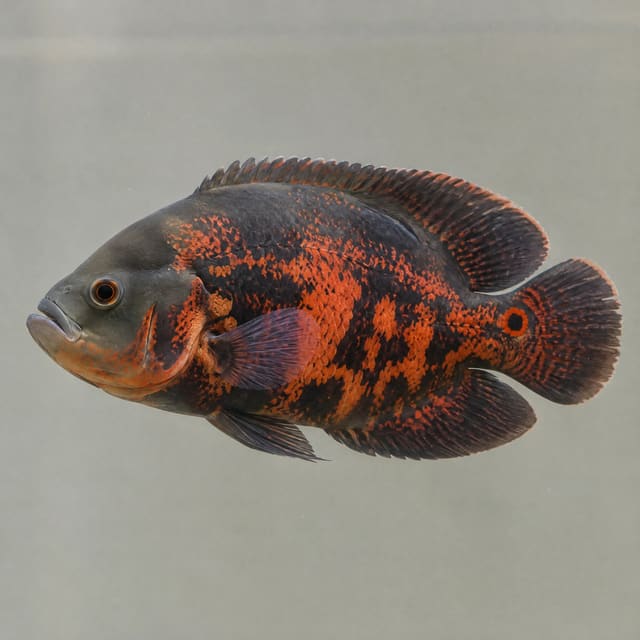
| Large cichlids such as oscars | Any fish an adult could swallow |
| Large armoured catfish such as sailfin plecos | A second male peacock bass |
| Arowana, only in public-aquarium-sized set-ups | Slender, slow or long-finned fish |
| Robust fish that share 25–27°C | Schools of small fish |
Our Oscar Cichlid and Leopard Sailfin Pleco are the kind of large, sturdy companions the sources describe; the Silver Arowana needs an equally huge tank. Our Oscar care guide and cichlid care guide explain how large cichlids share space; browse our oscar cichlids and pike cichlids, and test any combination with our tank mates tool.
OATA describes a healthy fish as having clear, bright eyes, undamaged fins, intact scales, no ulcers or bumps, normal swimming and steady breathing. Note how your pinima behaves at feeding time in its first month, so that changes stand out.
| If you see | Do this |
|---|---|
| Loss of appetite | Test the water before changing foods |
| Rapid breathing or gasping | Test ammonia and nitrite and add aeration |
| Damaged fins or scrapes | Look for sharp décor, loose rock or a bullying tank mate |
| Swollen belly | Cut back the portions and skip a day |
| White spots, fluffy patches or ulcers | Test the water and seek fish-health advice before treating |
Kullander and Ferreira found no obvious difference between the sexes in this species, except that males may lose the light spots completely while females keep some on the back; they recorded the forehead hump in larger fish. Seriously Fish notes that male peacock bass grow larger and develop the hump as they mature. Aquarium breeding is rarely reported. Fishkeeper describes the genus as biparental substrate spawners that lay adhesive eggs on a cleaned flat rock and later move the young in their mouths to a pit in the sand, and Seriously Fish records broods of 700–800 fry for C. monoculus; neither account is specific to the Pinima.
It is Cichla pinima Kullander & Ferreira, 2006, a large predatory cichlid from the lower parts of the southern Amazon tributaries in Brazil, including the Tapajós, Curuá-Una and Xingu, and the lower Tocantins and Capim rivers. Pinima is a Tupi-Guarani word meaning "spotted with white", and Brazilians call it tucunaré pinima.
Kullander and Ferreira identify it by a black, light-ringed blotch high up in the third dark bar, close to the soft dorsal fin, which appears before the fish reaches 100 mm standard length. Young adults also carry rows of white spots along the side.
FishBase records a maximum of 52.0 cm standard length, measured without the tail. Kullander and Ferreira examined fish up to 430 mm standard length. Plan for a fish of 50 cm or more.
No figure is published for this species. Seriously Fish gives at least 8 × 3 × 3 ft (about 244 × 91 × 91 cm, roughly 2,000 litres) for an adult Orinoco peacock bass of about 60 cm. Use that as the minimum for one adult Pinima.
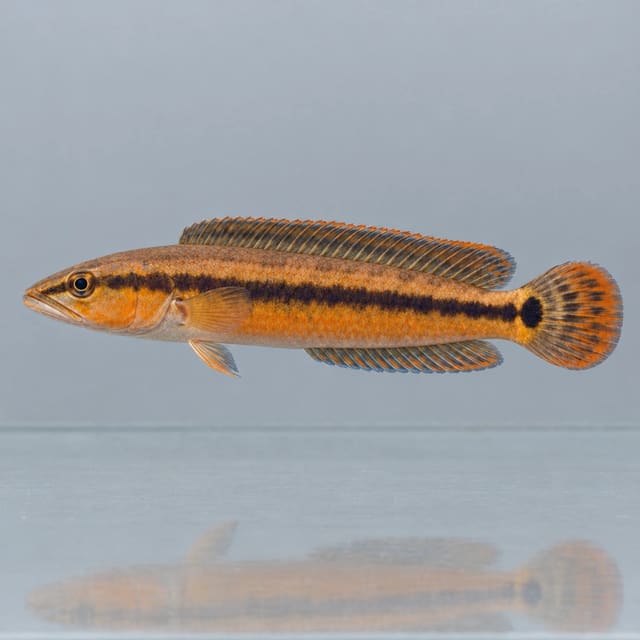
That is the juvenile pattern. Young Pinima have a dark band from the head to the tail spot, and Kullander and Ferreira found it stays distinct in fish of 100–200 mm standard length. The vertical bars, white spots and ringed blotches of the adult take over as the fish grows.
Meaty foods: prawn, mussel, krill, white fish and whole small frozen fish, with a carnivore pellet as the staple once it accepts one. Feed once a day, only what is eaten within a few minutes.
Warm, clean and well oxygenated. No species values are published; close relatives are kept at 24–28°C, pH 6.5–7.5 and up to 15 dGH. Aim for 25–27°C, pH 6.5–7.5, zero ammonia and nitrite and low nitrate.
Only large, robust fish that are too big to swallow, such as oscars and big armoured catfish, in a very large aquarium. Keep one male peacock bass per tank.
One live Pinima Peacock Bass of about 5–6 cm. It is a juvenile, it cannot be sexed, and its pattern will change a great deal as it grows.
No reviews for this item yet. Bought one? Honest reviews only, good or bad.
What customers say about ordering from us
Easy website plenty of info on fish your buying great to pick a time slot
TRACEY DURRANT · 7 Oct 2026
Got some lovely fish thank you
Kevin Mackie · 7 Oct 2026
Reviews of our shop, collected by Judge.me, an independent third-party review collector. Newest first.
Moved by UK carriers licensed to handle live animals
Hand-packed with oxygen bags, poly box, heat pack
Email photos the same day; an optional unboxing video helps us review problems faster — claim terms apply
Klarna & PayPal Pay in 3 at checkout