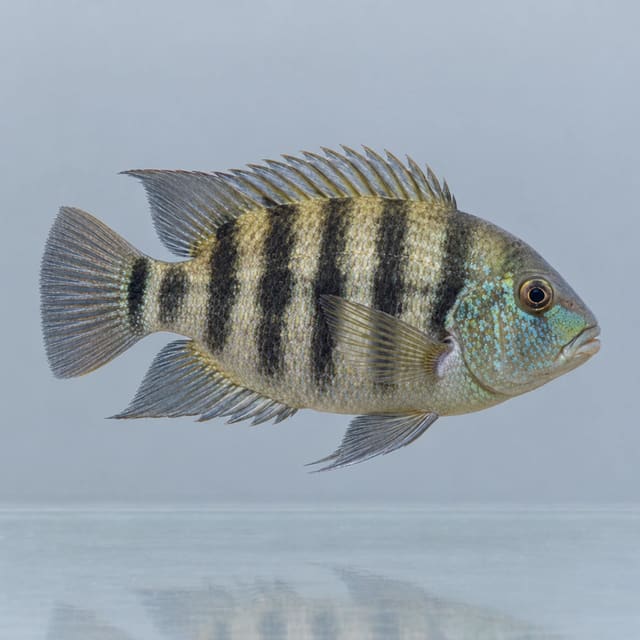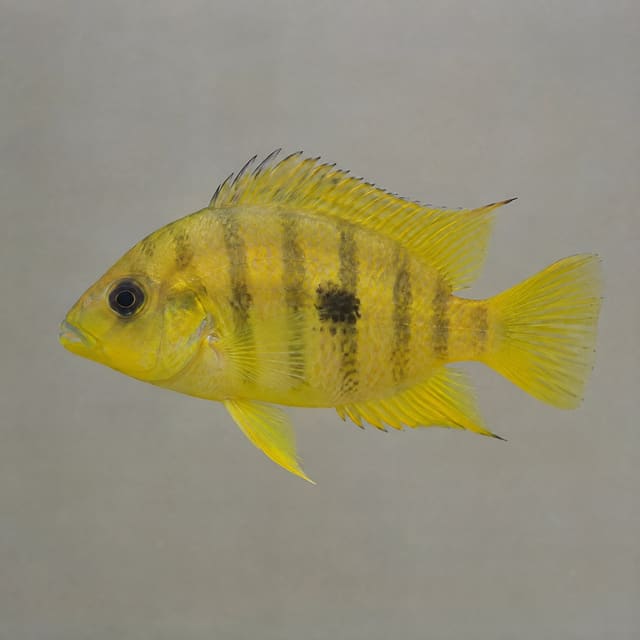
Cutter's Cichlid (Cryptoheros cutteri)
22–27°C · pH 6.5–8
£18.99
The Bocourti Cichlid (Cincelichthys bocourti, formerly Vieja or Cichlasoma bocourti) is a deep-bodied, mainly plant-eating cichlid from the Atlantic slope of Guatemala and Belize, named the chisel-tooth cichlid for its flattened front teeth. It reaches 20 cm standard length and needs an aquarium of at least 300 litres with warm, hard water and a vegetable-based diet. Sold individually as one live fish.
Cincelichthys bocourti
The Bocourti Cichlid (Cincelichthys bocourti, formerly Vieja or Cichlasoma bocourti) is a deep-bodied, mainly plant-eating cichlid from the Atlantic slope of Guatemala and Belize, named the chisel-tooth cichlid for its flattened front teeth. It reaches 20 cm standard length and needs an aquarium of at least 300 litres with warm, hard water and a vegetable-based diet. Sold individually as one live fish.
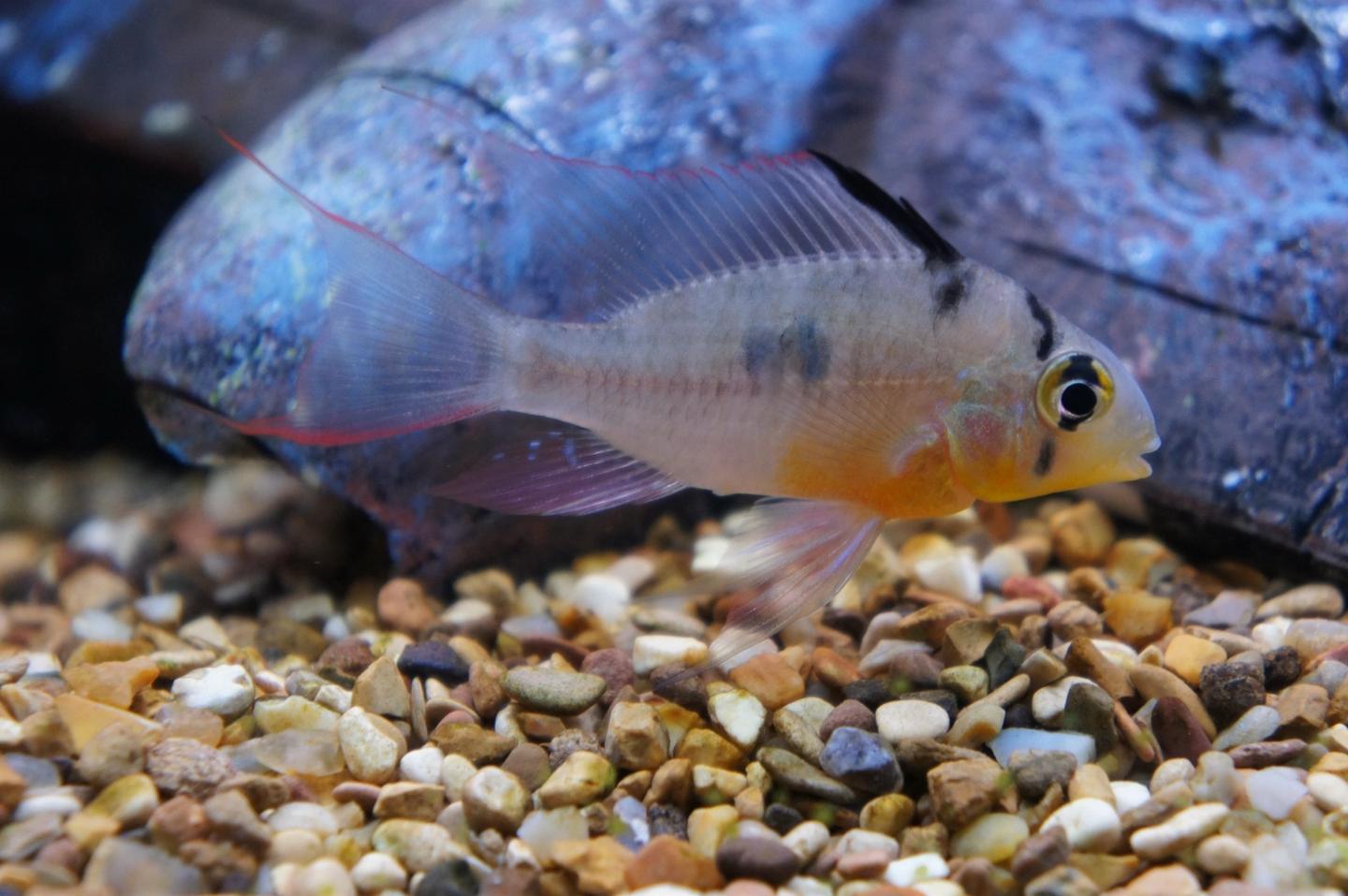
Cichlids are a family of roughly 1,800 accepted species, not one care type. Before buying, identify the exact species and source, then compare adult measurement, usable tank dimensions, social system, territory, tested water, diet and an exit plan. No family-wide minimum tank, water range or tank-mate list is safe.
The Bocourti Cichlid (Cincelichthys bocourti) is a deep-bodied Central American cichlid from Guatemala and Belize that lives mainly on plant food. FishBase calls it the chisel-tooth cichlid, after the flat, chisel-like front teeth it uses to bite and scrape vegetable matter, and records a maximum of 20 cm standard length. For a keeper with a large aquarium and hard water, it is a substantial, characterful fish that grazes rather than hunts.
FishBase lists its range as the Atlantic slope of Guatemala and Belize, and Říčan and colleagues (2016) place it in the Polochic river basin of Guatemala. The species was first described from Lake Izabal, and the genus is summarised on Wikipedia as living in lakes, typically sluggish rivers and other fresh waters. FishBase lists it as Near Threatened on the IUCN Red List.
| Name | What it means |
|---|---|
| Bocourti cichlid, chisel-tooth cichlid | Common names for the species |
| Cincelichthys bocourti (Vaillant & Pellegrin, 1902) | The current scientific name |
| Neetroplus bocourti | The original 1902 name |
| Cichlasoma, Herichthys, Vieja or Theraps bocourti | Older names still seen on labels and in books |
| Cincelichthys pearsei | The only other species in the genus, which grows far larger |
Eschmeyer's Catalog of Fishes traces a long list of homes for this fish. Léon Vaillant and Jacques Pellegrin described it in 1902 as Neetroplus bocourti from Lake Izabal in Guatemala. Later authors placed it in Herichthys, Cichlasoma, Vieja and Theraps, until McMahan and colleagues (2015) created the genus Cincelichthys for it and its relative C. pearsei. Říčan and colleagues accepted the genus in 2016, adding that the similar Kihnichthys is probably part of it too.
Explore its relatives in our South American cichlids hub, the American cichlids directory and the Central American cichlids page. Because it was long sold as a Vieja, you will find its closest look-alikes among our Vieja cichlids.
One purchase supplies one live Bocourti Cichlid. The size option is "Standard": the fish is sent at the size currently available, which is a young fish far smaller than its adult size. Sex is not chosen or guaranteed.
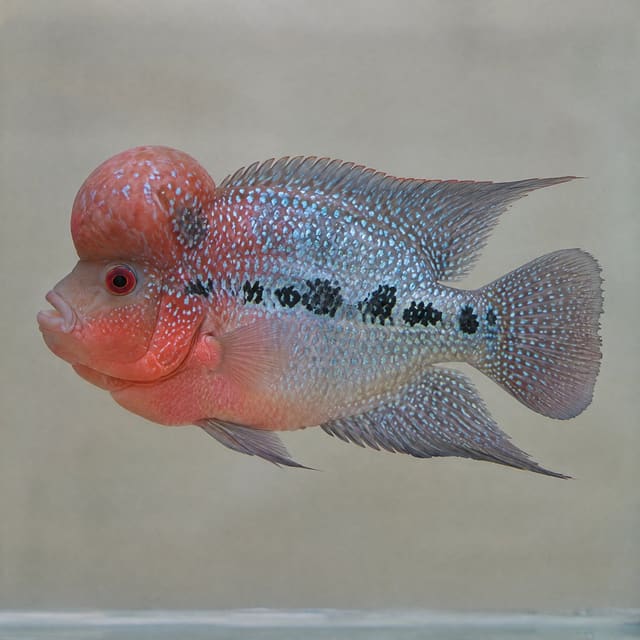
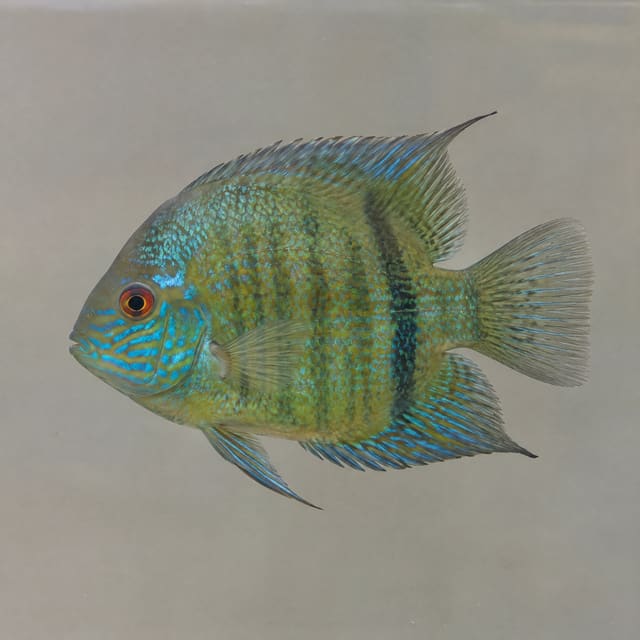
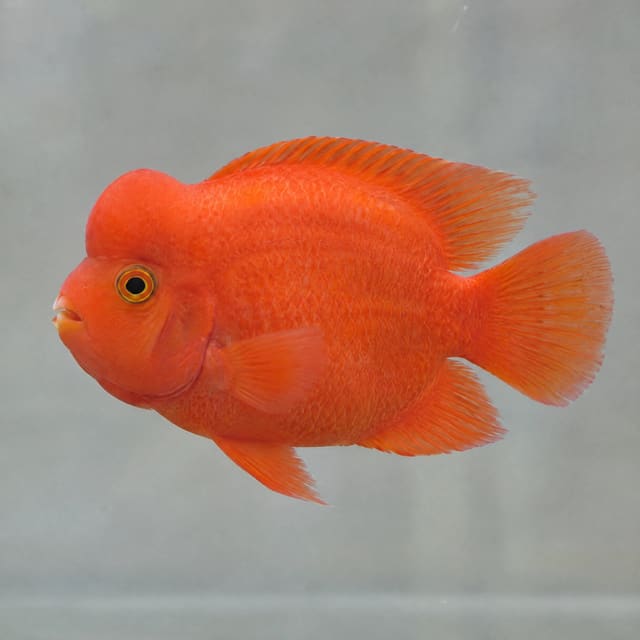
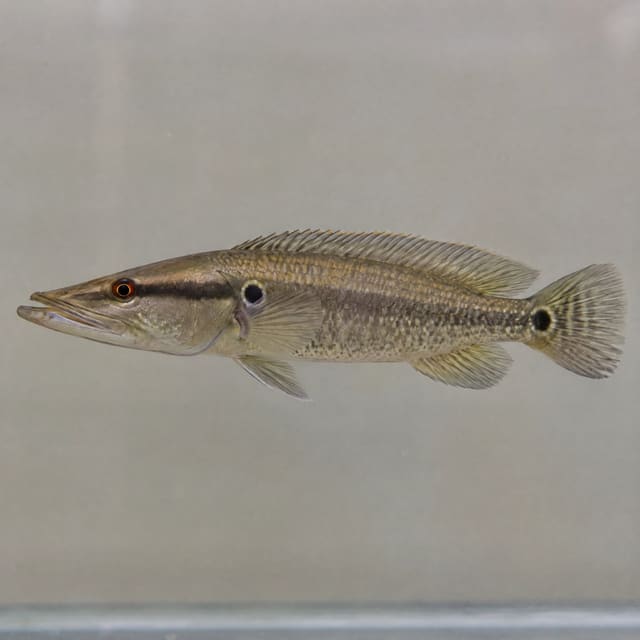
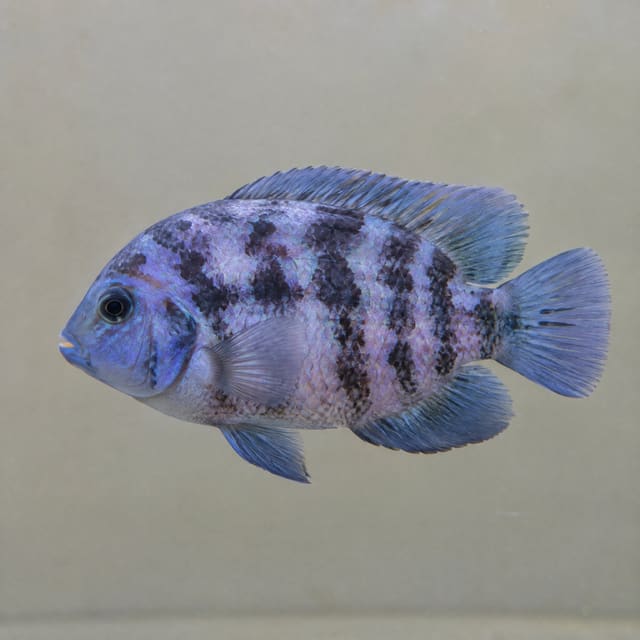
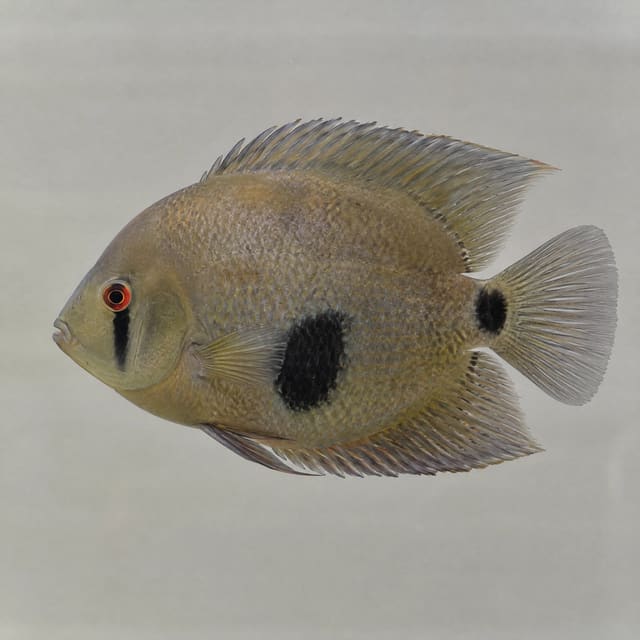
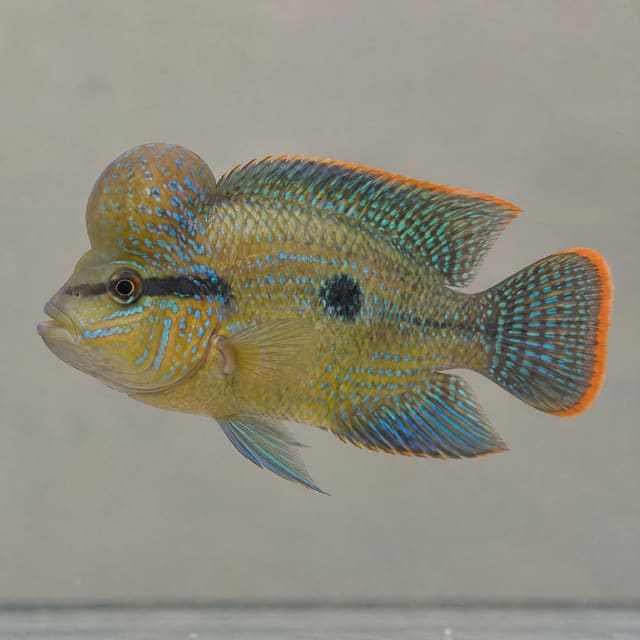
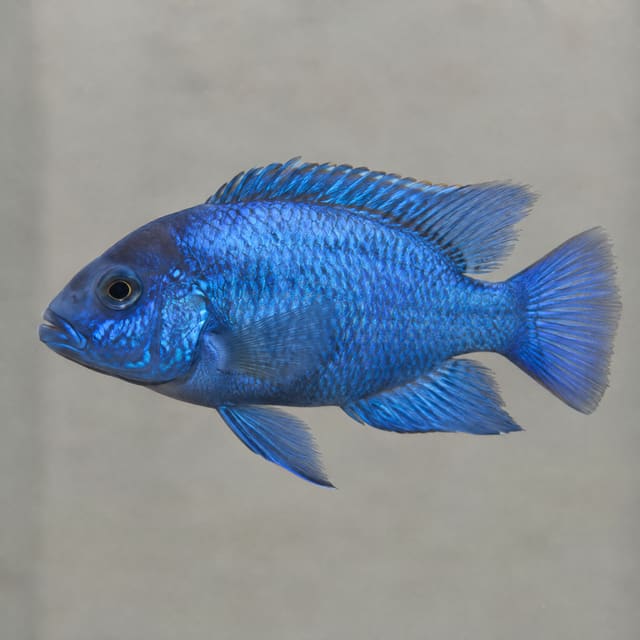
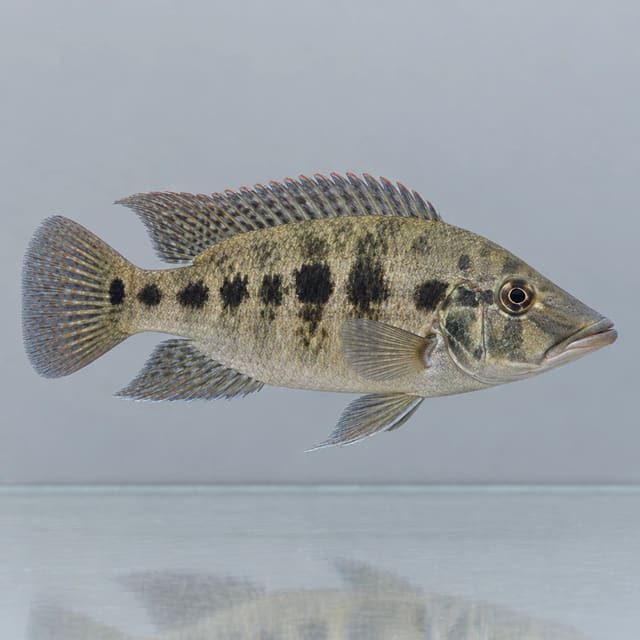
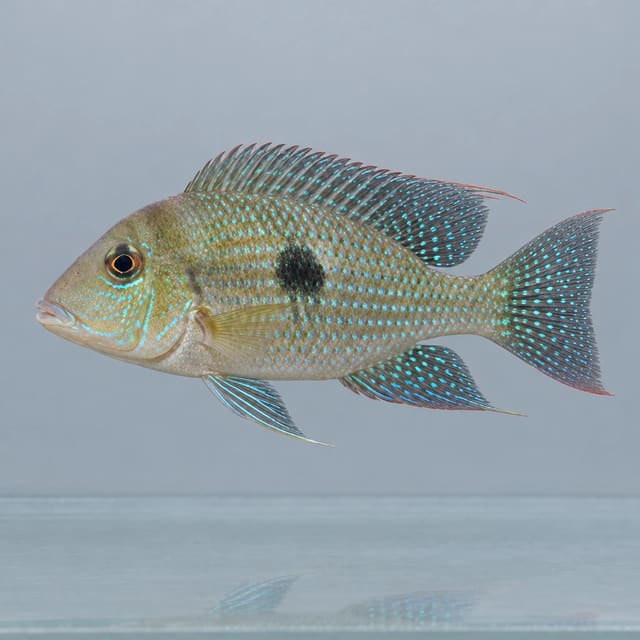
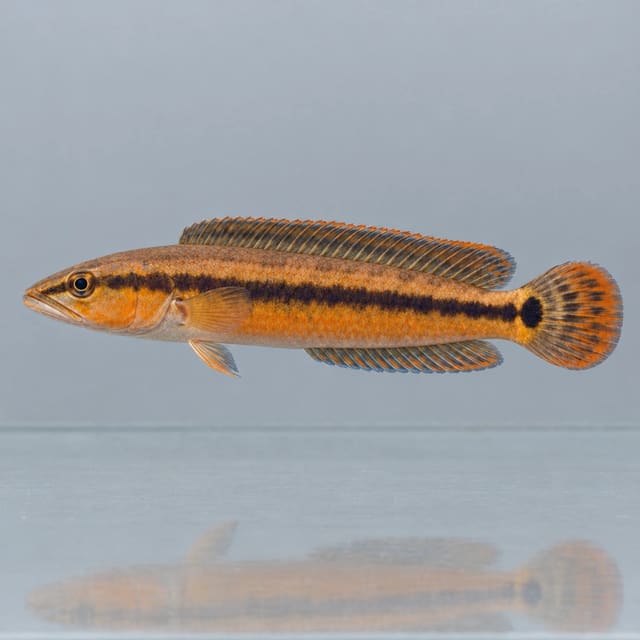
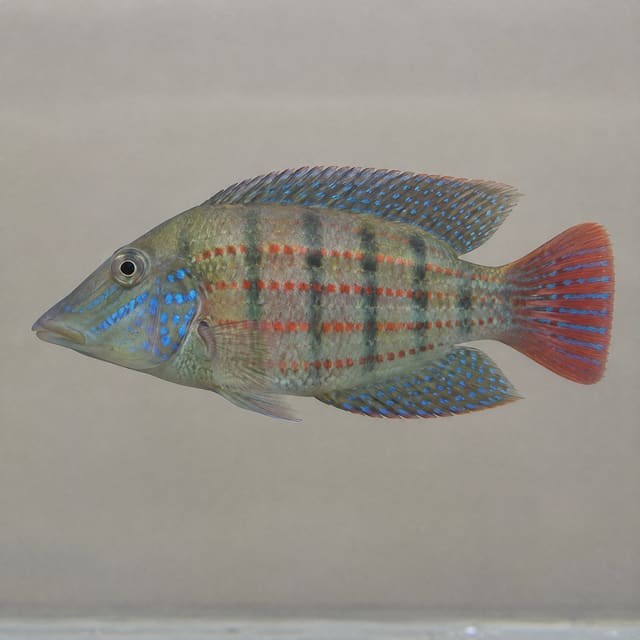
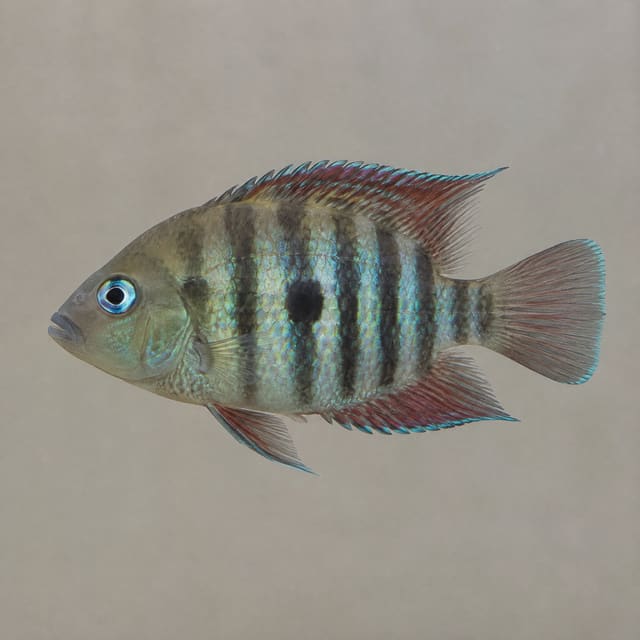
The photographs show the type of fish, not the individual you will receive. They show an olive-grey, deep-bodied fish with large black blotches along the side, a darker smudge on the nape and a reddish edge to the tail. Říčan and colleagues describe the genus as having its dark lateral stripe placed low on the body and some of its vertical bars doubled, and colour in all cichlids shifts with age, mood and breeding condition.
Read our delivery and live arrival terms before ordering, and have the aquarium matured and heated before the fish arrives.
FishBase gives a maximum of 20 cm standard length. Standard length leaves out the tail, so the whole fish is longer, and a deep body makes it heavier and bulkier than a slim fish of the same length. Wikipedia's genus summary notes that females stay smaller than males.
No published source gives a minimum aquarium for C. bocourti itself. OATA recommends at least 300 litres for American cichlids over 15 cm. For comparison, Seriously Fish gives a minimum base of 120 × 38 cm for the blackbelt cichlid at 254 mm standard length and 120 × 45 cm for Vieja fenestrata at 300 mm. We suggest at least 300 litres on a base of at least 120 × 45 cm for one bocourti. Do not use the figures for its relative: Seriously Fish's profile of C. pearsei gives 425 mm standard length for males and a base of 240 × 60 cm, because that species is twice the size.
Place the aquarium away from draughts, heat sources and direct sun, as OATA advises, and fit a heater, a thermometer and a secure lid.
Říčan and colleagues describe Cincelichthys as combining a biting, plant- and detritus-eating head with a deep body built for still water rather than current. That points to a calm aquarium with sand, large rocks and wood, and gentle rather than fierce flow. Seriously Fish suggests gravel or sand with large, smooth rocks and boulders for C. pearsei, and warns that any plants will be eaten immediately; plan for the same with bocourti.
| Area | Purpose |
|---|---|
| Open sand in front | Swimming and feeding space that is easy to siphon |
| Large smooth rocks | Territory markers and surfaces for algae |
| Sunken driftwood | Cover and broken sight lines |
| Artificial plants | Green cover the fish cannot eat |
OATA recommends sand or fine gravel because many American cichlids dig. Bed heavy rocks on the glass before adding sand so they cannot be undermined, and keep the arrangement stable: a large cichlid can push loose décor around.
FishBase gives 26–28°C for this species, and OATA's general range for American cichlids is 22–27°C, so we suggest 26–27°C. No source publishes a pH or hardness for C. bocourti itself. OATA's American cichlid range is pH 6.5–8.0 and 4–12 dGH, while Seriously Fish's profile of C. pearsei recommends hard, alkaline water of pH 7.2–8.5 and 10–25 dGH. The overlap gives pH 7.2–8.0 and moderately hard to hard water.
| Reading | Target |
|---|---|
| Temperature | 26–27°C (FishBase 26–28°C) |
| pH | 7.2–8.0 |
| General hardness | Moderately hard to hard; sources range from OATA's 4–12 dGH to 10–25 dGH for C. pearsei |
| Ammonia | 0 mg/l |
| Nitrite | 0 mg/l |
| Nitrate | No more than 20 mg/l above your tap water |
Hard tap water, common across much of southern and eastern England, usually needs little change. In soft-water areas, harden the water gradually with a buffering substrate or rock, and test until the readings hold steady. Our water matcher compares your tap water with these targets, and the water chemistry guide and our guide to pH for tropical fish explain how pH, hardness and buffering relate. Our article on setting tank temperature covers heaters and thermometers.
A large plant eater passes a lot of food and produces plenty of waste. Seriously Fish's species profiles size filters at four to five times the tank volume per hour, which for a 300-litre aquarium means about 1,200–1,500 litres per hour. Because this fish comes from still and slow waters, spread the outflow with a spray bar or angle it at the surface rather than creating a strong current.
Our article on how aquarium filtration works explains how to combine mechanical and biological filtration for a large fish.
Wikipedia's summary of the genus, drawing on the Cichlid Room Companion and FishBase, says Cincelichthys species feed on vegetable matter such as fruit, parts of aquatic and land plants, and algae. Říčan and colleagues describe their teeth as truncated and flattened, a shape shared only with Kihnichthys among similar cichlids, and Seriously Fish describes C. pearsei as almost exclusively vegetarian. Build the diet around plant foods.
OATA advises feeding American cichlids only what they eat within a few minutes, once a day, and warns that they can eat a great deal at once. A plant eater kept on rich, meaty food is fed the wrong way; keep the balance firmly on vegetable foods.
Add the fish only to an aquarium with a matured filter and zero ammonia and nitrite. Our first tropical tank guide shows how to mature a new set-up before any fish go in.
OATA recommends floating the sealed bag with the aquarium lights off for about 10 minutes, then adding small amounts of aquarium water over up to 20 minutes before releasing the fish with as little bag water as possible. Our step-by-step acclimatisation guide covers the details.
| Checkpoint | What to do |
|---|---|
| Before arrival | Set 26–27°C, confirm pH 7.2–8.0 and test ammonia and nitrite |
| Arrival | Acclimatise with the lights off; no food on the first day |
| Day 2 | Offer a small portion of herbivore pellets and remove leftovers |
| Days 3–7 | Watch breathing, colour and feeding, and note where it settles |
| Day 7 | Retest the water and do the normal weekly change |
A shy fish that hides for a few days is normal. Fast breathing or hanging at the surface is not: test the water at once.
No detailed behaviour account is published for C. bocourti. Seriously Fish describes its relative C. pearsei as quite placid for its size, suitable for a community of bigger fish, with large cyprinids, characins, catfish, plecos and, in a very large tank, other Central American cichlids as possible companions. OATA adds that all American cichlids become aggressive when breeding. Plan for a robust community of large fish that share hard, warm water.
| Suits | Avoid |
|---|---|
| Robust Central American cichlids of similar size | Small fish that could be bullied or eaten |
| Large armoured catfish such as sailfin plecos | Soft-water species |
| Fish comfortable at 26–27°C in hard water | Very aggressive predatory cichlids |
| Species that leave enough plant food | Live plants you want to keep |
The Redhead Quetzal Cichlid and Black Belt Cichlid are both large Vieja, a genus Říčan and colleagues class among the plant and detritus eaters, from the same region: Seriously Fish places the redhead in the Usumacinta basin of Mexico, Guatemala and Belize, and the blackbelt from the Usumacinta south to Panama. The redhead reaches 350 mm SL and the blackbelt 254 mm, so both need extra space. A Leopard Sailfin Pleco is a large armoured catfish of the kind Seriously Fish lists as a possible companion for the genus. Check every combination in our tank mates tool and read our cichlid care guide before you mix species.
OATA lists clear bright eyes, intact fins and scales, no ulcers or bumps, normal swimming and steady breathing as the signs of a healthy fish, and clamped fins, flicking, shimmying and loss of appetite as warning signs. Note what is normal for your fish in its first weeks.
| If you see | Do this |
|---|---|
| Hanging at the surface or fast breathing | Test ammonia, nitrite and temperature and add surface movement |
| Hollow belly | Check that tank mates are not taking the plant food first |
| Dull colour and hiding after the first week | Review water readings and look for bullying |
| Torn fins | Identify the aggressor and add territory markers |
| White spots or fluffy patches | Test the water and seek fish-health advice before treating |
Test first, then act, and record what you find so changes are easier to spot next time.
OATA describes American cichlids as egg layers that clean a flat surface and guard their fry until they swim freely. Seriously Fish describes C. pearsei as a pair-forming substrate spawner that lays in a pit dug by the male, and notes that males of that species grow larger, become brighter and develop a higher forehead. No published aquarium breeding account was found for C. bocourti itself, so breeding would be a project for a dedicated, very large aquarium.
Because FishBase lists the species as Near Threatened, every aquarium fish matters. Keep it for its whole life, never release it or its water into the wild, and pass on spare fish only through the hobby.
It is Cincelichthys bocourti (Vaillant & Pellegrin, 1902), a deep-bodied, plant-eating Central American cichlid from the Atlantic slope of Guatemala and Belize. FishBase calls it the chisel-tooth cichlid, after its flattened front teeth.
Yes. Over the last century the species has been placed in Neetroplus, Cichlasoma, Herichthys, Vieja and Theraps. Since 2015 it has been classified in Cincelichthys, a genus it shares with Cincelichthys pearsei.
FishBase records a maximum of 20 cm standard length, measured without the tail. Its only close relative, C. pearsei, grows much larger, so do not confuse the two when planning space.
No species-specific figure is published. OATA recommends at least 300 litres for American cichlids over 15 cm, so plan for at least 300 litres on a base of 120 × 45 cm or more.
Its genus feeds mainly on plant matter, including algae, fallen fruit and parts of water and land plants. Feed herbivore cichlid pellets, spirulina and algae wafers, and blanched vegetables, with meaty foods only occasionally. It will eat soft aquarium plants.
FishBase gives 26–28°C. No pH or hardness is published for the species itself; aim for pH 7.2–8.0 and moderately hard to hard water, which suits both OATA's range for American cichlids and the profile of its relative C. pearsei.
No detailed account exists for this species. Its relative C. pearsei is described by Seriously Fish as quite placid for its size. Plan as for any large cichlid: give it room, avoid small fish and watch closely when it matures or breeds.
FishBase lists it as Near Threatened on the IUCN Red List. Buy one fish you can keep for its whole life, and never release an aquarium fish.
One live Bocourti Cichlid of the standard size currently available. It is a young fish, it is not sexed, and its colour will differ from the photographs.
No reviews for this item yet. Bought one? Honest reviews only, good or bad.
What customers say about ordering from us
Easy website plenty of info on fish your buying great to pick a time slot
TRACEY DURRANT · 7 Oct 2026
Got some lovely fish thank you
Kevin Mackie · 7 Oct 2026
Reviews of our shop, collected by Judge.me, an independent third-party review collector. Newest first.
Moved by UK carriers licensed to handle live animals
Hand-packed with oxygen bags, poly box, heat pack
Email photos the same day; an optional unboxing video helps us review problems faster — claim terms apply
Klarna & PayPal Pay in 3 at checkout