Moderate
Red Head Bahia Eartheater (Geophagus sp. 'Bahia Red')
£18.29
Geophagus argyrostictus is a sand-sifting eartheater cichlid from the rio Xingu in Brazil whose larger fish develop silvery reflective scales and a rounded dark flank spot. It grows to about 18 cm standard length and needs a 150 × 45 cm base or larger, warm water at 26–30°C, soft sand and a group of five to eight. Sold individually as one live fish.
Geophagus argyrostictus
Save when buying multiple fish. Each quantity is one fish; sex and pair formation are not guaranteed unless the selected variant explicitly states them.
Geophagus argyrostictus is a sand-sifting eartheater cichlid from the rio Xingu in Brazil whose larger fish develop silvery reflective scales and a rounded dark flank spot. It grows to about 18 cm standard length and needs a 150 × 45 cm base or larger, warm water at 26–30°C, soft sand and a group of five to eight. Sold individually as one live fish.
Cichlids are a family of roughly 1,800 accepted species, not one care type. Before buying, identify the exact species and source, then compare adult measurement, usable tank dimensions, social system, territory, tested water, diet and an exit plan. No family-wide minimum tank, water range or tank-mate list is safe.
Read the full care guidance when planning conditions for your aquarium.
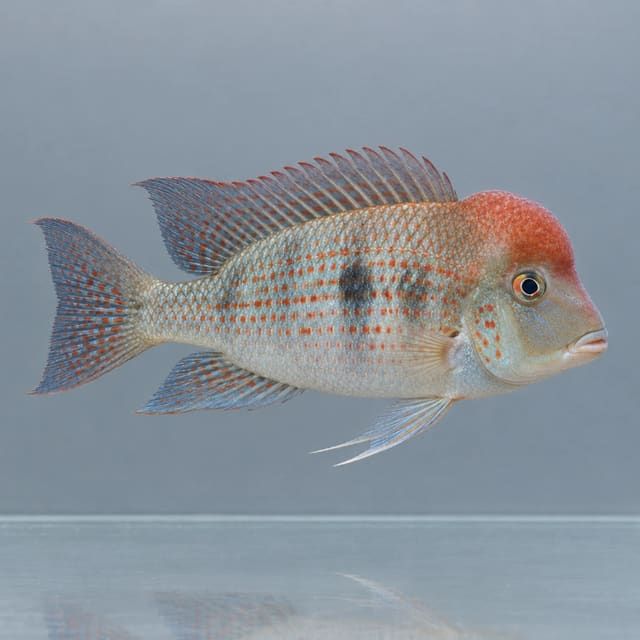
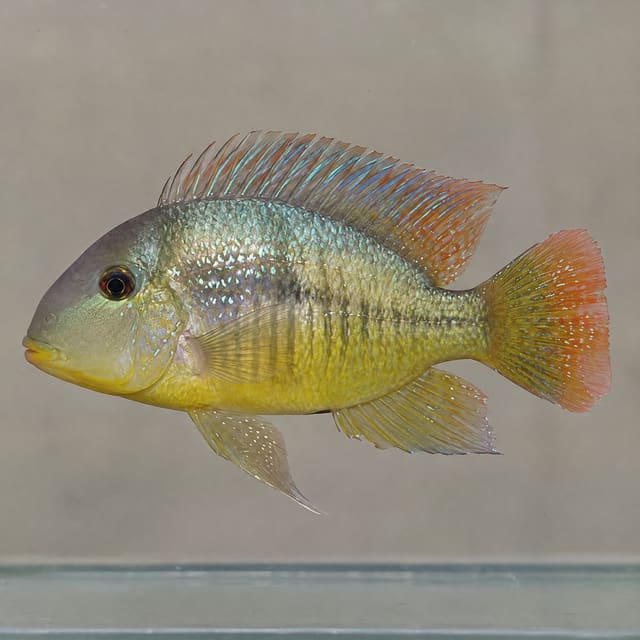
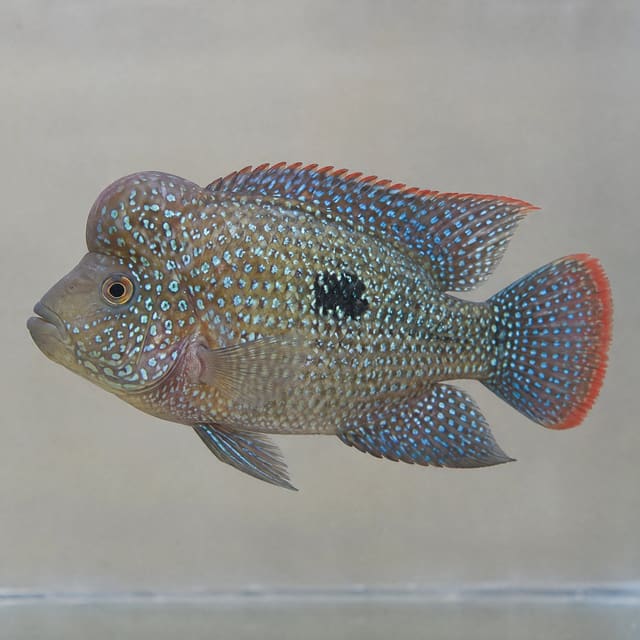
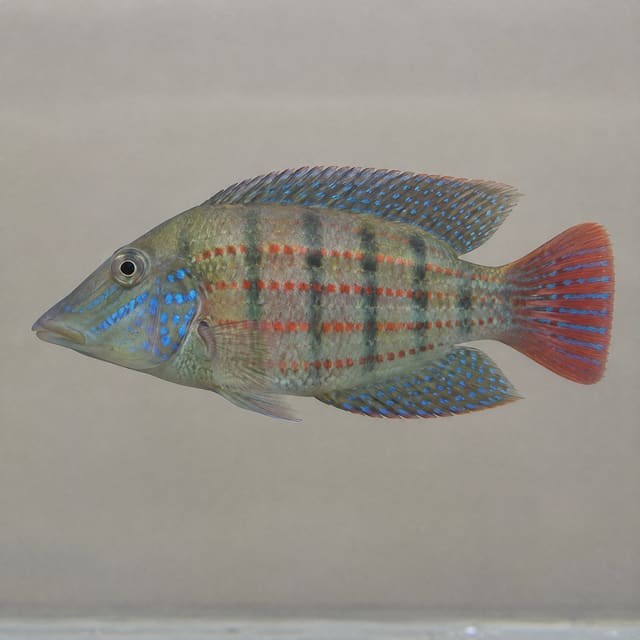
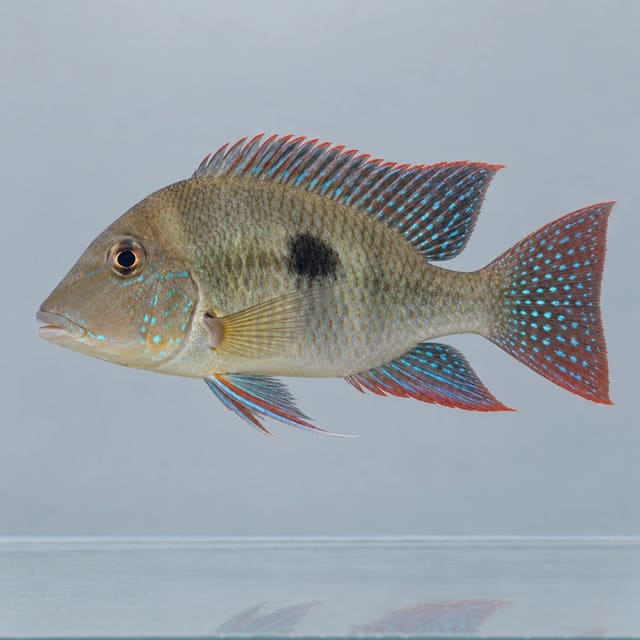
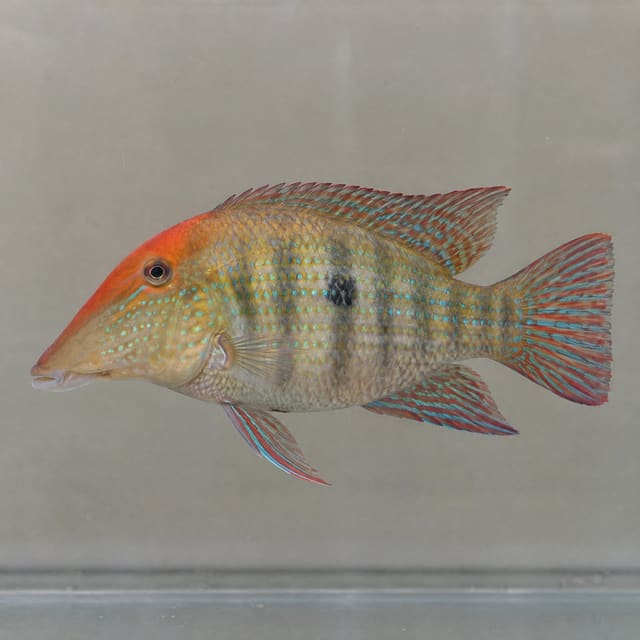
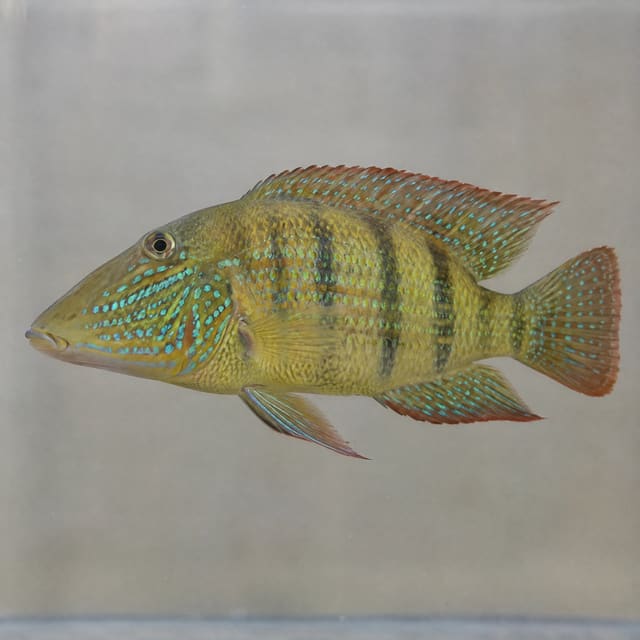
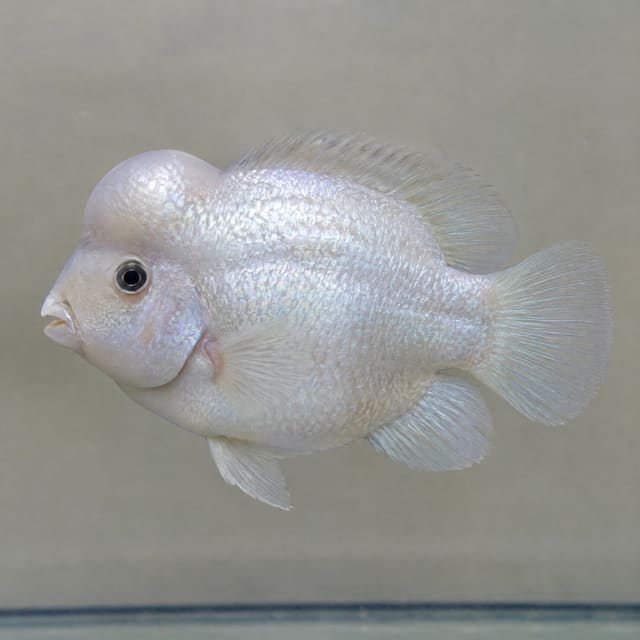
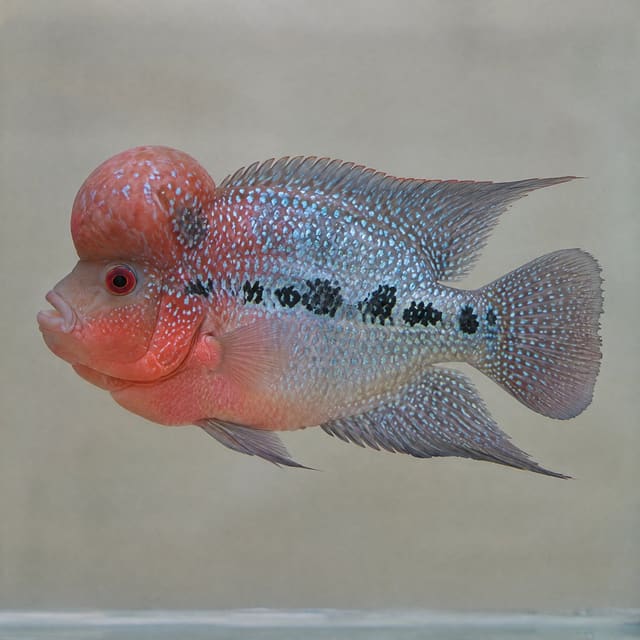
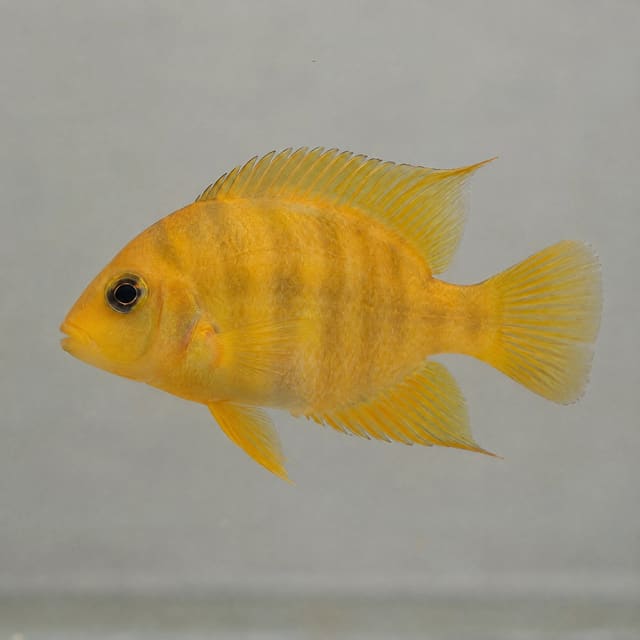
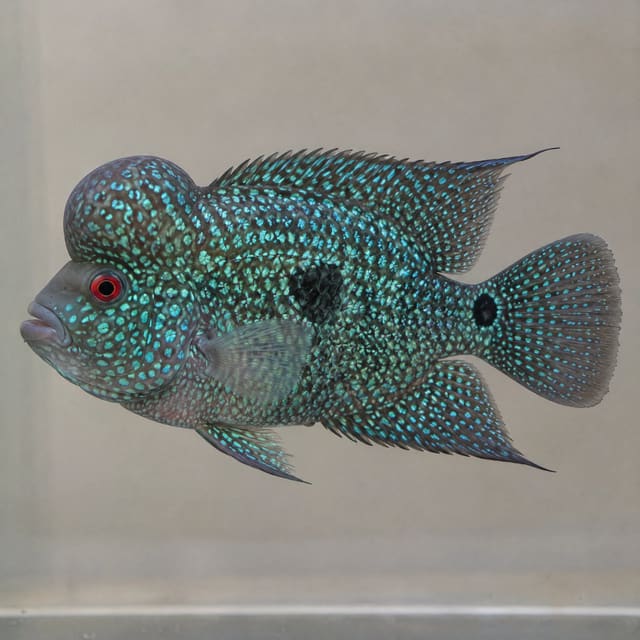
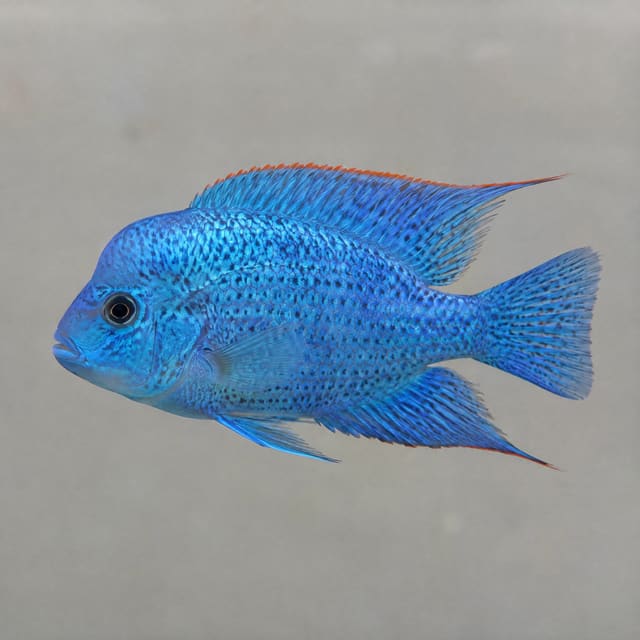
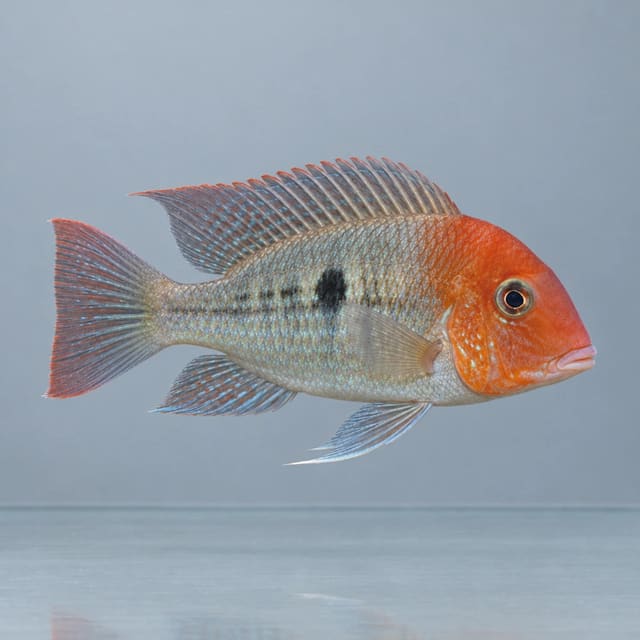
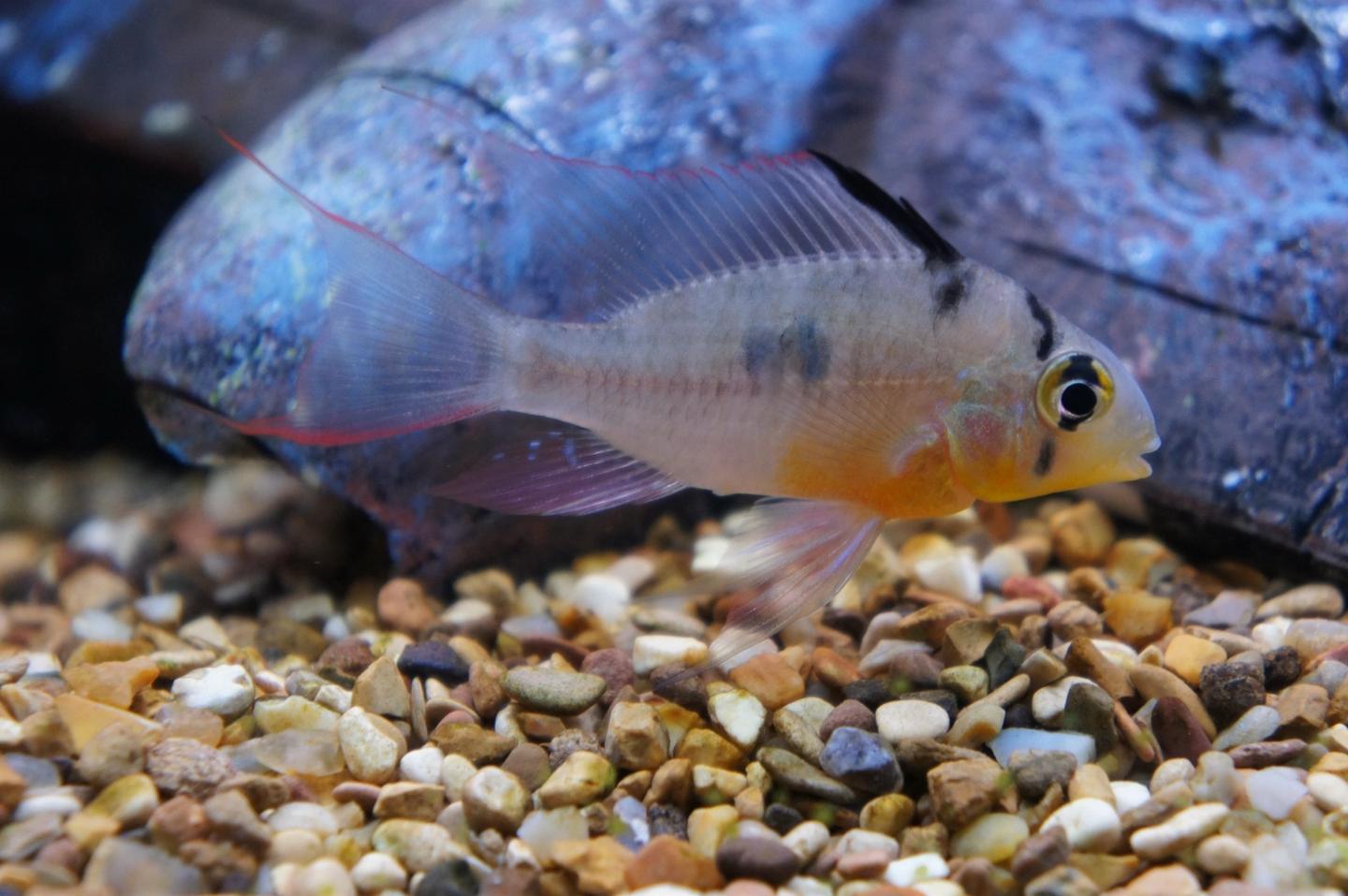
Geophagus argyrostictus is a sand-sifting South American cichlid from the rio Xingu, a great clear-water tributary that joins the Amazon from the south in Pará, Brazil. Its name means "silver-spotted": as the fish grows past about 7–8 cm, the scales on the front of its flanks turn silvery and reflective. Our photographs show an olive body spangled with rows of small turquoise spots, a rounded dark spot in the middle of each flank and long, spotted fins with fine reddish edges.
Sven Kullander described the species in 1991 from a rocky pool near a waterfall at Belo Monte. Seriously Fish notes that it had been collected long before and misidentified in 1976 as Geophagus surinamensis, a mix-up that still runs through the trade, where many eartheaters are sold under that name. It is widespread in the Xingu and its tributary the rio Iriri, and FishBase also lists the Curuá basin. Colour varies with collecting locality; populations known in the hobby include 'Altamira', 'São Félix' and 'Tamandua Zinho'.
| Feature | What to look for |
|---|---|
| Eye stripe | A dark stripe below the eye that is prominent only on the cheek and does not reach the edge of the gill cover |
| Flank spot | A single rounded or slightly oval dark spot in the middle of the flank |
| Silver scales | Silvery reflective scales on the front of the flanks and around the spot in fish larger than 70–80 mm standard length |
| Group | One of only five Geophagus outside the G. surinamensis group, all with a complete stripe below the eye |
| Spawning mode | A substrate spawner, unlike the many mouthbrooding Geophagus |
For a UK buyer this is a fish for the dedicated South American cichlid keeper: rarer than the common eartheaters, more spirited than most of its relatives and happiest in a warm, spacious aquarium with a group of its own kind. Seriously Fish describes it as relatively rare in the hobby and sometimes available from specialist retailers; FishBase notes it is becoming better established in the aquarium trade.
One purchase supplies one live Geophagus argyrostictus. The size option is "Standard": the fish is sent at the size currently available, which is a young fish well below the adult size given below. Sex is not chosen or guaranteed. Seriously Fish states that juveniles cannot be sexed by eye unless they are spawning.
The photographs show the species, not the individual you will receive. Young fish have not yet developed the silver flank scales that give the species its name, colour varies between localities, and any fish looks paler for a few days after a journey.
Read our delivery and Live Arrival Guarantee details before you order, and have the aquarium fully matured and heated before the fish arrive.
Seriously Fish gives a maximum of 180 mm standard length, which is measured from the snout to the base of the tail, and FishBase records 24.2 cm total length, tail included. Fully mature males tend to be a little larger than females, and dominant males often develop a pronounced hump on the forehead.
Seriously Fish asks for an aquarium base of at least 150 × 45 cm, about 304 litres, to house the species long-term. OATA independently gives at least 300 litres for American cichlids over 15 cm. Treat that as the floor and plan larger for the recommended group: a longer and deeper base gives every fish room to hold a patch of sand and to retreat.
Place the aquarium away from draughts, radiators and windows, and use a reliable heater. This is a warm-water fish, and a stable temperature matters more to it than to many community fish.
Part of the type series was collected near Altamira from rocky shore areas with clear water. Seriously Fish adds that the species prefers clear water and gently sloping margins around shores and islands, over sand, fine gravel and mud, with scattered rocks, submerged roots and branches in places; it has also been found in floodplain lakes. In the aquarium, the most essential item is a soft, sandy substrate. Gravel or small pebbles can stop it feeding, damage its gill filaments and even be swallowed.
| Area | Purpose |
|---|---|
| Wide open sand | The feeding ground, where the group sifts sand for food |
| Rounded rocks and boulders | A Xingu shoreline look, sight-breaks between rivals and possible spawning surfaces |
| Driftwood roots and branches | Shade and cover; Seriously Fish lists them in the favoured set-ups |
| Flat, water-worn stones | Spawning sites that a pair can clean and defend |
| Relatively dim lighting | Part of the set-up Seriously Fish recommends; it calms the group |
Seriously Fish advises against leaf litter in an eartheater aquarium: the constant sifting keeps broken-down leaf material in suspension, which looks untidy and can block filters and pumps. Stand rocks on the glass before adding sand so the fish cannot undermine them.
Seriously Fish gives 26–30°C, pH 6.0–7.5 and 1–10 dGH, and FishBase gives 25–30°C. It also warns that these cichlids are extremely susceptible to deteriorating water quality and to swings in water chemistry. That temperature range sits above OATA's general guidance of 22–27°C for American cichlids, so this species needs a warmer aquarium than many South American community set-ups.
| Reading | Target |
|---|---|
| Temperature | 26–30°C (Seriously Fish); FishBase 25–30°C |
| pH | 6.0–7.5 |
| General hardness | 1–10 dGH |
| Ammonia and nitrite | 0 mg/l |
| Nitrate | No more than 20 mg/l above your tap water (OATA) |
UK tap water is soft across much of Scotland, Wales and north-west England and hard in much of the south and east. In a soft-water area you can usually use conditioned tap water as it is. In a hard-water area, mixing tap water with reverse-osmosis water lowers the hardness; make the blend the same at every water change so the chemistry does not swing. Use a conditioner on all new water, as OATA advises. Our water matcher compares your readings with this range, our water chemistry guide explains GH, KH and pH, and our guide to tropical tank temperature covers heater sizing and placement.
Seriously Fish recommends over-filtering an eartheater aquarium with external canister filters, a sump or both, and changing at least 50–70% of the water every week. Its equipment note for a tank of about 304 litres suggests two filters rated around 610–760 litres per hour each, and roughly 175–250 W of heating split across two heaters. If maintenance falls short, it warns, head and lateral line erosion and stunted growth can follow.
Two details matter with sand-sifters. First, mechanical filtration should trap the fine particles the fish stir up, because sand running through a filter blocks and wears it. Second, high flow rates should be avoided, so angle the filter returns along the glass and the surface rather than across the sand.
Our aquarium filtration guide explains how to combine canister filters and how to set the flow.
Geophagus feed by taking mouthfuls of sand and sifting them, passing the rest out through the gills and mouth. Seriously Fish reports that wild stomach contents are mostly small aquatic and terrestrial invertebrates, seeds, organic detritus and sediment, and that even adults cannot properly swallow larger items. Once settled, the fish rise to take food when it is added but go on sifting the rest of the time.
Spread food across the sand so every fish in the group can sift, not only the dominant one.
Seriously Fish is clear that these cichlids should never be introduced to a biologically immature aquarium. Before the fish arrive, ammonia and nitrite must read zero and the heater must have held 26–30°C for several days. Use OATA's method: lights off, float the sealed bag for about 10 minutes, add small amounts of tank water over up to 20 minutes, then net or pour the fish in with as little bag water as possible. Our page on acclimatising new fish shows each step, and our cichlid care guide covers the basics for all cichlids.
| Checkpoint | What to do |
|---|---|
| Before arrival | Test the water, check the temperature, finish the rockwork and dim the lights |
| Arrival | Acclimatise with the lights off and release all the group together |
| Days 1–2 | Offer a few fine granules; do not worry if the fish hide |
| Days 3–7 | Watch for sifting, spread small meals and note any fish being singled out |
| End of week | Retest ammonia, nitrite and nitrate and make your first large water change |
Some chasing as the group sorts out its order is normal. A fish that is constantly hounded, hides all day or stops feeding needs more cover, more space or a separate tank.
Seriously Fish describes G. argyrostictus as markedly more aggressive than most other Geophagus, though several can share a larger aquarium. It ignores smaller fish, so schools of small characins can be added without fear of predation, but other cichlids are generally best avoided. Seriously Fish knows of cases where it has lived long-term with members of the G. surinamensis group, so a very large aquarium with a calm surinamensis-group eartheater is possible for experienced keepers.
| Suits | Avoid |
|---|---|
| Small schooling characins such as the Lemon Tetra, which Seriously Fish lists from the same Xingu habitats | Most other cichlids |
| Peaceful loricariid catfish such as the L046 Zebra Pleco, another Xingu fish of warm water, given its own caves | Aggressive or territorial bottom dwellers that compete for the sand |
| In a very large tank, a calm G. surinamensis-group eartheater such as the Trombetas Eartheater | Fish that need cool water below 26°C |
| A group of its own species, five to eight fish | Keeping just two or three, which concentrates the aggression |
Seriously Fish's list of fish collected alongside it in the Xingu also includes Satanoperca jurupari, our Demon Eartheater, though a second sand-sifting cichlid needs a very large floor. Check any planned mix with our tank mates tool, browse all South American cichlids, the full South American cichlid range and our Geophagus eartheaters, or look through our rare and collector fish.
OATA describes a healthy fish as having clear, bright eyes, undamaged fins, intact scales, no ulcers or bumps, normal swimming and steady breathing; clamped fins, flicking against décor and shimmying are warning signs. For this species, Seriously Fish adds two long-term warnings: head and lateral line erosion and stunted growth, both linked to poor maintenance.
| If you see | Do this |
|---|---|
| Pits or pale erosion on the head or along the lateral line | Increase water changes, test nitrate and review filtration and diet |
| One fish hiding with torn fins | Add rocks and roots to break sight lines, or move it before it is worn down |
| Rapid breathing or gasping | Test ammonia, nitrite and temperature at once; warm water holds less oxygen, so increase surface movement |
| Fish stop sifting | Check the sand is clean and fine and that no tank mate is guarding the floor |
| White spots or cotton-like patches | Test the water and get fish-health advice before treating |
| A thin fish in a growing group | Spread food more widely and add an extra small meal |
Most problems in large eartheaters trace back to water quality, so test, record and correct the water before reaching for treatments.
Unlike most Geophagus, which brood their eggs or young in the mouth, G. argyrostictus is a substrate spawner with a fairly simple strategy. Seriously Fish reports no particular trigger beyond a good diet and large weekly water changes, and notes that the fish can take at least a year to mature.
In a community aquarium, remove either the tank mates or the fry, because the young are easy prey even though both parents defend them for some time.
It is a sand-sifting eartheater cichlid described by Kullander in 1991 from the rio Xingu system in Brazil, including the rio Iriri. The name means "silver-spotted", after the silvery reflective scales that larger fish develop on the front of the flanks. It has a rounded dark spot in the middle of each flank and a dark stripe below the eye that shows mainly on the cheek.
Seriously Fish gives a maximum of 180 mm standard length, measured without the tail, and FishBase records 24.2 cm total length. Plan for a large adult even though you receive a young fish.
Seriously Fish asks for a base of at least 150 × 45 cm, about 304 litres, to house it long-term. Because it should be kept in a group of five to eight, plan larger than that minimum for a group.
Warm, steady water: Seriously Fish gives 26–30°C and FishBase 25–30°C. That is warmer than OATA's general 22–27°C for American cichlids, so check that your heater can hold the upper end in winter. Seriously Fish gives pH 6.0–7.5 and 1–10 dGH.
It is markedly more aggressive than most other Geophagus, according to Seriously Fish. It ignores smaller fish, so schools of small characins are safe, but other cichlids are generally best avoided. A group of five to eight spreads the squabbling; in smaller groups weaker fish can be picked on.
No. Unlike most Geophagus, it is a substrate spawner: the pair digs a large pit, lays up to 200–250 eggs on a solid surface within it and guards eggs and young.
Yes. Seriously Fish calls a soft, sandy substrate the most essential item of décor, because the fish feeds by sifting mouthfuls of sand. Gravel can stop it feeding, damage its gills and even be swallowed.
One live fish of the standard size currently available, normally a young fish well below adult size. Sex is not chosen or guaranteed, and young fish cannot be sexed by eye.
No reviews for this item yet. Bought one? Honest reviews only, good or bad.
What customers say about ordering from us
Easy website plenty of info on fish your buying great to pick a time slot
TRACEY DURRANT · 7 Oct 2026
Got some lovely fish thank you
Kevin Mackie · 7 Oct 2026
Reviews of our shop, collected by Judge.me, an independent third-party review collector. Newest first.
Moved by UK carriers licensed to handle live animals
Hand-packed with oxygen bags, poly box, heat pack
Email photos the same day; an optional unboxing video helps us review problems faster — claim terms apply
Klarna & PayPal Pay in 3 at checkout