Surinam Geophagus (Geophagus surinamensis)
22–25°C · pH 6.5–8
£13.99
The Red Head Tapajos Eartheater (Geophagus sp.) is a sand-sifting South American cichlid for a large, mature aquarium with a fine sand floor. Each purchase is one live fish, sent at 4–5 cm, 5–6 cm or 7–8 cm; that is its size when it leaves us, not its adult size.
Geophagus sp.
Save when buying more.
The Red Head Tapajos Eartheater (Geophagus sp.) is a sand-sifting South American cichlid for a large, mature aquarium with a fine sand floor. Each purchase is one live fish, sent at 4–5 cm, 5–6 cm or 7–8 cm; that is its size when it leaves us, not its adult size.
Maintain these water conditions for optimal health and vibrant colors
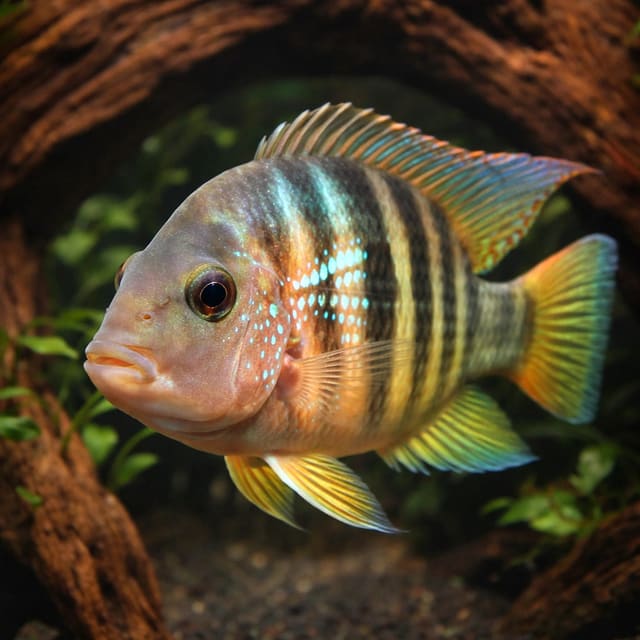
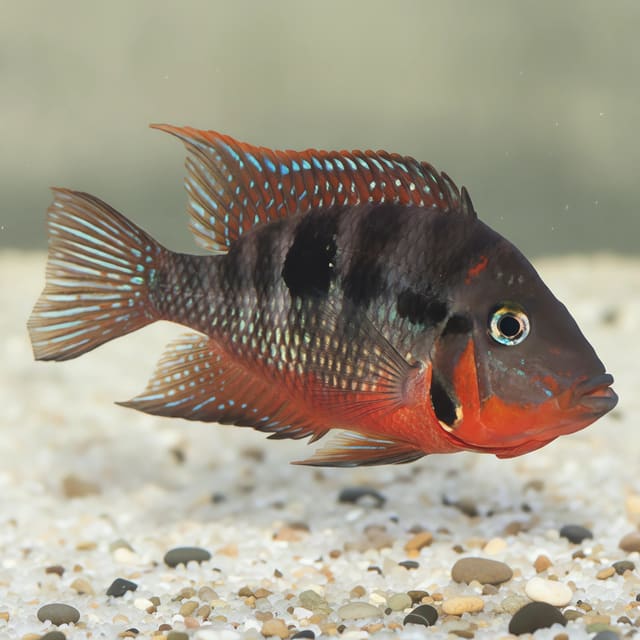
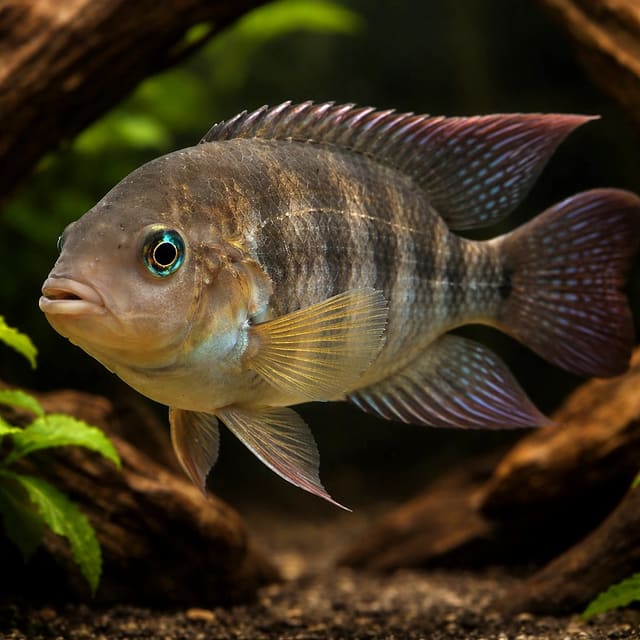
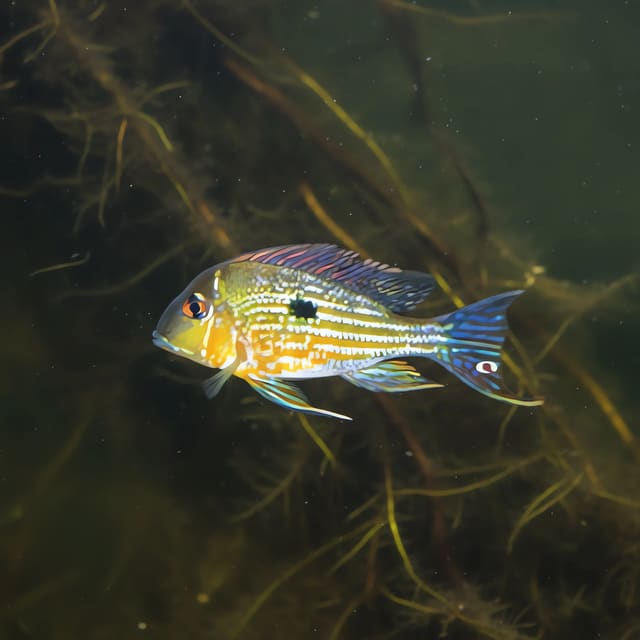
The Red Head Tapajos Eartheater (Geophagus sp.) is a South American cichlid named for its warm orange-red head, which in the photograph sits above flanks of shimmering blue-green scales. It belongs to Geophagus, one of the fish popularly called eartheaters because they feed by taking mouthfuls of sediment and sifting out anything edible. That habit shapes almost every decision about keeping one, from the floor of the aquarium to the way you feed it and the companions you choose.
That behaviour is also much of the appeal. Rather than hanging in open water, an eartheater works steadily across the floor, and an aquarium laid out with open sand shows this off far better than one crowded with decor. It is a fish to plan an aquarium around, not one to add as an afterthought to a tank that already exists.
The exact species has not been identified, so the care advice here follows the genus Geophagus and its care group. That care group is the American cichlids, and the water and aquarium figures on this page come from UK trade guidance written for the whole group. Where the genus could mean a larger fish, we plan for the larger fish.
Each purchase is one live fish of the size you choose. The size you select is the size supplied, not the adult size. The three sizes on this page are 4–5 cm, 5–6 cm and 7–8 cm, measured when the fish leaves us. All three are well below what the genus can reach: its largest species grow up to 28 cm in standard length, so even the biggest dispatch size may have a great deal of growing ahead of it.
Sex is guaranteed only when the selected option explicitly states male or female. This Red Head Tapajos Eartheater listing has no sex-guaranteed option. Choose it for itself rather than as a planned male or female.
The three sizes are the same trade form at different lengths when sent. None of them changes the aquarium you need, because that is planned for the adult fish. A smaller fish simply does more of its growing in your care.
| Suits | Keepers with a large, mature aquarium, a fine sand floor and time for a weekly water change |
|---|---|
| Not ideal if | Your tank is small or newly set up, or full of live plants you want left undisturbed |
| Sold as | One live fish per purchase |
| Sizes at dispatch | 4–5 cm, 5–6 cm or 7–8 cm |
| Water guidance | 22–27°C, pH 6.5–8.0, 4–12°dH, from broad guidance for American cichlids |
| Diet | Omnivore that often prefers meaty foods and feeds from the sand |
| Aquarium | Plan for at least 300 litres with open sand |
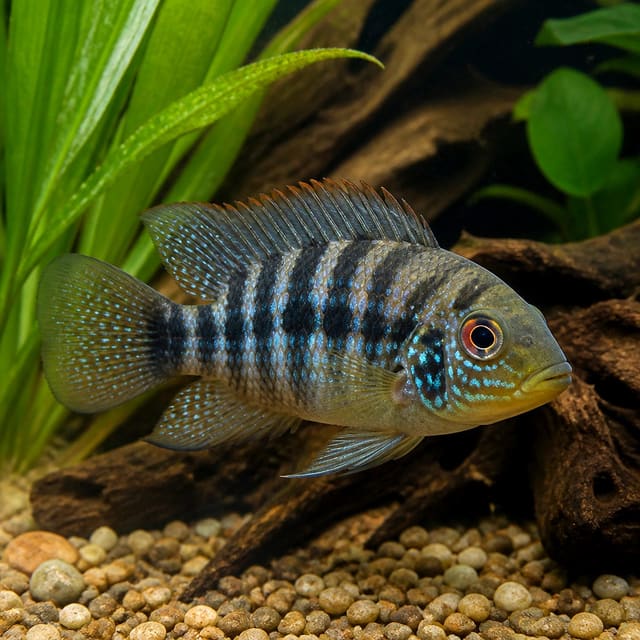
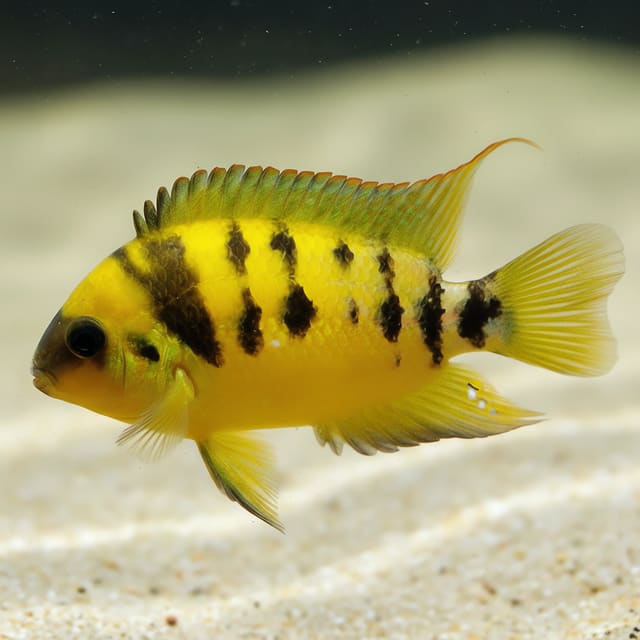
The photograph shows the look the trade name refers to: an orange-red head and face, rows of iridescent blue-green scales, faint darker bars and a dark blotch in the middle of the flank, with long pelvic fins trailing below. Gallery images have been digitally enhanced to improve image quality. Natural colour, pattern, size and maturity can vary between live animals.
If you are still comparing fish for a South American set-up, you can browse our South American cichlids to weigh this eartheater against other cichlids from the same continent before you decide.
The trade name has three parts. "Red Head" is the colour. "Tapajos" points to the Rio Tapajós, a river in Brazil; it tells you where the name comes from, but a trade name is a label rather than a documented collecting record for any particular fish. "Eartheater" is the popular name for the group that Geophagus belongs to, and it describes the behaviour you will watch every day.
Geophagus is an accepted genus in the cichlid family, Cichlidae, as the World Register of Marine Species record for Geophagus shows. The "sp." after the genus name means the fish has been placed in Geophagus without being matched to a named species. It is an honest label: the genus is settled, the species is not, and that is why the care on this page is written for the genus and its care group rather than for one species.
Geophagus species live mainly in South America, as far south as Argentina and Uruguay, and one species is recorded from Panama. They are found in a wide range of freshwater habitats. That spread explains why the wild conditions of one population cannot simply be copied onto a fish whose species is unknown. Steady aquarium conditions within the care-group guidance are the better aim.
Eartheaters mostly feed by picking up mouthfuls of sediment and sifting out food items such as invertebrates, plant material and detritus, as the Wikipedia summary of the genus Geophagus describes. In the aquarium this looks like repeated foraging along the floor: the fish dips its head to the sand, takes a mouthful, sorts through it and lets the sand fall away before moving on and starting again.
That behaviour has practical consequences for the way you set up and run the tank:
Set the aquarium up for the fish this will become rather than the fish that arrives. OATA advice for American cichlids is to buy, within reason, as large an aquarium as possible. It gives two planning figures: at least 120 litres for a pair of the smaller species, those under 15 cm, and at least a 300 litre aquarium for the larger or more aggressive species over 15 cm. With the largest Geophagus reaching up to 28 cm in standard length and this fish not matched to a species, plan around the larger figure of 300 litres.
An aquarium measuring 120 × 50 × 50 cm holds about 300 litres before any sand or decor goes in, and gives a floor of 120 by 50 cm to forage across. Sand, rock and wood take up part of that volume, so the same tank holds a little less water once furnished. If you are choosing between two tanks of similar volume for an eartheater, pick the longer and wider one over the taller one.
The larger the aquarium, the more stable conditions such as temperature and water quality will be. A big volume dilutes waste between water changes and changes temperature more slowly, which gives you time to notice and correct a problem before it affects the fish.
For a fish that spends much of its day working through the sand, floor area is more useful than height. A long footprint gives it more ground to forage and gives companions room to keep their distance. Keep a broad strip of open sand along the front, so feeding is easy to watch and food is easy to find.
OATA recommends fine aquarium gravel or sand for American cichlids, because many species will dig or sift the substrate when feeding or breeding. For an eartheater, fine sand is the natural choice. American cichlids may also dig up or eat live plants, and OATA suggests plastic plants as a suitable way to provide cover. If you prefer living plants, place them where uprooting will not ruin the layout, and be ready to replant.
Whatever the size of the aquarium, a filter is always essential. Fish release ammonia, which is toxic, and a working biological filter is what deals with it. Choose a filter suited to the full volume of the aquarium, keep it running continuously and maintain it on a regular routine.
A new filter needs time to build up the beneficial bacteria that process waste. Adding fish before that population exists, or stocking too quickly, can result in what OATA calls new tank syndrome: not enough nitrifying bacteria to cope with the waste, unhealthy levels of ammonia and nitrite, and fish that may become ill and die. Our step-by-step guide to setting up and maturing a first tropical tank walks through the process from empty glass to ready aquarium.
The figures below come from the OATA care sheet for American cichlids. OATA describes them as a general guide for the group and advises checking for any species-specific needs; as this fish has not been matched to a species, the group figures are the sound basis for planning. Aim for steady readings inside these ranges rather than chasing one exact number.
| Measure | Guidance for American cichlids |
|---|---|
| Temperature | 22–27°C |
| pH | 6.5–8.0 |
| General hardness (GH) | Soft to medium, 4–12°dH |
| Carbonate hardness (KH) | Soft to medium, 3–10°dKH |
| Ammonia | Zero mg per litre |
| Nitrite | Zero mg per litre |
| Nitrate | No more than 20 mg per litre above your normal tap water level |
OATA notes that American cichlids are usually undemanding of water chemistry. Test a sample of your own conditioned tap water for pH, general hardness and carbonate hardness before the fish arrives, so you know where you are starting from. If the readings already sit inside the ranges above, the simplest plan is to keep them there with regular water changes rather than trying to adjust the chemistry. Steady water that stays within the range serves the fish better than repeated corrections.
Fish release ammonia into the water. In a working biological filter, beneficial bacteria convert ammonia to nitrite, which is also toxic, and then to nitrate, which is safer; the RSPCA guidance on aquarium environments sets out the same chain. Good husbandry is essential, as American cichlids can be stressed by even the smallest amounts of ammonia. A reading above zero for ammonia or nitrite is a signal to act, not to wait.
Test the water regularly, at least once per week, so ammonia and nitrite never have the chance to build up unnoticed. Keep a simple note of each reading: a slow rise in nitrate or a drifting pH is far easier to spot on paper than by memory.
If the numbers are new to you, our guide to aquarium water parameters and what to test explains what each reading measures and why it matters. You can also enter your own results into our water parameter matcher to compare them with the guidance above before you order.
Hold the aquarium steady within 22–27°C using a heater with a thermostat, and confirm it with a separate thermometer that you can read at a glance. Check it when you feed, so a failed heater is noticed within a day rather than at the next water change.
OATA strongly recommends a 25% partial water change at least once every week. For a fish that lives on the floor and sifts it constantly, removing solid waste from the sand matters as much as replacing the water. A simple weekly order of work keeps the job quick:
Between water changes, a daily look at the fish, the thermometer and the filter output takes a minute and helps you catch problems early.
OATA describes American cichlids as generally omnivorous, often preferring meaty foods. Eartheaters add their own feeding style: in the wild they sift sediment for invertebrates, plant material and detritus. Put together, the aim is a varied diet that reaches the sand, built around a good cichlid food and topped up with meaty extras.
Feed once a day, offering only what the fish can eat within a few minutes. American cichlids can eat large amounts in one sitting, so it is easy to overfeed. Overfeeding leads to extra waste and uneaten food that breaks down and releases toxic waste into the water, undoing the work of your filter and water changes. If food is still lying on the sand after a few minutes, offer less next time.
One feed a day, sized so it is cleared within a few minutes, with the foods rotated through the week, might look like this:
| Day | Food |
|---|---|
| Monday | Sinking cichlid pellets |
| Tuesday | Frozen bloodworm, thawed |
| Wednesday | Sinking cichlid granules |
| Thursday | Frozen brine shrimp or daphnia, thawed |
| Friday | Sinking cichlid pellets |
| Saturday | A freeze-dried food for variety |
| Sunday | Sinking cichlid granules |
In a community aquarium, faster fish in mid-water can take food before it reaches the sand. Drop sinking food where the eartheater forages and watch that it actually eats rather than assuming it has. A fish that loses interest in food is one of the warning signs listed in the health section below.
A fish bought at 4–8 cm will change a good deal as it grows, and the aquarium should be ready for that from the start rather than upgraded later. Three things change as it gets bigger:
How large it finally becomes depends on the species, which has not been identified. Treat the genus maximum of 28 cm in standard length as the upper bound for planning. American cichlids can live for several years in a well matured set-up with good water quality, so the aquarium you choose now is the one it is likely to live in for a long time.
Make sure the aquarium is ready: filter matured, temperature steady and a fresh test showing zero ammonia and zero nitrite. OATA advises checking that the aquarium is an appropriate size for the species before buying, and adding fish slowly, because the filter bacteria need to increase every time more fish are added and feeding increases.
Everything is hand-packed by our team. Fish are bagged in pure oxygen and packed in an insulated poly box, with a heat pack when the weather calls for it, then carried by a tracked, licensed live-animal courier. We email the tracking number and your confirmed delivery date, so you know when to be in. The full terms are on our delivery and Live Arrival Guarantee page.
Give the fish time to settle before judging it. Watch that it begins foraging on the sand and takes food, and look for the signs of a healthy fish that OATA lists: clear, bright eyes, undamaged fins, intact scales, no ulcers or bumps and normal swimming.
Keep testing through this period, because a new fish adds waste to the filter. If you plan to add more fish later, do it gradually rather than all at once, so the bacteria can keep pace. Overstocking or stocking too quickly is the route to the new tank syndrome described in the planning section.
All fish show slight variations in behaviour and appearance, but noticing a change early gives you time to act before it becomes a real health issue. OATA suggests keeping an eye on changes in the following:
If you notice any of these, test the water quality first. Ammonia, nitrite and nitrate readings show whether the aquarium itself may be the cause. Then contact us with your readings and a description of what you have seen, and we will help you decide what to do next.
OATA is candid that mixing American cichlids can be difficult. The group varies in both size and temperament, and some species may be very aggressive. Calmer species can be mixed in a robust community aquarium with larger shoaling species, while the more aggressive species must be kept either alone or with equally aggressive cichlids. Because this eartheater has not been matched to a species, treat its temperament as something to watch rather than something to assume.
Most American cichlids do better either singly or in pairs, according to OATA, although a few species need a group. For this fish, a single eartheater or a pair in a large aquarium is the simplest plan. Some American cichlids show no obvious differences between the sexes unless they are breeding, so two young fish bought together are two fish of unknown sex rather than a planned pair.
| Companion type | Guidance |
|---|---|
| Larger shoaling fish | The usual partners for calmer American cichlids in a robust community aquarium. |
| Other American cichlids | Possible, but mixing is often difficult; plan the space and watch closely. |
| Highly aggressive cichlids | Avoid: OATA advises keeping the more aggressive species alone or with equally aggressive cichlids. |
| Very small shrimp and snails | Treat as possible food for a fish that sifts invertebrates from the sand. |
| Delicate live plants | May be dug up or eaten. |
An eartheater spends much of its time on and just above the sand. Companions that live in mid-water and near the surface use a different part of the aquarium, which leaves the floor to the eartheater and eases competition at feeding time. A second species that also feeds from the sand means two fish working the same ground, so it needs more floor area and closer watching.
Add fish gradually rather than all at once, so the filter can keep pace with the extra waste. Watch closely for several days after any addition, particularly at feeding time, when competition is most obvious. A fish that is chased away from the sand, hides more than usual or stops eating needs attention, and it helps to have a spare aquarium or another plan ready before you mix cichlids.
If you are planning a mix and are unsure how it will work, we are happy to talk it through with you before you order, using the size of your aquarium and the fish you already keep.
Its own adult size cannot be given with confidence, because the fish has not been matched to a species. It is sent at 4–8 cm, and the largest species in the genus Geophagus reach up to 28 cm in standard length, so plan the aquarium for a large fish.
Plan for at least 300 litres with a wide floor of fine sand. OATA gives 300 litres for American cichlids over 15 cm and 120 litres for a pair of smaller species; with the species unknown and the genus including large fish, the larger figure is the safer plan.
OATA guidance for American cichlids is that most do better singly or in pairs, although a few species need a group. Start with one fish, or two in an aquarium large enough for both, and watch how they share the sand before adding more.
Yes, if the aquarium is already large, filtered and mature. OATA describes American cichlids as usually undemanding, but this fish needs room to grow, open sand to forage and a weekly water change, and its exact species is unknown, so a steady routine matters most.
It is an omnivore that often prefers meaty foods, and in the wild eartheaters sift sand for invertebrates, plant material and detritus. Feed a sinking cichlid pellet or granule, add frozen or freeze-dried daphnia, brine shrimp or bloodworm, and give only what it clears within a few minutes, once a day.
OATA broad guidance for American cichlids is 22–27°C, pH 6.5–8.0 and a general hardness of 4–12°dH, with ammonia and nitrite at zero and nitrate no more than 20 mg per litre above tap water. Keep readings steady inside that range rather than chasing one exact figure.
Temperament varies widely among American cichlids. Calmer kinds can share a robust community aquarium with larger shoaling fish, while more aggressive kinds must live alone or with equally aggressive cichlids. With the species unknown, introduce it carefully and watch its behaviour for the first weeks.
Larger shoaling fish in a robust community suit calmer American cichlids. Avoid highly aggressive cichlids, take care when mixing other American cichlids, and treat very small shrimp and snails on the sand as possible food rather than companions.
It is hand-bagged in pure oxygen, packed in an insulated poly box with a heat pack when the weather calls for it, and carried by a tracked, licensed live-animal courier. Someone must be in to receive it. Film one continuous unboxing video from the sealed parcel to the fish still in its bag, then float the bag for 20–30 minutes before releasing the fish.
These public sources underpin the identity, natural history and care guidance on this page.
No reviews for this item yet. Bought one? Honest reviews only, good or bad.
What customers say about ordering from us
Easy website plenty of info on fish your buying great to pick a time slot
TRACEY DURRANT · 7 Oct 2026
Got some lovely fish thank you
Kevin Mackie · 7 Oct 2026
Reviews of our shop, collected by Judge.me, an independent third-party review collector. Newest first.