−15%
Easy
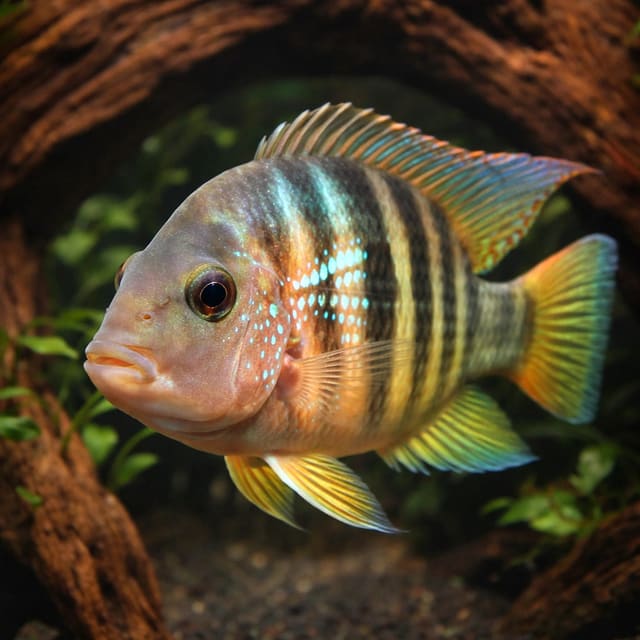
Electric Blue Acara (Andinoacara pulcher) – Neon Blue, 2–7cm Sizes
22–23°C · pH 6.5–8
£6.79£7.99

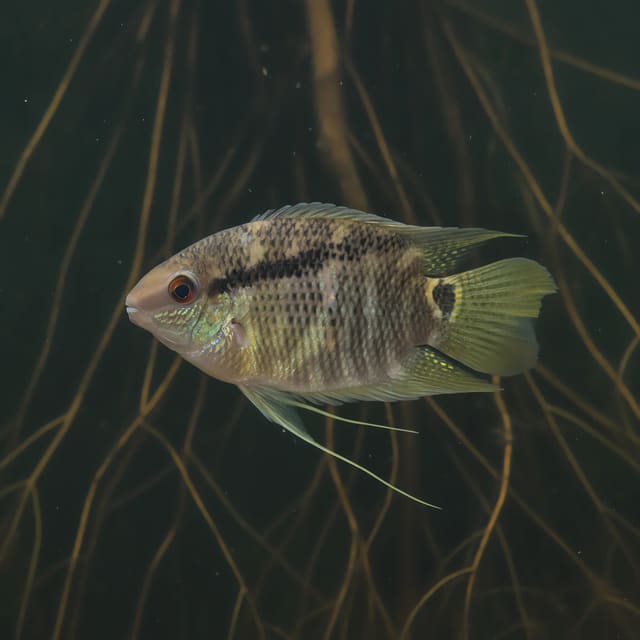
The Keyhole Cichlid (Cleithracara maronii) is a South American cichlid from the Orinoco delta and rivers from Guyana to French Guiana that reaches 7.1 cm standard length. It suits mature, covered aquariums with a base of at least 90 × 30 cm; keep it at 22–25°C and pH 6.0–7.5, the FishBase and Seriously Fish overlap, with 2–15 dGH. Sold individually in 3–4 cm, 5–6 cm, 7–9 cm and XL sizes.
Adult size is the maximum length this species reaches at full maturity (scientific sources). The livestock you receive will be younger and smaller — pick a size variant above for the actual shipping size. Product-photo provenance and any image-specific limitations are stated on the listing.
Cleithracara maronii
Save when buying multiple fish. Each quantity is one fish; sex and pair formation are not guaranteed unless the selected variant explicitly states them.
Confirm your email, then we’ll send an availability message for this exact item if it returns within 180 days.
This request is only for this product—no newsletter or other promotions. A mail-provider retry may very rarely duplicate the same availability message. Unconfirmed addresses are removed after 48 hours. See our privacy policy.
The Keyhole Cichlid (Cleithracara maronii) is a South American cichlid from the Orinoco delta and rivers from Guyana to French Guiana that reaches 7.1 cm standard length. It suits mature, covered aquariums with a base of at least 90 × 30 cm; keep it at 22–25°C and pH 6.0–7.5, the FishBase and Seriously Fish overlap, with 2–15 dGH. Sold individually in 3–4 cm, 5–6 cm, 7–9 cm and XL sizes.
Adult size is the maximum length this species reaches at full maturity (scientific sources). The livestock you receive will be younger and smaller — pick a size variant above for the actual shipping size. Product-photo provenance and any image-specific limitations are stated on the listing.
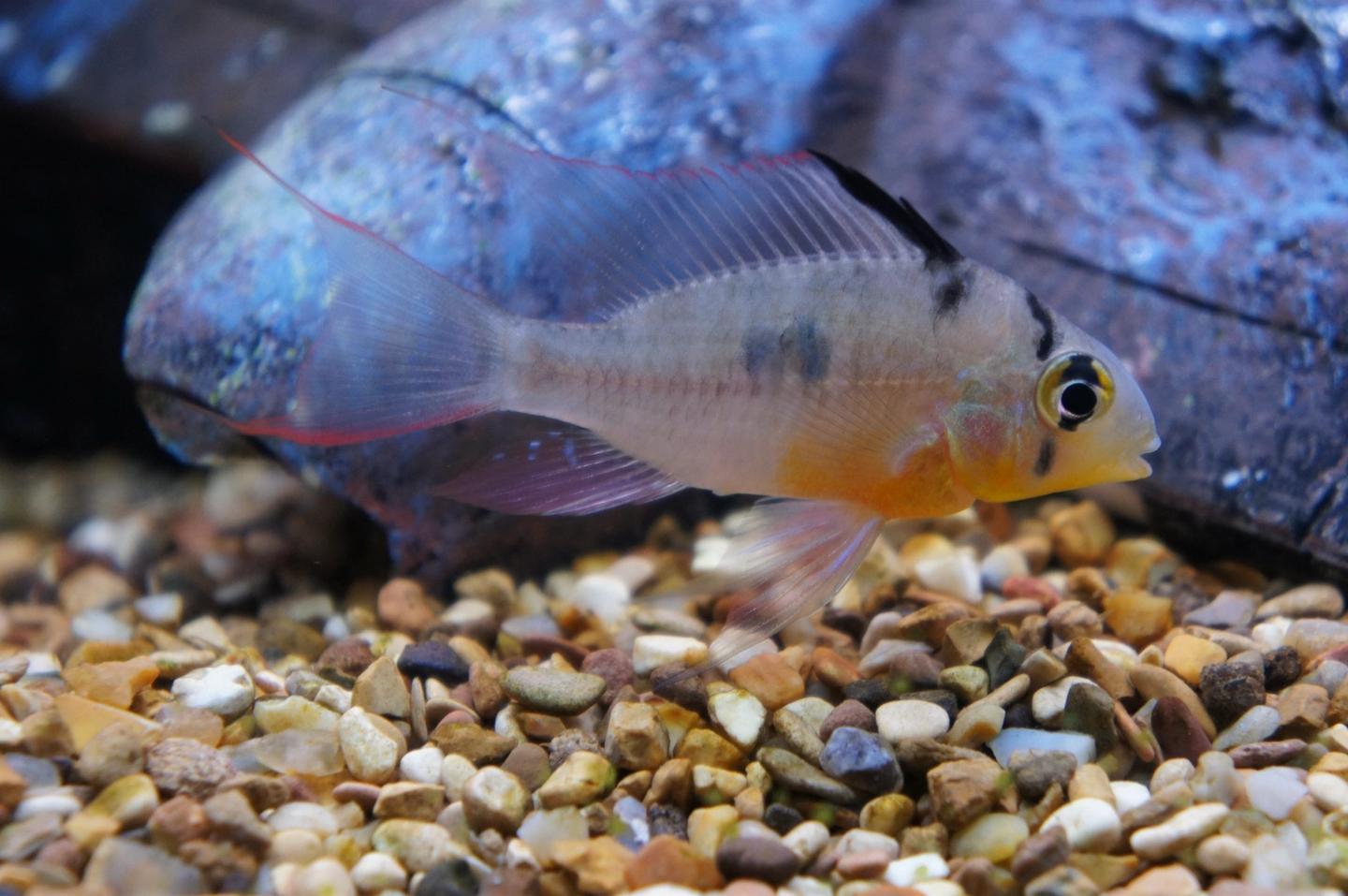
Cichlids are a family of roughly 1,800 accepted species, not one care type. Before buying, identify the exact species and source, then compare adult measurement, usable tank dimensions, social system, territory, tested water, diet and an exit plan. No family-wide minimum tank, water range or tank-mate list is safe.
Maintain these water conditions for optimal health and vibrant colors
The Keyhole Cichlid (Cleithracara maronii) is a South American member of the cichlid family from the Orinoco delta and rivers extending from Guyana to French Guiana. FishBase records a maximum length of 7.1 cm standard length for male or unsexed fish. It suits a keeper prepared to maintain a biologically mature aquarium, excellent water quality, sheltered structure and carefully screened peaceful companions. This naturally shy fish is generally not aggressive outside breeding, but a breeding pair may defend a territory.
The characteristic dark marking on each side resembles a keyhole, giving the fish its familiar common name. When danger is detected, its pattern may darken considerably and the fish may shelter among plants, submerged wood or leaf litter. Cover is therefore a functional part of the aquarium rather than decoration alone.
The Seriously Fish species profile uses 11 cm standard length as its aquarium-planning reference, compared with the 7.1 cm maximum recorded by FishBase. Use the recorded 7.1 cm adult figure consistently when comparing this animal, while giving it the footprint, cover and community space attached to the more cautious aquarium plan.
| Suits | Not suited to |
|---|---|
| A biologically mature aquarium with excellent water quality | A biologically immature aquarium |
| A base of at least 90 × 30 cm with plants, wood or other cover | A cramped or exposed layout without retreat areas |
| Peaceful fish sharing its water conditions | Aggressive or territorial fish, or species requiring harder water |
| A keeper prepared for territorial behaviour during breeding | A community with no space or separation plan for a breeding territory |
Plan movement as carefully as shelter. High flow rates should be avoided, so position the filter return to retain circulation without forcing the fish to remain in a strong current. Plants, wood, pipes or other structures should create retreat areas while leaving usable routes through the aquarium.
Older aquarium literature may place the fish in Acara or Aequidens. Its current scientific name is Cleithracara maronii; those older genera explain why historical labels can look different without representing a different keyhole cichlid.
One purchase supplies one Keyhole Cichlid from the size selected on the page. Use the live size selector to choose the dispatch size that fits your aquarium plan.
| Size label | What it means |
|---|---|
| 3–4 cm | The animal’s dispatch size. |
| 5–6 cm | The animal’s dispatch size. |
| 7–9 cm | The animal’s dispatch size. |
| XL | A dispatch size labelled XL without a stated centimetre range. |
The size you select is the size supplied, not the adult size. Use the selected size to understand the animal sent, then plan the permanent aquarium around the recorded adult size and a base measuring at least 90 × 30 cm or equivalent.
Sex is guaranteed only when the selected option explicitly states male or female. This Keyhole Cichlid listing has no sex-guaranteed option.
The gallery images are representative of this type of animal rather than photographs of the exact animal supplied, so colours can look slightly different from the live animal.
These figures define a suitable starting point, but the other fish, usable floor area and territorial boundaries still matter. A nominally large aquarium can be unsuitable when aggressive residents dominate it or all cover occupies one small area.
Prepare the aquarium before selecting the animal. Check its measurements, test the water and decide where retreat areas will sit. Read our delivery and Live Arrival Guarantee policy for the current packing, reception, acclimatisation and claim arrangements.
Start with an aquarium base measuring at least 90 × 30 cm or an equivalent footprint. Seriously Fish associates that minimum with approximately 81 litres, but the base dimensions remain the important planning figure because structure, territories and sheltered routes all use horizontal space. Increase the footprint when other fish or several keyholes must share the layout.
The aquarium must be biologically mature before this cichlid is introduced. If you are preparing a new system, follow our first tropical aquarium guide before choosing an introduction date.
| Layout element | Reason to include it |
|---|---|
| Wood roots or branches | They form sheltered routes and break up exposed areas. |
| Plants | The fish can retreat among them, and the species tends not to dig. |
| Leaf litter | It can form part of a natural-looking sheltered arrangement. |
| Pots or pipe | Ceramic flowerpots and plastic piping are useful artificial cover. |
| Flat rock | One or two water-worn rocks can act as potential spawning surfaces. |
A soft sandy substrate supports a natural-looking display, while OATA’s American-cichlid advice also permits fine aquarium gravel or sand. Choose aquarium-safe material and keep enough exposed base for routine waste removal. Because keyholes tend not to dig, most planted aquariums can work when the plants also leave navigable routes between shelters.
Spread structure across the footprint rather than concentrating every retreat in one corner. Several separated shelters allow a shy fish to move away from disturbance without crossing an entirely exposed tank. Wood, planting and upright décor can interrupt direct views while preserving access for cleaning.
Keep the layout practical. Place shelters where you can still observe breathing, body condition and feeding, and leave access around the filter intake. If breeding is not part of the plan, flat surfaces remain optional; cover and water quality are the essential elements.
Do not compensate for a small footprint by filling the aquarium densely with décor. The minimum base must still provide usable movement and distinct retreat areas after wood, plants and equipment are installed. Measure the clear internal footprint, sketch where the main structures will sit and check that the fish can pass between them without entering a high-flow zone.
Keep Cleithracara maronii at 22–25°C and pH 6.0–7.5. These routine values are the overlap of FishBase’s recorded range and the Seriously Fish aquarium range. Use 2–15 dGH for general hardness, as given by the species aquarium profile.
OATA’s American-cichlid sheet gives 22–27°C, pH 6.5–8.0 and 4–12 dGH as group guidance. Those figures can help with community screening, but this fish’s routine temperature must remain within 22–25°C and its pH must not exceed 7.5.
Test the aquarium rather than choosing a target from appearance or a general description such as soft water. Our water chemistry guide explains what the measurements mean, while the water matcher can compare your readings with the stated range.
| Example reading | Decision |
|---|---|
| 24°C, pH 7.0, 8 dGH | All three values sit within the routine aquarium ranges. |
| 20°C | Below the 22°C routine boundary; correct the temperature before introduction. |
| pH 7.8 | Above the 7.5 ceiling for this fish. |
| 16 dGH | Above the 15 dGH upper boundary and unsuitable without an appropriate water plan. |
A reading inside these ranges is only one part of the decision. Ammonia and nitrite must both be zero, and the filter must be mature enough to process the waste created by the complete stocking plan. Temperature, pH and hardness must also suit every peaceful companion being considered.
Avoid chasing a particular number merely because it appears in the middle of a range. Select a workable point that your aquarium can maintain, then test regularly so a change is noticed before it becomes a welfare problem. For a community, use the narrow overlap shared by every resident rather than selecting a different target for each fish.
Never introduce a Keyhole Cichlid to a biologically immature aquarium. Water quality is particularly important for this species, and deteriorating conditions are associated with health problems. A clear-looking aquarium is not necessarily biologically ready, so use test results and filter maturity rather than appearance.
The RSPCA explains why aquarium filtration is vital: fish release toxic ammonia, biological-filter bacteria convert it to toxic nitrite and another stage converts nitrite to the safer nitrate. Both ammonia and nitrite must read zero before the animal is introduced.
| Check | Required decision |
|---|---|
| Ammonia | Proceed only when the test reads zero mg/l. |
| Nitrite | Proceed only when the test reads zero mg/l. |
| Filter maturity | Confirm an established biological bacterial population is processing waste. |
| Stocking change | Add fish slowly so the bacterial population can respond to the increased waste and feeding. |
| Filter flow | Provide adequate turnover without creating the high flow this species should avoid. |
Do not add several unplanned fish at the same time simply because the aquarium previously tested well. OATA warns that increasing livestock too quickly can cause new tank syndrome when nitrifying bacteria cannot process the additional waste. Treat each addition as a change in the load placed on the biological filter.
If ammonia or nitrite is above zero before introduction, postpone the stocking step and restore biological performance. Check that the filter is operating, has not been run under the tap and is not blocked. Retest after the system has stabilised rather than relying on a single improved reading.
Nitrate is managed through maintenance rather than by the first two stages of the biological filter. OATA advises that it should not exceed 20 mg/l above the normal tap-water level. Test the tap water as the comparison point: if tap water measures 10 mg/l nitrate, the group ceiling works out at 30 mg/l in the aquarium.
These readings have different jobs. Zero ammonia and zero nitrite are immediate prerequisites, while the nitrate comparison helps assess whether water changes and stocking are keeping accumulated waste under control.
For an aquarium of about 81 litres, the species profile uses a filter turnover of four to five times the aquarium volume each hour. That calculation gives approximately 325–405 litres per hour. Treat the rating as an equipment starting point, then arrange the return so the fish is not forced to live in a strong current.
Filter ratings do not guarantee identical real-world flow after media, pipework and head height are considered. Observe whether the sheltered areas remain calm and position the return accordingly. Reducing an uncomfortable jet is different from turning filtration off; biological filtration must continue operating.
OATA strongly recommends a 25% water change at least once a week. In an 81-litre aquarium, 25% is approximately 20.25 litres. The exact amount in practice depends on the aquarium’s true water volume after substrate and décor, but the calculation gives a useful preparation figure for buckets and conditioner.
| Maintenance task | How to complete it |
|---|---|
| Test water | At least once a week, check that ammonia and nitrite remain at zero and compare nitrate with the tap-water baseline. |
| Remove water | Siphon 25% at least once a week, taking solid waste from accessible substrate areas. |
| Treat replacement water | Use tap-water conditioner to address chlorine or chloramine before adding it. |
| Check the filter | Look for blockages and confirm that flow has not changed unexpectedly. |
| Clean media when needed | Rinse it lightly in removed aquarium water; do not rinse it under the tap. |
Chlorine or chloramine can harm the beneficial bacteria living in filter media. Avoid replacing or aggressively cleaning all media during routine maintenance because biological performance depends on retaining that population. Link each task to a measurement or observation: test the water, inspect the filter, remove accumulated waste and confirm the temperature after replacement water is added.
Keyhole Cichlids forage as omnivores, taking benthic invertebrates and organic detritus in nature. FishBase also records worms, crustaceans and insects in the wild diet. In an aquarium they accept most prepared foods, but variety is important for good condition. Use a quality dried product as part of the diet and rotate suitable live or frozen items.
| Food type | Role in the diet |
|---|---|
| Quality dried food | A practical prepared foundation, offered in an appropriate bite size. |
| Bloodworm | Use live, frozen or freeze-dried forms as part of the varied rotation. |
| Artemia | Offer live, frozen or freeze-dried forms according to the product used. |
| Daphnia | A suitable smaller live or frozen food for an American cichlid. |
| Gel food | A prepared mixture can be cut into bite-sized discs when using a suitable recipe. |
OATA’s group feeding schedule is once a day, offering only what the fish can eat within a few minutes. Start with a modest amount, observe the response and stop before uneaten food accumulates. Keyholes can be shy, so watch whether the individual actually reaches the food rather than judging the portion only by how quickly the whole community clears it.
Overfeeding creates more faeces and leaves uneaten food to break down, adding waste that the biological filter must process. A large single meal is therefore not a shortcut to good condition. The useful measure is whether the fish receives a varied diet while the aquarium remains clean and chemically stable.
Do not rely on one favourite frozen food as the entire diet. Rotate it with quality dried products and other suitable items so “varied” describes the feeding pattern across time, not the number of foods tipped into one meal. Keep pieces bite-sized and observe body condition alongside appetite during the regular health check.
Prepare the receiving aquarium before the fish arrives: confirm a base of at least 90 × 30 cm, mature biological filtration, 22–25°C water, pH 6.0–7.5, hardness of 2–15 dGH and zero ammonia and nitrite. Check that cover is distributed across the aquarium and that the filter return does not create a high-flow zone.
Introduce this animal as one planned stocking step rather than combining it with several unrelated additions. Beneficial bacteria need to respond as waste and feeding increase, so slow stocking protects the biological filter from a sudden load.
| Checkpoint | What to do |
|---|---|
| Water | Test ammonia and nitrite and act before either rises above zero. |
| Breathing | Compare gill movement with the fish’s usual rate and investigate a marked change. |
| Colour | Remember that the pattern may darken when the fish detects danger; check the surroundings and companions. |
| Cover use | Confirm the fish can shelter among plants, wood or leaf litter without being trapped by another resident. |
| Feeding | Offer a modest daily portion and make sure the individual takes food. |
| Fins and scales | Look for damage, loss or new marks during routine observation. |
Hiding is a behaviour to interpret, not a reason to remove all shelter. Keyholes use cover when they perceive danger, and taking that cover away can leave the fish more exposed. Instead, examine whether aggressive behaviour, excessive flow or a poorly divided layout is preventing normal movement.
Keep the first week predictable. Complete essential maintenance without repeatedly disturbing every shelter, and observe from enough distance to see whether the fish emerges, feeds and moves normally when the aquarium is calm. Record the test results so a later change can be compared with a real baseline.
If the pattern darkens only during a disturbance and the fish later resumes feeding and ordinary movement, continue observation while keeping the aquarium calm. If dark colour accompanies abnormal breathing, damaged fins, loss of appetite or persistent isolation, move to the health-response checks rather than assuming shyness explains everything.
Learn the individual fish’s usual swimming, colour, breathing, appetite and use of cover. OATA notes that fish vary in behaviour and appearance, so the useful warning is often a change from the established pattern rather than one isolated pose.
| Change observed | First response |
|---|---|
| Hanging at the surface, sitting on the bottom or erratic swimming | Test the water and inspect filter operation. |
| Faster or slower gill movement | Check water quality, temperature and visible stress from other fish. |
| Darker or paler colour | Consider the keyhole’s threat response, then look for accompanying health or behaviour changes. |
| More hiding or new aggression | Assess companions, breeding behaviour, cover and territorial boundaries. |
| Reduced food intake | Test the water and compare body condition with earlier observations. |
| White spots, fluffy growths, ulcers, bumps or damaged scales and fins | Check water quality promptly and seek case-specific guidance. |
When a health change appears, test ammonia and nitrite first because even small amounts can stress American cichlids. Compare nitrate with the tap-water baseline, confirm temperature remains within 22–25°C and check that the filter has not become blocked.
Do not interpret every darkening event as disease. The species may darken considerably and take cover when it detects danger. Context matters: look at what happened immediately beforehand, whether another fish approached and whether ordinary movement and feeding resume.
Conversely, do not dismiss a cluster of signs as shyness. Dark colour combined with rapid breathing, appetite loss or damaged fins calls for immediate water testing and a review of the community. Record when the change began and the measured water values; concrete observations make the next decision more precise.
If you are concerned about a health change, test the water and contact us for guidance. Avoid selecting a treatment from appearance alone because different problems can produce similar behaviour, and maintaining safe water remains the first practical step.
Keyhole Cichlids are generally not aggressive unless breeding, and the species profile considers most peaceful fish sharing similar environmental conditions as possible companions. That is a screening starting point rather than a universal tank-mate guarantee because behaviour, adult size, water chemistry and the complete stocking plan still matter.
| Test | Decision rule |
|---|---|
| Temperament | Avoid aggressive or territorial fishes that may intimidate a naturally shy keyhole. |
| Water | Avoid fishes requiring harder water; every resident must share a workable point within 22–25°C, pH 6.0–7.5 and 2–15 dGH. |
| Predation | The profile says keyholes do not predate fish larger than a few millimetres, so fish only a few millimetres long require caution. |
| Breeding | Allow for a normally calm fish to defend a territory when breeding. |
Open-water characids or similar calm schooling and shoaling fish are particularly recommended in the species profile. Their presence may act as a cue that no threat is nearby, encouraging a shy keyhole to behave more confidently. This benefit still depends on those fish sharing the water conditions and not overwhelming the cichlid at feeding time.
Do not choose companions solely because they come from South America or carry a “community” label. Geographic association does not settle adult size, aggression, feeding competition or water requirements. Compare the actual needs of each fish and assess the aquarium as one community.
A peaceful combination can still fail if all fish compete for the same sheltered area. Provide several retreats, keep calm open-water space for suitable shoaling fish and ensure no resident controls every route between cover and food.
Compatibility remains conditional on individual behaviour and the full aquarium plan. Ask us for a stocking assessment with the aquarium dimensions, measured water values and complete resident list. To research other profiles without assuming they are compatible, browse the South American cichlid collection.
Juvenile Keyhole Cichlids are gregarious, but the species profile presents a group of young fish primarily as a route to natural pair formation. Pairs should be separated as they form. A group purchase therefore requires spare aquarium capacity and a realistic separation plan rather than an assumption that every fish will remain together indefinitely.
| Plan | Preparation needed |
|---|---|
| One fish | Apply OATA’s American-cichlid guidance cautiously and focus on peaceful companions, cover and stable water. |
| Prospective pair | Do not assume two unsexed fish form a compatible pair; pair formation is a behavioural process. |
| Juvenile group for pair formation | Use a larger, structured aquarium and prepare to separate pairs as they form. |
| Established breeding pair | Allow a defensible spawning area and screen community fish for territorial conflict. |
OATA’s group guidance says most American cichlids do better singly or in pairs, while the dedicated profile explains the juvenile-group route used for this animal. Use those statements according to the plan: a permanent group and a temporary pair-forming group are not the same arrangement.
This fish is a biparental, monogamous substrate spawner. Eggs may be laid on a flat rock, driftwood, a broad plant leaf or aquarium glass, and both parents participate in reproduction. Young or inexperienced pairs may eat early broods if they feel threatened or are disturbed.
The normally peaceful disposition does not remove territorial behaviour around a spawning site. If a pair begins cleaning or defending a surface, reassess the routes used by every other resident. A community that worked outside breeding may need separation once a territory is established.
Do not use litres alone to plan several fish. Floor area, separated shelters and the ability to move a pair safely are the decisive resources. Starting with the approximately 81-litre minimum for one suitable setup does not create a formula in which each additional fish can simply be assigned another fixed number of litres.
Keep the offer terms separate from the social plan. Each purchase supplies one animal, and its dispatch size does not establish a pair bond, maturity or sex. Build any breeding plan around observed pair formation and sufficient separation capacity.
FishBase records the Keyhole Cichlid at up to 7.1 cm standard length. Seriously Fish uses 11 cm standard length as a cautious aquarium-planning reference, so provide the full recommended footprint rather than planning around its dispatch size.
Use an aquarium with a base of at least 90 × 30 cm or equivalent, associated with approximately 81 litres by Seriously Fish. Provide mature biological filtration, sheltered structure and a filter return arranged to avoid high flow.
OATA’s American-cichlid group guidance supports single or pair keeping. Seriously Fish says a group of young fish can be used for natural pair formation, but pairs should be separated as they form, so that plan needs a larger structured aquarium and spare capacity.
A careful beginner can consider it after establishing a biologically mature aquarium and learning to test water consistently. It needs zero ammonia and nitrite, excellent water quality, cover, restrained flow and carefully screened companions.
Feed it once daily and give only what it can eat within a few minutes, following OATA’s American-cichlid schedule. Use a varied omnivore diet with quality dried food plus suitable bloodworm, Artemia and Daphnia in live, frozen or freeze-dried forms.
Keep it at 22–25°C and pH 6.0–7.5, the overlap of FishBase and Seriously Fish, with 2–15 dGH from the Seriously Fish aquarium profile. Ammonia and nitrite must remain at zero mg/l.
It is generally not aggressive unless breeding, when a pair may defend a territory. Avoid aggressive or territorial fishes, provide several retreat areas and reassess the community if breeding behaviour begins.
Consider peaceful fish that share 22–25°C, pH 6.0–7.5 and 2–15 dGH; Seriously Fish particularly recommends open-water characids or similar calm shoaling fish. Avoid aggressive or territorial fish and species requiring harder water, while treating fish only a few millimetres long with caution.
Tropical Fish Co’s policy requires someone to be present to receive the parcel. Start filming every delivery before opening it and continue in one take from the sealed parcel through opening, with the animal still inside the sealed bag; then float the bag for 20–30 minutes before releasing the fish and never pour the bag water into the aquarium.
Max adult size is the length this species reaches at full maturity (from scientific sources). The livestock you receive will be younger and smaller — pick a size variant on the buy box for the actual shipping size. Product-photo provenance and any image-specific limitations are stated on the listing.
Always research specific species before adding them to your tank. Consider:
No reviews for this item yet. Bought one? Honest reviews only, good or bad.
What customers say about ordering from us
I have a small group of long finned mountain minnows. So was delighted to be able to order ten of this variety to increase the genetics in my tank . The ones I recieved are healthy but it’s to early to give a verdict on wether they are of a long finned type since they are small currently.
Gordon Walker · 23 Sept 2026
100% success travel and "installation". Pleased with quality of purchase. The Siamese fighter a bit "shy" so have not yet seen him at his best yet but looking good. Happy customer. GG
George E Garratt · 21 Sept 2026
Reviews of our shop, collected by Judge.me, an independent third-party review collector. Newest first.