Moderate
Flag Acara (Laetacara curviceps)
20–28°C · pH 4.5–7.5
£6.99
The Flag Cichlid (Mesonauta insignis) is a South American cichlid from the Amazon and Orinoco basins that reaches a recorded maximum of 20 cm total length. It suits keepers who can provide a 120 × 38 cm base of around 137 litres and keep the overlap of FishBase, Seriously Fish and OATA guidance at 26–27°C, around pH 6.5 and 4–12°dH; OATA says most American cichlids do better singly or in pairs. Sold individually in dispatch sizes from 3–4 cm to 10–12 cm.
Adult size is the maximum length this species reaches at full maturity (scientific sources). The livestock you receive will be younger and smaller — pick a size above for the actual shipping size. Product-photo provenance and any image-specific limitations are stated on the listing.
Mesonauta insignis
Save when buying multiple fish. Each quantity is one fish; sex and pair formation are not guaranteed unless the selected variant explicitly states them.
The Flag Cichlid (Mesonauta insignis) is a South American cichlid from the Amazon and Orinoco basins that reaches a recorded maximum of 20 cm total length. It suits keepers who can provide a 120 × 38 cm base of around 137 litres and keep the overlap of FishBase, Seriously Fish and OATA guidance at 26–27°C, around pH 6.5 and 4–12°dH; OATA says most American cichlids do better singly or in pairs. Sold individually in dispatch sizes from 3–4 cm to 10–12 cm.
Adult size is the maximum length this species reaches at full maturity (scientific sources). The livestock you receive will be younger and smaller — pick a size above for the actual shipping size. Product-photo provenance and any image-specific limitations are stated on the listing.

Cichlids are a family of roughly 1,800 accepted species, not one care type. Before buying, identify the exact species and source, then compare adult measurement, usable tank dimensions, social system, territory, tested water, diet and an exit plan. No family-wide minimum tank, water range or tank-mate list is safe.
Maintain these water conditions for optimal health and vibrant colors
Mesonauta insignis is a freshwater cichlid from South America that closely resembles Mesonauta festivus, and both are likely sold under the trade name flag cichlid. FishBase places it in the upper Negro River drainage of the Amazon basin in Brazil and along the Orinoco River in Colombia and Venezuela. FishBase records a maximum of 20 cm total length, so this fish suits a keeper prepared to plan for its full size rather than its dispatch measurement.
FishBase records the wild species in lakes and swamps. In an aquarium, its peaceful temperament and preference for a well-planted layout make it a candidate for a carefully screened community, while its increased aggression when breeding means space and observation still matter. It is not a small-tank fish simply because a smaller specimen can be selected.
| Suits | Not suited to |
|---|---|
| A freshwater aquarium with a 120 × 38 cm base and around 137 litres | An aquarium that falls short of the recommended base dimensions |
| A planted layout with sand, wood, branches and moderate flow | A bare arrangement that cannot provide the recommended planted cover |
| A peaceful community screened for water needs and behaviour | A community where breeding aggression could not be managed |
| Water maintained at 26–27°C, around pH 6.5 and 4–12°dH | A cool-water aquarium or one outside the planned chemistry |
Keepers comparing related layouts can also browse our South American cichlid collection. Treat each fish as an individual when planning the final community, even when every proposed companion belongs to a kind named as peaceful.
One purchase supplies one animal in the size chosen on the live size selector. The selector uses the labels 3–4 cm, 4–5 cm, 5–6 cm, 6–7 cm, 8–10 cm and 10–12 cm. The size you select is the size supplied, not the adult size. Every choice therefore needs an aquarium planned around the recorded 20 cm maximum rather than the measurement at dispatch.
Sex is guaranteed only when the selected option explicitly states male or female. This Mesonauta insignis listing has no sex-guaranteed option.
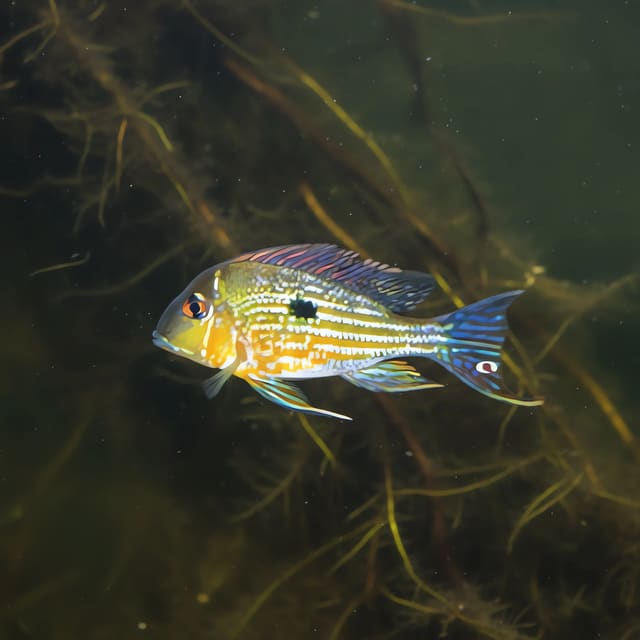
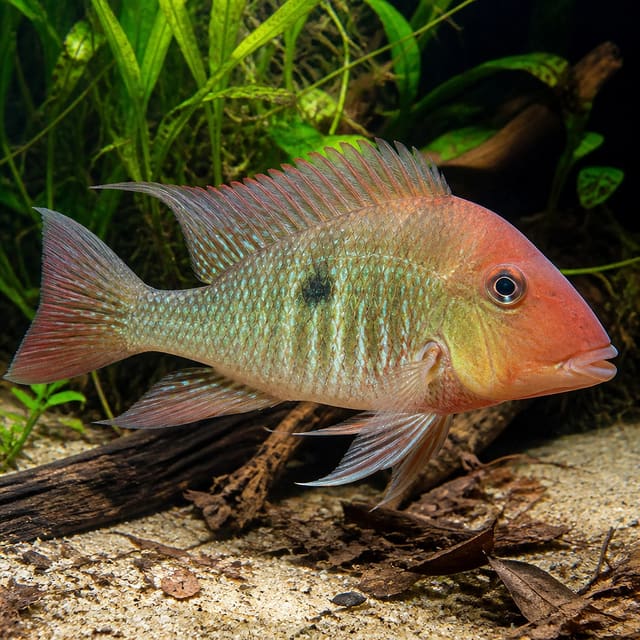
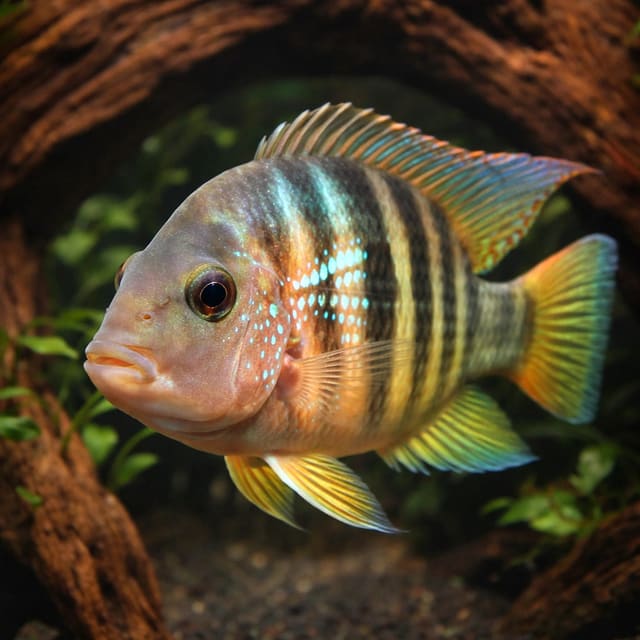
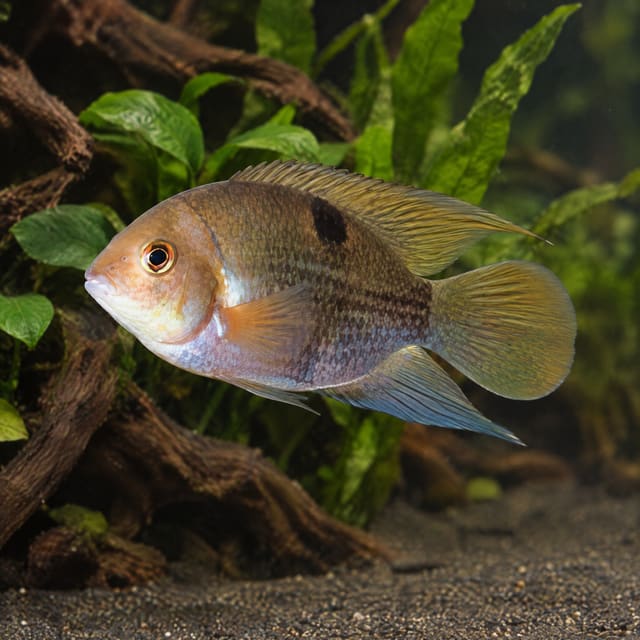
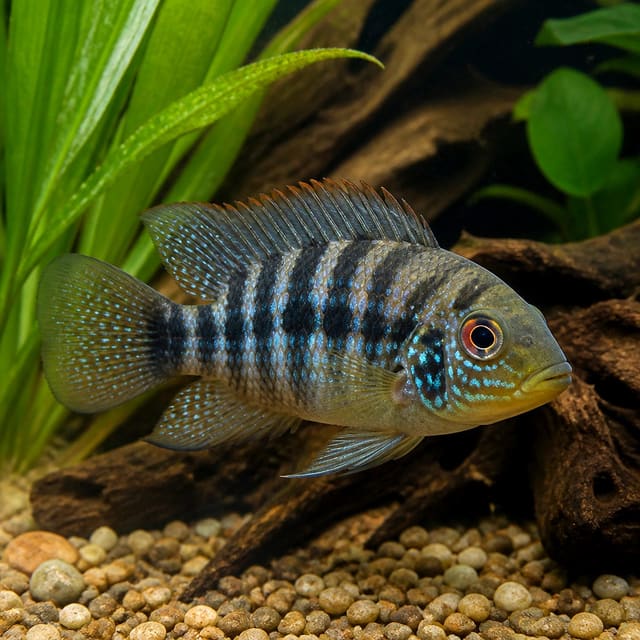
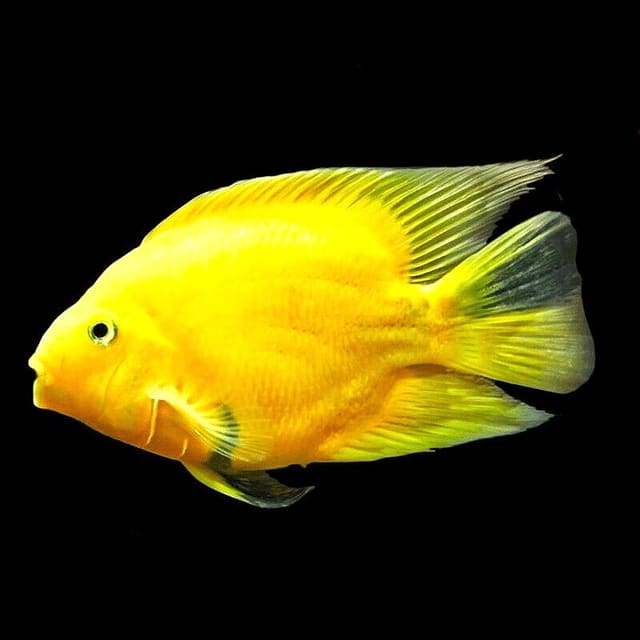
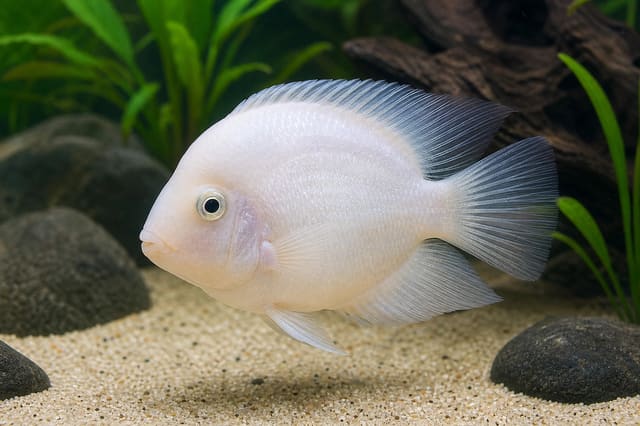
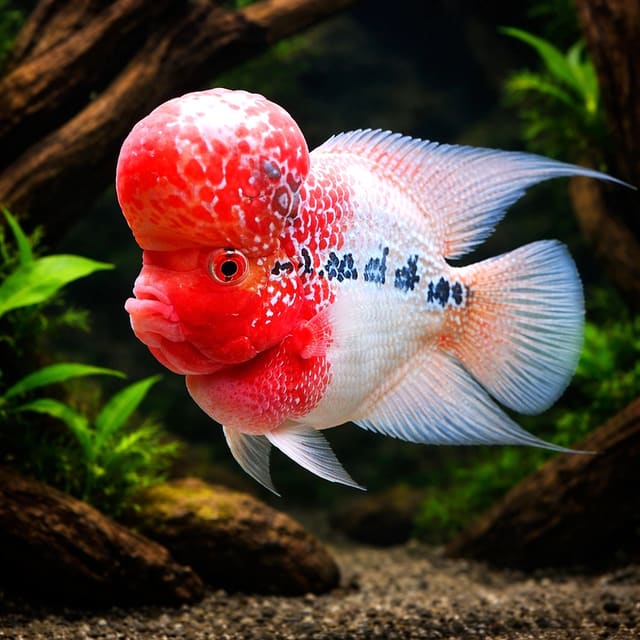
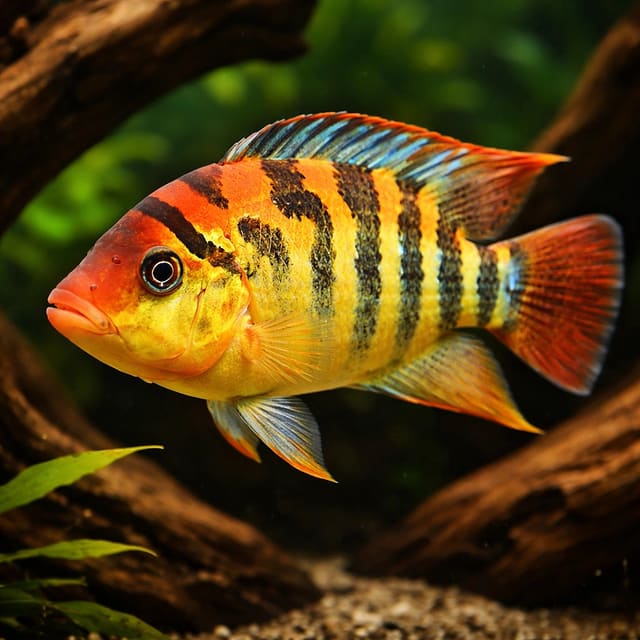
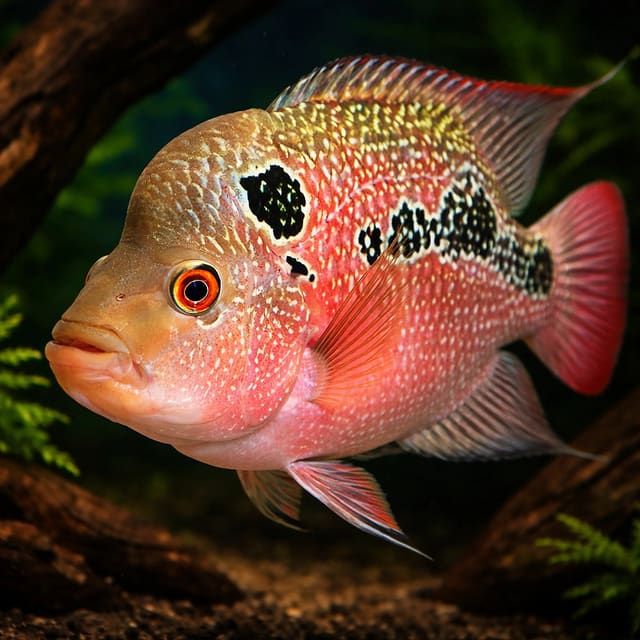
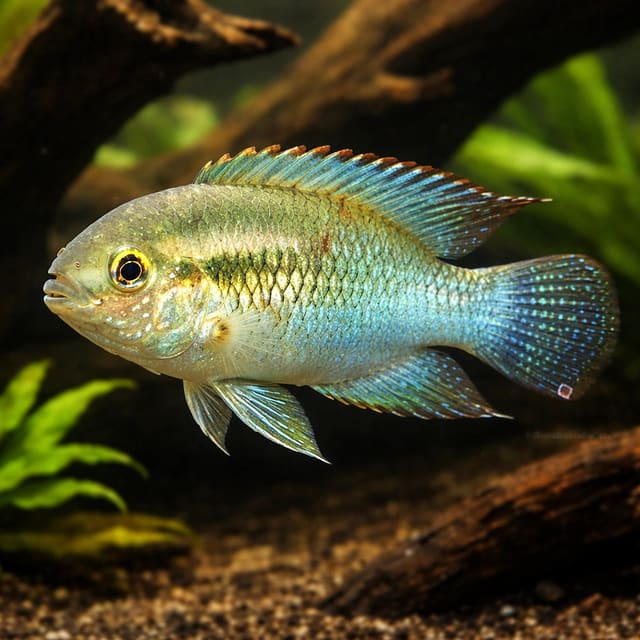
The gallery images are representative of this type of animal rather than photographs of the exact animal supplied, so colours can look slightly different from the live animal.
A smaller dispatch size does not reduce the eventual space requirement. It changes only the size at which the individual enters the aquarium.
Plan around a base of 120 × 38 cm and a volume of approximately 137 litres. The Seriously Fish species profile gives those aquarium dimensions and recommends a well-planted tank with moderate flow and a sandy substrate, with bogwood and branches as suitable decor.
Keep the routine aquarium at 26–27°C, around pH 6.5 and 4–12°dH. Those figures are the overlap of FishBase’s species environment, Seriously Fish aquarium guidance and OATA’s American-cichlid guidance. They give one practical working target rather than asking the fish to tolerate movement across the full outer ranges.
| Decision | Planning figure |
|---|---|
| Recorded adult maximum | 20 cm total length |
| Aquarium base | 120 × 38 cm |
| Volume | Approximately 137 litres |
| Routine water | 26–27°C; around pH 6.5; 4–12°dH |
Use a well-planted aquarium with a sandy substrate, bogwood and branches. Seriously Fish recommends a well-planted tank with sand and moderate water movement for Mesonauta insignis, with bogwood and branches as suitable decor and lighting that is not too strong.
Assess the whole layout against the recommended 120 × 38 cm base. A nominal volume can hide an unsuitable shape, whereas the base measurement preserves the horizontal footprint used by the husbandry recommendation. Keep the approximately 137-litre figure and the base dimensions together when choosing an aquarium.
OATA notes that many American cichlids will dig or sift the substrate when feeding or breeding and may dig up or eat live plants. Check planting regularly and restore uprooted cover before the layout becomes sparse. This is especially relevant when a fish begins preparing or defending a breeding area.
Moderate flow is the target, not stagnant water and not an unnecessarily forceful current. Observe whether the chosen filter distributes water across the planted layout without leaving waste trapped around wood or dense planting. The filtration rate and maintenance routine should then keep waste under control while preserving the planned aquascape.
Leave enough of the recommended base unobstructed for the fish to move around the planted structure. After arranging the wood and branches, view the aquarium from both ends and check that the hardscape has not divided the footprint into cramped pockets. The aim is a planted setting with cover and moderate circulation, while retaining the full practical value of the 120 × 38 cm base.
Keep the aquarium at 26–27°C, around pH 6.5 and 4–12°dH. This working range is the overlap of FishBase’s recorded species environment, Seriously Fish husbandry and OATA’s group guidance for American cichlids.
FishBase records 26–30°C, pH 5.0–8.0 and 1–19°dH for the species’ environment. Seriously Fish also recommends 26–30°C, places the ideal captive pH around 6.5 and allows hardness up to 20°dH. OATA gives 22–27°C, pH 6.5–8.0 and 4–12°dH for American cichlids. The narrower routine target stays inside all three sets of figures.
| Test | Routine target |
|---|---|
| Temperature | 26–27°C |
| pH | Around 6.5 |
| General hardness | 4–12°dH |
| Ammonia | 0 mg/l |
| Nitrite | 0 mg/l |
| Nitrate | Not more than 20 mg/l above the normal tap-water level |
Use our water chemistry guide to identify the measurements each test covers, then compare the measured results with the target through the water matcher. Test the aquarium itself rather than assuming the tap-water reading remains unchanged after conditioning, filtration and routine aquarium use.
If a result sits outside the target, check it again before changing anything. Review temperature, pH, hardness, ammonia, nitrite and nitrate together because a fish showing altered behaviour may be responding to a waste problem even when temperature remains correct. Make the target values the normal condition of the aquarium rather than using the outer species ranges as day-to-day endpoints.
A temperature of 26–27°C does not compensate for detectable ammonia or nitrite, and a pH around 6.5 does not remove the need to monitor nitrate. Record all six measurements together so a later test can be compared with the aquarium’s normal pattern. This makes a gradual shift easier to identify before it becomes a larger water-quality problem.
Run a well-established filter continuously and keep ammonia and nitrite at 0 mg/l. The RSPCA explains that biological filtration supports bacteria that convert toxic ammonia into nitrite and then into the safer nitrate. OATA adds that even small amounts of ammonia can stress American cichlids.
For an aquarium of approximately 137 litres, Seriously Fish recommends turnover of four to five times the aquarium volume per hour. That corresponds to a filter rating of about 550–685 litres per hour. Treat the rating as part of the whole design: plants, sand, wood and branches can influence how evenly water moves through the aquarium.
Clean filter media only when its condition or restricted flow calls for it. Do not rinse it under the tap. Rinse it lightly in aquarium water removed during the partial water change; this reduces the loss of the bacterial population established in the media.
Increase stocking slowly. OATA warns that adding fish and food faster than the bacterial population can adjust may cause new tank syndrome, allowing ammonia or nitrite to rise. After any increase in livestock, continue the weekly schedule and add extra tests if behaviour, breathing or feeding changes.
If ammonia or nitrite is detected, treat the result as a water-quality problem rather than waiting for visible injury. Recheck the measurement, inspect filter flow and blockages, remove decomposing uneaten food during maintenance and continue testing until both readings return to 0 mg/l.
Use the weekly water change to combine several jobs without disturbing the filter unnecessarily. Test first, siphon visible solid waste, remove 25% of the water, lightly rinse media in that removed aquarium water only when cleaning is needed, then add conditioned replacement water. Finish by confirming that the filter has restarted properly and that moderate circulation reaches the planted areas around the wood and branches.
Use a quality dried cichlid food as the staple, then rotate suitable animal and vegetable foods through the diet. Seriously Fish describes Mesonauta insignis as omnivorous in nature and names cichlid pellets, bloodworm, brine shrimp, other live or frozen foods, algae wafers, spirulina and blanched greens.
Feed once a day and offer only what the fish can finish within a few minutes. That portion and schedule come from OATA’s American-cichlid guidance. Avoid overfeeding: excess food and faeces increase the waste that the biological filter must process.
| Role | Supported choices |
|---|---|
| Regular dried food | Quality cichlid pellets or another suitable dried product |
| Animal-food variety | Bloodworm, brine shrimp and other live, frozen or freeze-dried items |
| Vegetable variety | Algae wafers, spirulina or blanched greens |
Watch the fish throughout the few-minute feeding period. Confirm that it approaches food, takes an appropriate share and finishes the offered portion. Reduced intake or a complete loss of interest is one of OATA’s signs that should trigger a water test and a wider health check.
Keep the once-daily schedule consistent. The goal is enough variety to reflect an omnivorous diet without leaving excess food to degrade water quality.
Judge each portion by what happens during the feeding period, not by the amount used on a previous day. A portion is too large when food remains after a few minutes or settles where it can break down. Remove those remnants, reduce the next serving and keep the same once-daily rhythm. Where several fish share the aquarium, observe whether each individual reaches food rather than increasing the total portion automatically.
Use 20 cm total length as the adult planning figure. FishBase records that maximum for Mesonauta insignis, and the aquarium, filter and community should be suitable for that size from the beginning.
Keep the footprint, filtration and community planned for a 20 cm fish from the day it is introduced.
Track condition as well as length. OATA advises watching for increases or decreases in body weight and condition, changes in colour, altered swimming, increased hiding, changed aggression and reduced feeding. A change in any of these areas calls for water testing and closer observation.
Do not use the selected dispatch measurement as a long-term stocking allowance. Reserve the adult footprint before introduction so growth does not force an urgent move after the fish has settled.
At each routine maintenance session, look at how much of the 120 × 38 cm base remains usable after plants and hardscape, whether moderate flow still reaches the full layout and whether the fish can feed without persistent chasing. As body size and food intake increase, compare filter flow and waste accumulation with earlier observations. These checks keep the aquarium aligned with the adult plan rather than reacting only when space or filtration has already become restrictive.
Have the aquarium matured, filtered and holding the routine water values before the parcel arrives. Our first tropical aquarium guide covers the preparation and maturation process. Confirm 26–27°C, around pH 6.5, 4–12°dH, 0 mg/l ammonia and 0 mg/l nitrite before introduction.
Tropical Fish Co hand-bags live fish in pure oxygen and uses an insulated poly box, with a heat pack when the weather calls for it. A licensed live-animal courier carries the parcel. Read the current delivery and Live Arrival Guarantee policy before the delivery date so the receiving and filming steps are clear.
The continuous video should begin with the sealed parcel for every delivery, not after the box has already been opened. Keep the fish inside the sealed bag while its condition is first shown on camera.
For a Live Arrival Guarantee claim, contact us the same day with the order number and continuous unboxing video. The video should show the sealed parcel, the opening and the fish still in the sealed bag before release.
Temperature and water-quality testing belong to the aquarium preparation completed before arrival. Do not delay preparation until the parcel is open. A mature biological filter and correct readings allow the policy’s simple float-and-release sequence to proceed without last-minute changes to the aquarium.
Observe swimming, breathing, colour, body condition, appetite, fins and scales every day. OATA identifies changes in those areas as useful early warnings: hanging at the surface, sitting on the bottom, erratic swimming, faster or slower gill movement, darker or paler colour, increased hiding, altered aggression and reduced feeding all deserve attention.
| If you see | Do this |
|---|---|
| Hanging at the surface, bottom-sitting or erratic swimming | Test ammonia, nitrite, nitrate, temperature and pH |
| Faster or slower gill-cover movement | Check water quality and confirm filter flow |
| Reduced appetite | Remove uneaten food and test the aquarium |
| Darker or paler colour, or more hiding | Review water readings and recent social changes |
| White spots, fluffy growths, damaged fins, missing scales, ulcers or bumps | Test the water, correct any ammonia, nitrite or nitrate problem and watch the fish closely |
| Increased aggression | Check whether breeding behaviour or a recent stocking change is involved |
Start with measured water quality because ammonia and nitrite should remain at 0 mg/l and both are harmful. Confirm that the filter is running, inspect it for blockages and compare nitrate with the limit of no more than 20 mg/l above the normal tap-water level.
Keep a simple record of test results and observations. A written comparison makes it easier to distinguish an isolated moment from a continuing change in appetite, breathing or behaviour. Continue the normal weekly maintenance schedule while increasing observation and testing around a concern.
Do not add extra food to compensate for reduced interest. Uneaten food raises the waste load and can make a water-quality problem worse. Offer the normal once-daily portion, remove remnants and use the fish’s response as part of the wider assessment.
Use feeding time as a consistent daily checkpoint because it allows appetite, swimming, breathing and interactions with companions to be viewed together. Note whether a change continues at the next observation and compare it with the latest water results. If aggression has increased, check for breeding behaviour and confirm that other fish still have access to food and the wider aquarium.
Seriously Fish describes Mesonauta insignis as a peaceful cichlid that can be kept with peaceful geophagus, apistogramma and community species such as tetras, barbs and small catfish. Treat those as conditional kinds of companion rather than universal matches.
Mixing American cichlids can be difficult, so choose only peaceful cichlids such as geophagus and apistogramma. Confirm that every proposed companion suits 26–27°C, around pH 6.5 and 4–12°dH and has room in the 120 × 38 cm base alongside a fish that reaches 20 cm.
After introduction, watch feeding, fins, hiding and swimming. If one fish repeatedly prevents another from feeding, causes damage or confines it to part of the aquarium, the arrangement needs intervention. Breeding behaviour deserves particular attention because the species becomes more aggressive at that time.
| Kind named by Seriously Fish | Screening rule |
|---|---|
| Peaceful geophagus | Match water, space and temperament |
| Peaceful apistogramma | Match water, space and breeding behaviour |
| Tetras and barbs | Choose peaceful community fish suited to the same water |
| Small catfish | Confirm water requirements and adequate aquarium space |
Compatibility remains conditional because this cichlid becomes more aggressive when breeding. Keep the aquarium layout, stocking level and observation plan capable of responding to that change.
Use single-fish or compatible-pair keeping as the starting point for social planning. OATA’s American-cichlid guidance says most members of the group do better singly or in pairs. Do not treat two unsexed fish as an established pair or assume that selecting two animals guarantees compatible behaviour.
Seriously Fish reports that breeding takes place on a flat stone or similar area. The female may lay more than 200 eggs, both parents guard them, and the fry hatch two to three days later before the parents move them to a pit. The young usually become free-swimming three to four days after hatching. These behaviours explain why a previously peaceful fish may begin defending an area.
Provide the recommended planted layout, sand, wood and branches, but do not rely on decor alone to resolve persistent aggression. Continue to assess whether the aquarium dimensions and stocking plan give every fish access to space and food.
For a single fish, maintain the same 120 × 38 cm base and approximately 137-litre planning baseline. For a pair or community, add room for every extra fish rather than treating 137 litres as an allowance for an unlimited number of fish.
Monitor any new arrangement closely during feeding and whenever behaviour changes. A peaceful species description does not remove the need to respond when breeding activity alters the balance of the aquarium.
FishBase records a maximum of 20 cm total length for Mesonauta insignis. Plan the aquarium around that adult figure rather than the fish’s dispatch measurement.
Seriously Fish recommends a 120 × 38 cm base and approximately 137 litres for Mesonauta insignis. Use both the footprint and volume as the planning baseline, with more space considered for a pair or community.
OATA’s group guidance says most American cichlids do better singly or in pairs. For Mesonauta insignis, plan one fish or a compatible pair and assess the aquarium carefully before adding further fish.
Choose the Flag Cichlid only if you can provide a mature filtered aquarium of the recommended size, maintain 26–27°C and stable water quality, feed a varied omnivorous diet and monitor community behaviour.
Mesonauta insignis is omnivorous. Feed a quality dried cichlid food with bloodworm, brine shrimp, other suitable live or frozen foods, algae wafers, spirulina or blanched greens; offer only what it finishes within a few minutes, once daily.
Keep it at 26–27°C, around pH 6.5 and 4–12°dH. This routine range is the overlap of FishBase’s species environment, Seriously Fish husbandry and OATA’s American-cichlid guidance.
Seriously Fish describes it as peaceful, although it becomes more aggressive when breeding. Do not assume every individual will behave identically: watch for chasing, damaged fins or blocked access to food and intervene before injury develops.
Seriously Fish names peaceful geophagus, apistogramma, tetras, barbs and small catfish. Each proposed companion must match the aquarium’s water, space and temperament plan, particularly because this cichlid becomes more aggressive when breeding.
Tropical Fish Co hand-bags each fish in pure oxygen inside an insulated poly box, using a heat pack when the weather calls for it, and a licensed live-animal courier carries the parcel. Receive it in person, film from the sealed parcel onward and float the bag for 20–30 minutes before release.
No reviews for this item yet. Bought one? Honest reviews only, good or bad.
What customers say about ordering from us
Easy website plenty of info on fish your buying great to pick a time slot
TRACEY DURRANT · 7 Oct 2026
Got some lovely fish thank you
Kevin Mackie · 7 Oct 2026
Reviews of our shop, collected by Judge.me, an independent third-party review collector. Newest first.