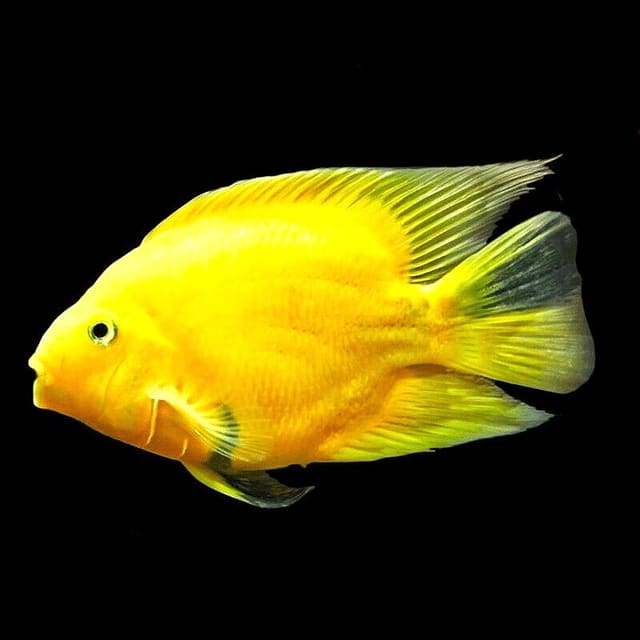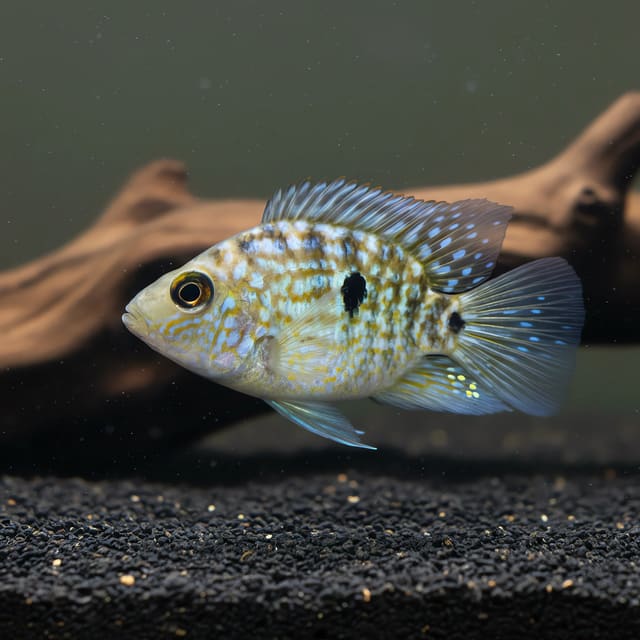
Round Pearlscale Texas Cichlid (Herichthys carpintis)
24–26°C · pH 7–7 · 205L
£78.99

One unsexed Haitian Cichlid juvenile in the selected approximate 2–6 cm size. This highly territorial Caribbean cichlid is best for an advanced keeper planning a 450L+ species-focused aquarium; sex, pair formation and adult appearance are not guaranteed.
Adult size is the maximum length this species reaches at full maturity (scientific sources). The livestock you receive will be younger and smaller — pick a size above for the actual shipping size. Product-photo provenance and any image-specific limitations are stated on the listing.
Nandopsis haitiensis
One unsexed Haitian Cichlid juvenile in the selected approximate 2–6 cm size. This highly territorial Caribbean cichlid is best for an advanced keeper planning a 450L+ species-focused aquarium; sex, pair formation and adult appearance are not guaranteed.
Adult size is the maximum length this species reaches at full maturity (scientific sources). The livestock you receive will be younger and smaller — pick a size above for the actual shipping size. Product-photo provenance and any image-specific limitations are stated on the listing.

Cichlids are a family of roughly 1,800 accepted species, not one care type. Before buying, identify the exact species and source, then compare adult measurement, usable tank dimensions, social system, territory, tested water, diet and an exit plan. No family-wide minimum tank, water range or tank-mate list is safe.
Maintain these water conditions for optimal health and vibrant colors
The Haitian Cichlid (Nandopsis haitiensis), also known in the hobby as the Black Nasty Cichlid or Odo, is a powerful Caribbean cichlid for an experienced keeper with a genuinely large aquarium. It is not a community fish and it should not be bought as a casual “centrepiece” for a mixed tank. Its appeal is its intelligence, presence and changing adult pattern, but those qualities come with intense territorial behaviour, substantial waste production and a need for careful long-term planning.
What one quantity buys: one live, unsexed juvenile in the size selected above. The listed size choices cover approximately 2–2.5 cm, 3–4 cm, 4–5 cm or 5–6 cm when available. One quantity does not mean a pair, and ordering two does not guarantee compatible sexes or a bonded pair. Juveniles cannot be reliably selected for adult sex, eventual nuchal hump, final colour or temperament.
Plan the adult aquarium before ordering. For one adult, we recommend starting at about 450 litres with a footprint around 180 × 60 cm; the footprint, sight lines, filtration and strength of the layout matter as much as the nominal volume. An established compatible pair normally needs considerably more room, a way to divide the aquarium and a second prepared home because pair aggression can change quickly. Read the full behaviour and pairing sections below before deciding whether this species suits your setup.
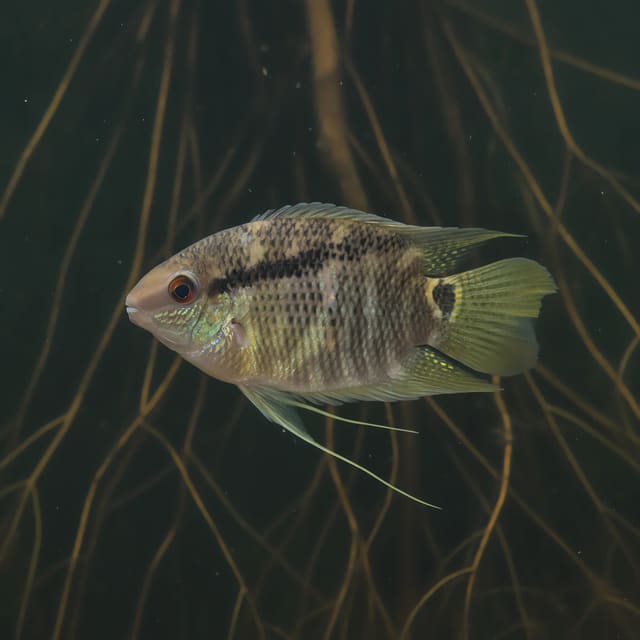
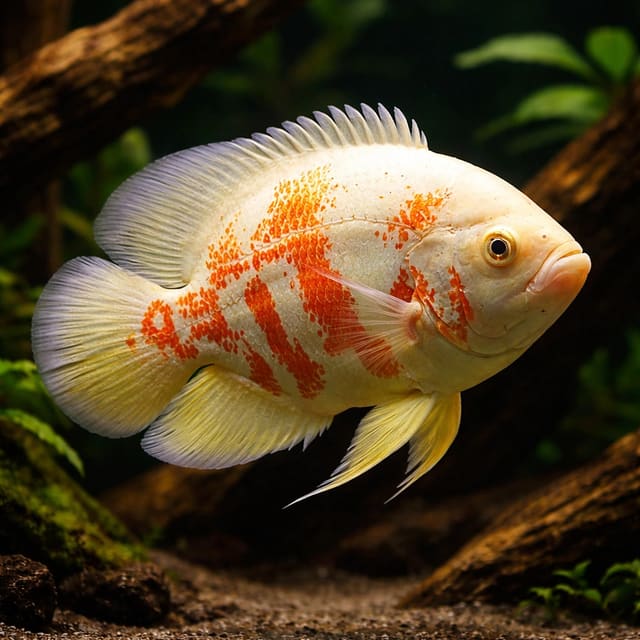
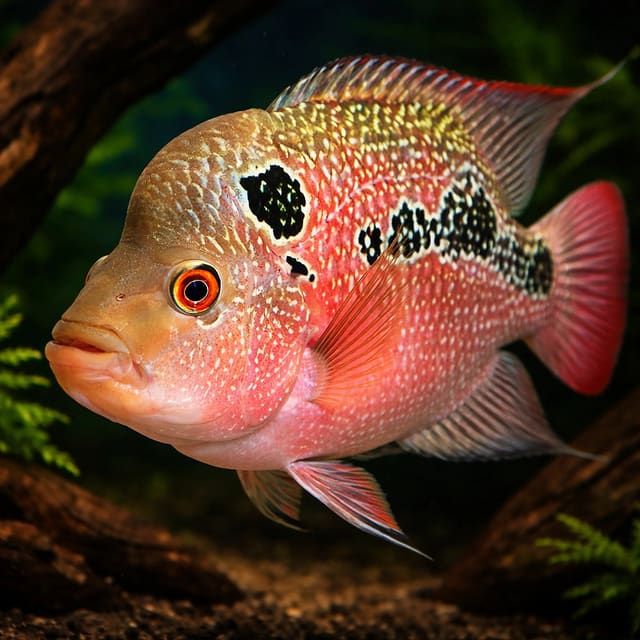
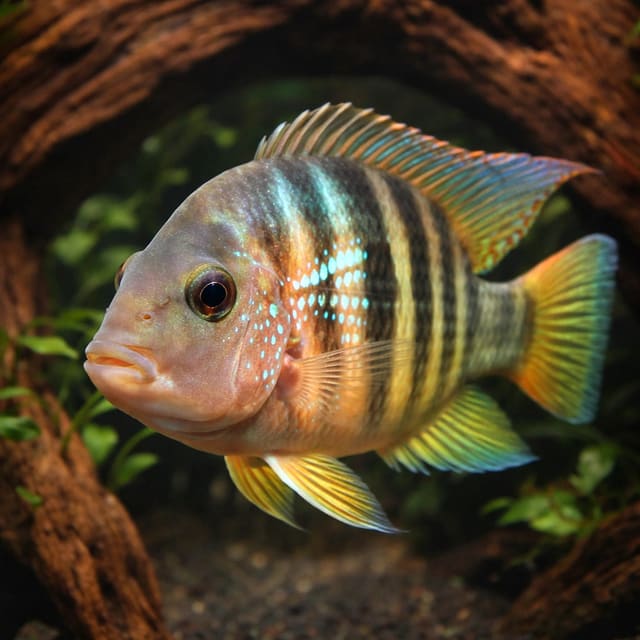
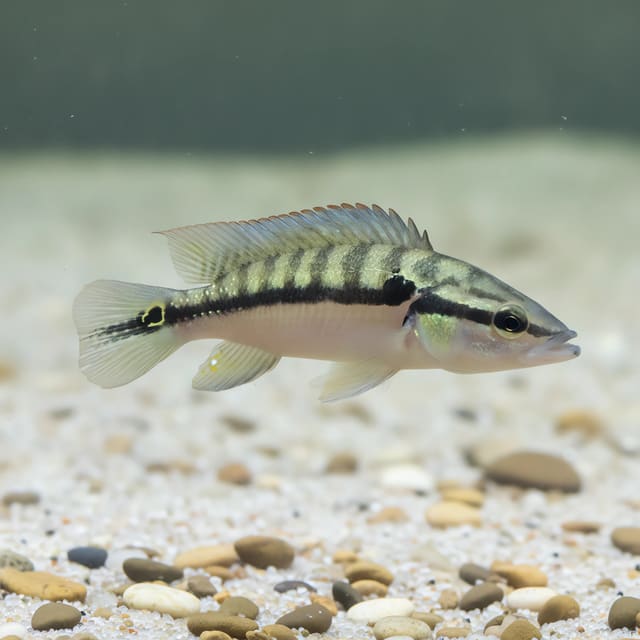
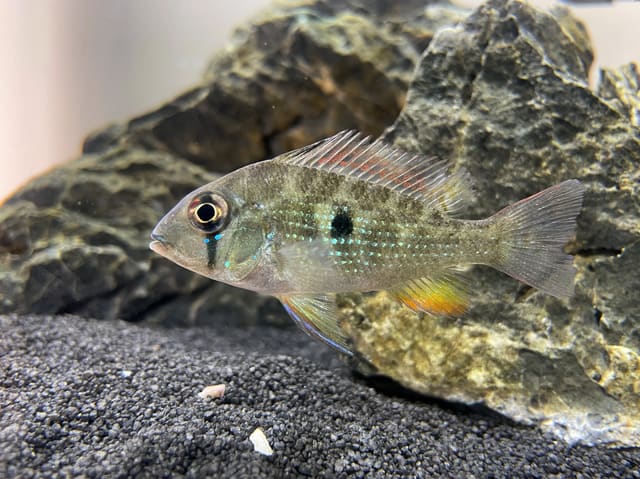
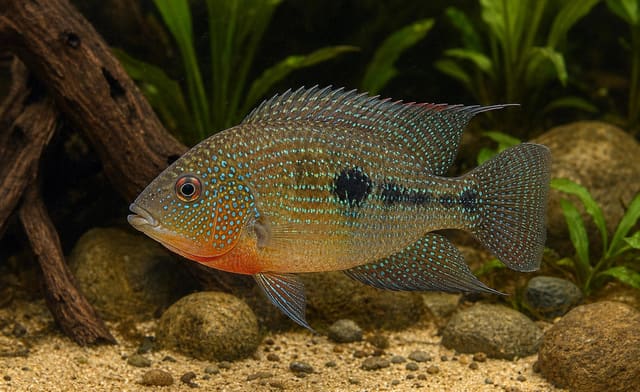
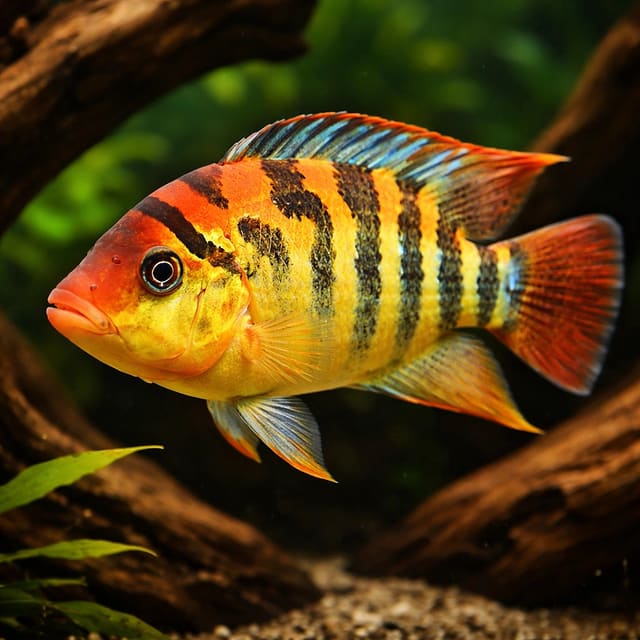
Image note: the gallery contains representative illustrations based on the reference photo. They show a stylised mature male form, not the exact juvenile you will receive. A pronounced forehead hump and dark pearled pattern are not guaranteed. The two-fish scene is illustrative and does not mean that one quantity contains two fish or that any two juveniles will form a safe pair.
| Scientific name | Nandopsis haitiensis (Tee-Van, 1935) |
|---|---|
| Common names | Haitian Cichlid, Black Nasty Cichlid, Odo |
| Native range | Hispaniola: Haiti and the Dominican Republic; freshwater and occasionally brackish habitats |
| Adult size | FishBase records 21.5 cm standard length, measured without the tail; allow for a total length in the mid-20 cm range and plan the aquarium conservatively |
| Fish supplied | One unsexed juvenile in the selected approximate size; no pair, sex or adult-colour guarantee |
| Experience level | Advanced, primarily because of aggression, pairing risk and adult space requirements |
| Temperament | Highly territorial and potentially very aggressive, especially towards its own species and during breeding |
| Long-term aquarium | About 450 litres and 180 × 60 cm footprint or larger for one adult; substantially larger with safeguards for any attempted pair or mixed display |
| Temperature | Use 24–27°C as a stable everyday target; avoid abrupt changes |
| Practical water range | Aim around pH 7.0–8.0 and 4–16 dGH, prioritising stable, clean and well-oxygenated water |
| Diet | Omnivorous; quality cichlid pellets with plant material, algae-based foods and measured invertebrate or frozen foods |
| Safest social plan | One adult in a species-focused aquarium; pairs require exceptional caution, space and a separation plan |
These figures are planning guidance, not promises that every individual will behave identically. A large volume does not neutralise aggression, and a fish that appears peaceful as a juvenile may become strongly territorial as it matures.
Nandopsis haitiensis is a cichlid native to Hispaniola, the Caribbean island shared by Haiti and the Dominican Republic. It is therefore not a South American species, despite older supplier and retail category labels that sometimes place many New World cichlids together. The accepted scientific name is useful because the common name “Black Nasty” is informal and refers mainly to the species’ reputation for aggression rather than a guaranteed colour.
FishBase records the species from lakes and streams, while the Smithsonian Tropical Research Institute’s Greater Caribbean fish database describes it from freshwater and sometimes brackish environments. Adults can use open water while sheltering under rocks, wood or debris; younger fish may stay closer to vegetation. That combination suggests an aquarium with both unobstructed swimming room and strong, clearly separated refuges rather than a tank filled edge-to-edge with decoration.
The fish changes markedly with age and mood. The Smithsonian account describes a grey-brown to blackish body, pale scale centres or edges, dark blotches and bars that can vary in visibility. Large males may develop a nuchal hump. Juveniles are slimmer and less imposing than the mature male often pictured online, so a small dispatch fish should not be judged against a dramatic adult illustration. Stress, social context, lighting, substrate and maturation all affect the appearance seen at a particular moment.
The scientific maximum commonly cited by FishBase is 21.5 cm standard length. Standard length stops at the base of the tail, so it is not the same as the total nose-to-tail measurement used casually by aquarists. For practical aquarium planning, allow for a robust fish in roughly the mid-20 cm total-length range and do not build a setup around the hope that an individual will remain small. Retail claims of a universal 30–40 cm adult should not be treated as a scientific maximum, but a conservative footprint remains justified by the animal’s body mass, activity and territorial reach.
The trade name is memorable and it carries real search interest, but it can encourage an unhelpfully simplistic view of the fish. This species is not permanently black and it is not “nasty” in a human sense. It is a territorial cichlid whose behaviour is shaped by maturity, breeding condition, available space, refuge layout and the animals around it. The practical lesson is serious: do not assume that a peaceful juvenile, a large tank or a temporary truce makes a pairing safe.
Use the scientific name when comparing care information. It helps separate this fish from other dark cichlids and from advice written for unrelated species. It also makes it easier to find source-led information rather than pages repeating the same retail copy.
A Haitian Cichlid can be a rewarding fish for someone who enjoys observing one complex, responsive animal and is prepared to organise the aquarium around it. It is a poor choice for anyone seeking a flexible community resident, a predictable breeding pair or a fish that can simply be moved into an existing collection of cichlids.
For broader context on this family, our cichlid care guide explains the general relationship between territory, filtration and behaviour. Species-specific guidance on this page should take priority where it is more cautious.
Tank-size discussions often focus on litres alone. That is inadequate for this species. A tall 450-litre aquarium can offer less useful territory than a lower aquarium of similar volume with a long, wide base. For one adult, use approximately 450 litres as a starting point and prioritise a footprint near 180 × 60 cm or larger. More length and front-to-back depth create room for separate refuges, open swimming, maintenance access and safer movement around hardscape.
This is a planning recommendation, not a claim that a fish becomes safe at exactly 450 litres. Individual behaviour varies, and the tank’s shape, decoration and other occupants can matter more than a small difference in calculated volume. An adult may defend most of the aquarium. If another fish has nowhere to leave the defended area, the nominal size does not protect it.
A juvenile can initially look lost in a large aquarium, but that is not a reason to buy it for a small permanent tank. A carefully managed grow-out aquarium may be used by an experienced keeper, provided water quality is stable, the fish can feed confidently and the adult home is already ready. Repeated moves carry their own stress, so moving once into a suitable long-term aquarium is usually simpler than relying on a sequence of upgrades.
Do not calculate the upgrade deadline from an advertised growth rate. Growth depends on age, diet, temperature, health and prior conditions. Instead, watch the fish’s ability to turn, swim, choose distance from activity, retreat from the front glass and use more than one zone of the aquarium. Rising nitrate, frequent filter cleaning and increasing aggression are also signs that the system is being pushed.
| Plan | Space and safeguards | Main risk |
|---|---|---|
| One adult | About 450 litres and 180 × 60 cm footprint or larger, strong filtration, secure hardscape and enrichment | The fish may still attack equipment, react to reflections or become difficult to handle during maintenance |
| Established compatible pair | Often 500–700 litres or more, multiple visual barriers, divider ready and a second cycled home | A previously tolerant pair can injure or kill one another, especially around spawning |
| Mixed large-cichlid display | A much larger custom plan based on adult territories, not a list of species names | No named “robust” tank mate is guaranteed safe; pressure can be constant even without obvious wounds |
The single-adult plan is the most predictable. A pair or mixed display is a specialist project and should never depend on returning a fish after harm has started.
The best layout balances security with open space. The fish needs places to withdraw, but a solid wall of decoration can reduce swimming room and create narrow traps. Build two or more visually distinct zones using wood or rock structures, then leave broad passages and an open front or central area. From one end of the aquarium, the fish should not have an uninterrupted view of every refuge at the opposite end.
Use sand or smooth fine gravel that can be moved without damaging the mouth. Digging and rearranging are normal cichlid behaviours. Place heavy rocks directly on a stable base before adding loose substrate, and make sure wood cannot roll or float into the glass. Avoid precarious piles. A fish that excavates beneath an unsupported rock can create a sudden collapse.
Rounded caves, broad slate or stones and branching wood can provide shelter and visual barriers. Openings must be large enough that a growing fish cannot wedge itself inside. Check them again as the fish gains depth and forehead mass. Decorations with sharp cut-outs or abrasive surfaces are a poor fit for a powerful fish that may dash during a territorial display.
Young fish may use vegetation, but this is not a dependable planted-aquarium species. Rooted plants can be uprooted during digging and soft leaves may be damaged or eaten. If plants are important, use robust epiphytes attached securely to wood or rock and treat them as optional enrichment rather than permanent aquascape architecture. Floating cover can soften light, but it must not block gas exchange or filter flow.
Choose filtration for waste handling, oxygenation and reliability, not only a manufacturer’s nominal tank rating. A large cichlid produces substantial solid waste. Mechanical media should be accessible for regular rinsing, while biological media should remain stable and should not all be cleaned at once. Use guards where the fish can reach inlets, heaters or sensors.
Surface movement is important, especially in warm water where dissolved oxygen is lower. Arrange outlets so that waste does not settle behind every structure, but provide calmer refuge areas as well as flow. A backup air pump is sensible for a high-biomass aquarium. Power interruptions, blocked inlets and reduced filter flow can become serious more quickly than they do in lightly stocked tanks.
Use a secure lid with no fish-sized gaps around cables or pipes. Keep lighting moderate and predictable. Sudden switching from darkness to bright light can startle fish; a room light or gradual schedule helps. Place the aquarium where repeated knocks, door movement and floor vibration are limited. Covering one or two external sides can reduce reflections and create a more secure zone without taking away internal swimming space.
A stable everyday temperature of 24–27°C fits the FishBase range and sits within the broader ranges used by specialist aquarium references. Do not move the temperature to an extreme in an attempt to accelerate growth, trigger breeding or suppress behaviour. Stability, oxygen and water quality are more valuable than chasing a single “perfect” number.
For practical captive care, aim around pH 7.0–8.0 and 4–16 dGH. Test the source water before trying to alter it. If your tap water is already stable and reasonably close, repeated chemical correction can be more harmful than a modest difference from a published value. Any necessary adjustment should be made consistently in replacement water, not as sudden dosing inside the aquarium.
Set the water-change schedule from measured waste and feeding, not from a generic calendar. Many keepers of large cichlids need substantial weekly changes, sometimes divided into more than one session. Match temperature closely, use a suitable dechlorinator and avoid exposing the fish to a rapid swing in dissolved minerals. Vacuum accessible waste while leaving biological filter media undisturbed.
Clean viewing panels and inspect silicone, braces, lid fittings, intake guards and heater protection during routine maintenance. A powerful cichlid can reveal a loose fitting that a small community fish would never disturb. Keep nets, a rigid divider and a fish-safe container where they can be reached without searching during an emergency.
This species is omnivorous. FishBase reports natural feeding that includes algae, aquatic plant material and snails, which is a useful warning against an all-meat aquarium diet. Use a complete, reputable cichlid pellet as the base and include foods with plant or algae content. Add measured portions of suitable frozen or invertebrate foods for variety rather than building every meal around rich protein.
Our frozen fish-food range can provide variety, but frozen food should complement a balanced staple rather than replace it. Thaw and portion it hygienically; do not add packing liquid or a large frozen block to the aquarium.
Avoid feeder fish, mammal or poultry meat, and repeated oversized meals. Feeder fish can introduce disease and have an unpredictable nutritional profile. Terrestrial meat is not a natural staple for a cichlid and can add excessive fat. Overfeeding also increases solid waste and can hide declining filter performance behind temporarily enthusiastic feeding.
Feed an amount the fish clears promptly, then adjust from body condition and waste. Juveniles may benefit from more frequent small feeds than adults, but every feed still needs to fit the filtration capacity. A healthy fish should look well muscled without a permanently swollen abdomen. A rounded belly immediately after food can be normal; persistent swelling, stringy faeces, loss of appetite or repeated spitting warrants investigation rather than another type of food.
Use target feeding or feed at a consistent location so you can confirm the fish actually eats. In any multi-fish experiment, feeding response does not prove that social pressure is absent. A subordinate fish may take food while still being chronically excluded from shelter or open water.
The safest recommendation is a single adult in a species-focused aquarium. Haitian Cichlids are widely described as highly aggressive and territorial, particularly towards their own species and during reproduction. That does not mean every juvenile attacks immediately. It means that a stocking plan must remain safe when adult behaviour emerges, not only while the fish are small.
Older care sheets often list “large cichlids” or “large catfish” as tank mates. Body size alone does not establish compatibility. Fish can conflict over the same cave, floor space, feeding area or visual territory. A heavily armoured catfish can still suffer eye, fin or stress damage. Another large cichlid may be strong enough to fight back, which can make injuries worse rather than make the pairing safe.
Do not combine this species with small fish, shrimp or ornamental snails. Small animals may be eaten or injured, and their presence can encourage constant hunting. Long-finned, slow, timid or bottom-dwelling fish can be especially vulnerable because they may not leave the defended area quickly.
Do not wait for severe wounds. Divide or remove the pressured fish as soon as persistent targeting is clear. Rearranging decoration may interrupt a territory briefly, but it is not a substitute for separation. A transparent divider may still allow visual stress; an opaque section or separate aquarium can be necessary.
Two juveniles are not a “pair”. Sex may not be clear at dispatch size, and opposite sexes are not automatically compatible. Even fish that spawn can attack one another before or after breeding. A serious pairing attempt needs a much larger aquarium, multiple escape routes, a divider that can withstand a large fish and a second cycled aquarium ready before the animals meet.
Never add a smaller new individual directly to an adult’s established territory. Introducing fish through a secure divider can allow observation, but calm behaviour through a barrier does not prove they will be safe together. The keeper must be present for any first physical introduction and able to end it immediately.
The fish offered here is a juvenile. It may show bars, blotches or a lighter base colour that differs from a mature display animal. Adult pattern and darkness can change with age, mood, background and social context. This natural variation is not a reason to manipulate water conditions or provoke displays.
Large mature males may develop a pronounced nuchal hump, but not every male develops the same shape and females should not be expected to show it. Juvenile external sexing is unreliable. We do not promise male, female, pair formation, mature hump size, exact black colour or a copy of the illustrated fish.
The four current gallery images are representative illustrations created from the reference photo. They are useful for showing a possible mature male profile and the general high-bodied cichlid form, but they are stylised. One image shows two fish only as an illustrative scene, and a small eye-like mark on the upper forehead of one rendered fish is a generation artefact rather than a real anatomical feature. The actual juvenile will vary and should be assessed from its health and normal development, not from a promise of identical markings.
We retain the gallery so customers can review the listing history and available visual context, while the disclosure prevents an illustration from being mistaken for an exact specimen photograph. No image changes the sale unit: one quantity is one unsexed juvenile in the selected size.
Prepare the aquarium before the dispatch date. The filter must be cycled, the temperature stable and the lid secure. Do not plan to assemble the final hardscape while the fish waits in its transport bag. Review the current delivery and Live Arrival Guarantee before ordering, including the evidence and contact steps required if a livestock problem is visible on arrival.
Inspect the unopened bag promptly and follow the instructions supplied with the order. Avoid prolonged floating or opening the bag and then leaving the fish in transport water. Transport water chemistry changes once the bag is opened, so acclimation should be controlled and purposeful rather than extended for its own sake. Our step-by-step new-fish acclimation guide explains the current process.
Transfer the fish with minimal transport water entering the aquarium. Keep lighting low, provide a secure refuge and allow the juvenile to settle. Do not tap the glass, repeatedly move decoration or add another fish to encourage it out. A new cichlid may hide at first; breathing, balance and gradual interest in the environment are more useful observations than immediate colour.
Offer little or no food immediately if the fish is stressed from transport. Once posture and breathing are normal, try a small amount of familiar, easy-to-eat food. Remove leftovers. Check that the fish can move between open water and cover without getting trapped, and confirm that filter flow is not pinning a small juvenile in one position.
Quarantine protects both the new fish and an established collection. Use dedicated equipment where practical. Observe appetite, faeces, skin, fins, eyes, breathing and swimming every day. Record changes rather than treating preventively with a mixture of medicines. If a health concern develops, accurate observations and water-test results are more useful than a vague report that the fish “looks off”.
Increase food gradually as normal appetite returns. Do not use heavy feeding to force rapid growth. The goal is steady development, clean water and confident behaviour. A juvenile that learns a consistent feeding routine is easier to monitor than one receiving many rich foods at random times.
Most apparent health problems should begin with a water and environment check. Test ammonia, nitrite, nitrate, temperature and pH; verify filter flow and oxygenation; review recent changes; and look for social pressure. Medication cannot correct a blocked filter, unstable heater, chronic bullying or an unsuitable tank.
Isolate an injured or pressured fish when necessary and seek advice from an aquatic veterinarian or an experienced fish-health professional. Do not diagnose a disease from one photograph or use salt, antibiotics or parasite treatments without a reason. Different problems can produce similar external signs, and some treatments affect biological filtration.
This is a substrate-spawning cichlid. FishBase reports spawning on a cleaned stone, with roughly 150–200 eggs and female care of eggs and larvae. Those natural-history details do not make captive breeding straightforward. The central challenge is pair compatibility and aggression, not simply finding the right temperature or feeding a richer diet.
A breeding project should use mature, healthy fish in a large dedicated aquarium with broad spawning surfaces, separated refuges and a strong divider. The keeper needs a second cycled aquarium capable of housing either adult permanently. Do not rely on a perforated divider that can be moved or bypassed by a powerful fish.
Watch both animals before, during and after spawning. Courtship, cleaning a stone and guarding an area can be followed by sudden attack. If one fish cannot retreat, divide them immediately. Removing eggs or fry may also change the adults’ behaviour towards one another. There is no universal recipe that guarantees a stable pair.
Do not attempt breeding by ordering two small juveniles and assuming they will become compatible. A group grow-out sometimes used by specialist breeders requires very large space, multiple separate homes and rapid intervention; it is not appropriate for an ordinary display aquarium.
| Question | Practical answer |
|---|---|
| What arrives? | One unsexed juvenile in the selected approximate size for each quantity ordered. |
| Is it a community fish? | No. A single fish in a species-focused setup is the safest long-term plan. |
| How large should the adult aquarium be? | Start around 450 litres with a footprint near 180 × 60 cm for one adult; pairs and mixed displays need substantially more planning and space. |
| Can sex or a pair be selected? | No. Juveniles are sold unsexed and ordering more than one does not create a compatible pair. |
| Will it look like the gallery? | The gallery is representative. Adult sex, hump, darkness and markings are not guaranteed. |
| What is the main husbandry risk? | Territorial aggression, followed by inadequate adult footprint and declining water quality in an under-filtered setup. |
| What diet is appropriate? | A complete varied omnivore diet with plant/algae content and measured aquatic invertebrate or frozen foods. |
| Who should keep it? | An advanced keeper who can maintain a large aquarium and separate fish immediately if social behaviour changes. |
Yes. Haitian Cichlid, Black Nasty Cichlid and Odo are hobby names used for Nandopsis haitiensis. “Black Nasty” refers to its dark adult appearance and aggressive reputation; it does not mean every individual is permanently black or behaves identically.
One quantity buys one live, unsexed juvenile in the size selected above. The two-fish gallery image is illustrative. It does not show the number supplied, and no listed size represents a pair.
No. The fish are offered at juvenile sizes and sex is not guaranteed. A pronounced nuchal hump is most associated with large mature males, but it cannot be promised from a small unsexed fish.
No. The fish may be the same sex, they may not form a bond, and opposite-sex fish can still be dangerously incompatible. Any pairing attempt needs a large dedicated aquarium, divider and second cycled home.
For one adult, use about 450 litres and a footprint near 180 × 60 cm as a conservative starting point. The useful floor area, hardscape, filtration and territorial layout matter more than litres alone. A pair or mixed display requires substantially more room and safeguards.
FishBase records a maximum of 21.5 cm standard length, which excludes the tail. For aquarium planning, allow for a strongly built fish around the mid-20 cm range in total length rather than treating 21.5 cm as the full nose-to-tail size.
Keep a stable everyday target of 24–27°C. Avoid sudden changes and excessive heat. Warm water holds less oxygen, so surface movement and dependable filtration are essential.
A practical target is around pH 7.0–8.0 and 4–16 dGH. Stable, clean water is more important than repeatedly adjusting a safe local supply to hit one exact number.
Use a complete cichlid pellet with plant or algae content as the staple, with measured vegetable and aquatic invertebrate foods for variety. Avoid feeder fish, terrestrial meat and repeated heavy meals.
There is no guaranteed compatible species list. Another large fish may survive an initial introduction but still suffer chronic pressure or serious fighting. A single-adult setup is safer; any mixed display needs much more space, observation and immediate separation capacity.
Armour and size do not make a catfish automatically safe. Both animals may use the same lower territory or shelter, and eye or fin injuries can occur. Do not use a catfish as a routine “clean-up” tank mate for this cichlid.
Plants may be uprooted or eaten, especially soft rooted species. Shrimp and ornamental snails are not suitable tank mates. Natural diet records include algae, plant material and snails, so a delicate planted invertebrate display is not an appropriate home.
Temporary hiding can follow transport or a move into a new aquarium. Keep lighting low, provide secure cover and check breathing and water quality. Persistent hiding with rapid breathing, refusal of food or pressure from another fish needs prompt investigation.
No. They are representative illustrations based on the reference photo and show a stylised mature male form. The supplied juvenile will differ in size, sex, hump, pattern and colour. One rendered forehead mark is an image artefact, not a feature of the species.
No. Nandopsis haitiensis is native to Hispaniola in the Caribbean, including Haiti and the Dominican Republic. Some legacy trade categories group it with South or Central American cichlids, but that is a retail taxonomy rather than its natural distribution.
Usually not. Its aggression, adult footprint and pairing risk make it an advanced species. A keeper should already be comfortable with large-aquarium maintenance, quarantine, protected equipment and emergency separation.
Cycle and test the aquarium, stabilise temperature, secure the lid and prepare a quiet refuge before dispatch. Read the current acclimation and delivery guidance, then inspect the unopened bag promptly when it arrives.
Core identity, distribution, size, temperature, diet and spawning facts were checked against FishBase: Nandopsis haitiensis and the Smithsonian Tropical Research Institute Shorefishes of the Greater Caribbean. Practical aquarium planning was cross-checked against specialist care accounts, including Aquatic Community’s Haitian Cichlid profile. Aquarium recommendations on this page are deliberately conservative because individual aggression and pair compatibility cannot be guaranteed.
Browse the current cichlid collection only after comparing adult needs and temperament. For this species, suitability should be decided from the long-term aquarium and separation plan, not from temporary stock, price or a dramatic adult image.
No reviews for this item yet. Bought one? Honest reviews only, good or bad.
What customers say about ordering from us
I have a small group of long finned mountain minnows. So was delighted to be able to order ten of this variety to increase the genetics in my tank . The ones I recieved are healthy but it’s to early to give a verdict on wether they are of a long finned type since they are small currently.
Gordon Walker · 23 Sept 2026
100% success travel and "installation". Pleased with quality of purchase. The Siamese fighter a bit "shy" so have not yet seen him at his best yet but looking good. Happy customer. GG
George E Garratt · 21 Sept 2026
Reviews of our shop, collected by Judge.me, an independent third-party review collector. Newest first.