Easy
Electric Blue Acara (Andinoacara pulcher) – Neon Blue, 2–7cm Sizes
22–23°C · pH 6.5–8
£6.19
The Round Pearlscale Texas Cichlid (Herichthys carpintis) is a cichlid from Mexico’s Panuco and Soto La Marina river drainages that reaches 30.5 cm. It suits keepers ready for a territorial fish; the overlap of FishBase’s recorded environment and Seriously Fish’s aquarium guidance is 24–26°C, pH 7.0 and 9–14 dGH, with about 205 litres recommended. Sold individually as one live fish.
Adult size is the maximum length this species reaches at full maturity (scientific sources). The livestock you receive will be younger and smaller. Product-photo provenance and any image-specific limitations are stated on the listing.
Herichthys carpintis
The Round Pearlscale Texas Cichlid (Herichthys carpintis) is a cichlid from Mexico’s Panuco and Soto La Marina river drainages that reaches 30.5 cm. It suits keepers ready for a territorial fish; the overlap of FishBase’s recorded environment and Seriously Fish’s aquarium guidance is 24–26°C, pH 7.0 and 9–14 dGH, with about 205 litres recommended. Sold individually as one live fish.
Adult size is the maximum length this species reaches at full maturity (scientific sources). The livestock you receive will be younger and smaller. Product-photo provenance and any image-specific limitations are stated on the listing.
Cichlids are a family of roughly 1,800 accepted species, not one care type. Before buying, identify the exact species and source, then compare adult measurement, usable tank dimensions, social system, territory, tested water, diet and an exit plan. No family-wide minimum tank, water range or tank-mate list is safe.
Maintain these water conditions for optimal health and vibrant colors
The Round Pearlscale Texas Cichlid (Herichthys carpintis) is a freshwater cichlid from the Atlantic slope of Mexico, including the Panuco and Soto La Marina river drainages. FishBase places it in the family Cichlidae and records a maximum length of 17 cm standard length. It suits a keeper who can plan a spacious, filtered aquarium around territorial behaviour, deliberate decoration and carefully screened companions.
In nature, this benthopelagic fish occurs in both fast-flowing rivers and still waters. The aquarium does not need to imitate only one flow pattern, but it does need open swimming room alongside clear territorial features made from rock or wood. Its combination of substantial space needs, digging behaviour and possible aggression makes the overall layout more important than decorative detail alone.
Use an aquarium of about 205 litres with a base around 120 × 38 cm as the practical starting plan. The overlap between FishBase’s recorded environment and Seriously Fish aquarium guidance is 24–26°C, pH 7.0 and 9–14 dGH, giving a clear routine target.
| Suits | Not suited to |
|---|---|
| Keepers prepared to manage a territorial cichlid | Aquaria built around small fish |
| About 205 litres with rock, wood and open space | Layouts too small to create separate territories |
| Stable water at 24–26°C and pH 7.0, the FishBase/Seriously Fish overlap | Water outside the planned range |
| Strong biological filtration and measured maintenance | Unfiltered or biologically immature aquaria |
| Flexible decoration that can tolerate digging | Rooted planting that must remain undisturbed |
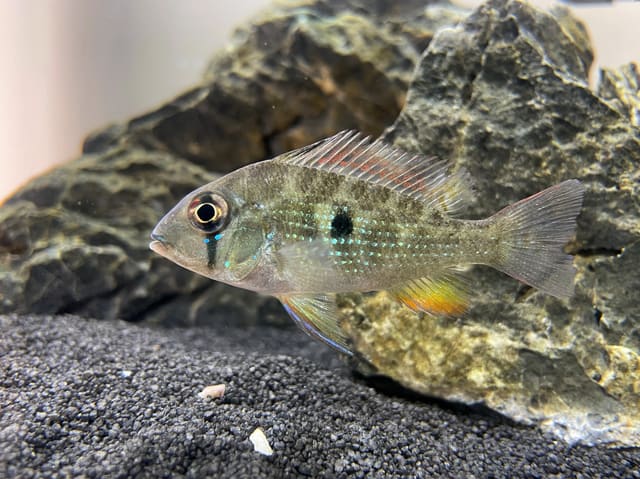
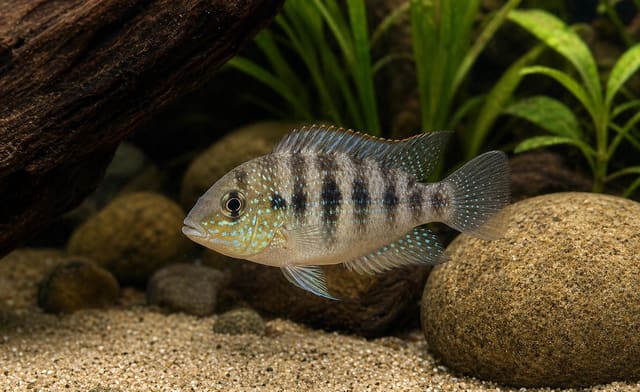
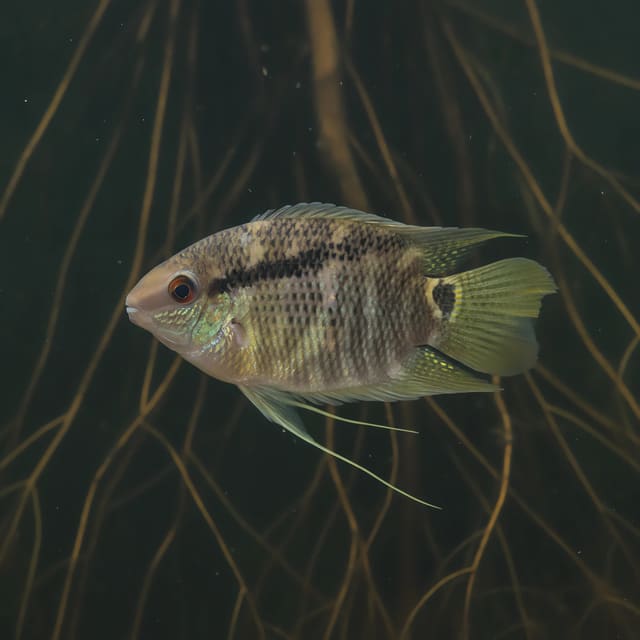
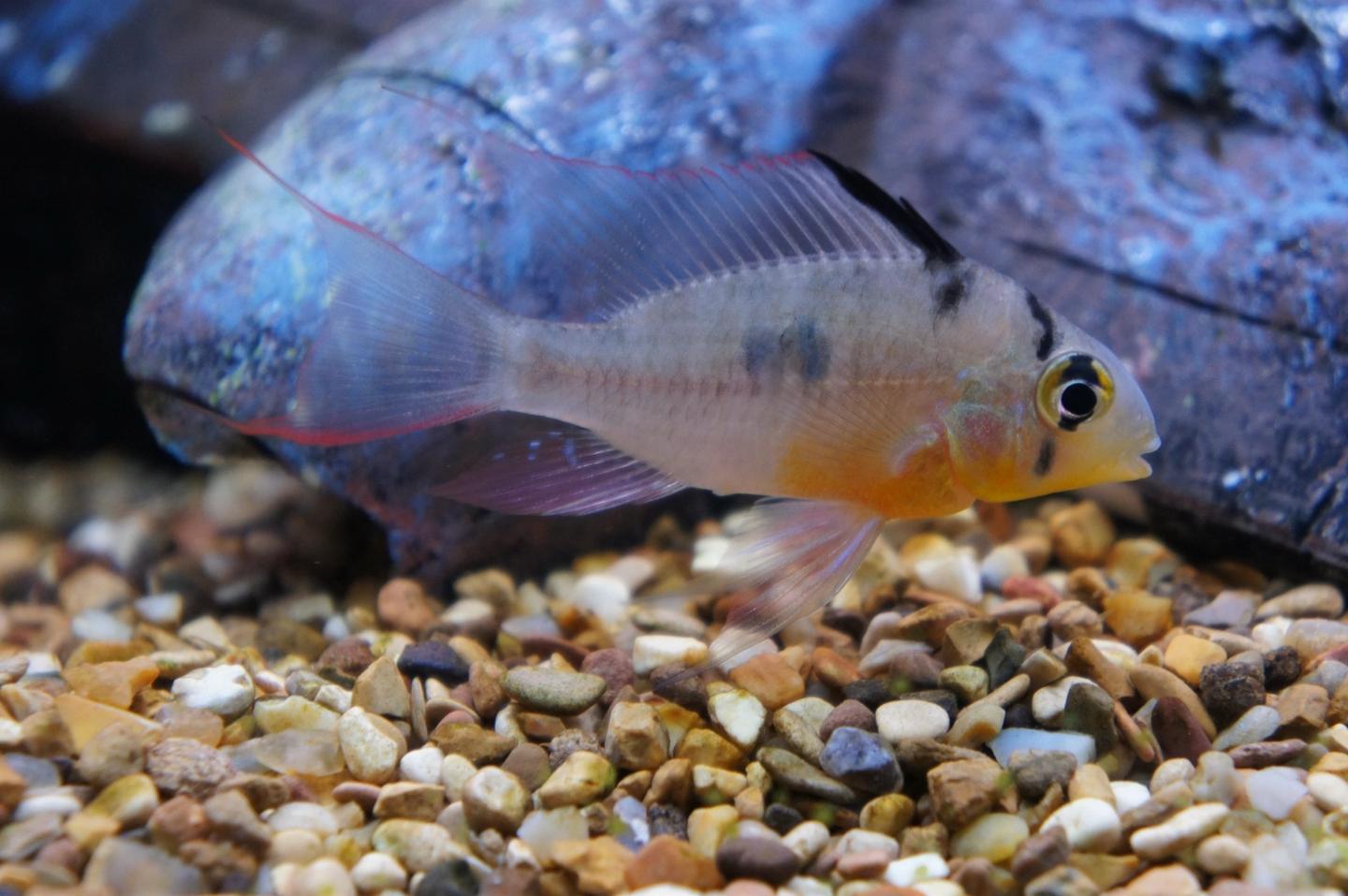
Its flanks show blue-green hues and reflective flecks. It is also traded as the Green Texas Cichlid, although the true Texas Cichlid is a different species, Herichthys cyanoguttatus. H. carpintis is listed as Least Concern on the IUCN Red List.
One purchase supplies one live Round Pearlscale Texas Cichlid. That purchase unit describes the animal supplied; it does not remove the need to assess territory, aquarium dimensions and any resident fish before introduction. Plan from the 17 cm recorded adult length and the species’ territorial behaviour rather than judging its long-term needs from its size on arrival.
Sex is guaranteed only when the selected option explicitly states male or female. This Round Pearlscale Texas Cichlid listing has no sex-guaranteed option. Colour, body depth, fin shape and behaviour in a gallery image must not be used as a promise of the sex supplied.
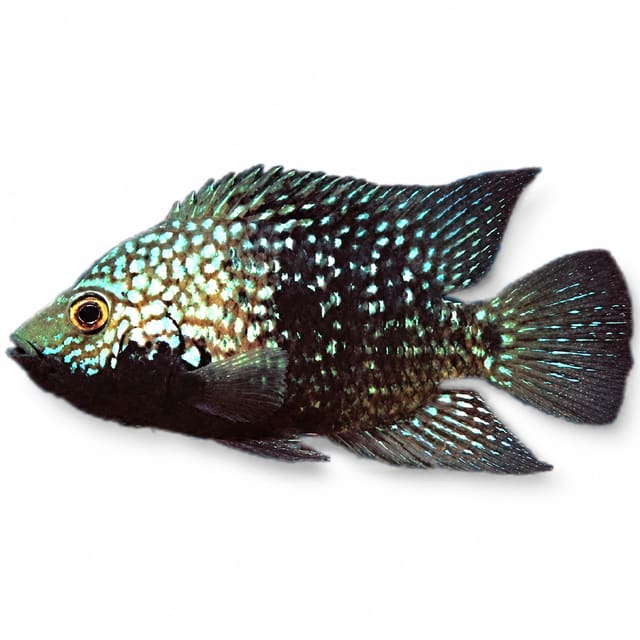
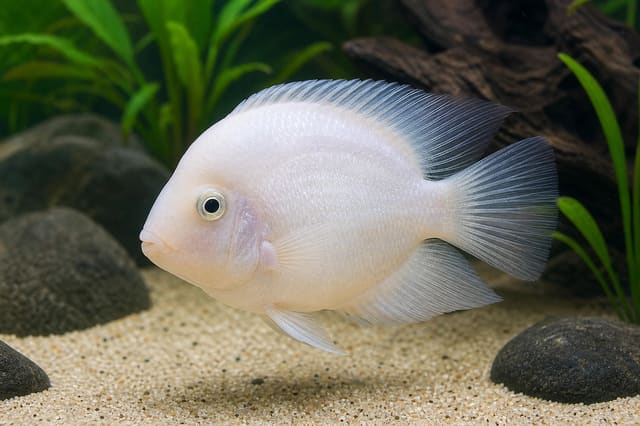
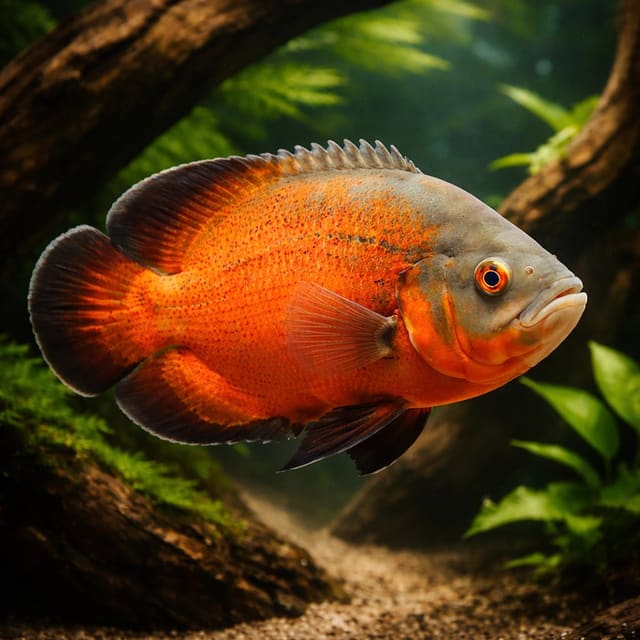
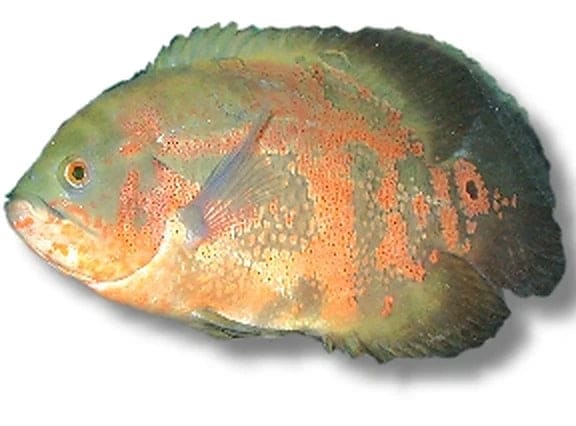
The gallery images are representative of this type of animal rather than photographs of the exact animal supplied, so colours can look slightly different from the live animal. The pictured fish has a pale gold and blue body, dense pearl-like markings, dark flank spots and blue-spotted fins. Individual pattern placement and colour intensity can differ without changing the animal’s identity.
This is a candidate for a prominent display aquarium only when the display is designed around the fish’s behaviour. Browse the centrepiece fish collection to compare other focal animals, but do not treat collection placement as a compatibility recommendation. Aquarium volume, water chemistry, adult dimensions and temperament still need to match the individual stocking plan.
Plan around a recorded adult length of 17 cm standard length. Use that adult length for every space, filtration and companion decision. Adult planning matters from the beginning because rocks, wood, filters and other occupants all reduce the usable space within the aquarium.
Published size figures differ: Seriously Fish uses 30.5 cm standard length in its aquarium profile. Build the aquarium to the full 120 × 38 cm base and about 205 litres from the start rather than scaling it down to the 17 cm length. An aquarium of 120 × 45 × 37.5 cm holds about 213 litres and keeps the same 120 cm swimming length.
A nominally large aquarium can still work poorly if one solid barrier blocks the swimming route or if every surface is occupied by unstable decoration. Conversely, leaving the entire aquarium bare removes the rock and wood features used to mark territories. Divide the layout into open movement space and obvious boundaries without turning the base into a maze.
Review the stocking plan again as the fish develops. Increased body mass raises the demand on filtration, while established territorial behaviour can change how much of the aquarium remains usable to companions. If the fish repeatedly controls the full length of the tank, adding another animal is not a reasonable use of spare litres. Space must function for all occupants, not merely contain their combined body lengths.
Keep the aquarium at 24–26°C, pH 7.0 and 9–14 dGH. These values are the overlap between FishBase’s recorded species environment of 23–33°C, pH 7.0–8.0 and 9–20 dGH, and Seriously Fish’s aquarium guidance of 24–26°C, pH 7.0 and 8–14 dGH. Keep every routine reading inside this range.
Measure the source water and the established aquarium before deciding that the range is practical. A single pH reading does not describe the whole system: repeat testing shows whether the aquarium is remaining close to pH 7.0 through maintenance, feeding and stocking changes. Our water chemistry guide explains why ammonia, nitrite, nitrate, pH and hardness need separate attention.
| Reading | Decision |
|---|---|
| 24–26°C | Keep the heater and thermometer centred on this routine range |
| pH 7.0 | Compare repeated aquarium readings with the target |
| 9–14 dGH | Confirm the water remains within the shared hardness range |
| Ammonia 0 mg/l | Do not add the fish while ammonia is detectable |
| Nitrite 0 mg/l | Do not add the fish while nitrite is detectable |
Use the water matcher to compare measured values with the target before committing the aquarium. If the tap water and established tank differ, base the decision on readings from the aquarium that will house the fish. Test again after maintenance and after livestock additions because biological demand changes when feeding and stocking increase.
Stability comes from adequate water volume, an established biological filter and regular maintenance. Larger aquaria contain more water and are less susceptible to sudden temperature and pH variation than small setups. The 205-litre plan therefore supports both the fish’s space needs and a more stable environment; it is not merely an empty-volume target.
Use a mature biological filter and confirm ammonia and nitrite are both 0 mg/l before introduction. The RSPCA explains that fish release toxic ammonia, which filter bacteria convert first to toxic nitrite and then to safer nitrate. A filter therefore needs functioning biological media as well as enough mechanical capacity to collect waste.
At about 205 litres, aim for four to five aquarium turnovers per hour. Seriously Fish translates that rate to approximately 820–1,025 litres per hour for this setup. Treat the stated flow as the filter’s rated planning figure and check that rock, wood or accumulated waste is not blocking circulation. The fish occurs naturally in both moving and still water, so the goal is effective filtration and circulation rather than forcing every part of the aquarium into one powerful current.
OATA’s freshwater aquarium guidance gives broad setup and maintenance instructions: dechlorinate new water, switch on all equipment, allow 24–48 hours for temperature and equipment checks, and mature the biological filter before fish are added. The settling period checks equipment; filter maturation must continue until testing demonstrates safe water.
For a new setup, follow our first tropical aquarium guide before planning the arrival. A running filter is not automatically a mature filter, and clear water alone does not demonstrate that ammonia and nitrite are being processed safely.
Give the fish visible territories made from rock or wood while preserving an open swimming route. Seriously Fish describes H. carpintis as relatively flexible about decoration when territories and open space are both present. The useful question is therefore not whether the aquarium looks full, but whether the fish can move freely and whether another occupant can leave its line of sight.
Expect digging. Rooted plants are likely to be uprooted because the Pearlscale Cichlid moves substrate. Do not make an undisturbed planted carpet or precisely arranged rooted display the central requirement of the aquarium. Choose a layout that remains functional when substrate is shifted, and inspect territorial boundaries whenever the fish changes the base.
Position the aquarium away from direct sunlight, heat sources and draughts. Set it on a flat, level stand capable of supporting the filled system indefinitely, and avoid locations exposed to loud noise, vibration or sudden movement. Check these points before filling because a 205-litre aquarium cannot be repositioned safely as a casual adjustment once stocked.
Look at the completed structure from each end of the aquarium. If every location is visible from one central point, the decoration has not created meaningful separation. If rock and wood consume most of the 120 cm swimming run, the territory plan has taken away too much open space. Adjust the balance before the fish arrives, then reassess after digging changes the substrate.
Decoration also displaces water and catches waste. Keep the filtration calculation based on the aquarium plan, but use testing and waste accumulation to judge the real maintenance load. A visually impressive structure is only useful when circulation, cleaning access and territorial escape routes continue to work together.
Use a high-quality cichlid pellet as the staple food. Seriously Fish describes Herichthys carpintis as omnivorous and recommends varying that staple often with frozen and live foods, especially brineshrimp, while also offering vegetable or spirulina flakes regularly. This mixture covers the animal-based and plant-based parts of the stated diet without relying on one food format.
| Food role | Suitable choice |
|---|---|
| Staple | High-quality dried cichlid pellet |
| Animal-based variety | Frozen or live foods, including brineshrimp |
| Plant-based variety | Vegetable or spirulina flakes, or a similar algae-based food |
Watch the fish take each portion and prevent uneaten food from accumulating. Leftovers add to the ammonia load and increase the work required from the biological filter. The appropriate portion is one that the fish consumes while you can still observe appetite, access to food and waste; do not keep adding food simply because a large cichlid continues to investigate the feeding area.
A sudden reduction in food intake can accompany water-quality problems, stress or a health change. Test ammonia, nitrite, nitrate, pH and temperature before changing the diet at random. Also inspect the aquarium for increased hiding, territorial pressure or altered breathing because appetite should be interpreted alongside behaviour and water readings.
Keep plant-based foods as regular variety rather than the entire diet. Equally, do not limit the fish to frozen or live foods; keep the quality dried pellet as the staple. A consistent staple makes intake easier to judge, while planned variety reflects the omnivorous diet described for this species.
Test water quality at least weekly and check temperature regularly. OATA recommends measuring ammonia, nitrite, nitrate and pH, and you may wish to test more often while an aquarium is being established or after fish are added. Ammonia and nitrite should remain at 0 mg/l; use the nitrate trend, maintenance history and the condition of the aquarium to judge whether waste is accumulating between changes.
Carry out partial water changes of up to 25% each week. Treat replacement tap water to make it safe and bring it to the correct temperature before it enters the aquarium. The precise maintenance demand changes with aquarium size, stocking and feeding, so a heavily loaded 205-litre setup may need closer testing than the calendar alone suggests.
| What you notice | What to do first |
|---|---|
| Hanging at the surface or unusual bottom sitting | Test water and check temperature and filtration |
| Erratic swimming | Check water readings and observe territorial interactions |
| Darker or paler colour | Compare behaviour, breathing and recent aquarium changes |
| Faster or slower gill movement | Test water promptly and inspect filter operation |
| White spots, fluffy growths or damaged fins | Record the change and seek health guidance |
| Reduced appetite or changing body condition | Check water, feeding access and aggression |
Inspect the filter for blockages and accumulated fish waste during routine maintenance. Keep biological filtration running effectively because this cichlid’s feeding and adult body mass contribute directly to the waste load. A strong rated filter cannot compensate for clogged flow, excessive feeding or skipped water changes.
Compare each observation with the fish’s normal pattern. Individual fish vary, so a change in swimming, colour, aggression, hiding, breathing, appearance, condition or food intake is more informative than one isolated posture. If a health change continues after the water and equipment checks, contact us for guidance rather than applying an unselected treatment.
Following OATA’s freshwater aquarium guidance, have the mature aquarium at the FishBase/Seriously Fish temperature overlap of 24–26°C with ammonia and nitrite at 0 mg/l before the fish reaches you. Complete the compatibility assessment in advance, leave the 120 cm swimming route open and check that rock or wood territories have not restricted the filter.
Our current delivery and Live Arrival Guarantee policy explains that fish are hand-bagged in pure oxygen, packed in an insulated poly box and given a heat pack when the weather calls for it. The parcel travels with a licensed live-animal courier, and we email the tracking number and your confirmed Thursday or Friday delivery date.
Keep the bag floating for the full 20–30 minutes. Before release, make one final check that the intended aquarium is the correct one, its temperature remains at 24–26°C and the planned residents match the compatibility decision. Avoid switching the destination after acclimatisation has begun because the second aquarium may have different water or inhabitants.
If anything has gone wrong, send your order number and the unboxing video on the day the fish arrive. Routine care begins with the prepared aquarium, the stated floating period and close observation after release.
Avoid small fish because Herichthys carpintis will see them as food. Seriously Fish also describes this cichlid as very territorial, especially during breeding, and sometimes aggressive. Those two behaviours mean that a shared water range alone is not enough to make another animal a suitable companion.
No universal tank-mate list applies. Screen each proposed occupant for adult size, water requirements, territorial behaviour and its ability to use the aquarium without being trapped in the Round Pearlscale Texas Cichlid’s territory. Every animal under consideration must suit 24–26°C, pH 7.0 and 9–14 dGH, the overlap of FishBase’s recorded environment and Seriously Fish’s aquarium guidance.
Do not assume that another large fish is suitable simply because it cannot be swallowed. Two substantial territorial fish may still compete for the same rock, wood, floor area or open route. Likewise, a peaceful animal may fail if it cannot leave the cichlid’s line of sight or reach food without entering a defended area.
Give every invertebrate and every other fish the same individual assessment. Consider their adult dimensions, water range and vulnerability to an omnivorous territorial cichlid before placing them together. Aquarium size creates room for a decision; it does not turn an uncertain pairing into a reliable one.
Watch territorial behaviour most closely when a pair forms or breeding behaviour begins. Seriously Fish notes that a pair will bond and display by circling and flapping their tails at each other before cleaning a spawning site, usually a smooth rock. Aggression can intensify during this period, and a male may become aggressive towards the female.
Keep a tank divider ready if a pair is housed together. The divider is a practical separation measure when one fish repeatedly drives the other away, controls the entire swimming route or prevents normal feeding. It must create genuine separation rather than leaving the pursued fish confined inside the aggressor’s visual territory.
| Situation | Decision |
|---|---|
| Small fish proposed | Avoid the pairing because small fish will be seen as food |
| One fish controls the full tank | Separate rather than adding more decoration around ongoing aggression |
| Pair begins breeding behaviour | Increase observation and have the divider ready |
| Resident blocks feeding | Separate before loss of condition develops |
| Large candidate shares the water range | Continue the territory and filtration assessment |
Both fish change colour once a pair has formed, but colour is not a dependable promise about the sex supplied. Use behaviour to decide whether intervention is needed, not to reinterpret the offer.
Increase stocking slowly because the biological filter must respond whenever fish numbers and feeding rise. A planned introduction should not combine several changes at once: confirm the filter remains effective, maintain the routine water range and watch how the established territory is used before considering another addition.
For a stocking and compatibility assessment, ask us with the aquarium dimensions, measured temperature, pH and hardness, the complete resident list and each animal’s adult size. Those details allow the proposed combination to be considered as one aquarium rather than as isolated species names.
It reaches a recorded maximum of 17 cm standard length. Plan its permanent aquarium around that adult size and the territorial space it needs.
Use about 205 litres with a base around 120 × 38 cm, keeping open swimming space alongside rock or wood territories.
Do not use a fixed group target for this territorial cichlid. Plan each fish’s space individually and keep a divider ready when a pair is housed together.
It can suit a keeper moving into large North or Central American cichlids, provided they can manage about 205 litres, strong filtration, digging and possible aggression.
Feed a high-quality cichlid pellet as the staple, vary it often with frozen and live foods, especially brineshrimp, and offer vegetable or spirulina flakes regularly.
Keep it at 24–26°C, pH 7.0 and 9–14 dGH, the overlap of FishBase’s recorded environment and Seriously Fish’s aquarium guidance.
It can be very territorial and sometimes aggressive, especially during breeding. Provide defined territories, watch interactions closely and separate fish if one is persistently pursued.
Avoid small fish because they will be seen as food. Screen every other fish or invertebrate for adult size, matching water, territory and escape space before combining them.
Start filming while the parcel is still sealed, then open it in one continuous take and show the fish still inside the bag. It is hand-bagged in pure oxygen, packed in an insulated poly box with a heat pack when weather calls for it, and carried by a licensed live-animal courier. Someone must receive it; float the bag for 20–30 minutes before release and do not pour bag water into the aquarium.
No reviews for this item yet. Bought one? Honest reviews only, good or bad.
What customers say about ordering from us
Easy website plenty of info on fish your buying great to pick a time slot
TRACEY DURRANT · 7 Oct 2026
Got some lovely fish thank you
Kevin Mackie · 7 Oct 2026
Reviews of our shop, collected by Judge.me, an independent third-party review collector. Newest first.