Easy
Electric Blue Acara (Andinoacara pulcher) – Neon Blue, 2–7cm Sizes
22–23°C · pH 6.5–8
£6.19
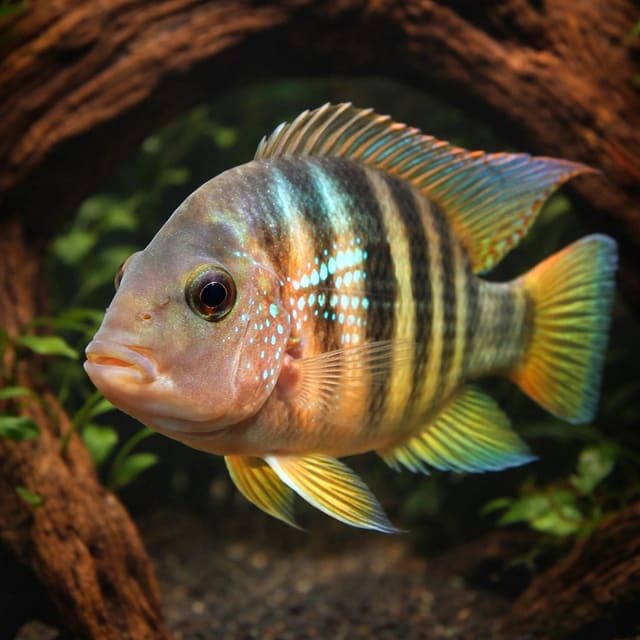
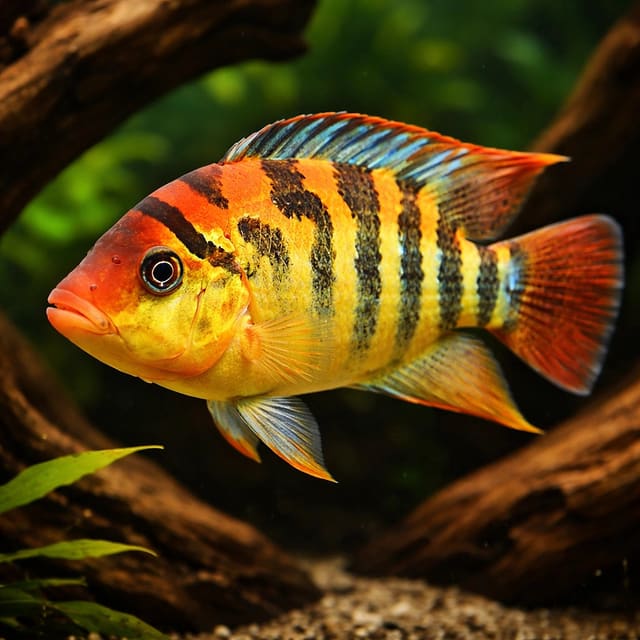
Heckel's Threadfin Acara (Acarichthys heckelii) is a relatively peaceful South American cichlid that reaches about 20 cm and needs a large, mature, heavily filtered aquarium with a sandy floor. One live fish is supplied per purchase, at 5–6 cm or 7–9 cm.
Adult size is the maximum length this species reaches at full maturity (scientific sources). The livestock you receive will be younger and smaller — pick a size above for the actual shipping size. Product-photo provenance and any image-specific limitations are stated on the listing.
Acarichthys heckelii
Heckel's Threadfin Acara (Acarichthys heckelii) is a relatively peaceful South American cichlid that reaches about 20 cm and needs a large, mature, heavily filtered aquarium with a sandy floor. One live fish is supplied per purchase, at 5–6 cm or 7–9 cm.
Adult size is the maximum length this species reaches at full maturity (scientific sources). The livestock you receive will be younger and smaller — pick a size above for the actual shipping size. Product-photo provenance and any image-specific limitations are stated on the listing.
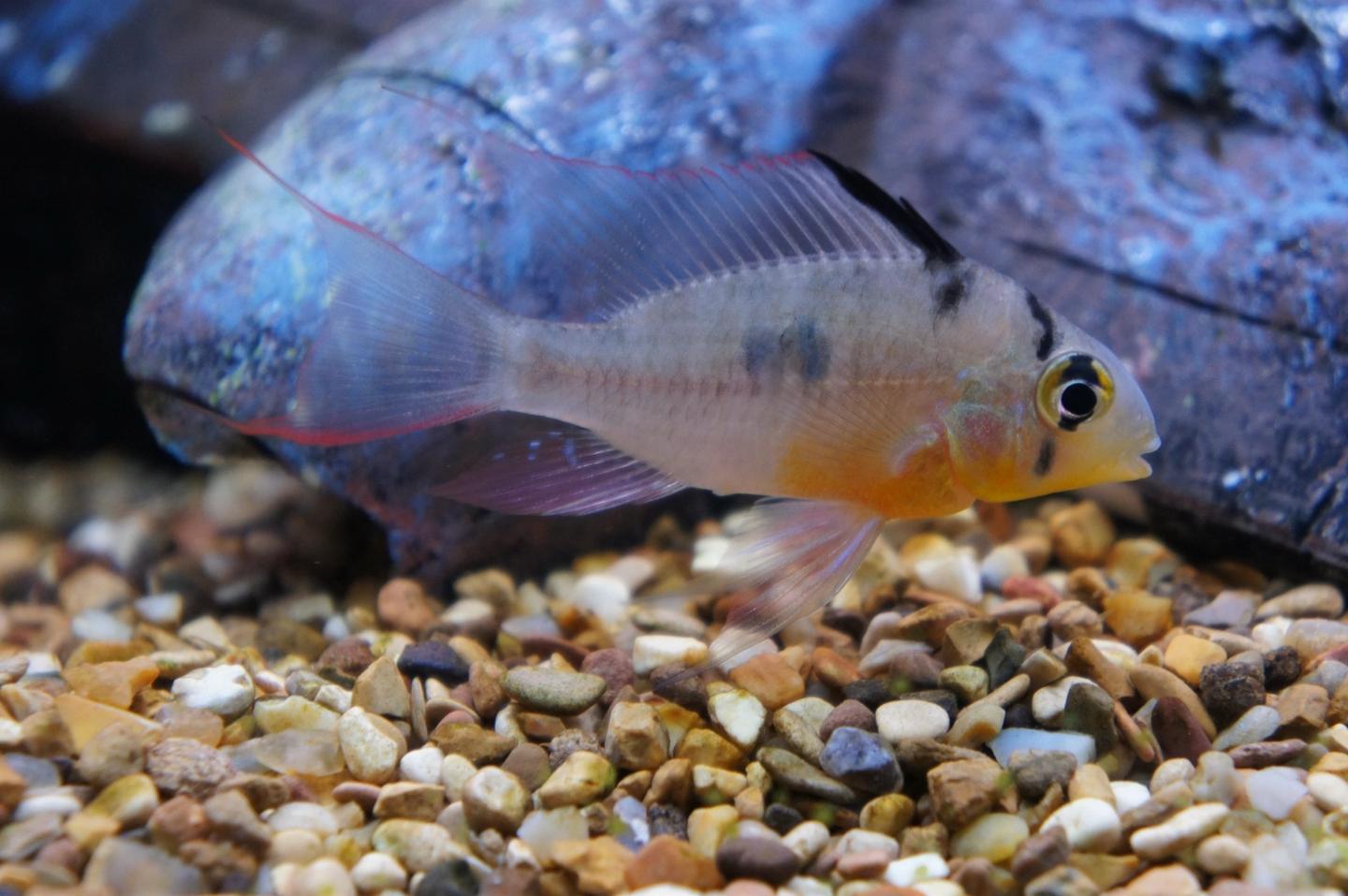
Cichlids are a family of roughly 1,800 accepted species, not one care type. Before buying, identify the exact species and source, then compare adult measurement, usable tank dimensions, social system, territory, tested water, diet and an exit plan. No family-wide minimum tank, water range or tank-mate list is safe.
Maintain these water conditions for optimal health and vibrant colors
Heckel's Threadfin Acara (Acarichthys heckelii) is a South American cichlid from the Amazon and Essequibo river systems that grows to about 20 cm. It is relatively peaceful towards other fish, spends much of its time in midwater, and is a tireless digger, so it belongs in a large, well-filtered aquarium with a soft sandy floor and a few pieces of driftwood. Seriously Fish treats a tank with a base of 150 × 45 cm as just about acceptable for a pair, which gives a fair idea of the space involved.
Water quality is the other deciding factor. This cichlid is sensitive to deteriorating conditions and to swings in water chemistry, so it needs a fully matured aquarium, generous filtration and large water changes every week. Given that space and routine, it makes a calm, characterful centrepiece for a big South American aquarium, and it sits comfortably among the larger fish in our centrepiece fish collection.
Its appeal lies in that combination: a large South American cichlid that is relatively peaceful with other fish, with a busy, purposeful habit of reshaping the sand and, in the wild, an unusual burrow-building way of raising its young. It rewards a keeper who enjoys a well-run, spacious aquarium more than one looking for a quick addition to an existing tank.
| Suits | Experienced keepers with a large, mature aquarium and time for heavy weekly maintenance |
|---|---|
| Adult size | About 20 cm |
| Sizes supplied | 5–6 cm or 7–9 cm, one fish per purchase |
| Temperament | Relatively peaceful with other fish; some adults turn on their own kind |
| Water | 24–30°C, pH 6.0–8.0, 1–12 dGH in Seriously Fish's aquarium guidance |
| Diet | Most foods: a varied mix of live, frozen and dried food with some vegetable matter |
| Home waters | The Amazon basin and the Essequibo River in South America |
| Need | Why |
|---|---|
| A tank with a base of at least 150 × 45 cm | The practical minimum for a pair of adults |
| Strong filtration from canister filters, a sump or both | Stable water is essential for this species |
| Time for a 50–70% water change every week | Keeps waste and nitrate low |
| Sand rather than gravel | It digs constantly |
| A fully matured filter | It must never go into a new, immature aquarium |
| Peaceful companions that share its water | Aggressive fish and fin nippers are best avoided |
This listing offers two sizes, 5–6 cm and 7–9 cm, and each purchase is one live fish of the size you choose. The size you select is the size supplied, not the adult size. Both are small next to a 20 cm adult, and Seriously Fish notes that the species takes two to three years to reach sexual maturity, so either choice calls for the same long-term plan: an aquarium built for the adult fish, not for the one that arrives. Sex is guaranteed only when the selected option explicitly states male or female. This Heckel's Threadfin Acara listing has no sex-guaranteed option.
Care is the same whichever size you pick: the same adult-sized aquarium, the same water and the same varied diet. A 7–9 cm fish starts a little further along the road to adulthood, while a 5–6 cm fish gives you longer to watch it grow in your own aquarium. If you are buying two, remember that two fish of either size cannot be promised as a pair, and plan the aquarium for two adults.
You may also meet the spelling heckeli, and the fish is sometimes traded under the German name Heckels Buntbarsch. FishBase lists it as Acarichthys heckelii, the threadfin acara, in the cichlid family Cichlidae. It is the only member of its genus.
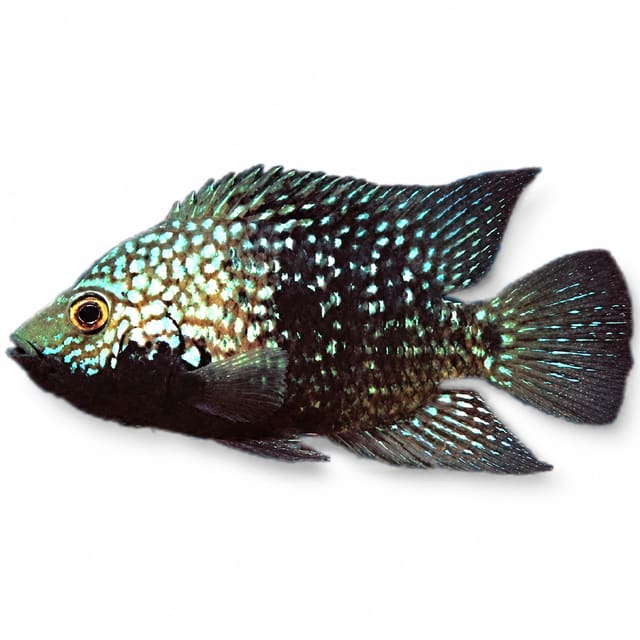
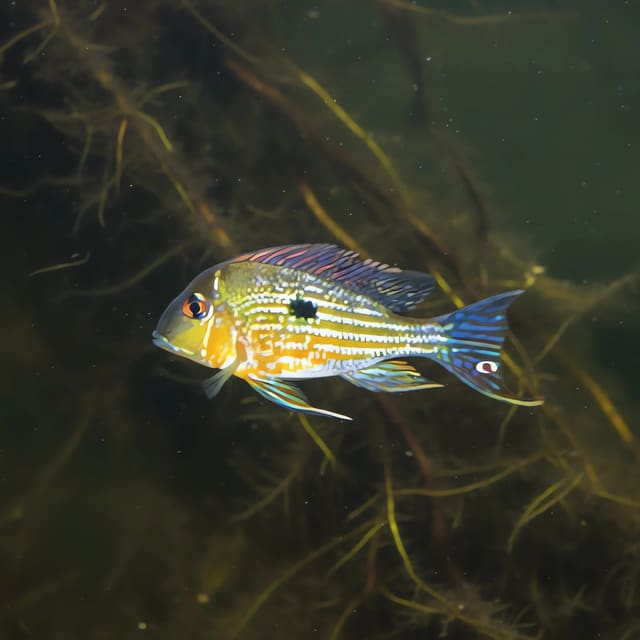
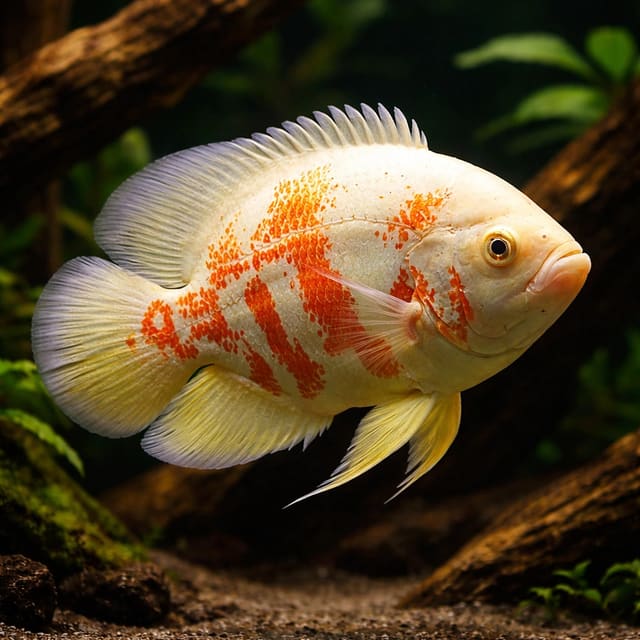
Gallery images have been digitally enhanced to improve image quality. Natural colour, pattern, size and maturity can vary between live animals.
In the wild, Heckel's Threadfin Acara lives along the mainstream Amazon in Peru, Colombia and Brazil, including the lower Putumayo, Trombetas, Negro and Xingu rivers, as well as the lower Tocantins and Capim rivers, the Branco River and the Essequibo River in Guyana. FishBase classes it as a benthopelagic freshwater fish that moves within river systems, and the IUCN assesses it as Least Concern.
Two habits shape life in the aquarium. Unlike some of its relatives, it does not sift sand for food, and it spends much of its time in midwater. Yet it is an incessant digger, and any aquascape built on gravel will quickly be rearranged. Its breeding behaviour explains why.
In nature, females compete for territories and excavate complex, burrow-like structures in the substrate. These can have several entrances, some of them false, and usually consist of a more or less vertical main entrance leading to a horizontal tunnel, with a larger chamber at the end where the eggs are laid. The female then attracts a partner. Once spawning is over, the pair share the work: the female carries out most of the brood care while the male defends the territory.
Free-swimming fry stay close by and dart back into the burrow when threatened, and the parents leave them once they measure around 10 mm in total length on average. Some young fish carry on using the burrow after that point. This is wild behaviour rather than a breeding plan for the home aquarium, but it shows why a soft floor matters so much to this cichlid.
Seriously Fish records that the species needs two to three years to reach sexual maturity, and that sexually mature females should be noticeably thicker-bodied than males. Body shape is therefore only a guide in adult fish, and fish bought at 5–6 cm or 7–9 cm are a long way from that stage.
OATA's guide notes that American cichlids can live for several years in a well-matured set-up with good water quality. With two to three years needed just to reach maturity, this is a fish to plan around for the long term rather than a short-term addition.
Acarichthys contains this single species. Kullander redescribed the genus in 1986, separating it by a combination of features that include comparatively few dorsal-fin rays (12–14), the lack of an epibranchial lobe and broad-tipped pelvic fins. His 1998 study then placed it with Guianacara in the tribe Acarichthyini, within the subfamily Geophaginae. For the keeper, that background mainly explains why you will rarely see anything else sold under the same genus name.
Plan the aquarium around a 20 cm adult from the start, even if your fish arrives at 5–6 cm. Seriously Fish considers a tank with a base of 150 × 45 cm just about acceptable for a pair, and says a significantly larger tank would be needed for a group. OATA's general guide for American cichlids recommends at least 300 litres for the larger or more aggressive species, those over 15 cm, and points out that a bigger aquarium keeps temperature and water quality more stable. Treat both figures as starting points rather than targets to squeeze under.
A sandy substrate is recommended. Gravel can be used if you prefer, but because this species digs constantly, a gravel aquascape will not stay the way you arranged it for long. Soft sand lets the fish dig naturally and suits OATA's general advice that many American cichlids dig or sift the substrate when feeding or breeding.
Beyond the substrate, décor is largely a matter of taste, but the set-ups that suit it best tend to combine relatively dim lighting with chunks of driftwood and scattered roots or branches. That arrangement gives cover without relying on delicate aquascaping that a digger would undo. Make sure anything heavy sits firmly, because a fish that excavates the floor can loosen décor resting on sand.
Live plants are a gamble. OATA notes that American cichlids may dig up or eat live plants, and suggests plastic plants as a practical way of adding cover.
This cichlid should never be introduced to a biologically immature aquarium. Before it arrives, the filter needs a well-established population of beneficial bacteria, ammonia and nitrite should both read zero, and the tank should already be running steadily. If you are starting from scratch, our guide to preparing and maturing a new tropical aquarium walks through getting the filter established before any fish go in.
Water quality is of the utmost importance for this fish. Seriously Fish describes it as susceptible to deteriorating water quality and to swings in chemical parameters, and recommends two things to achieve the stability it needs: over-filter the aquarium, using external canister filters, a sump or both, and carry out a minimum of one water change a week, replacing 50–70% of the water each time.
| Value | Aquarium guidance |
|---|---|
| Temperature | 24–30°C, preferably towards the upper end (Seriously Fish) |
| pH | 6.0–8.0 (Seriously Fish) |
| General hardness | 1–12 dGH (Seriously Fish) |
| Ammonia and nitrite | Zero (OATA) |
| Nitrate | No more than 20 mg per litre above your tap water level (OATA) |
| Water changes | Weekly, replacing 50–70% of the water (Seriously Fish) |
FishBase lists 23–26°C for the species, and OATA's general guide for American cichlids gives 22–27°C, pH 6.5–8.0 and 4–12°dH. The table follows Seriously Fish because its figures are written for keeping this species in an aquarium. Whatever temperature you settle on inside 24–30°C, hold it steady and make sure every companion is comfortable there too; for this fish, stability matters as much as the number itself.
Changing half or more of the water each week only helps if the new water is safe. OATA advises treating all replacement water with a tap water conditioner to remove harmful chlorine or chloramine before it goes into the aquarium, and testing at least once a week so that ammonia and nitrite never build up. Our guide to aquarium water chemistry explains what each test tells you, and the water matcher tool lets you compare your own readings with the ranges above.
OATA's nitrate limit is measured against your tap water, not against zero: no more than 20 mg per litre above normal tap water levels. Test your tap water once so you know its starting nitrate, pH and hardness, then compare it with the aquarium. That tells you how hard your filter and water changes are working, and whether the water you add each week already sits inside the range this fish needs.
The RSPCA's welfare guidance sums up why this matters: fish release toxic ammonia, and a working biological filter lets beneficial bacteria convert it into nitrite, which is also toxic, and then into nitrate, which is safer. Large, regular water changes then remove the nitrate that builds up.
Heckel's Threadfin Acara accepts most foods, which makes it straightforward to feed, but Seriously Fish stresses that a varied diet is essential if the fish is to develop its best condition and colour. Build the menu from a mixture of live, frozen and dried foods, and make sure some vegetable matter is included.
Fish supplied at 5–6 cm or 7–9 cm have a lot of growing to do. Choose items they can swallow comfortably, such as small pellets, daphnia or brine shrimp, and move towards larger frozen foods like cockles or prawns as they approach adult size. Keep the vegetable portion going throughout, because variety is what Seriously Fish links to the best condition and colour.
OATA's general guide for American cichlids is to feed only what the fish can eat within a few minutes, once a day. These cichlids can eat large amounts in one sitting, so it is easy to overdo it, and overfeeding leads to excess waste and uneaten food that breaks down, releasing toxic material into the water. With a fish this sensitive to water quality, a lean, varied menu is far better than a generous one.
Seriously Fish also warns that when the maintenance regime or the diet falls short, this species may develop health problems. Good food and clean water work together, and neither makes up for a lack of the other.
Our team hand-bags each fish in pure oxygen and packs it in an insulated poly box, adding a heat pack when the weather calls for it, and a tracked, licensed live-animal courier carries the parcel to you. We email the tracking number and your confirmed delivery date, so you know when to be at home. Live fish cannot be left unattended, so someone must be at the address to take the parcel in, and it should be opened and inspected the same day.
Take your time over acclimatisation; a slow start is the best start. If the fish has not arrived in good health, contact us the same day, with WhatsApp the quickest route, and send your order number and the unboxing video showing the sealed parcel being opened. We'll arrange a replacement or refund. The full terms, along with short clips from our own fishroom on unpacking and acclimatising, are on our delivery and Live Arrival Guarantee page.
OATA advises increasing the number of fish in an aquarium only slowly, because the filter's bacteria need time to catch up every time more fish are added and feeding increases. Add your acara to a settled tank, give it time to find its bearings among the wood and roots, and hold back on further new fish until you are sure the water is still reading well.
OATA describes a healthy fish as one with clear, bright eyes, undamaged fins, intact scales and no ulcers or bumps. Every fish has its own small quirks, so learn how yours normally looks and behaves, then watch for changes such as these:
| Task | How |
|---|---|
| Water change | Replace 50–70% of the water with conditioned tap water |
| Testing | Ammonia and nitrite at least once a week, plus nitrate, pH and temperature |
| Filter check | Look for blockages; rinse media only in removed tank water |
| Observation | Watch feeding, colour, breathing and behaviour against the list above |
If something looks wrong, test the water first, because OATA notes that American cichlids can be stressed by even the smallest amounts of ammonia. If the readings are good and the fish is still unwell, get in touch and describe what you are seeing.
Seriously Fish describes this species as relatively peaceful in the main, and it will not prey on anything larger than a couple of centimetres. That makes it a good centre for a peaceful community of larger fish, provided its companions suit its size and water.
Suitable tank mates are too numerous to list, but they include most peaceful species that enjoy similar environmental conditions. In practice that means fish that are happy in the same warm, soft-to-moderate water and large enough not to be mistaken for food. A biotope-style community drawn from the same Amazonian waters is an attractive option if you want to go further.
OATA's general guide notes that calmer American cichlids can share a robust community with larger shoaling fish, while the more aggressive species must be kept alone or with equally aggressive cichlids. A relatively peaceful fish like this one belongs on the calmer side of that line, so any other cichlid you consider should be judged on its temperament and adult size before it goes in.
Start with the acara's needs and choose companions to fit them, rather than the other way round. Pick fish that are comfortable at the temperature you have chosen, peaceful by nature and too large to be swallowed, and add them gradually so the filter keeps pace. Check any other cichlid with us before you buy it, and keep stocking light enough that the weekly water change can hold nitrate down.
The main compatibility question with this species is its own kind. Some adults appear prone to unpredictable and extreme bursts of aggression towards other members of the species, which can easily result in the death of weaker individuals, and Seriously Fish links this to both tank size and group size.
For most keepers, one fish or a pair is the sensible choice. OATA's general guide notes that most American cichlids do better singly or in pairs, and Seriously Fish's 150 × 45 cm base for a pair is the practical minimum. Sex isn't guaranteed with this listing, so two fish bought together can't be promised to be a male and female, and body shape only becomes a guide once they mature after two to three years.
Aggression between adults can escalate quickly and can be fatal for the weaker fish, so act on early signs rather than waiting. Watch for one fish hiding far more than usual, torn or missing fins, lost scales, or a fish that stops feeding while another dominates the tank. If one fish is clearly being targeted, separate them promptly.
A group needs a significantly larger aquarium than a pair, and even then the risk of sudden aggression between adults does not disappear. Keep a close eye on the temperament and hiding changes listed in the health checks, and have a second aquarium or a way of separating fish ready before you need it.
It reaches about 20 cm. FishBase records a maximum of 20 cm total length and Seriously Fish gives 20 cm standard length, so plan the aquarium around a fish of that size.
Seriously Fish describes a base of 150 × 45 cm as just about acceptable for a pair of Heckel's Threadfin Acaras, with a significantly larger tank for a group. OATA recommends at least 300 litres for American cichlids that grow beyond 15 cm.
One or a pair suits most aquariums. Some adult Acarichthys heckelii show sudden, extreme aggression towards their own kind that can kill weaker fish, and this appears related to tank and group size, so keep a group only in a much larger aquarium.
It is better suited to experienced keepers. It grows large, needs a big, heavily filtered and fully matured aquarium with weekly water changes of 50–70%, and it is susceptible to poor water quality and swings in water chemistry.
It accepts most foods. Give a varied mix of live, frozen and dried foods, including some vegetable matter such as blanched spinach or a Spirulina product. OATA's general rule for American cichlids is to feed only what they clear within a few minutes, once a day.
Seriously Fish advises 24–30°C, preferably towards the upper end, with pH 6.0–8.0 and hardness of 1–12 dGH. FishBase lists 23–26°C. Choose a temperature inside the aquarium range and keep it steady.
Towards other fish it is relatively peaceful and will not prey on anything larger than a couple of centimetres. The aggression to plan for is between adults of its own species, and it should itself be kept away from fin-nipping fish.
Most peaceful species that enjoy similar water conditions make suitable companions. Avoid particularly aggressive or territorial fish and fin nippers, and take care with freshwater stingrays, which have preyed on this species at night in some aquariums.
Each fish is hand-bagged in pure oxygen and packed in an insulated poly box, with a heat pack when the weather calls for it, then carried by a licensed live-animal courier. Record one continuous unboxing video from the sealed parcel, float the sealed bag for 20–30 minutes before releasing the fish, and never pour the bag water into your tank. If anything is wrong, contact us the same day with your order number and the video.
No reviews for this item yet. Bought one? Honest reviews only, good or bad.
What customers say about ordering from us
Easy website plenty of info on fish your buying great to pick a time slot
TRACEY DURRANT · 7 Oct 2026
Got some lovely fish thank you
Kevin Mackie · 7 Oct 2026
Reviews of our shop, collected by Judge.me, an independent third-party review collector. Newest first.