Moderate
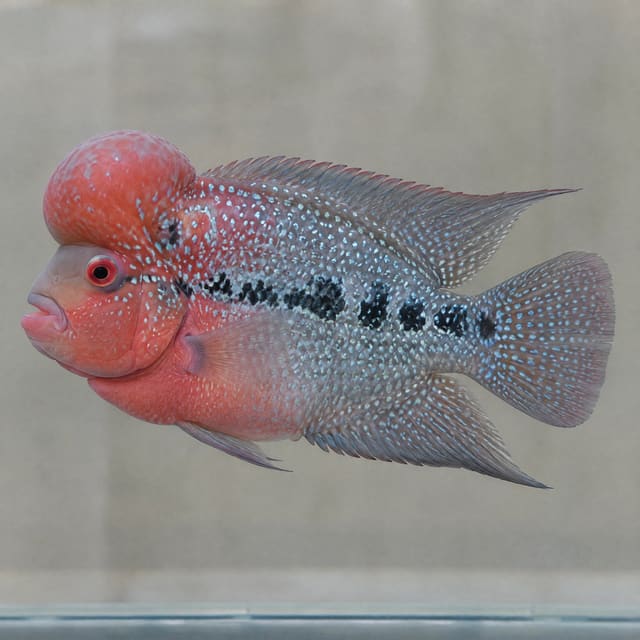
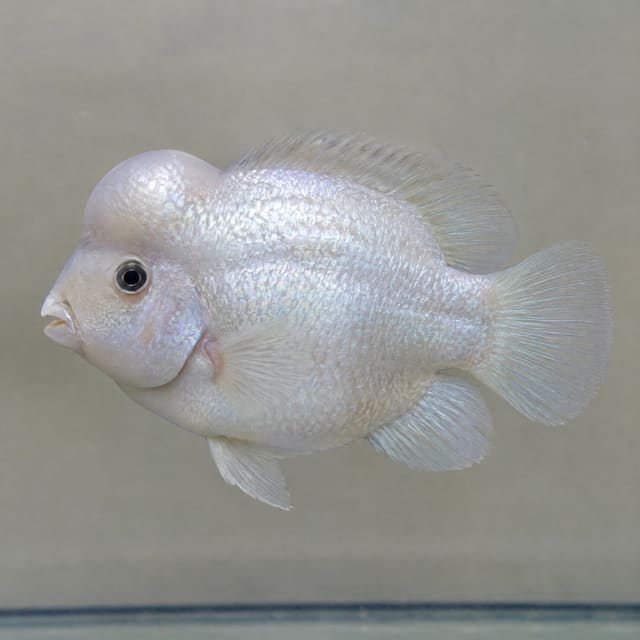
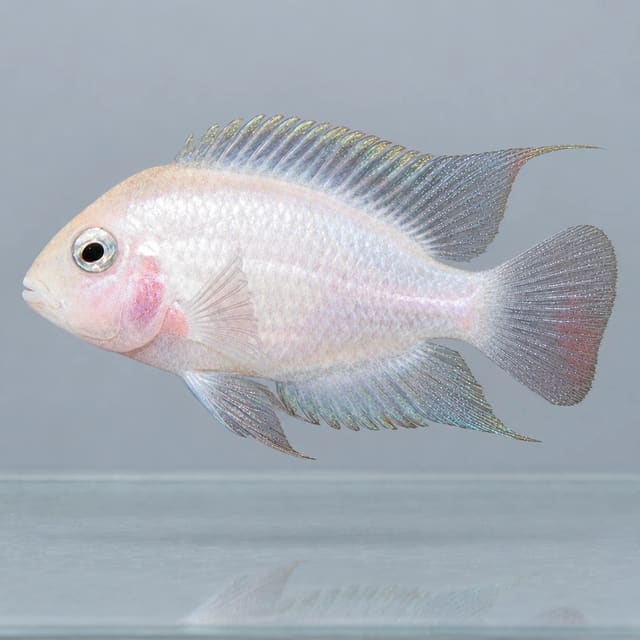
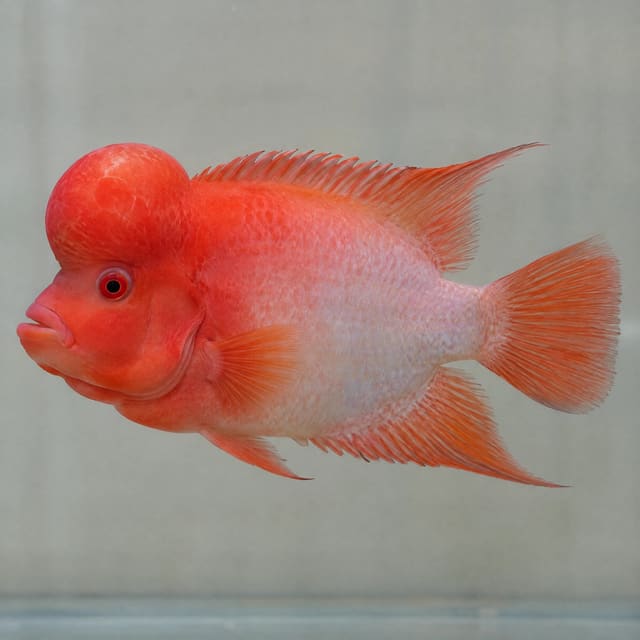
Thai Silk Flowerhorn Cichlid (Hybrid)
24–28°C · 350L
£162.99
The Bay Snook (Petenia splendida) is a giant predatory cichlid from Mexico, Guatemala and Belize, with jaws that shoot forward to catch fish. Aquarium fish reach at least 30 cm, so plan an aquarium of at least 180 × 45 × 45 cm with powerful filtration, warm hard water and meaty foods. Sold singly as one live fish.
Petenia splendida
The Bay Snook (Petenia splendida) is a giant predatory cichlid from Mexico, Guatemala and Belize, with jaws that shoot forward to catch fish. Aquarium fish reach at least 30 cm, so plan an aquarium of at least 180 × 45 × 45 cm with powerful filtration, warm hard water and meaty foods. Sold singly as one live fish.
Cichlids are a family of roughly 1,800 accepted species, not one care type. Before buying, identify the exact species and source, then compare adult measurement, usable tank dimensions, social system, territory, tested water, diet and an exit plan. No family-wide minimum tank, water range or tank-mate list is safe.
Read the full care guidance when planning conditions for your aquarium.
The Bay Snook, Petenia splendida, is a large, fish-eating cichlid from Central America and the only species in its genus (Wikispecies). It is also sold as the Red Bay Snook; FishBase lists giant cichlid and tenguayaca as further names, and Mexican researchers call it tenhuayaca. It belongs to the cichlid family, Cichlidae, and to the tribe Heroini, the group of Central American cichlids that also includes the jaguar and wolf cichlids.
In the wild it lives on the Atlantic slope of Mexico, from the Grijalva to the Usumacinta river basins, in the Usumacinta in Guatemala, and in Belize. FishBase describes its habitat as lakes and lower river valleys, where it prefers slow water in the lower and middle reaches of rivers over soft sand or mud. It is fished commercially, farmed for food in south-eastern Mexico, and assessed as Least Concern on the IUCN Red List.
Its most remarkable feature is its mouth. The jaws shoot far forward to grab prey: in a study of jaw mechanics in Neotropical cichlids, Waltzek and Wainwright (2003) classed the bay snook as an extreme jaw protruder, with protrusion of more than 30% of head length, and found that it closed on prey faster than the oscar because its jaws reach further. They suggest this helps it catch evasive fish.
| Suits | Not suited to |
|---|---|
| One fish in an aquarium of at least 180 × 45 × 45 cm | Any smaller aquarium, even for a young fish, unless the large tank is ready |
| Very powerful filtration and large weekly water changes | A lightly filtered display |
| Warm, hard, slightly alkaline water | A soft, acidic set-up |
| Living alone, or robust fish of a similar size | A community of small fish |
| Meaty frozen foods and large cichlid pellets | A keeper who wants a fish that stays small |
Browse our South American cichlids and the American cichlids directory, or see the Central American cichlids page for its closest relatives. If you want one large fish as the focus of the room, our centrepiece fish selection shows other options.
One purchase quantity supplies one live Bay Snook, sold as a young fish. No dispatch size is listed, so ask us if you need the current size before ordering. Sex is not specified, because young fish cannot be sexed reliably.
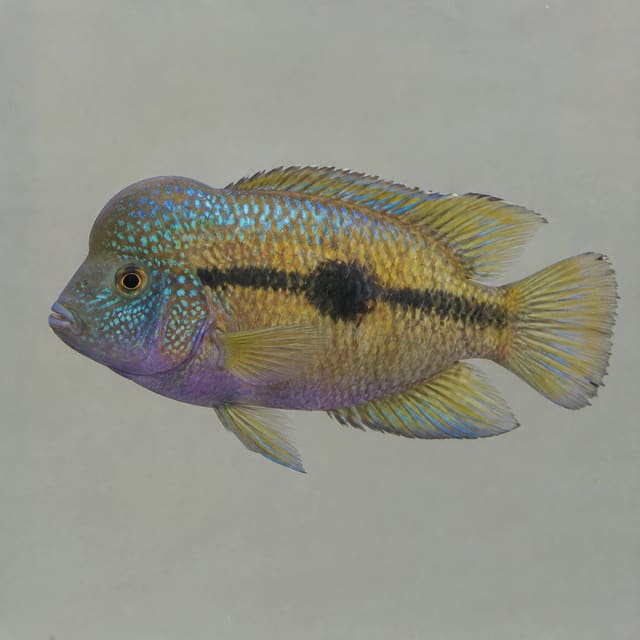
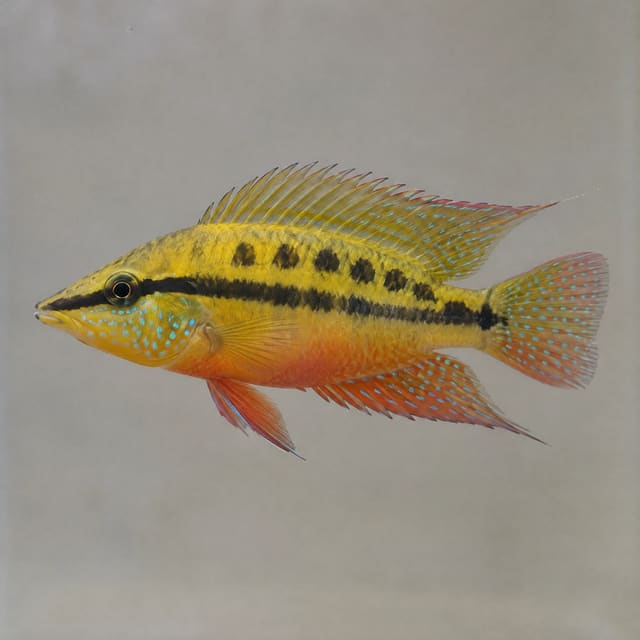
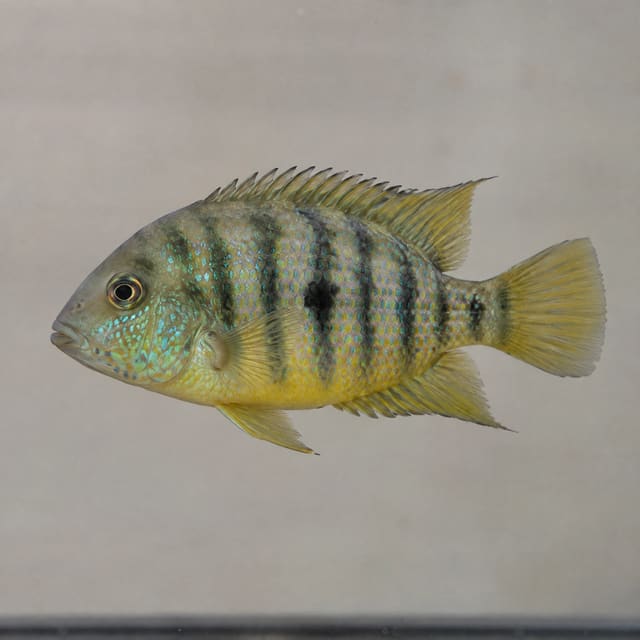
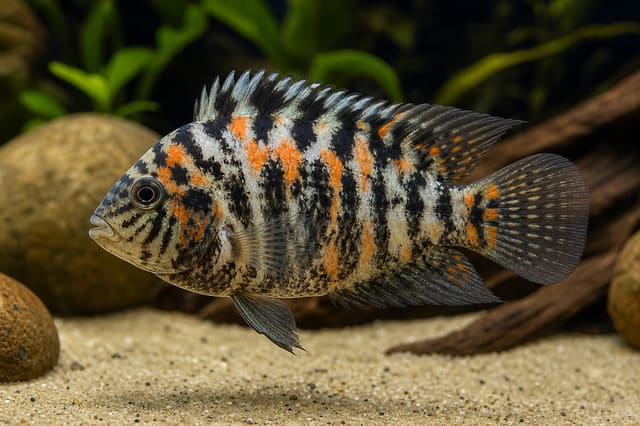
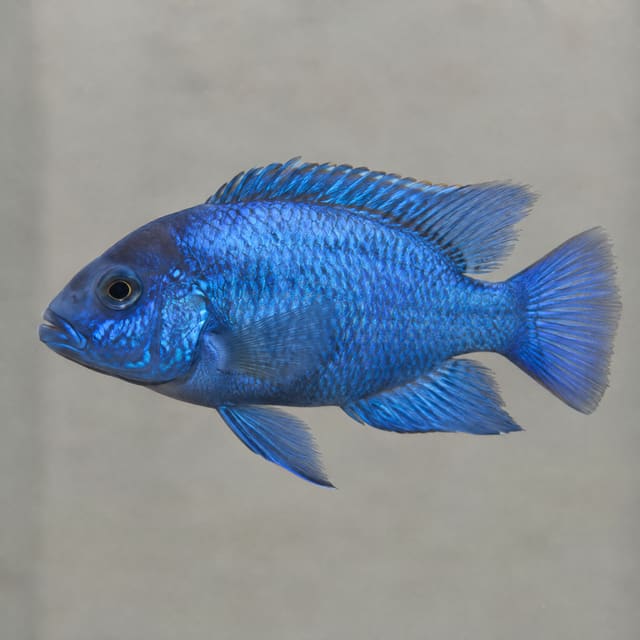
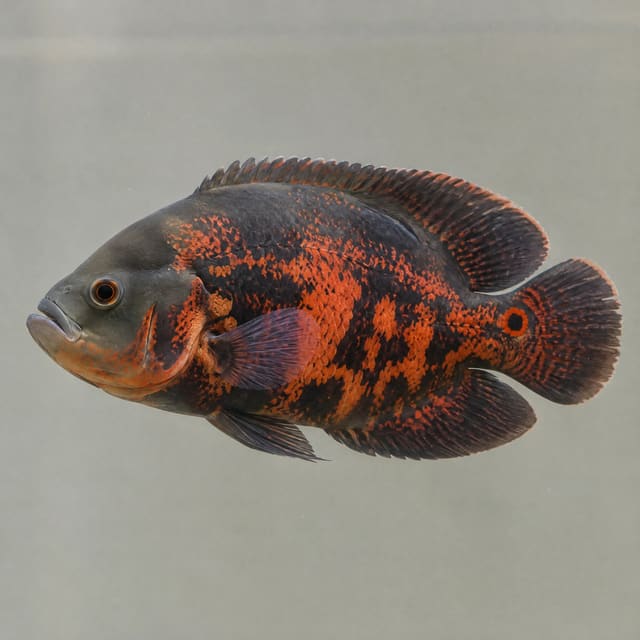
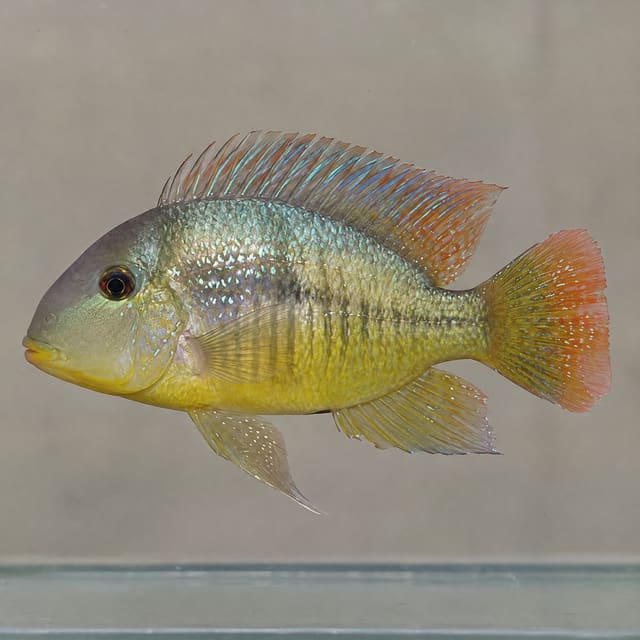
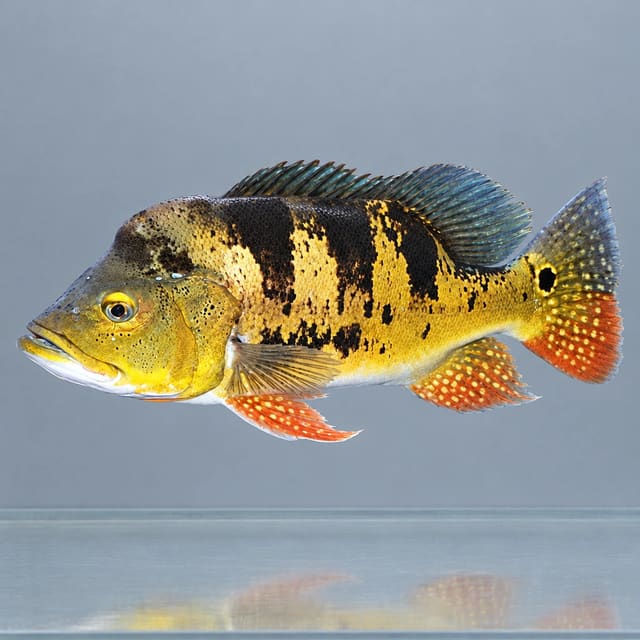
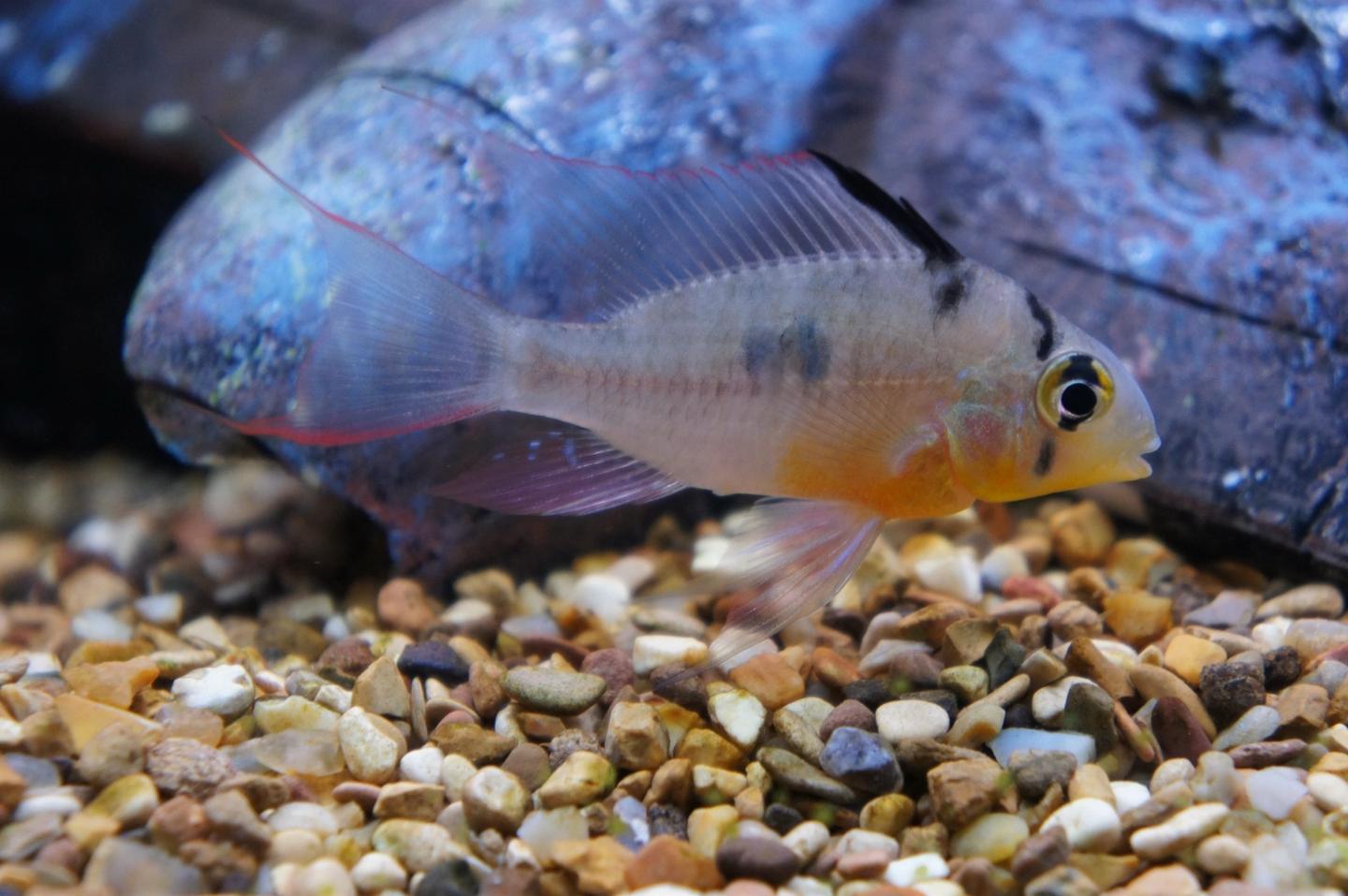
Red Bay Snook is a trade name for the red and pink colour forms; they are the same species as the olive-gold fish. The photographs show the species, not the individual you will receive.
Sources give different adult sizes, so plan for the large end. FishBase records a maximum of 50 cm standard length (the body without the tail). Practical Fishkeeping gives up to 45 cm and several kilograms in the wild, and at least 30 cm, probably more, in aquariums. Researchers at the Universidad Juárez Autónoma de Tabasco report fish of up to 40 cm and 1,500 g in local markets.
Practical Fishkeeping recommends an aquarium of at least 180 × 45 × 45 cm for an adult, and OATA’s American cichlid care sheet sets a minimum of 300 litres for species over 15 cm. A 180 × 45 × 45 cm tank holds about 365 litres before sand and rock go in (180 × 45 × 45 = 364,500 cm³), so it meets both; more front-to-back depth gives a fish of this bulk more room to turn.
Have the final aquarium ready, or a firm plan for it, before buying a young fish. Our tank volume calculator works out the real litres of your aquarium.
Practical Fishkeeping advises heavy rocks and bogwood, so the fish cannot rearrange the décor too much. OATA suggests fine gravel or sand for American cichlids, because many species dig, with wood, rockwork or caves for cover and open space for swimming. Live plants may be dug up or eaten; plastic plants are an alternative.
| Area | Purpose |
|---|---|
| Open central lane | Room to swim and turn a large body |
| Heavy rocks set on the base glass before the sand goes in | Stability: digging cannot undermine them |
| Large bogwood | Cover and broken sight lines |
| Fine gravel or sand | A safe substrate for digging |
| A secure, heavy cover | Keeps a large, powerful fish in the aquarium |
Keep equipment robust: a large cichlid can knock loose heaters, pipework and thermometers, so fix them firmly or fit guards. OATA notes that American cichlids need a heater all year. Place the aquarium away from draughts, radiators and direct sunlight, with overhead lighting for a regular day and night.
FishBase gives 26–30°C, pH 7.0–7.5 and hardness from 15 °dH for this species, and Practical Fishkeeping describes it as adaptable to most conditions, with pH 7.0–7.5 and general hardness above 15 ideal. OATA’s group care sheet for American cichlids gives 22–27°C, pH 6.5–8.0 and 4–12 °dH; for this species, follow the species-level values.
| Reading | Keep it at |
|---|---|
| Temperature | 26–30°C (FishBase); 26–27°C sits inside both FishBase’s range and OATA’s group range |
| pH | 7.0–7.5 |
| General hardness | 15 °dH or more |
| Ammonia | 0 mg/l |
| Nitrite | 0 mg/l |
| Nitrate | No more than 20 mg/l above your tap water level (OATA) |
UK tap water varies from soft to very hard by region. Hard-water areas often match these values with little adjustment, while soft-water areas may need buffering. Measure your tap water and compare it in our water matcher; our aquarium water parameters guide explains general and carbonate hardness. Change conditions gradually rather than chasing a number.
Practical Fishkeeping calls for a very powerful filter. A fish that eats whole frozen fish and large pellets produces a lot of waste, and that waste becomes ammonia, which filter bacteria turn into nitrite and then nitrate. Our aquarium filtration guide explains how to size and combine filters; for a tank of this size, two large external filters or a sump are common choices.
Mature the filter before the fish arrives; our nitrogen cycle guide explains fishless cycling. Remove any food the fish ignores within a few minutes, because large meaty leftovers foul the water quickly.
In the wild the bay snook feeds on fish; FishBase gives it a trophic level of 4.5, the level of a top predator. In aquariums, Practical Fishkeeping notes, it takes most meaty frozen foods and pellets. OATA recommends cichlid pellets or granules as the base diet for American cichlids, with foods such as cockles, lance fish and prawns for larger species, fed once a day in amounts eaten within a few minutes.
We do not recommend live feeder fish: frozen foods avoid carrying disease from another tank and are easier to measure. Do not overfeed either, because large cichlids are greedy and put on fat easily.
Before the fish arrives, confirm that ammonia and nitrite are zero, the temperature is in range and the aquarium is the size the adult will need. Add it to a quiet aquarium and keep the lights low on the first day.
These are OATA’s steps; our guide to acclimatising new fish explains them in more detail. A young fish may hide for a few days. Offer a small meal of frozen food the following day, and retest ammonia and nitrite after the addition. Our delivery information covers delivery days and the Live Arrival Guarantee.
OATA describes healthy fish as having clear, bright eyes, undamaged fins, intact scales, no ulcers or bumps, normal swimming and steady breathing. Note how your fish behaves once it has settled, so that changes stand out.
| If you see | Do this |
|---|---|
| Hanging at the surface or rapid breathing | Test ammonia, nitrite and temperature; increase aeration |
| Sitting on the bottom or erratic swimming | Check water readings, filter flow and any recent change |
| Clamped fins, flicking or shimmying | Test the water; OATA lists these as common signs of disease |
| White spots, fluffy growths, lost scales or damaged fins | Test the water and seek fish-health advice |
| Refusing food for several days | Check temperature and water, then try a different frozen food |
| Constant chasing of a tank mate | Separate the fish; the aquarium is not big enough for both |
Do not diagnose from a single sign. If a problem continues after the water checks, contact us with the aquarium size, temperature, pH, hardness, ammonia, nitrite and nitrate readings, the tank mates and what you have seen.
Any fish small enough to fit in its mouth will be eaten, and the bay snook’s mouth opens far wider than it looks when closed. OATA advises keeping the more aggressive American cichlids alone or only with equally aggressive cichlids, and that is the safest plan here. None of the sources we checked lists proven tank mates for this species, so treat every companion as a trial, keep a spare aquarium available and never add a fish it could swallow.
| Suits | Avoid |
|---|---|
| Living alone in a large aquarium | Tetras, livebearers, barbs, small catfish and any fish that fits in its mouth |
| In a very large aquarium, robust Central American cichlids of a similar size, such as the Black Belt Cichlid or the Redhead Quetzal Cichlid | Highly aggressive giant predators such as the Wolf Cichlid, unless the aquarium is exceptionally large |
| Companions added at the same time or earlier, at a similar size | Small or timid cichlids |
| Hard-water species that share its temperature and pH | Soft-water species |
Our tank mate checker screens proposed companions. For care on the same scale, compare the Jaguar Cichlid and the Motaguense Cichlid, or read our cichlid care guide, Jack Dempsey guide and Oscar guide for large-cichlid tank planning.
Like other American cichlids, the bay snook lays eggs and guards its young: OATA’s group care sheet notes that these cichlids clean a flat surface before spawning, guard the fry until they swim freely and become aggressive while breeding. In aquaculture research at the Universidad Juárez Autónoma de Tabasco, broodstock spawned naturally; the newly hatched young were collected from the nests and became free-swimming about six days after fertilisation, at around 28°C and pH 7.3. The larvae did not readily accept artificial food at first and were raised on newly hatched brine shrimp (Artemia) nauplii.
Petenia splendida, a large, fish-eating cichlid from Mexico, Guatemala and Belize, and the only species in its genus. It is also sold as the Red Bay Snook and is known in Mexico as tenhuayaca.
FishBase records up to 50 cm standard length in the wild. Practical Fishkeeping expects aquarium fish to reach at least 30 cm, and probably more.
At least 180 × 45 × 45 cm for an adult (Practical Fishkeeping), about 365 litres, with very powerful filtration. OATA’s minimum for American cichlids over 15 cm is 300 litres.
No. It eats fish, and its jaws shoot forward to catch anything that fits in its mouth. Keep it alone or with robust fish of a similar size in a very large aquarium.
Warm, hard water: FishBase gives 26–30°C, pH 7.0–7.5 and hardness from 15 °dH. Keep ammonia and nitrite at zero and nitrate low.
Meaty frozen foods such as cockle, mussel, krill and whole smelts, plus large cichlid pellets, once a day in amounts eaten within a few minutes.
No. Red Bay Snook is a trade name for the red and pink colour forms of the same species. Colour ranges from olive-gold to pink, red and gold.
Not reliably in young fish. Adult males grow slightly larger and more intensely red, and females are rounder.
No reviews for this item yet. Bought one? Honest reviews only, good or bad.
What customers say about ordering from us
Easy website plenty of info on fish your buying great to pick a time slot
TRACEY DURRANT · 7 Oct 2026
Got some lovely fish thank you
Kevin Mackie · 7 Oct 2026
Reviews of our shop, collected by Judge.me, an independent third-party review collector. Newest first.
Moved by UK carriers licensed to handle live animals
Hand-packed with oxygen bags, poly box, heat pack
Email photos the same day; an optional unboxing video helps us review problems faster — claim terms apply
Klarna & PayPal Pay in 3 at checkout