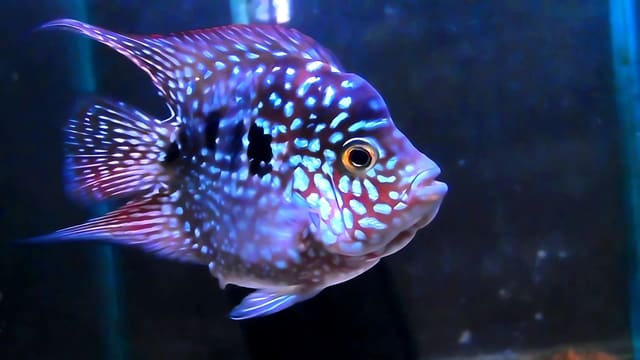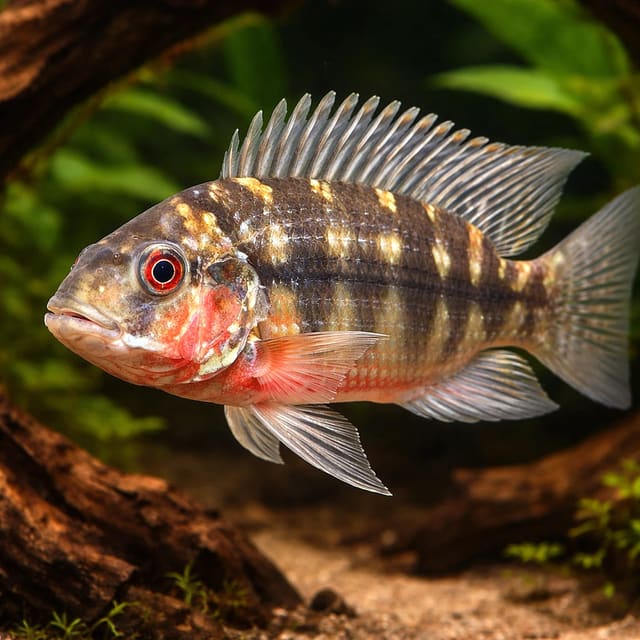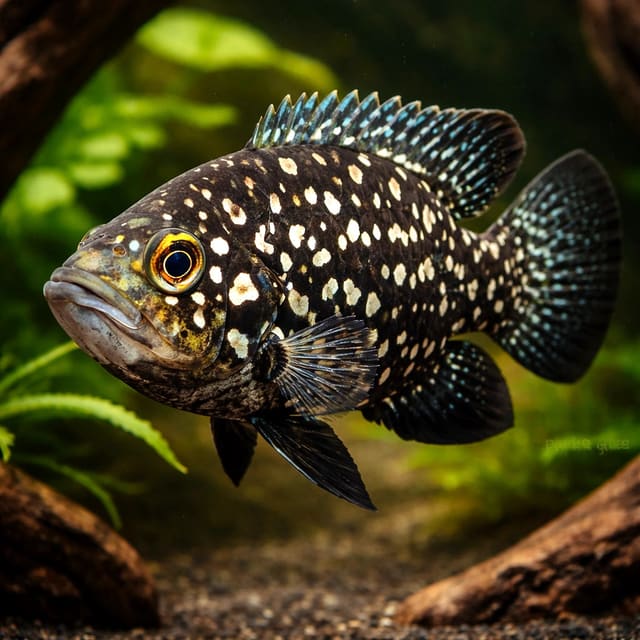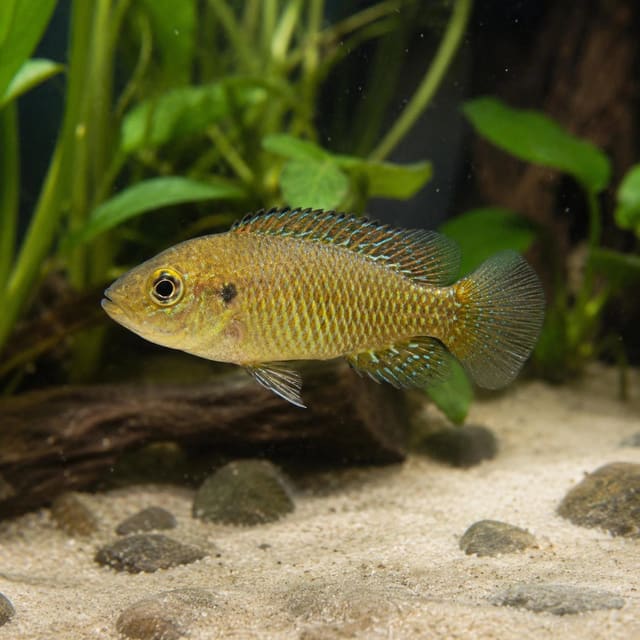
Dwarf Egyptian Mouthbrooder (Pseudocrenilabrus multicolor)
20–24°C · pH 6.8–7.2 · 71L
£6.99

A compact Asian chromide cichlid for hardwater or low-end brackish aquariums, with orange spotting, steady behaviour and thoughtful tank-mate planning.
Adult size is the maximum length this species reaches at full maturity (scientific sources). The livestock you receive will be younger and smaller — pick a size above for the actual shipping size. Product-photo provenance and any image-specific limitations are stated on the listing.
Etroplus maculatus
Save when buying multiple fish. Each quantity is one fish; sex and pair formation are not guaranteed unless the selected variant explicitly states them.
Confirm your email, then we’ll send an availability message for this exact item if it returns within 180 days.
This request is only for this product—no newsletter or other promotions. A mail-provider retry may very rarely duplicate the same availability message. Unconfirmed addresses are removed after 48 hours. See our privacy policy.
A compact Asian chromide cichlid for hardwater or low-end brackish aquariums, with orange spotting, steady behaviour and thoughtful tank-mate planning.
Adult size is the maximum length this species reaches at full maturity (scientific sources). The livestock you receive will be younger and smaller — pick a size above for the actual shipping size. Product-photo provenance and any image-specific limitations are stated on the listing.

Cichlids are a family of roughly 1,800 accepted species, not one care type. Before buying, identify the exact species and source, then compare adult measurement, usable tank dimensions, social system, territory, tested water, diet and an exit plan. No family-wide minimum tank, water range or tank-mate list is safe.
Maintain these water conditions for optimal health and vibrant colors
The Orange Chromide (Etroplus maculatus, also listed in modern references as Pseudetroplus maculatus) is a small Asian chromide cichlid from southern India and Sri Lanka. It is a useful choice for aquarists who want a colourful cichlid without the bulk of many larger species, but it should still be planned as a specialist hardwater or low-end brackish fish rather than a generic soft-water community fish.
Juveniles are usually sold at a modest size and develop their warmer yellow-orange body colour, darker flank markings and orange spotting as they settle. The species is naturally adaptable, but it looks and behaves best when the aquarium gives it stable mineral-rich water, a calm layout, and tank mates that will not compete too aggressively for territory.
| Care point | Recommendation |
|---|---|
| Adult size | Usually around 8-10 cm in aquarium conditions |
| Current listing size | 2 cm juvenile |
| Minimum aquarium | 110 litres for a pair or small group; larger for mixed communities |
| Temperature | 24-30 C, with stability more important than chasing exact numbers |
| pH and hardness | Neutral to alkaline water, pH 7.0-8.5, moderately hard to hard |
| Water type | Hard freshwater or carefully maintained low-end brackish conditions |
| Temperament | Generally manageable, but territorial during pair bonding and breeding |
| Diet | Omnivore with a strong algae, aufwuchs and vegetable component |
Orange Chromides have a rounded, compressed cichlid shape with a pale yellow to golden body, orange spotting and darker markings through the mid-body and fins. The exact intensity changes with age, mood, diet and background. Young fish can appear softer in colour at first, then become more attractive as they mature and settle into consistent water conditions.
This is not a large display cichlid, and that is part of its appeal. A well-kept adult has a neat, bright profile and an inquisitive manner without demanding the tank size required by many Central or South American cichlids. Good food, clean water and reduced stress do more for the colour than trying to force it with harsh lighting.
The species is associated with coastal and lowland waters in India and Sri Lanka, including freshwater habitats as well as lagoons, estuaries and other waters that may become slightly brackish. This background explains why Orange Chromides are often recommended for mineral-rich water and why they are a poor match for very soft, acidic blackwater communities.
In the wild they browse algae films, aufwuchs, small invertebrates and fine organic material. In the aquarium, the most natural results come from a tank that has some mature surfaces to graze, a sandy or fine gravel base, and structure such as smooth rocks, wood, robust plants and open areas for short bursts of swimming.
Use a mature aquarium of at least 110 litres for this 2 cm juvenile, with more space if you intend to keep several individuals or combine them with other hardwater fish. A larger footprint makes a real difference because it lets weaker individuals move out of a pair's territory and gives each fish a defined area to explore.
Decor should be practical rather than delicate. Smooth rocks, caves, pieces of wood, hardy plants such as Java fern or Anubias, and broken lines of sight all help. If plants are used, choose species that tolerate harder water or low-end brackish conditions. Keep filtration efficient, oxygen levels high and maintenance regular; chromides are hardy, but they are still cichlids and will not reward neglected water quality.
If you decide to keep them in low-end brackish water, raise salinity slowly and use a proper marine salt mix rather than table salt. A hydrometer or refractometer is useful because stable, measured conditions are safer than occasional guesswork.
A practical target is 24-30 C, pH 7.0-8.5 and moderately hard to hard water. Avoid sudden swings, especially when fish are newly introduced. The aquarium should be fully cycled, with ammonia and nitrite at zero and nitrate controlled through sensible feeding and regular partial water changes.
Because this species is often kept in harder or slightly brackish water, check that any tank mates, plants and filtration media are suitable for the same conditions. Stability is more valuable than repeatedly adjusting the aquarium to hit a perfect number.
Orange Chromides are omnivores, but they should not be fed as if they are purely predatory cichlids. Base the diet around quality small cichlid pellets, spirulina flakes, algae-based foods and occasional vegetable foods such as softened courgette, spinach or shelled peas. Add small frozen or live foods such as brine shrimp, daphnia and bloodworm in moderation.
Several small feeds are better than one heavy meal. The goal is active feeding without waste collecting in the substrate. A vegetable-rich diet helps digestion, supports colour and suits their natural grazing behaviour.
For a cichlid, Etroplus maculatus is usually manageable, but it is still territorial when mature and especially when a pair forms. Keep them as a pair or small group only where the tank has enough room and cover. Expect some display behaviour, short chases and defence of a chosen area during breeding.
Good tank mates are robust hardwater or low-end brackish fish of similar size, such as suitable mollies, peaceful gobies and other calm species that share the same chemistry. Avoid tiny fish, dwarf shrimp, slow long-finned fish, aggressive cichlids, fin nippers and any species that needs soft acidic water. A carefully planned community is much safer than a mixed tank chosen only by appearance.
Orange Chromides are pair-forming substrate spawners. A settled pair may clean a flat rock, tile or similar surface before spawning, and both adults can show parental care by guarding eggs and fry. Breeding is more likely in mature, clean water with a calm layout and minimal disturbance.
If fry appear in a community aquarium, survival is usually better in a dedicated rearing setup. Very small early foods such as infusoria or suitable liquid fry foods may be needed at first, followed by newly hatched brine shrimp and finely crushed foods as the fry grow.
This listing is for the 2 cm Orange Chromide variant, so plan for growth before purchase. Have the aquarium heated, cycled and chemically suitable before the fish arrive. Acclimatise slowly, especially if your tank uses brackish conditions or sits at the harder end of the range.
Tropical Fish Co supplies Orange Chromides with care information so you can match them to the right aquarium. For delivery timing, livestock packing and current arrival support, check the live-fish delivery terms shown at checkout and on the delivery page rather than relying on static product-page wording.
No reviews for this item yet. Bought one? Honest reviews only, good or bad.
What customers say about ordering from us
I have a small group of long finned mountain minnows. So was delighted to be able to order ten of this variety to increase the genetics in my tank . The ones I recieved are healthy but it’s to early to give a verdict on wether they are of a long finned type since they are small currently.
Gordon Walker · 23 Sept 2026
100% success travel and "installation". Pleased with quality of purchase. The Siamese fighter a bit "shy" so have not yet seen him at his best yet but looking good. Happy customer. GG
George E Garratt · 21 Sept 2026
Reviews of our shop, collected by Judge.me, an independent third-party review collector. Newest first.