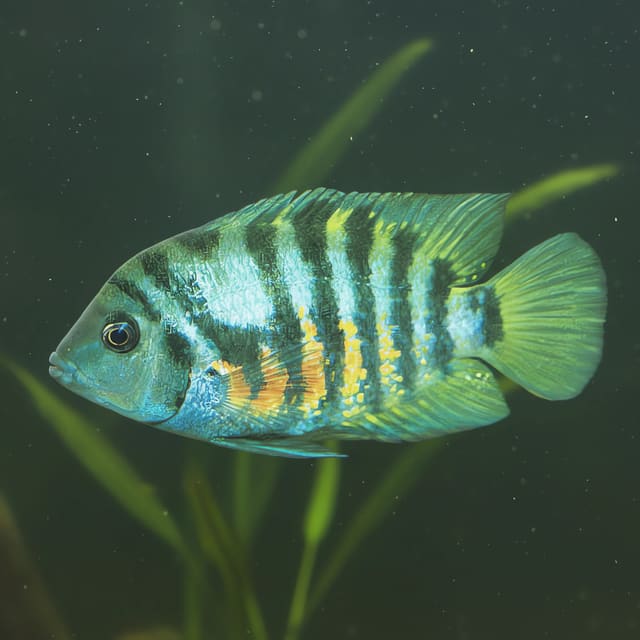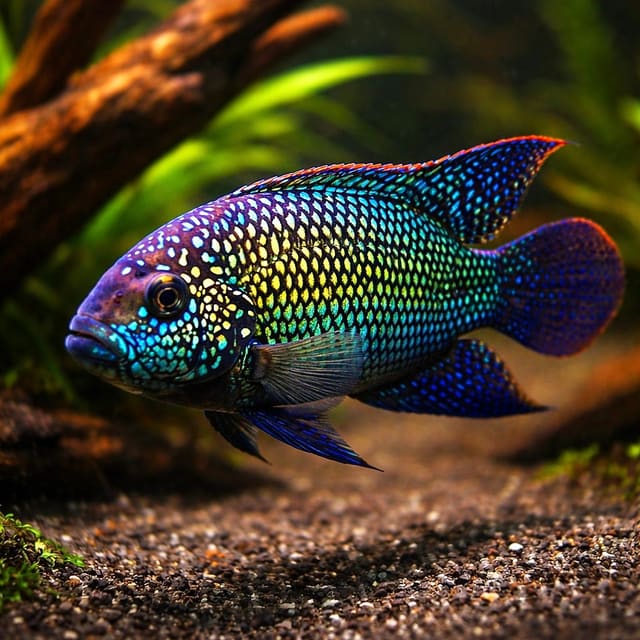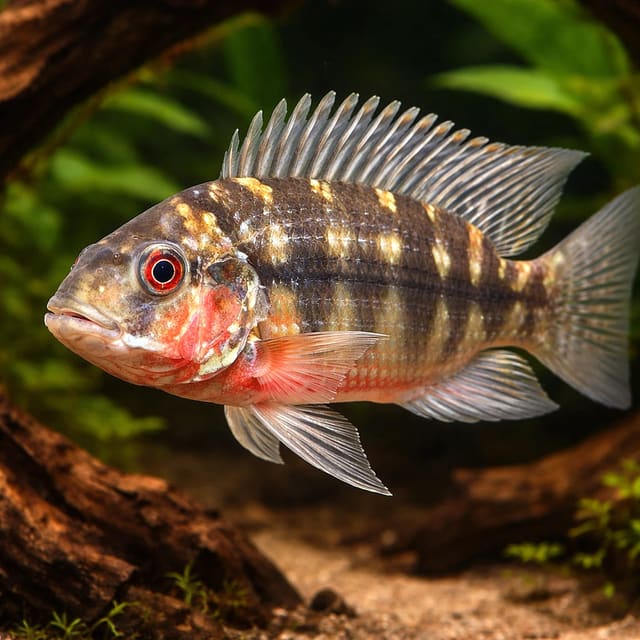
Redbreast Tilapia (Coptodon rendalli)
24–28°C
£7.99

The Dwarf Egyptian Mouthbrooder (Pseudocrenilabrus multicolor) is a freshwater cichlid from the African Nile system and associated East African waters that reaches 8 cm. It suits an observant keeper; Seriously Fish gives 71 litres for a pair and a larger tank for a harem, while the FishBase and Seriously Fish overlap is 20–24°C, pH 6.8–7.2 and 10–14 dGH. Sold individually in 3.5–4 cm and 4.5–6 cm sizes.
Adult size is the maximum length this species reaches at full maturity (scientific sources). The livestock you receive will be younger and smaller — pick a size above for the actual shipping size. Product-photo provenance and any image-specific limitations are stated on the listing.
Pseudocrenilabrus multicolor
Save when buying multiple fish. Each quantity is one fish; sex and pair formation are not guaranteed unless the selected variant explicitly states them.
The Dwarf Egyptian Mouthbrooder (Pseudocrenilabrus multicolor) is a freshwater cichlid from the African Nile system and associated East African waters that reaches 8 cm. It suits an observant keeper; Seriously Fish gives 71 litres for a pair and a larger tank for a harem, while the FishBase and Seriously Fish overlap is 20–24°C, pH 6.8–7.2 and 10–14 dGH. Sold individually in 3.5–4 cm and 4.5–6 cm sizes.
Adult size is the maximum length this species reaches at full maturity (scientific sources). The livestock you receive will be younger and smaller — pick a size above for the actual shipping size. Product-photo provenance and any image-specific limitations are stated on the listing.

Cichlids are a family of roughly 1,800 accepted species, not one care type. Before buying, identify the exact species and source, then compare adult measurement, usable tank dimensions, social system, territory, tested water, diet and an exit plan. No family-wide minimum tank, water range or tank-mate list is safe.
Maintain these water conditions for optimal health and vibrant colors
The Dwarf Egyptian Mouthbrooder, Pseudocrenilabrus multicolor, is a freshwater cichlid from Africa that reaches 8 cm total length. FishBase places it in the family Cichlidae and records populations across the Nile River system and waters associated with Lakes Albert, Victoria, Kyoga and George, together with streams, rivers, ponds and swampy lakes in Uganda and neighbouring drainage systems. It suits a keeper prepared to plan around territorial behaviour, watch individual interactions and act when another animal cannot feed or rest normally.
Its modest body length should not be confused with peaceful community behaviour. This fish uses the lower reaches of the aquarium, and a male may defend that area forcefully. The decisive requirements are therefore a suitable footprint, several hiding places and a stocking plan that accounts for territorial behaviour.
| Suits | Not suited to |
|---|---|
| A keeper who can monitor territorial interactions | An unplanned peaceful community aquarium |
| A covered aquarium with lower-level territory | A layout without plenty of hiding places |
| A pair in the stated 71-litre aquarium | A harem kept in the pair-sized aquarium |
| A one-male harem in a larger aquarium | A harem containing multiple males |
| Companions screened for water and swimming level | Lower-level companions added without a large tank |
Natural feeding is broad. FishBase records worms, crustaceans, insects, algae, vegetable fragments and small fish in the wild diet. Aquarium feeding should use a quality cichlid pellet as the staple, supported by regular live or frozen foods, rather than attempting to reproduce every wild item.
Females carry eggs and developing young in the mouth. FishBase describes this as maternal mouthbrooding and records that the species does not form a pair bond. That biology helps explain why an apparent pair is not necessarily a stable social unit and why a persistent male can place considerable pressure on one female.
This is a fish for a structured cichlid aquarium rather than an unplanned addition to a peaceful mixed tank. Before choosing it, confirm that the intended aquarium can remain within its water range, has a mature filter and gives lower-level occupants enough separate space.
One purchase quantity supplies one animal of the selected option. Use the live size selector to choose between the labelled dispatch sizes “3.5–4 cm” and “4.5–6 cm”; the selector is the place to check which choice can be ordered.
The size you select is the size supplied, not the adult size. FishBase records a maximum of 8 cm total length for male or unsexed fish. Plan the aquarium and its companions around that maximum rather than around the smaller dispatch size. A fish selected at 3.5–4 cm still needs space for its adult body, territory and interactions with other lower-level fish.
Sex is guaranteed only when the selected option explicitly states male or female. This Dwarf Egyptian Mouthbrooder listing has no sex-guaranteed option. Do not treat body size, colour or a gallery image as a sex confirmation. Males tend to become a little larger and more colourful than females, especially when breeding, but those tendencies do not identify the animal supplied through a size-only choice.
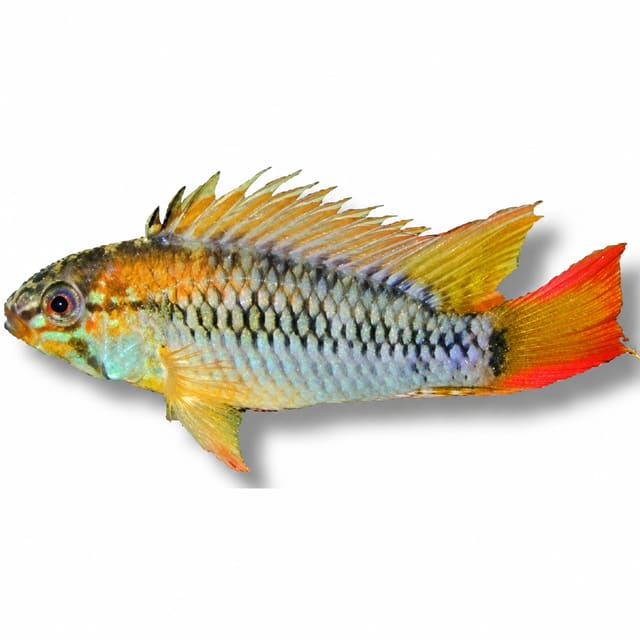
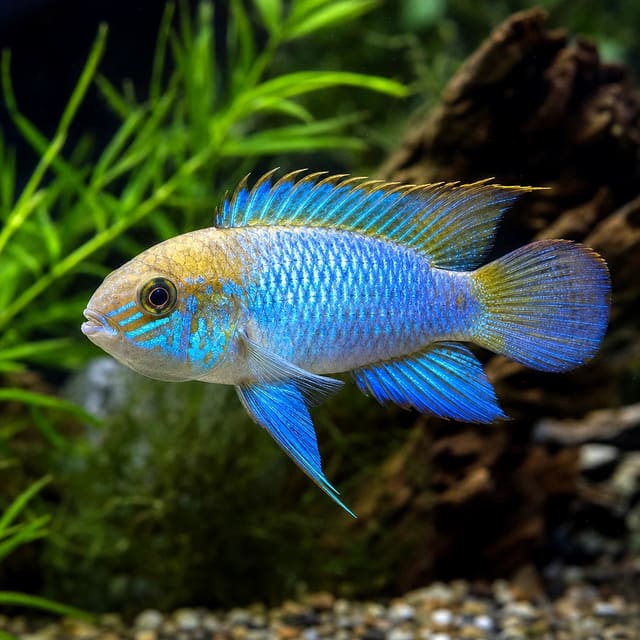
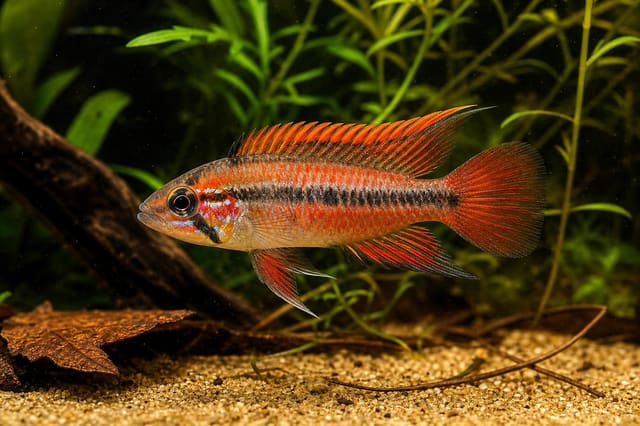
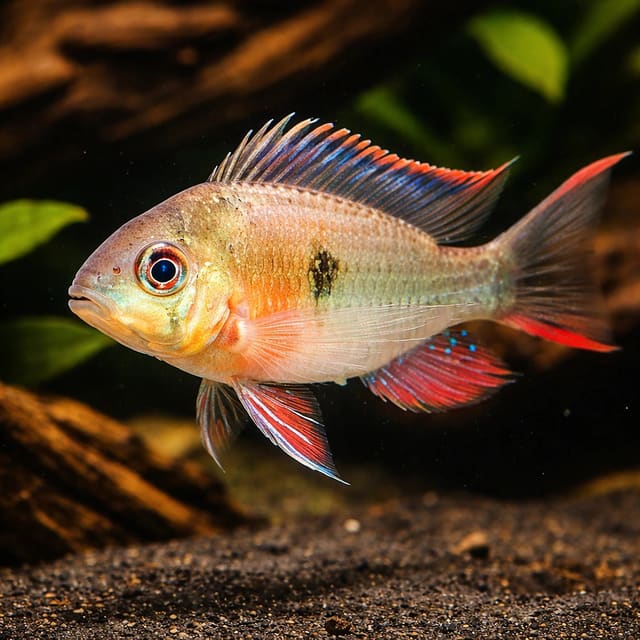
The gallery images are representative of this type of animal rather than photographs of the exact animal supplied, so colours can look slightly different from the live animal. The reviewed scenes show a golden fish with a dark cheek spot and turquoise markings. Individual appearance can differ without changing the care plan.
| Buying decision | What to plan around |
|---|---|
| Purchase unit | One animal for each purchase quantity |
| Size choice | The labelled dispatch size selected |
| Adult planning size | Up to 8 cm total length |
| Sex planning | No sex-guaranteed size option |
| Appearance | Natural individual variation |
Seriously Fish gives a 60 × 37.5 × 30 cm aquarium of 71 litres as suitable for a pair and says that a larger tank is needed for a harem. Treat those dimensions as part of the recommendation: a useful base offers substrate territory and room to place caves, roots, wood and cover.
The same profile gives aquarium ranges of 20–26°C, pH 6.5–7.2 and 5–15 dGH. FishBase records the narrower environmental ranges of 20–24°C, pH 6.8–7.2 and 10–14 dH. Use the overlap of 20–24°C, pH 6.8–7.2 and 10–14 dGH for routine aquarium planning, keeping each value within both species-level ranges.
| Decision | Working value |
|---|---|
| Maximum recorded length | 8 cm total length |
| Pair aquarium | 71 litres; 60 × 37.5 × 30 cm |
| Harem aquarium | Larger than the pair aquarium |
| Temperature | 20–24°C |
| pH | 6.8–7.2 |
| Hardness | 10–14 dGH |
Plenty of hiding places, a sand or fine-gravel substrate and a mature biological filter complete the essential starting plan. A pair-sized aquarium is not a basis for adding several extra fish: decorations consume space, males defend the lower reaches and every added animal increases the filtration load.
If you are comparing cichlids by geography and behaviour, browse the separate South American cichlid collection without assuming that fish of similar size share the same water or social needs.
Start with the 60 × 37.5 cm base associated with the 71-litre pair aquarium, or a larger footprint when planning a harem. Seriously Fish recommends plenty of hiding places and specifically names clay-pot caves, roots and pieces of driftwood. Plants are optional, but the fish appreciates the additional cover they create.
Sand or fine gravel is preferable because spawning males dig in the substrate. Keep open substrate beside several hiding places so that the layout includes both recommended features.
Place the aquarium out of direct sunlight and away from heat, draughts, loud noise, vibration and sudden movement. Its stand or supporting surface must be flat, level and able to carry the filled aquarium indefinitely. These choices help temperature remain stable and reduce avoidable disturbance.
Decorations and plants reduce the swimming and territorial space inside the stated volume, even though they are valuable for enrichment and shelter. Assess the usable layout after everything is installed. If a 71-litre aquarium cannot contain several distinct retreats and open substrate, reduce the stocking ambition rather than removing the cover that the fish needs.
Watch how each animal uses the finished structure. A retreat is useful only when a subordinate fish can enter it and remain there without persistent aggression. If one fish controls every cave and the entire open floor, change the layout or separate animals instead of adding more fish.
Set routine temperature at 20–24°C, pH at 6.8–7.2 and hardness at 10–14 dGH. Those values are the overlap of the broader Seriously Fish aquarium figures and FishBase’s recorded environmental range. Choose a stable point your source water can support rather than moving the aquarium repeatedly towards a nominal middle value.
Use a reliable thermometer and test pH and hardness before introducing the fish. The aquarium water chemistry guide explains what the measurements mean, while the water matcher can compare measured values with this 20–24°C, pH 6.8–7.2 and 10–14 dGH plan.
| Reading | Action |
|---|---|
| Inside all three ranges | Keep the routine steady and continue regular checks |
| Temperature changes sharply | Check the heater, room conditions and replacement-water temperature |
| pH moves between tests | Compare the aquarium with its source water before making changes |
| Hardness falls outside 10–14 dGH | Resolve the mismatch gradually before adding the fish |
| Ammonia or nitrite appears | Treat it as a filtration and water-quality problem, not a normal reading |
Match replacement water to the aquarium’s temperature and treat tap water to make it safe before use. Avoid abrupt adjustments. A value that remains steady within the working range is more useful than a sequence of rapid changes made in pursuit of one exact number.
Test more often while an aquarium is being established and after livestock or feeding increases. Each increase adds waste that the biological filter must process. Temperature, pH and hardness describe suitability, while ammonia and nitrite show whether the system is safely processing waste; one set of readings cannot replace the other.
Record results with the date and any maintenance performed. A short sequence of measurements makes gradual movement easier to recognise than a single isolated test and helps connect a change with a new fish, altered feeding, filter blockage or replacement-water difference.
OATA’s freshwater aquarium sheet gives broad group guidance: dechlorinate the water, switch on the equipment, allow 24–48 hours for temperature and equipment checks, and mature the filter before fish are introduced. Beneficial bacteria must then process ammonia into nitrite and nitrite into less toxic nitrate.
A newly filled aquarium that has merely stood for 24–48 hours is not automatically biologically mature. Follow the first tropical aquarium guide to prepare the filter, then confirm with tests that ammonia and nitrite are both zero before introducing livestock.
The RSPCA explains why a well-set-up and maintained filter is vital: fish release toxic ammonia, and the biological filter supports bacteria that convert it through nitrite to safer nitrate. Keep the filter running and maintain it as an essential life-support system.
Add fish slowly because the population of beneficial bacteria must respond whenever the livestock and feeding load rise. Do not use the 71-litre pair reference as a stocking formula. Adult body size, territorial behaviour, decorations, water parameters and the filter’s demonstrated capacity all affect what the aquarium can support.
If ammonia or nitrite rises above zero, reduce the immediate waste burden through appropriate partial water changes and inspect feeding and filter performance. Continue testing until both return to zero. Do not add more animals while the biological filter is struggling with the existing load.
Use a good-quality cichlid pellet as the staple food. Seriously Fish recommends varying that base with regular feedings of live and frozen foods. Choose pieces the fish can take readily and avoid relying on one food type for every feed.
The wild diet explains why variety is appropriate: worms, crustaceans, insects, algae, vegetable fragments and small fish are all recorded. Aquarium care does not require collecting those wild items. A complete cichlid pellet provides a consistent base, while suitable live and frozen foods add the recommended variation.
Territorial behaviour can make a group look well fed while one animal receives little. Observe individuals rather than judging only by how quickly food disappears. Where one fish controls a single feeding point, distribute the appropriate portion where the other animals can reach it without entering that fish’s immediate territory.
Uneaten food and fish waste contribute to ammonia. Feeding more heavily cannot compensate for poor access caused by aggression; it adds pressure to the filter while the excluded fish may still miss out. Change the social arrangement or structure when one animal is consistently prevented from feeding.
Reduced appetite deserves attention because OATA includes loss of interest in food among the changes that may signal a health or welfare problem. Check water quality, breathing, swimming, colour and social pressure together. A fish hiding from a dominant male needs a different response from an aquarium where several fish stop eating as ammonia or nitrite rises.
Prepare before the animal reaches the aquarium. Confirm that temperature is stable within 20–24°C, ammonia and nitrite are zero, the filter is mature and the hiding places are secure. Check compatibility before opening the transport bag so that the new fish is not released into a lower-level territory already controlled by an unsuitable companion.
Follow the current delivery and Live Arrival Guarantee policy. Arrange for someone to receive the parcel and begin filming before the sealed parcel is opened.
| Checkpoint | What to do |
|---|---|
| Breathing | Compare gill movement with the fish’s settled pattern |
| Swimming | Watch for surface hanging, bottom sitting or erratic movement |
| Feeding | Confirm that the fish takes an appropriate food |
| Social access | Check that it can leave cover and reach food without persistent pursuit |
| Water quality | Test more frequently after adding livestock |
A newly introduced fish may use the supplied caves, wood or plants while orientating itself. Judge progress by breathing, controlled swimming, feeding and the ability to move between cover and open space. If it remains trapped at the surface, behind equipment or inside one retreat because another fish pursues it, intervene in the social arrangement rather than waiting for visible injury.
Seriously Fish describes males as very aggressive towards one another and recommends keeping only one male in a harem with several females. It also says that a larger tank is required for a harem than the 71-litre aquarium considered suitable for a pair.
A purchase quantity does not create a pair or a planned harem. It supplies one animal chosen by size, and appearance should not be used as a guaranteed sex test. Build a harem only when the group can be managed around one male, several females, a larger aquarium and enough cover for each animal to leave the male’s immediate territory.
| Observation | Decision |
|---|---|
| Brief display with normal feeding | Continue observing all animals |
| One fish controls every lower retreat | Rework the recommended caves, roots, wood and plant cover |
| A fish cannot reach food | Separate it or change the social arrangement promptly |
| Two males fight persistently | Do not maintain them as a harem group |
| The group outgrows the usable layout | Move to a larger aquarium rather than removing essential cover |
Males tend to be slightly larger and more colourful, particularly during breeding, but colour intensity is a tendency rather than a commerce guarantee. Base intervention on what each fish is doing: repeated pursuit, blocked feeding and loss of access to shelter are more useful signals than a guess about sex made from one moment of colour.
Review the arrangement as the fish approach the recorded maximum of 8 cm. Social relationships that appear calm at a smaller dispatch size may change as adult territorial behaviour develops. The aquarium must continue to offer open sand or fine gravel for digging alongside several hiding places.
Do not add fish merely to reach a numerical ratio. Every extra animal adds waste and needs usable territory. The larger-harem instruction, mature filtration and one-male limit must all be met together; satisfying one part does not compensate for ignoring another.
This species is an ovophilic maternal mouthbrooder. The female carries the eggs and developing young in her mouth, while the species forms no pair bond. Seriously Fish describes the male digging a shallow pit in the substrate and displaying to females from that area.
That sequence explains three layout decisions: retain sand or fine gravel for digging, provide plenty of hiding places and give the group more space than the pair aquarium when several females are kept with one male. Mouthbrooding does not turn a territorial male and female into a permanently compatible pair.
A male’s attention can be forceful during courtship, which is why Seriously Fish favours one male with several females for a harem. Even then, the larger aquarium and hiding structure remain essential. Observe whether every female can leave the courtship area, reach shelter and feed without being continually driven back.
The fish has been kept and spawned in aquaria for more than a century, but its breeding reputation should not reduce the standard of care. Plan around adult condition, space and stable water rather than treating fry as the only measure of success.
Seriously Fish notes two distinct subspecies in the hobby and advises against keeping them together because of hybridisation risk. Keep fish with a known different subspecies identity in separate breeding groups. This offer is identified at species level as Pseudocrenilabrus multicolor, so do not assign it a subspecies from colour, dispatch size or a gallery scene.
Use the first month to confirm that the prepared aquarium works for the actual animal. A successful introduction means more than survival: the fish should be able to swim normally, feed, use cover and occupy the aquarium without being continually displaced by another inhabitant.
OATA advises watching for changes in swimming, colour, temperament, breathing, appearance, body condition and feeding. Compare the animal with its own established pattern. If several signs change together, test the aquarium and inspect the social arrangement before making any other change.
Do not postpone a space decision until the fish reaches maximum length. If usable floor area, filtration capacity or territorial separation is already marginal, choose the larger aquarium while the move can be planned carefully.
Seriously Fish warns that this cichlid can be aggressive towards other species using the lower reaches of the aquarium. Dwarf cichlids, catfish and loaches require a large tank when mixed with it because they enter the same general zone. Do not classify any bottom-dwelling species as automatically compatible.
In smaller aquaria, the profile names African tetras and small surface-dwelling fish such as hatchetfish as possible companions. These are conditional examples, not universal tank mates. The chosen species must still share the 20–24°C, pH 6.8–7.2 and 10–14 dGH working range, have enough swimming space and remain able to feed without entering a defended lower territory.
Compatibility remains dependent on the aquarium’s footprint, structure and individual behaviour. For a stocking and compatibility assessment, contact us with the aquarium dimensions, measured temperature, pH and hardness, current livestock and intended group plan.
Introduce livestock gradually so the biological filter can respond to the added load. A larger aquarium helps with territorial separation, but litres alone do not solve a layout where every lower-level fish must pass through the same cave or feeding area.
Observe compatibility at feeding time and when the aquarium is quiet. A dramatic fight is not the only sign of failure. Repeated hiding, blocked feeding, altered breathing, colour change or a fish confined to the surface or one corner can show that the arrangement is placing it under pressure.
| What you see | What to do |
|---|---|
| Short display, then both fish resume normal activity | Continue close observation |
| One lower-level fish loses access to every retreat | Add or rearrange the recommended cover, or separate the fish |
| Persistent pursuit by a male | Review the sex and group arrangement without assuming a pair bond |
| Damaged fins or missing scales | Separate the affected fish and test the water |
| Several fish breathe abnormally | Test ammonia, nitrite and temperature immediately |
| One fish stops feeding while others eat | Check whether territorial exclusion is blocking access |
A layout change is useful when it creates genuinely separate lower territories with caves, roots, wood or plant cover. Simply moving one ornament may not help if the dominant fish can still reach every other animal. Where structure cannot create separation, use a larger aquarium or keep the incompatible fish apart.
Water and social problems can occur together. Aggression may increase waste through disrupted feeding, while poor water quality can alter breathing, swimming and temperament across several fish. Test ammonia and nitrite rather than assuming every behaviour change is territorial.
OATA advises monitoring swimming, colour, temperament, breathing, appearance, body condition and feeding. If you are concerned by a health change, test the water and contact us for further guidance. Do not begin a disease treatment solely from a colour change or hiding response.
Review the community again as the cichlid approaches 8 cm. A companion that shared space with a smaller fish may face a different territorial pattern after growth or breeding behaviour develops. Compatibility is an ongoing welfare decision, not a one-time label attached to a species name.
FishBase records the Dwarf Egyptian Mouthbrooder at a maximum of 8 cm total length; plan the aquarium around that adult size rather than its dispatch size.
Seriously Fish gives a 60 × 37.5 × 30 cm aquarium of 71 litres as suitable for a pair of Pseudocrenilabrus multicolor and says a harem needs a larger tank.
A pair can use the stated 71-litre aquarium, while Seriously Fish advises only one male with several females in a larger harem aquarium because males are very aggressive towards one another.
Seriously Fish describes the Dwarf Egyptian Mouthbrooder as a good beginner choice, but the keeper must still manage lower-level aggression, provide plenty of hiding places and maintain stable water.
Feed Pseudocrenilabrus multicolor a good-quality cichlid pellet as the staple and add regular live or frozen foods; FishBase records worms, crustaceans, insects, algae, vegetable fragments and small fish in its wild diet.
Keep this fish at 20–24°C, pH 6.8–7.2 and 10–14 dGH; these values are the overlap of the FishBase environmental range and the broader Seriously Fish aquarium range.
It can be aggressive towards species using the lower reaches, and males are very aggressive towards one another; fin-nipping is not used as the compatibility test, so watch for pursuit, blocked feeding and loss of access to shelter.
Consider African tetras or small surface-dwelling fish such as hatchetfish where water needs overlap; dwarf cichlids, catfish and loaches require a large tank because they share the lower reaches.
Someone must be present to receive it. Film every delivery continuously from the sealed parcel as it is opened, showing the fish still inside the sealed bag; then float the bag for 20–30 minutes before release and never pour the bag water into the aquarium.
No reviews for this item yet. Bought one? Honest reviews only, good or bad.
What customers say about ordering from us
I have a small group of long finned mountain minnows. So was delighted to be able to order ten of this variety to increase the genetics in my tank . The ones I recieved are healthy but it’s to early to give a verdict on wether they are of a long finned type since they are small currently.
Gordon Walker · 23 Sept 2026
100% success travel and "installation". Pleased with quality of purchase. The Siamese fighter a bit "shy" so have not yet seen him at his best yet but looking good. Happy customer. GG
George E Garratt · 21 Sept 2026
Reviews of our shop, collected by Judge.me, an independent third-party review collector. Newest first.