Moderate
Short Body Texas Cichlid (Trade Morph)
24–28°C · pH 7–8 · 300L
£57.99
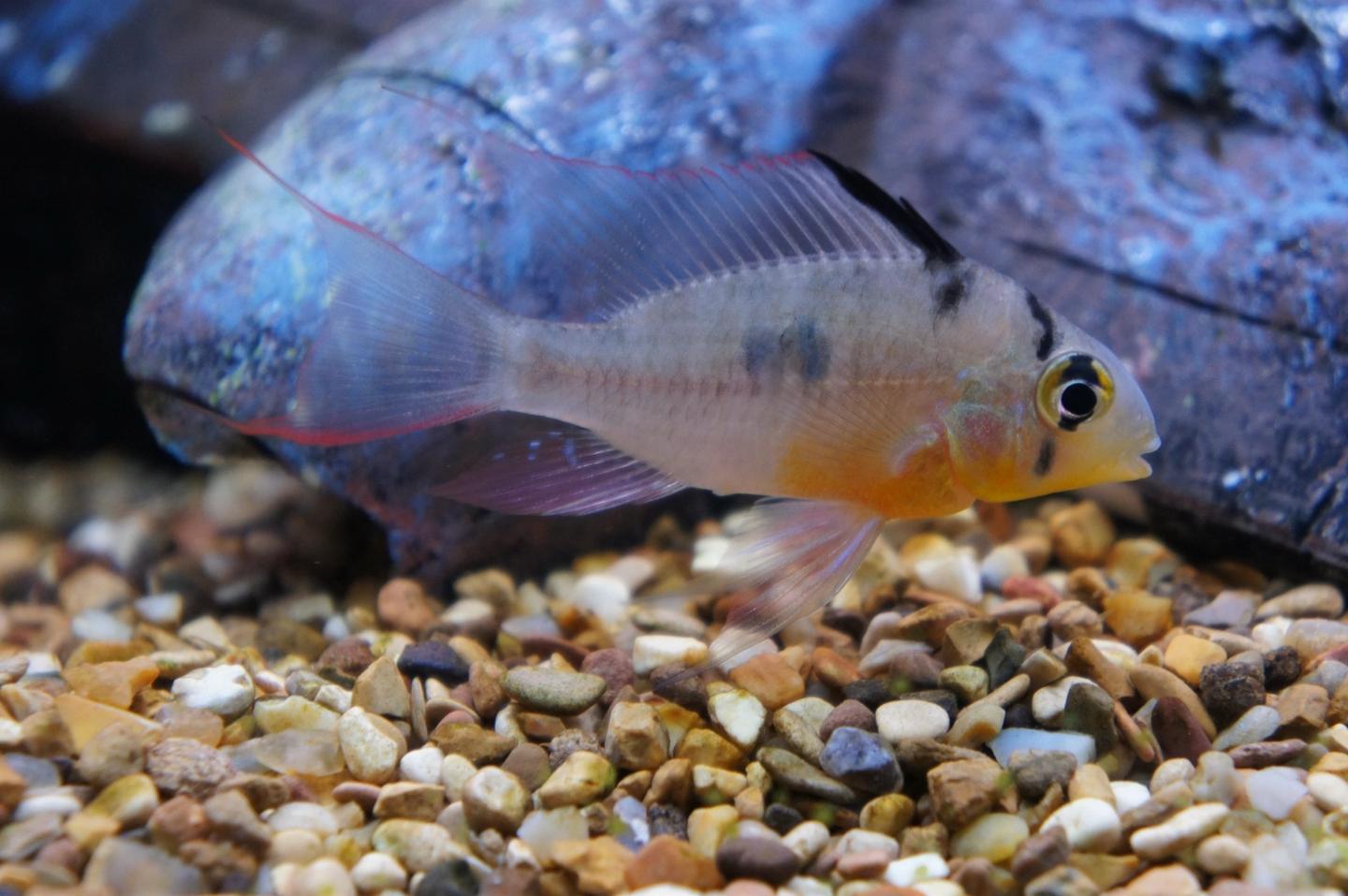
The Pinstripe Damba (Paretroplus menarambo) is a captive-bred Madagascan cichlid, Critically Endangered in the wild, with rows of fine dark spots that read as pinstripes. Plan for a 25 cm adult in a group of about six, in a 180 × 60 × 60 cm aquarium kept at 28°C or above with sand, bogwood and large weekly water changes. Sold individually.
Adult size is the maximum length this species reaches at full maturity (scientific sources). The livestock you receive will be younger and smaller. Product-photo provenance and any image-specific limitations are stated on the listing.
Paretroplus menarambo
Save when buying multiple fish. Each quantity is one fish; sex and pair formation are not guaranteed unless the selected variant explicitly states them.
The Pinstripe Damba (Paretroplus menarambo) is a captive-bred Madagascan cichlid, Critically Endangered in the wild, with rows of fine dark spots that read as pinstripes. Plan for a 25 cm adult in a group of about six, in a 180 × 60 × 60 cm aquarium kept at 28°C or above with sand, bogwood and large weekly water changes. Sold individually.
Adult size is the maximum length this species reaches at full maturity (scientific sources). The livestock you receive will be younger and smaller. Product-photo provenance and any image-specific limitations are stated on the listing.
Cichlids are a family of roughly 1,800 accepted species, not one care type. Before buying, identify the exact species and source, then compare adult measurement, usable tank dimensions, social system, territory, tested water, diet and an exit plan. No family-wide minimum tank, water range or tank-mate list is safe.
The Pinstripe Damba (Paretroplus menarambo) is a deep-bodied cichlid from the Sofia River basin of north-western Madagascar and one of the rarest fish a UK hobbyist can keep. Allgayer described it in 1996. It belongs to the Etroplinae, the cichlid subfamily it shares with the chromides of India and Sri Lanka, and FishBase notes that the genus name Paretroplus refers to that relationship with Etroplus. You may also see it sold as the pinstripe menarambo, or under Redseam Madagascar cichlid, the common name FishBase uses.
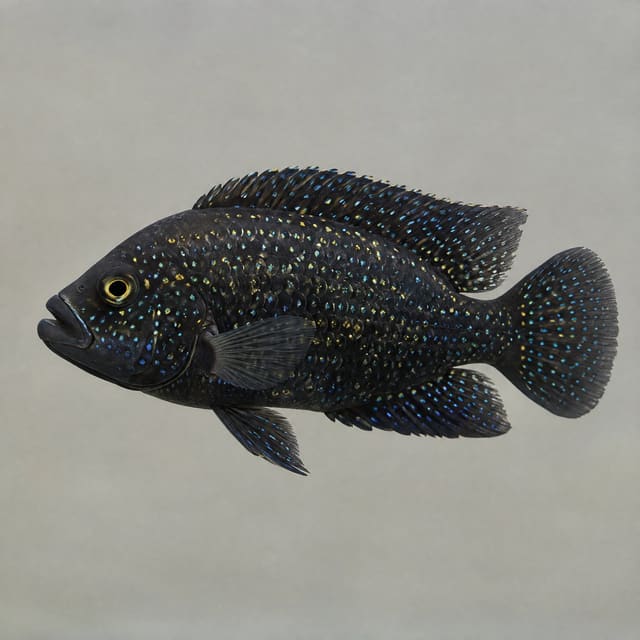
The pinstripe name describes a pattern of spots rather than true stripes. FishBase separates this species from the other Paretroplus by numerous horizontal rows of black spots along the flanks, a black stripe between the eyes and a dark blotch below each eye. From a few steps away those rows of fine blue-black spots read as lines, and the fins carry delicate red fringes, as Practical Fishkeeping described when Blue Planet Aquarium bred the species. Wikipedia describes a relatively deep, strongly flattened body that is grey-brown with darker vertical bands, grey fins with reddish-brown borders and a crescent-shaped tail. Practical Fishkeeping rates it the best-looking of Madagascar's paretropline cichlids and says mature fish look more like a marine fish than a typical cichlid.
| Suits | Not suited to |
|---|---|
| A group of about six young fish grown on together | A short-term home, or a plan to keep one fish in a general community tank |
| An aquarium of about 180 × 60 × 60 cm (roughly 648 litres) | Tanks much shorter or narrower than that footprint |
| Warm water, with a keeper-quoted minimum of 28°C, and large weekly water changes | A tank that runs cool or goes weeks without a water change |
| Sand, bogwood and smooth river boulders | Sharp gravel, or a bare tank with nowhere to shelter |
| Sturdy catfish and carefully chosen warm-water companions | Ornamental snails and shrimp, and very aggressive cichlids |
This is a fish for a keeper with a large, established aquarium and the patience for a slow-growing species. Practical Fishkeeping says it takes nearly two years to reach sexual maturity, so the reward comes from long-term keeping rather than quick results. Browse the other fish in our African cichlids collection, where Madagascar's cichlids are grouped, and our rare and collector fish for other specialist species.
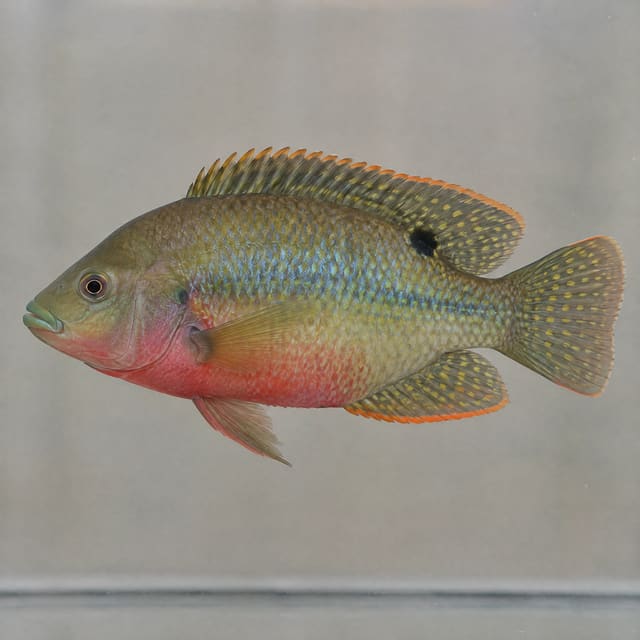
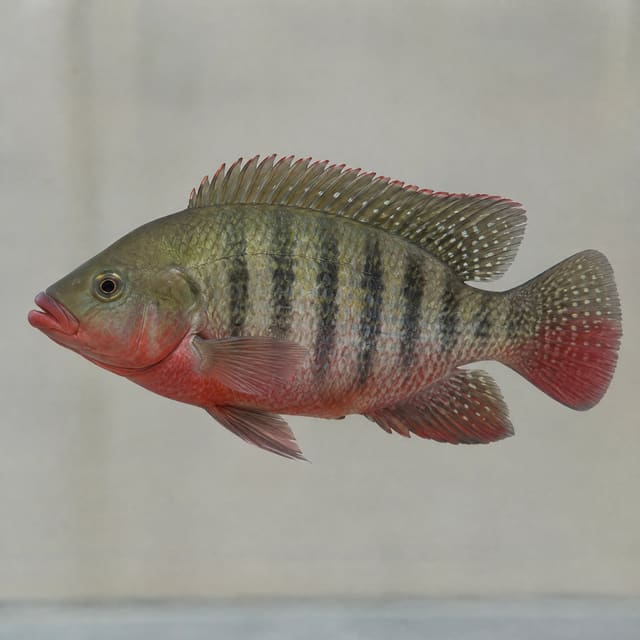
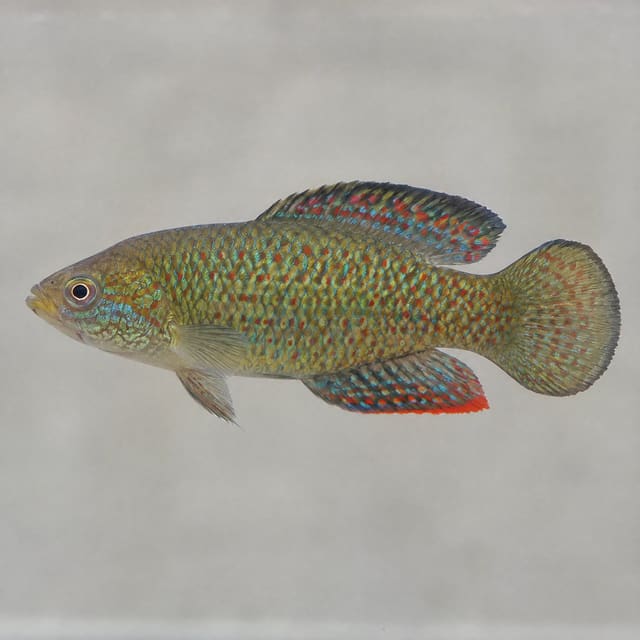
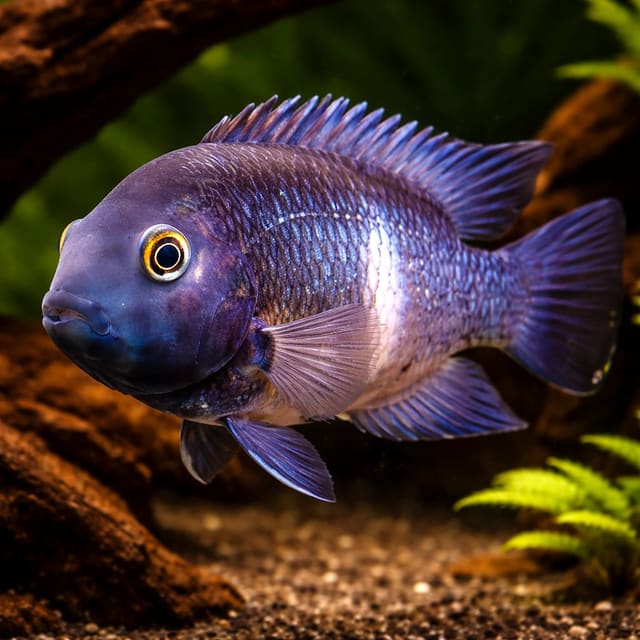
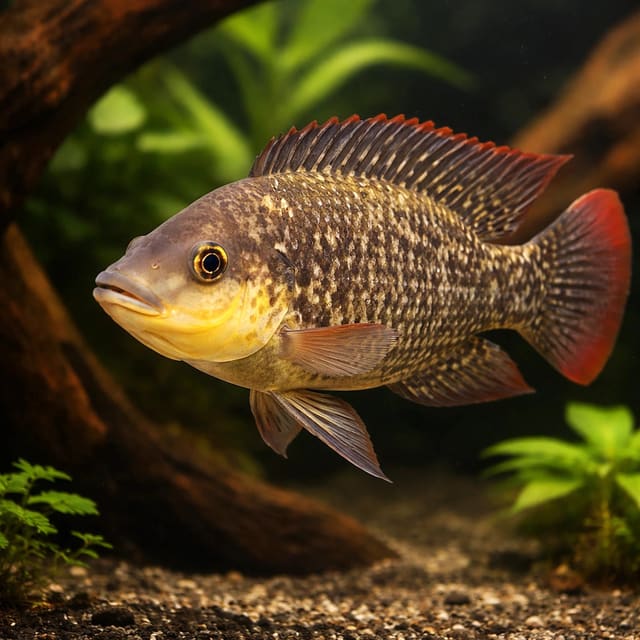
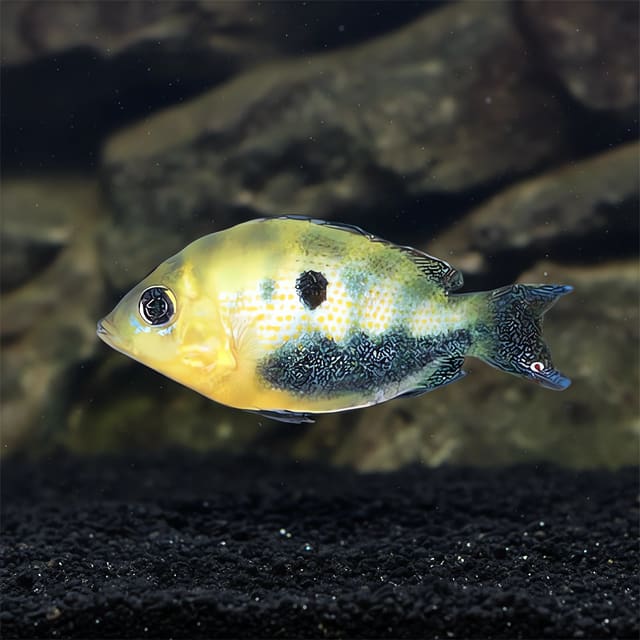
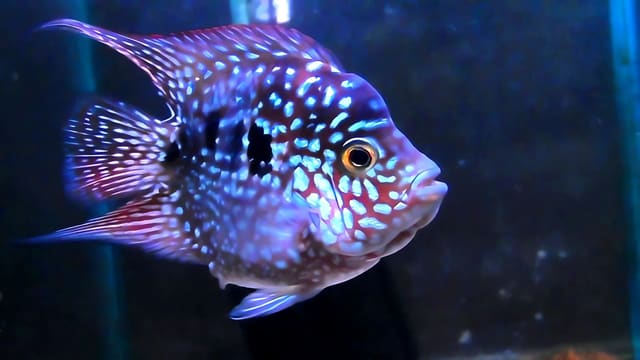
The gallery images are representative. They are made from a reference picture of this species and do not show the individual fish supplied, so expect the spotting, banding and fin edging of the real fish to differ from the pictures.
Practical Fishkeeping's profile, first published in 2008, records the species from a single lake, Lake Sarodrano in the Sofia basin, and says it had not been seen in the wild since the late 1990s despite searches. Deforestation, introduced fish and overfishing for food were the likely causes, and the IUCN then listed it as extinct in the wild. Bolton's public aquarium, which keeps this species, links the decline to habitat loss: once the forest was cleared, rain washed natural salts and chemicals into the rivers.
A remnant population was later found in Lake Tseny. A fish survey there in October 2010, published by Andriafidison and colleagues in 2011, confirmed that the species still survives. Local fishers associate it with submerged trees along the western shore, which give it places to breed and feed and also make net fishing difficult. The same survey recorded overfishing, illegal small-mesh nets and ignored closed seasons as the main threats to the lake's fish. FishBase now gives its IUCN status as Critically Endangered, assessed on 26 June 2016. The older "extinct in the wild" wording still appears in some articles, so where sources disagree this page follows the current IUCN assessment.
The fish in the aquarium trade are captive-bred; the tiny wild population is not a source. British hobbyists, including Sonia Guinane and Dave Tourle, helped work out how to keep and breed the species, and Practical Fishkeeping reported commercial production in Singapore. Public aquariums keep it as well: Bolton holds it as one of two Madagascan species it describes as gone from the wild, and Blue Planet Aquarium in Cheshire has bred it and raised about 50 young.
One purchase quantity supplies one live Pinstripe Damba of the Standard option. No size grade is published for this fish, so the selector shows a single choice. Whatever size arrives, plan every purchase around the adult size described below rather than the fish in the bag.
Sex cannot be chosen. None of the sources we checked gives a reliable way to tell young males from females, so two fish are not a guaranteed pair. Practical Fishkeeping's advice is to keep a group of about six, raised together to adulthood, and let pairs form naturally within the group. That is the approach to plan for if you hope to breed this fish one day.
Budget the aquarium for six adults before you order, not for six juveniles. Six fish of 20–25 cm with deep, flattened bodies need the full footprint, a filter matched to that load and the time for weekly water changes on a large tank. Read our delivery and live arrival information before ordering, and have the aquarium mature and at temperature before the fish leave us.
Published sizes for the pinstripe damba vary, partly because different sources measure in different ways. Standard length runs from the snout to the base of the tail and leaves the tail out, so it always reads shorter than the total length you see in the tank.
| Source | Figure | What it describes |
|---|---|---|
| FishBase | 16.7 cm | Largest recorded standard length, without the tail |
| Wikipedia | 12.8–25 cm | Range of recorded lengths |
| Practical Fishkeeping | 20–25 cm | Size reached in aquariums |
| Fishipedia | About 20 cm, up to 30 cm | Average and maximum in a French species database whose entry is marked as unfinished |
Plan for a 25 cm fish. Practical Fishkeeping suggests an aquarium of 180 × 60 × 60 cm for a spacious set-up, which works out at about 648 litres of glass volume and a little less once sand and boulders are in. Fishipedia asks for at least 800 litres in a community, which is a sensible figure if you add companions. Our tank volume calculator converts any tank's measurements into litres, so you can check a second-hand aquarium before you commit.
Practical Fishkeeping recommends a sand substrate, because this species sifts the bottom for food, with plenty of bogwood and river-worn boulders for cover. That matches what is known of its last wild home: the Lake Tseny survey describes submerged trees along the western shore as the places the fish uses to breed and feed. A layout of sand, branching wood and smooth stone gives captive fish the same mix of open ground and shelter.
Set heavy boulders directly on the glass base before adding the sand, so sifting fish cannot undermine them. Keep the open front of the tank clear for swimming and feeding, and build cover towards the back and ends, where fish can rest out of sight of the room. Plants are optional; if you want greenery, tough species attached to wood or rock survive digging better than rooted plants in the sand.
| Zone | Purpose | How to build it |
|---|---|---|
| Front and centre | Swimming, feeding and sifting | Open fine sand, kept clear of décor |
| Back and ends | Resting and retreat | Bogwood branches and stacked river boulders |
| Flat stones in the wood | Possible spawning sites later | Smooth slabs set firmly on the glass |
| Surface | Gas exchange and calm light | Gentle ripple from the filter return; a tight lid |
Published water values for Paretroplus menarambo are thin, and the sources do not fully agree. Practical Fishkeeping calls the fish adaptable, says most keepers use hard, alkaline water and quotes the keeper Tom Williams, who found it does best warm, at a minimum of 28°C. It gives no pH or hardness range. Fishipedia gives 24–30°C and pH 6.5–8.5, and suggests breeding near 28°C at about pH 7.
| Value | Planning figure | Where it comes from |
|---|---|---|
| Temperature | At least 28°C | Practical Fishkeeping, quoting a keeper; Fishipedia gives 24–30°C |
| pH | Stable, neutral to alkaline | Most keepers use alkaline water (Practical Fishkeeping); Fishipedia gives 6.5–8.5 |
| Hardness | Moderately hard to hard, kept steady | Most keepers use hard water; no published dGH range for aquariums |
| Ammonia and nitrite | Zero | OATA water-quality guidance |
| Water changes | 30–50% every week | Practical Fishkeeping |
Stability matters more than chasing a number. Much of the UK has hard tap water, which suits this fish, while some regions are soft; OATA suggests checking your water company's postcode tool to see what comes out of your tap. Our water matcher compares your readings with a fish's needs, and the water chemistry guide explains pH, general hardness and carbonate hardness in plain terms.
Temperature, pH and hardness describe the kind of water the fish lives in. Ammonia, nitrite and nitrate describe waste, and they need a different response. Keep ammonia and nitrite at zero, as OATA advises, and treat any reading above zero as a filter or feeding problem to fix at once with water changes. At 28°C in a UK living room the heaters work hard in winter, so size the heating for the full volume and read our guide to tropical tank temperature before choosing equipment.
Practical Fishkeeping describes Madagascan cichlids as intolerant of pollutants and recommends large partial water changes of 30–50% every week. Six large fish produce a lot of waste, so the filter has to handle the whole adult load from day one, and the biological side must be fully mature before the fish arrive. If the tank is new, cycle it first; our guide to the aquarium nitrogen cycle shows how to tell when it is ready.
Large external canister filters or a sump suit a tank of this size, and many keepers run two filters so one can be cleaned while the other keeps working. Our article on understanding aquarium filtration explains mechanical, biological and chemical media and how to balance flow against a calm tank.
Practical Fishkeeping says the pinstripe damba accepts most foods, including frozen foods, flakes and pellets. It also notes that the fish's single-pointed (unicuspid) teeth suggest it ate snails in the wild. Fishipedia recommends varying dry, fresh and frozen foods to avoid deficiencies and offering meals the fish clear within two to three minutes. Our fish food range covers sinking pellets, flake and frozen foods suitable for large cichlids.
Because the fish probably ate snails in the wild, ornamental snails in the same tank are likely to be eaten. Keep mystery snails, nerites and shrimp elsewhere.
Have the aquarium ready, mature and at temperature before delivery day. Test the water the evening before: ammonia and nitrite should read zero, the temperature should be stable at your planned figure and the pH and hardness should be where you intend to keep them. Dim the room and the tank lights before you open the box, as OATA suggests, because bright light right away adds stress after transport.
Float the sealed bag for about 10 minutes to even out the temperature, then add small amounts of tank water over at least 30 minutes, following OATA's floating-bag method. Net the fish into the tank and throw the bag water away rather than pouring it in. Our step-by-step guide on how to acclimatise new fish covers the same routine with pictures.
| When | Check | Action if it fails |
|---|---|---|
| Day 1 | Fish settling in cover, breathing evenly | Keep lights low and the room quiet; do not feed until the next day |
| Day 2 | First small meal taken | Remove uneaten food after three minutes and try again the next day |
| Days 3–4 | Ammonia and nitrite still zero | Change 30% of the water and reduce feeding |
| Day 7 | All fish feeding and exploring the sand | Look for a fish being kept from food or cover and add more shelter |
OATA lists the changes that signal a problem in aquarium fish: unusual swimming or inactivity, a darker or paler colour than normal, more hiding or aggression, faster or laboured breathing, spots, lesions or damaged fins, weight loss or swelling, and less interest in food. With a fish this sensitive to pollutants, the first response to almost any of those signs is a water test, followed by a large water change if anything is off.
| Observation | Likely cause to rule out | Action |
|---|---|---|
| Fish hanging near the surface or breathing fast | Ammonia, nitrite or low oxygen | Test at once, change 30–50% and increase surface movement |
| Fish dark and hiding for days | Bullying, too little cover or a cold tank | Check the thermometer, add wood and stone, watch at feeding time |
| One fish chased constantly | A pair forming and claiming a territory | Add visual barriers; rehome the extra fish if the chasing continues |
| Food refused | Water quality or a new food | Test the water first, then offer a familiar frozen food |
Breeding this fish is a long-term project. Practical Fishkeeping notes that it takes nearly two years to mature and that captive breeding rarely gives quick results. Fishipedia describes it as a substrate spawner that lays its eggs on open surfaces and guards them, rates breeding as difficult and gives about 28°C and pH 7 as ideal conditions. Practical Fishkeeping reports that keepers have reared eggs and fry fairly successfully with artificial incubation, and Blue Planet Aquarium raised about 50 young from one breeding. Bolton's aquarium team says breeding fish need a plentiful supply of food and good water chemistry in the run-up to the breeding season.
Once a pair forms it may claim a territory and chase the rest of the group. Watch closely after the first spawn and be ready to separate the pair or rehome surplus fish if the others cannot feed or rest.
Practical Fishkeeping suggests sturdy catfishes and other Madagascan cichlids as companions. Seriously Fish goes further and names the pinstripe damba among the endemic cichlids for which the Madagascan rainbowfish Bedotia madagascariensis makes a good dither fish, and that rainbowfish's recorded range of 23–32°C overlaps a 28°C tank. The catch with any companion is temperature, because many fish that look right for a Madagascan display prefer cooler water.
Check the values of our related fish before you mix them. The Orange Chromide, a smaller Asian member of the same subfamily, is listed on our site at 24–30°C in hard water, so it overlaps. The L047 Magnum Pleco is listed at 24–30°C and grows big enough to hold its own as a sturdy catfish. By contrast our Madagascar Rainbowfish (Bedotia geayi) page gives FishBase's 20–24°C, and our Starry Night Cichlid (Paratilapia polleni) page gives roughly 22–27°C, so both belong in a cooler Madagascan tank rather than with this fish. The other cichlids category and the Paratilapia range list more Madagascan and related cichlids to research.
| Suits | Check carefully | Avoid |
|---|---|---|
| Sturdy catfish that are happy at 28°C | Other Madagascan cichlids: overlap of temperature and space | Ornamental snails and shrimp, which it is likely to eat |
| Warm-water dither fish too large to swallow | Orange Chromide and other territorial cichlids at breeding time | Very aggressive cichlids that would bully a slow-growing group |
| Calm bottom-dwellers that do not compete for every scrap | Fast, greedy feeders that may take food before the damba | Coolwater fish that need less than 28°C |
Our tank mates tool runs these checks against the fish you already keep, and the cichlid care guide explains territory, pairing and aggression in cichlids generally.
It is Paretroplus menarambo, a deep-bodied cichlid from the Sofia River basin of north-western Madagascar, also sold as pinstripe menarambo or Redseam Madagascar cichlid. Rows of fine black spots along its flanks look like pinstripes from a distance, and its fins have reddish edges.
Not quite. It was listed as extinct in the wild after it disappeared from Lake Sarodrano, but a remnant population survives in Lake Tseny, confirmed by a 2010 survey. The IUCN now lists it as Critically Endangered (assessed 2016).
No. Fish in the trade are captive-bred; the wild population is tiny and Critically Endangered. Never release this fish, its eggs or its young.
Plan for about 25 cm. Practical Fishkeeping gives 20–25 cm in aquariums; FishBase records 16.7 cm standard length, which leaves out the tail, and other sources give up to 25 or 30 cm.
Practical Fishkeeping suggests 180 × 60 × 60 cm, about 648 litres, for a group. Fishipedia gives at least 800 litres for a community tank. Use sand, bogwood and smooth boulders.
Practical Fishkeeping quotes a keeper who found it does best at a minimum of 28°C and says most keepers use hard, alkaline water; Fishipedia gives 24–30°C and pH 6.5–8.5. Keep ammonia and nitrite at zero and change 30–50% of the water every week.
Practical Fishkeeping recommends a group of about six raised together, so pairs can form naturally. Sex cannot be chosen, and two fish are not a guaranteed pair.
Sturdy catfish and other fish that are happy at 28°C, such as warm-water Madagascan rainbowfish. Check every companion's temperature range first, and avoid very aggressive cichlids.
It is best not to. Practical Fishkeeping notes that its teeth suggest it ate snails in the wild, so ornamental snails and shrimp are likely to become food.
No reviews for this item yet. Bought one? Honest reviews only, good or bad.
What customers say about ordering from us
Easy website plenty of info on fish your buying great to pick a time slot
TRACEY DURRANT · 7 Oct 2026
Got some lovely fish thank you
Kevin Mackie · 7 Oct 2026
Reviews of our shop, collected by Judge.me, an independent third-party review collector. Newest first.
Moved by UK carriers licensed to handle live animals
Hand-packed with oxygen bags, poly box, heat pack
Email photos the same day; an optional unboxing video helps us review problems faster — claim terms apply
Klarna & PayPal Pay in 3 at checkout