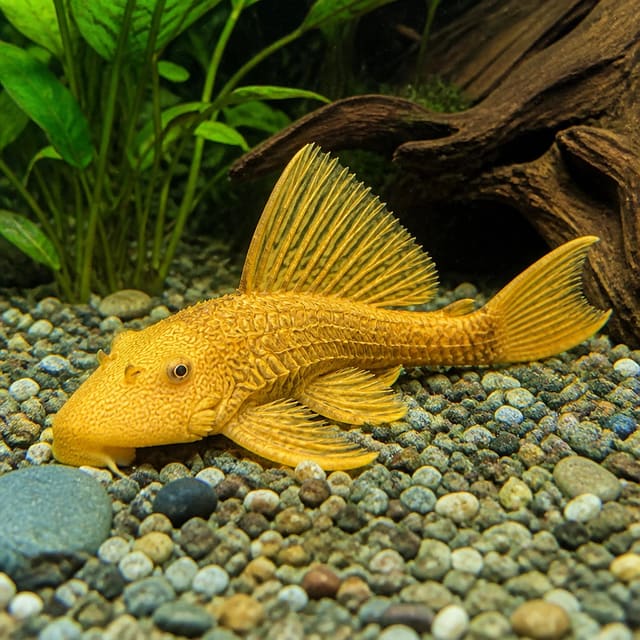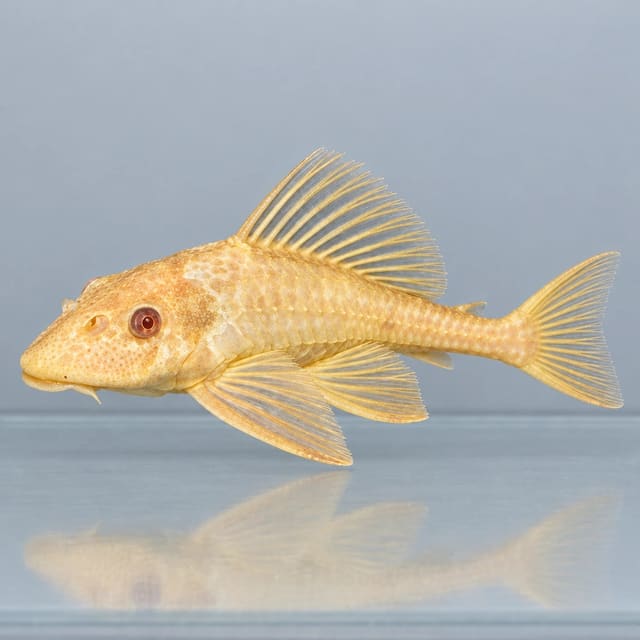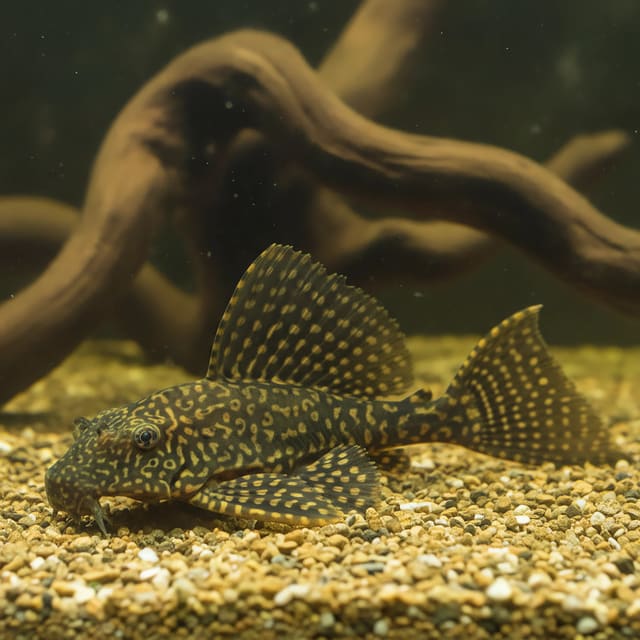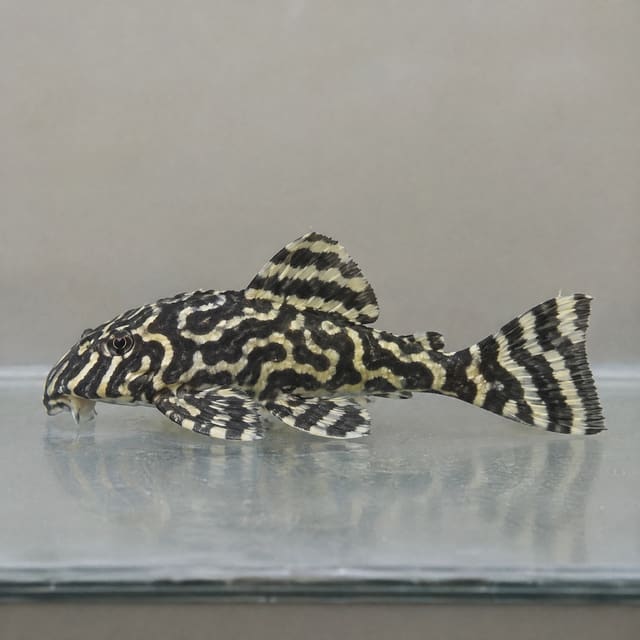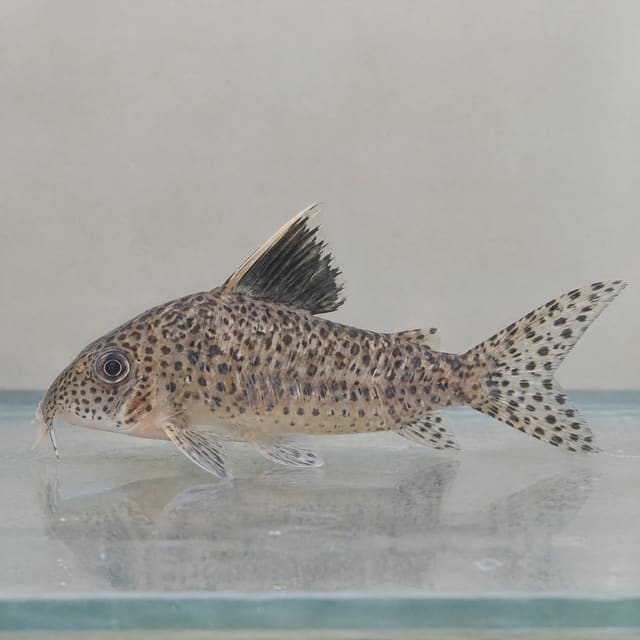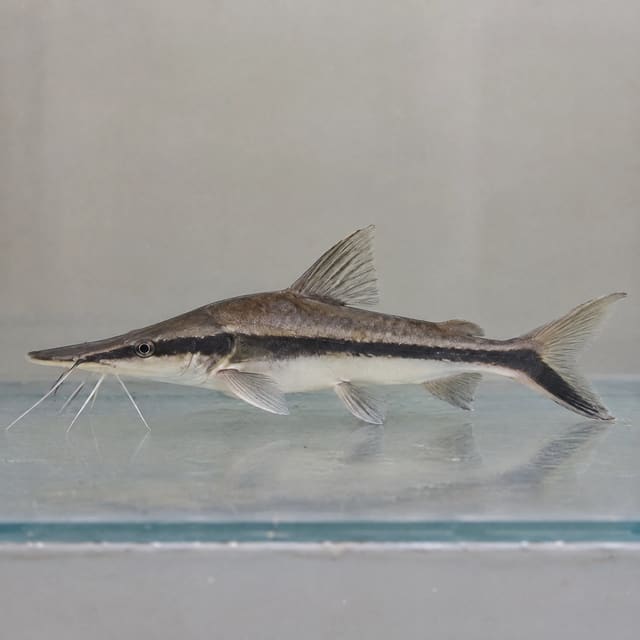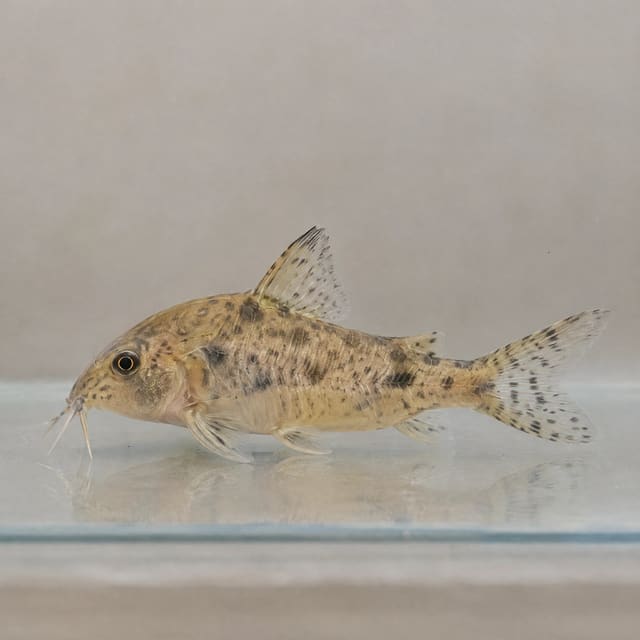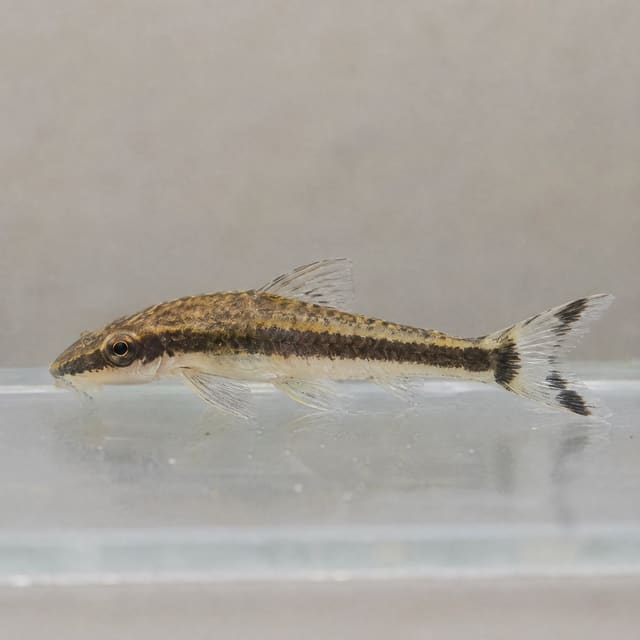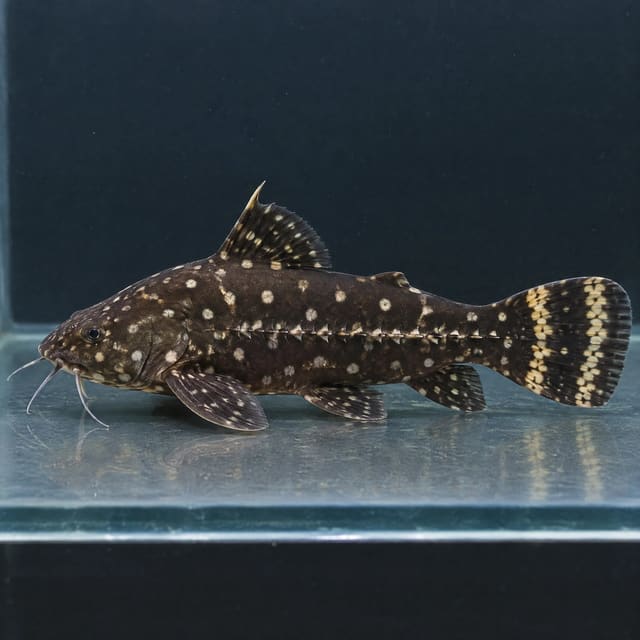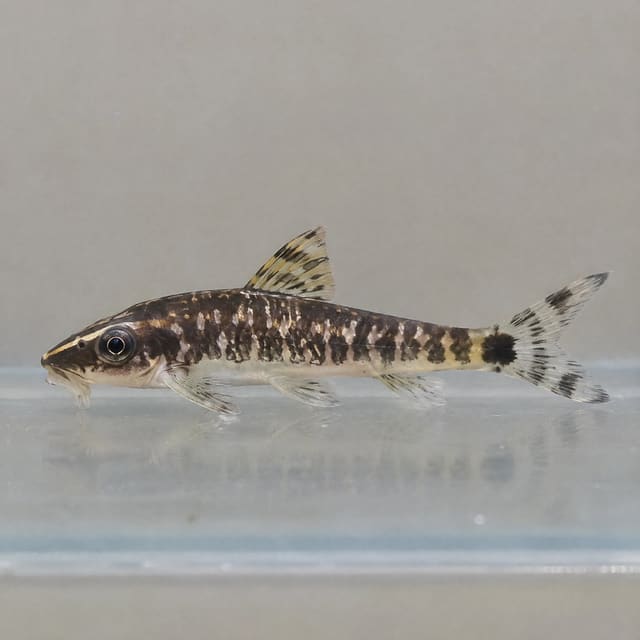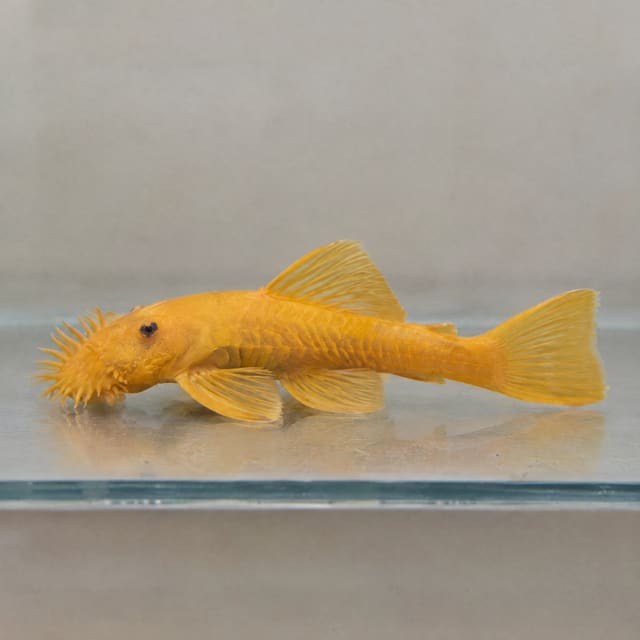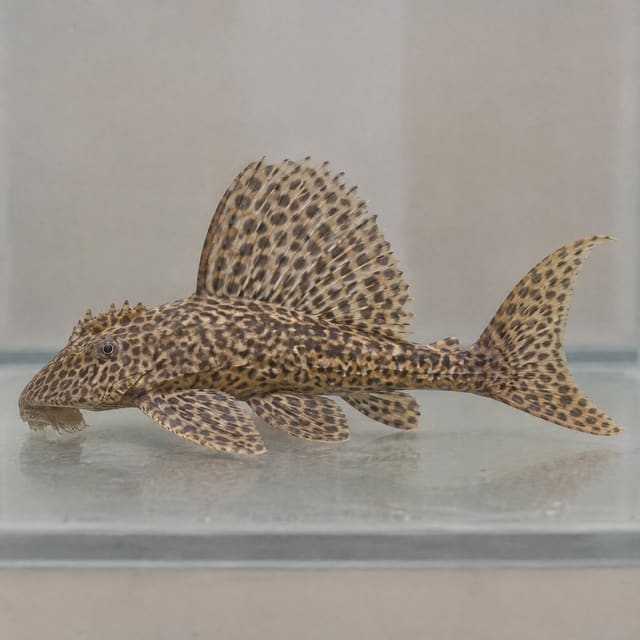
Leopard Sailfin Pleco (Pterygoplichthys gibbiceps)
23–27°C · pH 6–8
£11.99
The Common Plec (Pterygoplichthys pardalis) is a hardy Amazon sailfin pleco with leopard-like spots and a tall, sail-like dorsal fin that grazes algae and biofilm. It grows to around 40–50 cm, so it needs a very large aquarium (OATA: often over 500 litres) or a heated indoor pond. Sold individually in four sizes from 6 cm to 12–15 cm.
Pterygoplichthys pardalis
The Common Plec (Pterygoplichthys pardalis) is a hardy Amazon sailfin pleco with leopard-like spots and a tall, sail-like dorsal fin that grazes algae and biofilm. It grows to around 40–50 cm, so it needs a very large aquarium (OATA: often over 500 litres) or a heated indoor pond. Sold individually in four sizes from 6 cm to 12–15 cm.
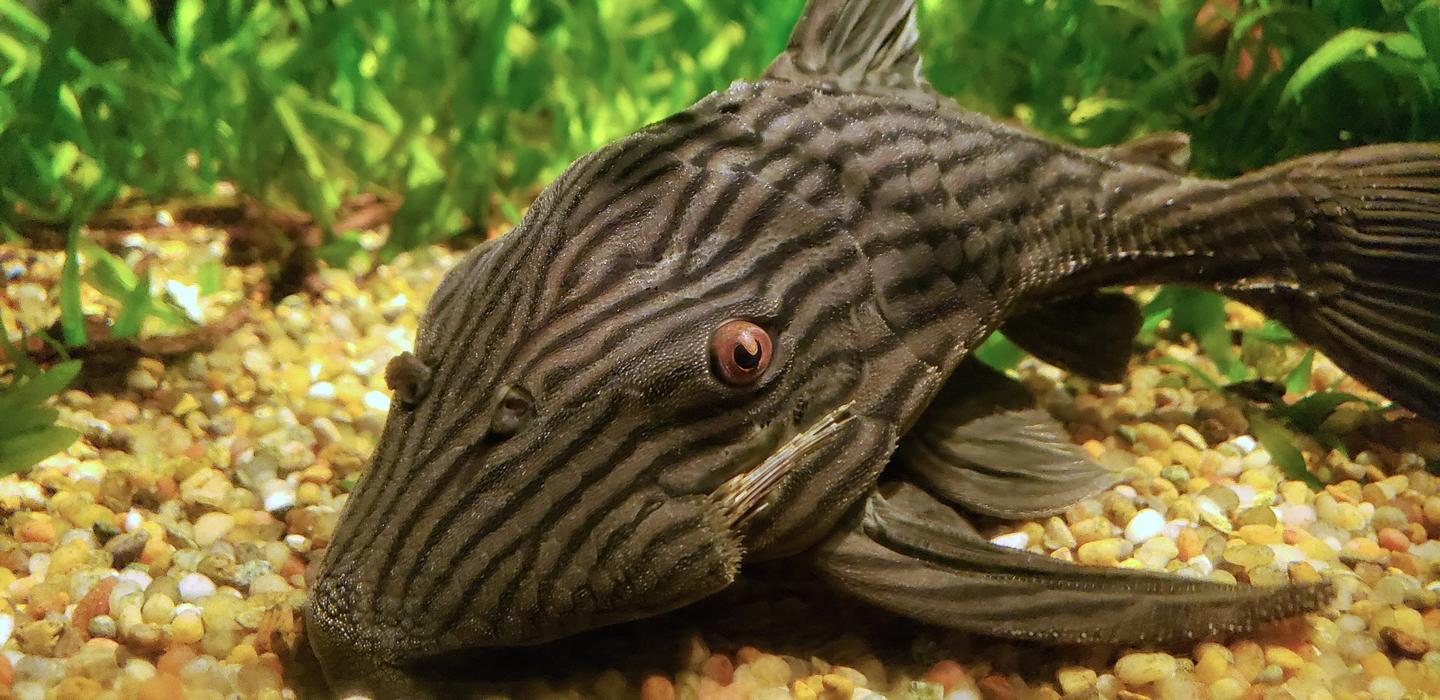
‘Pleco’ is a loose aquarium-trade label, not one species or one care sheet. Before buying, confirm the scientific name or defensible L-number, adult size and measurement method, required footprint, temperature and water, diet, social plan and source. No universal pleco tank size, menu or algae result is honest.
Read the full care guidance when planning conditions for your aquarium.
The Common Plec is Pterygoplichthys pardalis, a large armoured suckermouth catfish from the Amazon basin. FishBase calls it the Amazon sailfin catfish and records it from the lower, middle and upper Amazon River basin. It has a tall, sail-like dorsal fin, a body covered in bony plates and a pattern of dark spots on a lighter brown to tan background; the species name pardalis means leopard. It is hardy, peaceful with most other fish and a tireless grazer of algae and biofilm, which is why it has been sold as a common pleco for decades.
Be clear about one thing before you buy: this is a very big fish. The little plec in the bag becomes a heavy-bodied adult of around 40–50 cm, and published records go higher. It suits keepers who already have, or are building, a very large aquarium or a heated indoor pond. If you want an algae grazer for an ordinary community tank, a Bristlenose Pleco is the better choice.
The name common pleco (or common plec in the UK) has never belonged to one species. ScotCat explains that older books called the common pleco Hypostomus plecostomus, while today the name covers several Pterygoplichthys species, chiefly P. pardalis, plus some Hypostomus. Practical Fishkeeping goes further: it names P. pardalis and P. disjunctivus as the true common plecs of recent years and says fish are still often labelled H. plecostomus in error.
| Name you may see | What it refers to |
|---|---|
| Common plec / common pleco | A trade name used for this fish and, historically, for several other large brown plecs |
| Amazon sailfin catfish | The FishBase and USGS common name for P. pardalis |
| L021, L023, janitor fish | Other names ScotCat lists for this species |
| Liposarcus pardalis, Hypostomus pardalis | Older scientific names (synonyms) for the same species |
| Hypostomus plecostomus | A different genus and species from the Guianas, which we sell as the Common Pleco / Suckermouth Catfish |
You can tell the two genera apart by counting the rays in the dorsal fin. The USGS fact sheet gives 7–8 rays for Hypostomus against 9–14 for Pterygoplichthys, and ScotCat gives 11–13 for P. pardalis. Our Common Pleco (Hypostomus plecostomus) listing is the other fish; both grow large, so read each page before you choose. The look-alike P. disjunctivus has a more worm-like (vermiculated) pattern on the belly, where P. pardalis is spotted; Practical Fishkeeping notes that the difference often does not show until the fish are sub-adult.
One purchase is one live Common Plec of the size you select: 6 cm, 7.5 cm, 10 cm or 12–15 cm. Every size is the same species and grows into the same large adult, so the choice is about how big a fish you want to start with, not how big it will end up. Larger fish settle quickly into a big system that is already running; smaller ones cost less but still need the full adult plan.
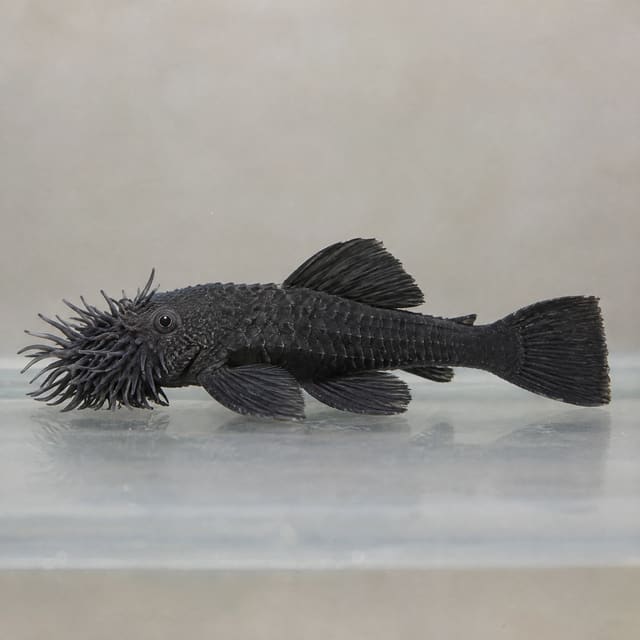
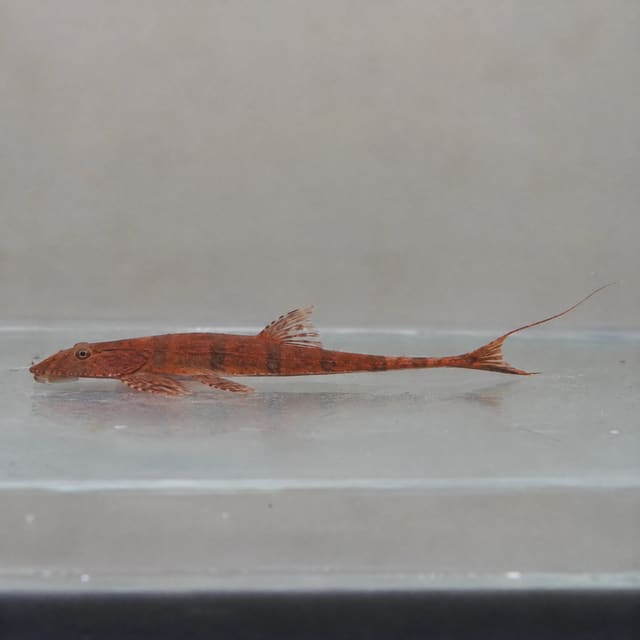
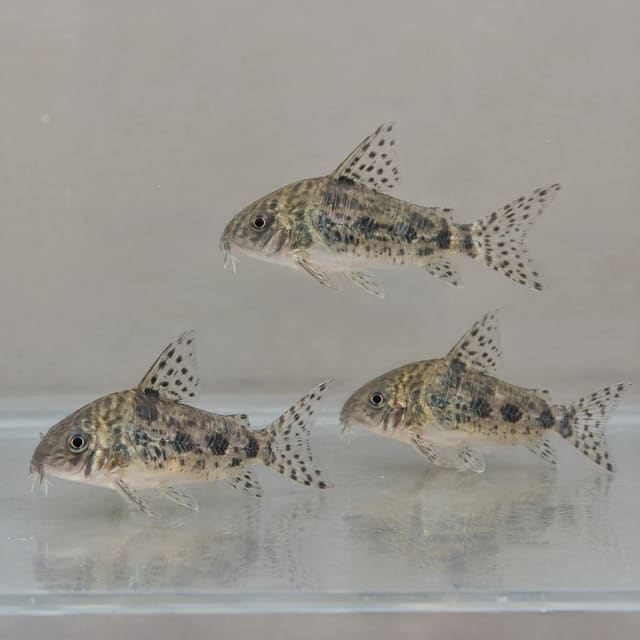
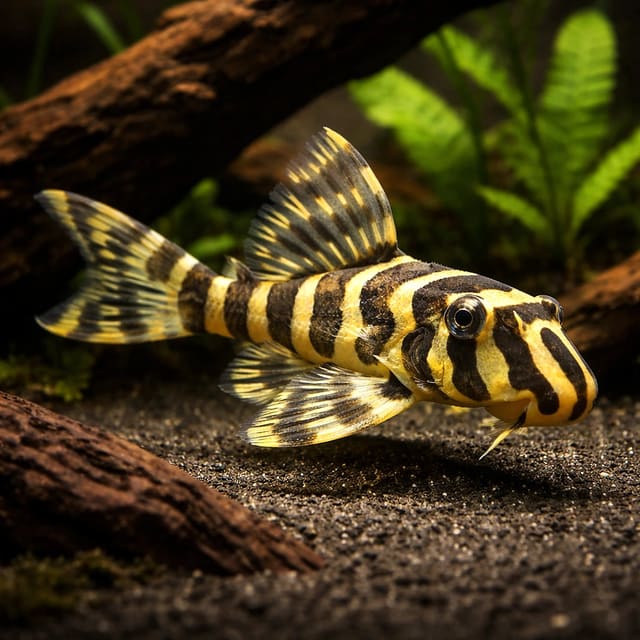
The photographs show the species and its typical colour, not the individual fish you will receive. They were prepared from a reference image of this species. The spotting, shade of brown and fin length vary between individuals and change as the fish grows.
| Size you select | What to plan for |
|---|---|
| 6 cm | A 40–50 cm adult; a mature aquarium for now with a clear route to a much larger one |
| 7.5 cm | The same 40–50 cm adult and the same long-term space |
| 10 cm | The same adult; heavier feeding and more waste already, so strong filtration from day one |
| 12–15 cm | The same adult; best suited to a large system that is already established |
Before you order, check our delivery days and Live Arrival Guarantee so you can be at home to unpack the fish. Plecs have sharp fin spines, and OATA advises double-bagging catfish so a spine cannot puncture the bag, so open the box and bags carefully.
The published sizes differ, and the difference matters. ScotCat gives 30 cm. The USGS fact sheet says generally to 50 cm total length. Practical Fishkeeping gives an adult size of over 50 cm. FishBase records a maximum of 57.8 cm total length and a maximum published weight of 655.3 g. Total length includes the tail, and these are maximum records rather than averages, but they all point the same way: plan for a fish of 40–50 cm, not one that stays the size of a hand.
The aquarium has to match. OATA's guidance on very large fish says an exceptionally large aquarium is required, often in excess of 500 litres, and that indoor heated ponds can be built for these animals. Practical Fishkeeping says the sheer size of sailfin plecs dictates tanks of many hundreds of litres. ScotCat's older factsheet suggests a tank of 3' 6" or over; that may hold a young fish, but it is far too small for an adult of the size the other sources describe.
Use our tank volume calculator to check the real capacity of a tank or pond, and our stocking calculator before you add other fish. Our common pleco guide and pleco care guide compare the large plecs with the smaller species that suit ordinary aquariums.
Practical Fishkeeping recommends an uncomplicated layout of bogwood, rocks and ceramic or plastic pipes for shelter. A big plec spends much of the day resting on wood, rock or the glass and grazes mostly when the lights go down, so it needs at least one cave or pipe big enough to hide its whole body. Replace shelters with larger ones as the fish grows.
| Area | Purpose |
|---|---|
| Large pipe or cave on the floor | A daytime retreat the plec can claim, sized to its body length |
| Driftwood | A grazing surface and resting place covered in biofilm |
| Rocks set on the glass base | Structure and grazing surfaces that cannot be undermined or knocked over |
| Open sand or fine gravel | Feeding space; OATA advises sand or fine gravel because catfish have sensitive barbels |
| Heater guard and secure lid | OATA advises protecting heaters from large fish and fitting a fish-proof cover |
OATA warns that large fish tend to disturb décor and can knock over ornaments and plants, so set rocks directly on the base before adding substrate and wedge heavy pieces so they cannot shift. Choose robust plants, or fix them to wood and rock, because a big plec ploughs through soft planting. Keep the aquarium away from draughts, heat sources and direct sunlight, as OATA recommends for all tropical fish.
Leave easy access to the floor for siphoning. A large plec produces a lot of solid waste, and the layout should let you reach it every week without dismantling the tank.
Common Plecs are adaptable, but the sources give slightly different ranges, so aim for the zone where they agree. FishBase gives 23–28°C, pH 7.0–7.5 and 10–20 dH. ScotCat gives 20–26°C and pH 6.5–7.2. Practical Fishkeeping suggests a neutral pH, medium hardness and around 26°C, and reports wild fish in a Peruvian creek at 28°C and pH 7.0 in the dry season. OATA's general catfish range is 22–27°C, pH 6.0–8.0 and 4–18°dH.
| Reading | Target |
|---|---|
| Temperature | 23–26°C, where FishBase and ScotCat overlap; around 26°C suits it well |
| pH | Around neutral, 7.0–7.2, where FishBase and ScotCat overlap |
| General hardness | Medium; 10–18°dH fits both FishBase and OATA |
| Ammonia | Zero mg per litre (OATA) |
| Nitrite | Zero mg per litre (OATA) |
| Nitrate | No more than 20 mg per litre above your tap water (OATA) |
UK tap water ranges from soft to very hard depending on where you live, and this fish's preference for neutral, medium-hard water means many supplies suit it once dechlorinated. Test your own tap water first; our water chemistry guide explains pH, GH and KH. Stability matters more than an exact number, so do not adjust pH with chemicals in a tank that is already stable and within range.
A plec this size produces far more waste than a tetra or a small catfish, so the waste readings are the ones to watch. Test ammonia, nitrite and nitrate every week, and straight away if the fish behaves unusually.
Practical Fishkeeping calls heavy-duty external power filtration vital because these are greedy eaters, and OATA says several large aquarium filters, or even a pond filter, may be needed to handle the solid waste of very large fish. Choose mechanical filtration you can clean easily plus plenty of biological media, and aim the outlets so debris keeps moving towards the intakes. Our guide to understanding aquarium filtration covers how the mechanical and biological stages work together.
Never clean all the biological media at once. Chlorine, chloramine or over-cleaning can wipe out the bacteria that convert ammonia, and a large fish's waste turns into an ammonia spike quickly.
Do not rely on algae alone. Practical Fishkeeping explains that these plecs are generalist omnivores that scrape biofilm from hard surfaces with comb-like teeth, but that home aquariums do not grow enough of it to support one. ScotCat says the wild diet is algae, aquatic weeds, other plant matter and small crustaceans, and that in the aquarium it eats mostly vegetable foods along with tablets and pellets.
You can blanch vegetables in batches and freeze them, as Practical Fishkeeping suggests. Adding green algae wafers to the rotation helps on days when vegetables are refused, and driftwood gives the plec a surface to rasp between meals.
Watch the belly. A well-fed plec has a gently rounded underside; a hollow, sunken belly means it is not getting enough, often because faster fish take everything first. Feed later in the evening, or in several places, rather than increasing the total so much that leftovers rot.
Add the plec only to an aquarium with a fully established filter: ammonia and nitrite at zero, temperature, pH and hardness within the ranges above, and somewhere dark to hide. OATA describes the floating-bag method: switch the aquarium lights off, float the bag for 10 minutes to match temperature, then add small amounts of tank water to the bag over up to 20 minutes before releasing the fish, letting as little bag water into the tank as possible. Our step-by-step acclimatisation guide walks through it.
| When | What to do |
|---|---|
| Before arrival | Test the water and make sure the cave, heater guard and lid are in place |
| Day one | Acclimatise with the lights off; leave the fish to find its own shelter |
| First evening | Offer a small piece of vegetable and one wafer after lights out |
| Days two to seven | Check the belly and droppings each morning; remove uneaten food |
| End of week one | Retest ammonia and nitrite and do the normal water change |
Expect it to hide for the first days and to come out mostly at dusk. FishBase notes that this species is a facultative air breather, so an occasional dash to the surface to gulp air is normal. Repeated surface visits with fast gill movement are different: test the water at once.
ScotCat describes the Common Plec as peaceful on its own but territorial with its own kind, and says it can live with most aquarium fish in a large enough tank. Practical Fishkeeping says companions can be almost any fish that thrives in the same conditions, gives tinfoil barbs as an example, and notes that armoured sailfin plecs are often kept with large or aggressive cichlids because they can withstand them. Expect skirmishes with other large catfish, especially when hiding places are short.
| Suits | Avoid |
|---|---|
| Large, active midwater fish such as Tinfoil Barbs or Silver Dollars | A second Common Plec or another large sailfin plec without a very large floor area and separate caves |
| Medium to large South American cichlids such as the Severum | Goldfish and other slow, flat-sided fish; ScotCat warns plecs may rasp at their slime coat |
| Robust schooling fish that share 23–26°C | Any community in a tank too small for an adult plec, since crowding fouls the water for all |
| Bottom fish that use different shelter and feed separately | Fish that need cool or very soft, acidic water |
Our tank mates checker helps compare temperature and size before you mix species. If you like sailfins but want a fish that stays a little smaller, Practical Fishkeeping says the Gold Spot Pleco L001 grows to around 30 cm, smaller than the other Pterygoplichthys; the Leopard Sailfin Pleco is another member of the genus with similar care. Browse our catfish and plecos range, the South American catfish category and the Pterygoplichthys sailfin plecos.
Common Plecs are tough, which can hide problems until they are serious. Learn how your fish normally looks and where it rests, then check it at every evening feed. OATA lists the signs that matter for all fish: changes in swimming, colour, temperament, breathing, appearance, body condition and feeding.
| If you see | Do this |
|---|---|
| Hollow or sunken belly | Feed after lights out in several places; add vegetables and wafers |
| Fast gill movement or constant surface trips | Test ammonia, nitrite and temperature at once; check filter flow |
| Pale or blotchy colour that persists | Test the water and review recent changes and tank mates |
| White spots, fluffy growths or damaged fins | Test the water and seek fish-health advice before treating |
| Scrapes or split fins after a fight | Add or enlarge caves and review whether companions are too boisterous |
| Refusing food for several days | Check the water readings, then try a different vegetable at dusk |
Many treatments are dosed by water volume, and large systems hold a lot of it, so measure the true volume before dosing. Our guides to white spot treatment and fin rot explain the common problems. If signs continue after you have corrected the water, contact us with your test results and tank size.
Sailfin plecs released into warm waters abroad have become invasive in many countries. The USGS describes how burrowing males can destabilise river banks and add to siltation. Here in the UK, researchers caught a P. pardalis in a side channel of the River Kelvin in Glasgow on 6 September 2021, one of the first two Pterygoplichthys ever recorded in the UK (Munson et al., BioInvasions Records, 2024). Practical Fishkeeping also reports a 25 cm sailfin plec found dead in a Leicestershire canal in 2009.
In England and Wales, section 14 of the Wildlife and Countryside Act 1981 makes it an offence to release into the wild any animal that is not ordinarily resident in Great Britain; Scotland and Northern Ireland have their own non-native species laws. If you can no longer keep your plec, contact us, a local aquatic shop or a fishkeeping club about rehoming. Never put it in a river, canal, lake or outdoor pond.
Common Plecs are not bred in home aquariums. Practical Fishkeeping explains that Pterygoplichthys spawn in burrows dug into soft clay or mud banks, usually about 1 m long, which the male excavates and guards; several spawns a year can each hold up to 7,000 eggs. Commercial breeding happens in purpose-built clay ponds, and most fish in the trade are farmed. ScotCat records no known external differences between males and females, so plan on keeping a single fish.
Plan for 40–50 cm. ScotCat gives 30 cm, the USGS says generally to 50 cm total length, Practical Fishkeeping says over 50 cm, and FishBase records a maximum of 57.8 cm total length.
A very large one. OATA says very large fish often need more than 500 litres, or a heated indoor pond, and Practical Fishkeeping says sailfin plecs need tanks of many hundreds of litres. A small fish can start in a smaller mature tank only if the adult home is already planned.
No. Pterygoplichthys pardalis and Hypostomus plecostomus belong to different genera, but both have been sold as the common pleco. A sailfin plec has 9–14 dorsal-fin rays (11–13 in this species); Hypostomus has 7–8.
It grazes algae and biofilm constantly, but it cannot live on what a home aquarium grows. It needs daily sinking wafers or tablets and blanched vegetables such as courgette, cucumber and sweet potato.
Aim for 23–26°C, a pH around 7.0–7.2 and medium hardness, where FishBase and ScotCat overlap. Keep ammonia and nitrite at zero and nitrate no more than 20 mg per litre above your tap water.
Only in a very large aquarium with plenty of floor space and a cave for each. ScotCat describes the species as territorial with its own kind, and Practical Fishkeeping warns of skirmishes between large catfish when hiding places are short.
No. It is a tropical fish that needs heated water all year, and ScotCat warns that plecs may rasp at the slime coat of goldfish. It must never be put in an outdoor pond or released.
All four sizes, 6 cm, 7.5 cm, 10 cm and 12–15 cm, are the same species and grow to the same adult size. Choose a larger size if you already run a big system; choose a smaller one only with a firm plan for the adult.
No reviews for this item yet. Bought one? Honest reviews only, good or bad.
What customers say about ordering from us
Easy website plenty of info on fish your buying great to pick a time slot
TRACEY DURRANT · 7 Oct 2026
Got some lovely fish thank you
Kevin Mackie · 7 Oct 2026
Reviews of our shop, collected by Judge.me, an independent third-party review collector. Newest first.
Moved by UK carriers licensed to handle live animals
Hand-packed with oxygen bags, poly box, heat pack
Email photos the same day; an optional unboxing video helps us review problems faster — claim terms apply
Klarna & PayPal Pay in 3 at checkout