Moderate
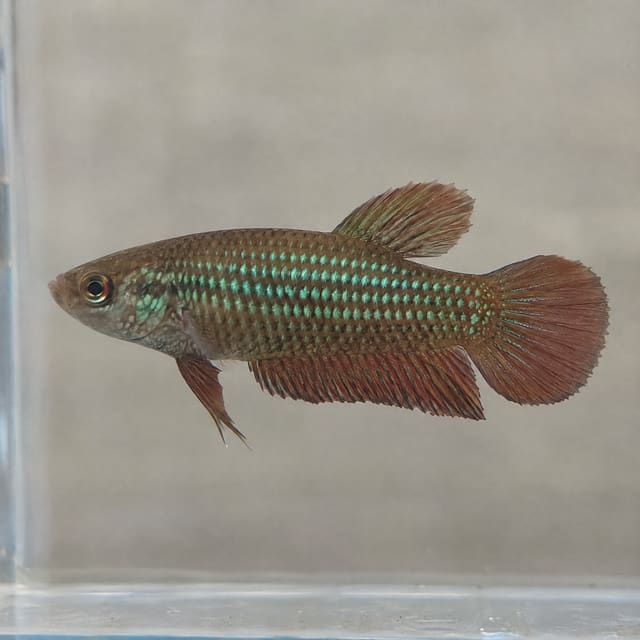
Wild Smaragdina Guitar Betta, Female (Betta smaragdina)
24–28°C · pH 6–7.5 · 20L
£36.99
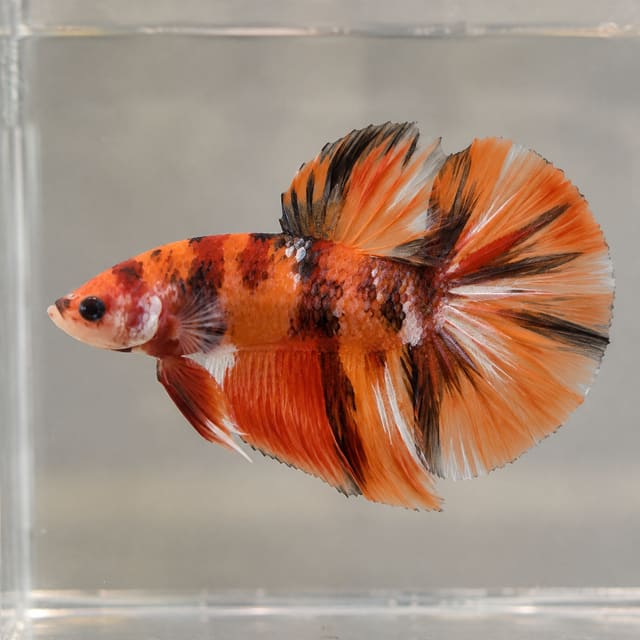
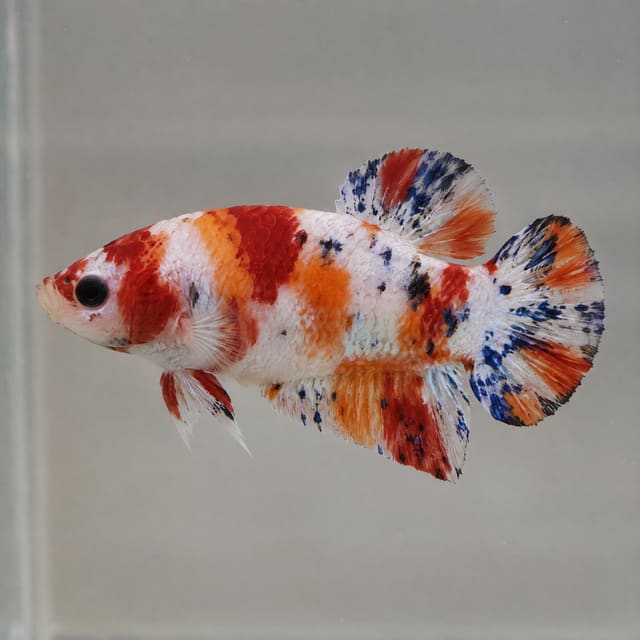
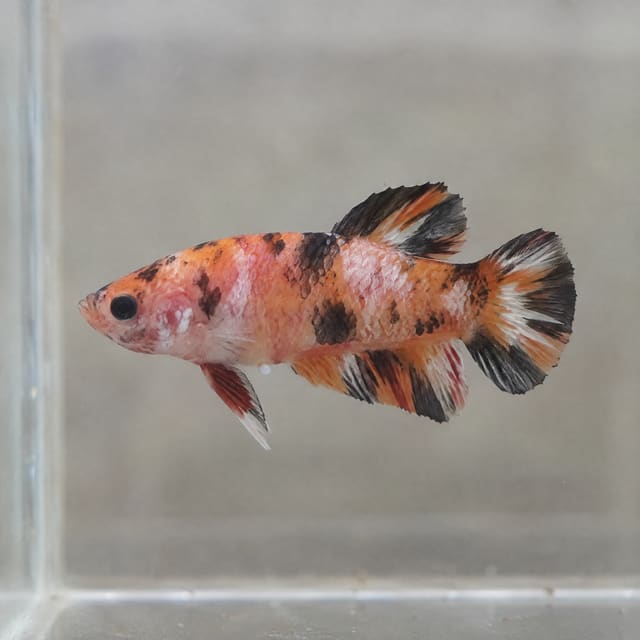
The Candy Koi Female Plakat Betta is a short-finned female Siamese fighting fish (Betta splendens) with a koi pattern of red, orange, white and black patches and metallic blue scales. She grows to about 6–7 cm and needs a heated, planted, covered aquarium at 24–28°C with gentle filtration. Sold individually as one live female.
Adult size is the maximum length this species reaches at full maturity (scientific sources). The livestock you receive will be younger and smaller. Product-photo provenance and any image-specific limitations are stated on the listing.
Betta splendens
The Candy Koi Female Plakat Betta is a short-finned female Siamese fighting fish (Betta splendens) with a koi pattern of red, orange, white and black patches and metallic blue scales. She grows to about 6–7 cm and needs a heated, planted, covered aquarium at 24–28°C with gentle filtration. Sold individually as one live female.
Adult size is the maximum length this species reaches at full maturity (scientific sources). The livestock you receive will be younger and smaller. Product-photo provenance and any image-specific limitations are stated on the listing.
For one typical domestic Betta splendens, start with at least 20 litres, a mature filter, thermostatic heater, separate thermometer, gentle flow, a secure lid with surface access, and plants or refuges. Keep one male per aquarium.
Read the full care guidance when planning conditions for your aquarium.
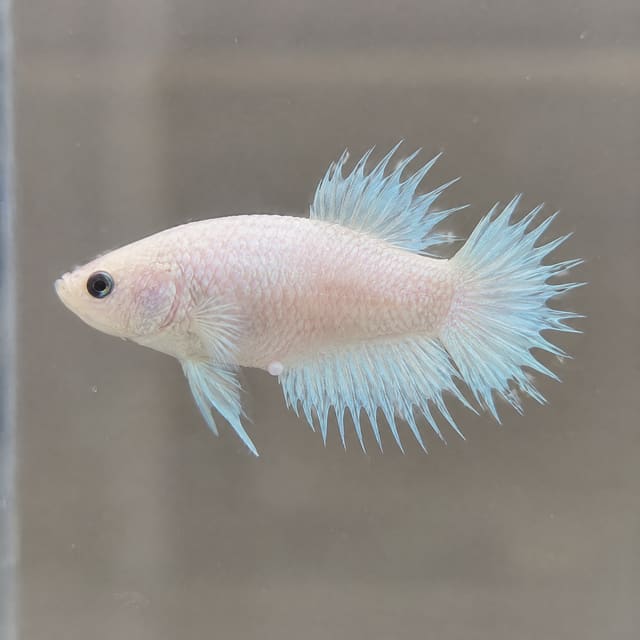
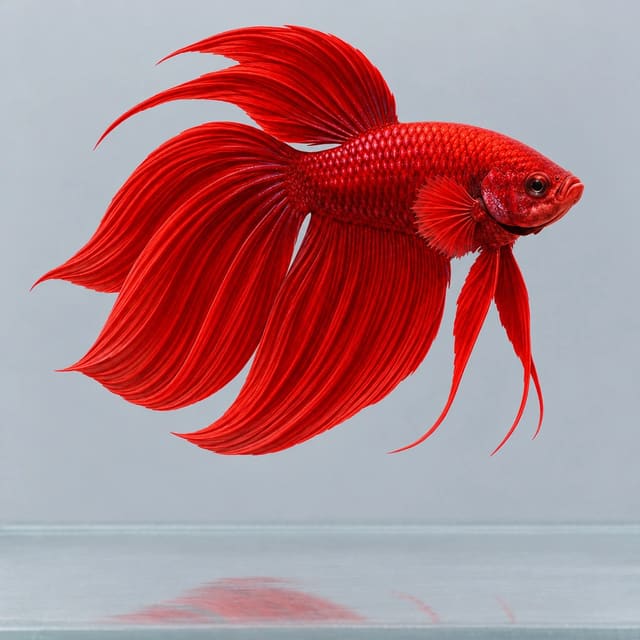
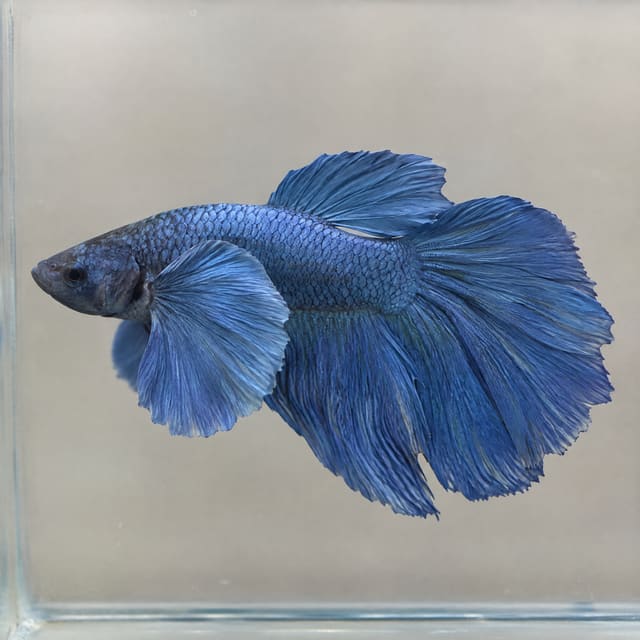
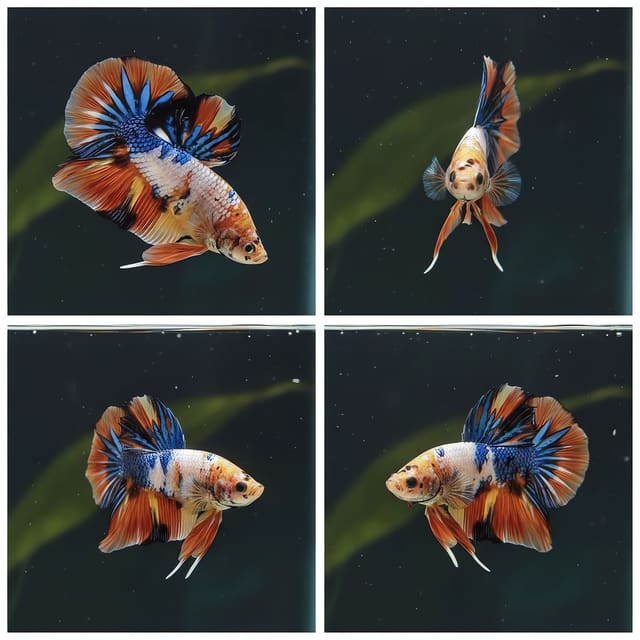
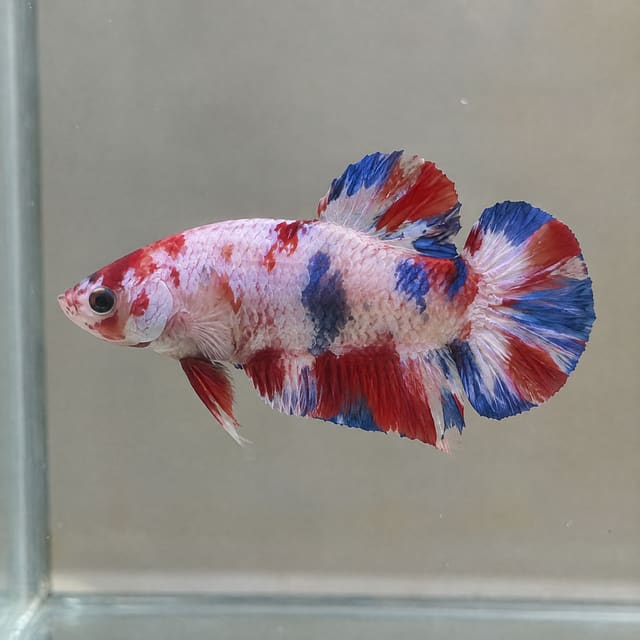
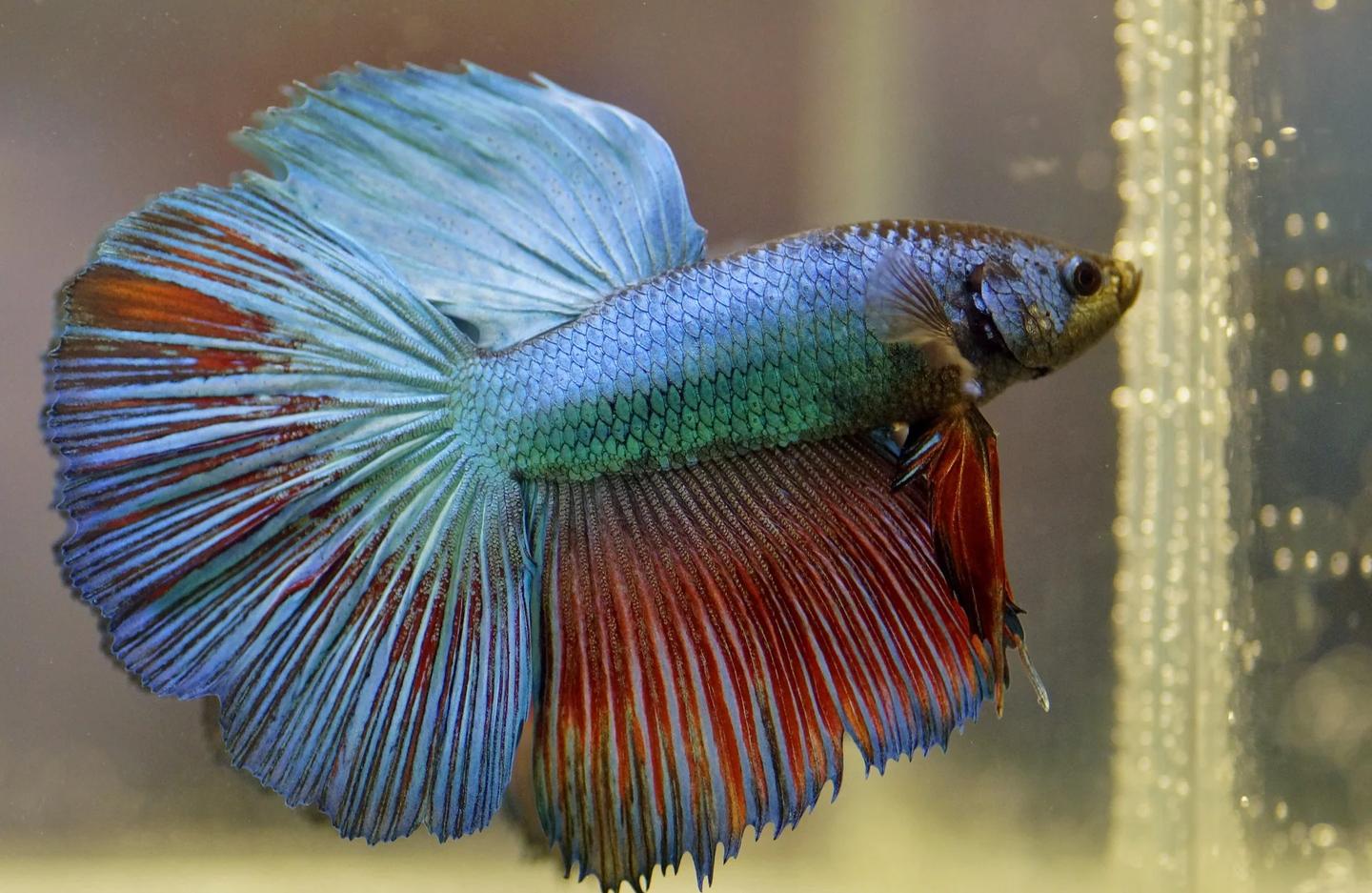
The candy koi female betta is a short-finned female Siamese fighting fish, Betta splendens, with a pale, pearly body splashed in red, orange and white, dark blotches along the back and flanks, and patches of metallic blue scales towards the tail. Her fins are short and rounded, red and white with blue streaks. This combination of a plakat fin shape and a multicoloured koi pattern makes a bright, active fish for a heated, planted aquarium.
Bettas are labyrinth fish: as well as gills, they have an organ that lets them breathe air at the surface, which suits the still, warm, sometimes oxygen-poor waters they come from. Seriously Fish places the wild species in central Thailand, from Chiang Rai province south to Surat Thani and Phang Nga, in rice paddies, swamps, ditches, streams and ponds, often shaded by plants. FishBase describes its range as the Mekong basin and lists the wild species as Vulnerable on the IUCN Red List (assessed in 2011).
| Name | What it means |
|---|---|
| Betta, Siamese fighting fish | Common names for Betta splendens Regan, 1910 |
| Plakat | A short-finned strain; Seriously Fish traces the word to the Thai pla kat |
| Koi | A trade name for a patchy, multicoloured pattern reminiscent of koi carp |
| Candy | A trade name for koi bettas with a wider palette, here including blue as well as red, orange, white and black |
| Female | The calmer sex, with shorter fins and less intense colour than males of the same strain |
"Koi" and "candy" are names used by breeders and shops, not formal standards, so different sellers may draw the line between them differently. Compare her with our Koi Plakat Female Betta, the Galaxy Plakat Female Betta and the long-finned Halfmoon Koi Female Betta, or browse all our betta fish, the betta and labyrinth fish category and the female betta category.
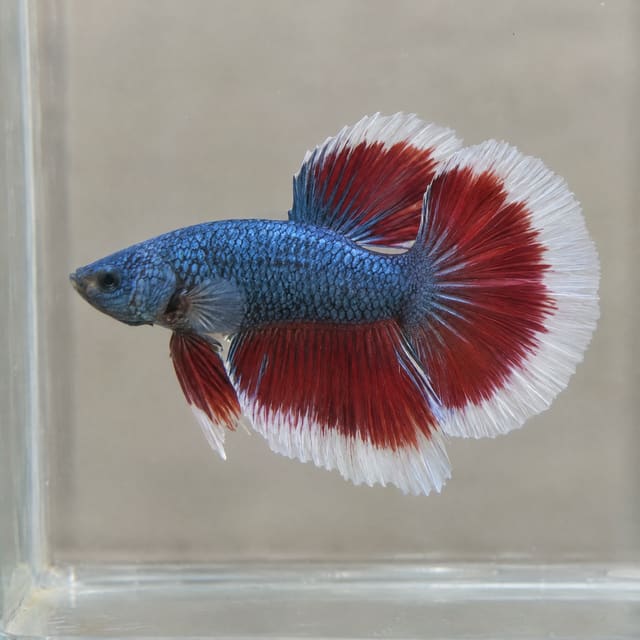
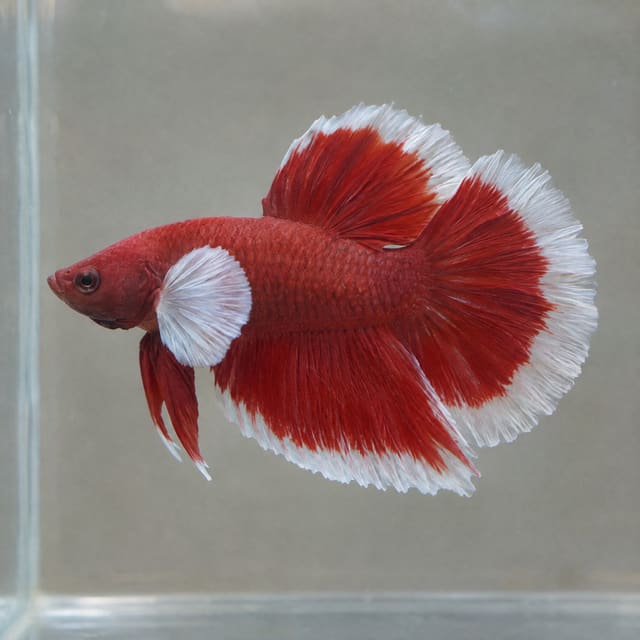
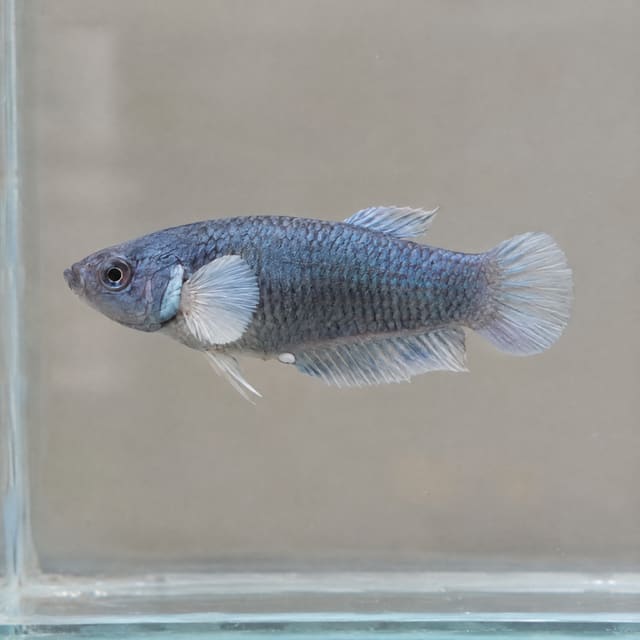
One purchase supplies one live female candy koi plakat betta, graded medium-large. She is a young adult or near-adult fish; the species reaches about 6–7 cm, with OATA giving about 7 cm, Seriously Fish 70 mm standard length and FishBase 6.5 cm total length. The photographs show the colour form, not your individual fish: every koi betta carries its own arrangement of colours.
Breeders widely report that koi and other marble-type bettas keep changing their pattern as they mature, with patches spreading, shrinking or shifting colour. We have not found a scientific study that identifies the genes behind this, so treat it as hobby experience rather than proven fact, and enjoy the pattern as it develops. Colour also responds to mood: a settled, well-fed betta is brighter than a stressed one.
Ornamental bettas have a long and mixed history. A genomic study by Kwon and colleagues (2022) found reports of bettas being kept in Thailand from as early as the 14th century and estimated that domestication began around 700 generations ago; 76% of the ornamental bettas they sampled carried ancestry from other Betta species. Seriously Fish notes crosses with B. imbellis, B. smaragdina and B. mahachaiensis.
Short-finned males and females can look alike. Seriously Fish notes that some commercial breeders reportedly sell very short-finned males as females, and males are usually the more colourful sex with longer fins. If you are building a group of females, watch for a fish that builds bubble nests at the surface, the job of a male, and keep a spare aquarium ready. Read our female betta fish guide and our delivery and Live Arrival Guarantee details before you order.
A betta is small, but it still needs a filtered, heated aquarium; Seriously Fish says the species should not be kept in tiny aquaria or jars. For a single betta it recommends a base of at least 45 × 30 cm, about 41 litres. OATA gives a minimum of 20 litres for a single male and at least 60 litres for a group of females, which should number at least four, and more is better.
| Plan | Aquarium | What the sources say |
|---|---|---|
| One female alone | Base of 45 × 30 cm, about 41 litres, or larger | Seriously Fish: ornamental bettas are usually best kept one per tank |
| Group of females | At least 60 litres, densely planted | OATA: at least four females, more is better; females are calmer than males |
| Female in a community | Sized for every species in it | OATA: only with fish that are not boisterous or aggressive |
The two sources genuinely differ on groups. OATA treats female groups as normal; Seriously Fish warns that ornamental strains are more aggressive than other betta species and that usually only one can be kept in a tank. A group can work in a large, heavily planted aquarium, but watch closely for chasing and torn fins in the first weeks and be ready to separate a bully. Turn your measurements into litres with our tank volume calculator.
Recreate a shaded, slow, overgrown water. Seriously Fish suggests a heavily planted aquarium with floating plants such as Salvinia or Riccia to dim the surface, rooted plants such as Cryptocoryne, and shelters such as clay pots or short lengths of pipe. Bettas are excellent jumpers, so the tank must be well covered, but they also need to gulp air.
| Layer | What to provide |
|---|---|
| Surface | Floating plants for shade, with open patches where she can breathe air |
| Middle | Fine-leaved and broad-leaved plants that break up sight lines |
| Floor | Sand or gravel, smooth caves or pots, and leaf-strewn corners |
| Above the water | A tight lid with a gap of warm, humid air below it |
OATA asks for a gap between the water surface and any cover glass so bettas can reach air, and warns against sharp or rough décor that could tear fins. Do not fill the aquarium to the brim, as Seriously Fish advises. Fit overhead lighting for a regular day and night, which live plants also need, and keep the aquarium out of direct sunlight, draughts and noisy, vibrating spots.
Bettas need a heater all year in a UK home. The three main sources give different ranges, so aim for the overlap:
| Reading | Target |
|---|---|
| Temperature | 24–28°C (OATA 20–28°C; Seriously Fish 22–30°C; FishBase 24–30°C) |
| pH | 6.0–8.0 (all three sources) |
| General hardness | About 5–12 dGH (OATA 4–12; Seriously Fish 1–15; FishBase 5–19) |
| Carbonate hardness | 3–10 dKH (OATA) |
| Ammonia and nitrite | 0 mg/l |
| Nitrate | No more than 20 mg/l above your tap water |
Ornamental bettas are bred for the aquarium, and Seriously Fish gives pH 6.0–8.0 for the species, adding that wild-caught fish are likely to prefer softer, more acidic water of pH 5.0–7.0. Most treated UK tap water falls inside the ornamental range. Use a thermostatic heater and check it with a thermometer; see our betta temperature guide for more on keeping bettas warm. Test your tap water and enter it in our water matcher to see how it compares.
OATA says a filter is always essential, set to give a gentle current so bettas can swim freely. Seriously Fish recommends an air-powered sponge filter and warns against strong water movement, which tires short-finned and long-finned bettas alike. Mature the filter before she arrives; our article on the nitrogen cycle explains how.
In the wild, bettas hunt small aquatic and land insects and other invertebrates. Seriously Fish says captive fish usually take dried foods once they recognise them but should also get small live or frozen foods, such as daphnia, brine shrimp and bloodworm, regularly. OATA recommends a good flake or pellet, ideally one made for bettas, fed once a day in an amount eaten within a few minutes. Seriously Fish warns that bettas are prone to obesity, so resist the temptation to feed more.
Kwon and colleagues linked red colour in bettas to genes involved in handling carotenoids, the pigments fish obtain from their food, so a varied diet supports the red and orange in her pattern.
OATA describes the floating-bag method: switch off the aquarium lights, float the sealed bag for about 10 minutes so the temperatures match, add small amounts of aquarium water to the bag over up to 20 minutes, then net her out or pour her in with as little bag water as possible. Our guide to acclimatising new fish shows each step. If you are adding her to a group of females, rearranging the plants first breaks up existing territories.
| Checkpoint | What to do |
|---|---|
| Before arrival | Heater set to 24–28°C, ammonia and nitrite at zero, lid on and floating plants in place |
| Arrival | Acclimatise with the lights off and leave her to explore |
| First feed | A few granules the next day; remove any left after a few minutes |
| Days 2–7 | Check fins, appetite and breathing daily, and watch for chasing in a group |
| End of week | Retest the water and make the first weekly change |
Females are calmer than males, and OATA says they can join community aquariums as long as there are no boisterous or aggressive fish. Seriously Fish is more cautious: it does not recommend bettas for a standard community tank but says some small cyprinids and loaches from similar habitats may suit, after research. Two males must never share a tank, and OATA advises that a male should only be kept with five or more females in a densely planted aquarium by experienced keepers.
| Suits | Avoid |
|---|---|
| Small, calm shoaling fish that stay in midwater | Fin-nipping species |
| Peaceful bottom fish such as loaches | Boisterous, fast feeders that take all the food |
| Other females in a group of four or more (OATA) | Male bettas outside supervised breeding |
| Fish happy at 24–28°C and gentle flow | Fish that need strong currents or cool water |
Popular choices are a shoal of harlequin rasboras, such as our 6 × Harlequin Rasboras, and the slender, secretive Kuhli Loach. For a group of females, the 5 × Female Bettas pack or the Female Plakat Betta Mix are starting points. Read our betta tank mates guide and check any mix with the tank mates tool.
OATA describes a healthy fish as having clear, bright eyes, undamaged fins, intact scales, no ulcers or bumps, normal swimming and steady breathing. Clamped fins, flicking against décor and shimmying are warning signs. Learn her normal routine in the first few days.
| If you see | Do this |
|---|---|
| Ragged or shrinking fin edges | Test the water, look for a fin-nipper or a bullying female, and read about fin rot |
| Swollen belly | Feed less and skip a day; bettas are prone to obesity |
| Lying on the bottom or hanging at the surface | Check the heater and thermometer, then test ammonia and nitrite |
| Faded colour and hiding | Look for chasing by tank mates and add more plant cover |
| White spots or fluffy patches | Test the water and seek advice before treating |
For more on everyday care and on the many fin and colour forms, see our betta fish care guide and our guide to betta types.
OATA notes that females ready to spawn show vertical bars on the body. The male builds a bubble nest at the surface, sometimes using plant debris, and the pair spawn in an embrace beneath it; Seriously Fish describes the female catching the eggs between her pelvic fins and body before the male carries them up. OATA advises removing the female afterwards, because the male guards the nest fiercely, and turning the filter flow down.
The eggs hatch in about one day according to OATA, or 24–48 hours according to Seriously Fish, and the fry stay in the nest for three to four days. They need the tiniest foods at first, then microworm and newly hatched brine shrimp, and Seriously Fish recommends the tightest possible lid so the young breathe warm, humid air while their labyrinth organ develops. Breeding needs a separate aquarium and plenty of space to grow on the young.
A female Siamese fighting fish, Betta splendens, of the short-finned plakat type, with a koi pattern: a pale body splashed with red, orange, white and black, plus metallic blue scales. "Koi" and "candy" are trade names for the pattern, not separate species.
About 6–7 cm. OATA gives about 7 cm, Seriously Fish 70 mm standard length and FishBase 6.5 cm total length for the species.
Yes. Seriously Fish says ornamental bettas are usually best kept one per aquarium, and a single female is the simplest choice. Plan for a base of at least 45 × 30 cm, about 41 litres, which Seriously Fish recommends for a single betta.
Sources differ. OATA says females are calmer than males and can be kept in groups of at least four in 60 litres or more, while Seriously Fish warns that ornamental strains are more aggressive than other bettas and usually only one can be kept per tank. If you try a group, plant it densely and have a spare aquarium ready.
A heated tropical aquarium. OATA gives 20–28°C, Seriously Fish 22–30°C and FishBase 24–30°C, so 24–28°C suits every source.
Betta pellets or granules once a day, only as much as she eats in a few minutes, with small frozen or live foods such as daphnia, brine shrimp and bloodworm as treats. Bettas put on weight easily, so do not overfeed.
They may. Breeders widely report that koi and other marble-type bettas keep changing pattern as they mature, although we have not found a scientific study of the genes involved. Colour also brightens as a fish settles and dulls when it is stressed.
OATA says females can join community aquariums that hold no boisterous or aggressive fish. Calm, small fish such as harlequin rasboras and kuhli loaches are typical choices. Never keep her with a male betta except briefly for supervised breeding.
One live female candy koi plakat betta of medium-large size. The photographs show the colour form; every koi betta has its own pattern, so yours will differ.
No reviews for this item yet. Bought one? Honest reviews only, good or bad.
What customers say about ordering from us
Easy website plenty of info on fish your buying great to pick a time slot
TRACEY DURRANT · 7 Oct 2026
Got some lovely fish thank you
Kevin Mackie · 7 Oct 2026
Reviews of our shop, collected by Judge.me, an independent third-party review collector. Newest first.
Moved by UK carriers licensed to handle live animals
Hand-packed with oxygen bags, poly box, heat pack
Email photos the same day; an optional unboxing video helps us review problems faster — claim terms apply
Klarna & PayPal Pay in 3 at checkout