−13%
Moderate
Crowntail Male Betta (Betta splendens)
26–28°C · pH 6–8 · 20L
£12.17£13.99
The Koi Plakat Female Betta (Betta splendens) is a short-finned form of Betta splendens, an Osphronemidae species whose wild range is central Thailand and the lower Mekong; plan for an adult length of 6.5 cm. It suits a careful beginner with a mature aquarium: plan one fish, using Tropical Fish Co’s 26–28°C target within the FishBase, Seriously Fish and OATA ranges, with their pH 6.0–8.0 and 5–12 dGH overlap. Sold individually as one female fish.
Adult size is the maximum length this species reaches at full maturity (scientific sources). The livestock you receive will be younger and smaller. Product-photo provenance and any image-specific limitations are stated on the listing.
Betta splendens
The Koi Plakat Female Betta (Betta splendens) is a short-finned form of Betta splendens, an Osphronemidae species whose wild range is central Thailand and the lower Mekong; plan for an adult length of 6.5 cm. It suits a careful beginner with a mature aquarium: plan one fish, using Tropical Fish Co’s 26–28°C target within the FishBase, Seriously Fish and OATA ranges, with their pH 6.0–8.0 and 5–12 dGH overlap. Sold individually as one female fish.
Adult size is the maximum length this species reaches at full maturity (scientific sources). The livestock you receive will be younger and smaller. Product-photo provenance and any image-specific limitations are stated on the listing.
For one typical domestic Betta splendens, start with at least 20 litres, a mature filter, thermostatic heater, separate thermometer, gentle flow, a secure lid with surface access, and plants or refuges. Keep one male per aquarium.
Maintain these water conditions for optimal health and vibrant colors
The Koi Plakat Female Betta (Betta splendens) is a short-finned ornamental freshwater fish in the family Osphronemidae. The wild species occurs in central Thailand and the lower Mekong, while domestic aquarium forms have a complex breeding history. FishBase records a maximum length of 6.5 cm total length and describes wild fish in standing waters of floodplains, canals, rice paddies and medium to large rivers. The NCBI taxonomy entry identifies the species as Betta splendens.
This fish suits a careful beginner who will prepare a mature, heated and filtered aquarium before it arrives. We rate its care as intermediate because stable water, gentle flow, surface access and a cautious social plan all matter. Its labyrinth organ lets it breathe atmospheric air, but it still needs effective biological filtration and clean water.
Plan to keep one fish at Tropical Fish Co’s stable 26–28°C target. Keep pH at 6.0–8.0 and general hardness at 5–12 dGH; those values sit in the overlap of the FishBase, Seriously Fish and OATA ranges. A furnished aquarium with a 45 × 30 cm base or equivalent, around 41 litres, follows the Seriously Fish species profile.
| Suits | Not suited to |
|---|---|
| A mature, heated and filtered aquarium | A tiny jar, bowl or unfiltered container |
| A one-fish social plan | An assumed standard community setup |
| Plants, shade, refuges and surface access | Strong current or blocked surface access |
| A keeper who tests and maintains water weekly | An uncycled aquarium with detectable ammonia or nitrite |
Read our complete Betta fish care guide if you are preparing the aquarium and equipment from the beginning.
One purchase supplies one Koi Plakat Female Betta. Sex is guaranteed only when the exact product or selected option explicitly states male or female. This Koi Plakat Female Betta listing is sold as female.
The words plakat and koi identify the short-finned ornamental form and its trade colour-pattern name. Domestic Betta splendens vary widely in colour and fin form, so use the scientific name for the care plan and regard the decorative form name as a description of the aquarium strain.
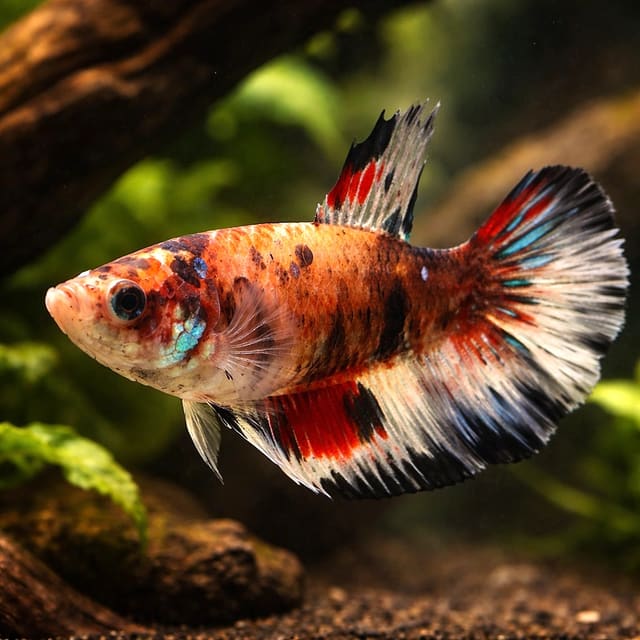
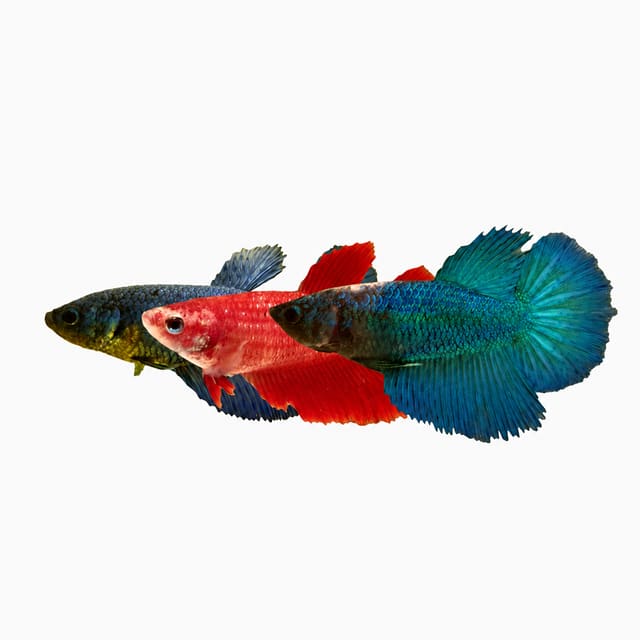
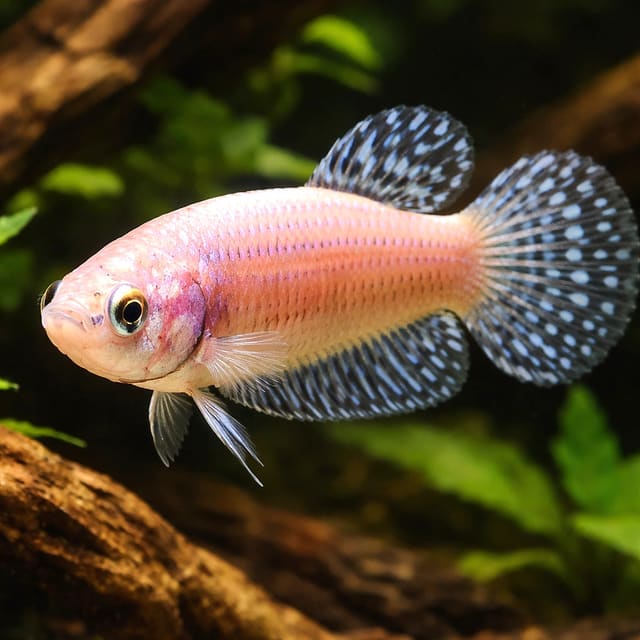
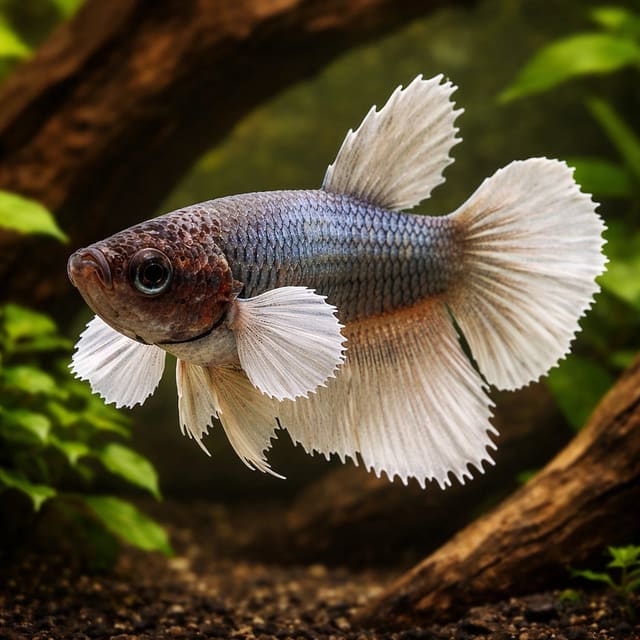
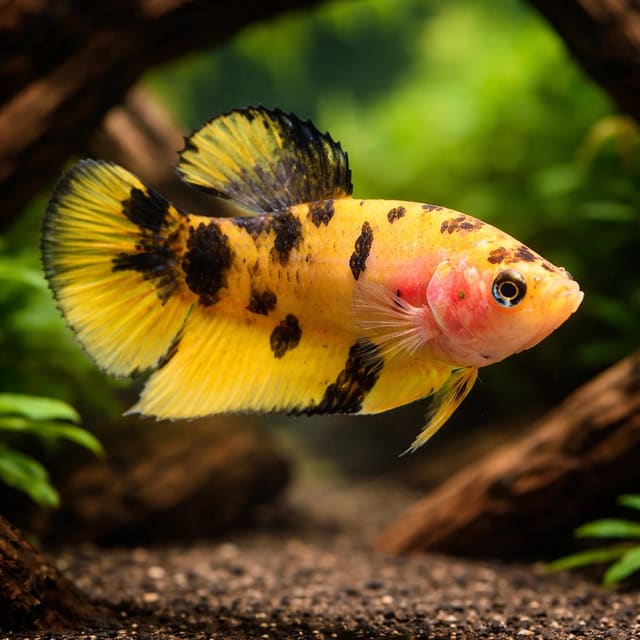
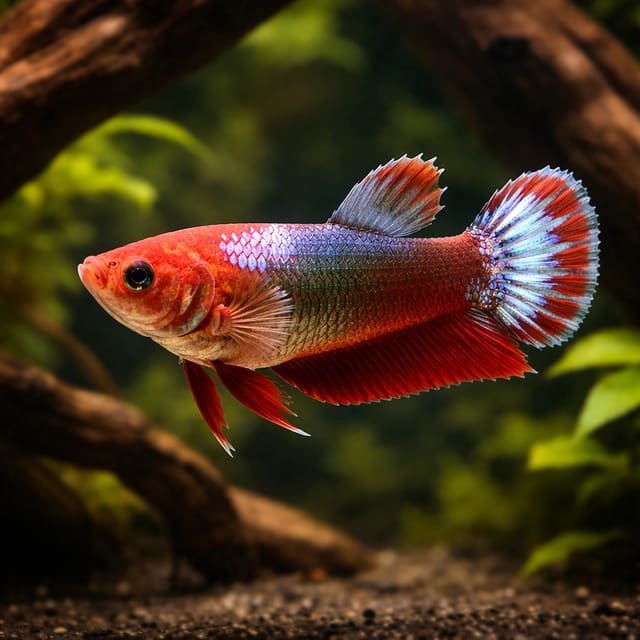
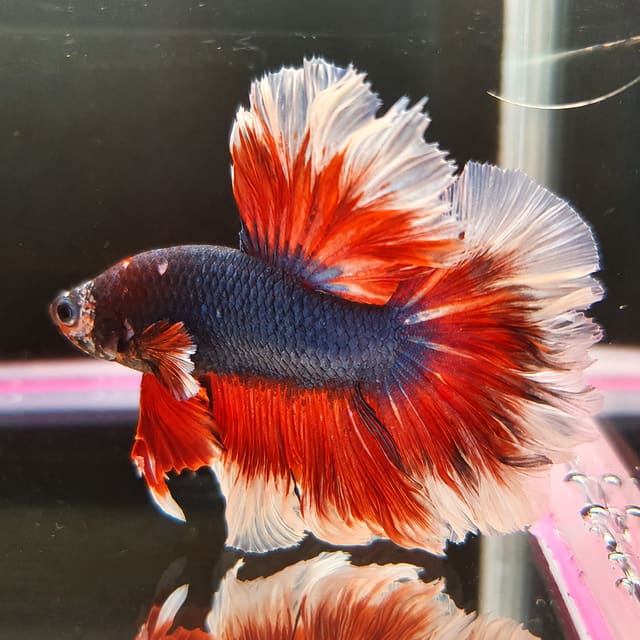
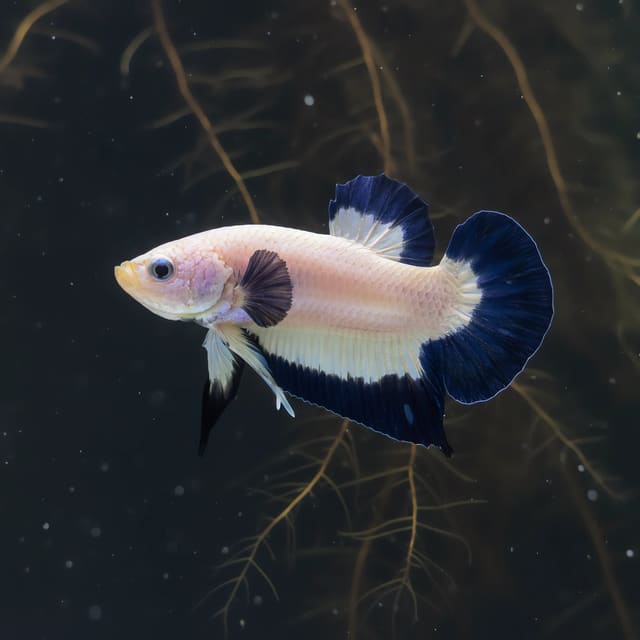
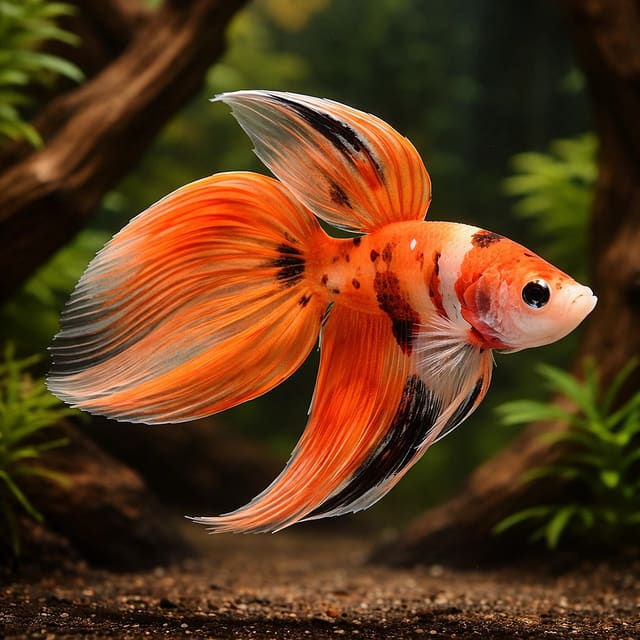
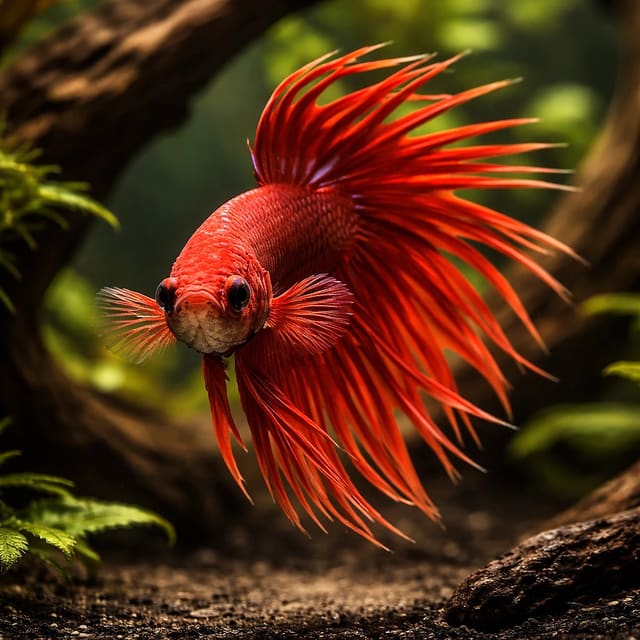
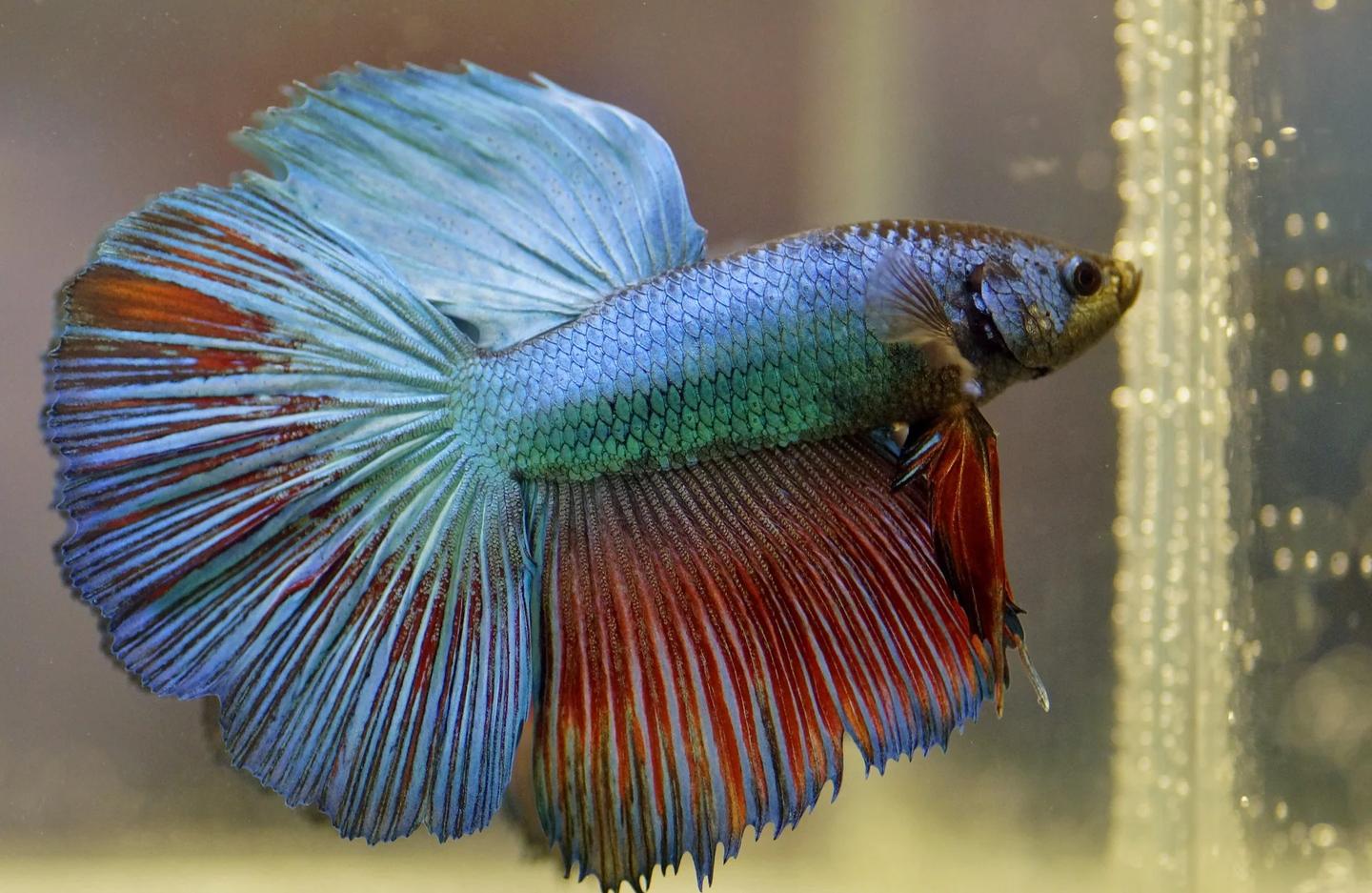
The gallery images are representative of this type of animal rather than photographs of the exact animal supplied, so colours can look slightly different from the live animal. The visible gallery fish has short, fan-shaped fins and mottled orange, pale pink, black and white markings, but the image does not determine age, temperament, pedigree or the appearance of the individual received.
Plan the aquarium around the recorded adult size and the fish’s long-term needs, not its dimensions when it arrives. The adult planning figure is 6.5 cm, and the social plan is one fish by default. The aquarium must therefore be mature, heated, covered and ready before the animal enters it.
For other scientifically identified forms, use the Betta collection and compare each animal’s own care and social requirements rather than treating every member of the genus as interchangeable.
Prepare a furnished aquarium with a base of 45 × 30 cm or equivalent, around 41 litres, for this female. Seriously Fish gives those dimensions and approximate volume for a single male or pair; using that footprint for one female provides a clear species-based planning reference. Tropical Fish Co’s care guide sets at least 20 litres as the starting minimum for one typical domestic Betta; the 45 × 30 cm footprint gives more room.
Hold the water at 26–28°C with a thermostatic heater and confirm it with a separate thermometer. Keep pH at 6.0–8.0 and hardness at 5–12 dGH. Stability matters alongside the numbers: prepare replacement water, avoid abrupt chemistry changes and test the aquarium rather than assuming tap water is suitable unchanged.
Keep one fish unless you have deliberately planned a more demanding female-group aquarium. OATA permits female groups of at least four and recommends at least 60 litres for such a group, while Seriously Fish says only a single individual can be kept per tank in most cases and that the species is best kept alone. For this individually sold female, one fish is the safer default.
Use a 45 × 30 cm base or equivalent, around 41 litres, and furnish it without blocking the surface. A longer, usable footprint gives the fish room to move between open water, cover and resting places. Check the real internal dimensions and filled volume because substrate, wood, rocks and an unfilled air gap reduce the usable water in a nominal aquarium.
Seriously Fish recommends a well-planted, shady aquarium with surface cover, tall stems, floating plants and refuges. Cryptocoryne species, driftwood and plants attached to wood are among its examples. Small smooth shelters can add further cover, but every opening must be large enough for the fish to pass through safely. Reject sharp edges, rough holes and unstable furnishings.
Seriously Fish says dried leaf litter offers additional cover and brings microbe colonies as it decomposes. Use only aquarium-appropriate material and remove any item that causes maintenance or water-quality problems. The aim is usable structure, not a compulsory list of plants or decorations.
A Betta’s labyrinth organ allows atmospheric breathing, so leave unobstructed routes to the surface and a safe air space below a secure lid. The cover also reduces escape risk. Floating plants can provide shade, but thin them if they create a complete mat or prevent the fish from reaching open air.
Observe how the fish uses the aquarium. It should be able to swim into the current, leave it and rest without being swept away. If it repeatedly struggles against the flow, diffuse or reduce the output while keeping the biological filter running. Do not replace filtration with stagnant water merely because the fish can breathe at the surface.
Run and mature the biological filter before adding the fish. The RSPCA explains that beneficial filter bacteria process toxic ammonia into nitrite and then the safer nitrate. Clear-looking water is not proof that this biological process is ready, so use aquarium tests and wait until ammonia and nitrite have risen and returned to zero during a proper fishless cycle.
If this is your first setup, follow the first tropical aquarium preparation guide before livestock enters the tank. The aquarium, heater and filter should run together so you can check temperature, flow, lid fit and equipment reliability as one system.
For an aquarium of about 41 litres, Seriously Fish suggests a filter rated around 80–125 litres per hour because the species prefers gentle movement. The printed rating is only a starting point: media loading, outlet position and furnishings alter the actual current. A sponge filter or a carefully diffused outlet can provide biological filtration without turning the aquarium into fast-flowing water.
Use a thermostatic heater appropriate to the aquarium and installation conditions, then measure the result with a separate thermometer. Follow the equipment maker’s volume, minimum-depth and positioning instructions instead of relying on a universal watts-per-litre rule.
Keep the aquarium at Tropical Fish Co’s practical target of 26–28°C, pH 6.0–8.0 and 5–12 dGH. The temperature target lies within the FishBase, Seriously Fish and OATA ranges; pH 6.0–8.0 and hardness 5–12 dGH are their overlap. OATA’s Betta sheet gives broad group guidance of 20–28°C, pH 6.0–8.0 and 4–12 dGH, while FishBase and Seriously Fish bound the values for Betta splendens.
Use a separate thermometer to confirm the water temperature rather than trusting the heater dial. Check at a consistent point in the aquarium and investigate unexpected movement instead of repeatedly turning the thermostat up and down. Stability within the target is preferable to rapid correction towards a chosen decimal.
Ammonia and nitrite must remain at zero. OATA says nitrate should not exceed 20 mg per litre above the normal tap-water level. Test the aquarium at least weekly and also investigate whenever appetite, breathing, posture or swimming changes.
UK tap water varies. Treat replacement water with a conditioner that handles chlorine or chloramine, then measure its pH and hardness. Our aquarium water-chemistry guide explains what each test means, while the water matcher helps compare measured aquarium values with the stated ranges.
| Reading | Decision |
|---|---|
| 26–28°C | Hold this practical target steadily |
| pH 6.0–8.0 | Avoid abrupt adjustment within the range |
| 5–12 dGH | Measure before trying to alter hardness |
| Ammonia or nitrite above zero | Investigate the filter, waste and recent changes |
Use a suitably sized complete Betta pellet or quality dried aquarium food as the measured nutritional base, with small live or frozen invertebrate foods offered regularly for variety. FishBase records wild Betta splendens feeding on zooplankton, mosquito larvae and other insect larvae. Seriously Fish likewise says it is likely to prey on aquatic and terrestrial invertebrates in nature and recommends Daphnia, Artemia and chironomid larvae such as bloodworm.
Feed once a day and offer only what the fish eats within a few minutes, following OATA’s schedule. Food size must suit the fish, and the portion must reflect the particular product rather than a universal pellet count. Different foods vary in dimensions and energy density.
Take care not to overfeed. Seriously Fish notes that Bettas appear particularly prone to obesity, while OATA explains that uneaten food breaks down and releases toxic waste. Watch body condition over time rather than responding to begging behaviour with extra food.
If more than one person feeds the aquarium, prepare measured portions and keep a simple record. A missed record can become a duplicated feed, and repeated excess affects both body condition and water quality. Do not introduce routine fasting days or eye-size portion formulas as fixed rules; use the food maker’s guidance, the once-daily schedule and the fish’s condition.
OATA strongly recommends a partial water change of 25% at least once every week, and says a siphon is useful for removing solid waste from the gravel.
Test ammonia and nitrite at least once per week and keep both at zero. Record nitrate, pH and temperature so gradual movement is visible before it becomes a larger problem. Test again when equipment fails, feeding changes, livestock is added or the fish shows a change in behaviour or appearance.
Check the filter for blockages. If its media needs cleaning, do not rinse it under the tap. Rinse it lightly in aquarium water removed during the partial change, which reduces the loss of beneficial bacteria.
Use the weekly routine to inspect the lid, heater, thermometer, filter outlet and surface access. Remove dead plant material and uneaten food before decomposition increases the waste burden. OATA says the larger the aquarium, the more stable temperature and water quality will be, but it still needs regular testing and maintenance.
Compare results with the previous week rather than treating each test as an isolated number. A rising nitrate trend, slowing filter flow or repeated debris build-up points to a routine that needs adjustment even when ammonia and nitrite remain at zero.
Have the mature aquarium ready and make sure someone is present to receive the parcel. The fish cannot be left unattended. Follow the current Tropical Fish Co delivery and Live Arrival Guarantee policy for the complete terms.
Contact us the same day if something has gone wrong, using the order number and continuous unboxing video. The video should begin with the parcel sealed and continue through opening to the fish still inside the sealed bag.
Before release, confirm that the aquarium remains at 26–28°C and that ammonia and nitrite are zero. Make sure the filter is running gently, the lid is secure and the surface remains accessible. These checks belong to aquarium preparation and should already have passed before the delivery arrives.
After release, compare swimming, breathing, posture and interest in food with the fish’s developing normal pattern. Do not add another animal as part of the settling-in process. The planned social arrangement remains one fish unless a separate compatibility assessment has already been completed.
Act when appetite, breathing, posture, swimming, colour, fins or body condition changes. OATA’s warning signs include hanging at the surface, sitting on the bottom, erratic swimming, unusual hiding or aggression, faster or slower gill movement, white spots, fluffy growths, loss of fins or scales and reduced interest in food.
The MSD Veterinary Manual emphasises aquarium history, water analysis and appropriate diagnosis. One visible sign can have several causes, so do not combine medicines, raise temperature or select a treatment solely because an online photograph looks similar.
| If you see | Do this first |
|---|---|
| Rapid breathing or surface hanging | Test water and check temperature, flow and surface access |
| Reduced feeding | Check water, food condition and recent changes |
| Fin or scale damage | Inspect decor, filter intake and any social interaction |
| White or fluffy growth | Record the change and seek qualified diagnosis |
Use OATA’s fish-vet directory when signs are severe, persistent or unexplained. Correcting a confirmed water-quality problem may be urgent, but it does not identify a pathogen or replace diagnosis.
Use 6.5 cm as the adult planning figure for this listing; FishBase records that maximum as total length for male or unsexed Betta splendens.
The domestic aquarium species has been extensively line-bred, and ornamental strains vary greatly in colour pattern, fin form and body traits. A genome-wide study of domestic Betta diversity found a complex history behind colour, fin, body-size and behavioural variation. A colour or tail label therefore should not be used to infer wild origin, pedigree, health, fertility or temperament.
Seriously Fish says males are more colourful and develop more-extended fins than females. Short fins and visible markings in the representative image describe that scene only.
Plan for ongoing heated, filtered care, regular maintenance and suitable holiday cover throughout the fish’s life.
Keep this Koi Plakat Female Betta as one fish by default. Seriously Fish describes Betta splendens as best maintained alone, says community tolerance is the exception rather than the expected result and notes that only a single individual can be kept per tank in most cases.
OATA permits females to be kept in groups of at least four and recommends an aquarium of at least 60 litres for a female group. That permission is not a requirement and does not make every set of females compatible. A group changes the space, refuge and observation demands, and buying one female is not a starting point for a group without a complete plan.
Watch for persistent chasing, blocked access to food, repeated hiding, fin damage, altered breathing or one fish being excluded from a preferred area. Separate animals when the interaction creates continuing stress or injury; do not wait for severe damage to prove the combination has failed.
The RSPCA’s guidance on keeping fish together also treats compatibility as a decision requiring research into the species involved. Make the social plan before acquiring a companion, not after two animals are already sharing the aquarium.
Best kept alone is the safest answer for this female. Seriously Fish says some individuals may tolerate other species, but this is an exception, and it does not recommend Betta splendens for the standard community aquarium. Individual temperament means no named companion is universally safe.
Seriously Fish says some small cyprinids and loaches from similar environments are suitable after proper research, but OATA says females mixed into a community aquarium must be kept in a group, so a single female is best kept alone. Check the exact companion species for adult size, temperature, pH, hardness, activity, feeding behaviour and the part of the aquarium it uses.
| Screen | Decision |
|---|---|
| Water values | Reject a companion that cannot live steadily at 26–28°C, pH 6.0–8.0 and 5–12 dGH |
| Behaviour | Reject boisterous, aggressive or persistently chasing fish |
| Finnage and shape | Avoid Betta-like shapes and trailing fins |
| Feeding | Reject a plan in which the Betta is repeatedly outcompeted |
| Space | Plan for every animal’s adult needs, not just the Betta |
| Fallback | Have a mature, heated and filtered separation space ready |
Shrimp, snails and fry are not safe by default. The Betta may investigate or hunt small animals, while larger or defensive invertebrates can introduce injury risks. Do not add an invertebrate as a cleaning tool or assume dense planting turns predation risk into compatibility.
Monitor an attempted community for access to food, resting places and the surface. Persistent hiding, repeated chasing, torn fins, altered breathing or weight loss means the arrangement needs prompt reassessment. The absence of immediate fighting on the first day is not a long-term compatibility result.
Plan for an adult length of 6.5 cm, the maximum total length FishBase records for male or unsexed Betta splendens.
Use a furnished aquarium with a 45 × 30 cm base or equivalent, around 41 litres. Seriously Fish gives that footprint and approximate volume for a single male or pair, and it provides a clear planning reference for one female.
Keep one Koi Plakat Female Betta by default. OATA permits female groups of at least four in at least 60 litres, but Seriously Fish says only a single individual can be kept per tank in most cases and that the species is best kept alone.
This fish can suit a careful beginner after a proper aquarium has matured. A thermostatic heater, separate thermometer, mature filter, secure lid, plants or refuges, water tests and a weekly maintenance routine must be ready first.
Feed a Koi Plakat Female Betta a measured, suitably sized complete Betta pellet or quality dried food once daily, with small live or frozen Daphnia, Artemia or bloodworm offered regularly for variety.
Keep it at Tropical Fish Co’s 26–28°C target, with pH 6.0–8.0 and 5–12 dGH. The target lies within the FishBase, Seriously Fish and OATA ranges, while the pH and hardness values are their overlap.
Betta splendens is territorial and is best kept alone; individual behaviour varies, so peaceful community behaviour cannot be assumed. Separate fish if persistent chasing, stress or fin damage develops.
Keep a single Koi Plakat Female Betta alone. OATA says females mixed into a community aquarium must be kept in a group and without boisterous or aggressive fish; Seriously Fish says some small cyprinids and loaches are suitable after proper research, but no companion is universally safe. Avoid male Bettas and species with Betta-like body shapes or trailing finnage, and keep a separation aquarium ready.
Tropical Fish Co hand-packs the fish in pure oxygen inside an insulated poly box, adding a heat pack when the weather calls for it. Someone must receive the parcel; film continuously from the sealed box through opening to the fish in its sealed bag, then float the bag for 20–30 minutes before release.
No reviews for this item yet. Bought one? Honest reviews only, good or bad.
What customers say about ordering from us
Easy website plenty of info on fish your buying great to pick a time slot
TRACEY DURRANT · 7 Oct 2026
Got some lovely fish thank you
Kevin Mackie · 7 Oct 2026
Reviews of our shop, collected by Judge.me, an independent third-party review collector. Newest first.