−13%
Moderate
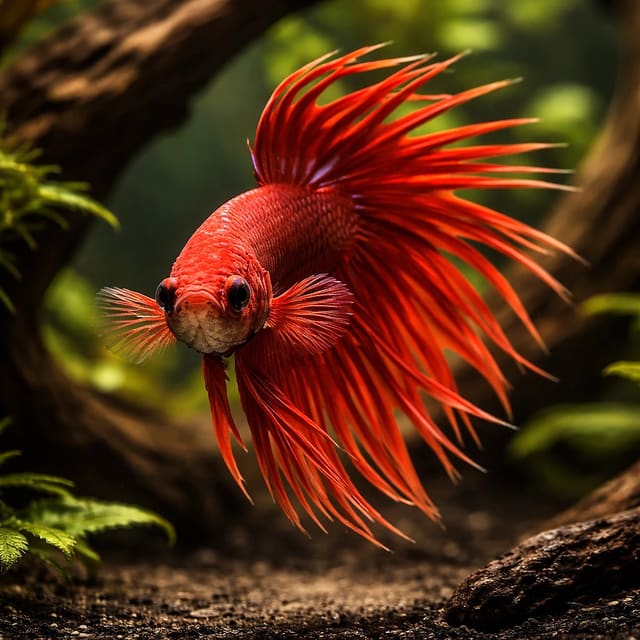
Crowntail Male Betta (Betta splendens)
26–28°C · pH 6–8 · 20L
£12.17£13.99

SuperDelta Big Ears Female Betta Mix (Betta splendens) is one female Siamese fighting fish with enlarged big-ear pectoral fins and a broad SuperDelta tail, sold from a colour mix. She reaches about 7 cm and needs a cycled, heated and planted aquarium of at least 20 litres, kept at 24–28 °C.
Adult size is the maximum length this species reaches at full maturity (scientific sources). The livestock you receive will be younger and smaller. Product-photo provenance and any image-specific limitations are stated on the listing.
Betta splendens
SuperDelta Big Ears Female Betta Mix (Betta splendens) is one female Siamese fighting fish with enlarged big-ear pectoral fins and a broad SuperDelta tail, sold from a colour mix. She reaches about 7 cm and needs a cycled, heated and planted aquarium of at least 20 litres, kept at 24–28 °C.
Adult size is the maximum length this species reaches at full maturity (scientific sources). The livestock you receive will be younger and smaller. Product-photo provenance and any image-specific limitations are stated on the listing.
For one typical domestic Betta splendens, start with at least 20 litres, a mature filter, thermostatic heater, separate thermometer, gentle flow, a secure lid with surface access, and plants or refuges. Keep one male per aquarium.
Maintain these water conditions for optimal health and vibrant colors
This is one female Siamese fighting fish, Betta splendens, from a domestic line bred for two fin traits at once: the enlarged, fan-like pectoral fins that breeders call big ears and a broad, wide-spreading SuperDelta tail. She comes from a colour mix, so her exact shade and pattern are not picked in advance. The first thing to settle is where she will live. Ornamental bettas are territorial, and many do best as the only betta in a heated, filtered and planted aquarium that is ready before she arrives.
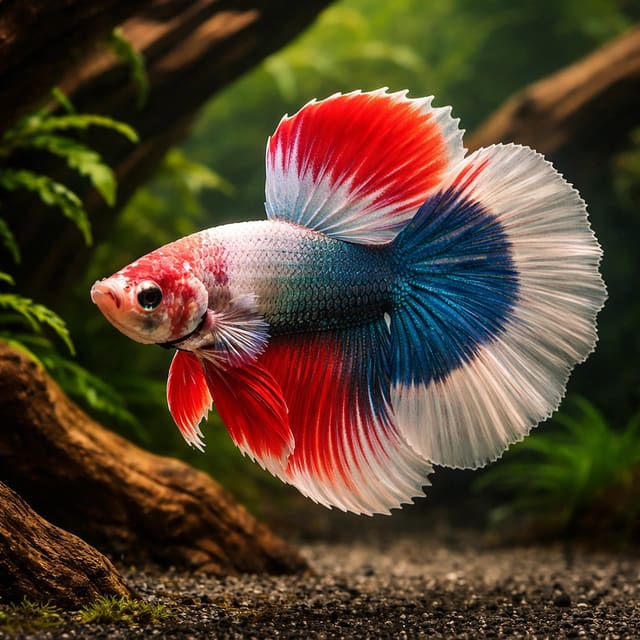
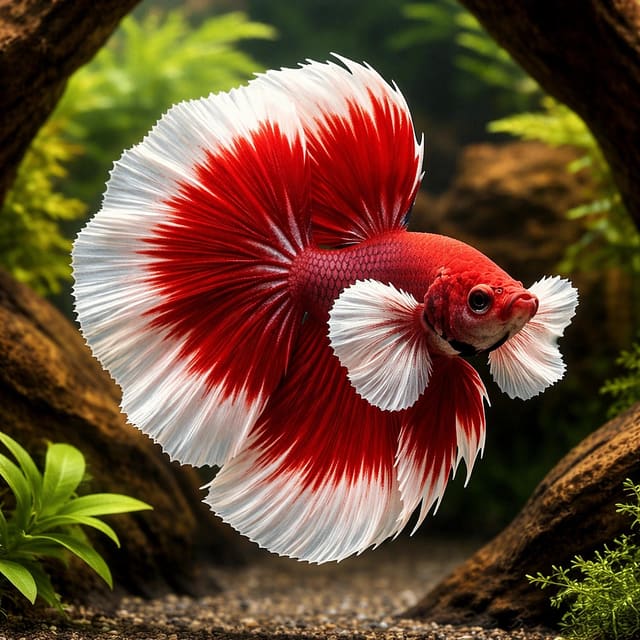
Big ears, sometimes sold as dumbo, describes the oversized pectoral fins just behind the gill covers. A big-ear betta shows them off as she hovers, turns and investigates the planting, which is a large part of the appeal. SuperDelta is a breeders' name for a tail with a wide spread that stops short of the full half-circle expected of a halfmoon. Both names are trade descriptions of fin form rather than scientific categories, and a female's fins normally stay shorter than those of a male from a similar line, because male bettas develop more extended fins.
| Suits | Think again if |
|---|---|
| A keeper who wants one showy betta in her own planted tank of 20 litres or more | You hoped to drop her into a busy community of fast or nippy fish |
| A careful beginner whose aquarium is already cycled, heated and tested | The tank is new, unheated or still showing ammonia or nitrite |
| Someone planning a group of at least four females in 60 litres or more, with a spare tank | You intend to house her with a male betta outside a planned spawning |
| Anyone happy to welcome whichever colour arrives from the mix | You need one exact colour or pattern |
One purchase supplies one live female betta. The 7 cm figure is the length the species reaches when grown, so she may arrive smaller and still be filling out. Sex is guaranteed only when the exact product or selected option explicitly states male or female. This SuperDelta Big Ears Female Betta Mix listing is sold as female. You do not need to work out her sex from her colour or fins; it is part of the offer itself.
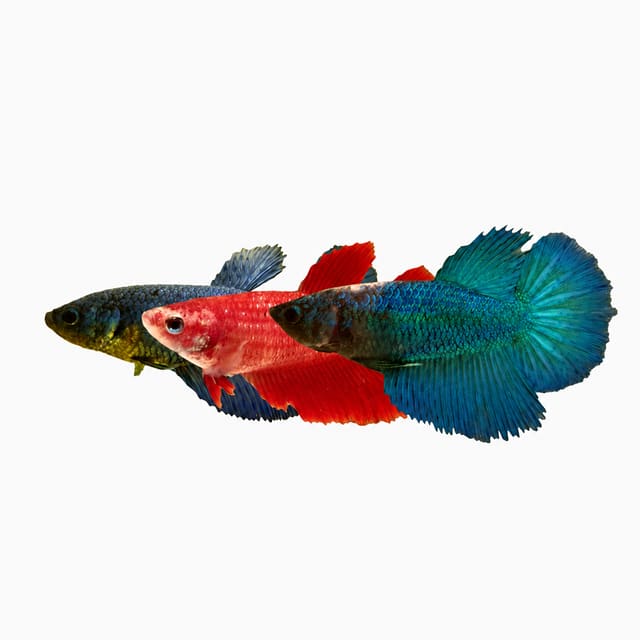
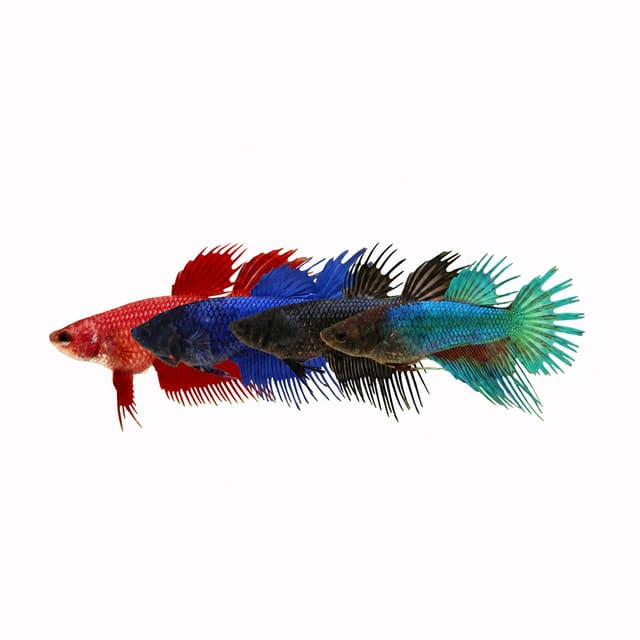
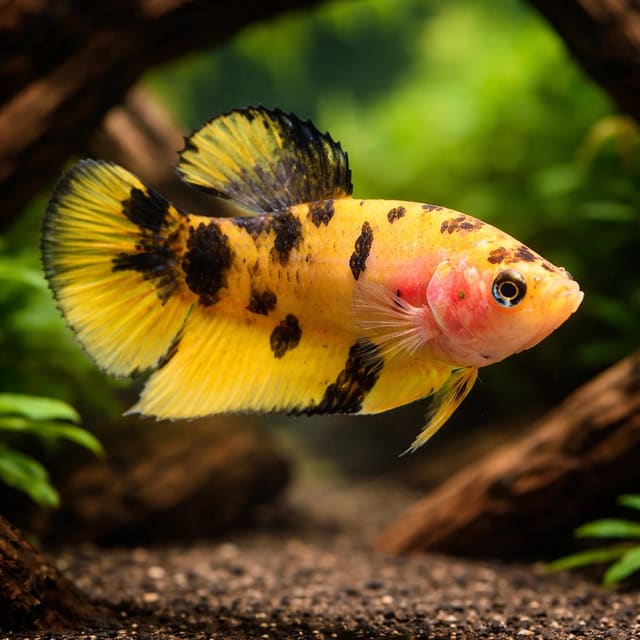
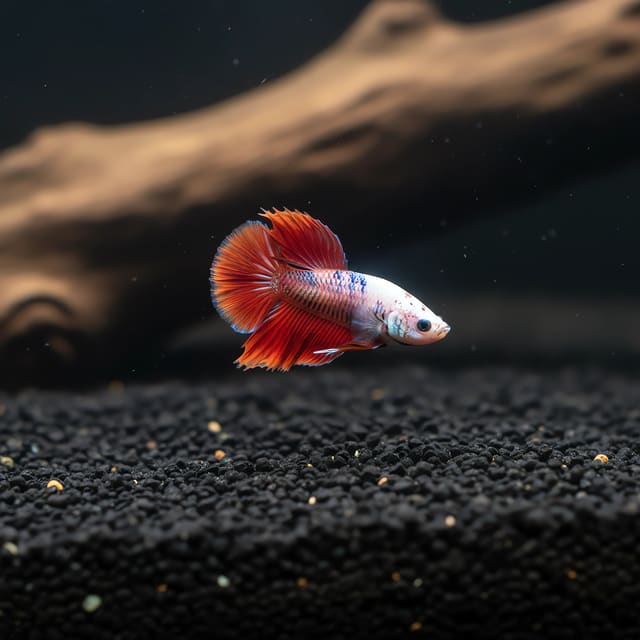
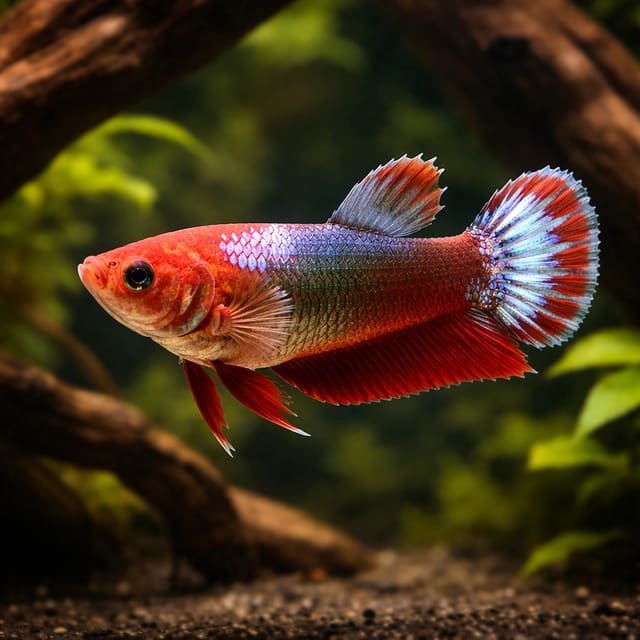
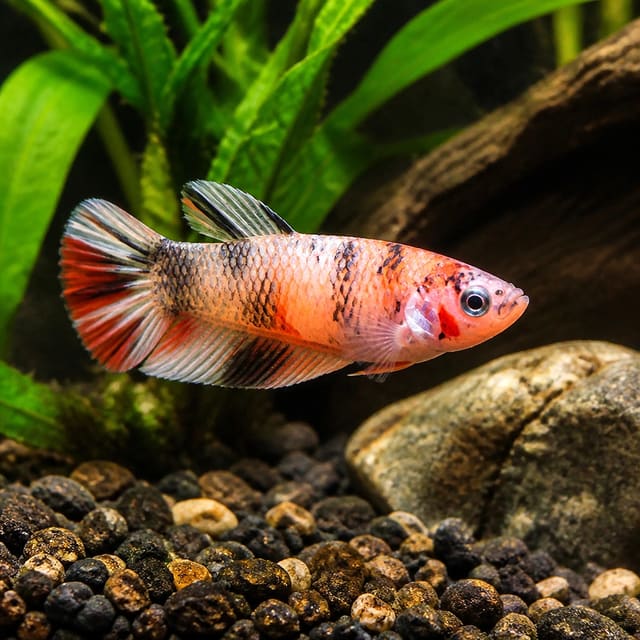
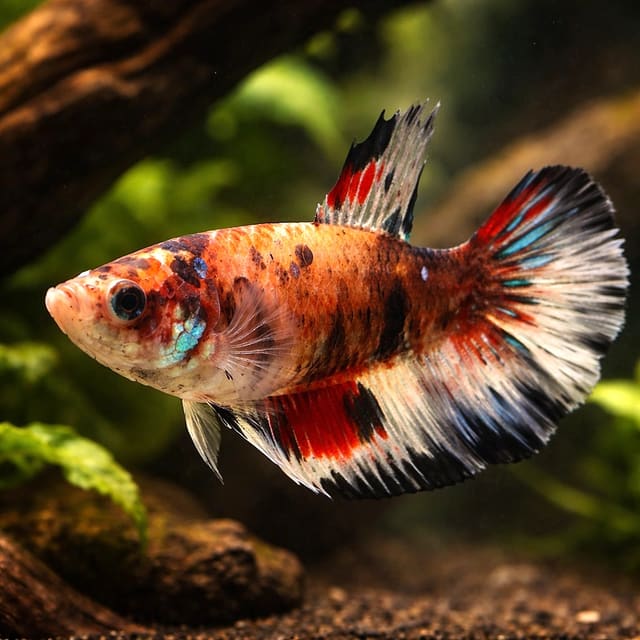
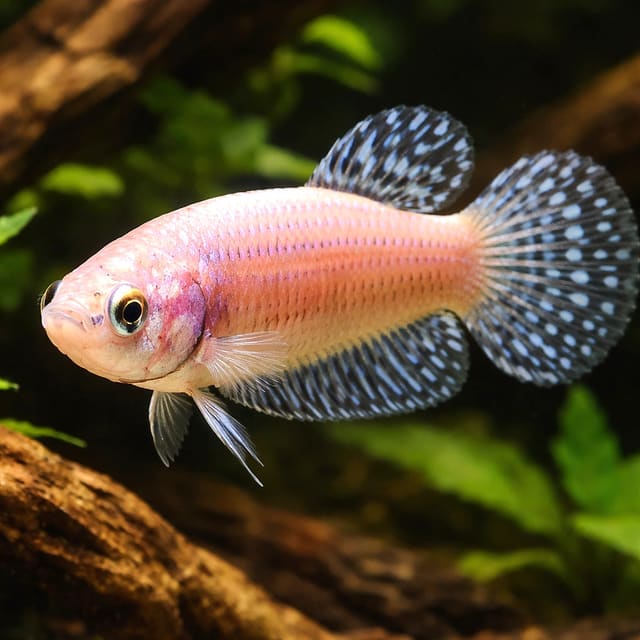
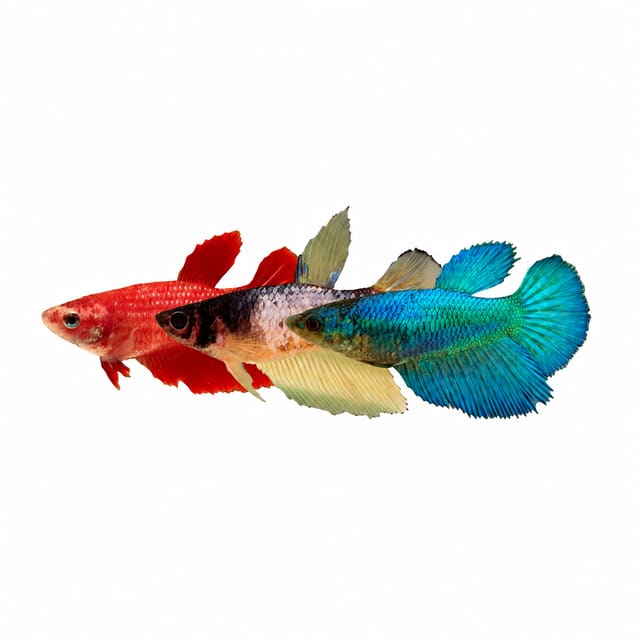
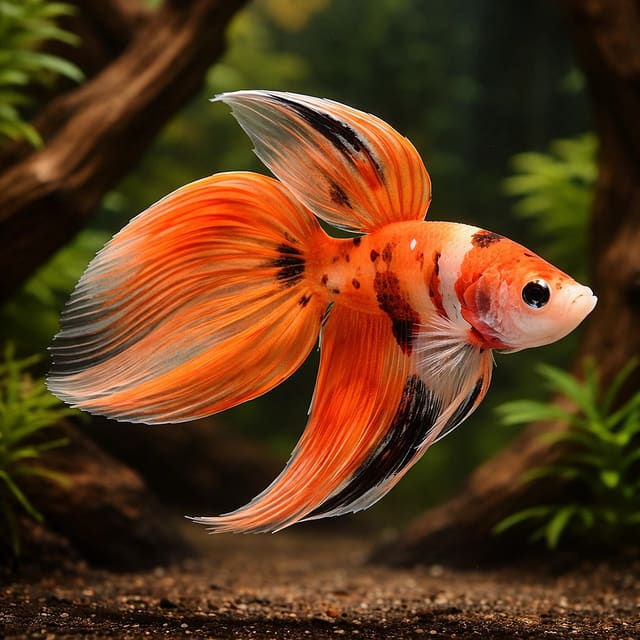
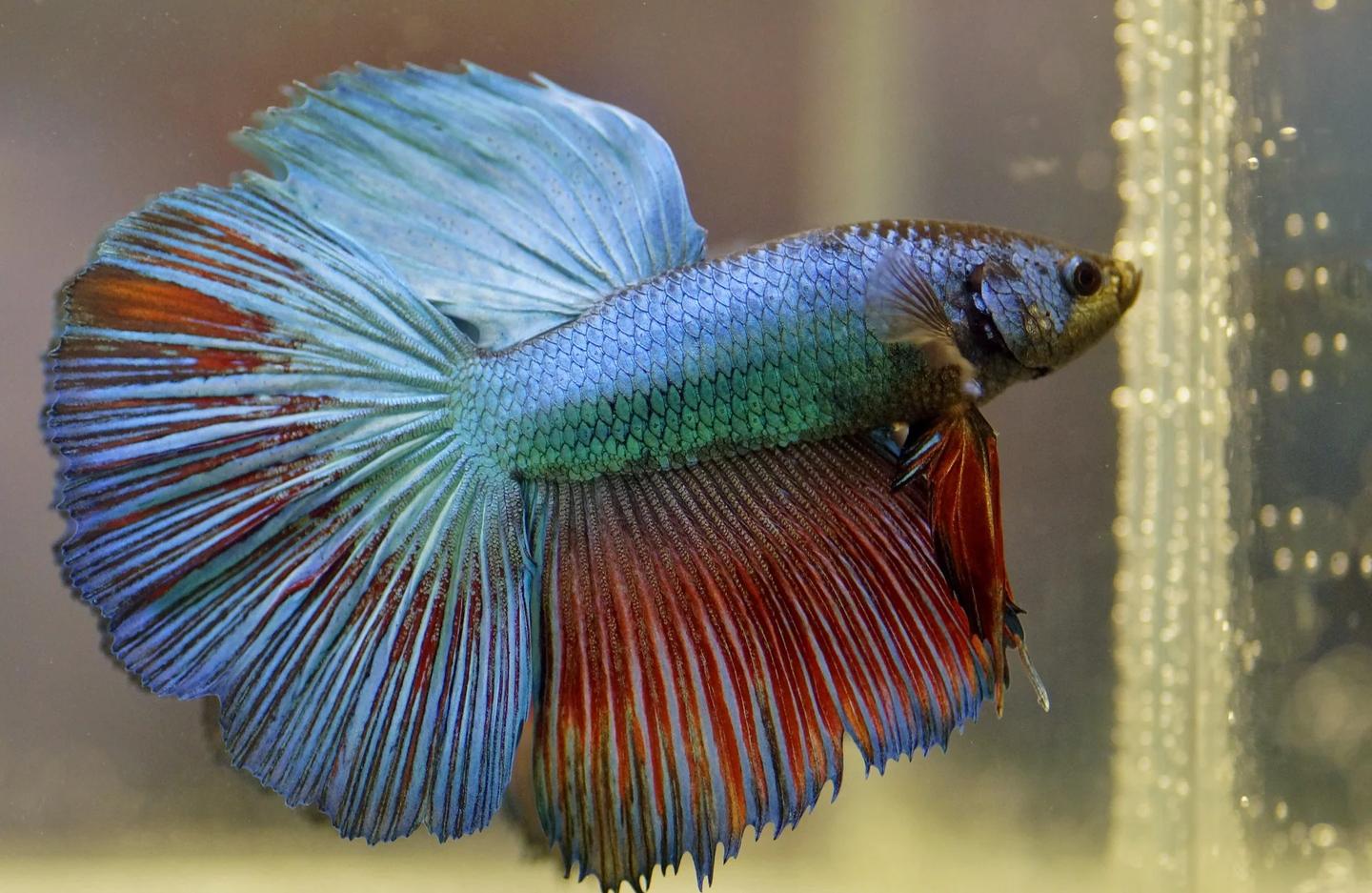
The photographs show the SuperDelta big ears form with a blue-grey body, a rust-toned head and pale, fan-shaped fins. Gallery images have been digitally enhanced to improve image quality. Natural colour, pattern, size and maturity can vary between live animals. Because she is chosen from a mixed colour batch, the fish you receive may carry a different body colour or fin shade from the one pictured, while the fin type stays the reason to choose this line.
Wild Betta splendens come from the Mekong basin, where FishBase records them in standing floodplain water, canals, rice paddies and larger rivers. Aquarium bettas are the product of long domestic breeding, and genome research on domestic bettas has mapped the variation behind their colours, fins and body size. If you would like to compare her with other domestic and wild bettas before deciding, browse our betta collection.
The wild form is rarely seen in the hobby. Ornamental lines have been bred for vigour and appearance over many generations, and some have been crossed with related Betta species. The IUCN lists wild Betta splendens as Vulnerable; that assessment describes wild populations rather than domestic fish such as this one.
Get the aquarium right first and almost everything else about keeping her becomes easier. A female betta is small, but she needs stable heat, clean water and furnishings that suit her long, delicate fins.
The UK trade body OATA recommends an aquarium of at least 20 litres for a single male betta and at least 60 litres for a group of females. Tropical Fish Co uses the same 20 litres as a minimum starting screen for one domestic betta. Seriously Fish suggests a base of 45 × 30 cm, about 41 litres, for a single male or a pair, and does not support keeping this species in tiny aquaria or small jars. FishBase adds that holding males in very small containers should be discouraged.
For one female, treat 20 litres as the floor and something nearer 41 litres as the comfortable choice. Larger volumes hold temperature and water quality more steadily, and decor takes up real space, so check the actual filled volume and internal dimensions rather than the name on the box. Two 2024 behaviour studies on male bettas point the same way: tiny bowls restricted normal swimming, and a furnished 19.3-litre tank produced better behaviour than smaller or bare set-ups.
That last point matters. Bettas carry a labyrinth organ that lets them gulp atmospheric air at the surface, but OATA is clear that this does not mean they need less care or less filtration than other fish. Keep the surface reachable, with no decor or dense floating mat sealing it off.
Clear water is not the same as a mature aquarium. Fishless cycling builds the filter bacteria first, and fish should only go in after ammonia and nitrite have risen and fallen back to zero. OATA warns that stocking too quickly can cause new tank syndrome, when there are not enough nitrifying bacteria to handle the extra waste. If this is your first heated aquarium, work through our guide to setting up a first tropical tank and give the filter time to mature before you order.
Stable water matters more than chasing a perfect number. These are the values to hold her in:
| Measure | Aim for |
|---|---|
| Temperature | 24–28 °C, with 26–28 °C as the everyday target |
| pH | 6.0–8.0, held steady |
| General hardness | 5–12 dGH |
| Carbonate hardness | 3–10 dKH, soft to medium |
| Ammonia | 0 mg per litre |
| Nitrite | 0 mg per litre |
| Nitrate | no more than 20 mg per litre above your tap water |
FishBase records the wild species at 24–30 °C, pH 6.0–8.0 and 5–19 dH, which describes where the fish lives in nature rather than an aquarium target. Seriously Fish gives 22–30 °C, pH 6.0–8.0 and 1–15 dGH, noting that wild-collected fish probably prefer pH 5.0–7.0 while ornamental strains are unfussy across 6.0–8.0. OATA's betta care sheet suggests 20–28 °C, pH 6.0–8.0 and 4–12 dGH for tank-reared fish. The everyday range in the table is where those sources agree, and Tropical Fish Co uses 26–28 °C as a practical target for a typical domestic betta.
Her line is domestic, so there is no reason to acidify or soften water that already sits steadily inside the range. Sudden swings are the real risk. Adjust slowly if you must adjust at all, and never change pH or hardness simply to land in the middle of a published range.
UK rooms cool sharply overnight and in winter, which is why the heater stays on all year. Size and fit it using the manufacturer's guidance for aquarium volume, installation, minimum water depth and room temperature, rather than a universal watts-per-litre rule, then confirm the result with the separate thermometer over a day or two before she arrives. If the reading drifts outside 24–28 °C, find the cause before changing the setting.
UK tap water varies from region to region, and chlorine or chloramine must be neutralised with an aquarium conditioner before it reaches her tank. Test ammonia and nitrite at least once a week, and more often while the aquarium is young. Our aquarium water parameters guide explains what each test tells you, and the water parameter matcher lets you compare your own readings with the ranges above.
Bettas are at their best in a well-planted, shady aquarium with plenty of cover near the surface. Seriously Fish suggests tall stem plants, floating plants such as Salvinia or Riccia, tropical lilies from the genus Nymphaea and Cryptocoryne. Driftwood works well, with Microsorum ferns or Taxiphyllum moss attached to it.
Small clay plant pots or short lengths of smooth plastic pipe give her somewhere to retreat. A layer of dried leaf litter adds cover and encourages microbe colonies as it breaks down, and the tannins it releases are considered beneficial.
Her enlarged pectorals and wide tail are easy to tear on sharp or rough decor. Choose smooth wood, rounded stone and soft-leaved plants, and avoid ornaments with narrow openings that could trap a body. Very long fins can also change how an individual copes with current and clutter, so watch her swim: if she is pushed around or cannot rest, reduce or spread out the outflow without switching off the filter. A 2024 study found that in the same 19.3-litre volume, a bare tank produced more hovering, repetitive swimming and wall interaction than a furnished one, so meaningful structure is part of her welfare, not decoration.
Leave some open water at the front for her to swim and display, and keep at least part of the surface clear of floating plants so she can always reach the air.
In nature FishBase describes Betta splendens feeding on zooplankton, mosquito larvae and other insect larvae, and Seriously Fish expects wild fish to take small aquatic and land invertebrates. In the aquarium, OATA calls bettas omnivorous and happy to take most food types.
OATA advises feeding bettas only what they can eat within a few minutes, once a day. Seriously Fish warns that bettas seem particularly prone to obesity, so a slim, active fish is the goal. Skip rules based on the size of her eye or a fixed pellet count: pellet sizes and energy content vary between brands, and age, condition and temperature all change how much she needs. Follow the food maker's guidance, watch her body shape, and remove anything uneaten before it breaks down and fouls the water.
If several people feed the tank, pre-measure portions. Before a holiday, arrange a competent carer with measured feeds and written notes, and test any automatic feeder well before you leave rather than trusting it for the first time while you are away.
There is no need for a fixed weekly fasting day. Judge her portions by body shape and appetite instead: a gently rounded belly after feeding is fine, while a fish that grows steadily broader needs smaller meals.
A betta tank stays healthy through a short routine done every week rather than a big clean now and then. OATA notes that bettas can be stressed by even the smallest amounts of ammonia and nitrite, which is why testing and water changes matter so much.
Any detectable ammonia or nitrite needs investigating the same day. Check that the filter is running and has not been over-cleaned, think back over feeding and any recent additions, remove uneaten food, and make a partial water change with conditioned water, avoiding any sudden change in temperature. Keep testing until both readings are back at zero. Nitrate that keeps climbing towards 20 mg per litre above your tap water is a sign that water changes need to keep better pace.
Keep a simple log of test results, water changes and anything unusual. Patterns in the log make problems far easier to spot early.
Your betta is hand-bagged in pure oxygen and packed in an insulated poly box, with a heat pack when the weather calls for it, then carried by a tracked, licensed live-animal courier. You will receive a tracking number and your confirmed delivery date by email. Someone needs to be at the address to receive the parcel, because live fish cannot be left unattended.
The Live Arrival Guarantee needs that continuous video for any claim, so film every parcel from sealed. The full terms are on our delivery and Live Arrival Guarantee page.
Give her time to explore. Healthy fish have clear, bright eyes, undamaged fins, intact scales, no ulcers or bumps and normal swimming. Offer a small amount of food once she is moving around, and remove anything she ignores. Test ammonia and nitrite more often for the first few weeks, because the filter bacteria need time to catch up whenever a new fish adds waste. If you plan a female group, OATA's advice to build up numbers slowly applies here too.
Every fish varies a little in behaviour and appearance, so learn what is normal for her. OATA lists the changes worth watching:
Remember that she visits the surface to breathe air as a matter of course; it is a change from her usual pattern that deserves attention.
Signs are not diagnoses. A torn fin, a white mark or a swollen belly can each have more than one cause, and the MSD Veterinary Manual stresses aquarium history, water analysis and proper diagnostic work over picking a medicine from one symptom. Work through it in order: confirm the temperature and test ammonia, nitrite, nitrate and pH; review recent additions, feeding and equipment changes; and compare her breathing, posture, appetite and fins with her normal pattern. Avoid mixing medicines or raising the temperature on the strength of an internet guess. If signs are severe, persistent or unexplained, speak to an experienced aquatic retailer or use OATA's find a fish vet directory.
The Animal Welfare Act 2006 expects every keeper to provide a suitable environment, a suitable diet, the chance to behave normally, appropriate company or separation, and protection from pain, injury, suffering and disease. For a betta, that turns into a practical checklist. Order when every line is true:
If any line is not true yet, finish that step first. A betta that arrives to a ready, stable aquarium settles far more easily than one added to a tank still finding its balance.
Betta splendens is a bubble-nest builder. Breeding is a separate, planned project, and buying a female does not commit you to it. The outline below explains the behaviour you may read about.
FishBase advises keeping the sexes separate except for mating, with only one female brought into a breeding tank of about 20–30 litres. Seriously Fish stresses giving the female plenty of cover. Outside a planned spawning with space for both fish afterwards, keep her away from males.
Deciding how she will live is the biggest choice you make with this fish. Female bettas are calmer than males, which widens the options, but ornamental strains are still some of the most combative bettas in the hobby.
This is the safest default. Seriously Fish advises that the species is best kept alone and not in a standard community, noting that ornamental strains seem more aggressive than any other Betta species and that in most cases only a single individual can be kept per tank. A single female in a well-planted aquarium of 20 litres or more has room to explore, rest among the plants and display those big pectorals without competition.
OATA describes females as much calmer than males and able to live in groups of at least four, in an aquarium of at least 60 litres. Because one purchase is one fish, that means buying at least four and setting up the larger tank first. Plant it densely, add plenty of cover, and keep a spare, cycled aquarium ready. Individual temperament varies, and a group that looks settled can change, so watch for one fish being chased, cornered or kept from food.
OATA notes that it is easier to mix females into community aquariums than males, but they must be kept in a group and without boisterous or aggressive fish. Seriously Fish accepts that some small cyprinids and loaches from similar natural habitats can work, with proper research before purchase. Screen every candidate for adult size, water overlap, activity, fin-nipping and feeding competition, and remember that the whole community needs space, not just the betta. Male bettas, with their long fins, are often the target of intense fin nipping, and her enlarged pectorals and spreading tail offer fin-nippers the same kind of target. The RSPCA likewise treats compatibility as something to research species by species.
Our Betta fish care guide sets out the screening questions for any tank mate in more depth.
Use these lists as a starting point, then judge the actual fish in front of you.
Torn or ragged fins, a fish hiding far more than usual, repeated chasing or a change in aggression all mean the arrangement needs rethinking. Separate fish early rather than waiting for injuries to worsen, and add any new fish gradually, testing ammonia and nitrite as you go so the filter can keep pace.
Expect an adult length of about 7 cm. Seriously Fish records 70 mm for the species and OATA gives about 7 cm, so plan her aquarium around that grown size even if she arrives a little smaller.
Start from at least 20 litres of heated, filtered and planted water for one fish, and choose more space where you can: Seriously Fish suggests a 45 × 30 cm base, roughly 41 litres. A group of females needs at least 60 litres.
Many ornamental bettas live best alone. If you want a group, OATA advises at least four females in an aquarium of 60 litres or more, with dense planting, plenty of cover and a spare tank ready in case one fish is singled out.
She can suit a careful beginner whose aquarium is already cycled, heated and tested before she arrives. We rate her care as intermediate because the heater, mature filter, lid, gentle flow and weekly maintenance all need to be in place from day one.
Use a quality betta pellet or flake as the base, with small frozen or live foods such as daphnia, brine shrimp or bloodworm for variety. Feed only what she eats within a few minutes, once a day, and remove leftovers, as bettas put on weight easily.
Keep her water at 24–28 °C, pH 6.0–8.0 and 5–12 dGH, where the FishBase and Seriously Fish ranges overlap with OATA's betta care sheet, and use 26–28 °C as a practical everyday target. Run a thermostatic heater all year and check it with a separate thermometer.
Female Betta splendens are calmer than males but still territorial, and ornamental strains can be hard on other bettas. Her enlarged fins can also attract fin-nipping fish, so choose calm companions or keep her on her own.
No tank mate is guaranteed safe. Seriously Fish lists some small cyprinids and loaches from similar calm, soft waters as possible after careful research, and OATA says females mix more easily when kept as a group away from boisterous or aggressive fish. Avoid male bettas and fin-nipping or long-finned species.
She is hand-bagged in pure oxygen and packed in an insulated poly box, with a heat pack when the weather calls for it, then carried by a licensed live-animal courier. Film a continuous unboxing video from the sealed parcel, float the sealed bag for 20–30 minutes before releasing her, and send that video with your order number the same day if anything has gone wrong.
The care advice on this page draws on these public sources:
No reviews for this item yet. Bought one? Honest reviews only, good or bad.
What customers say about ordering from us
I have a small group of long finned mountain minnows. So was delighted to be able to order ten of this variety to increase the genetics in my tank . The ones I recieved are healthy but it’s to early to give a verdict on wether they are of a long finned type since they are small currently.
Gordon Walker · 23 Sept 2026
100% success travel and "installation". Pleased with quality of purchase. The Siamese fighter a bit "shy" so have not yet seen him at his best yet but looking good. Happy customer. GG
George E Garratt · 21 Sept 2026
Reviews of our shop, collected by Judge.me, an independent third-party review collector. Newest first.