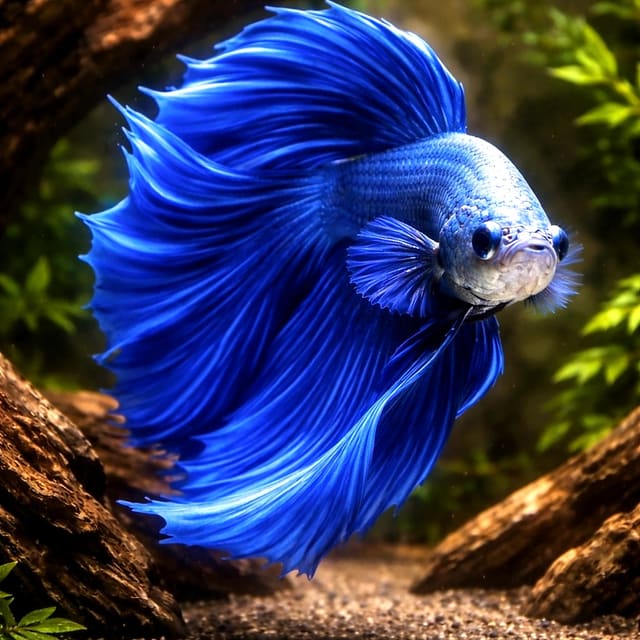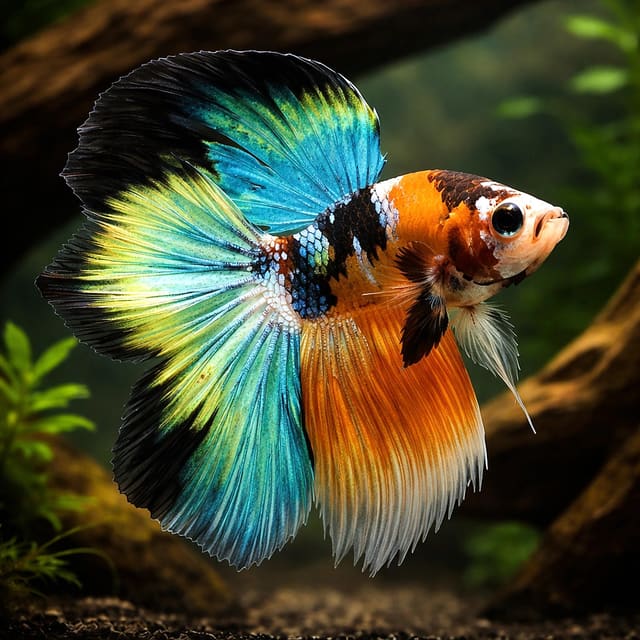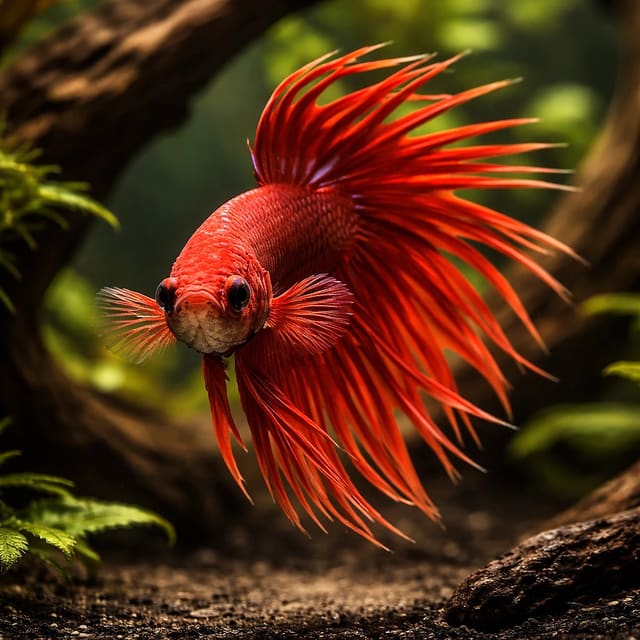
−13%
Moderate
Crowntail Male Betta (Betta splendens)
26–28°C · pH 6–8 · 20L
£12.17£13.99

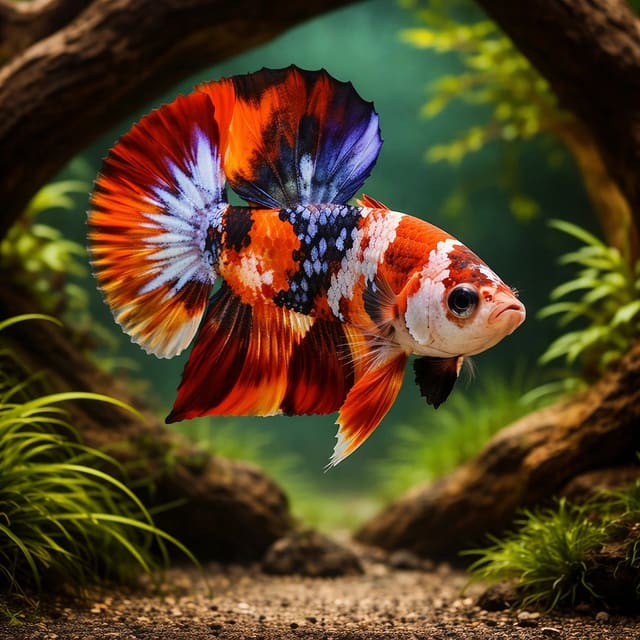
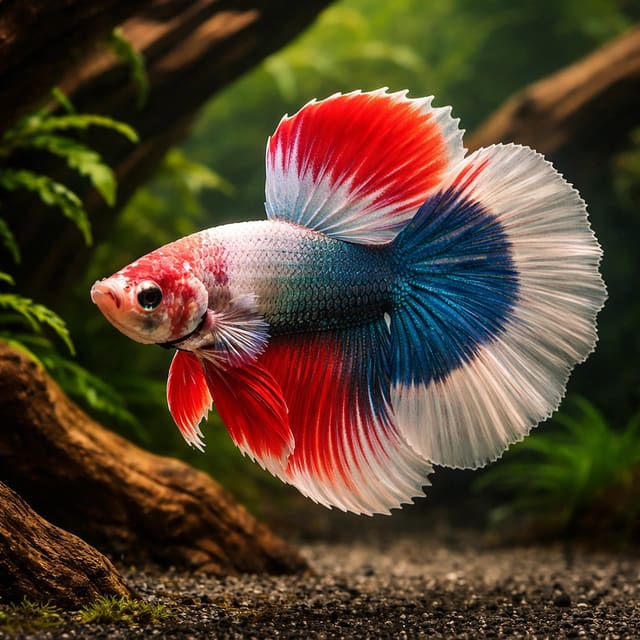
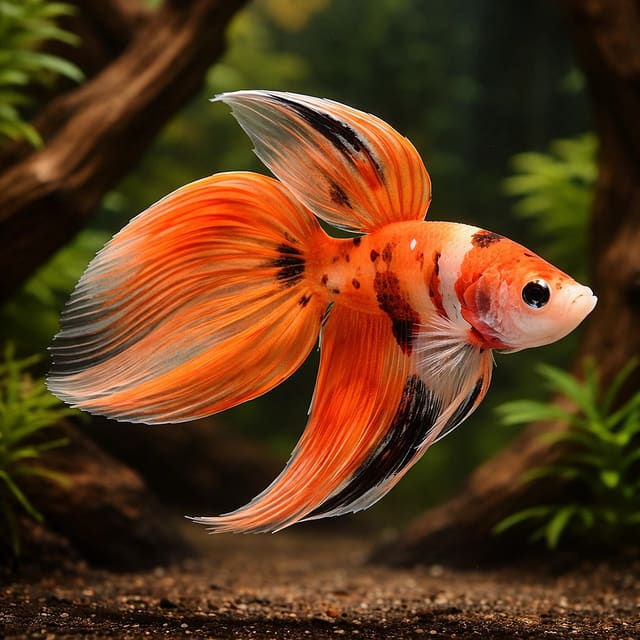
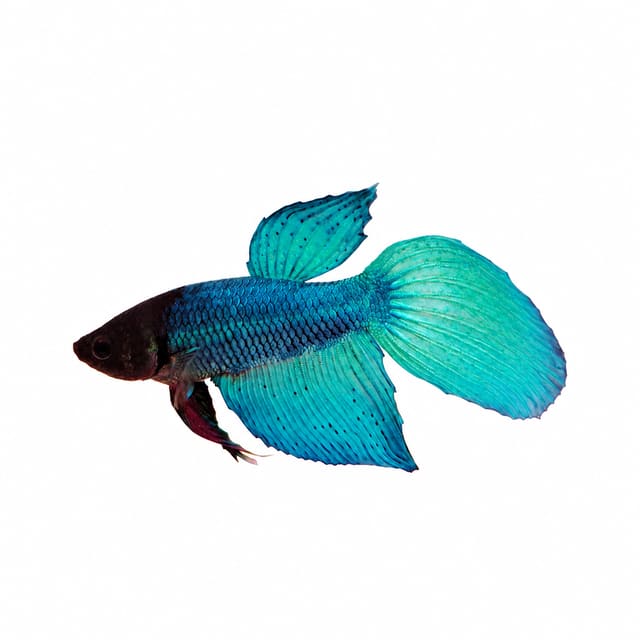
Super Delta Big Ear Male Betta Mix (Betta splendens) is one male domestic Betta with a broad fan-shaped tail and enlarged pectoral fins, from a mixed colour selection. He needs his own heated, filtered and covered aquarium of at least 20 litres, with gentle flow and open access to the surface.
Adult size is the maximum length this species reaches at full maturity (scientific sources). The livestock you receive will be younger and smaller. Product-photo provenance and any image-specific limitations are stated on the listing.
Betta splendens
Super Delta Big Ear Male Betta Mix (Betta splendens) is one male domestic Betta with a broad fan-shaped tail and enlarged pectoral fins, from a mixed colour selection. He needs his own heated, filtered and covered aquarium of at least 20 litres, with gentle flow and open access to the surface.
Adult size is the maximum length this species reaches at full maturity (scientific sources). The livestock you receive will be younger and smaller. Product-photo provenance and any image-specific limitations are stated on the listing.
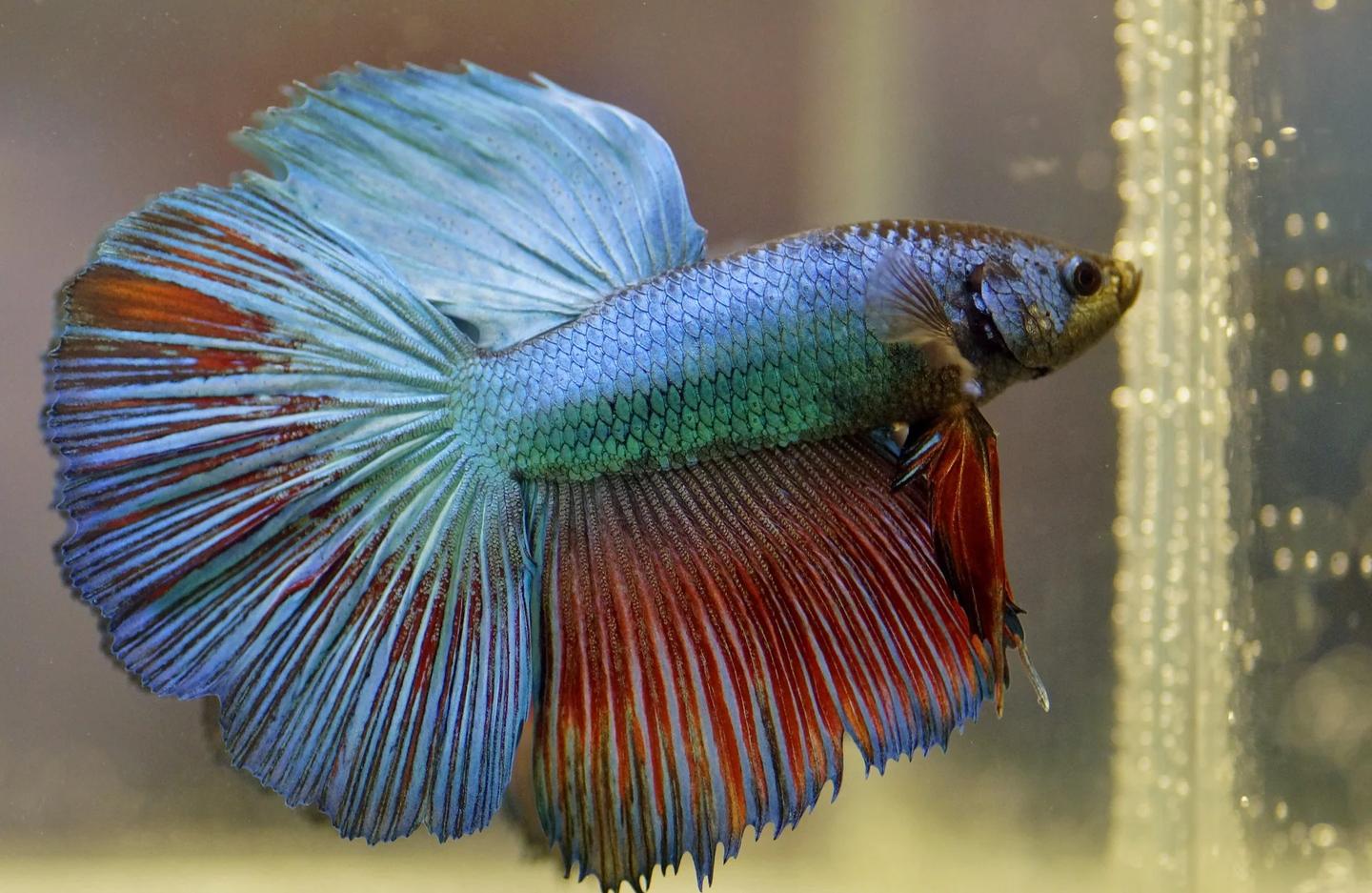
For one typical domestic Betta splendens, start with at least 20 litres, a mature filter, thermostatic heater, separate thermometer, gentle flow, a secure lid with surface access, and plants or refuges. Keep one male per aquarium.
Maintain these water conditions for optimal health and vibrant colors
The Super Delta Big Ear Male Betta Mix is one male Siamese fighting fish, Betta splendens, from a domestic line bred for a broad, fan-shaped tail and oversized pectoral fins. He is a single-fish centrepiece rather than a community fish. Before he arrives, have a heated, filtered and covered aquarium of at least 20 litres ready for him alone, with gentle water movement, smooth furnishings and free access to the surface, where he gulps air.
Betta splendens belongs to the gourami family, Osphronemidae, and its accepted name is Betta splendens Regan, 1910. Wild fish come from central Thailand and the lower Mekong basin, where FishBase records them in standing waters of floodplains, canals, rice paddies and medium to large rivers. The long-finned fish kept in aquariums are domestic strains; the wild form is rarely seen in the hobby.
| Species | Betta splendens, family Osphronemidae |
|---|---|
| Sold as | One live male per purchase, colour from a mixed selection |
| Size supplied | One size, described by the trade grade XL rather than a measured length |
| Adult size | About 7 cm; the long fins make him look larger |
| Aquarium | At least 20 litres for one male, heated, filtered, covered and cycled |
| Temperature | A steady 26–28°C, our practical target |
| Social needs | One male per aquarium |
| Suits | A careful keeper who wants one showpiece fish in a calm, planted tank |
| Care level | Intermediate, in our assessment |
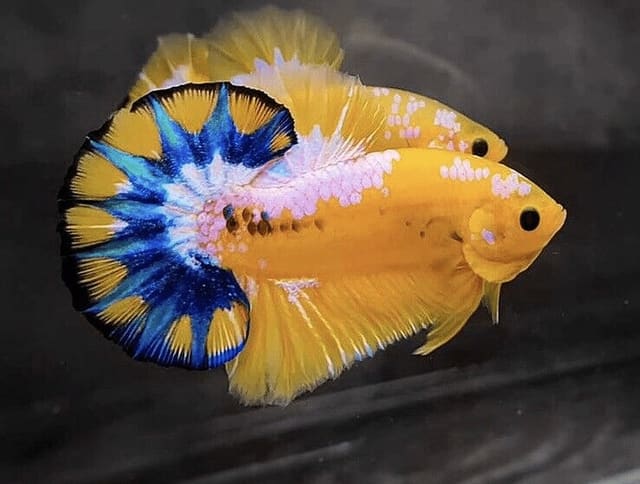
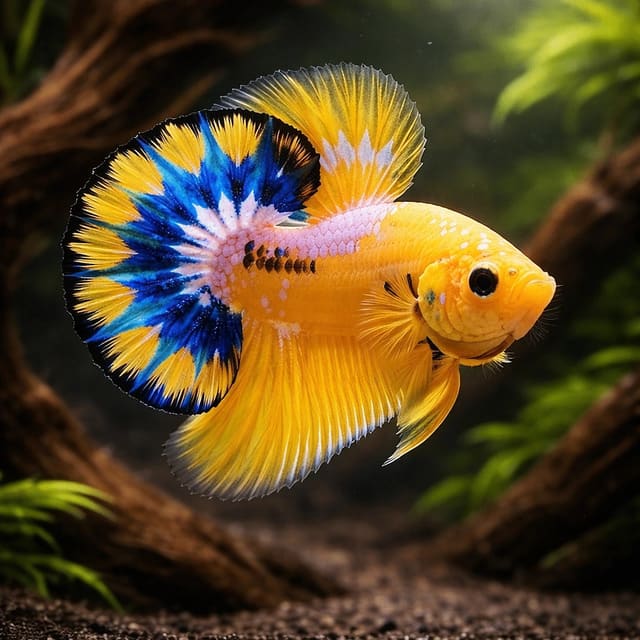
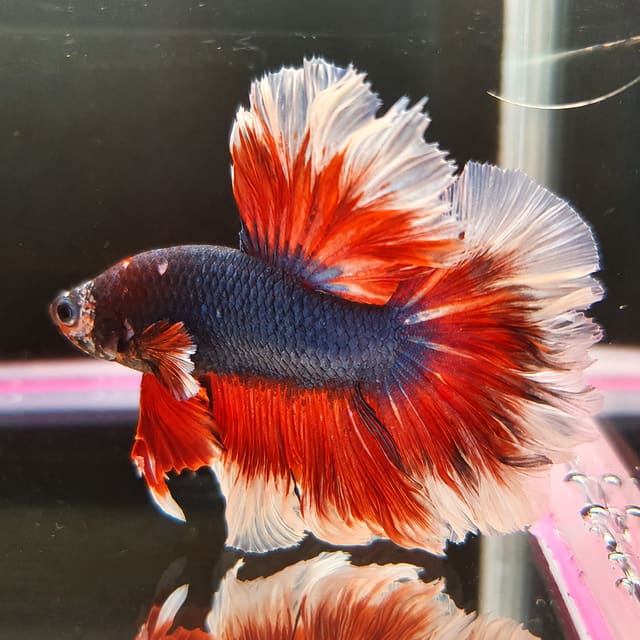
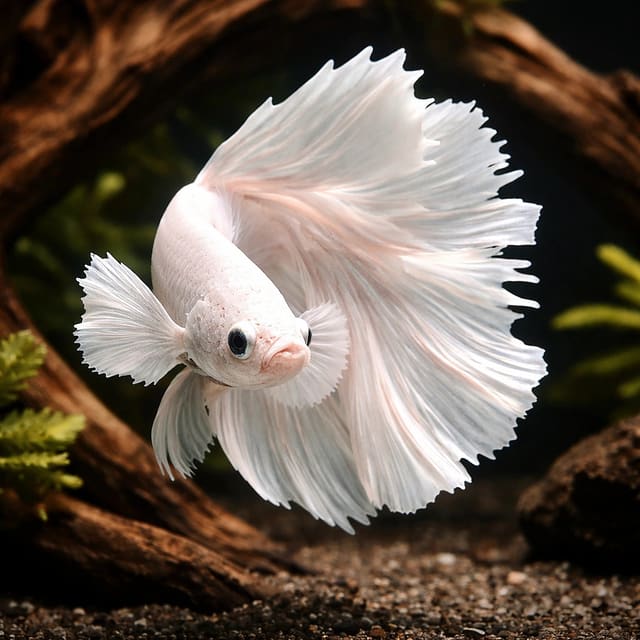
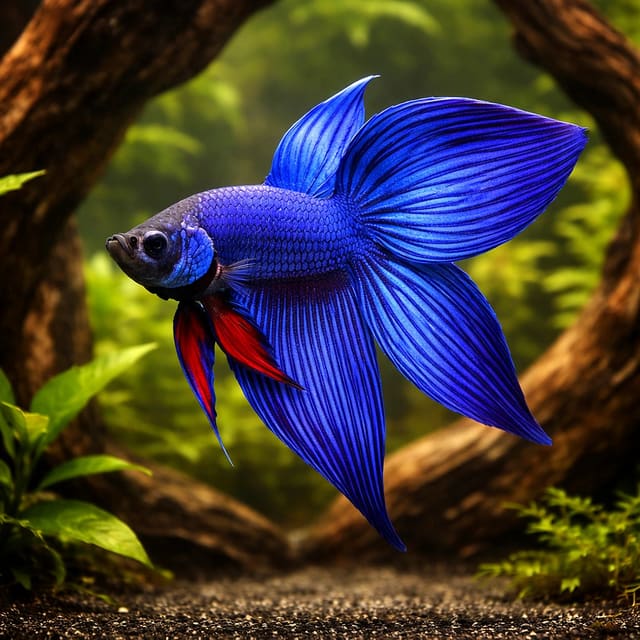
“Super delta”, “big ear” and “mix” are trade terms for a domestic form, not scientific categories. Super delta describes the wide, fan-like tail. Big ear, also sold as dumbo ear, refers to the enlarged pectoral fins just behind the gill covers: the large pale fins at the sides of the fish in the gallery. Mix means the colour is not fixed for this listing, so the male you receive may not be red and white like the fish photographed.
Betta splendens has been extensively line-bred for vigour, strength and the ornamental trade, and it has been crossed with close relatives such as B. imbellis, B. smaragdina and B. mahachaiensis. The result is countless strains that differ in colour, fins, body shape and quality. A genome study of domestic Bettas mapped part of that variation in colour, fin and body traits, which is also a reminder that a fin name describes appearance, not health, age or temperament.
FishBase lists wild Betta splendens as Vulnerable on the IUCN Red List. That status belongs to the assessed wild populations, not to domestic show lines such as this one.
Sex is guaranteed only when the exact product or selected option explicitly states male or female. This Super Delta Big Ear Male Betta Mix listing is sold as male. Males are more colourful than females and grow much longer fins, a difference taken to extremes in show forms like this. There is one size for this listing, sold under the trade grade XL; treat that as a description of the male supplied, not a promise of a particular length or age.
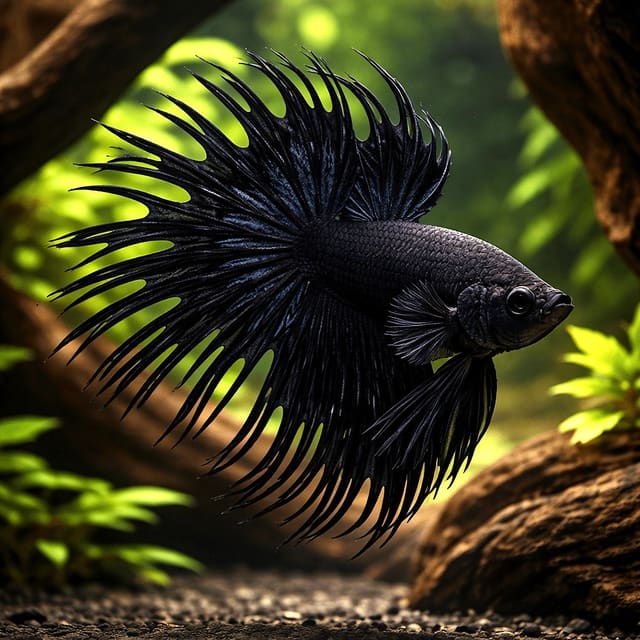
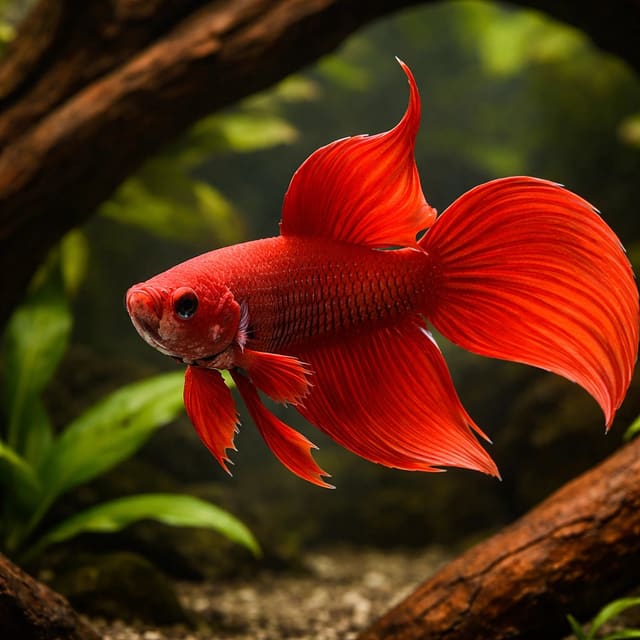
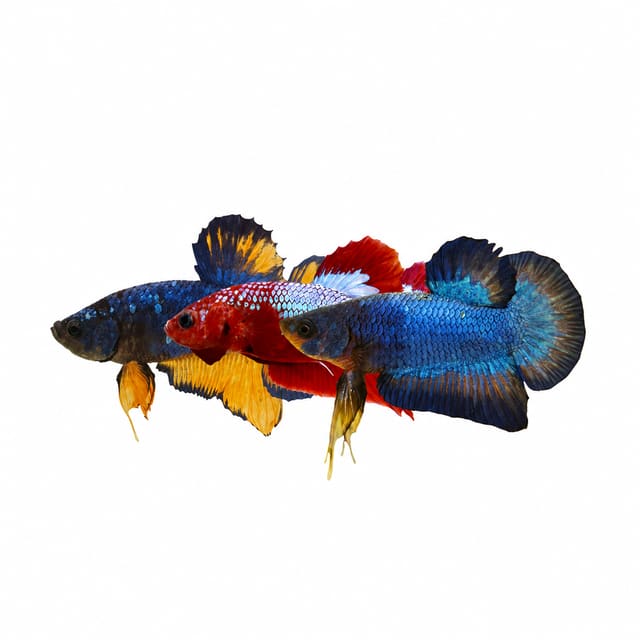
Gallery images have been digitally enhanced to improve image quality. Natural colour, pattern, size and maturity can vary between live animals. One gallery picture shows two of these long-finned fish facing each other among plants. Read it as a view of the fin shape, not as a housing plan: two males must never share a tank.
If you would rather compare fin types side by side, our range of Betta fish brings the other forms together.
The UK ornamental fish trade body, OATA, recommends an aquarium of at least 20 litres for a single male Betta, and we use the same figure as the minimum starting point. Treat it as a floor, not a target. Gravel, wood, plants and the air gap under the lid all take up volume, and a larger body of water holds its temperature and quality more steadily.
The species profile on Seriously Fish suggests a base of 45 × 30 cm, roughly 41 litres, as large enough for a single male, and does not support keeping Betta splendens in tiny aquaria or jars. FishBase makes a similar point: the colourful varieties are popular aquarium fish, but keeping males in very small containers should be discouraged. If you have room for the larger footprint, a heavily finned male gains more calm water to cruise and more places to rest.
Our Betta care guide summarises two recent behavioural studies. In one, 13 males were moved between tanks of 1.5, 3.3, 5.6 and 19.3 litres: larger, furnished housing produced more activity and fewer abnormal behaviours, and in the same 19.3-litre volume the bare version produced more hovering, repetitive swimming and wall interaction than the furnished one. In the other, small bowls restricted normal swimming. Neither study shows that extra space makes it safe to add a second male.
The RSPCA is clear that no fish should be kept without a well set-up and maintained filter. Fish release ammonia, which is toxic; a working biological filter grows bacteria that convert it to nitrite, which is also toxic, and then to the safer nitrate. The labyrinth organ that lets a Betta breathe air at the surface does not change this, and OATA stresses that Bettas still need an appropriate aquarium with adequate filtration.
That bacterial population takes time to grow. Stocking too soon can lead to what OATA calls new tank syndrome: there are not yet enough nitrifying bacteria to cope with the waste, ammonia and nitrite rise to unhealthy levels, and fish may become ill or die. Mature the filter first, and add the fish only when ammonia and nitrite have both returned to zero. Our step-by-step guide to setting up a first tropical tank walks through the whole process.
Betta splendens is a facultative air-breather: it takes air from the surface as well as using its gills. Floating plants are welcome, but leave clear patches so he can reach the surface easily. A secure lid is still essential, since Bettas can jump, yet a sealed surface is unsafe: leave a small air gap between the water and the cover, so he can breathe at the surface while the lid prevents an escape.
In the wild, Betta splendens lives in still or sluggish water: FishBase records it in standing waters of floodplains, canals, rice paddies and medium to large rivers. Seriously Fish advises avoiding strong water movement and suggests an air-powered sponge filter; for its 41-litre example it points to a filter rated at roughly 80–125 litres per hour. Our care guide also recommends gentle flow.
A super delta tail and big pectoral fins look magnificent in calm water and are hard work in a current. Our care guide notes that very long fins can change how an individual copes with flow and furnishings, so watch how he swims rather than assuming a named form is hardy. If he is repeatedly swept across the tank or cannot settle to rest, reduce or spread the outflow. Keep the biological filter running while you do it: the bacteria in it keep the water safe.
Seriously Fish describes the species at its best in a well-planted, shady aquarium with plenty of surface cover. Its suggestions include:
For a long-finned male, check every item for fin hazards. Avoid sharp edges, rough surfaces and openings narrow enough to trap a body, and keep decor from blocking the surface. Broad leaves and floating cover near the top give him somewhere to rest out of the current. Live plants or smooth, aquarium-safe alternatives both work; what matters is shelter and shade without anything that snags.
Domestic Bettas are adaptable about water chemistry, but they cope badly with pollution and sudden change. OATA notes that tank-reared individuals are usually undemanding of chemistry, and Seriously Fish explains that wild-collected fish are likely to prefer a pH of 5.0–7.0, while ornamental strains are unfussy across 6.0–8.0. This male belongs to an ornamental strain, so the second range is the relevant one.
| Measure | Aim for |
|---|---|
| Temperature | A steady 26–28°C |
| pH | 6.0–8.0 |
| General hardness | 4–12 dGH, soft to medium |
| Carbonate hardness | 3–10 dKH |
| Ammonia | Zero |
| Nitrite | Zero |
| Nitrate | No more than 20 mg per litre above your tap water |
The pH, hardness and waste figures are OATA's UK guidance for tank-reared Bettas; the temperature is our own practical target, explained below.
Published ranges differ because they describe different things. FishBase records the wild species in tropical water of 24–30°C. Seriously Fish gives 22–30°C for the aquarium, and OATA gives 20–28°C for tank-reared Bettas. We use a steady 26–28°C as the practical target for a typical domestic Betta splendens because it sits inside all three, and our Betta fish care guide sets out the evidence and the exceptions. Stability matters as much as the number itself.
OATA says a heater is needed all year round in the UK. Choose a thermostatic heater rated by its maker for your tank volume, follow its installation guidance, and check the result with a separate thermometer: the heater setting tells you what it is aiming for, and the thermometer tells you what the water is actually doing.
UK tap water varies from area to area in hardness and pH, and it carries chlorine or chloramine, which must be removed with a tap water conditioner before the water goes into the tank. Test the aquarium itself rather than relying on a postcode estimate, and test at least once a week so that ammonia and nitrite never build up unnoticed. Our guide to aquarium water parameters explains what each reading means, and the water parameter matcher lets you compare your own results with published guidance.
If a reading sits near the edge of a range, change it gradually and only with a clear reason. Stability and gradual adjustment matter more than chasing the exact middle of a range.
Wild Betta splendens feed on zooplankton and on mosquito and other insect larvae, and Seriously Fish expects them to take both aquatic and land-dwelling invertebrates. In the aquarium, OATA describes Bettas as omnivorous and recommends a good-quality flake or pellet, including the specialised Betta pellets made for them.
Seriously Fish notes that Betta species seem particularly prone to obesity, and OATA warns that uneaten food breaks down and releases toxic waste into the water. Measure portions if more than one person feeds the tank. Pellet sizes vary between brands, so follow the maker's guidance and judge the amount by his body condition rather than by a fixed pellet count.
If he ignores dried food at first, be patient: Seriously Fish notes that captive fish normally accept dried products once they recognise them as edible, and small frozen foods keep him eating in the meantime.
The Animal Welfare Act 2006 protects vertebrates, fish included, and gives keepers a duty to provide a suitable environment and diet, the chance to behave normally, appropriate housing with or apart from other animals, and protection from pain, injury, suffering and disease. For a male Betta, that duty becomes a short list you can tick off before ordering.
Plan cover before you need it. Arrange a competent carer with pre-measured feeds and written instructions, and make sure they know how to read the thermometer and notice a heater or filter that has stopped working. If you intend to use an automatic feeder, test it well before you travel instead of trusting it for the first time while you are away. Pre-measured portions also protect him from a well-meaning helper who overfeeds, which harms the water as much as his diet.
Every order is hand-packed by our team: fish are bagged in pure oxygen and packed in an insulated poly box, with a heat pack when the weather calls for it, then carried by a licensed live-animal courier. We email the tracking number and your confirmed delivery date so you know when to be at home. The full terms are on our delivery and Live Arrival Guarantee page.
Once he is in, keep the tank quiet and stable for his first days. Every new fish adds waste for the filter to handle, so OATA advises raising stock levels slowly and keeping an eye on ammonia and nitrite during this period. Use OATA's picture of a healthy fish as your baseline: clear, bright eyes, undamaged fins, intact scales, no ulcers or bumps and normal swimming.
Notice where he likes to rest, how he swims and how keenly he feeds during his first week. Those observations become his normal, and a change from normal is the most useful early warning you will get.
OATA stresses that good husbandry is essential because Bettas can be stressed by even the smallest amounts of ammonia and nitrite.
OATA lists the changes to watch for in any fish. For a Betta, read them against his own habits: visiting the surface for air is normal for a labyrinth fish, but hanging there listlessly is not.
| Watch for | Examples |
|---|---|
| Swimming | Hanging at the surface, sitting on the bottom or swimming erratically |
| Colour | Turning darker or paler than usual |
| Temperament | More aggression, or hiding more than normal |
| Breathing | Gill covers moving faster or slower than usual |
| Appearance | White spots, fluffy growths, lost scales or fin loss |
| Condition | Gaining or losing weight |
| Feeding | Eating less, or losing interest in food |
A torn fin, white mark, swollen belly or odd swimming can each have more than one cause. The MSD Veterinary Manual emphasises the aquarium's history, a water analysis and proper diagnostic work rather than choosing a medicine from one symptom, and correcting water quality can be urgent even though it does not identify the cause. On a long-finned male, check the decor for snags too, especially after adding a new ornament.
FishBase states simply that males will fight each other. OATA is blunter: two males should never be mixed, because they will fight until one is severely injured or, more likely, killed. The RSPCA's guidance on keeping fish together also recognises that male Bettas fight their own kind. Research summarised in our Betta care guide found that larger or more complex tanks reduced some approach and display behaviour but did not make it safe for males to share. Give this male his own aquarium, and position any neighbouring Betta tank so the two males cannot see each other directly.
Seriously Fish does not recommend Betta splendens for the standard community aquarium and notes that ornamental strains seem more aggressive than any other Betta species; in most cases only one individual can be kept per tank. It also warns against species with trailing fins or a similar body shape, because a male may treat them as rivals. OATA describes the other half of the risk: males are not usually aggressive towards other species, but they are often the target of intense fin nipping, which can cause stress, disease and death. With a wide tail and large pectoral fins, this form has plenty of fin to lose, so a nipper is as much of a threat as his own temper.
Seriously Fish says some small cyprinids and loaches that share similar habitats in the wild can be suitable, but only after proper research, and that most males are best kept alone. OATA recommends keeping males alone or with very placid tank mates. No species is automatically safe, and individual Bettas differ, so treat any mixed tank as a trial with a backup plan.
| Check | Why it matters |
|---|---|
| Adult size of every animal | The aquarium must give the whole community room, not just the Betta |
| Water overlap | Any companion must thrive at 26–28°C in the same water |
| Fin-nipping reputation | A known nipper is ruled out, however peaceful it looks |
| Fins and body shape | Long fins or a Betta-like outline can be read as a rival |
| Feeding speed | Quick feeders can take food before a heavily finned male reaches it |
| Backup plan | A second cycled tank lets you separate them at once if it fails |
Treat these as uncertain companions rather than a clean-up crew or a source of live food. A male Betta may investigate or hunt smaller animals, while larger or defensive invertebrates can bring their own risk of injury. If you try it, give the invertebrates suitable refuges and be ready to separate them.
Seriously Fish and FishBase both describe keeping males and females apart except for breeding. OATA notes that females are much calmer and can be kept in groups of at least four, and that a male can live with at least five females only in a densely planted aquarium that breaks up the line of sight, an arrangement it says inexperienced keepers should not attempt. For this male, our advice is simple: keep him on his own.
Expect a fish with presence. Seriously Fish explains that the common name comes from the tradition of keeping males to fight each other in organised bouts, and that the species has been line-bred for vigour and strength as well as for the ornamental trade. A show male like this one is bred for his fins, but the one-male rule still applies in full.
Betta splendens is a bubble-nest builder, and a male may build a raft of bubbles at the surface even with no female present. A nest is reproductive behaviour. It does not certify that he is healthy, and a male without one is not necessarily unwell. Judge his welfare on water tests, feeding, breathing and posture instead.
This listing supplies one male for display. If you later want to breed, plan it as a separate setup. FishBase notes that the sexes should be kept apart unless mating, and that only one female should be introduced to a breeding tank of about 20–30 litres. Seriously Fish adds that the female needs plenty of cover, that the male builds the nest under a broad leaf, in a tube or among floating plants, and that the tank needs the tightest possible cover, because the fry need a layer of warm, humid air for the labyrinth organ to develop properly.
Plan for an adult of about 7 cm. FishBase records the species at up to 6.5 cm in total length, Seriously Fish gives 70 mm standard length, and OATA says Bettas grow to about 7 cm. The broad tail and large pectoral fins make him look bigger than his body length.
At least 20 litres for one male, which is OATA's UK minimum and our own starting point. The tank should be heated, filtered, covered and fully cycled before he arrives. More space is easier to keep stable, and Seriously Fish suggests a 45 × 30 cm base, about 41 litres, for a single male.
Only one. Males will fight each other, and OATA warns that two males kept together will fight until one is severely injured or killed. Keep one male per aquarium and place neighbouring Betta tanks so the males cannot see each other directly.
He can suit a careful beginner whose aquarium is cycled, heated and tested before he arrives. We rate him intermediate because the long fins need gentle flow, smooth decor and clean water, and he must be kept apart from other male Bettas.
Give a complete Betta pellet or quality flake as the base, with small live or frozen foods such as daphnia, brine shrimp or bloodworm for variety. OATA advises feeding once a day, only as much as he can eat within a few minutes, and Bettas are prone to becoming overweight.
We aim for a steady 26–28°C, set with a heater and checked with a separate thermometer. OATA's broad UK guidance for tank-reared Bettas is 20–28°C, pH 6.0–8.0 and 4–12 dGH, with ammonia and nitrite at zero. Keep conditions stable rather than chasing the middle of a range.
He is aggressive towards other male Bettas, and Seriously Fish warns that he may treat fish with trailing fins or a similar shape as rivals. OATA notes that males are often the target of intense fin nipping by other fish, so keep him away from fin-nipping species as well as other males.
Most males are best kept alone. Seriously Fish says some small cyprinids and loaches from similar wild habitats can suit after careful research, and OATA suggests only very placid tank mates. Avoid other male Bettas, fin-nippers and long-finned fish, and treat shrimp, snails and fry as uncertain companions.
He is hand-bagged in pure oxygen and packed in an insulated poly box, with a heat pack when the weather calls for it, then carried by a licensed live-animal courier on the delivery date we confirm by email. Be in to receive him, film a continuous unboxing video from the sealed parcel, open it the same day and float the bag for 20–30 minutes before releasing him without the bag water.
No reviews for this item yet. Bought one? Honest reviews only, good or bad.
What customers say about ordering from us
I have a small group of long finned mountain minnows. So was delighted to be able to order ten of this variety to increase the genetics in my tank . The ones I recieved are healthy but it’s to early to give a verdict on wether they are of a long finned type since they are small currently.
Gordon Walker · 23 Sept 2026
100% success travel and "installation". Pleased with quality of purchase. The Siamese fighter a bit "shy" so have not yet seen him at his best yet but looking good. Happy customer. GG
George E Garratt · 21 Sept 2026
Reviews of our shop, collected by Judge.me, an independent third-party review collector. Newest first.