−14%
Moderate
Gold Gourami (Trichopodus trichopterus)
24–28°C · pH 6–8 · 81L
£2.99£4.99

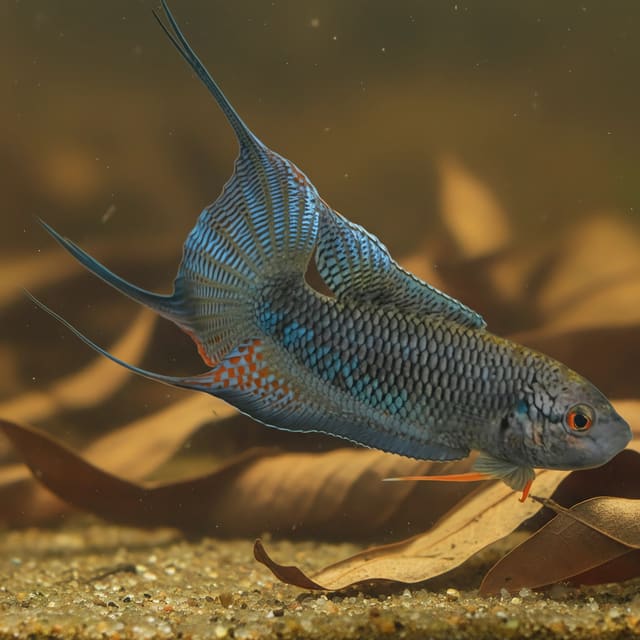
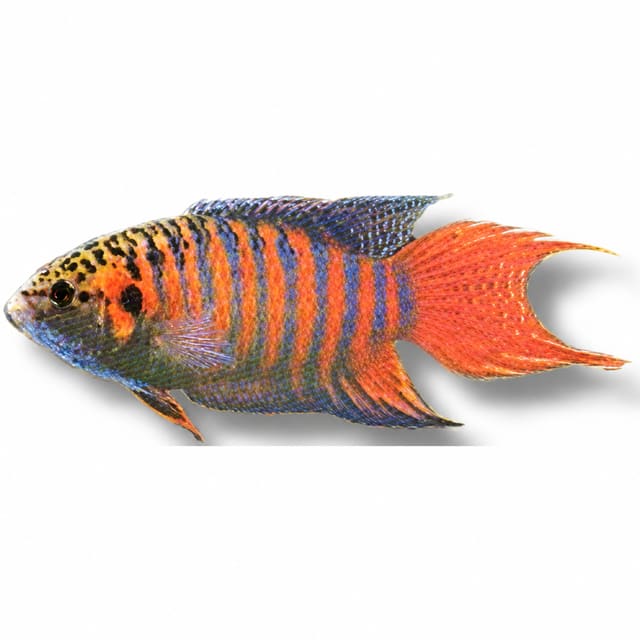
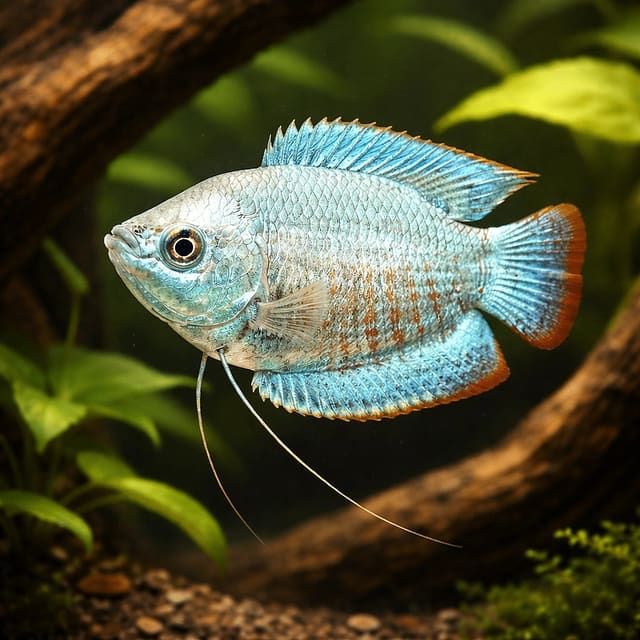
The Blue Paradise Fish (Macropodus opercularis) is an osphronemid labyrinth fish from China, Hainan, Taiwan and northern Viet Nam that reaches 6.7 cm standard length. It suits an intermediate keeper able to provide an 80 × 30 cm aquarium, surface access and Seriously Fish’s 10–22°C, pH 6.0–8.0 and 5–20 dGH aquarium range. Sold individually in 4–5 cm and over 5.5 cm dispatch sizes.
Adult size is the maximum length this species reaches at full maturity (scientific sources). The livestock you receive will be younger and smaller — pick a size above for the actual shipping size. Product-photo provenance and any image-specific limitations are stated on the listing.
Minimum of 2 per order.
The Blue Paradise Fish (Macropodus opercularis) is an osphronemid labyrinth fish from China, Hainan, Taiwan and northern Viet Nam that reaches 6.7 cm standard length. It suits an intermediate keeper able to provide an 80 × 30 cm aquarium, surface access and Seriously Fish’s 10–22°C, pH 6.0–8.0 and 5–20 dGH aquarium range. Sold individually in 4–5 cm and over 5.5 cm dispatch sizes.
Adult size is the maximum length this species reaches at full maturity (scientific sources). The livestock you receive will be younger and smaller — pick a size above for the actual shipping size. Product-photo provenance and any image-specific limitations are stated on the listing.
Maintain these water conditions for optimal health and vibrant colors
The Blue Paradise Fish is the blue aquarium form of Macropodus opercularis, an Asian member of the gourami family Osphronemidae from China, Hainan, Taiwan and northern Viet Nam. FishBase records a maximum length of 6.7 cm standard length. It suits an intermediate keeper who can provide a large footprint, accessible water surface and careful management of territorial behaviour.
FishBase places Macropodus opercularis in Osphronemidae and records freshwater and brackish environments across its native range. Like other anabantids, it has a labyrinth organ that allows it to breathe atmospheric air. Keep the water surface accessible, but do not treat surface breathing as a substitute for filtration or clean water.
Use a base measuring at least 80 × 30 cm. Keep the aquarium at 10–22°C, pH 6.0–8.0 and 5–20 dGH, following the species aquarium range from Seriously Fish. Choose a stable point inside these ranges rather than moving conditions between their limits.
| Suits | Not suited to |
|---|---|
| An intermediate keeper prepared to manage territorial behaviour | A keeper seeking a uniformly peaceful community fish |
| An aquarium with an 80 × 30 cm or larger base | An aquarium that cannot provide the stated footprint |
| A layout with shaded retreats and clear surface access | A layout that blocks access to atmospheric air |
| Carefully screened peaceful schooling companions with comparable water needs | Similarly shaped fish, timid species, edible small fish or fin nippers |
Use 6.7 cm standard length as the adult figure throughout the plan. For comparison, Seriously Fish lists 8 cm standard length, while OATA’s broad gourami and paradise-fish guidance describes paradise fish as growing to approximately 10 cm. These figures differ between the references, so retain the FishBase maximum recorded length as the consistent listing value while still providing the larger published aquarium footprint.
For other members of this aquarium family, browse our gouramis and labyrinth fish collection. Treat each species as a separate care decision because size, temperature and temperament differ across the family.
One purchase supplies one Blue Paradise Fish from the size selected. The live selector includes a 4–5 cm size and an over 5.5 cm size.
The size you select is the size supplied, not the adult size. A larger dispatch size gives you a larger fish at dispatch; it does not represent a different adult species, a guaranteed final length or a particular life stage. Build the aquarium around the 6.7 cm adult figure and territorial behaviour rather than treating either selector value as the finished size.
Sex is guaranteed only when the selected option explicitly states male or female. This Blue Paradise Fish listing has no sex-guaranteed option.
One purchase is not a pair or a managed social group. If you intend to keep more than one, calculate the total number of animals, then assess the proposed sex arrangement, aquarium footprint, cover and separation capacity before making that plan. Buying several fish cannot create a guaranteed male-to-female ratio when the selected sizes carry no sex guarantee.
Seriously Fish gives an 80 × 30 cm base and approximately 72 litres as the minimum to consider for a single pair. Retain that footprint as a conservative baseline even for one animal rather than shrinking the aquarium around a dispatch-size fish. A pair or larger arrangement still needs behavioural screening; the footprint figure does not guarantee that two particular animals will coexist.
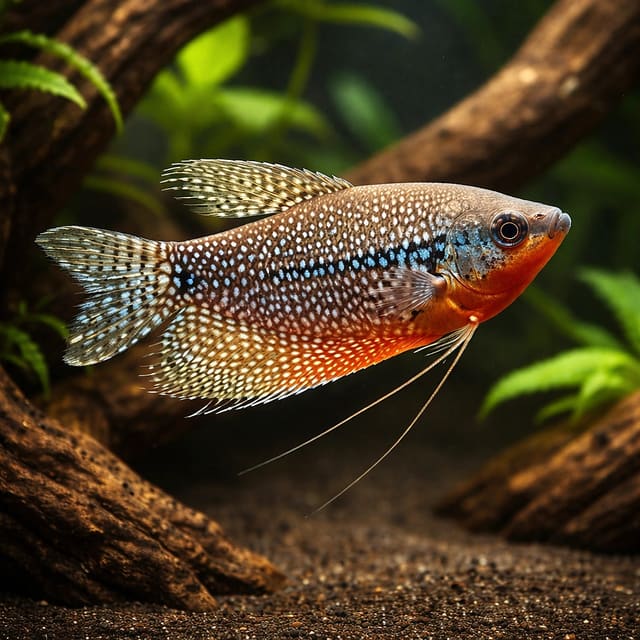
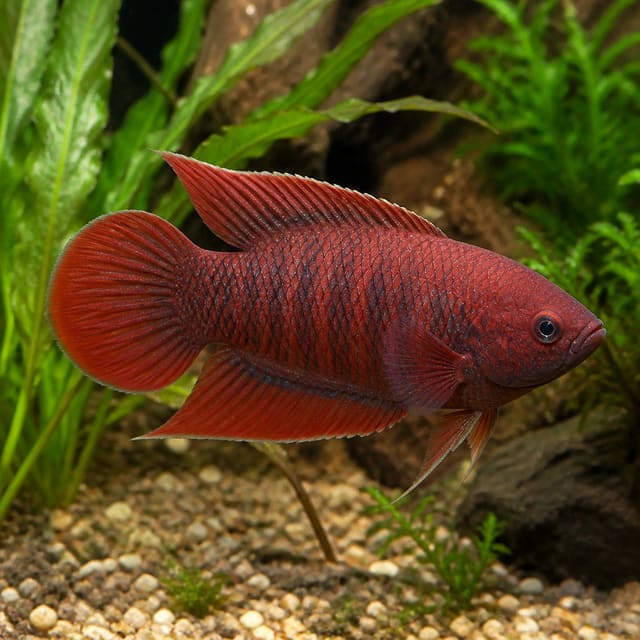
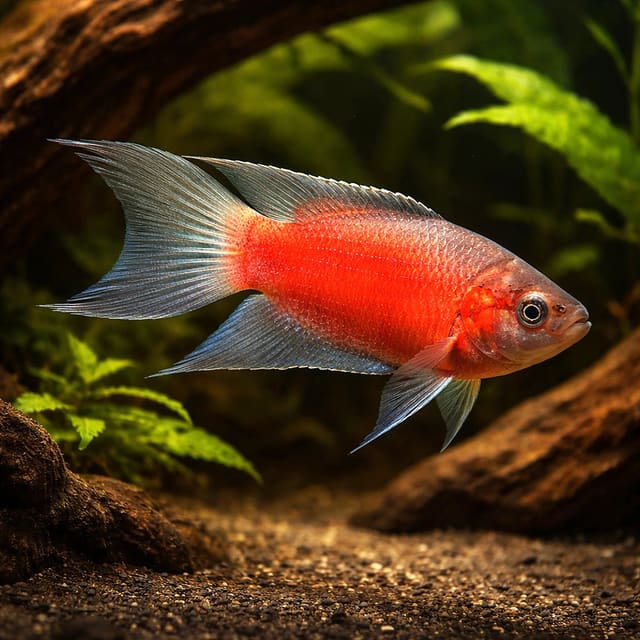
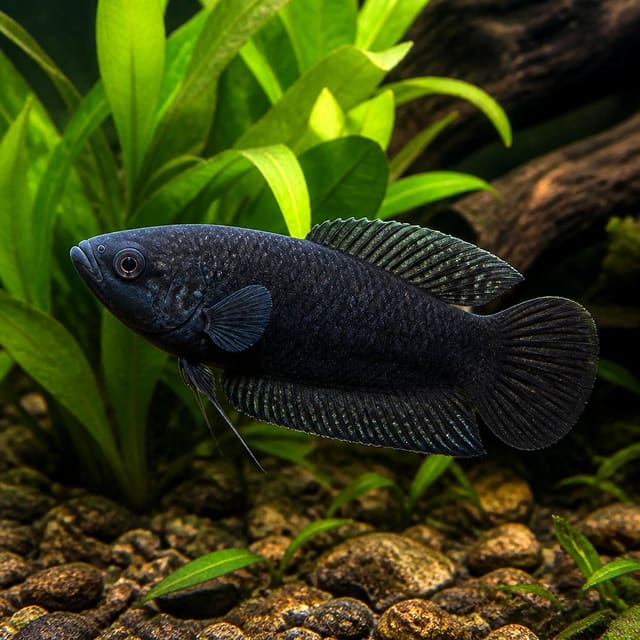
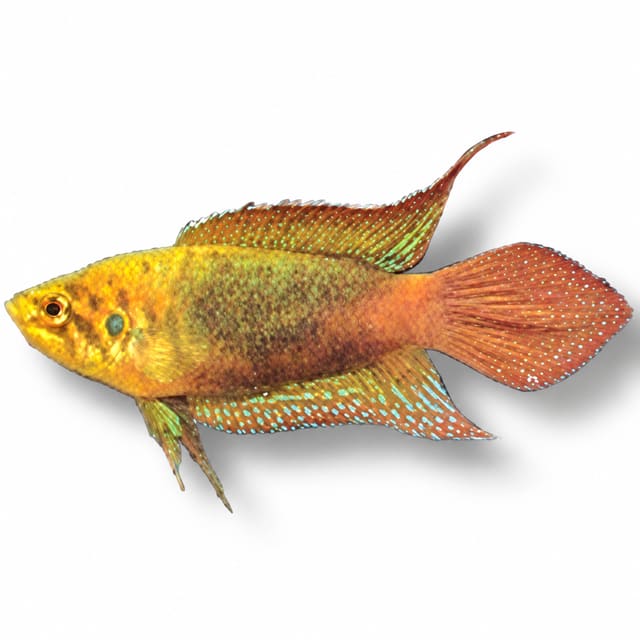
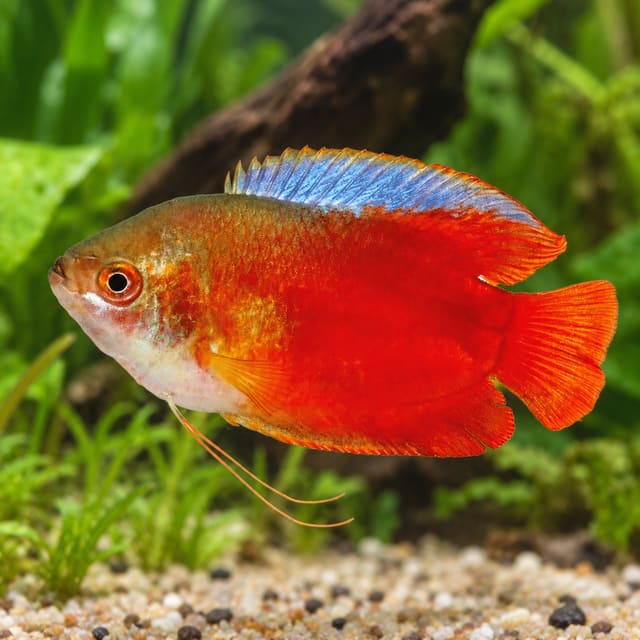
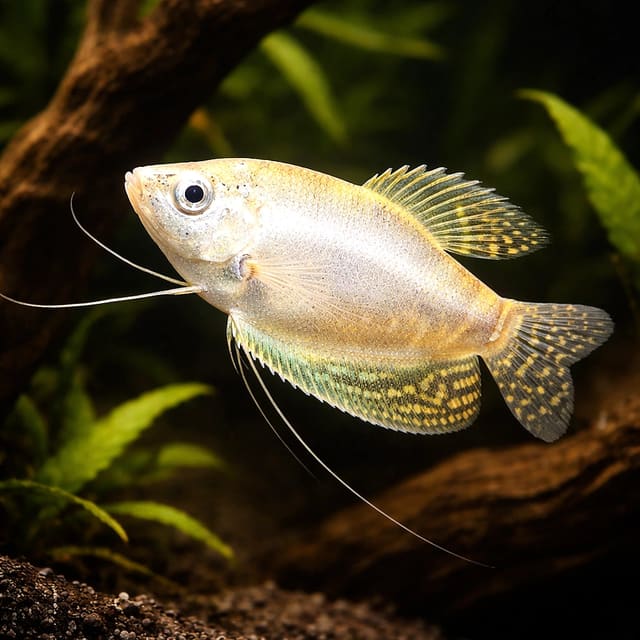
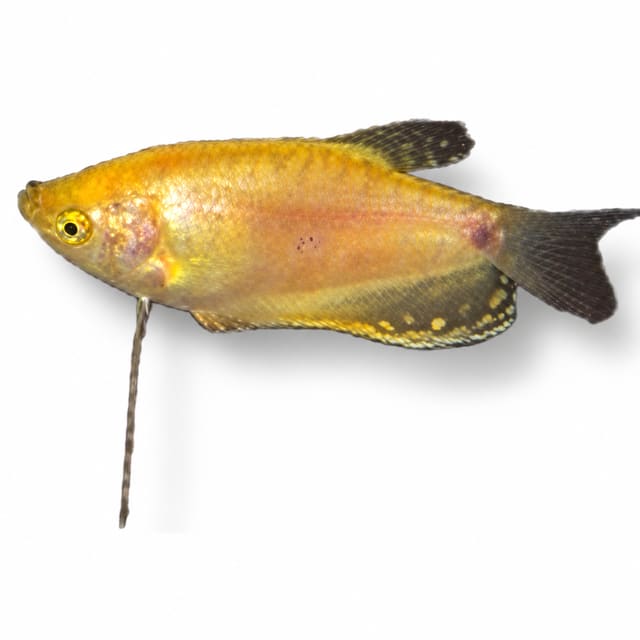
Some gallery images are representative, based on reference photographs of this species, and none shows the exact animal supplied, so colours can look slightly different from the live animal.
Use the size wording and quantity control for purchase decisions, then use the adult-size, water and compatibility guidance for aquarium decisions. Keeping those two tasks separate prevents a dispatch measurement from becoming an accidental long-term stocking limit.
Start with a base measuring at least 80 × 30 cm. The species profile pairs this footprint with approximately 72 litres as the minimum to consider for a single pair. For one fish, retain the same baseline so the animal has room to move between open water and sheltered areas; for additional animals, use more space and more shaded retreats rather than relying on volume alone.
A fully decorated aquarium can work well. Seriously Fish recommends driftwood roots or branches positioned to create shady places. Add live plants while retaining open swimming routes and clear approaches to the surface.
| Feature | Purpose |
|---|---|
| Wood and branches | Create shaded retreats |
| Live plants | Add cover around activity areas |
| Open surface patches | Preserve access to atmospheric air |
| Open feeding area | Let you see whether the fish takes food normally |
| Separation equipment | Provide a prompt response to sustained aggression |
Surface vegetation can add shelter, particularly in a breeding arrangement, but it must not seal the entire surface. Leave several clear routes where the fish can rise without forcing its way through a dense mat. Check those routes after plant growth or routine maintenance changes the layout.
Substrate can be aquarium gravel or sand. Choose and maintain it according to the aquarium’s waste-removal routine, and keep decorations stable. A territorial fish may repeatedly use the same shaded area, so avoid collapsing that refuge each time the aquarium is serviced.
For a worked layout, divide an 80 cm tank into three zones: a planted or wooded retreat at one end, open swimming space in the centre and a second sheltered area at the opposite end. Keep surface gaps above more than one zone. This arrangement gives the fish a choice between open water and the shaded places recommended by the species profile.
Reassess the structure as the fish settles. If it spends all its time exposed because every shaded place is occupied by another animal, add or reposition cover. If it cannot reach the surface without encountering another fish, change the social arrangement immediately rather than waiting for repeated confrontation.
Use the species aquarium range of 10–22°C, pH 6.0–8.0 and 5–20 dGH. These are practical boundaries, not a target to move between from day to day. Measure the aquarium’s normal conditions and choose a stable point within all three ranges.
The temperature guidance is cooler than that used for many tropical community displays. Seriously Fish notes that this species can be maintained without aquarium heating in many cases and may benefit from a cool winter period. An unheated plan still needs measurement: room conditions can change, and the aquarium must remain within the stated range.
| Reading | Action |
|---|---|
| 10–22°C | Keep the normal temperature stable inside the range |
| pH 6.0–8.0 | Use a stable value that also suits every companion |
| 5–20 dGH | Match the fish to measured aquarium water |
| Outside a boundary | Resolve the mismatch before introducing the fish |
Learn what each reading means in our aquarium water chemistry guide, then enter measured values into the water matcher. Use actual test results rather than labels such as “soft”, “hard”, “tropical” or “room temperature”, because those labels do not show whether all three values fit.
For example, an aquarium at 20°C, pH 7.2 and 10 dGH sits within the three species ranges. A tank at 25°C fails the aquarium-temperature screen even if its pH and hardness fit. Solve that temperature mismatch as an aquarium-planning decision rather than assuming one acceptable reading cancels another.
Seriously Fish estimates that maintaining this range in an aquarium of approximately 72 litres may need roughly 25 W of heating when the room is around 20°C. Treat that as an example tied to those conditions. Heater demand changes with room temperature and aquarium design, while a room already holding the required range may not need added heat.
When considering companions, compare their routine temperature, pH and hardness requirements against this range. A fish that merely tolerates one edge temporarily is not as strong a match as one whose normal care range overlaps comfortably.
Run a well-established biological filter before introducing livestock. The RSPCA explains that biological filtration supports bacteria that convert toxic ammonia to nitrite and then to safer nitrate. Atmospheric breathing does not remove this requirement: the labyrinth organ helps the fish use air, but waste still enters the water.
For an aquarium of approximately 72 litres, Seriously Fish gives a turnover of four to five times the volume each hour and a filter rating around 290–360 litres per hour. Use that as a model tied to the stated aquarium size. Confirm that the chosen filter can move and process the water without obstructing the fish’s route to the surface.
Test at least weekly. Pair each result with an action: ammonia or nitrite above zero requires prompt attention to stocking, feeding and biological filtration; rising nitrate calls for maintenance and a review of waste input. Do not use clear-looking water as a replacement for a test, because dissolved waste is not assessed by appearance alone.
At least once every week, change 25% of the water. Treat replacement tap water with conditioner to remove chlorine or chloramine before it enters the aquarium. Siphon settled solid waste where needed, and check the filter for blockages as part of the same routine.
If filter media needs cleaning, rinse it lightly in aquarium water removed during the partial water change. Do not run it under the tap because any chlorine or chloramine present may kill the beneficial bacterial population established in the media.
Keep a simple weekly log of temperature, pH, hardness when relevant, ammonia, nitrite, nitrate and water-change completion. The value of the log is comparison: a changing trend can prompt action before behaviour or appetite deteriorates.
Make small live or frozen prey the main food choice. The species profile recommends Daphnia, Artemia, white worm and grindal worm, reflecting its likely predation on insect larvae and similar prey in nature. High-quality dried foods may also be accepted, particularly by commercial aquarium strains.
OATA’s group guidance adds good-quality flake, granule or pellet and small live or frozen foods such as daphnia, small bloodworm or tubifex. Feed only what the fish can consume within a few minutes, once a day. This schedule gives a clear portion limit and reduces uneaten food entering the biological system.
| Check | What to do |
|---|---|
| Food size | Choose pieces the fish can take and swallow readily |
| Portion | Stop when the few-minute feeding window is reached |
| Access | Confirm this fish and every companion can reach food |
| Leftovers | Remove uneaten food before it breaks down |
A practical rotation might use frozen Daphnia as one meal, frozen Artemia at another and an accepted high-quality dried food at another. This is a variety example, not a requirement to combine several foods in one serving. Portion control remains the same whichever suitable item is used.
Watch the whole feeding period. A territorial fish that reaches food first can appear well fed while quieter companions lose access. If one animal repeatedly hangs back, distribute an appropriate measured portion across more than one accessible point, then confirm that this does not increase the total beyond what the aquarium can process.
Reduced appetite is a health signal when it differs from the fish’s normal pattern. Pair that observation with the water and behaviour checks rather than adding more food. Extra food left in the aquarium breaks down and adds waste, which can make a water-quality problem worse.
Review the portion as the fish grows from its dispatch size. The correct amount is governed by what it can finish within a few minutes and by body condition, not by using the same count of flakes or granules indefinitely.
Territorial behaviour is the main social-care decision. Males are territorially aggressive, with that behaviour becoming more pronounced during reproductive periods. Similarly shaped fish may also draw unwanted attention, so the aquarium must be planned around more than adult length alone.
Do not house males together unless the aquarium is very large. When planning a mixed-sex arrangement, the species profile advises two or more females per male to spread male attention. Because none of the selected sizes guarantees sex, buying a particular number cannot guarantee that ratio.
| Plan | Required decision |
|---|---|
| One animal | Provide the full footprint, cover and enrichment baseline |
| Proposed pair | Screen sex, behaviour and retreat access rather than relying on the word “pair” |
| Mixed-sex arrangement | Use at least two females per male and provide extra structured space |
| More than one possible male | Do not proceed without a very large aquarium and separation capacity |
OATA advises that paradise fish are usually best kept on their own. A single-animal plan is therefore a valid starting point when sex is not guaranteed or when the aquarium cannot safely support a managed social arrangement. Keeping one does not justify reducing the aquarium footprint or simplifying care.
Monitor access rather than waiting only for visible injury. Repeated pursuit, one fish being confined to a corner, exclusion from food or obstruction of surface access all show that the arrangement needs intervention. Separate the animals when changing cover does not promptly restore normal movement and feeding.
Seriously Fish describes mature males as larger than females with extended soft rays in the dorsal, anal and caudal fins. Do not infer sex from the dispatch size, colour or gallery imagery; these biological differences do not create a sex guarantee for this offer.
Before adding another paradise fish, write down the expected number of males and females, the location of at least two distinct retreats, and the place where a separated fish could be housed. If any part of that plan depends on receiving a particular sex, use an explicitly sexed offer.
Complete the aquarium before the fish arrives. The filter should already be mature, ammonia and nitrite should both read 0 mg per litre, and temperature, pH and hardness should be stable inside the species range. Place wood and plants before introduction so the fish enters the intended long-term layout.
Check the surface from the fish’s point of view. Remove dense plant growth that closes every route to air, confirm the filter outlet is not blocking access, and make sure more than one surface approach remains usable if companions are present.
Read our current delivery and Live Arrival Guarantee policy for the terms that apply to the delivery. Contact us the same day if anything has gone wrong, providing the order number and continuous unboxing video.
| Checkpoint | What to confirm |
|---|---|
| Before introduction | Mature filter, 0 mg/l ammonia, 0 mg/l nitrite and stable water |
| First feeding | The fish sees food, takes suitable pieces and is not excluded |
| Daily | Normal swimming, breathing, colour, appetite and access to shelter |
| End of week | Test results remain safe after the added biological load |
Add aquarium livestock gradually. Beneficial bacteria increase in response to added waste and feeding; adding too many animals too quickly can leave the biological filter unable to process ammonia and nitrite safely. Count the Blue Paradise Fish as a real increase in bioload even if it is small at dispatch.
During the first week, compare behaviour with the specific warning signs in the observation section. Rising to the surface is part of labyrinth-fish biology; remaining at the surface, erratic swimming, rapid changes in breathing or persistent refusal to feed call for checks rather than being dismissed as normal settling.
Keep the first week simple. Do not add further fish merely because this animal has begun feeding. Give the aquarium’s biological filter and social structure time to respond, then use measured water quality and observed behaviour to decide whether any later stocking step is sensible.
Learn the fish’s normal swimming, colour, feeding response and use of cover. Individual patterns vary, so the most useful warning is a clear change from the behaviour repeatedly seen in that aquarium.
| What you see | What to do |
|---|---|
| Hanging at the surface | Check water quality, breathing rate and whether another fish blocks movement |
| Sitting on the bottom | Test the water and inspect for injury or social pressure |
| Erratic swimming | Check temperature, ammonia, nitrite and recent changes promptly |
| Darker or paler colour | Compare behaviour, aggression and water readings with the normal pattern |
| More hiding or aggression | Review retreats, sex arrangement and feeding access |
| Faster or slower gill movement | Check water quality and surface access immediately |
| White spots or fluffy growth | Separate when safe and seek informed health guidance |
| Fin, scale or weight loss | Check aggression, feeding and water, then act on the cause |
| Reduced food intake | Remove leftovers and assess water and behaviour before the next meal |
Start with measured water quality because ammonia and nitrite are toxic and can affect several animals at the same time. If either is above 0 mg per litre, treat the aquarium condition as urgent. Review filtration, recent stocking and feeding rather than waiting for a second symptom.
Then check social access. A fish may have clean water yet still lose condition if another animal controls the surface, feeding area or only secure retreat. Repeatedly displaced fish need a changed layout or separation, not a larger food portion added to the same contested space.
Do not choose a disease treatment from appearance alone. Similar signs can follow water problems, physical injury or aggression. Contact us for health guidance after recording the water results, temperature, recent changes and the behaviour you observed.
At the end of each month, compare body condition, fin condition and the weekly water log with the previous month. This checkpoint catches gradual changes that are easy to miss during daily feeding and helps distinguish a one-off event from a developing trend.
Begin with environmental overlap. A proposed companion should be comfortable at 10–22°C, pH 6.0–8.0 and 5–20 dGH as part of its normal care. Reject the match if it requires a warmer routine or different chemistry, even when its temperament appears suitable.
Next compare behaviour and body form. Seriously Fish says similarly shaped fishes should be avoided and identifies peaceful schooling species with comparable environmental requirements as possible companions. OATA advises robust tank mates while warning against timid species, small fish that could be eaten and fish that may nip paradise-fish fins.
| Screen | Decision |
|---|---|
| Comparable water needs | Required for every proposed companion |
| Peaceful schooling behaviour | Potentially suitable when the other screens also pass |
| Robust temperament | Prefer over timid fish that cannot withdraw or feed |
| Similarly shaped fish | Avoid |
| Small enough to be eaten | Avoid |
| Fish that may nip its fins | Avoid |
| Another male paradise fish | Avoid unless the aquarium is very large |
Do not turn “peaceful schooling species” into a universal tank-mate list. Adult size, normal swimming level, feeding speed and response to a territorial fish still matter. The same species can also behave differently between aquariums because layout, group structure and individual temperament differ.
A worked screen makes the order clear. If a peaceful schooling fish needs 25°C, it fails at the water stage. If another fish fits 20°C but is timid and easily excluded from food, it fails at the behaviour stage. If a robust fish fits the water but may nip extended fins, it fails at the fin stage. Only a fish that passes every stage should move to introduction planning.
Compatibility remains an individual and aquarium-specific judgement rather than a guarantee. Request a stocking assessment from our team when you can provide the aquarium dimensions, measured water, current inhabitants and number of Blue Paradise Fish proposed.
Set the aquarium up for the proposed social arrangement before adding the fish. Create more than one sheltered area, preserve several routes to the surface and make sure food can be distributed without forcing every animal into one contested point.
Increase livestock numbers slowly so the biological filter can adapt. A socially careful introduction can still fail if the added waste pushes ammonia or nitrite above 0 mg per litre, so assess biological capacity and behaviour as two parts of the same decision.
If pursuit begins, confirm that the targeted fish has an accessible retreat. Separate the animals when the layout does not promptly restore surface use, feeding and ordinary movement. Do not wait for fin loss or weight loss before using the separation plan.
Reassess as fish mature. Dispatch-size animals can change in size and territorial intensity, and males may become more aggressive during reproductive periods. A combination that appears calm initially still needs ongoing observation rather than being treated as permanently settled.
For multiple Blue Paradise Fish, sex arrangement remains decisive. Two or more females per male is the advised mixed-sex ratio, while males should not share an aquarium unless it is very large. Since the selected sizes carry no sex guarantee, do not build a plan that only works if every animal develops into the hoped-for sex.
A successful community is one in which all fish maintain normal feeding, movement, breathing and condition inside a shared water range. If one animal must hide continuously or cannot use the surface, the match has failed even when no obvious injury is present.
The Blue Paradise Fish reaches a FishBase maximum of 6.7 cm standard length. Plan its permanent aquarium around that adult figure rather than its dispatch size.
Use a base of at least 80 × 30 cm. Seriously Fish pairs that footprint with approximately 72 litres as the minimum to consider for a single pair; retain the footprint as a conservative baseline for one fish and increase space for a more complex arrangement.
One Blue Paradise Fish is a valid plan, and OATA says paradise fish are usually best kept on their own. Males should not live together unless the aquarium is very large; for a mixed-sex arrangement, provide at least two females per male, extra structured space and a separation option.
Macropodus opercularis is an intermediate choice because territorial behaviour, companion screening and reliable surface access require active planning. It suits a keeper prepared to observe interactions and separate incompatible fish.
Feed the Blue Paradise Fish small live or frozen foods such as Daphnia or Artemia as its main food, with accepted high-quality dried foods for variety. OATA’s group guidance says to feed only what it can consume within a few minutes, once daily.
Keep it at 10–22°C, pH 6.0–8.0 and 5–20 dGH, following the species aquarium range from Seriously Fish. Maintain ammonia and nitrite at 0 mg per litre.
Males are territorially aggressive and will fight each other; they should not be housed together unless the aquarium is very large. The references do not describe this fish as a fin nipper, but OATA says to avoid companions that may nip its fins.
Peaceful schooling species with comparable environmental requirements may be suitable after screening. Avoid similarly shaped fish, timid species, small fish that could be eaten and fish that may nip its fins.
Start filming the sealed parcel before it is opened, continue filming while opening it and show the fish still inside the sealed bag. Someone must be present to receive it; float the bag for 20–30 minutes before releasing the fish, and never pour the bag water into the aquarium.
Independently collected by Judge.me from customers who bought this item. All reviews are shown.
Very aggressive attacking my rams ,had to get rid of it. But was a nice fish
Healthy and going well
Reply from Tropical Fish Co
<p>Thanks Tracey. Blue Paradise Fish are tougher than they look and happy in cooler water than most tropicals, which makes them a good pick for an unheated or lightly heated tank. Just keep an eye on the males with each other and with anything long-finned. Glad this one's settled. - Tropical Fish Co</p>