Moderate
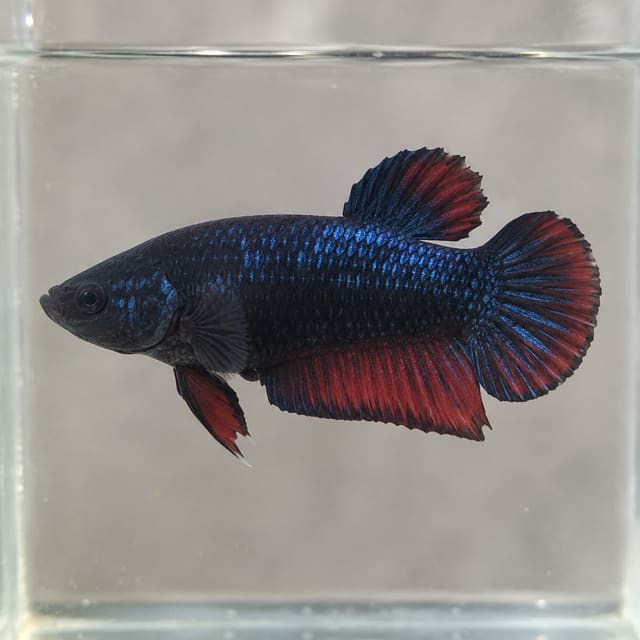
Avatar Plakat Male Betta (Betta splendens)
26–28°C · pH 6–8
£44.99
The Metallic Halfmoon is a male Siamese fighting fish (Betta splendens) bred for a mirror-like metallic sheen and a tail that opens to a full half circle. Keep one male on his own in a heated, gently filtered aquarium of at least 20 litres (40 litres or more is better) at a steady 26–28°C, with plants and a lid. One live male per purchase.
Adult size is the maximum length this species reaches at full maturity (scientific sources). The livestock you receive will be younger and smaller. Product-photo provenance and any image-specific limitations are stated on the listing.
Betta splendens
The Metallic Halfmoon is a male Siamese fighting fish (Betta splendens) bred for a mirror-like metallic sheen and a tail that opens to a full half circle. Keep one male on his own in a heated, gently filtered aquarium of at least 20 litres (40 litres or more is better) at a steady 26–28°C, with plants and a lid. One live male per purchase.
Adult size is the maximum length this species reaches at full maturity (scientific sources). The livestock you receive will be younger and smaller. Product-photo provenance and any image-specific limitations are stated on the listing.
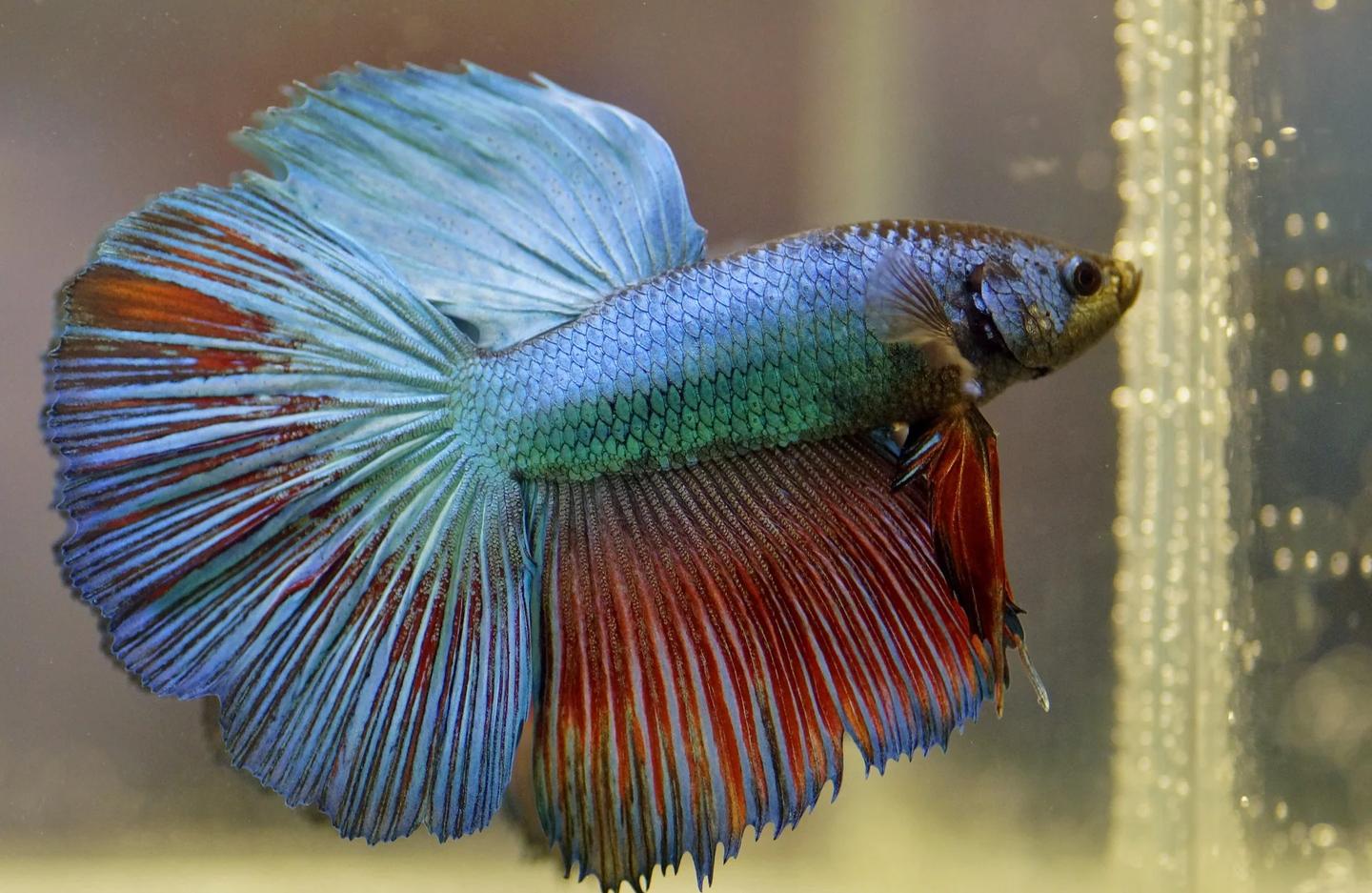
For one typical domestic Betta splendens, start with at least 20 litres, a mature filter, thermostatic heater, separate thermometer, gentle flow, a secure lid with surface access, and plants or refuges. Keep one male per aquarium.
Read the full care guidance when planning conditions for your aquarium.
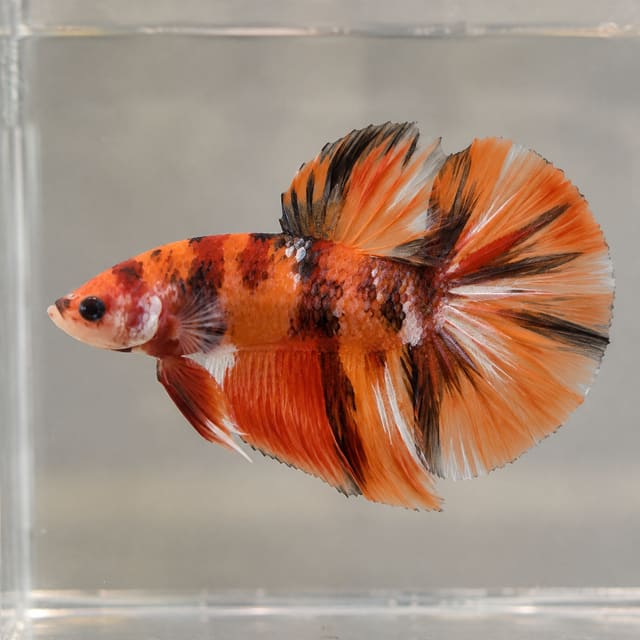
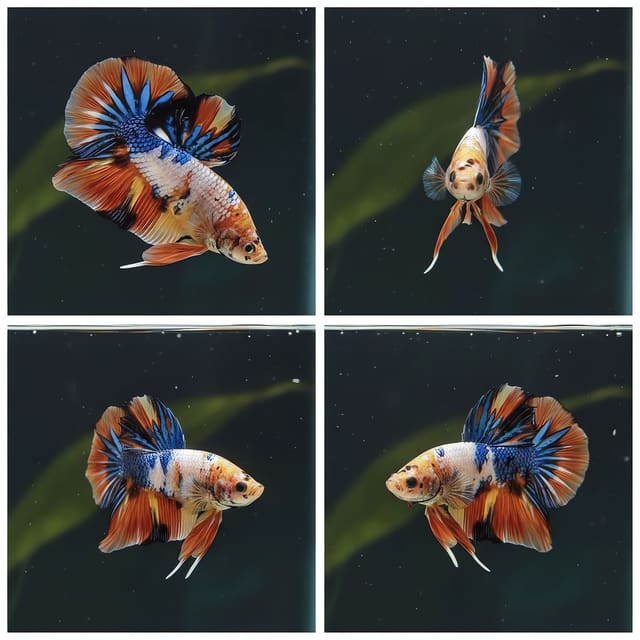
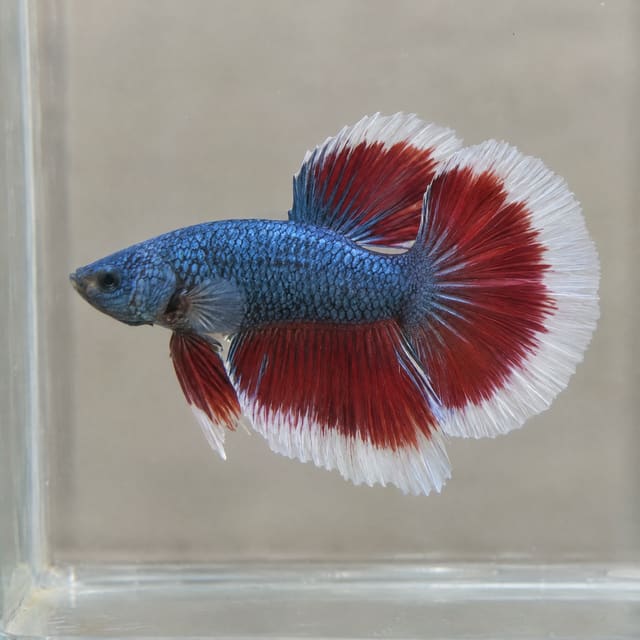
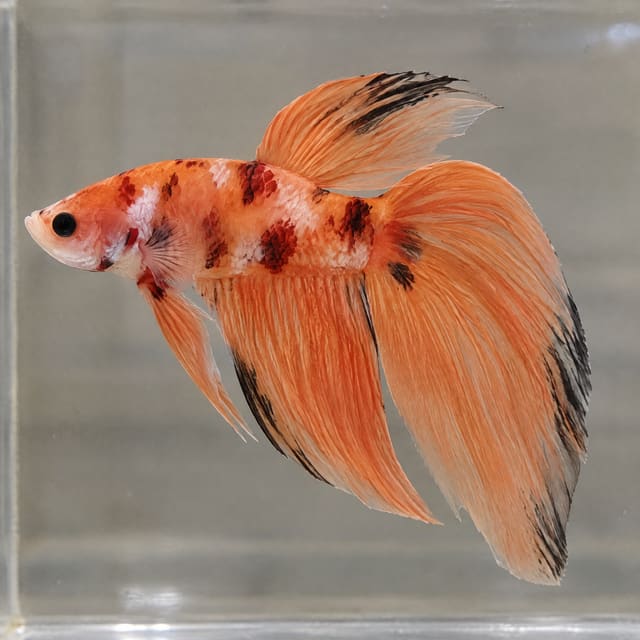
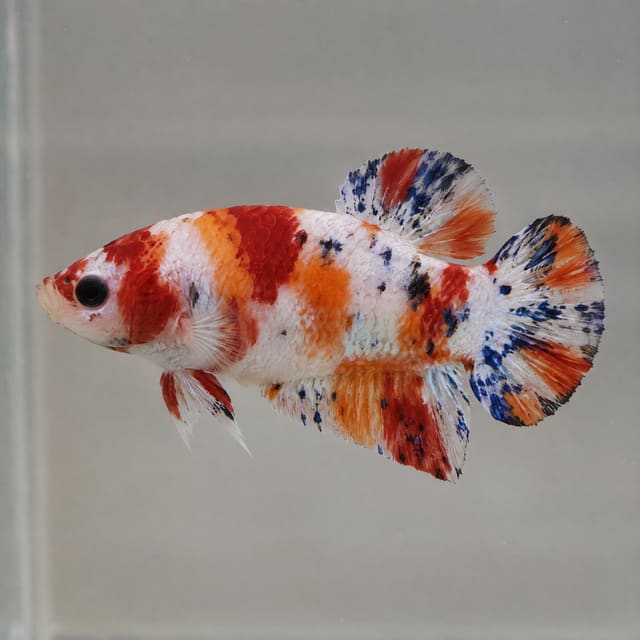
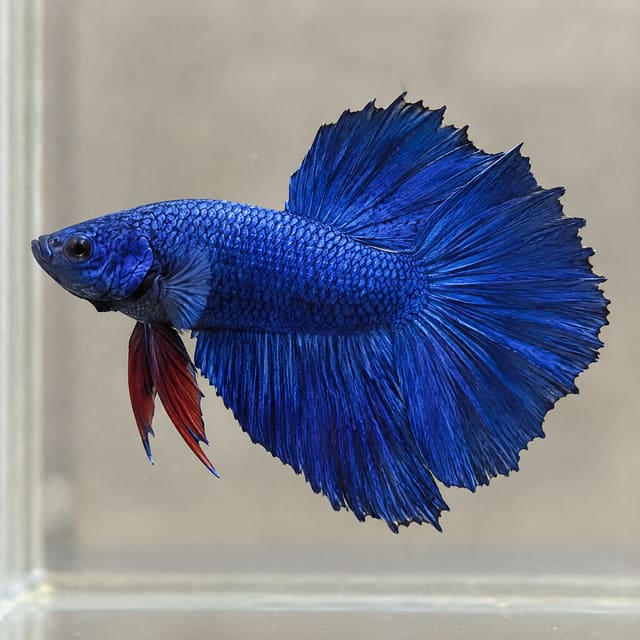
A metallic halfmoon betta is a male Siamese fighting fish, Betta splendens, bred for two things at once: a bright, mirror-like sheen over the body and fins, and a tail that opens into a full half circle when he displays. The example in our photographs is copper and steel-blue, with scales that catch the light like polished metal and a tail streaked in both colours. Like every ornamental betta, he is a captive-bred, domesticated fish; the wild species lives in still and slow-moving water in central Thailand.
"Metallic" is a breeders' description, not a scientific category. Fish skin reflects light through cells called iridophores, and a 2022 genomics study of domestic bettas notes that purines are the main component of the reflective platelets in those cells that make a fish look iridescent (Kwon et al., Science Advances). Breeders have selected lines in which that reflective layer is unusually strong, so the base colour looks as if it has been dusted with metal. The same study links the red-to-blue colour variation of ornamental bettas to particular regions of the genome, which helps explain why metallic males come in so many shades.
| Name you may see | What it tells you |
|---|---|
| Metallic halfmoon betta | The trade name for this male |
| Metallic | A strong reflective sheen over the base colour; the shade varies from fish to fish |
| Halfmoon | Long fins and a tail that spreads to 180 degrees, so the open fish looks like a capital D |
| Male | Males carry the long fins and the brightest colour; females are shorter-finned and calmer |
| Betta splendens | The species: the Siamese fighting fish, family Osphronemidae |
| Plakat or HMPK | The short-finned form; a halfmoon plakat has short fins with a D-shaped tail, so it is a different fish from this long-finned male |
Our guide to betta tail types shows how the halfmoon compares with veiltail, crowntail and double tail males. Browse all of our betta fish, the wider labyrinth fish and bettas category, or just the male Betta splendens to compare him with other halfmoons such as the Blue Halfmoon Betta, the Halfmoon Platinum Male Betta and the Butterfly Halfmoon Betta. If it is the metal-coloured look you want in a heavier-scaled fish, see the Copper Giant Dragon Betta.
One purchase supplies one live male metallic halfmoon betta in our Medium-large size grade. The grade describes the fish at dispatch, not the adult. OATA gives about 7 cm as the adult size for the species, Seriously Fish gives 70 mm standard length and FishBase 6.5 cm total length, so plan the tank for a fish of about 7 cm of body plus his fins.
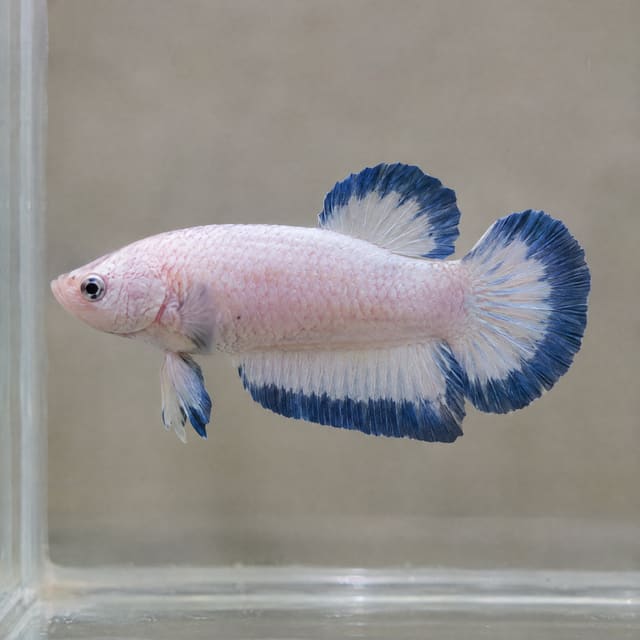
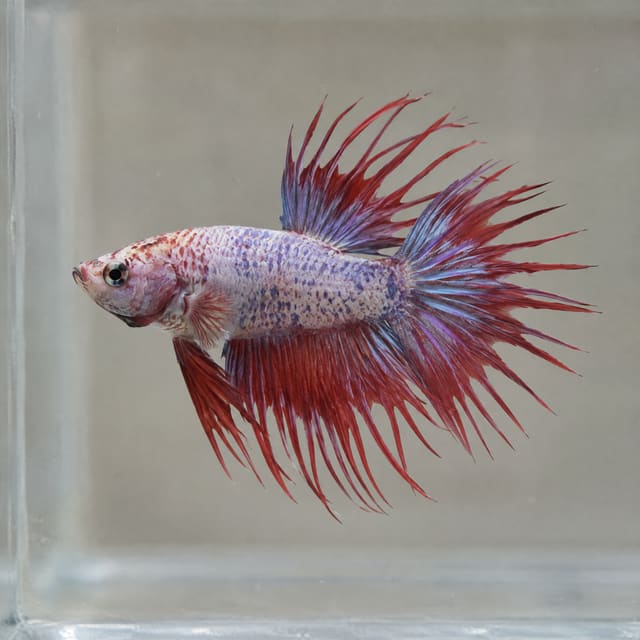
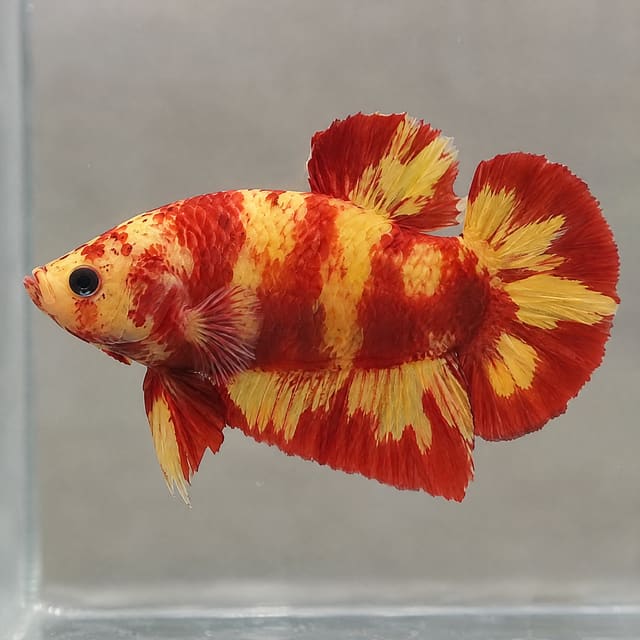
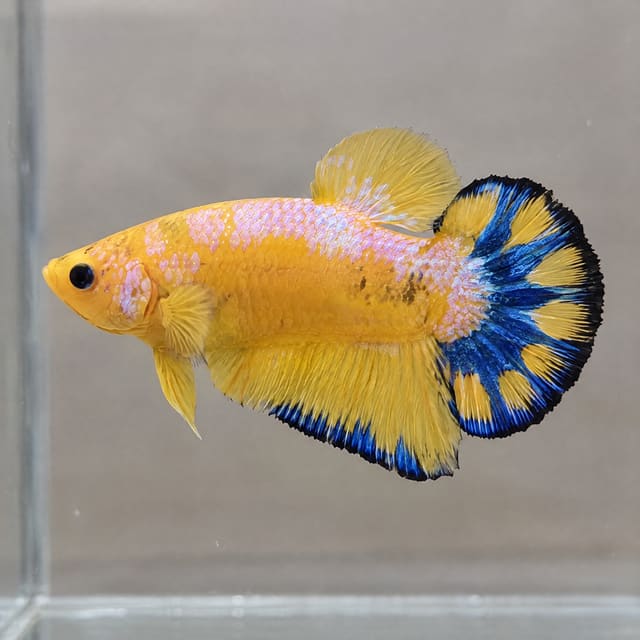
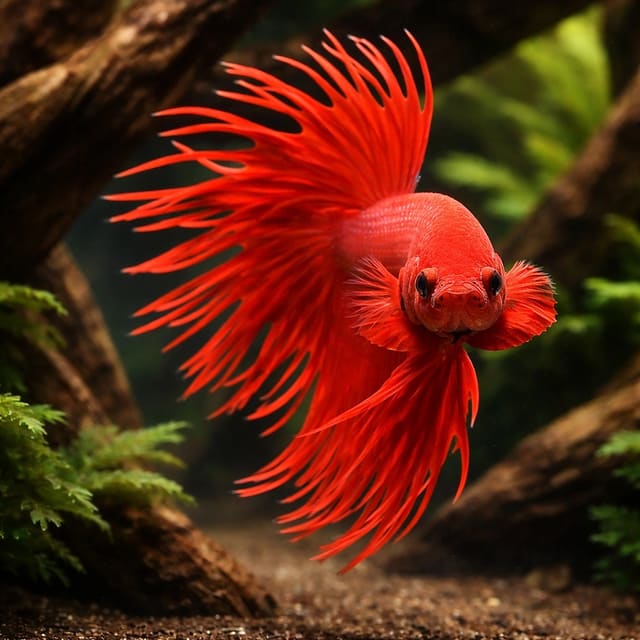
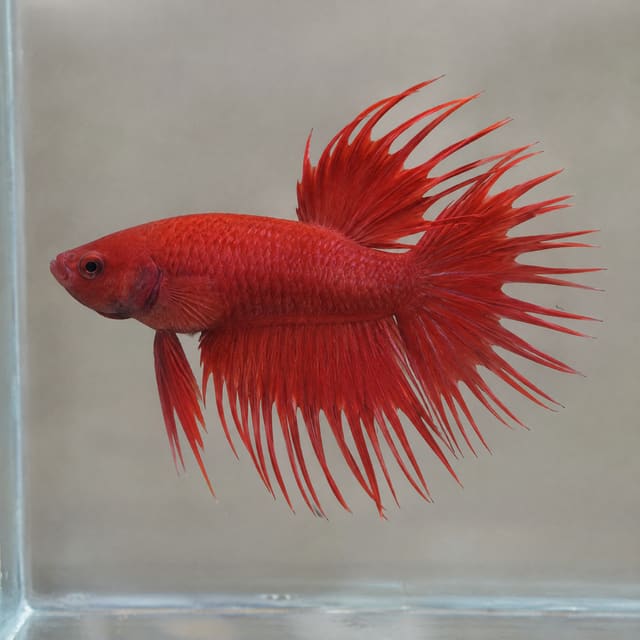
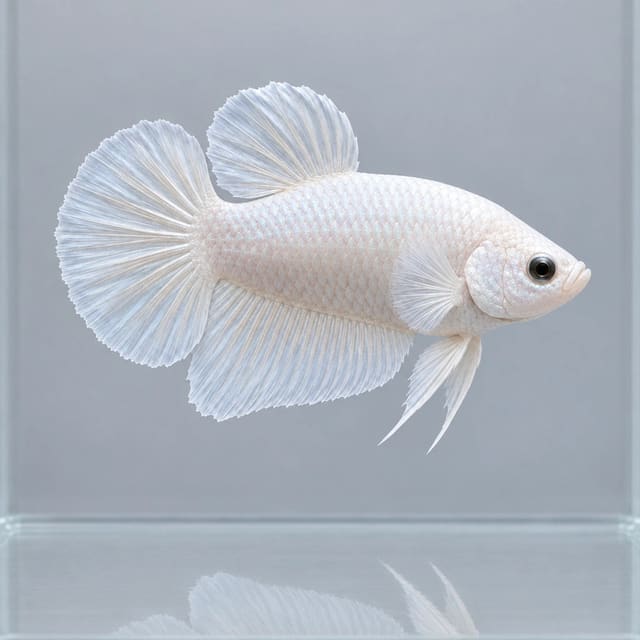
The photographs show the colour form, not the individual fish. Metallic males vary: one may lean more copper, another more blue, green or steel-grey, and the strength of the sheen changes with age, mood and lighting. A male who has just travelled often looks paler and holds his fins closer to his body; colour and finnage open up once he has settled in a warm, clean tank. As our betta care guide puts it, a colour name or tail label is not a scientific identity certificate: it describes a type, and every fish is an individual.
Read our delivery and Live Arrival Guarantee policy before you order so you know the dispatch days and what to do on arrival.
The published minimums differ. OATA's UK care sheet says at least 20 litres for a single male and asks you to buy the largest tank you reasonably can. Seriously Fish recommends a base of 45 x 30 cm, about 41 litres, for a single male or a pair, and says it does not support keeping bettas in tiny tanks or jars. We treat 20 litres as the floor and recommend 40 litres or more: a larger volume holds its temperature and water quality better, and lets you spread the filter flow so a long-finned male is not pushed around.
Shape matters for a halfmoon. His tail is large for his body, so he swims in short bursts and rests often. A long, fairly shallow tank with plants that reach close to the surface lets him rest near the top and breathe air without a long climb. Very tall, narrow tanks make him work harder for every breath.
| Step | What to check |
|---|---|
| Measure | At least 20 litres of real water; 40 litres or a 45 x 30 cm base is better |
| Subtract decor | Gravel, rock and wood displace water, so count what is left, not the size on the box |
| Check the lid | A cover with a small air gap above the water and no openings he could jump through |
Our tank volume calculator turns your measurements into litres. OATA asks for a heater all year round and a site away from draughts, radiators, direct sunlight, loud noise and vibration.
Bettas are labyrinth fish. Seriously Fish describes the labyrinth organ as a pair of chambers above the gills, lined with folded, blood-rich skin, that lets the fish take in air from the surface. OATA stresses that this does not reduce the need for clean water and a filter; it simply means the fish must always be able to reach the surface, and the air just above the water should stay warm and humid. Leave a small gap between the water and the cover glass, as OATA advises, and keep the lid on.
Halfmoon fins tear easily. OATA recommends live plants, or smooth plastic plants, pots and caves, and warns against sharp or rough edges that can rip long fins. Pull a pair of tights over any ornament you are unsure about: if the fabric snags, so will his fins.
| Area | Purpose |
|---|---|
| Broad leaves near the surface | Resting places where he can lie close to the air |
| Floating plants over part of the surface | Shade, calm water and a site for a bubble nest |
| Dense planting at the back and sides | Cover, and fewer reflections to flare at |
| Open water at the front | Room to spread the tail and display |
| Smooth gravel or sand | The substrates OATA suggests, with no sharp edges |
Keep the lighting moderate and on a regular day and night cycle. A betta that sees his reflection in bare glass all day may flare constantly, so plants against the side panes help him settle.
Domestic bettas are tropical fish that do best in warm, steady water. The sources give overlapping ranges, and we recommend aiming for the middle of the overlap rather than either edge.
| Reading | OATA | Seriously Fish | FishBase | Aim for |
|---|---|---|---|---|
| Temperature | 20-28°C | 22-30°C | 24-30°C | 26-28°C |
| pH | 6.0-8.0 | 6.0-8.0 | 6.0-8.0 | 6.5-7.5 |
| General hardness | 4-12 dGH | 1-15 dGH | 5-19 dH | 5-12 dGH |
| Carbonate hardness | 3-10 dKH | not given | not given | 3-10 dKH |
| Ammonia and nitrite | zero | not given | not given | zero |
| Nitrate | no more than 20 mg/l above tap water | not given | not given | as low as possible |
The 26-28°C target is Tropical Fish Co's practical figure for a domestic male, explained in our betta temperature guide; it sits inside every published range. Use a thermostatic heater and check it with a separate thermometer, because a heater stuck on or off is the commonest cause of a sudden swing.
UK tap water varies from soft to very hard depending on where you live, and your water company publishes the hardness for your postcode. Seriously Fish notes that domestic bettas accept a pH from 6.0 to 8.0 (wild-caught fish prefer softer, more acidic water), so most UK tap water treated with a dechlorinator suits this fish without any chemistry. What matters more is consistency: each water change should match the tank's temperature and hardness. Our water chemistry guide explains pH, GH and KH, and the water matcher compares your test results with this fish's range.
OATA calls a filter essential for every betta tank, but asks for a gentle current. A halfmoon tail acts like a sail: strong flow pushes him around and tires him, and our betta care guide notes that very long fins can change how a fish copes with flow and furnishings. An air-driven sponge filter, or a small internal filter with its outlet turned against the glass or softened with a sponge, gives clean water without a current he has to fight. Our guide to aquarium filtration explains how to size it.
Remove dead leaves and uneaten food as you see them. In a small tank, a few leftover pellets can push ammonia up within a day.
OATA recommends a good-quality flake or pellet, ideally one made for bettas, fed once a day and only as much as he finishes within a few minutes, with small live or frozen foods such as daphnia, small bloodworm or tubifex for variety. Seriously Fish suggests regular small live or frozen meals of daphnia, brine shrimp or bloodworm for colour and condition, and warns that bettas are prone to obesity, so overfeeding is a bigger risk than underfeeding. In the wild, FishBase records the species eating zooplankton and insect larvae, including mosquito larvae.
A swollen belly, resting on the bottom after meals or long, stringy droppings usually mean too much food. Our betta care guide covers portion size and daily care in more detail.
Before he arrives, check that ammonia and nitrite read zero and that the heater is holding the target temperature. OATA's floating-bag method suits bettas well, and keeping the light off helps a stressed male settle.
| Checkpoint | What to do |
|---|---|
| Day 1 | Lights off, no food; let him explore |
| Day 2 | A first small meal; remove anything left |
| Days 2-7 | Watch breathing, fins, colour and appetite every day |
| Day 3 and day 7 | Test ammonia and nitrite |
Our guide to acclimatising new fish covers the same steps with pictures. A new male often hides and stays pale for a day or two; worry only if he lies on the bottom breathing hard, refuses food for several days or his fin edges start to fray.
The sources agree on the main rule. OATA says two males must never share a tank, because they fight until one is badly injured or killed. Seriously Fish says ornamental strains are best kept alone, and that males and females are normally kept apart unless you are breeding. The less obvious risk runs the other way: OATA notes that males are not usually aggressive to other species but are often fin-nipped, which causes stress, disease and death. A halfmoon tail is an easy target.
| Suits | Avoid |
|---|---|
| Living alone in a planted tank | Any other male betta |
| A few very calm, small, short-finned fish in a larger planted tank | Females, unless you have a planned breeding set-up |
| Snails, in a tank big enough for both | Fin-nippers, including many barbs and some tetras |
| A heavily planted tank with plenty of surface cover | Fish with long or showy fins, which a male may treat as rivals |
| Quiet tank mates that feed at the bottom | Fast, pushy feeders that take his food |
Our betta tank mates guide and tank mates tool help you check a planned mix. Our own advice is that no species is automatically safe with a betta, and one male per aquarium is the safest default.
A healthy male has clear, bright eyes, intact fins and scales, steady breathing and a good appetite. OATA lists clamped fins, flicking against objects and shimmying as signs of trouble, and advises against buying a healthy-looking fish from a tank where others are sick. Seriously Fish adds that cheap, mass-produced strains can carry genetic defects or health problems, so watch any new fish closely for the first weeks.
| If you see | Do this first |
|---|---|
| Ragged, darkening or shortening fin edges | Test the water, change some of it and read our fin rot treatment guide |
| A clean split in the tail overnight | Check the decor for sharp edges; keep the water clean and warm while it heals |
| Lying on the bottom with fins clamped | Check the heater and thermometer, then test ammonia and nitrite |
| Swollen belly and no interest in food | Skip a day of food, then feed less |
| White spots, or a fine dusty coating on the skin | Test the water and get advice before you treat |
Do not mistake a metallic sheen for illness. The shine of a metallic betta lies evenly over the scales and looks the same from day to day, while a parasite coating shows as fine dust or patches that come and go and usually arrives with scratching or clamped fins.
Bettas are bubble-nesters. OATA describes the female showing vertical bars when she is ready, the male building a raft of bubbles at the surface, sometimes with bits of plant, and a courtship dance before the eggs go into the nest. Seriously Fish says the eggs hatch in 24 to 48 hours, the fry stay in the nest for another three or four days until the yolk sac is used up, and the male guards the nest and returns any eggs that fall. Remove the female after spawning, because the male defends the nest fiercely, and turn the filter right down so the nest is not broken. The fry need the smallest first foods, then microworm and newly hatched brine shrimp.
Ornamental bettas have a long history. Kwon and colleagues cite reports of fighting fish being bred in Thailand from as early as the 14th century, with breeding for looks starting in the early 20th century, and they found that 28 of the 37 ornamental bettas they sampled (76%) carry some ancestry from other Betta species. The wild Betta splendens is listed as Vulnerable on the IUCN Red List (assessed in 2011, according to FishBase), and Seriously Fish warns that ornamental fish released into the wild are already affecting the genetics of some wild populations. Never release a betta, or any aquarium fish, into ponds, rivers or drains.
A male Siamese fighting fish, Betta splendens, from ornamental lines bred for a strong reflective sheen over the body and fins and a halfmoon tail that spreads to a full 180 degrees, so the open fish looks like a capital D. The metallic shade varies from fish to fish.
About 7 cm of body, according to OATA. Seriously Fish gives 70 mm standard length and FishBase 6.5 cm total length. The long fins make him look larger than the body measurement.
OATA gives at least 20 litres for one male. Seriously Fish recommends a 45 x 30 cm base, about 41 litres. We recommend 40 litres or more, with a heater, a gentle filter and a lid that leaves a small air gap above the water.
A steady 26 to 28 degrees C, our practical target for a domestic male. It sits inside OATA's 20-28 degrees C, Seriously Fish's 22-30 degrees C and FishBase's 24-30 degrees C.
Never with another male betta. Living alone is the safest choice. A few very calm, small, short-finned fish can work in a larger planted tank, but avoid fin-nippers, fish with long or showy fins and fast feeders that take his food.
No. The photographs show the colour form, not the individual fish. Metallic males range from copper to blue, green or steel-grey, and the sheen and fins look their best once he has settled in a warm, clean tank.
A small betta pellet, granule or flake once a day, only as much as he finishes within a few minutes, with daphnia, brine shrimp or bloodworm two or three times a week. Bettas put on weight easily, so overfeeding is the main risk.
The water is the same, but the large tail needs gentle flow, smooth decor and resting places near the surface. Halfmoon fins tear more easily than short fins, and strong current makes swimming hard work.
No reviews for this item yet. Bought one? Honest reviews only, good or bad.
What customers say about ordering from us
Easy website plenty of info on fish your buying great to pick a time slot
TRACEY DURRANT · 7 Oct 2026
Got some lovely fish thank you
Kevin Mackie · 7 Oct 2026
Reviews of our shop, collected by Judge.me, an independent third-party review collector. Newest first.
Moved by UK carriers licensed to handle live animals
Hand-packed with oxygen bags, poly box, heat pack
Email photos the same day; an optional unboxing video helps us review problems faster — claim terms apply
Klarna & PayPal Pay in 3 at checkout