By Tropical Fish Co Editorial Team
The useful answer is a range, not a magic number
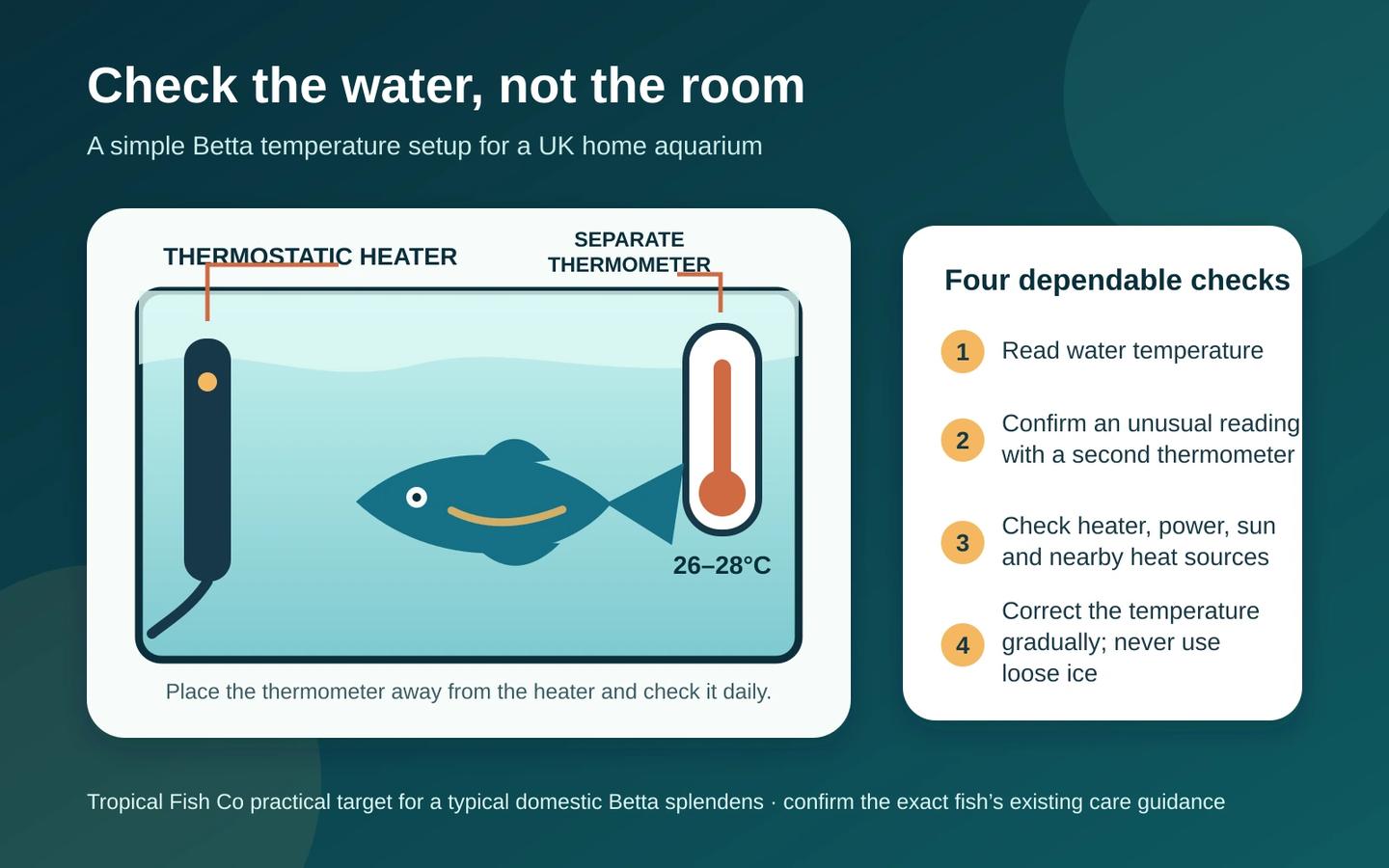
For a typical domestic Betta splendens, Tropical Fish Co uses 26–28°C as a practical target. That is our cautious husbandry decision, not a claim that every Betta has one scientifically proven “perfect” temperature.
Why the qualification? Credible sources publish different ranges. FishBase reports 24–30°C for the species, the UK Ornamental Aquatic Trade Association (OATA) gives 20–28°C, and PetMD's veterinarian-authored care sheet gives 76–81°F—about 24.4–27.2°C [2][3][7]. Those figures overlap, but their purpose and context differ.
If the aquarium is outside our target, first confirm the reading and the fish's established conditions. Check the heater, room and water quality, then make any correction gradually. An abrupt change can create a second problem while you are trying to solve the first.
The accepted trade species on this page is Betta splendens Regan, 1910, in the family Osphronemidae [1]. “Betta” can also mean other species or hybridised domestic stock, so advice from the seller of the exact fish still matters.
Why trustworthy temperature sources disagree
Temperature figures are easy to copy and easy to misuse. A field observation, species profile, laboratory colony and domestic care sheet do not answer exactly the same question.
| Source | Temperature context | How to use it here |
|---|---|---|
| FishBase | 24–30°C species profile | A broad biological reference, not a promise that every point is equally suitable for every pet |
| OATA | 20–28°C UK care sheet | UK trade-body husbandry context; it also says a heater is required year-round |
| PetMD | 76–81°F (about 24.4–27.2°C) | Veterinarian-authored domestic care guidance that prioritises stability |
| Lichak et al. | 28°C research colony | A documented laboratory protocol, not a universal optimum for adult pets |
| Tropical Fish Co | 26–28°C practical target | A cautious domestic target chosen inside the published ranges |
The peer-reviewed laboratory review is useful because it documents an actual Betta research colony held at 28°C. It is not permission to turn one colony's reproduction-oriented protocol into a universal rule [5].
Natural habitat figures need the same care. University of Florida Extension reports a sampled Thai breeding habitat averaging 29.9°C, with a 27–31.5°C range [6]. That describes one wild population and season. It does not mean a domestic aquarium should be set to 29.9°C, nor that warm, shallow, low-oxygen habitat is a welfare target to recreate.
Do Betta fish need a heater in the UK?
Plan on a heater. OATA's UK Betta care sheet says one is required all year [3]. A warm room is not enough evidence because the water can differ from the air and can change with tank position, night-time heating, open windows and water changes.
Use two separate pieces of equipment:
- A thermostatic aquarium heater suitable for the aquarium.
- A separate thermometer that measures the water itself.
The RSPCA also recommends a thermostat-controlled heater and a separate digital thermometer, checked daily [4]. The thermometer is not a decorative extra: it is how you notice a heater that is unplugged, incorrectly set, undersized for the room or malfunctioning.
Choose heater capacity without a false formula
Do not rely on a universal rule such as “25 watts per 10 litres”. Heater performance depends on more than volume:
- the difference between the coldest room temperature and the target water temperature;
- the tank's volume, shape, cover and minimum water depth;
- the heater's design, thermostat and permitted orientation;
- nearby windows, radiators, sunlight and draughts;
- whether the manufacturer rates the model for that exact use.
Follow the maker's instructions for both aquarium volume and temperature lift. If the manual or label is unclear, ask the manufacturer or an aquatic retailer before using it. Do not assume a larger heater is automatically safer: excess capacity does not repair a poor thermostat, incorrect installation or missing thermometer.
How to measure Betta water temperature
Use the same simple routine so that readings are comparable:
- Put the aquarium away from direct sunlight, radiators and strong draughts.
- Install the heater exactly as its instructions specify, including minimum water level and safe isolation before maintenance.
- Place a separate thermometer where it reads ordinary tank water rather than the small warm area immediately beside the heater.
- Check the reading daily and after a heater, room or water-change event.
- If the result is surprising, compare a second thermometer before changing the setup.
- Record repeated readings if the temperature appears to drift; one glance cannot show the daily pattern.
This is deliberately a measurement process, not a promise that colour, a bubble nest or one swimming posture proves the aquarium is at the right temperature.
What to do when the reading is lower or higher than expected
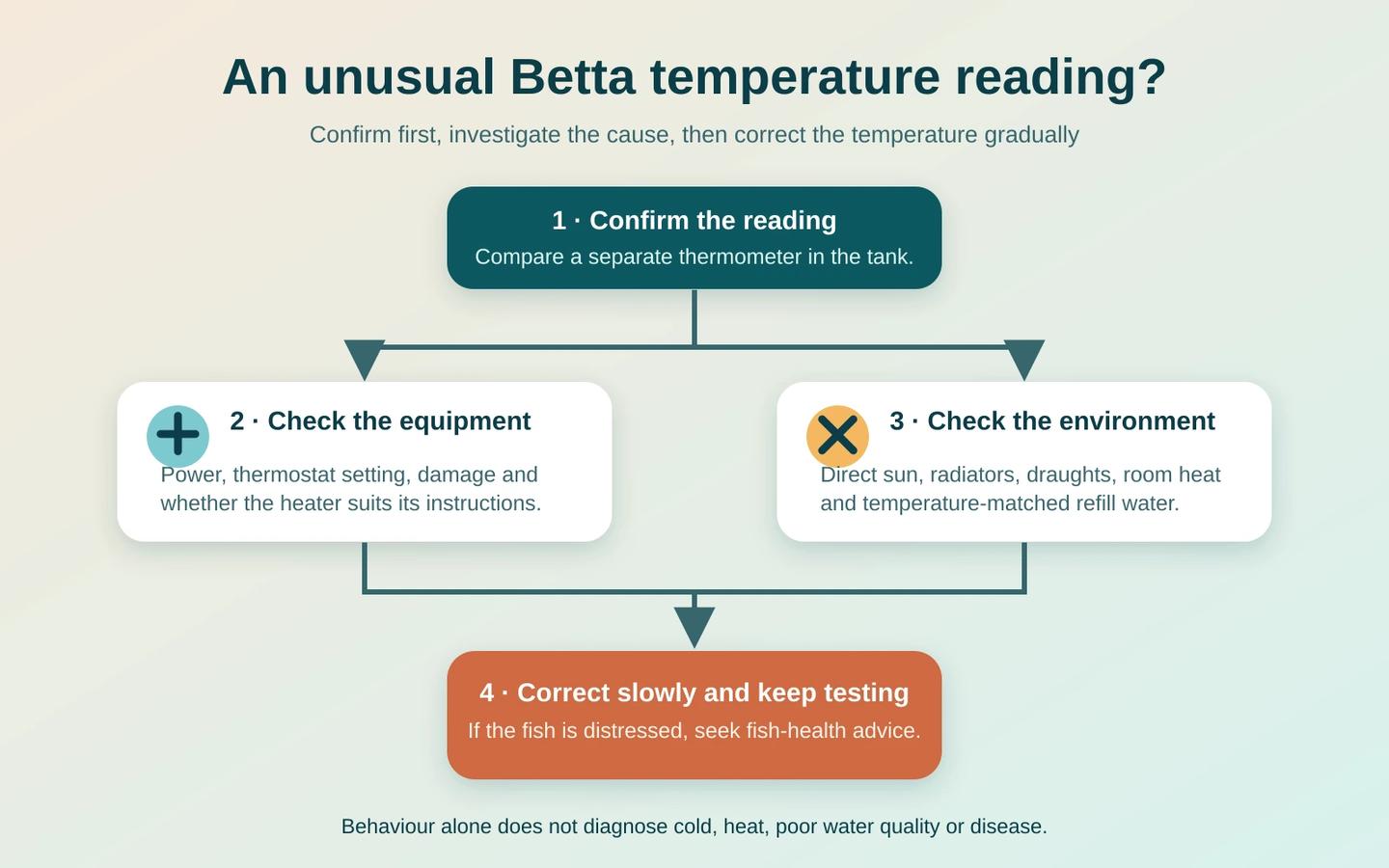
First: confirm and investigate
- Compare a second thermometer in the water.
- Check power, plug, thermostat setting, heater indicator and visible damage without putting hands into the tank around unsafe electrical equipment.
- Check whether sun, a radiator, a cold window, a draught or a room-temperature change explains the movement.
- Review the most recent water change. The RSPCA advises matching replacement water to the aquarium temperature [4].
- Test the normal water-quality parameters. A temperature reading does not rule out ammonia, nitrite, oxygen or another husbandry problem.
Then: correct gradually
Use the heater's controls and the room environment to return the tank gradually towards its established target. Do not add loose ice, press a frozen pack against the fish, pour in hot water or make a large temperature-changing water replacement. Keep the lid secure because Bettas can jump.
If two thermometers confirm overheating and the heater is stuck on or damaged, isolate power safely before touching the aquarium and replace the equipment or seek qualified advice. If the fish shows severe breathing difficulty, loss of balance, collapse or rapid deterioration, contact a fish-experienced veterinary professional or knowledgeable aquatic retailer promptly.
Behaviour is a warning, not a thermometer
OATA lists changes in swimming, colour, feeding, breathing and temperament as signs that a fish's health may be affected [3]. These signs are nonspecific. A Betta resting low in the tank might be cold, but water quality, disease, age, stress, injury or normal resting behaviour can produce a similar observation.
Use this order:
- Measure temperature.
- Test water quality.
- Check equipment and recent changes.
- Observe breathing, balance, appetite, fins, skin and waste.
- Escalate when signs are severe, persistent or unexplained.
Do not raise the temperature as a general treatment for lethargy, fin damage, “swim-bladder” signs or suspected infection. This page does not provide a heat-treatment recipe, and a diagnosis should not be guessed from one symptom.
UK winter and summer checks
During colder weather
- Read the tank thermometer rather than relying on the room thermostat.
- Keep the aquarium away from draughts and cold glazing.
- Check that the heater can maintain the chosen target at the room's coldest normal time.
- Temperature-match conditioned replacement water.
- Keep the manufacturer's instructions and a safe replacement plan available.
During warmer weather
- Prevent direct sunlight and nearby heat from reaching the aquarium.
- Confirm any high reading with a second thermometer.
- Improve safe room ventilation while keeping the aquarium securely covered.
- Check the heater is regulating rather than heating continuously.
- Maintain surface movement appropriate for the fish and monitor water quality.
- Never use floating ice bags or an uncovered tank as routine cooling methods.
Warm water can hold less dissolved oxygen, but a Betta's ability to breathe atmospheric air does not make poor oxygenation or dirty water acceptable. Keep unobstructed surface access and normal filtration and maintenance.
Does water movement change the target?
No. Temperature and flow are separate parts of the setup. University of Florida Extension describes Bettas as preferring calm water and warns that heavy filtration can be stressful [6]. Use gentle, suitable circulation and preserve surface access, but do not use low flow as a reason to skip the heater, thermometer, water testing or maintenance.
Before buying a Betta
Have the cycled aquarium, secure cover, gentle filter, thermostatic heater, separate thermometer and water tests ready first. Ask the seller what temperature and water the exact fish is currently kept in so that any transition can be planned rather than guessed.
When that setup is ready, browse the current Betta range. Availability and prices change, so the shop hub—not this care article—is the source for current stock. For the rest of the species' needs, read our Betta fish care guide, and use the water chemistry guide to interpret the tests alongside temperature.
How this guide was prepared
The Tropical Fish Co Editorial Team compared current taxonomy, a scientific species profile, a peer-reviewed laboratory husbandry review, UK trade and welfare guidance, university-extension natural-history context and veterinarian-authored pet guidance. Where those sources answer different questions, the difference is shown rather than hidden. The 26–28°C figure is explicitly our practical domestic target, and the reader correction link below is available for evidence-backed updates.