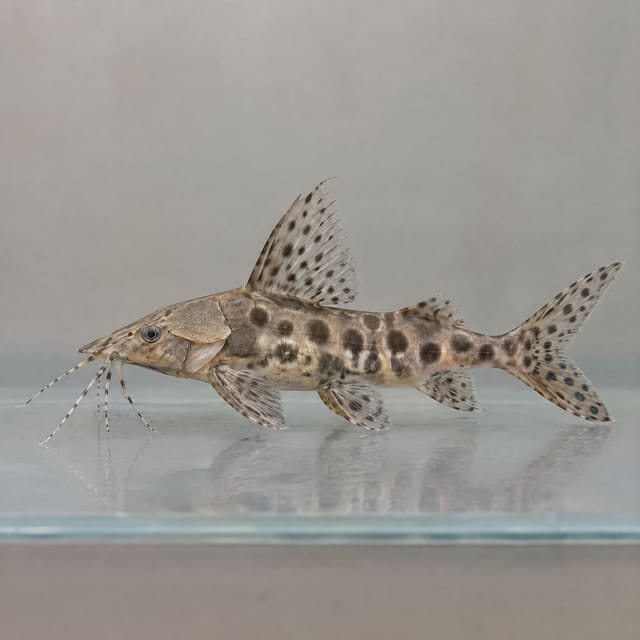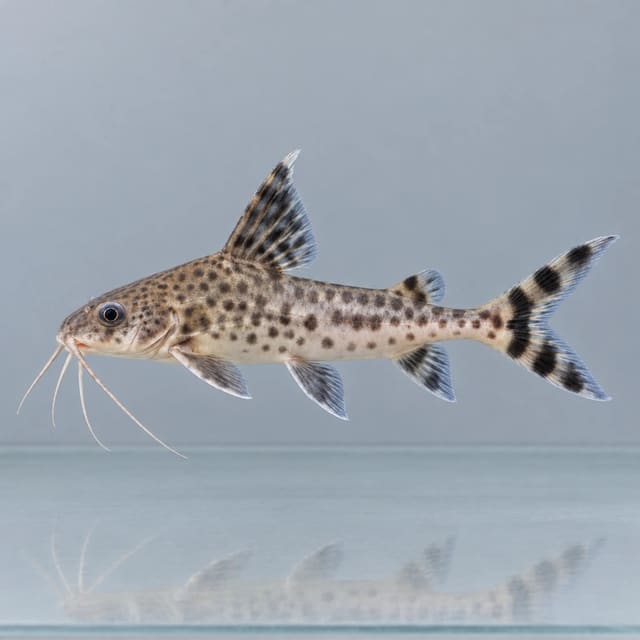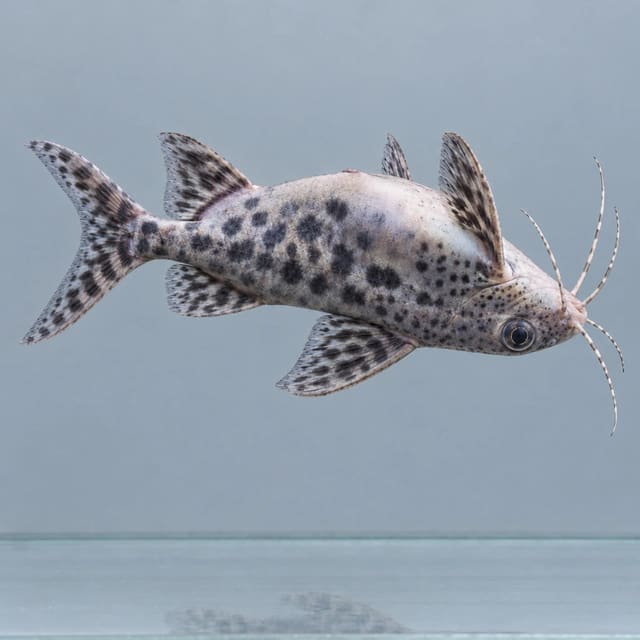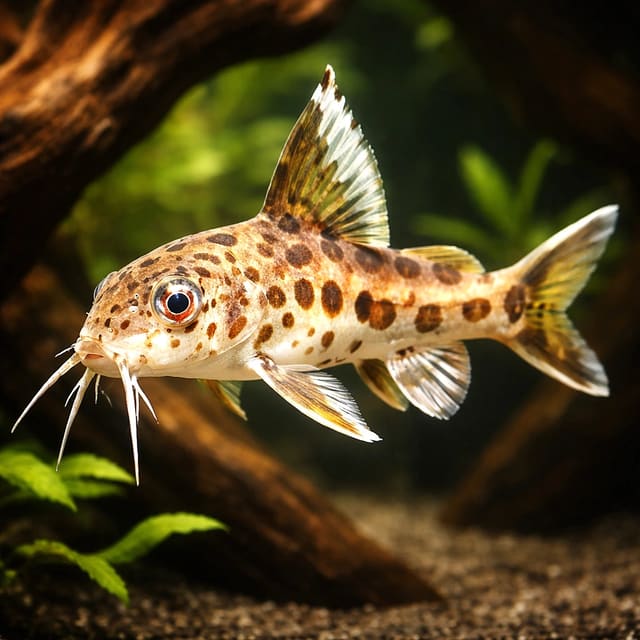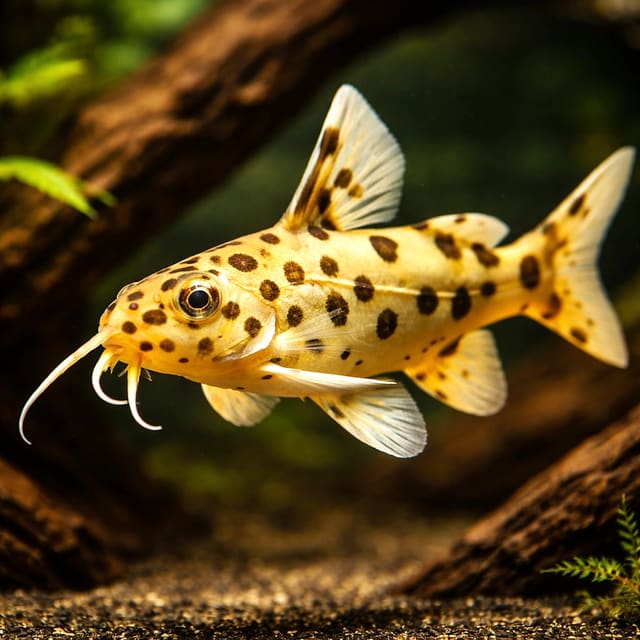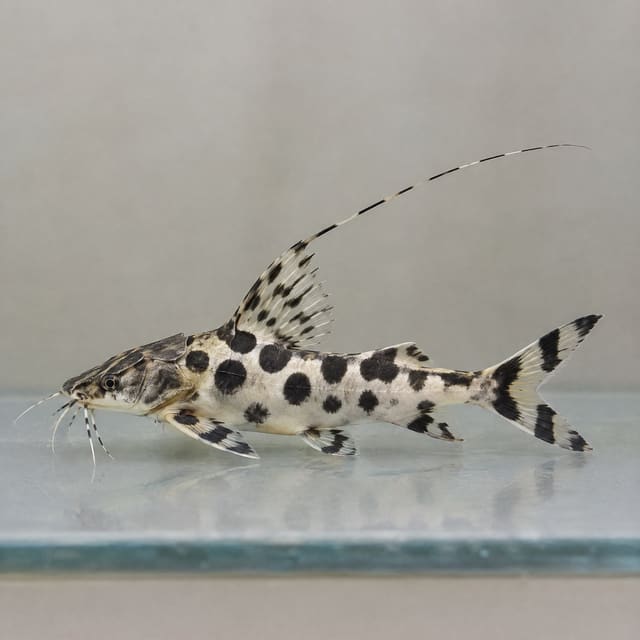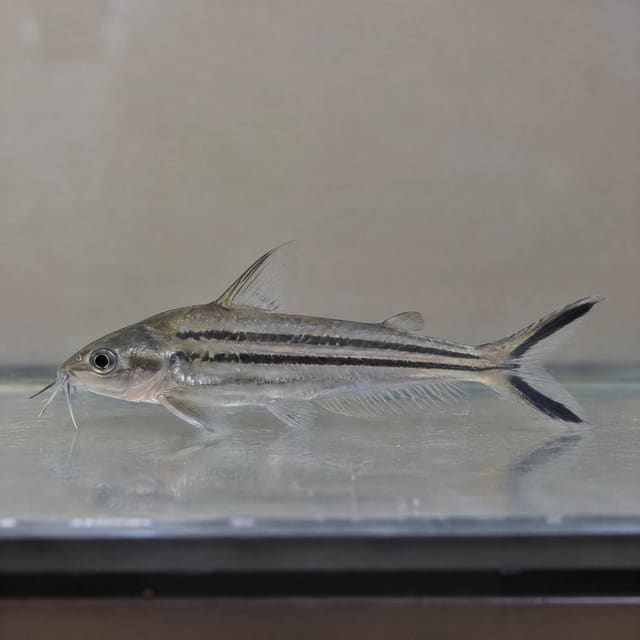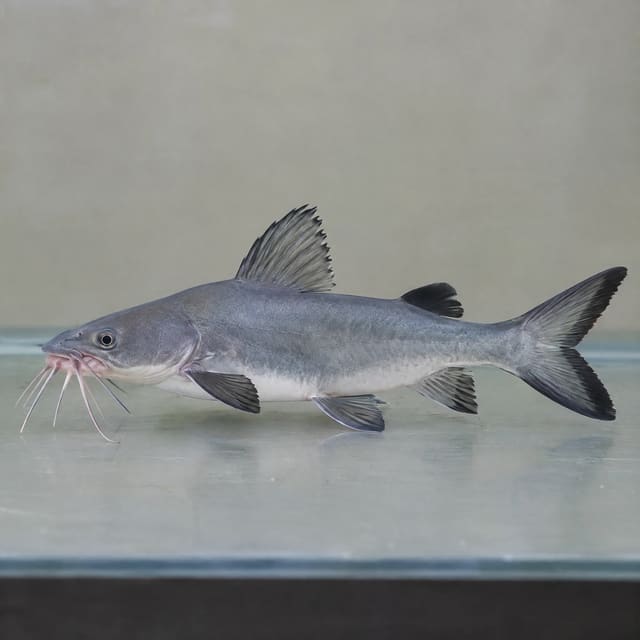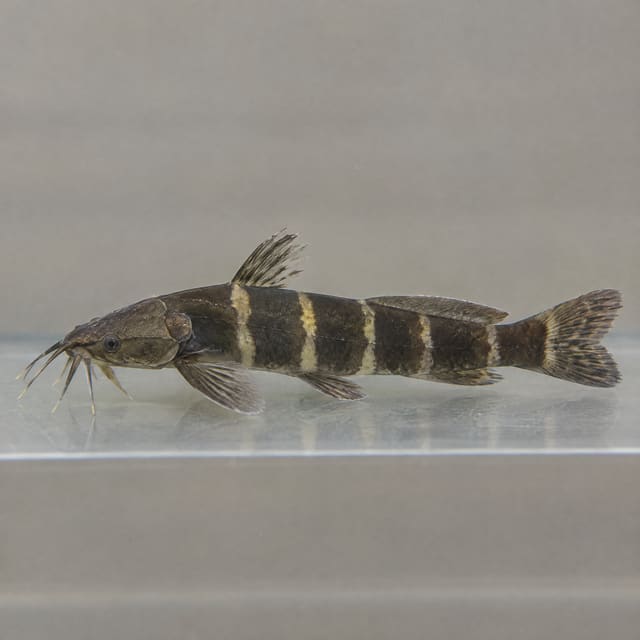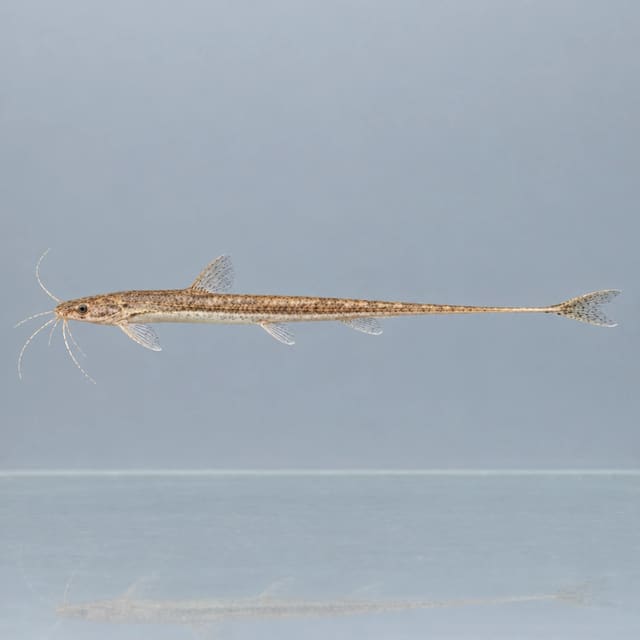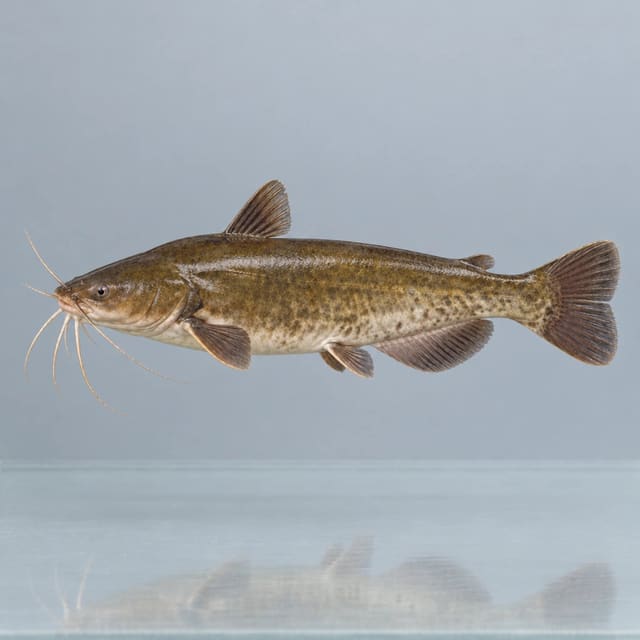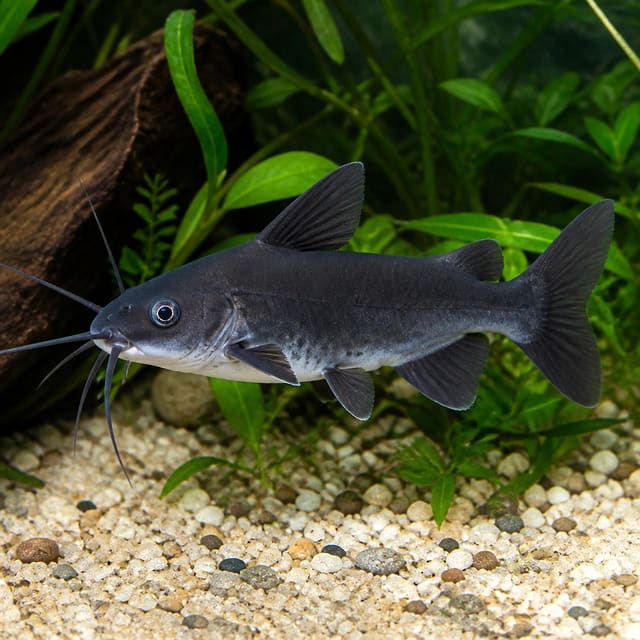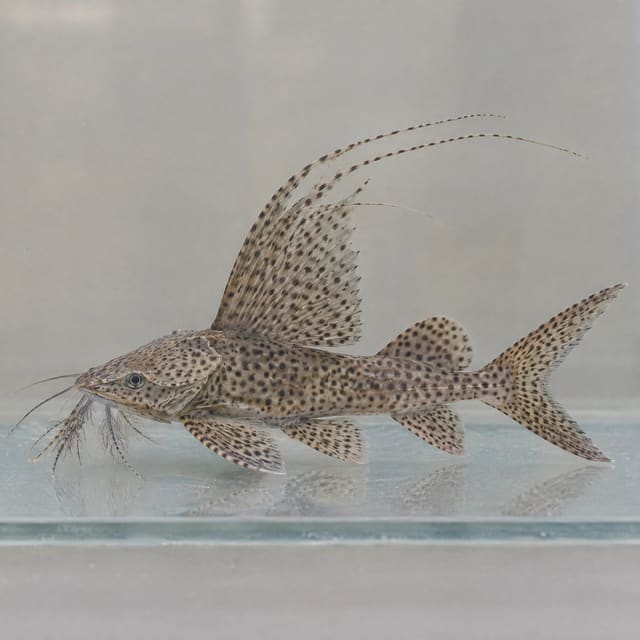
Featherfin Synodontis (Synodontis eupterus)
22–26°C · pH 6.2–7.5
£6.99
The One-Spot Synodontis (Synodontis notatus), also called the Domino Syno, is a large Congo squeaker catfish with a silvery-grey body and usually one big dark spot on each side. It grows to about 25–27 cm, needs at least a 120 × 30 cm base and is best kept as a single fish with robust tank mates. Sold individually as one live fish.
Adult size is the maximum length this species reaches at full maturity (scientific sources). The livestock you receive will be younger and smaller. Product-photo provenance and any image-specific limitations are stated on the listing.
Synodontis notatus
The One-Spot Synodontis (Synodontis notatus), also called the Domino Syno, is a large Congo squeaker catfish with a silvery-grey body and usually one big dark spot on each side. It grows to about 25–27 cm, needs at least a 120 × 30 cm base and is best kept as a single fish with robust tank mates. Sold individually as one live fish.
Adult size is the maximum length this species reaches at full maturity (scientific sources). The livestock you receive will be younger and smaller. Product-photo provenance and any image-specific limitations are stated on the listing.
The One-Spot Synodontis (Synodontis notatus) is a large squeaker catfish from the Congo River basin. FishBase records it throughout the basin, including Pool Malebo and the drainages of the Kasai and Ubangi, in both the Democratic Republic of the Congo and the Republic of the Congo. Most fish carry one big dark spot on each silvery-grey flank, which gives the One-Spot Synodontis its name.
What sets it apart from many of its relatives is its timetable. Seriously Fish describes it as far more active by day than many Synodontis, so it makes a good catfish for a tank of lively, robust fish where you actually want to see the catfish. In return it grows large, at 25 cm or more, and it needs a big aquarium and companions it cannot swallow.
| Name | What it means |
|---|---|
| One-Spot Synodontis, One-spot Squeaker | The common names, after the usual single flank spot |
| Domino Syno | Trade name listed by Planet Catfish |
| Synodontis notatus Vaillant, 1893 | The current scientific name |
| Synodontis notata | An older spelling that many books and labels still use |
| S. maculatus, "S. ocellata" | A synonym, and an invalid name some spotted forms are sold under |
The Latin notatus means marked. ScotCat notes that it refers to the one to four blackish spots on the sides, usually one. Browse our other Synodontis squeakers, such as the Large-Spot Synodontis, to compare patterns.
One purchase supplies one live One-Spot Synodontis. The size option is "Standard": the fish is sent at the size currently available, which is well below the adult size. Sex is not chosen or guaranteed.
The photographs show the type of fish, not the individual you will receive. ScotCat describes a grey-brown to olive back with a gold sheen around the gill cover in healthy fish and a whitish underside. The number of spots varies more than the name suggests, which the next section explains.
Before you order, read our delivery and Live Arrival Guarantee terms and make sure the aquarium is mature and large enough for the adult.
The published sizes are close but not identical. Seriously Fish gives 275 mm standard length, Planet Catfish 265 mm standard length, FishBase 26.5 cm total length and ScotCat 23 cm. Standard length stops at the base of the tail, so a fish at the top of that range is longer still. Plan for a heavy-bodied catfish of 25 cm or more.
Seriously Fish recommends a base of at least 120 × 30 cm, roughly 108 litres, and Planet Catfish agrees that an adult needs a tank of at least 120 cm. Treat that as the minimum for one fish on its own. With other large fish, or if you hope to keep more than one Synodontis, go longer and deeper.
Place the aquarium away from radiators, windows and draughts, as OATA's catfish care sheet recommends, and use a heater all year round. Fit a secure lid: a large, active catfish can push loose cover glass aside.
Seriously Fish recommends a dimly lit aquarium with a soft substrate and rocks, driftwood and twisted roots arranged into hiding places, plus floating plants to diffuse the light. It adds that planting is welcome but not essential, because this species often swims in midwater. Planet Catfish suggests caves made from pipes, rocks or bogwood, with an area of open swimming space as well.
| Area | Purpose |
|---|---|
| One large cave per Synodontis | A secure home base it can defend without fighting |
| Bogwood and roots along the back | Shade, cover and surfaces to rasp |
| Open water in the middle | Room for a catfish that swims in midwater by day |
| Floating plants | Softer light, which keeps it confident |
| Sand at the front | Feeding area that is easy to siphon |
Use smooth sand or fine gravel; OATA notes that catfish barbels are sensitive and need a soft bottom. Stand heavy rocks on the glass before adding sand, because a large Synodontis will dig under anything it can move.
Planet Catfish describes it as not a delicate species that tolerates most water conditions. The figures differ slightly between sources: Seriously Fish gives 22–25°C, pH 6.5–7.5 and 8–18 dGH; Planet Catfish and FishBase give 22–26°C, pH 6.0–7.5 and 4–15 dGH; ScotCat gives 22–26°C and pH 6.5–7.2. The values below sit inside all of them.
| Reading | Target |
|---|---|
| Temperature | 23–25°C (sources span 22–26°C) |
| pH | 6.5–7.5 |
| General hardness | 8–15 dGH |
| Ammonia | 0 mg/l |
| Nitrite | 0 mg/l |
| Nitrate | No more than 20 mg/l above your tap water |
The ammonia, nitrite and nitrate limits are OATA's. Much of the UK has moderately hard tap water, which suits this fish once it is treated with a conditioner to remove chlorine or chloramine. Some UK supplies are very soft and may sit below 8 dGH, so check your water company's figures, compare them with our water matcher, and read our water chemistry guide before adjusting anything.
A 25 cm omnivore that eats meaty foods produces a lot of waste. For a 108-litre tank, Seriously Fish suggests a filter turning the water over four to five times an hour, which it puts at 430–540 litres per hour, and a heater of roughly 75–100 W in a room at about 20°C. Larger tanks need proportionally more.
Add fish gradually so that the filter bacteria keep pace; OATA explains that stocking too quickly causes "new tank syndrome". Large fish make water problems worse faster, so keep testing even when the water looks clear.
Synodontis are omnivorous and unfussy, Seriously Fish says, taking frozen, live and dried foods and rasping at vegetable matter such as shelled peas and cucumber with the teeth in the lower jaw. Planet Catfish adds that bloodworm, shrimp and chopped cockle make it grow quickly and put on weight, while a sinking catfish pellet will do day to day.
Because it is active by day, it usually feeds alongside the other fish rather than waiting for darkness. If faster fish beat it to the food, add a second portion near its cave after the lights go out.
Add it only to a mature, filtered aquarium with zero ammonia and nitrite. OATA recommends double-bagging catfish because their spines can pierce a bag, and acclimatising in a darkened room: float the sealed bag for about 10 minutes, add small amounts of aquarium water to it over up to 20 minutes, then release the fish with as little bag water as possible. Our step-by-step acclimatisation guide covers each stage.
| Checkpoint | What to do |
|---|---|
| Before arrival | Test the water, place the caves and dim the lighting |
| Arrival | Acclimatise, release near cover and leave the lights off for the day |
| Days 1–3 | Offer small sinking meals and watch which cave it claims |
| Days 4–7 | Watch for chasing between it and other bottom fish |
| End of week | Retest the water and do the usual water change |
A newly arrived fish may hide for a few days before showing the daytime activity the species is known for. Rapid breathing, hanging at the surface or lying on its side are signs to test the water at once.
Seriously Fish says it should not share a tank with any fish small enough to be eaten, and is not recommended for a general community because of its adult size. Its suggested companions are alestiid African tetras, robust cichlids (especially West African species), Ctenopoma, mormyrids, knifefish, gouramis and the larger rasboras and barbs. Its daytime activity makes it a good fit for tanks of boisterous fish.
| Suits | Avoid |
|---|---|
| Congo Tetras and the Long-Finned African Tetra | Neon tetras, small rasboras and anything that fits in its mouth |
| Bushfish such as the Leopard Bushfish | Dwarf shrimp |
| Mormyrids such as the Elephantnose Fish | A second One-Spot Synodontis in an average-sized tank |
| Gouramis such as the Pearl Gourami | Several Synodontis competing for too few caves |
| Robust West African cichlids | Very small or slow fish that rest on the bottom at night |
This is where the sources disagree. Seriously Fish says it may become territorial as it matures, especially towards other Synodontis, and is particularly aggressive towards its own species, so only one should be kept unless the tank is very large. Planet Catfish describes it as peaceful despite its size and tolerant of other catfish and of its own kind, and ScotCat calls it quite well behaved if it has room. We recommend one per aquarium, or a cave each in a tank well over 120 cm if you want more. Other large Synodontis to compare include the Angel Squeaker and the Featherfin Synodontis. Check your plan with our tank mates checker, read our cichlid care guide if you are pairing it with West African cichlids, and browse catfish and plecos, other African catfish or more centrepiece fish.
Seriously Fish warns that similar species such as S. nummifer and S. congicus are often imported with it and all sold as notata. They need the same care, but if you want the true species, ScotCat lists the features that matter. Spot count is not one of them, because it varies in all three.
| Feature | S. notatus | Look-alikes |
|---|---|---|
| Upper-jaw (maxillary) barbels | Long, reaching nearly to the end of the pectoral fins | S. congicus and S. nummifer: short, reaching just past the pectoral fin base |
| Snout and head | Pointed, straight snout and a straight upper head profile | S. congicus: shorter, blunter snout and a larger eye |
| Adipose fin | Very small and set far back | S. congicus: larger |
| Head and tail | Plain head | S. nummifer: spotted head and pigment in the tail fin |
ScotCat adds that the bony shoulder process is too similar in all three to separate them, especially in juveniles.
OATA warns that most catfish carry spines on the pectoral fins and just behind the gills. A Synodontis locks its serrated dorsal and pectoral spines upright when alarmed, and they snag nets easily, so guide it into a container when you must move it. Healthy fish, OATA says, have clear eyes, undamaged fins, no ulcers or bumps, normal swimming and steady breathing.
| If you see | Do this |
|---|---|
| Rapid breathing or gasping at the surface | Test ammonia, nitrite and temperature and check the filter flow |
| Hiding all day after the first week | Look for a bully, add cover and check the water |
| Torn fins on tank mates | Watch at feeding time and after dark; rehome whichever fish is causing it |
| Worn barbels | Check for sharp gravel and a dirty substrate |
| White spots or fluffy patches | Test the water and seek fish-health advice before treating |
Seriously Fish, Planet Catfish and ScotCat all list it as unbred in home aquariums, although Seriously Fish mentions reports of commercial breeding projects. In the wild it breeds in seasonally flooded areas rich in tiny food organisms; it scatters its eggs and gives no parental care. Seriously Fish says adult females are much plumper than males, and that experienced keepers can sex adults by the genital papilla, though most Synodontis take two years or more to mature.
It is Synodontis notatus, a large squeaker catfish (family Mochokidae) from the Congo River basin in the Democratic Republic of the Congo and the Republic of the Congo. It is also sold as the Domino Syno or One-spot Squeaker, and older labels spell it Synodontis notata.
No. Most have one large dark spot on each flank, but some have two or more, some have none, and the two sides of one fish may differ. Seriously Fish notes regional forms with three, six or twelve spots. The spots do not grow with the fish, so they look smaller on adults.
Seriously Fish gives 275 mm standard length, Planet Catfish 265 mm and FishBase 26.5 cm total length. Plan for a fish of 25 cm or more.
At least a 120 × 30 cm base, about 108 litres, according to Seriously Fish; Planet Catfish also says an adult needs a tank of at least 120 cm. More space is better for a fish of this size.
The sources disagree. Seriously Fish says it is particularly aggressive towards its own species and only one should be kept unless the tank is very large, while Planet Catfish describes it as tolerant of its own kind. We recommend one per aquarium unless the tank is well over 120 cm and has a cave for each fish.
Seriously Fish gives 22–25°C, pH 6.5–7.5 and 8–18 dGH; Planet Catfish and FishBase give 22–26°C, pH 6.0–7.5 and 4–15 dGH. We suggest 23–25°C, pH 6.5–7.5 and 8–15 dGH, which satisfies all of them.
More than most Synodontis. Seriously Fish describes it as far more diurnal than many species, which makes it a good catfish for a tank of boisterous fish where you want to see it.
It is an unfussy omnivore. Give a sinking catfish pellet as the staple, with frozen bloodworm, shrimp or chopped cockle and some vegetable food such as shelled peas or cucumber.
One live fish of the standard size currently available. Sex is not chosen or guaranteed.
No reviews for this item yet. Bought one? Honest reviews only, good or bad.
What customers say about ordering from us
Easy website plenty of info on fish your buying great to pick a time slot
TRACEY DURRANT · 7 Oct 2026
Got some lovely fish thank you
Kevin Mackie · 7 Oct 2026
Reviews of our shop, collected by Judge.me, an independent third-party review collector. Newest first.
Moved by UK carriers licensed to handle live animals
Hand-packed with oxygen bags, poly box, heat pack
Email photos the same day; an optional unboxing video helps us review problems faster — claim terms apply
Klarna & PayPal Pay in 3 at checkout