−12%
Moderate
African Glass Catfish (Pareutropius debauwi)
22–27°C · pH 6–8
£12.31£13.99

Microsynodontis batesii is a small, shy African catfish for a mature, dimly structured aquarium. Plan for up to 10 cm, 22–26°C, pH 6.7–7.5 and 10–15 dGH, with calm companions, soft substrate, several retreats and food that reaches the lower level. One purchase supplies one live, unsexed fish.
Adult size is the maximum length this species reaches at full maturity (scientific sources). The livestock you receive will be younger and smaller. Product-photo provenance and any image-specific limitations are stated on the listing.
Microsynodontis batesii
Microsynodontis batesii is a small, shy African catfish for a mature, dimly structured aquarium. Plan for up to 10 cm, 22–26°C, pH 6.7–7.5 and 10–15 dGH, with calm companions, soft substrate, several retreats and food that reaches the lower level. One purchase supplies one live, unsexed fish.
Adult size is the maximum length this species reaches at full maturity (scientific sources). The livestock you receive will be younger and smaller. Product-photo provenance and any image-specific limitations are stated on the listing.
Maintain these water conditions for optimal health and vibrant colors
Microsynodontis batesii is a compact member of the mochokid catfish family from rivers in Cameroon and Gabon. It is a thoughtful choice for a peaceful, well-established aquarium with subdued areas, a soft floor and plenty of secure retreats. Its adult length is modest, but it should not be treated as a decorative cleaner or expected to live on scraps. This is a shy catfish with its own feeding and shelter requirements, and it does best when those needs are built into the aquarium from the start.
One purchase supplies one live fish. The supplier grade for this listing is 1–2 cm, which is the size at dispatch rather than the eventual adult size. FishBase records a maximum of 8.5 cm standard length in its summary and also reports a maximum standard length of 100 mm; for conservative aquarium planning, this guide uses up to 10 cm. The smaller 88 mm standard-length figure in the specialist aquarium profile remains useful context, but it should not be used to shrink the space allowed for an adult.
| Suits | A mature, filtered aquarium with calm companions, dim areas, a soft substrate and several hiding places |
|---|---|
| Not suited to | An uncycled aquarium, a bare brightly lit display, or a community dominated by aggressive or very vigorous fish |
| Adult planning size | Up to 10 cm standard length, using the most conservative record supplied for this species |
| Aquarium range | 22–26°C, pH 6.7–7.5 and 10–15 dGH |
| Space guide | At least a 60 × 30 cm base; the specialist profile equates a 60 × 30 × 30 cm aquarium to about 54 litres |
| Social choice | May be kept singly or with its own kind when the aquarium offers enough room and shelter for every fish |
| Food | Appropriately sized dried, frozen and live foods; make sure a shy bottom-dweller receives its share |
The best reason to choose this fish is not a dramatic display habit but the opportunity to keep a less commonly offered African catfish in a carefully structured community. The specialist aquarium profile describes M. batesii as shy and compatible with most peaceful species. It also notes that members of its own species do not fight and can be maintained together. Those points make it flexible, but not effortless: boisterous fish can keep it hidden or beat it to food, while an exposed layout removes the cover that gives it confidence.
FishBase records Microsynodontis batesii in the family Mochokidae, the group that contains the squeakers and upside-down catfishes. Its documented range includes the Ntem River in Gabon and Cameroon, as well as the Campo, Ivindo, Lobe, Nyong and Sanaga river systems in Cameroon. Reports historically assigned to this species from the Congo basin are regarded there as another species, probably Microsynodontis christyi. The documented range used here therefore stays with the named river systems in Cameroon and Gabon.
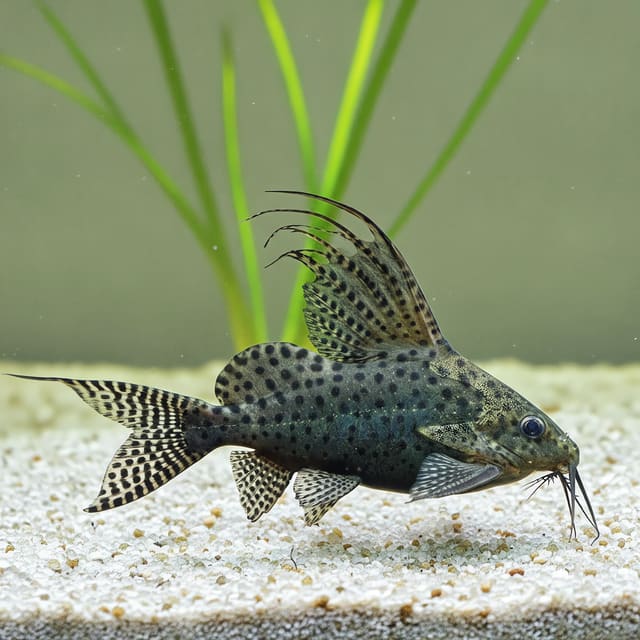
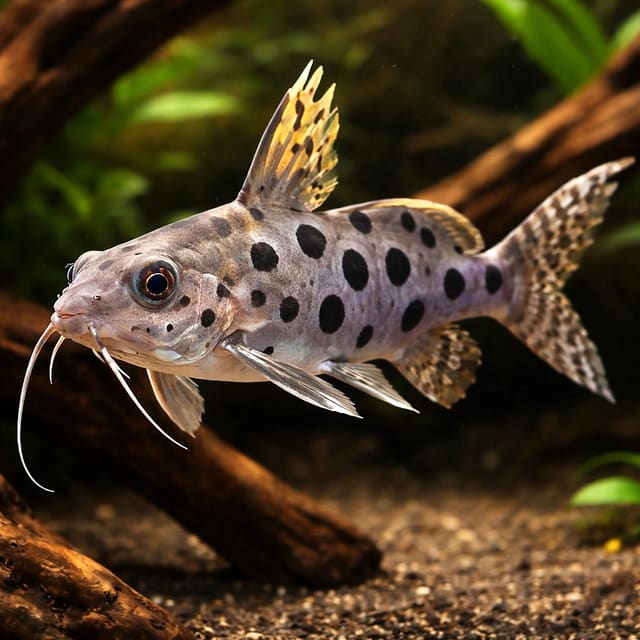
The specialist account describes juvenile fish as spotted or reticulated, with the pattern breaking into more characteristic barring as they mature. It also points to useful genus-level distinctions: Microsynodontis are much smaller than typical Synodontis, have a rounded or only slightly forked tail, and have fixed rather than moveable eyes. These details are helpful for understanding the fish, but the gallery is not being used to promise the exact colour, maturity or sex of the individual supplied.
Sex is guaranteed only when the selected option explicitly states male or female. This Microsynodontis batesii listing has no sex-guaranteed option.
Gallery images have been digitally enhanced to improve image quality. Natural colour, pattern, size and maturity can vary between live animals.
Start with the aquarium, not the order. A filter must already be biologically established, ammonia and nitrite must test at zero, and the intended temperature, pH and hardness should be stable. If you are building your first setup, follow the first tropical aquarium guide before choosing livestock. If the system is mature and the layout is calm, browse the wider catfish and pleco collection to compare different bottom-dwelling fish without assuming that they share the same care or temperament.
Delivery and the Live Arrival Guarantee are governed by the shop’s delivery policy. Be present to receive live fish, inspect the parcel on arrival and follow the policy’s video requirements if a claim is needed. Practical introduction steps appear in the care section below.
The species profile gives a minimum base of 60 × 30 cm and illustrates that footprint with a 60 × 30 × 30 cm aquarium of roughly 54 litres. The floor area is important because shelter, open feeding space and routes between retreats all compete for the same lower part of the aquarium. A tall narrow tank may hold a similar volume while providing much less useful bottom area. Choose a longer or wider aquarium when keeping several bottom-dwellers, mixing this fish with dwarf cichlids, or maintaining more than one M. batesii.
Treat 54 litres and a 60 × 30 cm base as the species-profile starting point, not as permission to crowd the tank. The figure assumes sensible stocking and a layout that leaves usable space around the cover. Additional fish increase waste, feeding competition and the need for distinct resting places. Aquarium volume is only one part of capacity; filtration, maintenance, oxygen exchange, décor and the adult size and behaviour of every resident matter as well.
A new keeper sometimes sees a 1–2 cm dispatch grade and plans around that juvenile size. That is a mistake. The fish needs an adult-appropriate home from the beginning, and the filter needs enough established biological capacity for the whole community. Moving a delicate newly imported catfish repeatedly as it grows adds avoidable disruption. Plan around the conservative adult record of up to 10 cm standard length, even though the fish supplied is much smaller.
The detailed aquarium account recommends dim lighting, a soft substrate, rocks, driftwood and twisted roots arranged to make hiding places. Plants are appreciated but not essential. That gives plenty of freedom in style: the tank can be planted, wood-led or arranged as a restrained river display, provided the bottom remains gentle and the fish can move between cover without being trapped by territorial neighbours.
There is no requirement to reproduce a supposed tannin-stained Congo habitat. The reliable range given for this species is in Cameroon and Gabon, and the supplied records do not establish a compulsory botanical recipe. Leaves or other botanicals can be used when they suit the aquarium and the keeper understands their effect on water, but they are not a substitute for filtration, testing or maintenance.
The specialist aquarium profile gives 22–26°C, pH 6.7–7.5 and 10–15 dGH for Microsynodontis batesii. FishBase gives 22–26°C, pH 6.8–7.5 and 10–15 dH as environmental values. The close agreement supports a practical routine aquarium target of 22–26°C, pH 6.7–7.5 and 10–15 dGH. These are not reasons to chase a single perfect reading. A stable value within the range, backed by regular testing and careful water changes, is more useful than repeated chemical adjustments.
Measure your own source water before purchase. Temperature can be controlled with an appropriately rated heater, but pH and hardness are often tied to the local supply and the materials in the aquarium. The aquarium water-chemistry guide explains what the common tests mean, while the water-parameter matcher helps compare measured readings with the stated range. Use liquid or otherwise dependable tests, record the results over time and make changes gradually.
| Temperature | 22–26°C for routine aquarium care |
|---|---|
| pH | 6.7–7.5 in the specialist profile; FishBase begins at 6.8 |
| General hardness | 10–15 dGH |
| Ammonia | Zero; toxic waste should be processed by a mature biological filter |
| Nitrite | Zero; any detectable reading needs prompt investigation |
| Nitrate | Managed with stocking restraint, feeding control and regular partial water changes |
The OATA catfish sheet gives a much broader group guide of 22–27°C, pH 6.0–8.0 and 4–18 dGH. That range covers many very different catfishes and should not replace the tighter values above. Its strongest contribution here is general welfare practice: use a filtered aquarium, keep ammonia and nitrite at zero, test regularly, introduce fish gradually and maintain the system consistently.
A working biological filter is essential. The RSPCA’s aquarium guidance explains the basic waste pathway: fish release ammonia, beneficial filter bacteria convert it to nitrite and then to the less harmful nitrate. A clear-looking aquarium can still contain dangerous ammonia or nitrite, so appearance cannot replace testing.
The specialist profile uses four to five aquarium turnovers per hour as its example for a roughly 54-litre setup, equating to a filter rated around 215–270 litres per hour. Manufacturer ratings are measured under ideal conditions and real flow falls when media collects debris or pipework adds resistance. Choose filtration that can maintain water quality without turning the lower level into a relentless current. Arrange the outlet for steady circulation and surface movement, then watch whether food, waste and the fish itself are being pushed around.
The OATA freshwater catfish care sheet recommends a partial water change of 25% at least once every week. Use that as a dependable maintenance baseline, adjusting only in response to measured water quality, stocking and feeding. Treat replacement tap water with a conditioner that deals with chlorine or chloramine, and bring it close to the aquarium’s temperature before adding it. Large abrupt differences are especially unhelpful to a fish described as delicate when first imported.
If ammonia or nitrite is detectable, do not buy another fish to “test” the tank. Pause additions, check the filter and recent feeding, carry out suitable partial water changes and seek experienced help if the cause is unclear. Likewise, unexplained rapid breathing, marked colour change, unusual hiding, damaged fins, loss of condition or refusal of food should prompt a water-quality check before medication is considered.
The species profile states that frozen, live and dried foods are all accepted. This supports a varied diet built around correctly sized sinking foods rather than one narrow menu. OATA’s broader catfish advice is equally important: catfish are not waste-disposal animals and should receive food suited to them. Offer only what the fish can consume in a few minutes, normally once a day under that OATA advice, and remove persistent leftovers before they decay.
For a 1–2 cm fish, particle size matters. A large hard pellet that reaches the bottom is not automatically usable. Choose small sinking granules or wafers that soften appropriately, and complement them with small frozen or live foods. Vary the format while keeping the total ration controlled. The supplied records do not establish a carnivore-only diet, an exact protein percentage or a schedule of four or five frozen feeds each week, so this guide does not impose those claims.
Feeding observation is particularly useful with a shy fish. Place food near, but not deep inside, a retreat and remain still long enough to see whether it is eaten. In a community, offer food in more than one place so fast midwater fish do not intercept every piece. If the catfish never emerges while food is available, reconsider the light level, the confidence offered by cover and the behaviour of its companions. Simply adding more food can worsen water quality without solving competition.
The species account says M. batesii does not fight with conspecifics and can be kept in groups without problems. It does not prescribe a minimum group size, so there is no basis for turning that observation into a compulsory shoal of five or six. One fish can be planned as a single catfish; a group is also possible when the aquarium has the footprint, filtration and separate cover to support every member.
When keeping more than one, assess the whole layout rather than counting caves. Several entrances to one cramped structure may still function as a single defended refuge. Spread shelters across the base and leave more than one feeding area. Observe body condition and access to food after any addition. Peaceful behaviour does not remove the effects of crowding or competition.
The specialist profile warns that Microsynodontis can be delicate when first imported, so preparation should be finished before the parcel arrives. The aquarium should already be stable, the lights can remain subdued during introduction, and aggressive or overactive residents should not be waiting at the bag. Do not redesign the tank while the fish is being introduced.
During the first week, prioritise stable water and observation. Check ammonia and nitrite, confirm normal breathing and look for evidence that the fish is feeding. A shy catfish may use cover extensively, but a change from its own emerging routine, loss of body condition or persistent failure to eat deserves attention. Avoid adding more livestock until the aquarium and its new resident are demonstrably stable.
The specialist profile describes adult males as having an elongated caudal fin and small bristles over the body, and notes differences in the genital papillae. It also says sexing by the papilla is difficult because the fish is small. Those adult distinctions do not turn a juvenile photograph or a 1–2 cm dispatch grade into a reliable sex guarantee. This offer is unsexed.
FishBase records the species as oviparous, while the aquarium profile says reproduction is unrecorded in aquaria. There is no dependable home-spawning recipe in the supplied care material. Keep the fish for its own qualities and welfare rather than buying it on an expectation of breeding. Claims about seasonal triggers, male guarding, egg placement or fry foods would go beyond the established account and are therefore omitted.
Microsynodontis batesii is described as shy and suitable with most peaceful species. The specialist account names African tetras, dwarf cichlids such as Pelvicachromis or Anomalochromis, and small mormyrids as particularly appropriate examples. Those are useful categories, not a universal shopping list: the adult size, water requirements, activity and territorial behaviour of the exact species still need to be checked.
The clearest exclusion is aggressive or very vigorous fish. A companion does not need to attack the catfish to be a poor match; constant rushes through the bottom zone or intense competition at every feed can keep a shy fish concealed and underfed. Territorial substrate-spawners also need careful planning because their defended area may overlap the catfish’s retreats. Dwarf cichlids are named as possible companions, but their space and breeding behaviour must be accommodated.
| Usually suitable when requirements overlap | Peaceful African tetras; suitable dwarf cichlids; suitable small mormyrids; calm community fish that do not dominate food or the lower level |
|---|---|
| Needs individual assessment | Other bottom-dwellers; breeding cichlids; groups of this catfish; any busy feeder likely to reach sinking food first |
| Avoid | Aggressive fish and very vigorous species that intimidate the catfish or consistently outcompete it |
Do not buy a larger Synodontis or another catfish as a “friend” without researching it separately. Catfish vary from small peaceful species to large predators, and similar names do not imply similar adult size or behaviour. Related products shown elsewhere on the page are alternatives for browsing, not endorsements as tank mates.
Add livestock slowly so the established filter can adjust to greater waste production. Before introduction, test the aquarium and confirm that the values suit every resident. Place new cover before the fish arrives rather than chasing settled animals around during the introduction. After release, observe from a distance: the first useful signs are access to shelter, unlaboured breathing and eventual interest in food, not immediate display in the open.
If another fish repeatedly blocks cover or food, rearranging one ornament may not solve an underlying stocking problem. Separate incompatible residents or provide a more suitable aquarium. Compatibility is an ongoing welfare decision, especially as cichlids mature, territories change or a once-small companion becomes much larger.
Plan for up to 10 cm standard length. FishBase reports 8.5 cm SL in its length line and also gives a maximum reported standard length of 100 mm, while the specialist aquarium profile lists 88 mm SL. Using the largest supplied record gives the fish enough space rather than planning around the 1–2 cm dispatch grade.
Use at least a 60 × 30 cm base. The species profile illustrates that footprint with a 60 × 30 × 30 cm aquarium of about 54 litres. Choose more floor area when adding other bottom-dwellers or keeping a group, and count filtration, décor and the adult needs of every resident rather than relying on litres alone.
The species may be kept singly or with its own kind. The specialist account says conspecifics do not fight and groups can be kept, but it gives no mandatory minimum number. If keeping several, provide extra base area, filtration, feeding places and separate retreats for every fish.
It is best for a keeper who can run a mature filtered aquarium, test water reliably and make sure a shy fish receives food. The actual care is methodical rather than exotic, but the species profile warns that Microsynodontis can be delicate when first imported, so it is not a good choice for a newly cycled or unstable tank.
Offer a varied selection of appropriately sized sinking dried foods plus suitable frozen or live foods. The species profile says all three forms are accepted. Feed only what can be eaten in a few minutes, normally once daily under OATA’s catfish care advice, and watch that fast companions do not take every piece.
Use 22–26°C, pH 6.7–7.5 and 10–15 dGH as the routine aquarium range. Test the source water and keep readings stable within that range. Ammonia and nitrite should remain at zero in a biologically mature, properly maintained aquarium.
The specialist profile describes the species as shy, able to live with most peaceful fish and non-aggressive towards its own kind. It is not presented as a fin-nipper. The greater risk is that aggressive or very vigorous companions intimidate it or prevent it from feeding.
The species account names African tetras, suitable dwarf cichlids such as Pelvicachromis or Anomalochromis, and small mormyrids. Choose exact species that share its water range and calm character. Avoid aggressive or very vigorous fish, and make sure territorial bottom residents cannot monopolise its cover.
Tropical Fish Co hand-packs live fish in oxygenated bags inside an insulated box, using a heat pack when conditions call for it, and sends them with a licensed live-animal courier. The Live Arrival Guarantee requires continuous video evidence for a claim; the recording begins with the parcel sealed before opening it. Inspect the fish the same day and contact the shop with the order number and video.
The care values used here come from the detailed records for this animal wherever they are available. General catfish advice supplies maintenance practice without widening its water range.
No reviews for this item yet. Bought one? Honest reviews only, good or bad.
What customers say about ordering from us
I have a small group of long finned mountain minnows. So was delighted to be able to order ten of this variety to increase the genetics in my tank . The ones I recieved are healthy but it’s to early to give a verdict on wether they are of a long finned type since they are small currently.
Gordon Walker · 23 Sept 2026
100% success travel and "installation". Pleased with quality of purchase. The Siamese fighter a bit "shy" so have not yet seen him at his best yet but looking good. Happy customer. GG
George E Garratt · 21 Sept 2026
Reviews of our shop, collected by Judge.me, an independent third-party review collector. Newest first.