Easy
Large-Spot Synodontis (Synodontis ocellifer)
23–27°C · pH 6.2–8 · 81L
£20.99

A bold Congo Basin Synodontis catfish with spotted patterning, nocturnal behaviour and real adult size; best for mature 300L+ aquariums with caves, smooth substrate and robust tank mates.
Adult size is the maximum length this species reaches at full maturity (scientific sources). The livestock you receive will be younger and smaller — pick a size above for the actual shipping size. Product-photo provenance and any image-specific limitations are stated on the listing.
Synodontis angelicus
Confirm your email, then we’ll send an availability message for this exact item if it returns within 180 days.
This request is only for this product—no newsletter or other promotions. A mail-provider retry may very rarely duplicate the same availability message. Unconfirmed addresses are removed after 48 hours. See our privacy policy.
A bold Congo Basin Synodontis catfish with spotted patterning, nocturnal behaviour and real adult size; best for mature 300L+ aquariums with caves, smooth substrate and robust tank mates.
Adult size is the maximum length this species reaches at full maturity (scientific sources). The livestock you receive will be younger and smaller — pick a size above for the actual shipping size. Product-photo provenance and any image-specific limitations are stated on the listing.
Maintain these water conditions for optimal health and vibrant colors
The Angel Squeaker is the aquarium trade name for Synodontis angelicus, a striking Congo Basin squeaker catfish with a dark body, pale spots and a confident nocturnal personality.
This is not a small nano catfish. Juveniles arrive at a manageable size, but mature Angel Squeakers become robust, long-lived African catfish that need space, shelter, strong filtration and tank mates that cannot be swallowed or bullied. In the right aquarium they are impressive centrepiece bottom dwellers: shy in bright light, active at dusk, and full of character once settled.
| Common names | Angel Squeaker, Angelicus Catfish, Polka Dot Squeaker, White-Spotted Squeaker |
|---|---|
| Scientific name | Synodontis angelicus |
| Supplier spelling to note | Often seen as Synodontis angelica; current reference spelling is Synodontis angelicus |
| Natural range | Congo River basin, including Pool Malebo and wider Congo drainage records |
| Adult size | Usually treated as a 25-30 cm aquarium catfish; wild records can be larger |
| Temperament | Confident, nocturnal, territorial around shelters and best with robust tank mates |
| Best for | Experienced aquarists with a mature, well-filtered large aquarium |
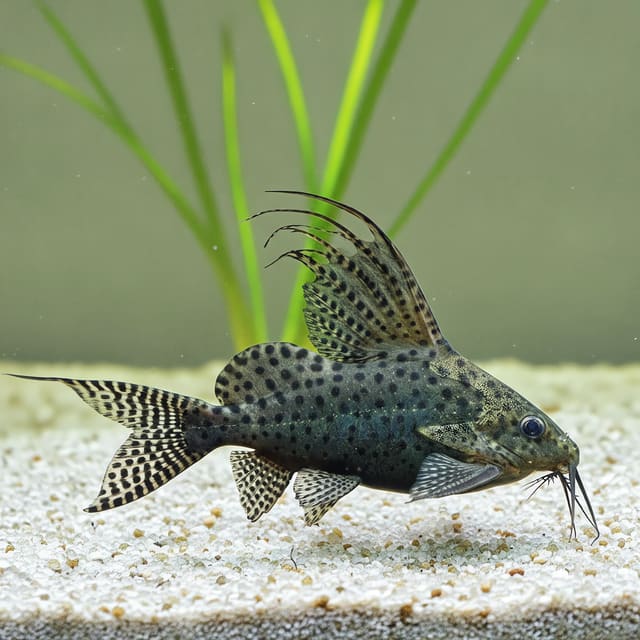
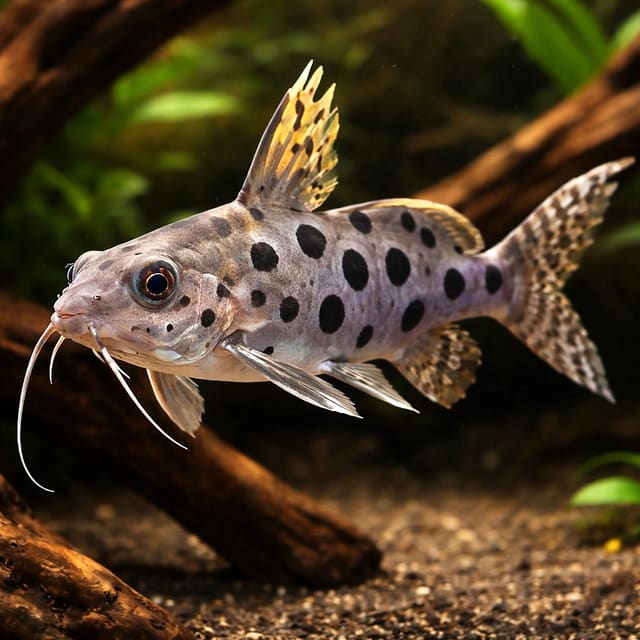
Angel Squeaker is popular because it looks different from ordinary community catfish. Young fish show bright pale spots on a deep red-violet, brown-black or purple-black background, and the pattern often becomes broader and more dramatic as the fish grows. The fins can carry matching markings, with a strong dorsal spine, pectoral spines and a deeply forked tail giving the fish a powerful silhouette.
Use the images as an identification guide, but allow for natural variation. Individual fish may show different spot size, body darkness and fin contrast depending on age, mood, lighting and supplier batch. The important health signs are clear eyes, intact barbels, smooth skin, clean fin edges and steady breathing.
The correct scientific spelling used by FishBase and current aquarium references is Synodontis angelicus. Some supplier feeds and older catalogue rows use Synodontis angelica, which is why both spellings may appear in historic data. The customer-facing page now uses the accepted spelling, while the older spelling is preserved naturally in the background as a synonym-style search bridge rather than repeated unnaturally.
The common name comes from the squeaker catfish habit of producing audible sounds with the pectoral-fin spines when stressed or handled. That sound is normal for Synodontis, but it is also a reminder to handle these catfish carefully: the spines can catch in coarse nets, so a container or soft fine net is safer during moves.
Synodontis angelicus is associated with the Congo Basin in Central Africa. It is a freshwater, bottom-oriented catfish from warm tropical river systems where cover, submerged wood, rocks, shaded margins and oxygenated water are important. FishBase gives a broad aquarium-relevant range around pH 6.0-8.0, hardness 5-19 dH and 24-28 C.
In the aquarium, the habitat lesson is simple: give the fish shelter and stable water before expecting bold behaviour. A bare, brightly lit tank makes Angel Squeaker more secretive. A tank with caves, wood, open feeding areas and shaded retreats lets it choose when to hide and when to patrol.
| Minimum aquarium | 300 litres or larger for long-term care; larger is better for adult fish and robust companions |
|---|---|
| Temperature | 24-28 C |
| pH | 6.0-8.0, with stability more important than chasing an exact number |
| Hardness | Soft to moderately hard water, broadly 5-19 dH |
| Substrate | Smooth sand or fine rounded gravel to protect barbels and belly |
| Decor | Large caves, driftwood, rockwork and shaded retreats with secure gaps |
| Flow and filtration | Strong biological filtration, good oxygenation and regular maintenance |
Choose decor with the adult fish in mind. Juveniles can enter small spaces that later become traps, so avoid sharp rock gaps and unstable piles. Provide more than one retreat, especially if the aquarium includes other bottom dwellers. A secure lid is sensible because powerful catfish can move suddenly when startled.
Angel Squeaker is an unfussy omnivore, but it should not be treated as a clean-up crew. Feed sinking catfish pellets, quality wafers, frozen bloodworm, mysis, chopped prawn, earthworm pieces and occasional vegetable-based foods such as spirulina wafers or blanched courgette. Offer most food after lights dim so the catfish gets a fair share before faster mid-water fish take everything.
Because this species becomes large and solid, heavy feeding can quickly affect water quality. Use a varied diet, remove leftovers and keep the filter mature. A slightly rounded body is healthy; a swollen belly, damaged barbels or constant hiding after feeding can indicate stress, poor water quality or unsuitable tank mates.
| Good companions | Medium to large tetras, Congo tetras, larger rainbowfish, peaceful robust cichlids and similar-sized catfish with enough territory |
|---|---|
| Use caution with | Other territorial bottom fish, delicate plecos, slow feeders and long-finned fish |
| Avoid | Small tetras, tiny rasboras, shrimp, fry and any fish small enough to fit in the mouth |
| Group or single? | Usually easiest as a single show catfish unless the aquarium is very large with several shelters |
Angel Squeaker is often peaceful with fish it cannot eat, but it is not a timid community fish. It may guard a favourite cave, push weaker bottom dwellers away from food and become more confident after dark. Plan the aquarium around its adult size and nocturnal feeding style, then choose tank mates that share the water without depending on the same hiding places.
Dim the lights before release and give the fish a clear route to a cave or shaded area. It may vanish for a few days while it learns the layout. That is normal. Avoid rearranging the tank repeatedly, and offer a small sinking meal after lights-out once breathing and posture look settled.
Check the barbels and pectoral fins during the first week. Smooth substrate, clean water and low competition at feeding time help the fish settle quickly. If it stays hidden but eats at night, that is usually a good sign rather than a problem.
Choose Angel Squeaker if you want a rare-looking African catfish for a large, mature aquarium and you enjoy fish with behaviour as well as colour. It is a strong choice for aquarists who can provide caves, low-stress lighting, robust filtration and tank mates of sensible size.
Choose a smaller Synodontis, Corydoras or community catfish instead if the aquarium is under 300 litres, if you keep tiny fish or shrimp, or if you want a bottom dweller that is active in bright daytime viewing.
Angel Squeaker is shipped through our UK live-fish courier process with insulated packing, weather-aware dispatch and our Live Arrival Guarantee. New customers can use the first-order discount shown on site, including the 10% welcome offer when available, without needing the product description to repeat awkward sales phrases.
We recommend preparing the aquarium before dispatch day: stable temperature, mature filtration, a covered cave and a low-light release plan. That gives this nocturnal Synodontis the best chance of settling cleanly after delivery.
No reviews for this item yet. Bought one? Honest reviews only, good or bad.
What customers say about ordering from us
I have a small group of long finned mountain minnows. So was delighted to be able to order ten of this variety to increase the genetics in my tank . The ones I recieved are healthy but it’s to early to give a verdict on wether they are of a long finned type since they are small currently.
Gordon Walker · 23 Sept 2026
100% success travel and "installation". Pleased with quality of purchase. The Siamese fighter a bit "shy" so have not yet seen him at his best yet but looking good. Happy customer. GG
George E Garratt · 21 Sept 2026
Reviews of our shop, collected by Judge.me, an independent third-party review collector. Newest first.