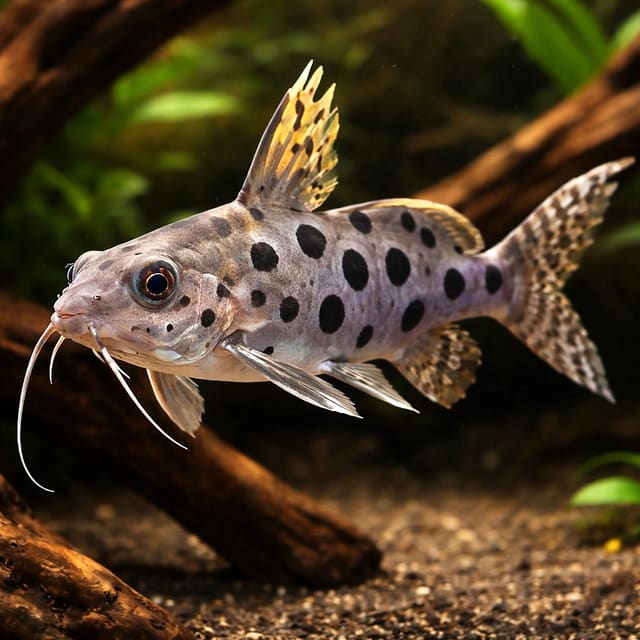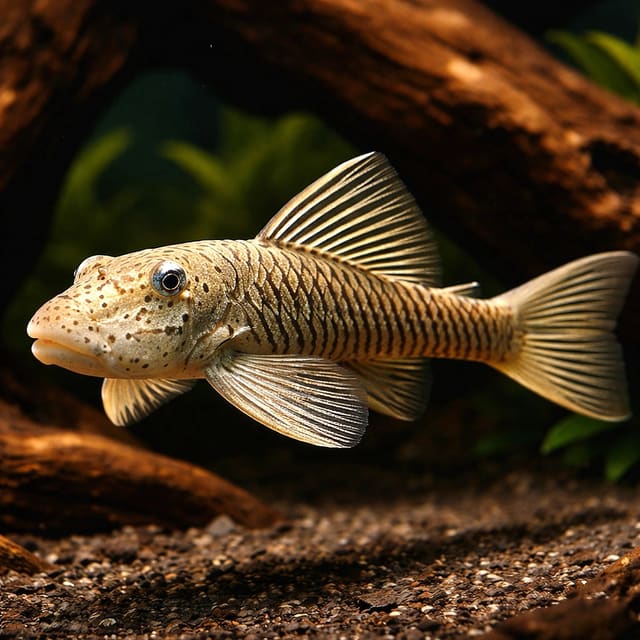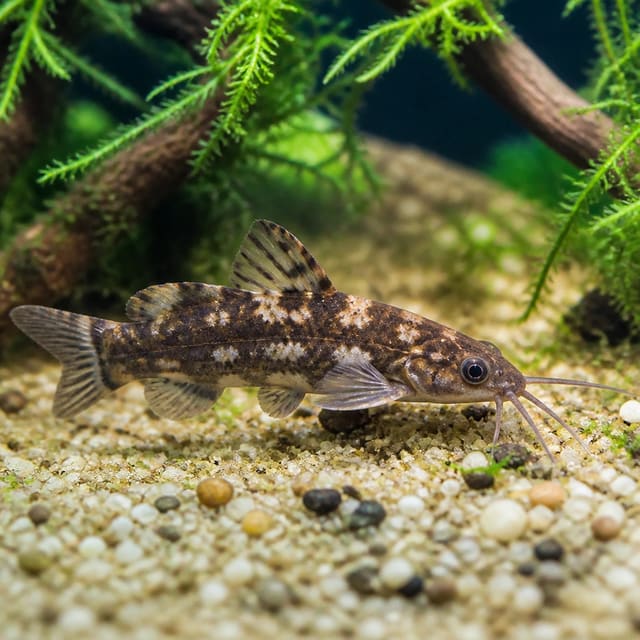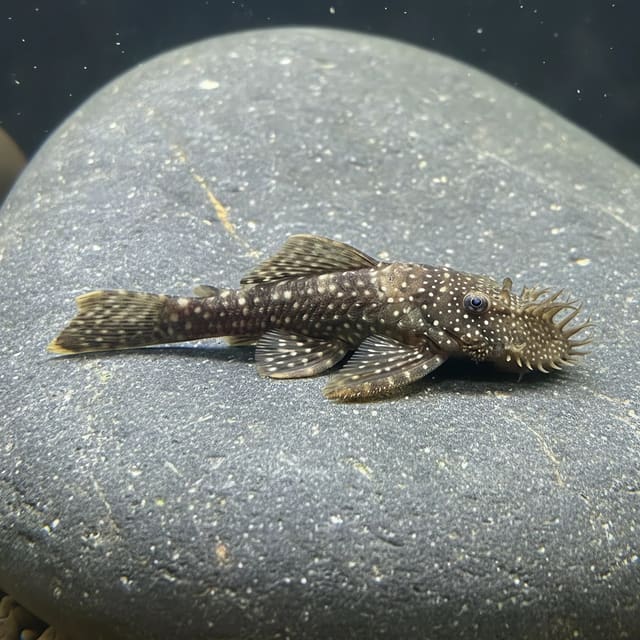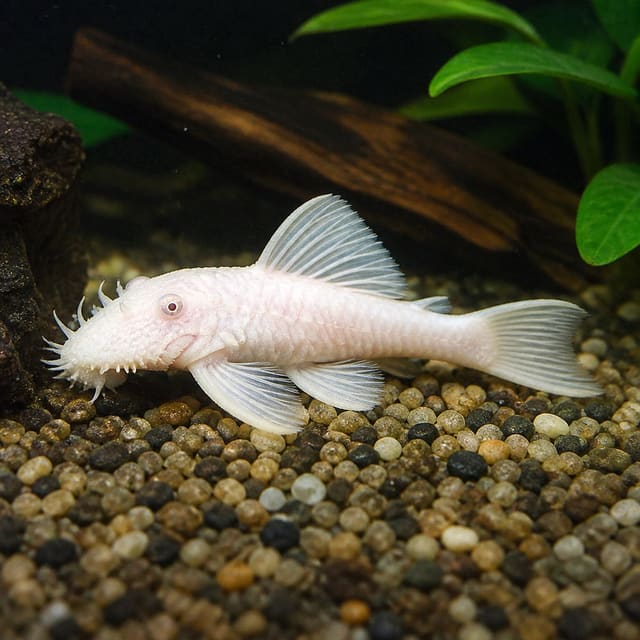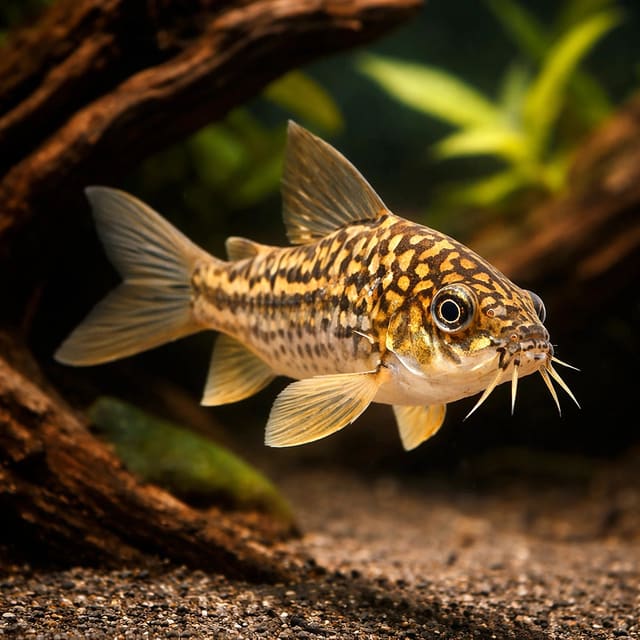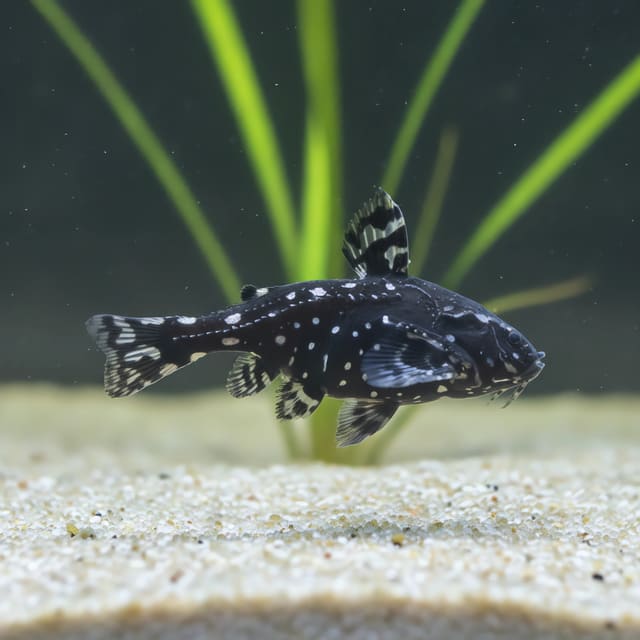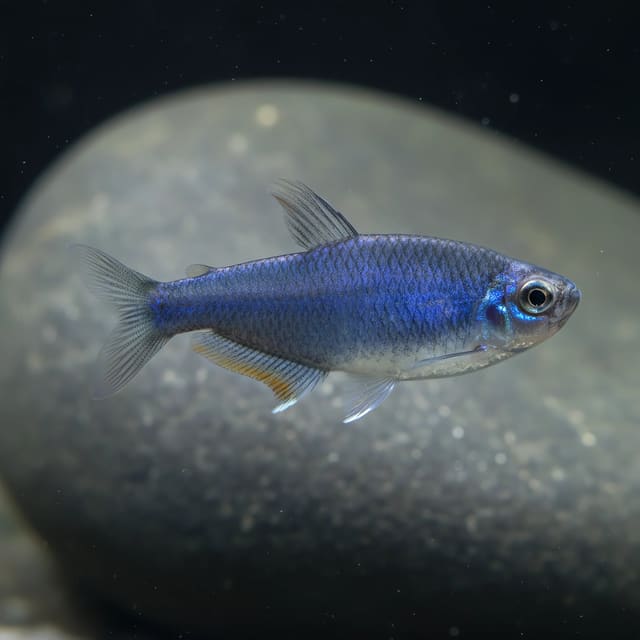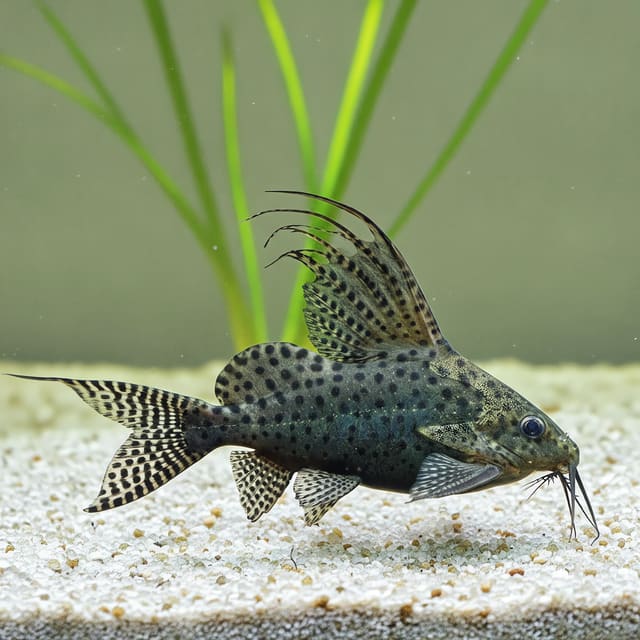
Featherfin Synodontis (Synodontis eupterus)
22–26°C · pH 6.2–7.5
£6.99

The African Glass Catfish (Pareutropius debauwi) is a freshwater schilbid catfish from rivers in Central Africa that reaches 12.6 cm. It suits keepers planning a school in a mature, filtered aquarium; OATA’s freshwater-catfish group guidance gives at least five as a practical shoaling benchmark, 22–27°C, pH 6.0–8.0 and 4–18°dH. Sold individually in 4 cm and 5 - 7 cm dispatch sizes.
Adult size is the maximum length this species reaches at full maturity (scientific sources). The livestock you receive will be younger and smaller — pick a size above for the actual shipping size. Product-photo provenance and any image-specific limitations are stated on the listing.
Pareutropius debauwi
Shoaling fish: kept in a group they feel safer, stay calmer and show their best colour.
The African Glass Catfish (Pareutropius debauwi) is a freshwater schilbid catfish from rivers in Central Africa that reaches 12.6 cm. It suits keepers planning a school in a mature, filtered aquarium; OATA’s freshwater-catfish group guidance gives at least five as a practical shoaling benchmark, 22–27°C, pH 6.0–8.0 and 4–18°dH. Sold individually in 4 cm and 5 - 7 cm dispatch sizes.
Adult size is the maximum length this species reaches at full maturity (scientific sources). The livestock you receive will be younger and smaller — pick a size above for the actual shipping size. Product-photo provenance and any image-specific limitations are stated on the listing.
Maintain these water conditions for optimal health and vibrant colors
African Glass Catfish (Pareutropius debauwi) is a freshwater member of the Schilbeidae, or schilbid catfish, family. The Wikipedia summary of Pareutropius debauwi also places it among the ray-finned fishes.
FishBase records an African range including rivers in Gabon, the Republic of Congo and Angola, together with most of the Congo River basin apart from the Zambian Congo. It reports a maximum length of 12.6 cm standard length and describes a riverine fish that forms schools.
This fish suits a keeper prepared to plan for a school, its adult length and the demands that several fish place on a mature biological filter. The aquarium must provide usable swimming space, suitable cover and water that remains within the stated working ranges.
| Decision | What it means |
|---|---|
| Purchase unit | One purchase quantity supplies one animal of the selected option. |
| Size labels | Choose 4 cm or 5 - 7 cm from the live size selector. |
| Growth planning | The size you select is the size supplied, not the adult size. |
| Sex | Sex is guaranteed only when the selected option explicitly states male or female. This African Glass Catfish listing has no sex-guaranteed option. |
The gallery images are representative of this type of animal rather than photographs of the exact animal supplied, so colours can look slightly different from the live animal.
Use the selector for the dispatch size, then set the purchase quantity from your school and stocking plan. You can also browse the wider catfish and plecos collection when comparing different types of catfish.
FishBase reports a maximum length of 12.6 cm standard length and separately records a maximum total length of 148 mm, or 14.8 cm. Use 12.6 cm as the adult figure throughout the care plan rather than assuming a 4 cm or 5 - 7 cm dispatch fish will remain near its arrival size. A recorded maximum is a planning reference, not a promise that every individual will reach exactly that length.
The same species account describes gregarious habits and school formation. OATA’s freshwater-catfish guidance advises at least five for shoaling catfish such as Corydoras. Applied alongside the species’ documented schooling behaviour, five is a practical starting benchmark for this fish; choose a larger school only when aquarium dimensions, filtration and the complete stocking load can support it.
OATA recommends an aquarium of at least 80 litres for a shoal of smaller catfish and explains that larger aquariums generally hold temperature and water quality more steadily. Treat 80 litres as the initial catfish benchmark. Then assess swimming length, usable open space, the planned school, adult dimensions and all other residents before deciding that a particular aquarium is suitable.
A long, uncluttered swimming route alongside planted or sheltered areas gives the school both movement space and places to retreat. Aquarium volume alone cannot describe that layout, so inspect the actual footprint before choosing a quantity.
OATA’s freshwater-catfish sheet gives group guidance of 22–27°C, pH 6.0–8.0 and general hardness of 4–18°dH. It also sets ammonia and nitrite at 0 mg/l, with nitrate no more than 20 mg/l above the normal tap-water level. Treat these figures as working boundaries rather than a precise optimum for Pareutropius debauwi.
| Planning point | Working instruction |
|---|---|
| Recorded length | Plan around a maximum length of 12.6 cm. |
| School | Use at least five as the practical starting benchmark, subject to the full stocking assessment. |
| Starting volume | Begin with OATA’s at least 80-litre benchmark for a shoal of smaller catfish, then assess dimensions and total load. |
| Temperature | Keep within 22–27°C. |
| pH | Keep within 6.0–8.0. |
| General hardness | Keep within 4–18°dH. |
| Nitrogen waste | Maintain ammonia and nitrite at 0 mg/l. |
| Suits | Not suited to |
|---|---|
| A mature, filtered aquarium planned around a school and an adult length of 12.6 cm. | An unfiltered aquarium or one that cannot maintain ammonia and nitrite at 0 mg/l. |
| A layout with open swimming space, cover and room for routine maintenance. | A plan that uses the dispatch size as the fish’s permanent size. |
| Water maintained within 22–27°C, pH 6.0–8.0 and 4–18°dH. | An aquarium whose measured water falls outside the working ranges. |
We class the care level as intermediate. The fish needs a planned school, a mature biological filter, regular testing and a compatibility decision based on the complete community. Those jobs are manageable when the aquarium is prepared in advance, but they leave little room for guessing about water quality or adding several fish to a new filter.
If one of those checks fails, correct the aquarium plan before choosing a dispatch size. A larger arrival size does not reduce the need for a school, biological capacity or adult-size planning.
Begin with an aquarium whose dimensions can accommodate the full school at the 12.6 cm planning length. The layout should preserve a clear route through the tank rather than dividing every part of the aquarium with tall ornaments. Schooling fish need room to change direction together, and that usable area matters alongside the nominal litre capacity.
OATA advises live plants for smaller or shy catfish because they provide cover, while also noting that many catfish appreciate wood, pots or caves. For this riverine, schooling animal, combine sheltered edges with an open central or front swimming route. Plants and wood can define the retreat areas without forming a solid barrier across the tank.
| Zone | Purpose |
|---|---|
| Open route | Allows the school to move and turn without repeatedly meeting hardscape. |
| Planted edge | Provides visual cover and a calmer retreat from activity outside the aquarium. |
| Sheltered area | Wood, suitable ornaments, pots or caves add structure used by many catfish. |
| Service access | Leave room to siphon debris, inspect the filter and remove trapped food. |
Walk through maintenance before settling the final layout. Make sure a siphon can reach the substrate, the filter intake remains clear and decorations do not create inaccessible pockets where solid waste accumulates. A visually dense aquarium that cannot be cleaned reliably works against the water-quality routine this fish needs.
Check the finished design from end to end. Five planning-length fish must be able to occupy the aquarium without every sheltered feature consuming the swimming route. Other residents also count towards that space. If the proposed community already fills the open water or pushes the filter near its limit, use a larger aquarium or revise the stocking plan rather than squeezing in the school.
Secure every ornament so routine maintenance cannot dislodge it. Catfish commonly have fin spines, so use calm, deliberate handling around equipment and avoid unnecessary netting once the fish is settled.
Measure the aquarium rather than estimating its chemistry from appearance. Keep temperature between 22 and 27°C, pH between 6.0 and 8.0, and general hardness between 4 and 18°dH. Our water chemistry guide explains what the common tests measure, while the water matcher helps compare your measured values with these working boundaries.
| Result | Decision |
|---|---|
| 22°C or 27°C | Both sit on a stated temperature boundary; prevent the value drifting beyond it. |
| pH 6.0 or 8.0 | Both are within the stated range at its limits; monitor consistency before adding fish. |
| 4°dH or 18°dH | Both meet the general-hardness range at its limits. |
| Ammonia above 0 mg/l | Pause livestock additions, investigate filtration and correct the water-quality problem. |
| Nitrite above 0 mg/l | Treat this as a failed readiness check and address the biological filter. |
Nitrate is judged against the normal tap-water reading rather than against a single universal total. OATA says it should not exceed 20 mg/l above that baseline. For example, if conditioned tap water measures 10 mg/l nitrate, the aquarium should remain at or below 30 mg/l under that rule. If the tap-water baseline is 25 mg/l, the corresponding ceiling is 45 mg/l. Record both results so the comparison remains meaningful.
Test with the same method each week and write the readings down. A sequence of results shows whether nitrate is rising between water changes and whether pH or hardness is moving towards a boundary. One acceptable result cannot show a trend.
Do not chase the middle of each range with abrupt adjustments. First establish what comes from the tap, how conditioning affects it and how the aquarium changes through a normal maintenance week. The practical goal is water that stays within the boundaries while ammonia and nitrite remain at zero.
A working biological filter is essential. The RSPCA’s aquarium welfare guidance explains that fish release toxic ammonia, beneficial bacteria convert it to nitrite, and further bacterial action produces the safer nitrate. Ammonia and nitrite are both toxic, so clear-looking water is not enough to show that an aquarium is ready.
Prepare and mature the aquarium before livestock arrives. Our first tropical tank guide sets out the preparation sequence. Use tests to confirm ammonia and nitrite are 0 mg/l, and check temperature, pH and hardness against the working ranges before deciding the filter and water are ready.
OATA warns that stocking too quickly can cause new tank syndrome because the bacterial population cannot process the increased waste. The result can be unhealthy ammonia and nitrite levels. Treat every addition as a change in biological load, even when the aquarium has been running for some time.
A mature filter can still be overwhelmed by a sudden increase. Consider the number and adult planning size of all incoming fish, the current nitrate trend and the filter’s maintenance history. If a test result fails the readiness gate, postpone the addition and restore zero ammonia and nitrite before proceeding.
Do not replace water testing with a calendar rule. The decision depends on measured water quality and the aquarium’s existing load, not simply on how many weeks it has been filled.
FishBase describes wild Pareutropius debauwi as carnivorous with an insectivorous preference. Choose an appropriate sinking food formulated for carnivorous catfish and suited to the mouth size of the fish. The aim is to match that animal-food preference without treating the catfish as a cleaner that can live on scraps left by other residents.
OATA advises feeding catfish once a day and limiting the portion to what they can eat within a few minutes. Start with a measured, modest amount and watch the entire school. If food remains after the feeding window, reduce the next portion and remove leftovers before they break down into waste.
| What you see | What to do |
|---|---|
| Food remains after a few minutes | Remove it and make the next daily portion smaller. |
| One fish repeatedly misses food | Review food placement and whether tank mates are dominating the feeding area. |
| The school stops taking food | Test water quality and check for changes in breathing, swimming, colour or body condition. |
| Food disappears immediately | Confirm every individual ate before increasing the measured portion. |
Feeding more does not compensate for poor access. Watch where the food travels and whether all members of the school can reach it. A proposed community that repeatedly prevents these catfish from feeding fails an important compatibility check, even when its water requirements overlap.
Overfeeding creates a second problem: uneaten food breaks down and contributes waste that the filter must process. Keep the daily portion tied to the few-minute feeding window and use weekly ammonia, nitrite and nitrate results to check that the maintenance routine is controlling the resulting load.
Do not add food on the assumption that every catfish scavenges. This species’ documented wild diet points towards animal food, especially insects, and the aquarium diet should reflect that biology.
Carry out a 25% partial water change at least once every week. OATA strongly recommends this schedule and advises testing ammonia and nitrite at least weekly. Test nitrate at the same time so you can compare the aquarium result with the normal tap-water baseline and keep the increase within 20 mg/l.
When filter media needs cleaning, rinse it lightly in aquarium water removed during the water change. Do not run it under the tap because chlorine or chloramine may kill part of the beneficial bacterial population. The aim is to clear obstructing debris while retaining the bacteria responsible for processing ammonia and nitrite.
Use the test results to adjust the routine. For example, a tap-water nitrate result of 8 mg/l gives an aquarium ceiling of 28 mg/l under the stated rule. If the aquarium reaches that boundary before the weekly change, reassess feeding, waste removal, stocking load and the effectiveness of the maintenance schedule.
Check the filter after maintenance to ensure water is moving through it normally and no intake has been left obstructed. Test again when a blockage, interrupted operation or unusually heavy waste load may have affected biological performance.
Consistency is more useful than occasional large interventions. The combination of weekly tests, a 25% partial change at least once a week, conditioned replacement water and careful filter-media cleaning protects the bacteria on which the aquarium depends.
Arrange for someone to receive the live-fish parcel because it must not be left unattended. Check the confirmed delivery window and prepare the aquarium before the parcel arrives: the filter should be running, ammonia and nitrite should be 0 mg/l, and the measured water values should already fit the working ranges.
Follow the current delivery and Live Arrival Guarantee policy when the parcel arrives. Float the bag in the aquarium for 20–30 minutes before release. Never pour the bag water into the aquarium.
Do not combine arrival day with an unplanned large increase in other livestock. OATA advises increasing fish numbers slowly because the filter’s bacterial population must respond whenever fish and feeding are added. The school requirement still matters, so plan the complete addition with the aquarium’s filter capacity before placing the order rather than improvising once the parcel arrives.
During the first week, compare each day’s behaviour and feeding with the previous day. Look for changes rather than expecting every individual to behave identically. Continue the established daily feeding limit and weekly maintenance cycle; arrival is not a reason to overfeed.
If ammonia or nitrite rises above 0 mg/l, treat it as a water-quality problem immediately and pause further livestock additions. Check filter operation, feeding and the stocking increase. A correctly timed float equalises temperature, but it cannot compensate for an immature filter or unsuitable aquarium water.
Learn the normal appearance and behaviour of each fish so that a change is easy to recognise. OATA recommends watching swimming, colour, temperament, breathing, external appearance, body condition and feeding. These observations do not identify a treatment by themselves, but they give an early signal to check the aquarium.
| Change | First response |
|---|---|
| Hanging at the surface, sitting on the bottom or erratic swimming | Test ammonia, nitrite and temperature, then inspect filter operation. |
| Faster or slower gill movement | Check water quality promptly and compare the fish with the rest of the school. |
| Darker or paler colour | Review recent water readings, maintenance and changes to the community. |
| More hiding or changed temperament | Check interactions, swimming space and whether the school is being disturbed. |
| White spots, fluffy growths, damaged fins or missing scales | Record what is visible and check water quality before choosing any further action. |
| Reduced feeding or body condition | Confirm food reaches the fish and compare its intake with other members of the school. |
Begin with measured values: ammonia and nitrite should remain at 0 mg/l, temperature at 22–27°C, pH at 6.0–8.0 and general hardness at 4–18°dH. Compare nitrate with the tap-water baseline and review whether the weekly water change or feeding amount has changed.
Also inspect practical causes. Confirm the filter is running and free of blockages, replacement water was conditioned, no uneaten food remains and the aquarium has not received a sudden stocking increase. Record the time and the affected fish so you can tell whether the condition is improving or spreading.
If you are concerned about a health change, contact us after testing the water and recording the signs. Do not choose medication from appearance alone; use the observed symptoms, water results and aquarium history to guide the next decision.
Compatibility cannot be reduced to a universal list for this catfish. OATA notes that catfish vary widely: some suit community aquariums, while others are extremely predatory and require caution when mixed. FishBase establishes that Pareutropius debauwi forms schools and has a carnivorous, insect-focused wild diet, but those facts do not settle every aquarium pairing.
Use a screening process based on the exact animals, their adult dimensions and the aquarium they will share. The decision must work in both directions: existing residents must not continually disrupt the school, and the catfish must fit the community’s size, water and feeding plan.
| Check | Question to answer |
|---|---|
| Water overlap | Can every animal remain within 22–27°C, pH 6.0–8.0 and 4–18°dH without compromise? |
| Adult dimensions | Does the aquarium retain swimming and shelter space when every resident reaches its planning size? |
| Behaviour | Will any resident attack, harass or continually displace the school? |
| Feeding access | Can each catfish obtain its daily food within the few-minute feeding window? |
| Biological load | Can the mature filter maintain 0 mg/l ammonia and nitrite after the whole addition? |
Predatory fish and catfish require particular caution. Do not assume that a shared broad label such as community fish or catfish settles the decision. Adult size, individual behaviour and feeding method can differ markedly within those labels.
Observe the aquarium after introduction. Repeated missed meals, damaged fins, abnormal hiding, erratic swimming or persistent displacement are reasons to reassess the mix and test the water. Ask us for a stocking and compatibility assessment using the aquarium dimensions, measured water values, filter, current livestock and intended school size.
One purchase quantity supplies one African Glass Catfish in the selected size. Set the quantity from a complete stocking plan rather than from the appearance of one dispatch fish. FishBase records school formation, while the practical OATA benchmark for shoaling catfish starts at five.
For example, a plan for five fish requires a purchase quantity of five because each purchase unit is one animal. That arithmetic does not complete the suitability check. The aquarium must still accommodate five fish using the 12.6 cm maximum length as the adult planning reference, alongside every existing resident.
Do not use the larger dispatch label as a substitute for adult planning. A 5 - 7 cm fish still has potential growth towards the recorded maximum, while a 4 cm fish needs the same long-term social and water-quality plan.
If the calculations leave little swimming space or put the aquarium close to its biological limit, revise the community or choose a larger aquarium. Reducing the school below its social benchmark is not the right way to make an undersized plan fit.
After introduction, reassess the calculation with real observations. Confirm that every fish feeds, the school can move without continual disturbance, and weekly tests continue to show 0 mg/l ammonia and nitrite.
African Glass Catfish reaches a recorded maximum length of 12.6 cm standard length, so plan the aquarium around that adult reference rather than its 4 cm or 5 - 7 cm dispatch size.
Start from OATA’s at least 80-litre benchmark for a shoal of smaller catfish, then confirm that the aquarium has enough dimensions, open swimming space and biological capacity for a school reaching 12.6 cm per fish.
FishBase records school formation, so use at least five as the practical starting benchmark drawn from OATA’s advice for shoaling catfish, subject to aquarium capacity.
We class African Glass Catfish as intermediate because it needs a planned school, a mature filter, regular water testing and an individual compatibility assessment.
Feed African Glass Catfish an appropriate sinking carnivorous catfish food that reflects its insectivorous preference, once daily in an amount eaten within a few minutes.
OATA’s freshwater-catfish group guidance gives 22–27°C, pH 6.0–8.0 and general hardness of 4–18°dH; keep ammonia and nitrite at 0 mg/l.
Its species account describes schooling but does not assign a general aggression or fin-nipping rating, so screen behaviour in both directions and reassess any mix that causes attacking, harassment, damaged fins or persistent displacement.
Compatibility varies by species and individual; choose animals that pass checks for water overlap, adult dimensions, behaviour, feeding access, swimming space and total biological load, with particular caution around predatory fish or catfish.
Start filming every delivery with the parcel still sealed and the outer box visible. Someone must be present to receive it; keep filming continuously as the parcel is opened and the fish is shown inside the sealed bag, float the bag for 20–30 minutes, then release the fish without pouring the bag water into the aquarium.
No reviews for this item yet. Bought one? Honest reviews only, good or bad.
What customers say about ordering from us
I have a small group of long finned mountain minnows. So was delighted to be able to order ten of this variety to increase the genetics in my tank . The ones I recieved are healthy but it’s to early to give a verdict on wether they are of a long finned type since they are small currently.
Gordon Walker · 23 Sept 2026
100% success travel and "installation". Pleased with quality of purchase. The Siamese fighter a bit "shy" so have not yet seen him at his best yet but looking good. Happy customer. GG
George E Garratt · 21 Sept 2026
Reviews of our shop, collected by Judge.me, an independent third-party review collector. Newest first.