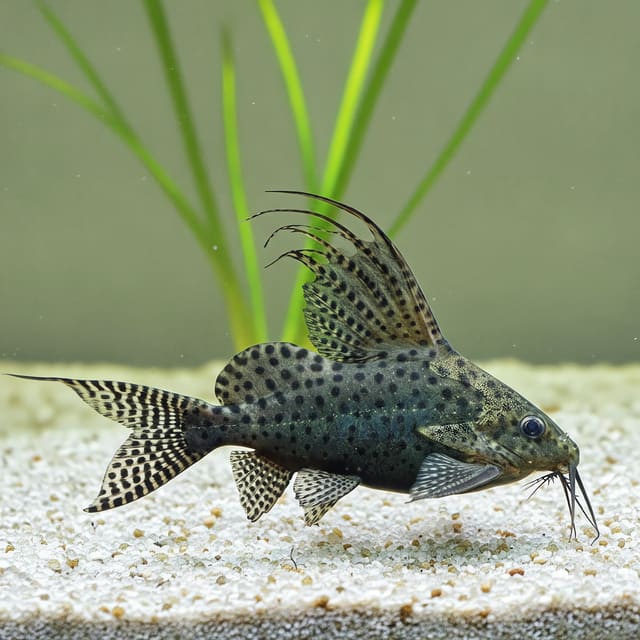
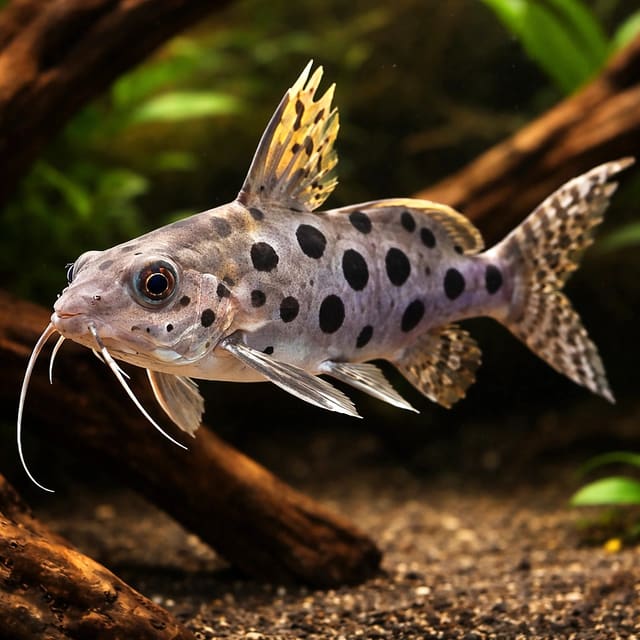
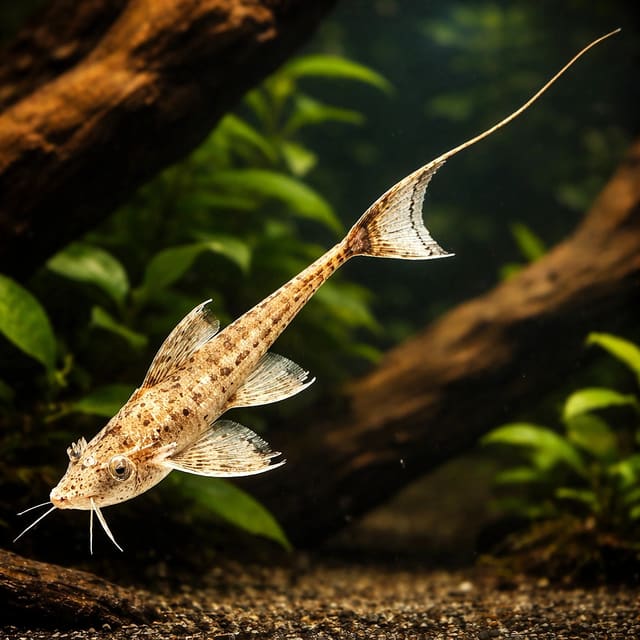
Decorated Upside-Down Catfish (Synodontis decorus)
22–27°C · pH 6–8 · 205L
£29.99
Photo coming soon
The size, price and care details on this page are for this listing.
One live Chrysichthys nigrodigitatus, the silver catfish of West and Central Africa. FishBase records 65 cm standard length, so it outgrows most home aquariums. It needs 22–28 °C fresh water, a sandy floor, large caves and a varied omnivore diet, and it will eat smaller fish as it grows.
Chrysichthys nigrodigitatus
One live Chrysichthys nigrodigitatus, the silver catfish of West and Central Africa. FishBase records 65 cm standard length, so it outgrows most home aquariums. It needs 22–28 °C fresh water, a sandy floor, large caves and a varied omnivore diet, and it will eat smaller fish as it grows.
Maintain these water conditions for optimal health and vibrant colors
This listing is for one live Chrysichthys nigrodigitatus, a claroteid catfish from the rivers, lakes and coastal lagoons of West and Central Africa. In English it goes by silver catfish, and ScotCat calls it the silver cat; FishBase lists the names belly up, bagrid catfish and silver catfish. The Tossou review also records the local name mâchoiron, which covers all three of the region's Chrysichthys species. We use silver catfish with the scientific name in brackets, because the scientific name is the label that pins down exactly which fish this is.
The most important fact on this page is the adult size. FishBase records a maximum of 65 cm standard length, measured from the snout to the base of the tail, so the tail fin comes on top of that. ScotCat gives 50 cm. Wild fish sampled along 200 km of the Cross River in Nigeria measured 16.7–42.4 cm in total length and weighed up to 2,354.8 g. In its home range this is a food fish, caught in commercial fisheries and farmed, and it grows like one.
That size makes it unsuitable for most home aquariums. We list it for the keeper who already runs, or is building, a very large system for big catfish, and who understands that the fish in the box is a fraction of the fish it will become. If that is not you, please do not buy one because it looks small and manageable today.
Each unit is one fish. The listing has no size option, so a particular length cannot be promised here, and the sex is not selected. If you need to know the size we are holding before you commit to the tank it will need, ask us before you order.
ScotCat describes a fairly plain catfish: grey to blue-grey over the head, back and flanks with a white underside, greyish-pink fins, a black adipose fin, and pink lips and barbels. A 2023 review by Tossou and colleagues describes the head and back as dark brown or grey with a white belly. The same review points out that it stands apart from its two West African relatives, C. maurus and C. auratus, through its larger size, its silvery-grey colour (the other two are yellowish) and its fast growth.
The features to look for are these:
Taken together, the forked tail, black adipose fin, pink barbels and silvery-grey body separate it from the yellowish C. maurus and C. auratus, and the scientific name on the label settles any doubt.
ScotCat explains the name. Chrysichthys joins the Greek words for gold and fish. Nigrodigitatus combines the Latin for dark with a word meaning having fingers or toes, a reference to the dark-edged fins.
FishBase places the species in Claroteidae, the claroteid catfishes, and gives the author as Lacepède, 1803. Some older and regional literature still files it under Bagridae, which fits the common name bagrid catfish; the 2008 Cross River study, for example, lists it that way. If you see either family name on a label, it is the same fish.
FishBase gives the range as Africa from Senegal to Cabinda in Angola, with reports from Mauritania to the north, and south as far as the lower Congo River and the coastal rivers of Angola. The Tossou review, citing earlier surveys, describes it in most coastal rivers from Senegal to Gabon, common in the Senegal, Gambia, Bandama and Niger basins, and caught in the upper, middle and lower reaches of rivers alike.
FishBase records adults in shallow lake water less than 4 m deep, over mud and fine sand, and classes the species as demersal, which means it lives on or near the bottom. It also lists it as potamodromous, migrating within fresh water, and the Tossou review mentions local movements within fresh water during the breeding season.
The same review describes the species as euryhaline, able to live across a range of salinities. It colonises brackish coastal lagoons, where it is often abundant, and prefers water of low to moderate saltiness, 0–20 grams of salt per litre. FishBase, by contrast, lists it simply as a freshwater fish, and ScotCat's care notes give freshwater conditions. In the aquarium we treat it as a freshwater catfish; the brackish tolerance is part of its natural history, not a requirement for keeping it.
The review also records that wild numbers fall as the water becomes more turbid, a useful reminder that clear, clean water suits this catfish.
FishBase lists it as Least Concern on the IUCN Red List, assessed in April 2019, and records it in minor commercial fisheries, in commercial aquaculture and as a gamefish. The Cross River study calls it a highly valued food fish and one of the dominant species in commercial catches. Tossou and colleagues warn that intense fishing threatens its stocks and argue that farming it is the way to protect them, which is why so much of the research on this catfish comes from fisheries and aquaculture rather than from fishkeeping.
It is easy to buy a large catfish as a youngster because it looks manageable in a bag. With this species that is exactly the trap, and the figures below are why we put them first.
| Measure | Figure | Source |
|---|---|---|
| Maximum recorded length | 65 cm standard length | FishBase |
| Maximum length in aquarium literature | 50 cm | ScotCat |
| Wild fish sampled in the Cross River, Nigeria | 16.7–42.4 cm total length; 87.8–2,354.8 g | Offem et al., 2008 |
| Wild fish sampled in Benin | 11.0–30.2 cm total length, average 19.7 cm | Tossou et al., 2023, citing Dele et al., 2016 |
| Size at first maturity | From 14 cm | FishBase |
| Maturity in the Cross River | Males 11.5 cm, females 16.7 cm | Offem et al., 2008 |
| Age at maturity | About 2 years, at more than 20 cm | Tossou et al., 2023, citing Legendre and Albaret |
The 65 cm figure is a maximum, not a target, and many fish will stop short of it. But the largest fish in the Cross River sample were already over 40 cm, the heaviest at more than 2.3 kg, and the review by Tossou and colleagues lists rapid growth as one of the features that set this species apart from its relatives.
ScotCat's factsheet records the author keeping two specimens of about 12 inches (roughly 30 cm) in a tank of 72 × 18 × 15 inches, about 183 × 46 × 38 cm or roughly 320 litres, with large clay pipes for shelter. That is a useful real-world reference, and it is worth reading carefully: those were fish of about half the size this species can reach, in a tank that many people would already consider large. An adult approaching 50–65 cm is roughly twice that length and very much heavier, and it needs room to turn its whole body, not just to fit in the tank.
Finding a new home for a fish of that size is far harder than for a small one, and it must never be released into any pond, lake or river. If you cannot answer yes to these questions today, the kind thing is to wait.
Everything in the wild record points to a fish that lives on the bottom: FishBase classes it as demersal and finds adults in shallow water over mud and fine sand. In the aquarium, that means the floor area of the tank matters far more than its height. A long, wide tank gives this catfish room to patrol; a tall, narrow one wastes most of its volume.
Use fine, smooth sand to echo the mud and fine sand of its natural habitat. Sand also makes uneaten food easy to see and lift out, which matters with a fish that eats this much.
Shelter is the most important piece of décor. ScotCat's keeper used large clay pipes, and the natural history explains why they work: in the wild, breeding pairs use crevices in dead wood and bamboo (Tossou et al.) and caves dug into riverbanks (ScotCat). Provide at least one cave or pipe the fish can fit into completely, and plan to replace it with larger ones as it grows. With more than one large bottom fish in the tank, give each its own retreat.
Leave a clear area of open sand in front of the shelters. That is where the fish will feed, and where you can watch it.
A large, omnivorous catfish fed on prawns, pellets and frozen food produces a lot of waste. Filtration needs to be generous, whether that is a sump or large external filters, with good mechanical filtration to catch debris and plenty of biological media. Keep the outlets spread so the water turns over across the whole floor. Plan regular partial water changes from the start, and size the tank so that you can physically carry out that maintenance.
Fit a secure, well-sealed cover. Keep heaters protected behind a guard or inside a sump, because a strong fish moving through the tank can knock equipment loose, and keep electrical cables tidy and well away from the water.
| Parameter | Range | Source and notes |
|---|---|---|
| Temperature | 22–28 °C | FishBase; ScotCat gives a narrower 23–26 °C |
| pH | 6.0–7.2 | ScotCat |
| Salt | Not needed in the aquarium | Wild fish tolerate 0–20 g/l in lagoons (Tossou et al.); FishBase and ScotCat treat it as freshwater |
| Ammonia and nitrite | Zero | Tank fully cycled before the fish arrives |
The two temperature figures fit together. FishBase gives the full tropical range of 22–28 °C, and ScotCat's narrower 23–26 °C sits in the middle of it. Setting the heater in the low to mid twenties and keeping it there is the simple answer. None of our sources gives a hardness range, so the sensible course is a stable, moderate water rather than chasing a particular number.
ScotCat's pH range of 6.0–7.2 runs from slightly acidic to just above neutral. If your tap water sits a little outside that, a steady pH is still better than one pushed about with chemicals. Make any change slowly, through your water-change water, rather than adjusting the tank directly.
With a large fish, the biggest risk to water quality is the food. Test ammonia, nitrite and nitrate regularly, particularly while the tank is new and as the fish grows and eats more. Siphon the open sand in front of the caves during each water change, because that is where leftovers collect. Use a dechlorinator on all new water, match its temperature, and change a steady proportion of the volume on a fixed routine rather than leaving long gaps.
Aim for clear, clean, well-oxygenated water. Surface movement from the filter returns, together with a moderate current across the bottom, keeps oxygen up without turning the tank into a torrent. If the fish ever hangs near the surface breathing hard, test the water straight away.
FishBase describes the species as omnivorous, feeding on seeds, insects, bivalves and detritus, and adds that its diet becomes more specialised with age and size, with larger fish taking decapod crustaceans and fish. The field studies agree. In the Cross River, fish and fish parts made up 21.6% of the diet, insects 19.6% and crustaceans 14.4%, and the authors describe high trophic flexibility, meaning the catfish switches to whatever food is most available. The Tossou review adds that juveniles feed mainly on algae, midge larvae, amphipods, rotifers, plants and fish fry, and that the diet changes with the season: in one study, fish ate mainly midge larvae, aquatic worms and snails in the rainy season, and midge and dragonfly larvae in the dry season.
ScotCat's experience is that it takes a wide variety of food in the aquarium, including frozen food, tablets, pellets and prawns. That makes it easy to feed well:
There is no need to feed live fish. ScotCat's experience shows it takes prepared and frozen foods readily, and those are easier to keep clean and consistent.
Drop food where it will reach the sand in front of the caves, so the catfish does not have to compete with faster fish in midwater. Feed an amount that is gone within a few minutes, then lift out what is left. Watch the fish's shape: a gently rounded belly is right, a swollen one means too much. Because this species grows quickly, it is tempting to feed a juvenile heavily; steady, moderate meals and clean water are the better plan.
Increase the size of the food, not just the amount. The shift towards crustaceans and fish that FishBase describes for larger fish is the reason the tank mates you choose for a juvenile need rethinking as it grows, which the next section covers.
ScotCat sums up the behaviour in one line: peaceful as youngsters, but not to be trusted with smaller fish as they grow, and should do all right with larger fish such as cichlids. Put that next to the wild diet, where larger fish eat crustaceans and other fish, and the rule for tank mates is clear. Choose them for the size the catfish will reach, not the size it is when it arrives.
| Possible companion | Verdict | Why |
|---|---|---|
| Large, robust fish such as big cichlids | Possible | ScotCat suggests larger fish such as cichlids; check each species for space and water needs |
| Another silver catfish | Possible in a very large tank | ScotCat's keeper housed two together at about 30 cm, with large clay pipes for shelter |
| Other big bottom-dwelling fish | Caution | They compete for the same floor space and caves; give each its own shelter |
| Small and medium fish | Avoid | Fish feature in the wild diet of larger individuals |
| Shrimp, crabs and crayfish | Avoid | Decapod crustaceans are a natural food for larger fish |
A juvenile may live peacefully with medium-sized fish at first, and that early calm is exactly what catches people out. Once it can fit a tank mate in its mouth, that tank mate is at risk. Have a plan for moving smaller companions on before that happens, rather than waiting for the first loss.
Males dig out nests in the breeding season, according to ScotCat, and a fish of this weight moving across the floor can shift anything that is not bedded in. Build the tank around rock, wood and sand that cannot be pushed over, give every large bottom fish its own cave, and introduce new fish carefully. Keep an eye on any companion that starts hiding more than usual or loses condition, and be ready to move it.
Adult silver catfish can be sexed, but only once they are mature. ScotCat says males develop a broader head, which they use to dig out their breeding nests. The Tossou review describes mature males as having swollen heads and enlarged mouths, while mature females are heavier-bodied. FishBase gives sexual maturity from 14 cm; in the Cross River, males matured at 11.5 cm and females at 16.7 cm, and the review cites maturity at around two years of age in fish of more than 20 cm.
This is a cave and crevice spawner with parental care. ScotCat records that the fish excavate caves in riverbanks, lay their eggs inside, and guard them until they hatch. The Tossou review, citing work by Hem and colleagues, describes pairs searching out crevices in dead wood and bamboo, then guarding the eggs and ventilating them.
Timing varies with place. In the Cross River, spawning ran from April to August, and mean fecundity was between 4,522 and 20,321 eggs. In lagoon studies cited in the review, spawning began towards the end of August, peaked in September and October and ended in early December, with ripening linked to the flood season, when temperature and salinity in the lagoons fall.
Most of what is known about rearing the young comes from aquaculture. The Tossou review reports hatching five days after fertilisation at 27–29 °C. The larvae weigh 25–30 mg and carry a large yolk sac of about 3 mm, which takes around ten days to be absorbed at 28–30 °C, after which farmed fry accept a prepared feed directly.
Realistically, breeding this species is a job for fish farms and research stations, not a home aquarium. A pair needs to reach maturity, which takes about two years and fish over 20 cm, and then needs a tank large enough for two adults to establish a nest. Enjoy the natural history, but buy this fish for its own sake rather than as a breeding project.
A silver catfish is a long-term animal. It takes about two years to mature, and none of the sources we used gives a reliable aquarium lifespan, so plan on many years of care rather than guessing a figure. Most problems in a big-fish tank come back to water quality and space, so those are always the first things to look at.
Feeding time is the moment to look the fish over. A healthy silver catfish comes out for food, swims steadily with its fins held open, and breathes at an even pace. Its skin should look smooth and clean, its barbels intact and its eyes clear. Look out for:
Whatever you see, test the water first. Ammonia, nitrite, nitrate and temperature are the first things to rule out, and a large water change with matched, dechlorinated water is often the first and best response.
Like other catfish in its genus, this species has no scales, as the Tossou review describes. Before using any aquarium treatment, read the label for guidance on scaleless fish and catfish, and if it gives none, ask for advice before dosing. Treat only once you have a likely cause; guessing with medicines in a tank this size is expensive and can do more harm than the original problem.
Because the species grows quickly, make a habit of noting its length every month or two, measured against something on the glass. Compare that with the tank. ScotCat's keeper housed two fish of about 30 cm in roughly 320 litres; as your fish passes that sort of size, the next tank needs to be ready rather than planned. Upgrading early is far easier on the fish, and on you, than moving a cramped adult at short notice.
The leading ray of the dorsal fin is a hardened, bony spine. When the fish has to be moved, guide it into a large container or a strong net rather than lifting it by hand, support its weight, and keep the time out of water as short as possible. As it grows, a container is better than a net, both for the fish and for the person holding it.
If you already keep large fish, quarantine a new arrival in a separate tank for a few weeks before it joins them. It protects your existing stock and gives you a clear view of how the newcomer eats and behaves. With a fish this size, a quarantine tank also doubles as a hospital tank if anything goes wrong later.
Have the tank ready before you order: filter running and matured, water tested, heater set and the temperature steady, and the caves already in place. Someone must be at the delivery address to receive the parcel, because live animals have to be taken in person. Please read our delivery and live-arrival information before ordering.
Your catfish travels in an oxygen-filled bag inside insulated packaging, with heat packs when the weather calls for them, carried by a tracked courier licensed to carry live animals. We email the confirmed delivery date and the tracking details.
Start a continuous video while the parcel is still sealed, and keep filming in the same take as you open it, until the fish is visible in its still-sealed bag. If a fish arrives dead, dying or clearly compromised, email hello@tropicalfishco.co.uk on the day of delivery with your order number and that video. Photos alone do not meet the policy. The resolution is a replacement with your next order or a refund for the affected fish, subject to the guarantee terms.
Expect the fish to hide for a while. Offer a small sinking meal near its shelter once it has had time to settle, and take out anything uneaten. Watch breathing, appetite and behaviour each day, and test the water more often than usual for the first few weeks. A catfish that starts to come out at feeding time and explore the open sand is settling in.
These are the sources used for the facts on this page. Where they disagree, the text above says so.
No reviews for this item yet. Bought one? Honest reviews only, good or bad.
What customers say about ordering from us
Easy website plenty of info on fish your buying great to pick a time slot
TRACEY DURRANT · 7 Oct 2026
Got some lovely fish thank you
Kevin Mackie · 7 Oct 2026
Reviews of our shop, collected by Judge.me, an independent third-party review collector. Newest first.