Moderate
Malawi Squeaker (Synodontis njassae)
22–26°C · pH 7.8–8.6 · 250L
£15.99
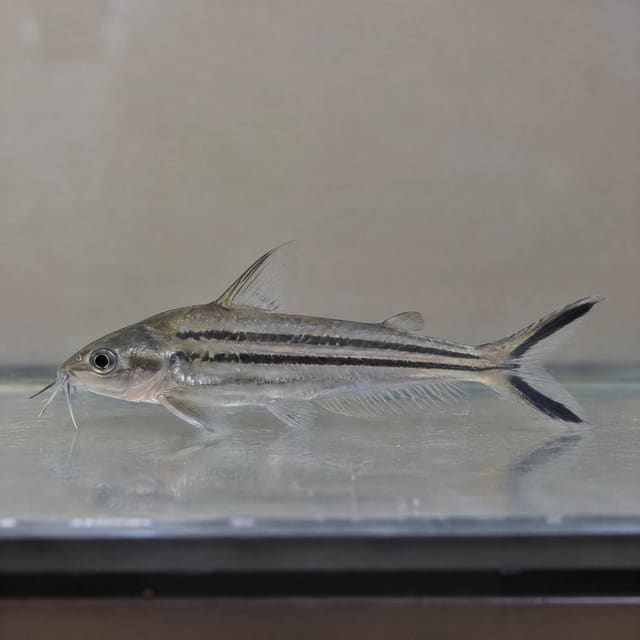
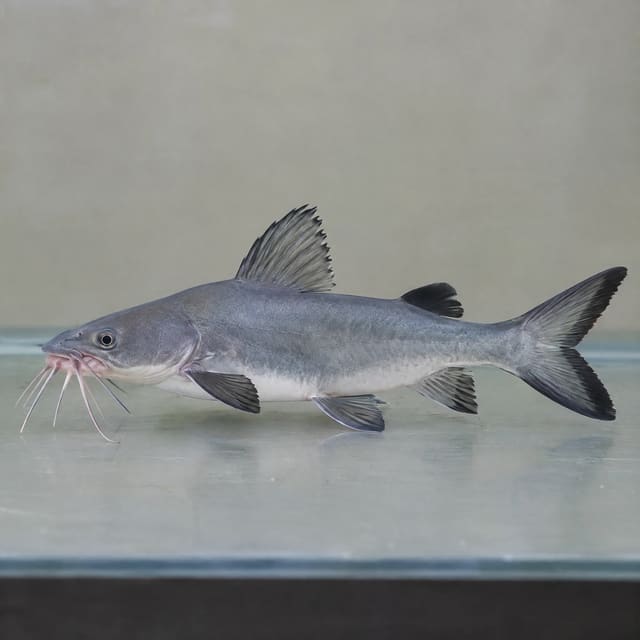
The Grasscutter Catfish (Schilbe intermedius) is a silvery African catfish that shoals in open water and feeds mostly at night, unlike most bottom-dwelling catfish. It usually grows to about 30 cm and needs a group of four or more in a well-filtered aquarium from 150 cm long, with tank mates too big to swallow. Sold individually.
Adult size is the maximum length this species reaches at full maturity (scientific sources). The livestock you receive will be younger and smaller. Product-photo provenance and any image-specific limitations are stated on the listing.
Schilbe intermedius
The Grasscutter Catfish (Schilbe intermedius) is a silvery African catfish that shoals in open water and feeds mostly at night, unlike most bottom-dwelling catfish. It usually grows to about 30 cm and needs a group of four or more in a well-filtered aquarium from 150 cm long, with tank mates too big to swallow. Sold individually.
Adult size is the maximum length this species reaches at full maturity (scientific sources). The livestock you receive will be younger and smaller. Product-photo provenance and any image-specific limitations are stated on the listing.
Read the full care guidance when planning conditions for your aquarium.
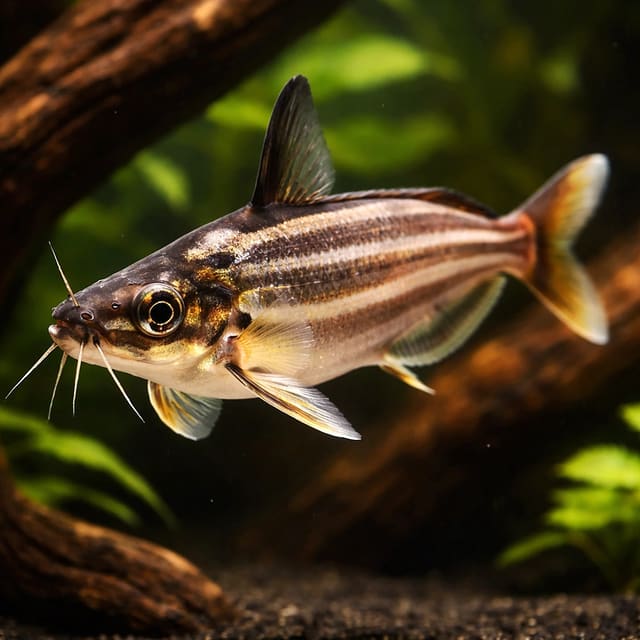
The Grasscutter Catfish (Schilbe intermedius) is an African catfish of the family Schilbeidae, and it lives nothing like the bottom-hugging catfish most fishkeepers know. It is a silvery, flat-sided fish that swims in open water in loose shoals, becomes most active after dark and, in the wild, eats a great many smaller fish. FishBase records a maximum of 50 cm standard length (SL, measured without the tail fin) but notes that it rarely grows beyond 30 cm SL, and ScotCat's care sheet plans for about 30 cm. Treat the Grasscutter Catfish as a large, active predator for a long aquarium and a group of its own kind.
Grasscutter is a trade name. In reference works the species is the silver catfish (FishBase) or the butterfish (ScotCat). We could not find a reliable source for where the grasscutter name comes from, so we do not repeat the stories told about it online. The species name intermedius means intermediate: ScotCat explains that it was described as intermediate between Schilbe uranoscopus and another schilbid then placed in the same genus.
Its range is one of the widest of any African catfish. FishBase lists Senegal, Gambia and many West African basins including the Niger and Volta, the Nile and Lake Victoria basins, the Congo, the Zambezi (including Lake Kariba), East African rivers and southern systems such as the Limpopo, Incomati and Pongola. It prefers large rivers and lakes, rarely enters small rivers, lives mainly in shallow open water and rises towards the surface at night. FishBase gives its IUCN Red List status as Least Concern (assessed 2019) and notes that it is caught as a food fish across its range.
| Feature | What to look for |
|---|---|
| Body | Fusiform and compressed from side to side; silvery, shading to brownish or olive on the back and top of the head (FishBase; ScotCat) |
| Flank bands | Two dark grey-to-olive bands: the longer runs from the upper gill cover to the base of the tail and starts at a dark shoulder spot; the shorter runs from the pectoral fins to the end of the anal fin (ScotCat) |
| Anal fin | Very long, from the vent almost to the tail, with 41–66 branched rays (FishBase) and a dark band near the body (ScotCat) |
| Barbels | Four pairs of short barbels around the mouth (ScotCat) |
| Dorsal fin | Short, with one spine and 5–6 soft rays (FishBase; ScotCat) |
| Adipose fin | Usually absent in fish from the Nile and West Africa, though small ones occur; Central and East African populations may have or lack one (FishBase) |
| Tail | Deeply forked, with a dark streak into each lobe (ScotCat) |
ScotCat also pictures an albino form, and notes that Schilbe marmoratus looks similar but is smaller, lighter brown and marbled, with the same dark shoulder patch. Browse the rest of our African catfish, or the full catfish and plecos range.
We also sell the Striped Schilbe Catfish (Schilbe mystus), and customers often ask whether the two are the same fish. FishBase treats them as two separate, valid species, and the confusion comes from a change of name rather than from the fish themselves.
Until 1990 the fish now called S. intermedius was itself known as Schilbe mystus. That year a study of the original specimen of Silurus mystus, the fish on which the name was founded, showed that it belonged to the species then called Schilbe niloticus. The older name takes priority, so S. mystus now means the former S. niloticus, and the widespread species previously known as S. mystus became S. intermedius. ScotCat still lists S. mystus among the synonyms of S. intermedius, which reflects the older usage, and the aquarium trade still uses both names.
| Feature | Grasscutter Catfish (S. intermedius) | S. mystus as FishBase now defines it |
|---|---|---|
| FishBase English name | Silver catfish | African butter catfish |
| Earlier scientific name | Called Schilbe mystus until 1990 | Formerly Schilbe niloticus |
| Adipose fin | Usually absent in Nile and West African fish; present or absent in Central and East Africa | Present and fully developed |
| Branched anal-fin rays | 41–66 | 45–64 |
| Maximum size | 50 cm SL, rarely over 30 cm SL | 35 cm SL |
| Range | West, Central, East and southern Africa, from Senegal to the Nile, Congo, Zambezi and Limpopo | Nile basin and West Africa from the Senegal River to the Cross, Wouri and Sanaga, including the Chad basin |
The quickest check in the tank is the adipose fin, the small fleshy fin on the back between the dorsal fin and the tail. A fully developed adipose fin points to S. mystus in the FishBase sense; no adipose fin, or only a tiny one, fits S. intermedius, although some Central and East African Grasscutters do have one. Both are shoaling, open-water predators of a similar size, so the care on this page suits either.
Two more names cause mix-ups. Our Silver Catfish (Chrysichthys nigrodigitatus) shares an English name with this fish in FishBase but is a different, bottom-living catfish from another family. Our African Glass Catfish (Pareutropius debauwi) belongs to the same family as the Grasscutter but is far smaller, and an adult Grasscutter would eat it, so they are relatives, not tank mates.
ScotCat recommends keeping four or more and notes that the species does better with its own kind, and FishBase describes it as often shoaling in the wild. A single fish loses the company it relies on. One purchase is one fish, so choose a quantity of four or more and make sure the aquarium can hold the whole group at adult size. Read our delivery and Live Arrival Guarantee terms before you order.
ScotCat advises a large, well-filtered aquarium from 150 cm (5 ft) long upwards for a group. Length matters most, because this is an open-water swimmer that cruises up and down rather than resting on the floor. OATA's guidance on very large fish adds two points that apply here: choose a tank that can house the fish at full size from the start, and remember that many large species grow quickly, so a tank that suits a juvenile may not last. For the biggest species OATA notes that volumes often run to more than 500 litres.
Our tank volume calculator converts your tank's measurements into litres, and the stocking calculator helps you check the whole adult population before you buy.
ScotCat describes the layout this fish wants: wide open spaces, long grass-like plants and a few pieces of bogwood around the margins. That leaves the centre of the tank free for the shoal to swim, while the planted edges give it somewhere to retreat. OATA recommends sand or fine gravel for catfish because of their sensitive barbels, and a fish-proof cover for large fish, which can be jumpy, especially in new surroundings.
| Area | Purpose |
|---|---|
| Open centre and front | Swimming room for the shoal |
| Long grass-like plants at the back and sides | Cover and broken sight lines (ScotCat) |
| Bogwood around the margins | Shade and resting places (ScotCat) |
| Sand or fine gravel | Protects the barbels (OATA) |
| Tight-fitting lid | Stops a startled fish from jumping out (OATA) |
Keep décor to the edges rather than in the swimming lane, and place heaters and filter intakes where a fast-moving fish cannot collide with them or wedge itself behind them.
Published water values for this species are few. ScotCat gives 22–25°C in its data box and 23–26°C in its care notes, with a pH of 6.5–7.2; FishBase gives none. OATA's general catfish guidance fills in hardness. The table shows each source and a range that satisfies them.
| Value | ScotCat (this species) | OATA (catfish in general) | Aim for |
|---|---|---|---|
| Temperature | 22–25°C (data box); 23–26°C (care notes) | 22–27°C | 23–25°C |
| pH | 6.5–7.2 | 6.0–8.0 | 6.5–7.2 |
| General hardness | Not given | 4–18°dH | 4–18°dH, kept steady |
| Carbonate hardness | Not given | 3–15°dKH | 3–15°dKH |
UK tap water varies from soft to very hard depending on where you live, so test yours before you plan. Treat every change of water with a conditioner that removes chlorine and chloramine, as OATA advises. Our water matcher compares your readings with these ranges, and our water chemistry guide explains pH and hardness in plain terms.
| Reading | Target |
|---|---|
| Ammonia | Zero mg/l |
| Nitrite | Zero mg/l |
| Nitrate | No more than 20 mg/l above your tap water |
These limits come from OATA. A shoal of fish that each reach about 30 cm produces a great deal of waste, so test every week and after every addition of fish.
ScotCat stresses a well-filtered aquarium, and OATA's very-large-fish guidance explains why: big fish produce large amounts of solid waste, and several large aquarium filters or a pond filter may be needed to keep up. Check filters for blockages and rinse the media lightly in water removed from the tank, never under the tap, so the beneficial bacteria survive. Our guide to aquarium filtration explains the options, and our nitrogen cycle guide explains why a new tank must mature before large fish arrive.
In the wild the Grasscutter eats almost anything it can catch. FishBase lists fish of all ages, aquatic and land insects, molluscs, freshwater prawns and other crustaceans, algae and other bottom and open-water organisms, with plant matter and eggs also recorded, and says it is mainly a fish-eater between 13 and 34 cm total length. It is described as a nocturnal surface feeder. In the aquarium, ScotCat says it accepts most standard foods, so there is no need to feed live fish.
OATA's guidance for large fish suggests appropriately sized pellets, with larger frozen foods such as mussel, shrimp or lancefish for carnivores. From our range, frozen Mysis, small frozen krill and Tropical Krill Gran granules make a good rotation. Feed once a day, and only what the fish finish within a few minutes, so that leftovers do not foul the water.
Before the fish arrive, make sure ammonia and nitrite read zero and that the temperature and pH sit within the ranges above. OATA's floating-bag method suits these fish: switch off the aquarium lights, float the sealed bag for 10 minutes to equalise the temperature, add small amounts of tank water over up to 20 minutes, then release the fish, leaving as much bag water behind as possible. Our guide to acclimatising new fish walks through each step.
Introduce the whole group together so the shoal forms straight away. Catfish carry spines on their pectoral fins and just behind the gills, so OATA advises handling them with care and double-bagging them for transport; a fish that tangles in a net is better lifted out in a container.
| Checkpoint | What to do |
|---|---|
| Before arrival | Test the water; check the lid, heater and filter |
| Day of arrival | Lights off, slow acclimatisation, release the group together |
| First feed | Next evening, a small measured meal |
| Every day | Watch breathing, feeding, colour and how the group swims together |
| End of the week | Full water test, then the normal weekly routine |
OATA advises monitoring water quality closely during the first week, because a new group adds a sudden load to the filter.
Expect a group that holds together in mid-water, cruising the open lane and turning as one. FishBase describes the species as nocturnal and notes that it rises towards the surface at night, so the group is often livelier after the lights go out than in the middle of the day.
| Behaviour | What it means | When to act |
|---|---|---|
| The group swims together in open water | Normal shoaling | No action needed |
| More activity after lights out | Normal nocturnal rhythm (FishBase) | No action needed |
| Small fish disappearing overnight | Predation: it is mainly a fish-eater (FishBase) | Move small fish to another tank |
| Sudden dashes or jumps when startled | A flight response, most common in a new tank | Check the lid and avoid sudden changes of light |
| One fish hiding alone and not feeding | Stress or illness | Check the group size and the water values |
ScotCat warns that tank mates must not be too small, as they may be eaten at night, and advises fish of the same size or larger. OATA's large-fish guidance gives the same rule: avoid mixing with much smaller fish. The safest plan is a group of Grasscutters as the main open-water shoal, with robust fish that are already too large to fit in an adult's mouth.
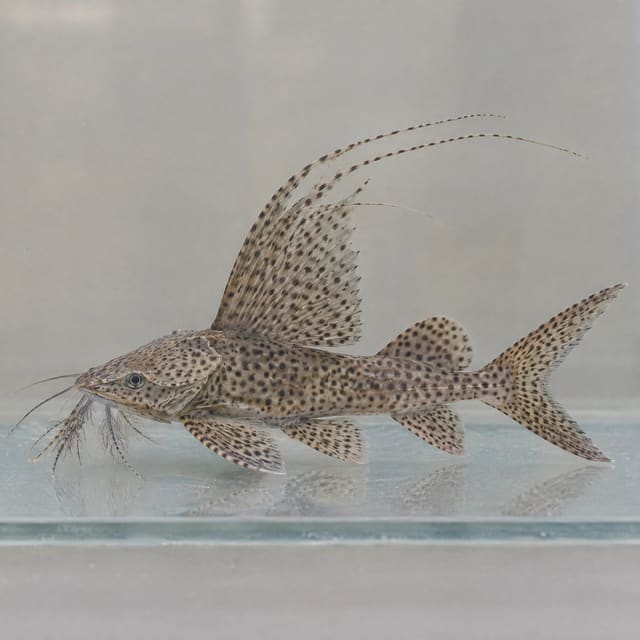
From our range, robust catfish such as the Featherfin Synodontis and other Synodontis catfish, the Senegal Bichir on the floor and the Tinfoil Barb in open water are candidates for a big aquarium, provided sizes are matched when you add them. Check every combination in our tank mates tool.
| Suits | Avoid |
|---|---|
| A group of four or more Grasscutters | Tetras, rasboras, small barbs and any fish that fits in its mouth (ScotCat) |
| Robust catfish too large to swallow, such as larger Synodontis | Small schilbids such as the African Glass Catfish |
| Large, calm floor-dwellers such as bichirs, matched for size | Shrimp: freshwater prawns are part of its natural diet (FishBase) |
| Large, active open-water fish of a similar size | Much smaller fish of any kind (OATA) |
OATA lists the warning signs that something is wrong in a catfish aquarium. Check them at every feed, and when you see one, test the water before doing anything else.
| If you see | Do this |
|---|---|
| Hanging at the surface, sitting on the bottom or swimming erratically | Test ammonia, nitrite and temperature; check filter flow and aeration |
| Gills moving faster or slower than usual | Check oxygen, temperature and water quality straight away |
| Colour much darker or paler than normal, or more hiding or aggression | Check the water values, the group and the tank mates |
| White spots, fluffy growths, or lost fins or scales | Test the water and seek fish-health advice before treating |
| Clamped fins, flicking against objects or shimmying | Test the water and watch closely for other signs |
| Weight loss or poor appetite | Review water quality and the feeding routine |
FishBase records a maximum observed lifespan of almost 10 years, so a well-kept group is a long commitment. OATA adds a rule for every aquarium fish: never release an unwanted fish or plant into the wild.
ScotCat reports that the species has not been bred in aquariums. In the wild FishBase describes spawning throughout the year with one peak: during the rainy season fish migrate upriver in fairly compact shoals to spawn in flooded pools, and the eggs are left unguarded. Females grow larger than males, which is the most practical way to tell the sexes in a mature group.
Grasscutter Catfish is a trade name for Schilbe intermedius, a silvery, open-water African catfish from the family Schilbeidae. FishBase calls it the silver catfish and ScotCat the butterfish. It lives in shoals, feeds mostly at night and eats smaller fish.
Not according to FishBase, which keeps them as two separate species. The Grasscutter was itself called Schilbe mystus until 1990, when that name was moved to the species formerly called Schilbe niloticus. The true S. mystus has a fully developed adipose fin, while the Grasscutter usually has none or only a small one. Their care is very similar.
Plan for about 30 cm. FishBase records a maximum of 50 cm standard length but says it rarely grows beyond 30 cm, and ScotCat gives about 30 cm. Females grow larger than males.
Four or more. ScotCat recommends a group of at least four and says the species does better with its own kind. One purchase is one fish, so choose a quantity of four or more.
ScotCat recommends a large, well-filtered aquarium from 150 cm long upwards, with wide open swimming space, long grass-like plants and a few pieces of bogwood around the edges.
Yes. FishBase describes it as voracious and predatory and mainly a fish-eater once it reaches about 13 cm, and ScotCat warns that small tank mates may be eaten at night. Keep it only with fish too large to swallow.
ScotCat gives 22–25°C in its data box and 23–26°C in its care notes, with a pH of 6.5–7.2. Aim for 23–25°C and pH 6.5–7.2, with zero ammonia and nitrite and nitrate no more than 20 mg/l above your tap water.
Meaty foods: good granules or pellets alongside frozen Mysis, krill and similar foods, once a day and only what the group finishes within a few minutes. ScotCat says it accepts most standard aquarium foods, so live fish are not needed.
No reviews for this item yet. Bought one? Honest reviews only, good or bad.
What customers say about ordering from us
Easy website plenty of info on fish your buying great to pick a time slot
TRACEY DURRANT · 7 Oct 2026
Got some lovely fish thank you
Kevin Mackie · 7 Oct 2026
Reviews of our shop, collected by Judge.me, an independent third-party review collector. Newest first.
Moved by UK carriers licensed to handle live animals
Hand-packed with oxygen bags, poly box, heat pack
Email photos the same day; an optional unboxing video helps us review problems faster — claim terms apply
Klarna & PayPal Pay in 3 at checkout