Easy
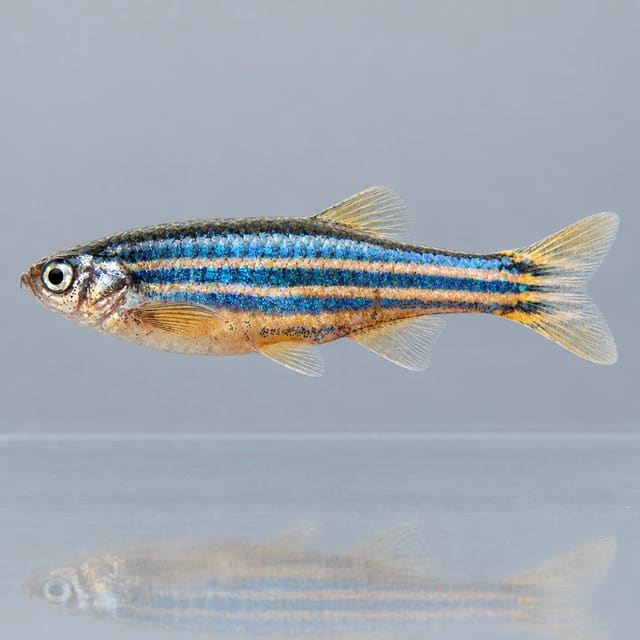
Zebra Danio (Danio rerio)
18–25°C · pH 6–8
£3.59
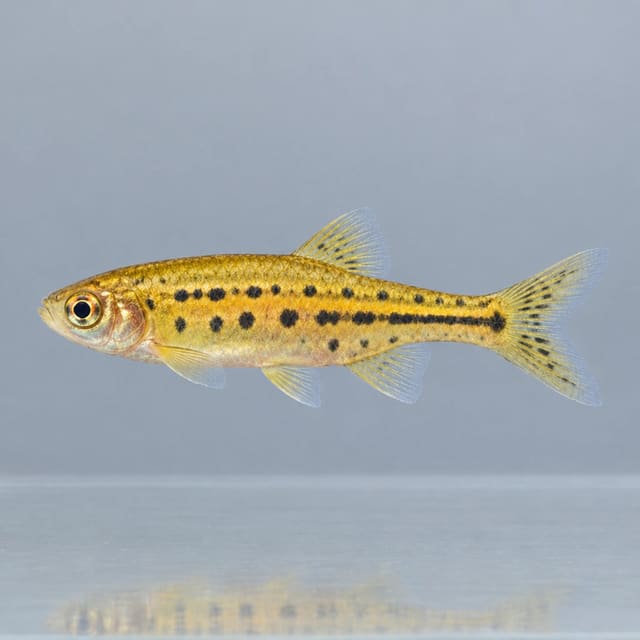
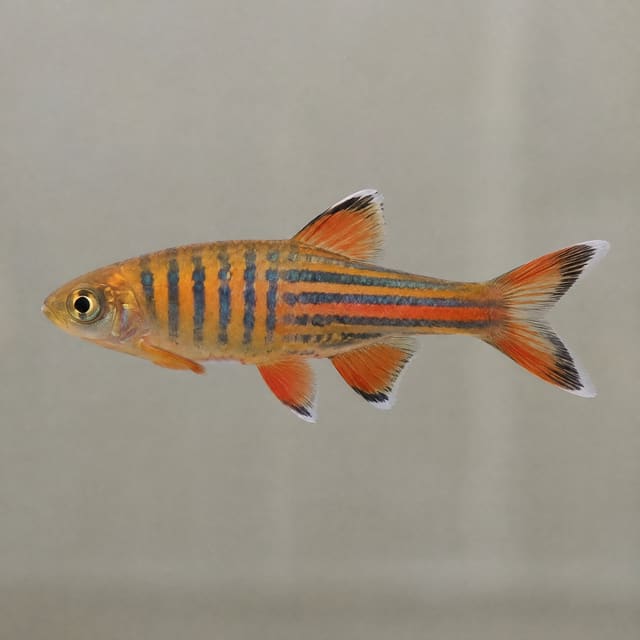
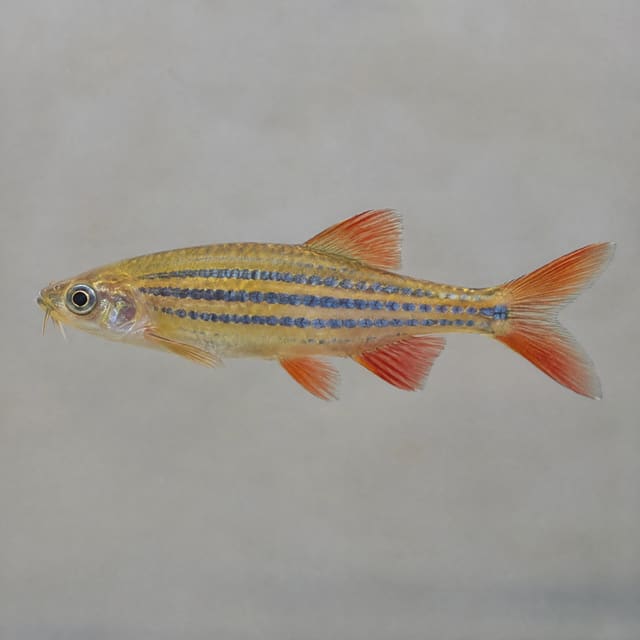
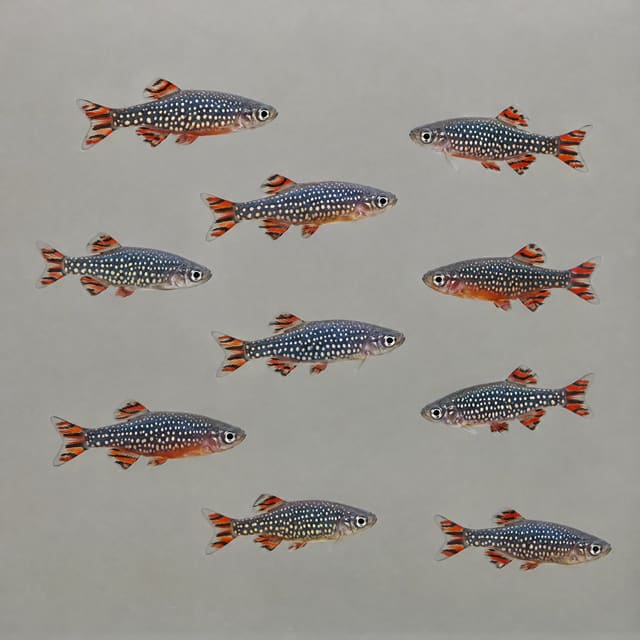
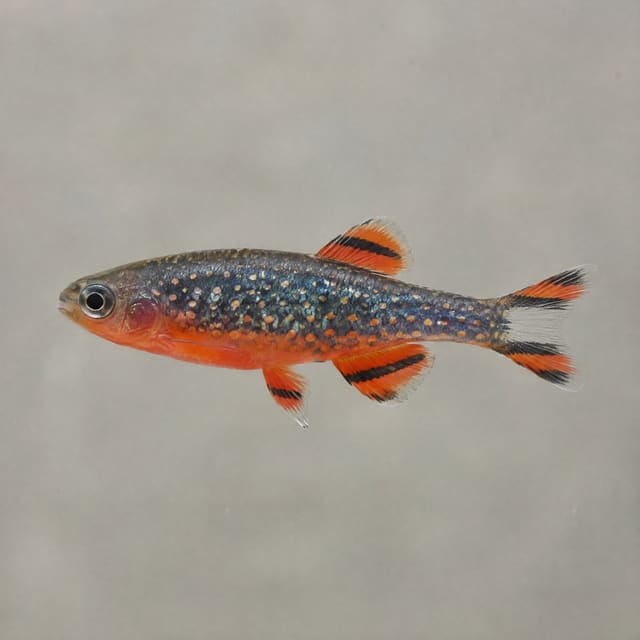
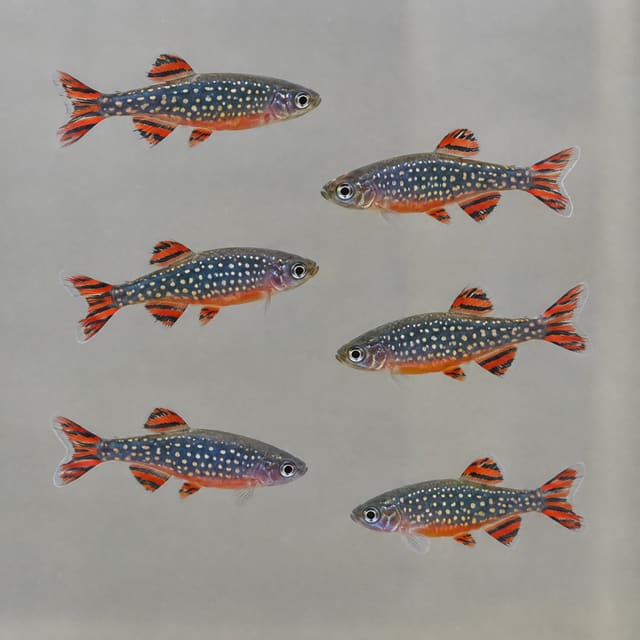
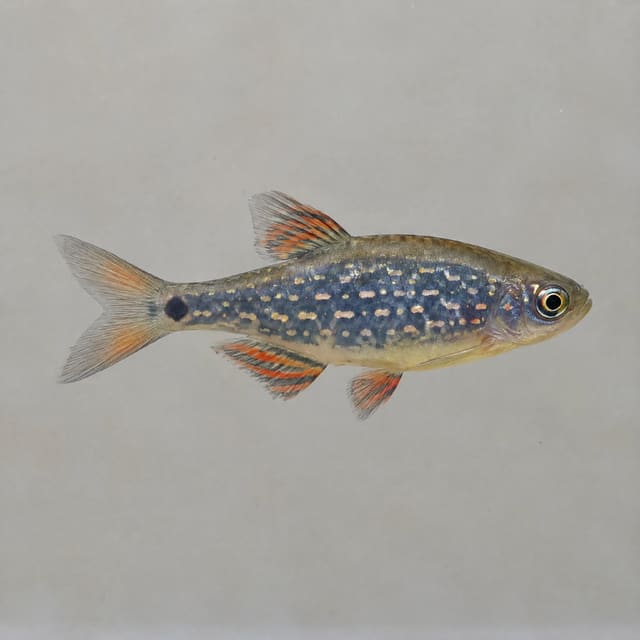
The Leopard Danio is the spotted form of the zebra danio (Danio rerio): a hardy, fast-swimming shoaling fish about 4–5 cm long with dark blue spots on a golden body. Keep a group of eight or more in a planted tank of 60–90 cm at 18–25°C. Sold individually as one live young fish.
Adult size is the maximum length this species reaches at full maturity (scientific sources). The livestock you receive will be younger and smaller. Product-photo provenance and any image-specific limitations are stated on the listing.
Danio rerio
Quantity discounts are pricing offers, not a group-size recommendation. Check the full care guidance and your existing animals before choosing a quantity.
Minimum of 2 per order.
The Leopard Danio is the spotted form of the zebra danio (Danio rerio): a hardy, fast-swimming shoaling fish about 4–5 cm long with dark blue spots on a golden body. Keep a group of eight or more in a planted tank of 60–90 cm at 18–25°C. Sold individually as one live young fish.
Adult size is the maximum length this species reaches at full maturity (scientific sources). The livestock you receive will be younger and smaller. Product-photo provenance and any image-specific limitations are stated on the listing.
Read the full care guidance when planning conditions for your aquarium.
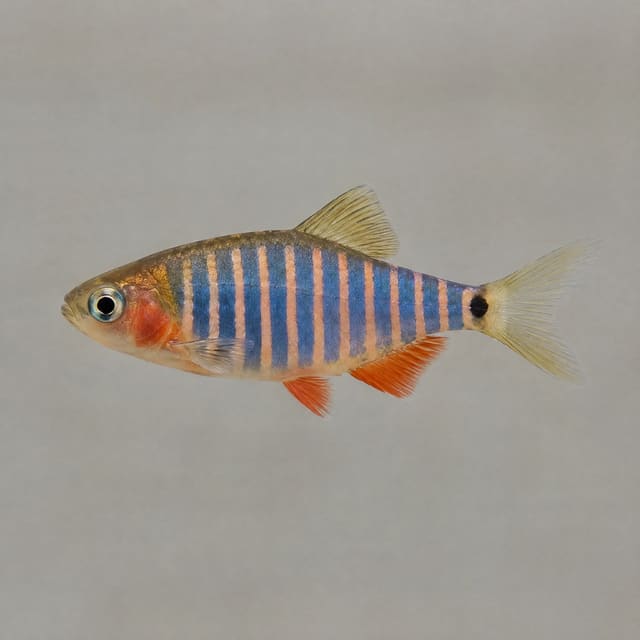
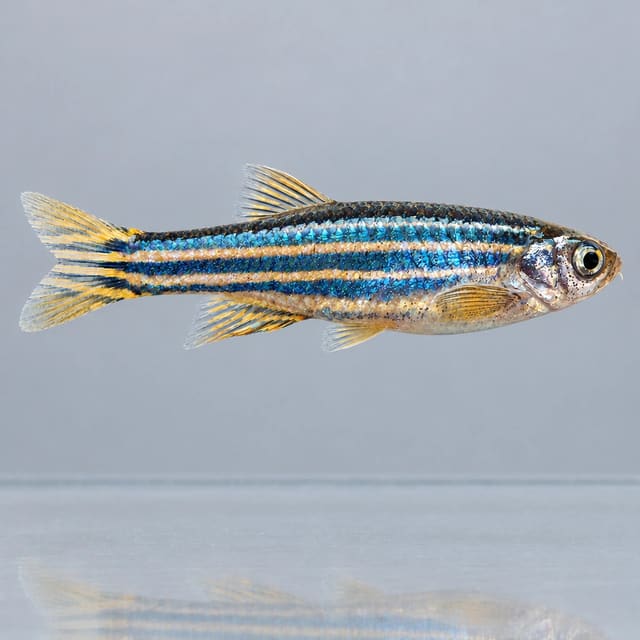
The Leopard Danio (Danio rerio) is the spotted form of the zebra danio, one of the hardiest and busiest small fish in the hobby. Instead of the familiar horizontal blue stripes, each fish carries rows of dark blue-black spots on a gold to olive body, and the spotting continues into the anal fin. A group of Leopard Danios races up and down the front glass all day, chases briefly at feeding time and settles into a loose shoal near the surface. It is peaceful, tolerant of a wide range of water and inexpensive, which is why it is so often recommended as a first fish.
It is not a separate species. Seriously Fish explains that the leopard pattern was once described as its own species, Brachydanio frankei (Meinken, 1963), and is now usually written Danio rerio var. frankei. For decades its origin was a puzzle, and many keepers assumed it had been made by selective breeding. Research summarised by Spence and colleagues (2008) showed that it is a spontaneous mutation of the striped form that also turns up in the wild. Its care is therefore identical to that of any zebra danio.
| Name | What it means |
|---|---|
| Leopard Danio | The trade name for the spotted form, used on this listing |
| Spotted zebra danio | A descriptive name you will also see in shops |
| Danio rerio (Hamilton, 1822) | The scientific name of the species, also called the zebrafish |
| Brachydanio frankei / D. rerio var. frankei | The old species name for the leopard form and its current informal label |
| Danionidae | The family of danios and their relatives, as listed by FishBase |
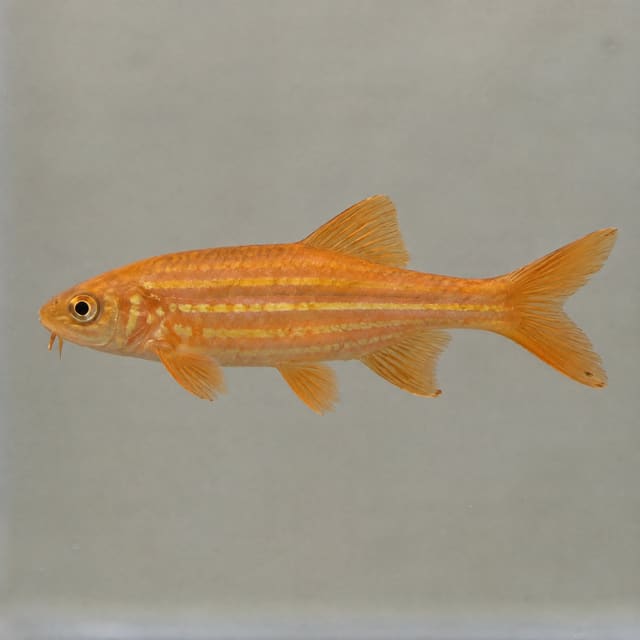
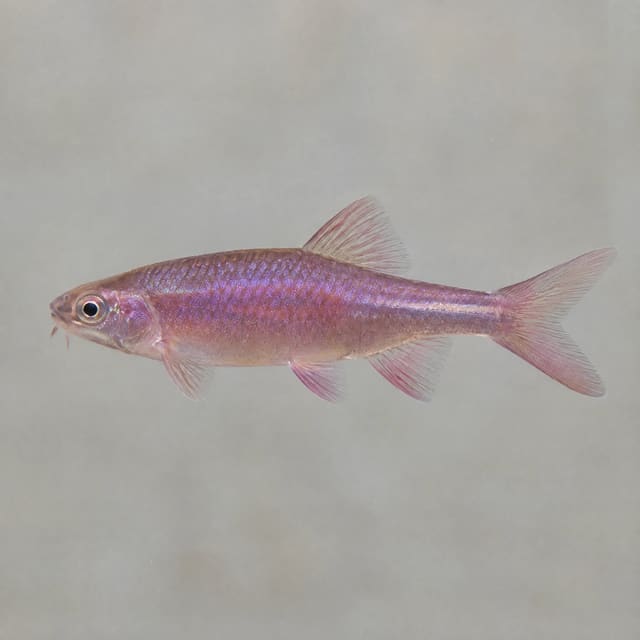
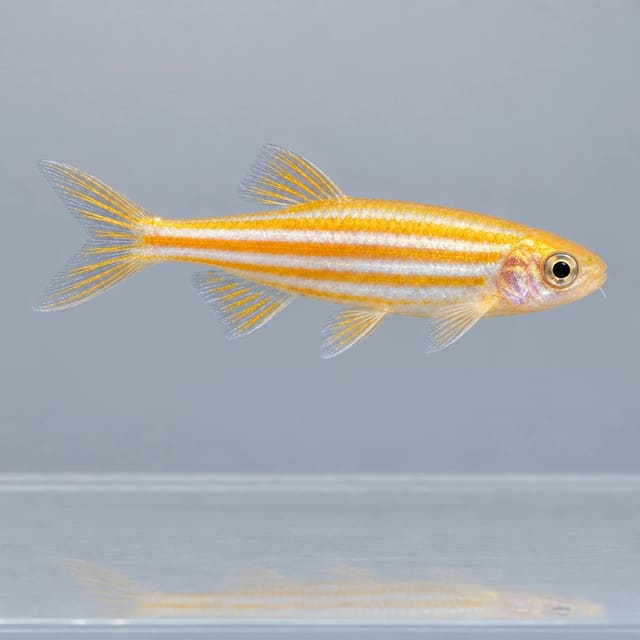
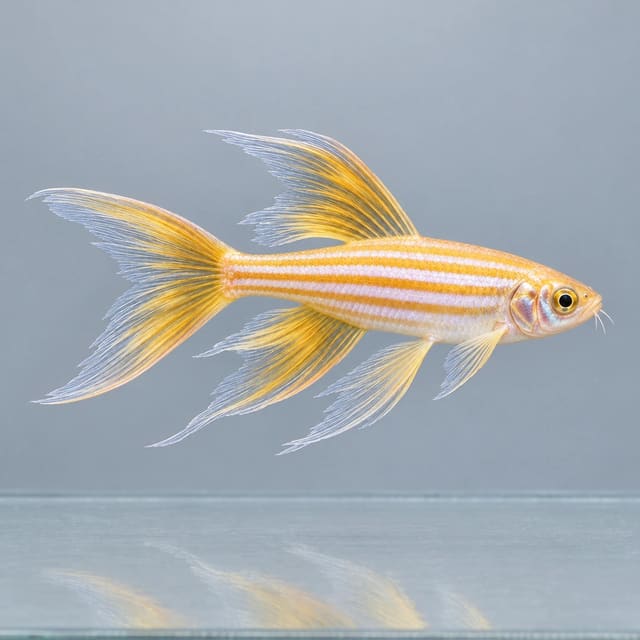
Other ornamental strains of the same fish include a xanthistic golden form and long-finned fish. You can compare the leopard pattern with our Golden Zebra Danio and the flowing Longfin Golden Zebra Danio, or browse every species in rasboras and danios.
One purchase supplies one live Leopard Danio. The size option is "Small": these are young fish, not yet at adult length, and they colour up further as they settle and mature. Sex is not chosen, and you will normally receive a mix when you buy several. The photographs show the type of fish; spotting differs from fish to fish, and no two Leopard Danios carry exactly the same pattern.
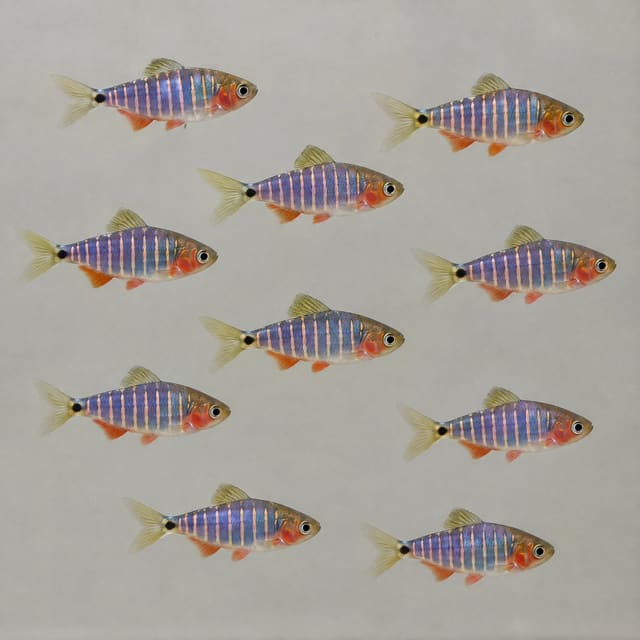
Because this is a shoaling fish, buy a group rather than a single fish. Seriously Fish recommends at least 8–10, while FishBase gives groups of five or more as the aquarium minimum. We suggest eight or more where the tank allows, since a larger group spreads chasing, shows more natural behaviour and makes the fish less nervous.
Mature females are usually rounder in the belly, a little larger and slightly less colourful than males. The difference is clearest in spawning condition, when males intensify in colour and females fill with eggs. Young fish cannot be sexed reliably.
Size figures differ between sources. Seriously Fish gives a maximum of 50 mm standard length (body length without the tail), while the current FishBase entry gives 3.8 cm standard length; in practice adults in home aquaria usually sit somewhere in that range. Tank recommendations differ too. FishBase lists a minimum aquarium of 60 cm for a group of five or more, while Seriously Fish advises a base of at least 90 × 30 cm, roughly 81 litres, because this is such an active swimmer. We would follow the larger figure for a group of eight or more. Our stocking calculator helps you check how many fish your tank can support.
| Planning point | Figure | Source |
|---|---|---|
| Adult size | 50 mm SL; 3.8 cm SL | Seriously Fish; FishBase |
| Minimum aquarium | 90 × 30 cm base, about 81 litres; 60 cm | Seriously Fish; FishBase |
| Group size | At least 8–10; 5 or more | Seriously Fish; FishBase |
| Lifespan (domesticated) | Average 3.5 years, oldest about 5.5 years | FishBase |
| Temperament | Very peaceful, schooling | Seriously Fish |
Wild zebra danios live in shallow, often slow or still water. A 2007 field survey by Engeszer and colleagues, summarised by Seriously Fish, found the species at 28 sites in north-eastern India; at half of them the water flow was slow or absent, the bottom was most often silt, and submerged or overhanging plants were typical. The fish were more abundant in marginal pools and mature rice paddies than in main stream channels, and in rocky streams they schooled along the vegetated margins.
Décor is not critical, but Seriously Fish notes that colours show better in a heavily planted tank with a dark substrate. Leave a clear swimming lane along the front and top, plant the back and sides, and add some floating plants or driftwood branches to diffuse the light. A tight-fitting lid is sensible, as active surface fish can jump when startled. Hardy plants from our aquarium plants range suit this fish well.
This is one of the most adaptable fish you can buy, and most UK tap water suits it once dechlorinated. Seriously Fish gives 18–25°C, pH 6.0–8.0 and 5–20 dGH, and notes that a heater may not always be needed. FishBase gives 18–24°C, pH 6.0–8.0 and 5–19 dH. In the wild, water temperatures in July were recorded at 24.6–38.6°C, falling in winter, so short swings are tolerated. In a heated community tank we suggest holding around 22–24°C, inside both sources' ranges, which also suits most tropical tank mates. Our water matcher compares your tap water with the needs of each fish.
| Value | Seriously Fish | FishBase | Our routine target |
|---|---|---|---|
| Temperature | 18–25°C | 18–24°C | 22–24°C in a heated community |
| pH | 6.0–8.0 | 6.0–8.0 | Stable within 6.5–7.8 |
| Hardness | 5–20 dGH | 5–19 dH | Your tap water, kept steady |
| Ammonia and nitrite | Zero in any established aquarium | Zero | |
Hard water areas of south and east England and softer water in Scotland, Wales and the north-west both fall inside these ranges. What matters more is stability: change water with dechlorinated tap water at the same temperature, and avoid large, sudden pH shifts. Our water chemistry guide explains pH, GH and KH in more detail.
Seriously Fish advises that filtration does not need to be especially strong given the still-water habitat, although the fish does appreciate some water movement. A turnover of four to five times the tank volume per hour is a reasonable guide for an 80-litre tank. Change about a quarter of the water each week, clean the filter sponge in old tank water rather than under the tap, and test regularly for ammonia, nitrite and nitrate, especially in the first weeks after adding a new group.
Stomach analyses of wild fish show a micropredator that eats small crustaceans and insect larvae such as mosquito larvae, and FishBase adds worms. In the aquarium the Leopard Danio is unfussy and will take almost any small food. Base the diet on a good flake or micro-pellet and add small frozen, freeze-dried or live foods such as daphnia, brine shrimp and bloodworm several times a week. Feed once or twice a day, only as much as the group clears in a couple of minutes, because this fish feeds at the surface and in midwater and leftovers sink out of reach.
| Day | Main meal | Extra |
|---|---|---|
| Monday, Thursday | Flake or micro-pellet | Frozen daphnia |
| Tuesday, Friday | Flake or micro-pellet | Brine shrimp |
| Wednesday, Saturday | Flake or micro-pellet | Small bloodworm |
| Sunday | Light feed or none | None |
Dim the tank lights, float the sealed bag for about 15 minutes to equalise temperature, then add small amounts of tank water over another 15–20 minutes before netting the fish into the aquarium. Do not tip the bag water into your tank. Our guide on how to acclimatise new fish walks through each step. For the first week, feed lightly, keep the lights on a normal day length and watch for fish that hide, separate from the group or stop eating. Read our delivery and live arrival information before ordering, so you are ready to unpack promptly.
Seriously Fish describes the species as very peaceful and suitable with many popular community fish: other small cyprinids, tetras, livebearers, rainbowfish, anabantoids, catfish and loaches. Its fast swimming can unsettle very slow, long-finned fish at feeding time, so give those species their own space. Our tank mates checker tests a planned community before you buy.
| Suits | Use care or avoid |
|---|---|
| Harlequin Rasboras and other small rasboras | Large predatory fish that can swallow a 4–5 cm danio |
| Rosy Danios and Pearl Danios | Slow, long-finned fish such as fancy bettas, which may be outcompeted for food |
| Bronze Corydoras on the bottom | Very shy species that dislike constant activity |
| Peaceful tetras, livebearers and small loaches | Single danios or pairs kept without a group |
Seriously Fish warns that decades of mass production have caused inbreeding and that good stock can be hard to find. Ailments to recognise early include the microsporidian parasite Pleistophora hyphessobryconis ("neon tetra disease"), which causes restlessness, faster breathing, white patches in the muscle and a fish separating from the group; it has no cure, and affected fish should be removed. Similar signs can be caused by the bacterium Flavobacterium columnare. Another parasite, Pseudoloma neurofilia, causes wasting and a curved spine ("skinny disease"). Buying from a healthy group, quarantining where possible and keeping the water clean are the best defences.
This is an excellent first breeding project. The fish scatter eggs and give no parental care; FishBase records that eggs are released a few at a time during chasing and settle loose without sticking. Seriously Fish suggests a dimly lit spawning tank with mesh, plastic grass or dense Java moss on the base so eggs fall out of reach, slightly acidic to neutral water at the upper end of the temperature range, and one or two well-conditioned pairs. Small additions of cool water and live or frozen foods help trigger spawning, often the next morning. Remove the adults after a couple of days, switch to a sponge filter, and expect hatching in 24–36 hours. Feed the fry Paramecium or a 5–50 micron dry food, then Artemia nauplii and microworm.
The zebra danio is also one of the most studied fish in science. Wikipedia notes its use as a model organism in developmental biology, gene function and drug development, partly because it breeds so readily. For more beginner species see our first tropical tank guide and the Danio category within our danios, rasboras and Tanichthys section.
No. It is a spotted form of the zebra danio, Danio rerio. It was once described as Brachydanio frankei, but it is now known to be a spontaneous mutation of the striped form that also occurs in the wild. Care is the same for both.
Buy a group. Seriously Fish recommends at least 8 to 10 and FishBase gives five or more as a minimum. One purchase is one fish, so add the number you need to your basket.
Seriously Fish gives 18 to 25 degrees C and says a heater may not always be needed in a warm room. In a typical UK home a heater keeps the temperature steady; around 22 to 24 degrees C suits the danio and most tropical tank mates.
FishBase gives a minimum of 60 cm for a small group, while Seriously Fish advises a base of at least 90 by 30 cm, about 81 litres, because the fish are so active. For eight or more, we recommend the larger figure.
Seriously Fish gives a maximum of 50 mm standard length and FishBase 3.8 cm standard length, measured without the tail. The fish you receive are young, sold as Small, and grow on in your tank.
They are peaceful but very fast. Guppies and other livebearers usually mix well. Long-finned fancy bettas can be outcompeted at feeding time and stressed by constant activity, so we would not combine them in a small tank.
FishBase reports that domesticated zebra danios live on average 3.5 years, with the oldest surviving about 5.5 years.
Yes. They scatter eggs and give no parental care, so use a separate spawning tank with mesh or fine plants on the bottom, remove the adults after spawning and feed the fry very fine foods. Eggs hatch in about 24 to 36 hours.
No reviews for this item yet. Bought one? Honest reviews only, good or bad.
What customers say about ordering from us
Easy website plenty of info on fish your buying great to pick a time slot
TRACEY DURRANT · 7 Oct 2026
Got some lovely fish thank you
Kevin Mackie · 7 Oct 2026
Reviews of our shop, collected by Judge.me, an independent third-party review collector. Newest first.
Moved by UK carriers licensed to handle live animals
Hand-packed with oxygen bags, poly box, heat pack
Email photos the same day; an optional unboxing video helps us review problems faster — claim terms apply
Klarna & PayPal Pay in 3 at checkout