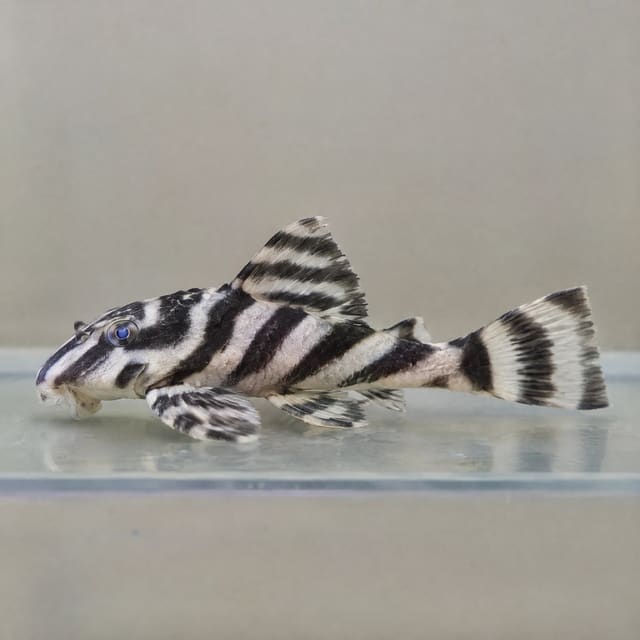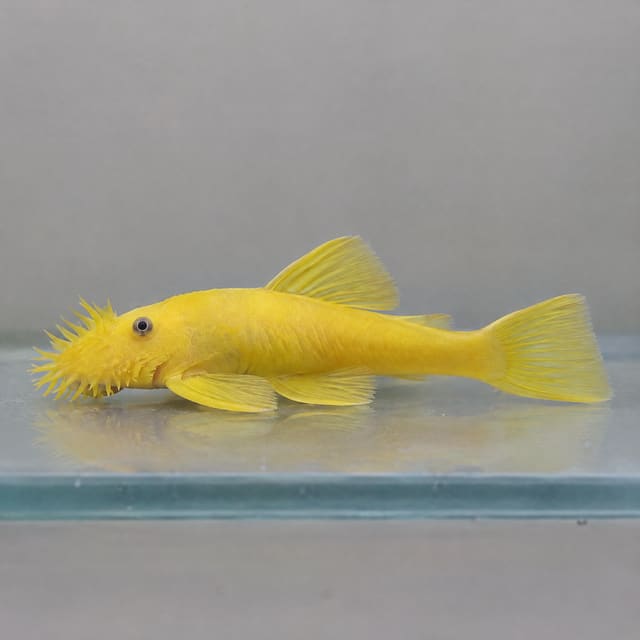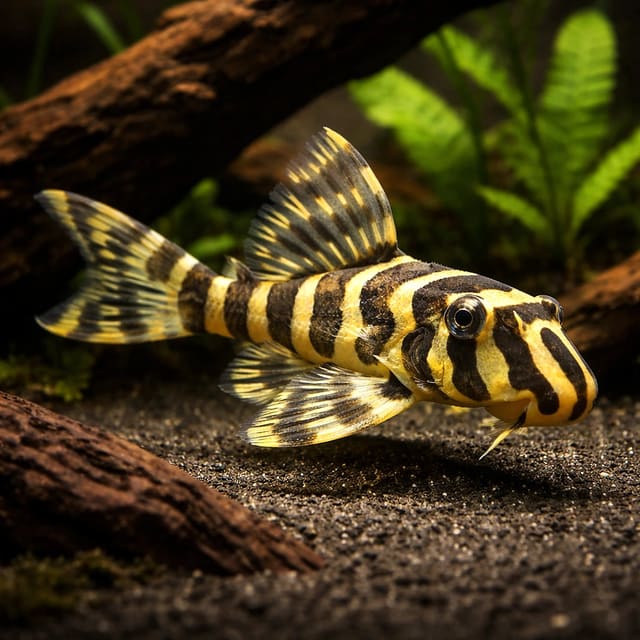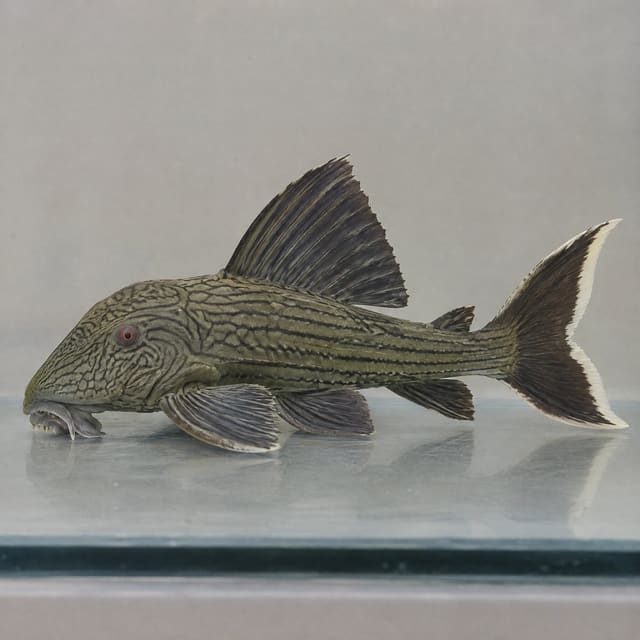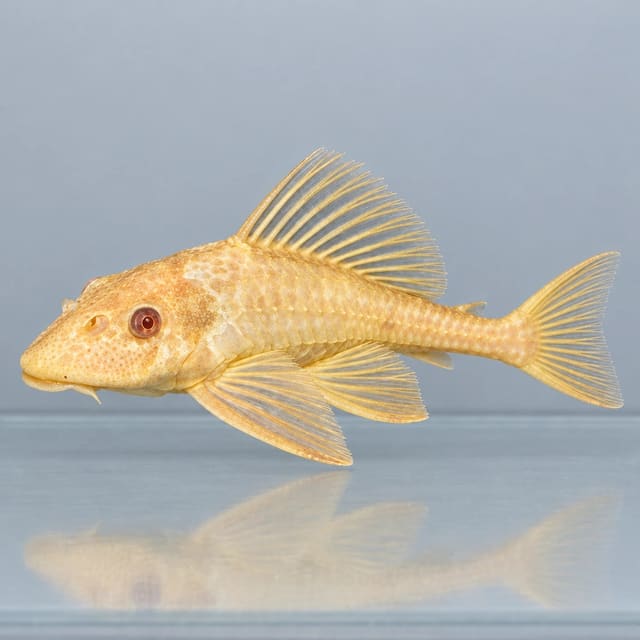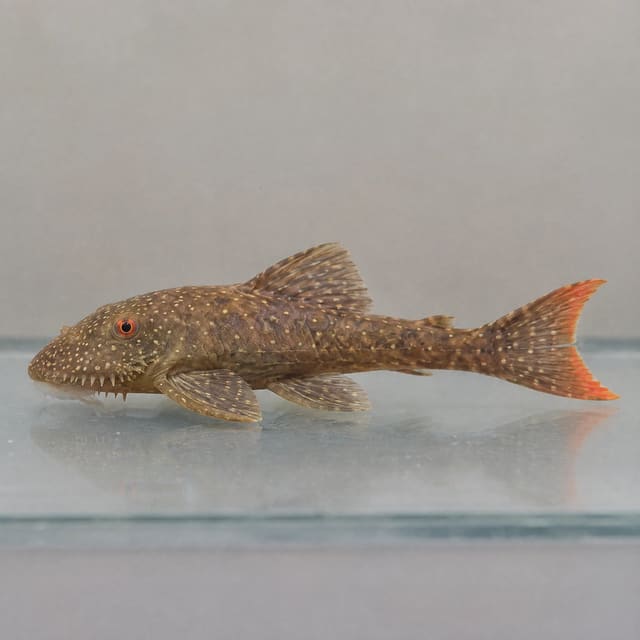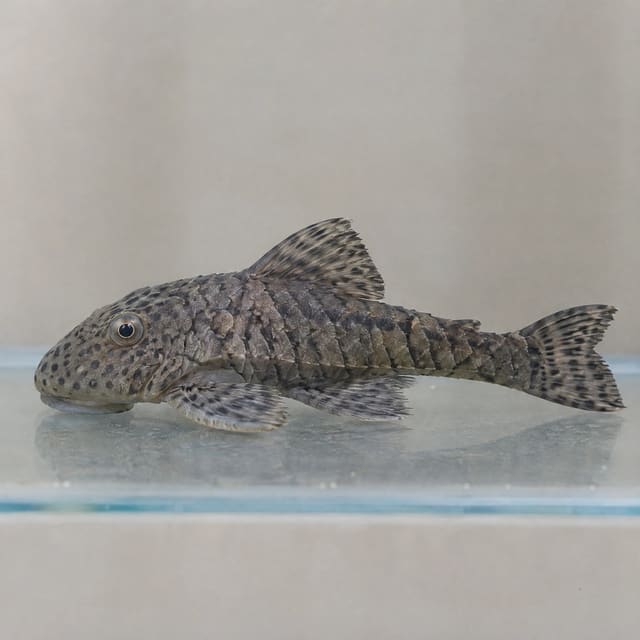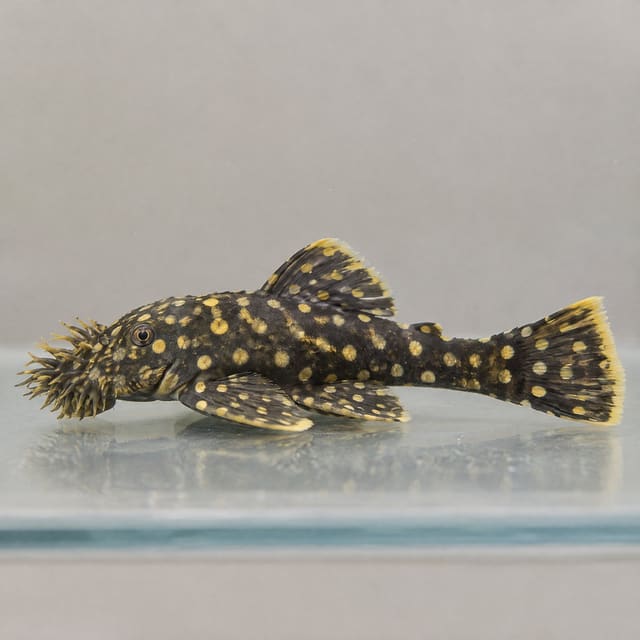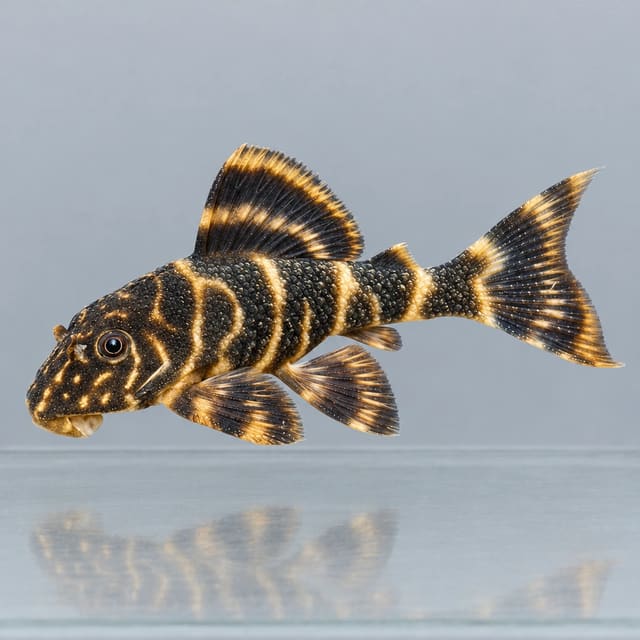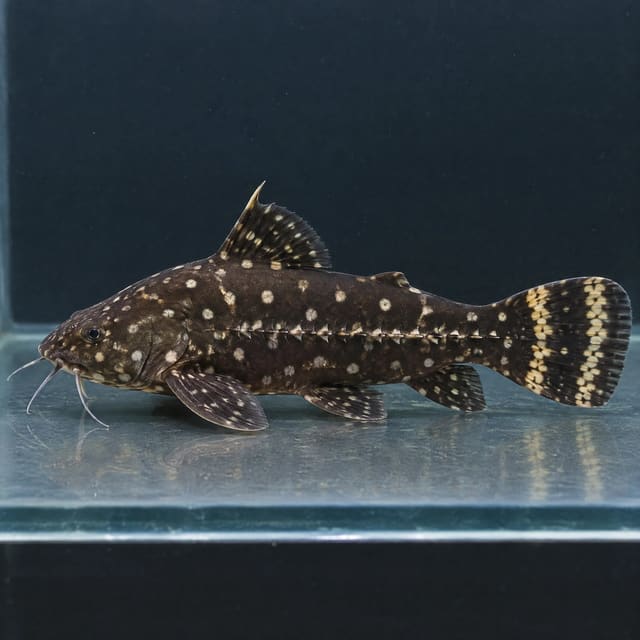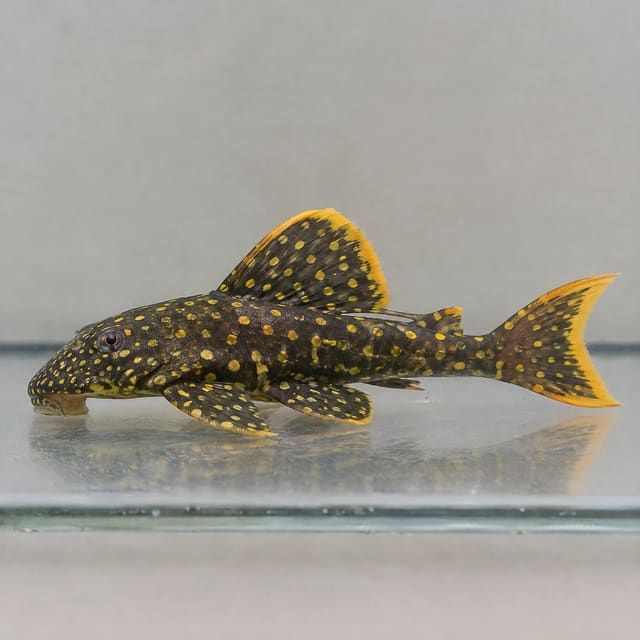
L018 Golden Nugget Pleco (Baryancistrus sp. L018)
22–27°C · pH 6–8
£80.00
The L019 Pleco is an undescribed Baryancistrus from the Rio Xingu at Altamira, Brazil, first shown in 1989 and still known only by its L-number. It grows to about 25–30 cm and needs a warm, fast-flowing 120 × 45 cm river aquarium with spotless water, caves and a vegetable-rich diet. Sold individually as one live fish.
Baryancistrus sp. (L019)
The L019 Pleco is an undescribed Baryancistrus from the Rio Xingu at Altamira, Brazil, first shown in 1989 and still known only by its L-number. It grows to about 25–30 cm and needs a warm, fast-flowing 120 × 45 cm river aquarium with spotless water, caves and a vegetable-rich diet. Sold individually as one live fish.
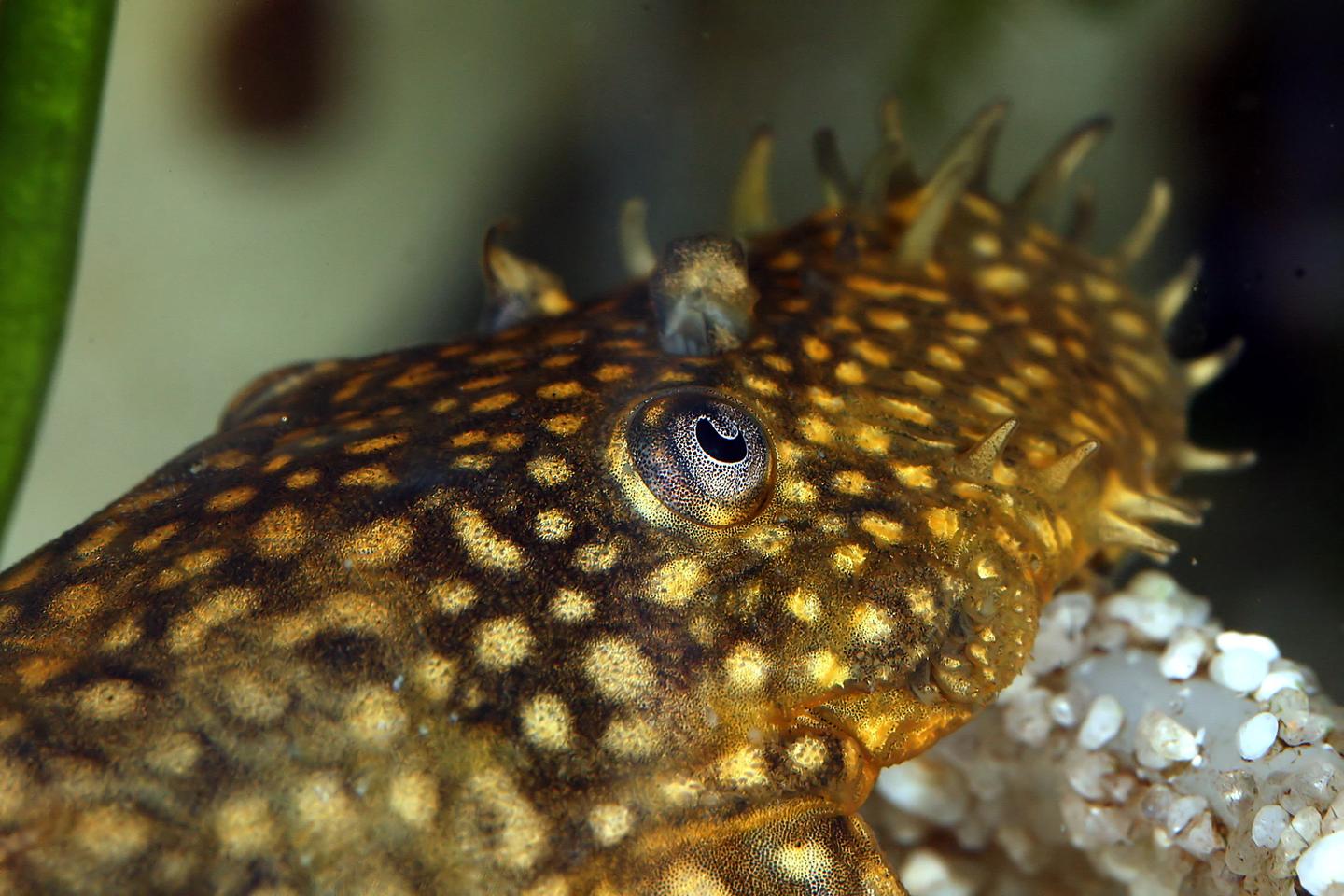
For one typical common bristlenose, start with a mature, filtered aquarium of at least 90 litres, useful floor area, wood and cover. OATA reports about 15 cm adult length, 22-27°C, pH 6-8 and 4-12 dGH. Confirm the exact trade identity before applying species-level claims.
The L019 Pleco is an undescribed suckermouth catfish of the genus Baryancistrus, known in the hobby only by its code, L019 (also written L19). It comes from the Rio Xingu at Altamira in Pará state, Brazil, the river that is also home to the gold nugget plecos. It was first presented in the German aquarium magazine DATZ in March 1989, and more than thirty years later it still has no scientific name. It is a rarely seen fish: Planet Catfish records only a handful of keepers.
Do not let the sale size mislead you. Planet Catfish gives a maximum of 250 mm standard length and ScotCat gives 30 cm, so this is a large, heavy pleco for a big, warm, fast-flowing river aquarium, not for a general community tank. ScotCat is clear that it can be problematic, especially for inexperienced keepers, and is not a beginner's fish.
| Name | What it means |
|---|---|
| L019 (L19) | The L-number given after the 1989 DATZ article; Planet Catfish and ScotCat file it as Baryancistrus sp. (L019) |
| Baryancistrus sp. | A member of the genus whose name means "heavy Ancistrus", not yet formally described |
| L020 | A different fish from the same place; Planet Catfish assigns L020 to the other genus in the original photograph |
| Gold nugget plecos (L018, L081, L085, L177) | Relatives from the same river, now described as Baryancistrus xanthellus; not this fish |
The history of the code explains why careful buyers check this fish closely. Planet Catfish describes L019 and L020 as problematic to identify: the original DATZ photograph was taken underwater (the fish was trying to hide in an old shoe) and showed only the colour pattern, and that pattern belongs to two different fish found at the same spot in the Xingu. To settle it, L019 is used for the Baryancistrus and L020 for the other fish. Planet Catfish also notes that one well-known L-number catalogue illustrates a Hypostomus under this code. ScotCat gives the feature that confirms the genus: in Baryancistrus the dorsal and adipose fins are joined by an expanded rear section of the dorsal-fin membrane, which no other plecos of its tribe have. Browse its relatives in our Baryancistrus gold nugget plecos, every coded catfish in our L-number plecos range, the wider South American catfish category and our full catfish and plecos collection.
One purchase supplies one live L019 Pleco at the standard size offered on this listing. Like most imported plecos it is sold young, so expect a fish far smaller than the adult, but plan the aquarium for a fish of 25–30 cm.
Sex is not specified. ScotCat describes mature males as having a broader and longer head and longer pectoral-fin spines; these differences only show in adults, so do not plan around receiving a particular sex.
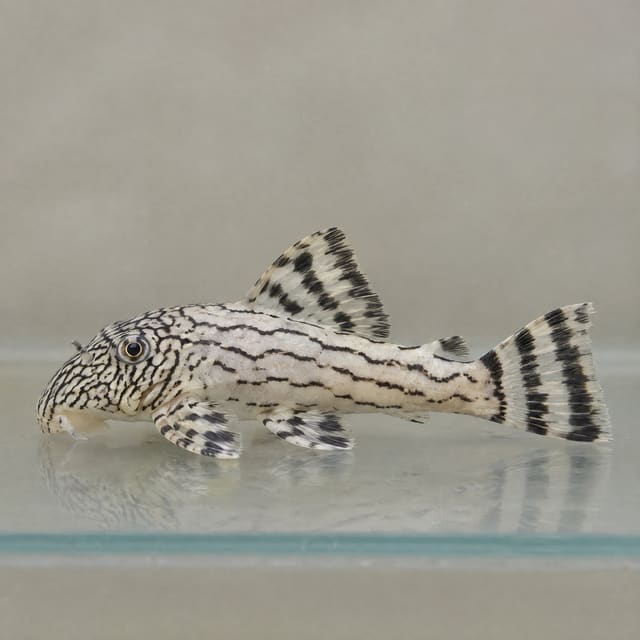
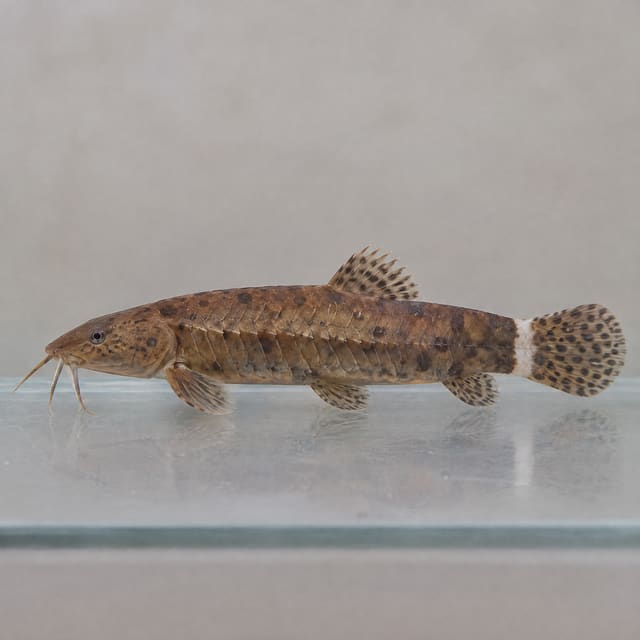
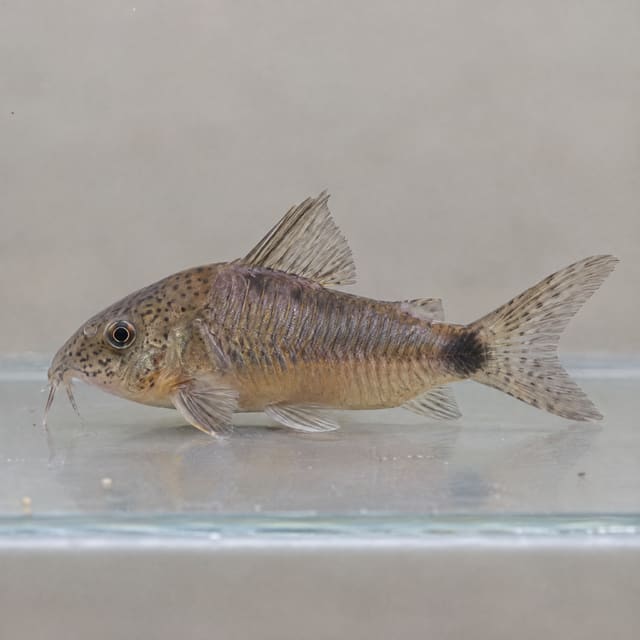
The photographs show the type of fish, not the individual you will receive. Spot size, spacing and the shade of the body vary between fish and with age, so expect some difference from the pictures.
Before ordering, read our delivery and Live Arrival Guarantee information and have the aquarium running, mature and already at temperature.
No tank size has been published for L019 itself. Seriously Fish's Baryancistrus overview gives a base of 120 × 45 cm for the large members of the genus, including the gold nugget pleco from the same river, and that is the minimum we suggest for a single L019. A pleco lives on the floor and the rocks, so length and depth from front to back matter more than height.
Plan for strength as well as size. A heavy pleco pushes against décor and digs under it, and OATA's guidance on large fish recommends secure décor, protected heaters and a cover. If you hope to keep more than one, remember ScotCat's warning that adults can be extremely territorial with their own kind and with other Baryancistrus.
Our tank volume calculator turns your tank's dimensions into litres for the filter, heater and water-change sums on this page, and our pleco care guide covers the basics shared by all suckermouth catfish.
The Xingu around Altamira is a river of rocks and rapids. For the gold nugget pleco from the same stretch, Seriously Fish describes whitewater rapids where young fish gather under flat rocks and adults live among submerged boulders, and recommends an aquarium built like a flowing river: a floor of variably sized rocks and gravel with some large water-worn boulders, driftwood branches and roots, and tough plants such as Microsorum, Bolbitis or Anubias grown on the décor. Bright lighting encourages the film of algae and tiny organisms, called aufwuchs, that these plecos graze.
| Area | Purpose |
|---|---|
| Rocks, gravel and water-worn boulders | A river-bed floor with gaps the fish can wedge into |
| Flat stones and caves | A home base it can claim; add one more retreat than you have bottom dwellers |
| Driftwood branches and roots | Cover, broken lines of sight and more surface for biofilm |
| Brightly lit rock tops | Grazing surfaces where aufwuchs can build up between cleanings |
| Open flow lane | A clear run where powerheads push water across the tank |
Set rocks and caves directly on the glass before adding gravel, so nothing can be undermined, and check every stack is stable. Seriously Fish suggests letting algae grow on every surface except the front glass.
Planet Catfish and ScotCat both give 25–30°C for L019, and ScotCat adds that it prefers higher temperatures. Seriously Fish gives 27–32°C for the gold nugget pleco from the same river and says that species will not thrive in cooler water. We suggest 27–30°C, the warm end of the L019 range, held steady. ScotCat gives a pH of 6.0–7.2. No hardness range is published for L019; Seriously Fish gives 3–15 dGH for the gold nugget pleco.
| Reading | Target |
|---|---|
| Temperature | 27–30°C, held steady |
| pH | 6.0–7.2 (ScotCat) |
| General hardness | Not published for L019; soft to moderately hard |
| Ammonia | Zero mg/l |
| Nitrite | Zero mg/l |
| Nitrate | No more than 20 mg/l above your tap water |
The waste limits come from OATA's catfish care sheet. They are a different test from pH and hardness: water can sit inside the right pH range and still be unsafe because ammonia or nitrite has built up.
UK tap water ranges from soft in much of Scotland, Wales and the north and west of England to hard and alkaline across much of the south and east. In a hard-water area, blend tap water with reverse-osmosis water to bring the pH down towards 7.0. Your water company publishes the hardness for your postcode. Always treat tap water with a conditioner that removes chlorine and chloramine. Our water matcher compares your readings with this fish's range, and our water chemistry guide explains each reading.
Rapids fish need clean, moving, oxygen-rich water. For the gold nugget pleco, Seriously Fish describes a fish that is intolerant of any build-up of organic waste, needs spotless water at all times, and must have strong water movement and plenty of dissolved oxygen from canister filters and powerheads, with the filter turning the tank over 8–12 times an hour. Warm water holds less oxygen than cool water, so at 27–30°C this matters even more. For a 243-litre tank Seriously Fish suggests about 200–275 W of heating split across two heaters, assuming a room near 20°C; protect them, as OATA advises for large fish.
If ammonia or nitrite reads above zero, test again, check the flow and review how much you are feeding before changing anything else. Clear water is not proof of clean water.
ScotCat recommends a vegetarian diet such as cucumber and courgette, with other foods such as frozen bloodworm, insect larvae and prawn or shrimp. That matches what is known for the genus: Seriously Fish reports that gut studies of wild gold nugget plecos found mainly algae, especially diatoms and filamentous algae, with smaller amounts of insect larvae and other invertebrates. Feed in the same proportions: mostly vegetable matter with some meaty food.
Seriously Fish notes that Baryancistrus have a relatively high metabolic rate and are often under-nourished after import, so for the first weeks offer several small meals a day rather than one large one. Check the belly when it rests on the glass: rounded is good, hollow means it needs more food or less competition.
Seriously Fish warns that Baryancistrus are often under-nourished or carrying health problems after import and may need an extended period of quarantine and acclimatisation. Add an L019 only to an aquarium that is fully mature and already at 27–30°C, with ammonia and nitrite at zero, strong flow running and plenty of grazing surfaces.
OATA recommends the floating-bag method: switch the aquarium lights off, float the sealed bag for about 10 minutes so the temperatures match, then add small amounts of tank water to the bag over up to 20 minutes before releasing the fish with as little bag water as possible. OATA also advises double-bagging catfish because their spines can puncture a bag, and the bristly armour catches easily in netting, so guide the fish into a container rather than lifting it in a net. Our guide on how to acclimatise new fish walks through each step.
| Checkpoint | What to do |
|---|---|
| Before release | Test ammonia, nitrite, temperature and pH; make sure its cave and grazing rocks are in place |
| First evening | Keep the lights off and offer a small vegetable-rich meal near the cave |
| Days 2–3 | Offer two or three small meals a day and look for it at dusk |
| Day 4 | Retest ammonia and nitrite and check the flow |
| End of week | Do the first large water change and compare its belly shape with day one |
Expect it to hide at first. Continued refusal to eat, heavy breathing or a hollow belly after the first week are reasons to test the water and contact us.
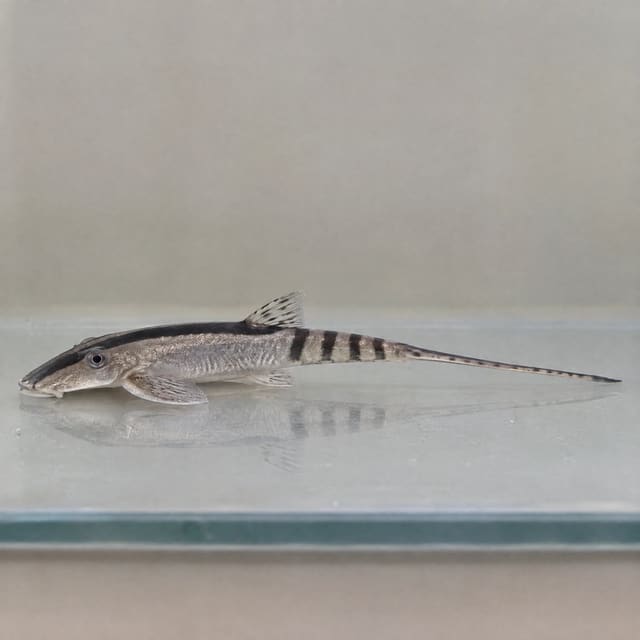
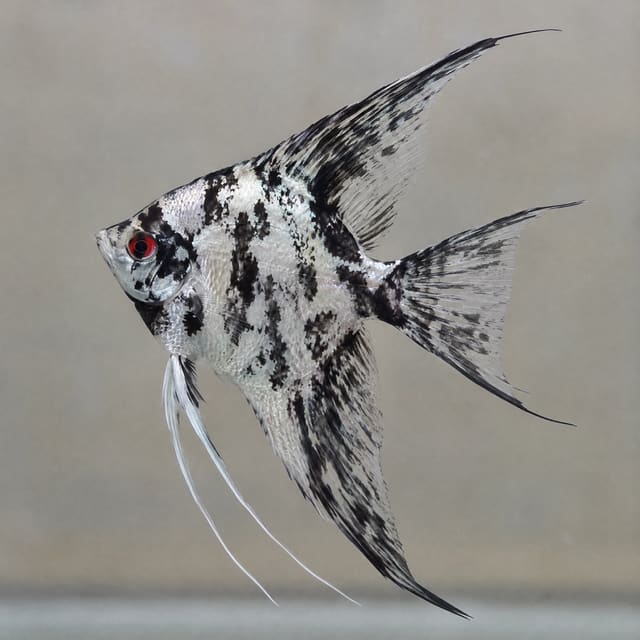
ScotCat warns that adult Baryancistrus can be extremely territorial, especially with their own kind and other members of the genus. Seriously Fish describes juvenile gold nugget plecos as relatively peaceful but says males in particular become highly intolerant of their own kind as they age, and recommends tank mates that live in other parts of the aquarium, with medium-to-large characins particularly suitable. The Spotted Silver Dollar and the Striped Headstander are characins of a suitable size; because this pleco needs 27°C or more, check each one's own range with our tank mates tool first.
| Suits | Avoid |
|---|---|
| Medium-to-large characins that swim in mid-water | A second L019 without separate territories |
| Robust fish that share warm, fast-flowing water | Other Baryancistrus and large plecos competing for caves |
| Fish that leave the floor and caves to the pleco | Fish that need cool or still water |
| Other catfish only in a very large tank with visual barriers | Boisterous feeders that take all the food first |
If you like Baryancistrus, compare it with the L018 Golden Nugget Pleco, the L177 Gold Nugget Pleco, the L081 Pleco and the L142 Snowball Pleco. The L014 Sunshine Pleco is another big pleco from the Xingu. Treat them as alternatives rather than tank mates unless each can have its own territory.
Because newly imported Baryancistrus are often thin, watch it closely in the first month. A rounded belly and clear, not sunken, eyes show it is feeding. OATA's warning signs for catfish include clamped fins, flicking against gravel or décor, shimmying, and changes in breathing, colour, appetite or hiding.
| If you see | Do this |
|---|---|
| Hollow belly or sunken eyes | Offer several small vegetable-rich meals a day near its cave and check it is not being outcompeted |
| Fast breathing or resting high in the water | Test ammonia and nitrite at once and increase oxygen and flow |
| Clamped fins, flicking or shimmying | Test the water, do a water change and look closely for parasites |
| Raised, grainy white dots unlike its normal spots | Test the water and follow our white spot guidance |
| Torn fins or scuffed skin | Look for a territorial dispute and add caves or visual barriers |
| Hiding and not eating after week one | Check the temperature first; this is a warm-water fish |
Do not diagnose from one sign alone. Poor water, low oxygen, bullying and hunger can all look alike, so test first and change one thing at a time. If you suspect white spot disease, our white spot treatment guide explains the next steps; read any medicine's label for warnings about catfish before using it.
Planet Catfish lists breeding of L019 as unreported in the aquarium, with no breeding report, so there is no published method to follow. Buy it as a long-term display fish. Sexing relies on the broader, longer head and longer pectoral spines of mature males described by ScotCat.
An undescribed suckermouth catfish of the genus Baryancistrus from the Rio Xingu at Altamira in Brazil. It was first shown in the German magazine DATZ in March 1989 and is still known only by its L-number.
No. Planet Catfish explains that the 1989 photograph showed only a colour pattern shared by two different fish from the same place in the Xingu. L019 is now used for the Baryancistrus and L020 for the other fish, a much smaller pleco of a different genus.
It is a close relative but not the same fish. Seriously Fish lists the gold nugget pleco as Baryancistrus xanthellus, traded as L018, L081, L085 and L177; L019 is a separate, undescribed Baryancistrus from the same river.
Planet Catfish gives 250 mm standard length (body length without the tail) and ScotCat 30 cm. Plan for a large, heavy pleco.
Warm water. Planet Catfish and ScotCat both give 25–30°C, and ScotCat notes that it prefers higher temperatures. We suggest 27–30°C, the warm end of that range, which also suits the gold nugget pleco from the same river.
Only in a very large aquarium with separate territories. ScotCat warns that adults of this genus can be extremely territorial, especially with their own kind and with other Baryancistrus.
No. ScotCat describes it as a fish that can be problematic, especially for inexperienced keepers, and not a beginner's fish. It needs warm, spotless, fast-moving water and a large tank.
Mostly vegetable foods with some meaty extras. ScotCat suggests cucumber and courgette with frozen bloodworm, insect larvae and prawn or shrimp, and a good vegetable-rich sinking food makes a reliable base.
No reviews for this item yet. Bought one? Honest reviews only, good or bad.
What customers say about ordering from us
Easy website plenty of info on fish your buying great to pick a time slot
TRACEY DURRANT · 7 Oct 2026
Got some lovely fish thank you
Kevin Mackie · 7 Oct 2026
Reviews of our shop, collected by Judge.me, an independent third-party review collector. Newest first.
Moved by UK carriers licensed to handle live animals
Hand-packed with oxygen bags, poly box, heat pack
Email photos the same day; an optional unboxing video helps us review problems faster — claim terms apply
Klarna & PayPal Pay in 3 at checkout