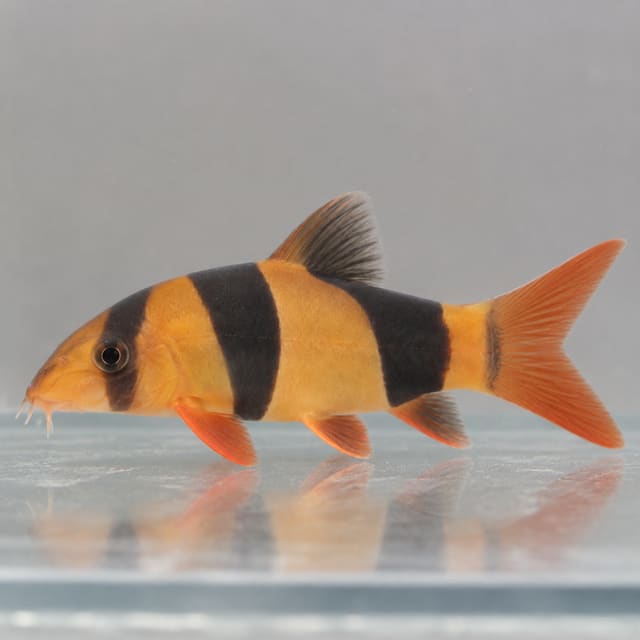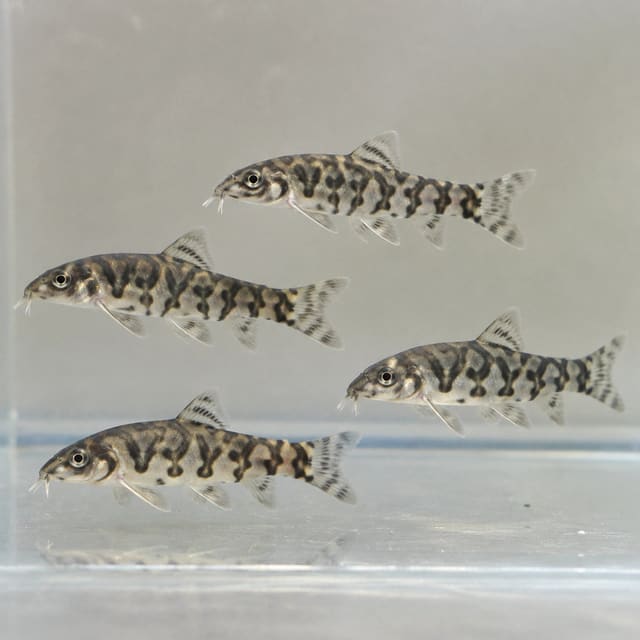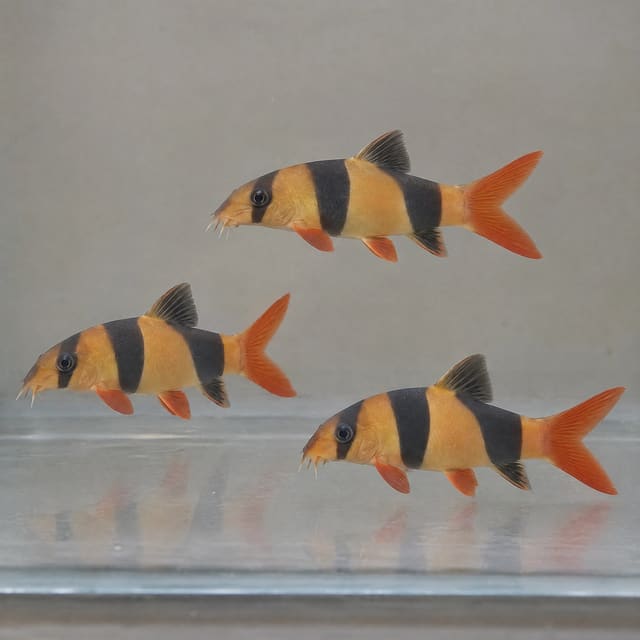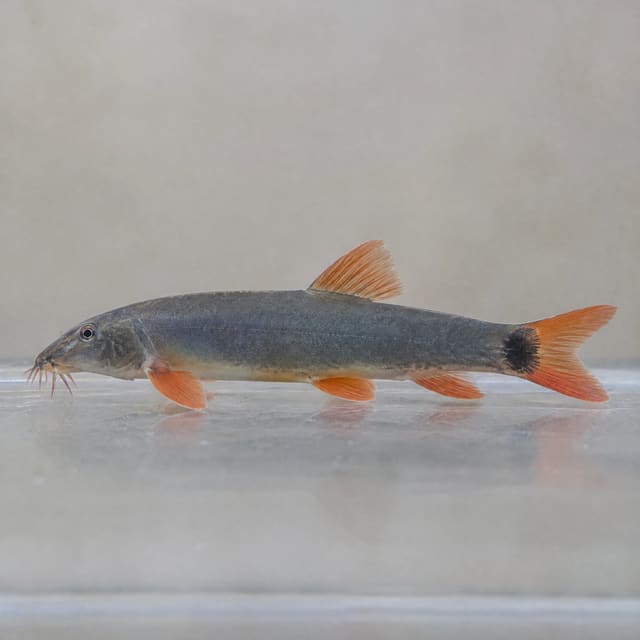
YoYo Loach (Botia lohachata)
24–27°C · pH 6.5–8
£6.29
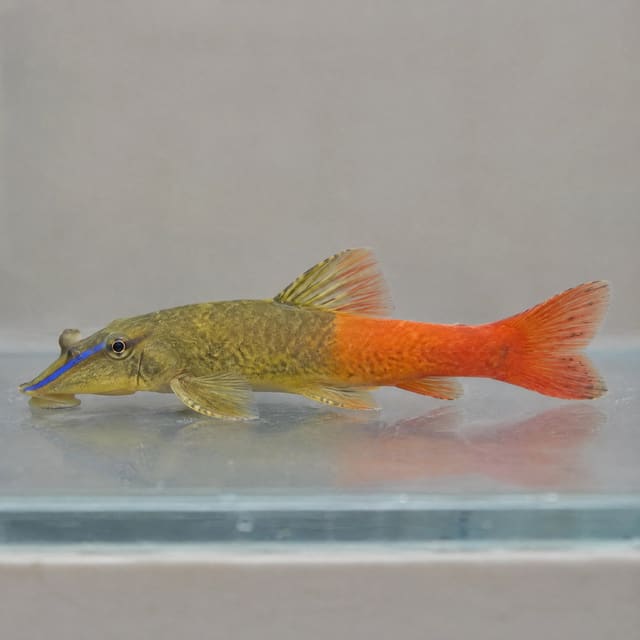
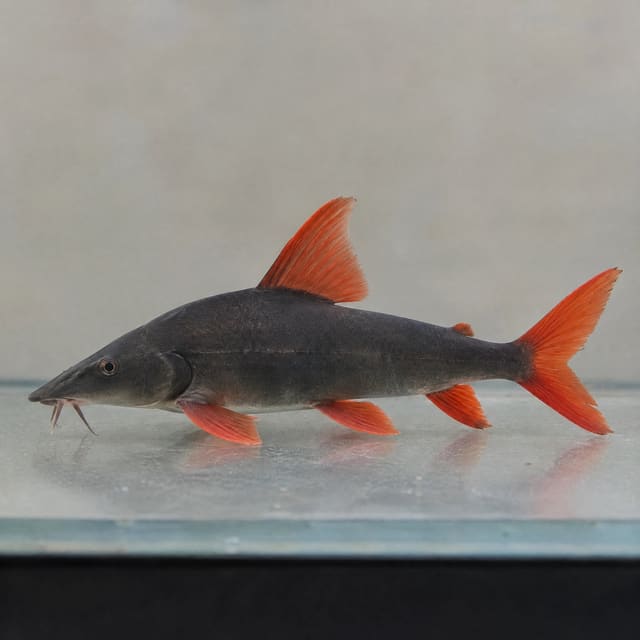
The Tiger Redfin Botia is a striped, red-finned tiger loach of the genus Syncrossus, a bold and sociable bottom-dweller that grows to 25–30 cm. It needs a group of five or more in an aquarium with a base of at least 180 × 45 cm, sand, rock caves and clean, oxygen-rich water. One live fish per purchase.
Syncrossus sp.
Quantity discounts are pricing offers, not a group-size recommendation. Check the full care guidance and your existing animals before choosing a quantity.
The Tiger Redfin Botia is a striped, red-finned tiger loach of the genus Syncrossus, a bold and sociable bottom-dweller that grows to 25–30 cm. It needs a group of five or more in an aquarium with a base of at least 180 × 45 cm, sand, rock caves and clean, oxygen-rich water. One live fish per purchase.
Read the full care guidance when planning conditions for your aquarium.
The Tiger Redfin Botia is a striped, red-finned loach of the genus Syncrossus, sold here as Syncrossus sp. because the trade name covers more than one closely related fish. Seriously Fish gives "Redfin Tiger Loach" as the common name of Syncrossus berdmorei, which is also called Blyth's loach, Berdmore's loach and the Burmese peppered firetail botia. These fish were once placed in the genus Botia, which is why shops still call them botias. Every Syncrossus is a robust, sociable bottom-dweller that grows large, digs, squabbles and needs a big, well-filtered aquarium.
In the wild S. berdmorei lives in the Irrawaddy, Sittaung and Salween river systems of Myanmar, north into Manipur in north-eastern India and possibly into western Thailand. Seriously Fish describes its home as forest-shaded headwaters with clear, well-oxygenated water, a mixed sand and rock bed, submerged wood and leaf litter. The related banded tiger loach, S. helodes, lives in the Mekong, Chao Phraya and Mae Khlong systems, and fish from the Mekong reportedly have orange to red lower fins as well.
| Species | Common name | How Seriously Fish separates it |
|---|---|---|
| Syncrossus berdmorei | Redfin tiger loach | 11–14 branched dorsal-fin rays; colour and pattern vary with locality and age |
| Syncrossus beauforti | Chameleon loach | 9–10 branched dorsal-fin rays; rows of small dark marks from an early age |
| Syncrossus helodes | Banded tiger loach | 10–12 vertical bars without bluish borders; no dark spot on the dorsal fin |
| Syncrossus hymenophysa | Green tiger loach | 12–15 bars with bluish borders; a dark dorsal-fin spot |
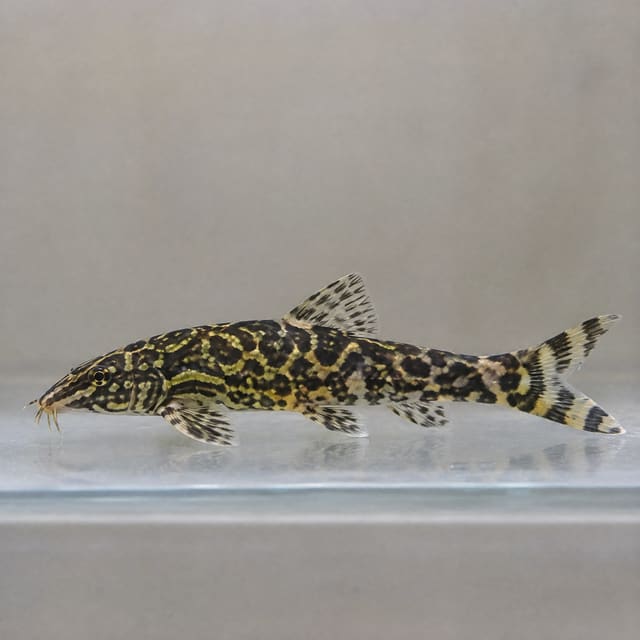
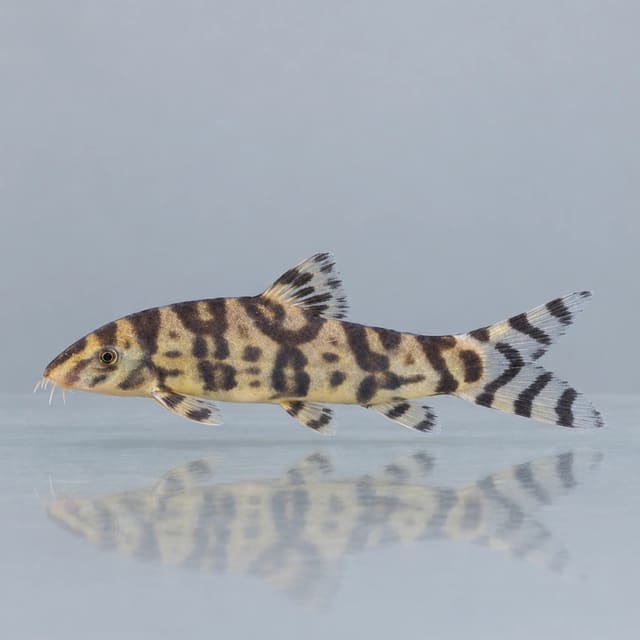
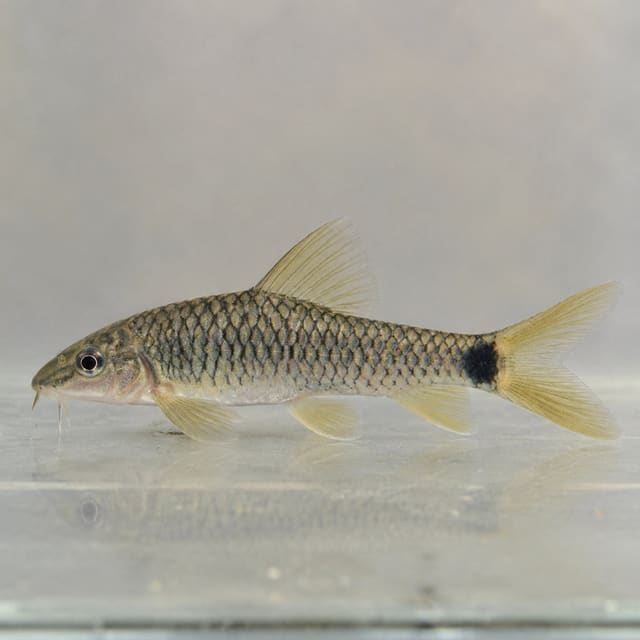
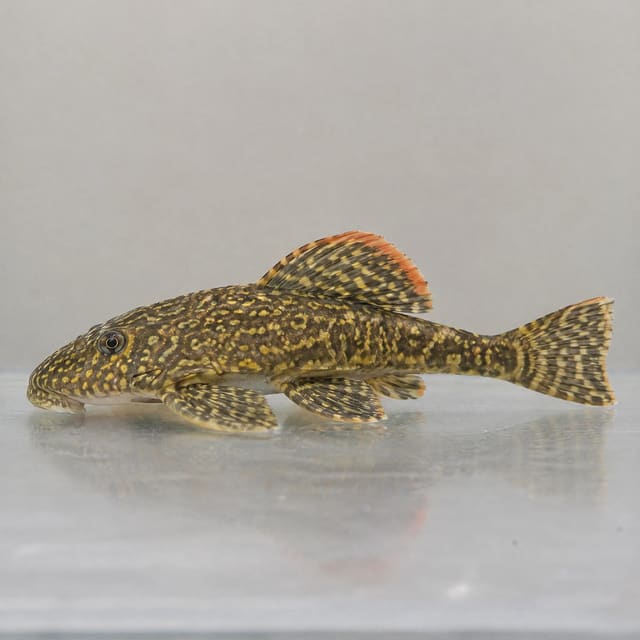
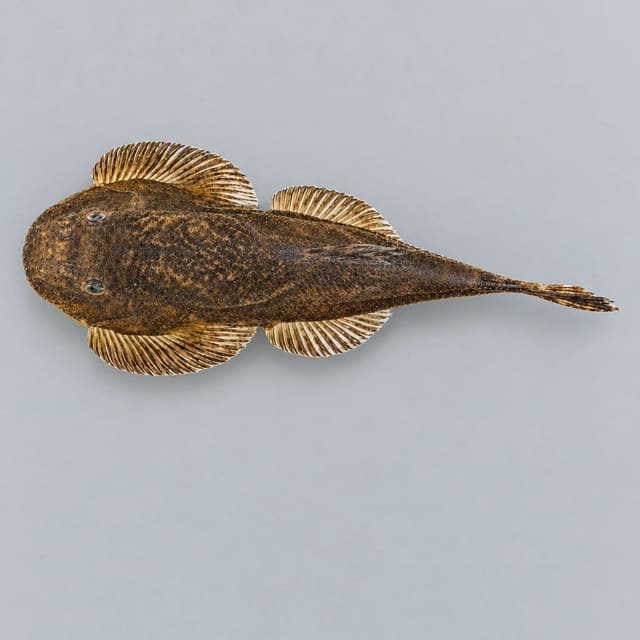
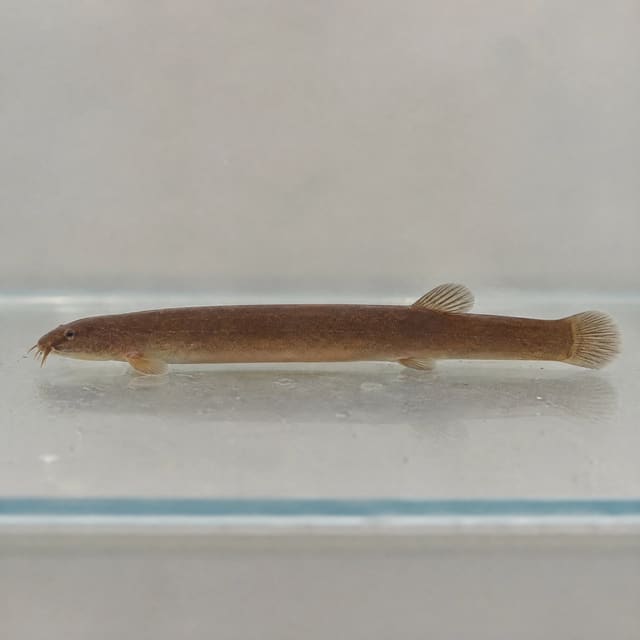
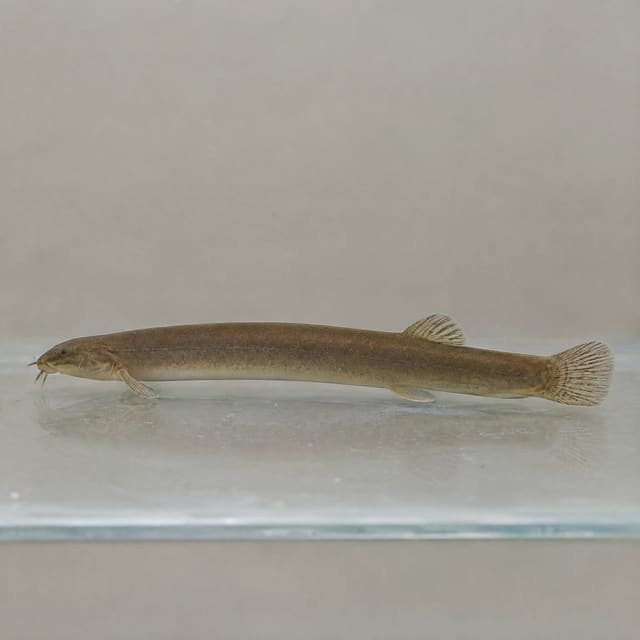
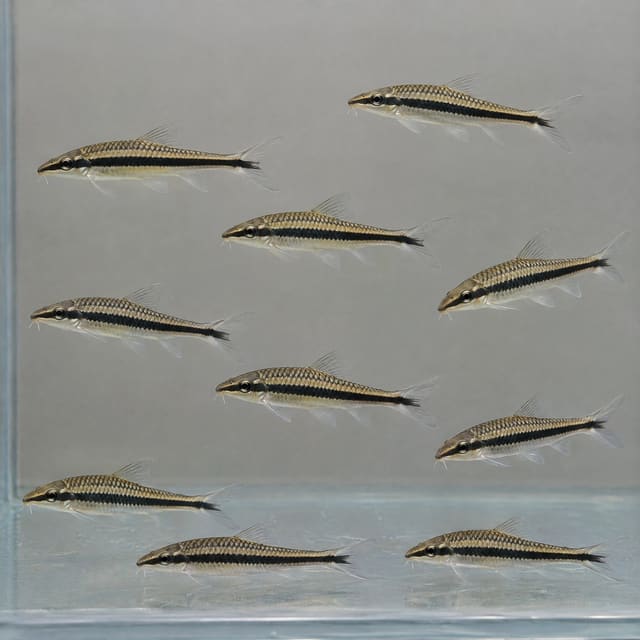
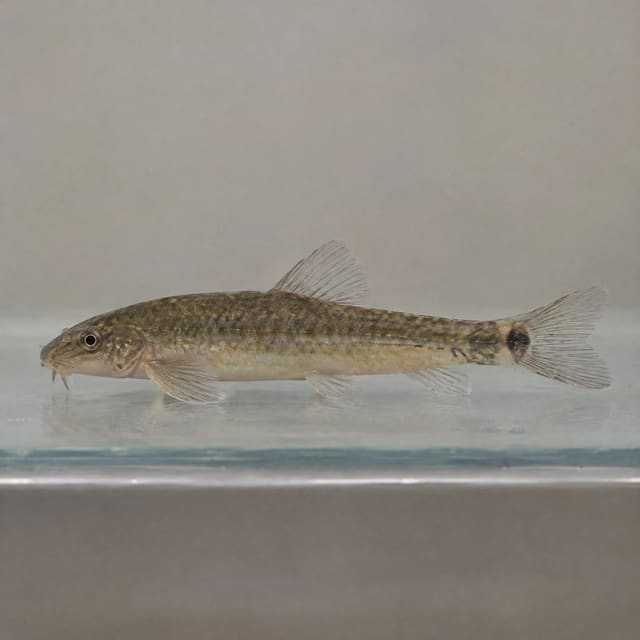
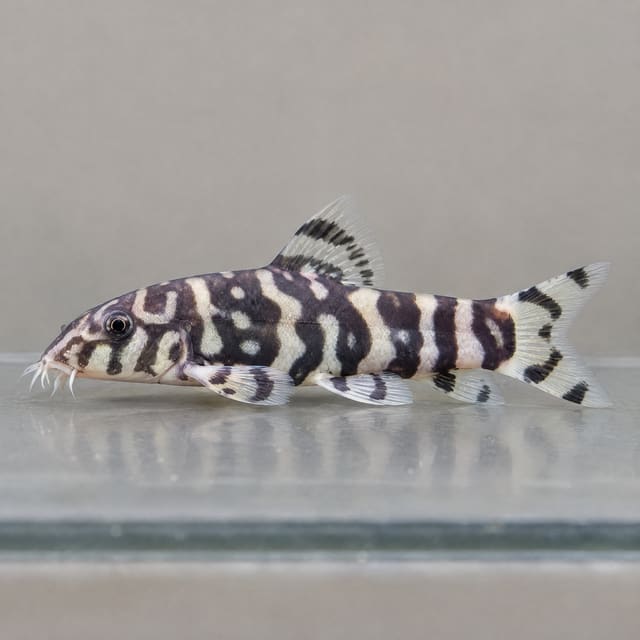
Young tiger loaches are hard to tell apart, and Seriously Fish notes that some forms of S. berdmorei may yet prove to be separate species. Their care is very similar: both red-finned species need the same 180 × 45 cm aquarium base, a group of their own kind and clean, oxygen-rich water. This page therefore plans for the genus, and its water table uses the range where the two red-finned species overlap. The gallery images are representative, prepared from a reference photograph, and do not show the exact fish supplied.
| Suits | Not suited to |
|---|---|
| A group of five or six, ideally ten or more | A single fish, a pair or a trio |
| An aquarium with a base of at least 180 × 45 cm | An average community tank |
| Fast, robust midwater fish | Small, slow or long-finned fish |
| A keeper ready for 30–50% weekly water changes | An immature or lightly filtered aquarium |
One purchase quantity supplies one live Tiger Redfin Botia in the standard size offered. Sex is not specified. Seriously Fish notes that adult females become noticeably stockier than males and probably grow larger, but young fish cannot be sexed reliably, so plan the group without counting on a ratio.
The size supplied is not the adult size. Whichever red-finned species arrives, it grows into a loach of 25–30 cm, and the aquarium, filter and group must be ready for that adult from the start.
Buy the whole group at once where you can, so that no single fish is dropped into a settled pecking order. Before ordering, measure the aquarium and read our current delivery and Live Arrival Guarantee policy.
Seriously Fish gives a maximum of 250 mm standard length for S. berdmorei and 300 mm for S. helodes, measured without the tail. FishBase lists a much smaller 15 cm for S. berdmorei but agrees on 30 cm for S. helodes. Because the sources disagree and the exact species is not guaranteed, plan for the larger figure.
For long-term care Seriously Fish gives a minimum base of 180 × 45 cm, about 365 litres, for both species. The floor area matters more than the volume: these loaches patrol the bottom and need room for every fish, with separate caves and resting places so that one dominant fish cannot control them all. A tall, narrow tank of the same volume is not a substitute. Our tank volume calculator turns your measurements into litres.
If your aquarium is smaller, choose a smaller species from our loaches and algae eaters instead. A tiger loach that outgrows its tank is a stressed and often aggressive fish.
Recreate a clear forest stream. Use sand or fine gravel, which protects the barbels and lets the fish sift and dig, and add smooth, water-worn rocks, pebbles and one or two pieces of driftwood or roots. Lighting can be fairly subdued. Plants that grow on wood and rock, such as Java fern (Microsorum), Java moss (Taxiphyllum barbieri) and Anubias, cope with the digging far better than rooted plants.
Tiger loaches are inquisitive and love squeezing into gaps, so build plenty of caves and crevices, remove sharp edges, and seal any gap a fish could become trapped in with aquarium-grade silicone. Fit a tight lid, because they can jump.
| Area | Purpose |
|---|---|
| Open sand along the front | Feeding and sifting space for the whole group |
| Rock caves along the back | More hiding places than there are loaches |
| Driftwood and roots | Broken sight lines that calm squabbles |
| Plants tied to wood and rock | Cover that digging cannot uproot |
Stand rocks directly on the glass before adding sand, so that digging cannot undermine them. Spread caves along the whole length rather than piling them in one corner: a dominant fish can guard one pile, but not several. Browse our botia loaches to compare other botiids that need similar decor.
Seriously Fish gives different ranges for the two red-finned tiger loaches. The shared range in the last column suits either fish, and it is the safest target while the exact species is unconfirmed.
| Value | S. berdmorei | S. helodes | Shared range |
|---|---|---|---|
| Temperature | 21–26°C | 24–30°C | 24–26°C |
| pH | 6.5–7.5 | 6.0–7.5 | 6.5–7.5 |
| General hardness | 5–15 dGH | 2–12 dGH | 5–12 dGH |
FishBase lists 22–26°C, pH 6.5–7.5 and up to 12 dH for S. berdmorei, which falls within the same band. Hardness and pH of UK tap water vary widely from region to region; your water company publishes figures for your postcode, and our water matcher compares them with this fish. Our water chemistry guide explains what each reading means and how to change it slowly.
| Reading | Target |
|---|---|
| Ammonia | Zero mg/l |
| Nitrite | Zero mg/l |
| Nitrate | No more than 20 mg/l above your tap water |
These waste limits come from OATA's loach care sheet. A tank can sit inside the right temperature and pH and still be unsafe if ammonia or nitrite are present, so test both kinds of reading every week.
Seriously Fish describes these loaches as intolerant of organic waste. They need well-oxygenated water with some flow and should only go into a stable, biologically mature aquarium. A group of large, hungry loaches produces a lot of waste, so choose filtration rated well above the tank's volume, direct some flow along the bottom and keep the surface moving for oxygen. Our guide to aquarium filtration explains how mechanical and biological filtration work together.
Never replace all the biological media at once. If ammonia or nitrite rise above zero, reduce feeding, change water and find the cause before adding any more fish.
Tiger loaches are mainly carnivorous but also eat vegetable matter, including soft-leaved aquatic plants. Use a good sinking dried food as the staple, with frozen or live bloodworm, Tubifex and Artemia. Add vegetables and fruit such as cucumber, melon, blanched spinach and courgette, and chopped earthworm sparingly; Seriously Fish also recommends home-made gel foods. They are bold feeders that often rise into midwater to take food.
They hunt aquatic snails, but Seriously Fish warns that they should not be bought as a cure for a snail infestation.
Before the fish arrive, confirm a mature filter, zero ammonia and nitrite, and water at 24–26°C, pH 6.5–7.5 and 5–12 dGH. Have every cave in place so that the group finds cover straight away.
Use the floating bag method OATA recommends: switch off the aquarium lights, float the sealed bag for about 10 minutes to equalise the temperature, then add small amounts of tank water to the bag over up to 20 minutes before releasing the fish, keeping the bag water out of the aquarium. Our guide to acclimatising new fish covers each step.
Handle with care. Syncrossus loaches carry sharp, movable spines below the eyes, which they raise when stressed. The spines catch in nets, and larger fish can break skin, so guide the fish into a container rather than lifting it in a fine net where you can.
| Checkpoint | What to do |
|---|---|
| Before introduction | Test the water and confirm the plan for the whole group |
| First feeding | Offer a small portion at several points and watch every loach |
| Every day | Count the loaches and check that each one feeds and breathes normally |
| After stocking | Retest ammonia and nitrite rather than waiting for the weekly test |
| End of week | Full test and a 30–50% water change |
Expect some squabbling. Tiger loaches settle their rank with chasing and display, and Seriously Fish notes that they often "grey out", turning pale and drab during dominance contests. They also make audible clicking sounds, thought to come from grinding their throat teeth. Both are normal in a healthy group. Persistent targeting of one fish, torn fins or a loach that never reaches food are not.
| If you see | Do this |
|---|---|
| Greying out during a squabble | Normal; check that every fish still feeds |
| One fish chased constantly or kept from food | Add caves, spread the food and review the group size |
| A thin body or sunken belly despite eating | Seek fish-health advice: Seriously Fish notes these loaches are prone to "skinny disease", thought to be caused by Spironucleus |
| Hanging at the surface or fast breathing | Test ammonia, nitrite and temperature at once and increase aeration |
| White spots, fluffy growths or damaged fins | Test the water and seek fish-health advice |
| Loss of appetite | Check water readings, temperature and feeding access |
OATA lists the general warning signs for loaches: hanging at the surface, sitting on the bottom, erratic swimming, colour change, more hiding or aggression, faster or slower breathing, white spots, fluffy growths, lost fins or scales, weight change and reduced appetite. Record the readings and changes before treating anything, and contact us with them if a problem continues.
Seriously Fish describes these loaches as capable of being belligerent. They suit fast, robust fish that are not much smaller than themselves and that live higher in the water, out of the loaches' way.
| Suits | Avoid |
|---|---|
| Fast midwater cyprinids such as Devario, Rasbora and robust barbs | Fish much smaller than the loaches |
| In very large tanks, bala sharks and tinfoil barbs | Slow, long-finned fish such as ornamental bettas and guppies |
| Robust algae eaters such as Crossocheilus and Epalzeorhynchos | Many cichlids, whose fins may be nipped |
| Non-territorial catfish | A pair or trio of tiger loaches |
Other robust botiids can share the tank, although Seriously Fish notes that keepers' experiences vary and some report excessive aggression. Suitable candidates from our range include the Giant Danio in midwater, the Siamese Algae Eater on rocks and wood, and, in a very large aquarium, the Bala Shark. For a related loach, compare our Banded Tiger Loach, the Zebra Loach (Botia hymenophysa) and the Clown Loach, or browse all our loaches and oddball fish and bottom-dwelling fish. Check any mix with our tank mates tool before you buy.
Tiger loaches are not known to have been bred in aquariums. In the wild they are thought to be seasonal, migratory spawners, so they are unlikely to breed in a home tank and the group you buy is the group you keep. FishBase lists S. berdmorei as Near Threatened on the IUCN Red List (assessed 2010) and S. helodes as Least Concern (assessed 2011), another reason to give each fish a long, healthy life.
It is a botiid loach of the genus Syncrossus. Seriously Fish uses the name Redfin Tiger Loach for Syncrossus berdmorei, and related tiger loaches such as S. helodes can also have orange to red fins, so we sell it as Syncrossus sp.
Seriously Fish gives up to 250 mm standard length for S. berdmorei and 300 mm for S. helodes, while FishBase lists 15 cm for S. berdmorei. Plan for a loach of 25–30 cm.
Seriously Fish gives a minimum base of 180 × 45 cm, about 365 litres, for long-term care. A group needs the full floor area, with more caves than there are loaches.
At least five or six, and preferably ten or more. Avoid keeping one, two or three, because a dominant fish may attack the others repeatedly and stop them feeding.
It eats aquatic snails, but Seriously Fish warns that it should not be relied on to cure a snail infestation. It still needs a full, varied diet of its own.
No. Avoid slow, long-finned fish such as guppies, ornamental bettas and many cichlids, and fish much smaller than the loaches. Choose fast, robust midwater fish instead.
Aim for 24–26°C, pH 6.5–7.5 and 5–12 dGH, which suits both red-finned species. Keep ammonia and nitrite at zero, oxygen high and change 30–50% of the water every week.
Take care. It has sharp, movable spines below the eyes that it raises when stressed. They catch in nets, and larger fish can break skin, so guide it into a container rather than lifting it in a net.
No reviews for this item yet. Bought one? Honest reviews only, good or bad.
What customers say about ordering from us
Easy website plenty of info on fish your buying great to pick a time slot
TRACEY DURRANT · 7 Oct 2026
Got some lovely fish thank you
Kevin Mackie · 7 Oct 2026
Reviews of our shop, collected by Judge.me, an independent third-party review collector. Newest first.
Moved by UK carriers licensed to handle live animals
Hand-packed with oxygen bags, poly box, heat pack
Email photos the same day; an optional unboxing video helps us review problems faster — claim terms apply
Klarna & PayPal Pay in 3 at checkout