Advanced
Clown Loach (Chromobotia macracanthus)
24–30°C · pH 5–7 · 648L
From £10.99Some sizes on sale

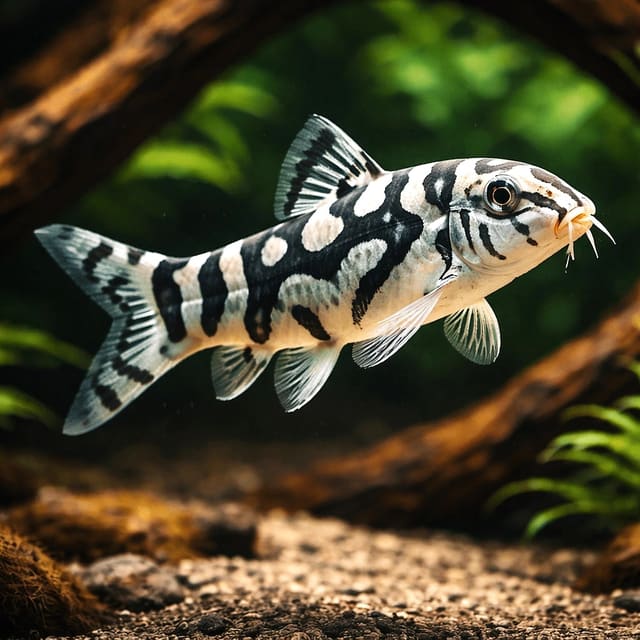
Banded Tiger Loach (Syncrossus helodes), a robust striped river loach for large mature aquariums with soft substrate, high oxygen and careful tank mates.
Adult size is the maximum length this species reaches at full maturity (scientific sources). The livestock you receive will be younger and smaller. Product-photo provenance and any image-specific limitations are stated on the listing.
Syncrossus helodes
Confirm your email, then we’ll send an availability message for this exact item if it returns within 180 days.
This request is only for this product—no newsletter or other promotions. A mail-provider retry may very rarely duplicate the same availability message. Unconfirmed addresses are removed after 48 hours. See our privacy policy.
Banded Tiger Loach (Syncrossus helodes), a robust striped river loach for large mature aquariums with soft substrate, high oxygen and careful tank mates.
Adult size is the maximum length this species reaches at full maturity (scientific sources). The livestock you receive will be younger and smaller. Product-photo provenance and any image-specific limitations are stated on the listing.
Maintain these water conditions for optimal health and vibrant colors
The Banded Tiger Loach (Syncrossus helodes, still widely sold under the older name Botia helodes) is a bold, striped river loach for experienced keepers with large, well-structured aquariums. This 5 cm listing is a juvenile size, but the species must be planned as a powerful adult loach rather than a small community bottom fish.
It is best suited to mature river-style aquariums with soft substrate, strong filtration, shaded retreats and robust tank mates. It can be boisterous and sometimes aggressive, especially if kept singly or in cramped conditions, so group planning and tank-mate choice matter.
| Care point | Recommendation | Why it matters |
|---|---|---|
| Adult planning size | Large loach; FishBase records up to 30 cm SL | Do not plan around the juvenile 5 cm sale size only. |
| Aquarium size | 120 cm / 300 litres minimum long term, larger preferred | Adults are active, social and need territory plus floor space. |
| Temperature | 24-28 C | Stable warm river conditions suit the species. |
| Water | Clean, oxygen-rich, soft to neutral/slightly acidic | River loaches suffer in dirty, low-oxygen aquariums. |
| Temperament | Boisterous, social, potentially aggressive | Choose robust companions and avoid timid fish. |
Banded Tiger Loaches have an elongated body, pointed head and strong dark vertical bars across a golden, olive or brown base colour. The fins can show dark edging and patterning, and the face gives the fish a distinctive predatory, river-loach look.
Like other botiid loaches, they have sharp sub-ocular spines near the eyes. These can be erected when the fish is stressed and may catch in nets, so handle gently and avoid rough mesh.
Syncrossus helodes is associated with large Southeast Asian river systems, including Mekong, Chao Phraya and Meklong drainage contexts. FishBase describes it from large rivers with muddy substrate and cover from rocks, logs or brush piles, with crepuscular or nocturnal feeding on molluscs, insect larvae and worms.
That habitat explains its aquarium needs: soft bottom areas, lots of cover, clean oxygenated water, and enough room for an active group to move without constantly forcing contact.
| Setup area | Best practice | Avoid |
|---|---|---|
| Substrate | Fine sand or smooth rounded gravel | Sharp gravel that can damage barbels and belly |
| Cover | Bogwood, rock caves, tubes and shaded retreats | Bare bright tanks with no shelter |
| Flow and oxygen | Strong filtration, high oxygen and regular water changes | Stale water, low oxygen or heavy organic waste |
| Tank layout | Multiple territories and open swimming runs | One cave only, cramped floor space or unstable rockwork |
Use a secure lid. Active loaches can startle, explore gaps and push through loose covers. Keep decor smooth and stable, because this species will investigate tight spaces and dig around the base of hardscape.
This species is much less forgiving of neglected water than its hardy appearance suggests. Keep oxygen high, avoid sludge behind decor and maintain a steady water-change routine. A powerful external filter or well-designed sump is useful, but flow should be arranged so the fish can rest behind wood and rocks when they choose.
Because Banded Tiger Loaches feed heavily and search the bottom constantly, trapped waste under rockwork can become a problem. Build the layout so you can clean around it without dismantling the whole aquarium every week.
Banded Tiger Loaches are chiefly carnivorous benthic feeders. Offer sinking carnivore pellets, quality loach foods, frozen bloodworm, mysis, brine shrimp, chopped earthworm and occasional snail prey. They will also browse some prepared foods that reach the bottom.
Feed after lights dim if tank mates intercept food too quickly. The aim is to satisfy an active bottom-feeder without overloading the aquarium, because poor water quality is one of the fastest ways to stress river loaches.
| Usually suitable | Use caution | Avoid |
|---|---|---|
| Robust barbs, larger rasboras and sturdy river fish | Other bottom dwellers competing for caves | Tiny fish, delicate long-finned fish and very timid species |
| Other active loaches in a large planned setup | Cichlids or catfish if floor space is limited | Shrimp, small snails and fry that may be eaten |
Keep in a group where space allows. Groups spread attention and allow more natural social behaviour, but the aquarium must be large enough to prevent constant bullying.
| Behaviour | What it means | Keeper response |
|---|---|---|
| Hiding after arrival | Normal settling behaviour | Keep lights low and offer cover. |
| Chasing or sparring | Social sorting or territory pressure | Check group size, cave count and tank volume. |
| Night feeding activity | Natural crepuscular/nocturnal pattern | Feed some sinking foods after lights dim. |
| Constant aggression | Tank too small, group too small or poor companion choice | Rework stocking before injuries occur. |
| Question | Good sign | Pause if... |
|---|---|---|
| Is the tank long-term suitable? | Large, mature, oxygen-rich aquarium with floor space | The aquarium is small or recently set up |
| Are tank mates robust? | Fast, sturdy fish that can handle loach activity | Tank mates are slow, tiny, long-finned or delicate |
| Is there enough shelter? | Several caves and shaded retreats | Only one hiding place exists |
| Can you manage water quality? | Strong filter and regular water changes | Nitrate/organics are already high |
Move this loach with patience. The sub-ocular spines can catch in coarse nets, so avoid rushing or pinning the fish against hard decor. A container transfer is often safer than lifting it in a deep mesh net.
On arrival, keep lights low and provide immediate shelter. It may hide for a few days while settling, especially if it has been shipped at the juvenile size. Offer a small sinking feed after lights dim once the fish is settled and breathing normally.
The most common mistake is buying a juvenile for a small community aquarium because it looks like a neat striped bottom fish. It is actually a large, active, sometimes pushy loach that needs adult-space planning. The second mistake is keeping one alone, where stress and aggression can be worse than in a properly planned group.
| Mistake | Likely result | Better choice |
|---|---|---|
| Small tank for a 5 cm juvenile | Outgrown aquarium and aggression later | Plan for adult size from day one |
| Keeping with tiny shrimp or snails | They may be eaten | Use robust mid-water fish instead |
| Only one cave | Territory pressure and chasing | Provide multiple retreats and broken sight lines |
| Rough substrate | Barbel and belly damage | Use sand or smooth rounded gravel |
Order this loach only for a mature aquarium that can handle an active, robust, snail-eating bottom fish. It is not a gentle nano-community species, and it should not be chosen as a casual clean-up fish for a peaceful small tank. If you want a calmer community loach, choose a smaller Botia or peaceful loach species instead.
Use code WELCOME10 for 10% off your first order where eligible. Live fish orders are packed for overnight livestock delivery, and our Live Arrival Guarantee applies when the delivery and acclimation conditions are followed.
Care details were cross-checked against FishBase for Syncrossus helodes, Seriously Fish Banded Tiger Loach guidance, Aquarium Glaser notes on the old Botia helodes naming, and the existing our stock records for SKU K565.
No reviews for this item yet. Bought one? Honest reviews only, good or bad.
What customers say about ordering from us
I have a small group of long finned mountain minnows. So was delighted to be able to order ten of this variety to increase the genetics in my tank . The ones I recieved are healthy but it’s to early to give a verdict on wether they are of a long finned type since they are small currently.
Gordon Walker · 23 Sept 2026
100% success travel and "installation". Pleased with quality of purchase. The Siamese fighter a bit "shy" so have not yet seen him at his best yet but looking good. Happy customer. GG
George E Garratt · 21 Sept 2026
Reviews of our shop, collected by Judge.me, an independent third-party review collector. Newest first.