Siamese Algae Eater (Crossocheilus cf. langei)
22–27°C · pH 6–8
£5.99

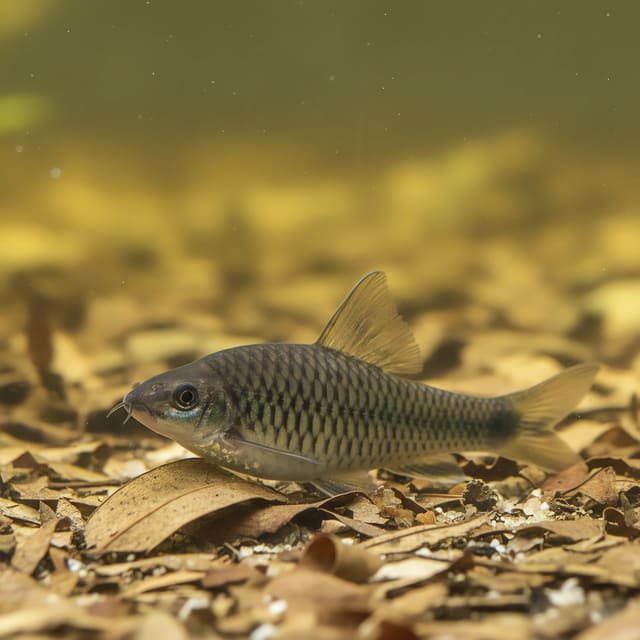
Ten young Siamese algae eaters (Crossocheilus cf. langei), unsexed, sent together as a ready-made group. They grow to about 15-16 cm, so plan a tank of around 300 litres with strong flow, 22-26 °C and pH 6.0-7.5. Valued for grazing young black brush algae.
Adult size is the maximum length this species reaches at full maturity (scientific sources). The livestock you receive will be younger and smaller. Product-photo provenance and any image-specific limitations are stated on the listing.
Crossocheilus cf. langei
Ten young Siamese algae eaters (Crossocheilus cf. langei), unsexed, sent together as a ready-made group. They grow to about 15-16 cm, so plan a tank of around 300 litres with strong flow, 22-26 °C and pH 6.0-7.5. Valued for grazing young black brush algae.
Adult size is the maximum length this species reaches at full maturity (scientific sources). The livestock you receive will be younger and smaller. Product-photo provenance and any image-specific limitations are stated on the listing.
Maintain these water conditions for optimal health and vibrant colors
This listing is for ten Siamese algae eaters, sold together as one group. They are the same fish as our single Siamese algae eater and our group of five; this is simply the size of group we would choose ourselves for a big river-style aquarium. Our stock records list them at about 3 to 3.5 cm at dispatch, so what arrives is a group of youngsters with a lot of growing still to do.
The fish are unsexed. That is not us being cagey: Seriously Fish notes that mature females are usually thicker-bodied than males, but that young fish cannot be sexed reliably from the outside. At this size nobody can promise you a ratio, and for a shoaling grazer kept as a community fish it does not matter.
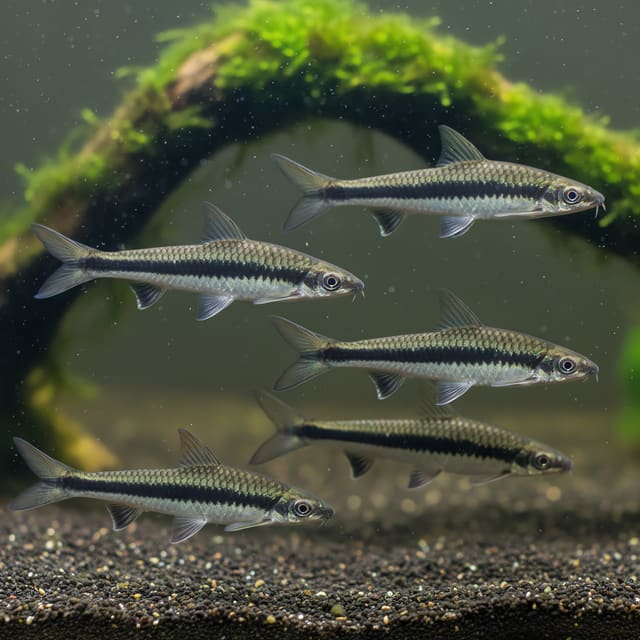
Siamese algae eaters are social, but not in the tidy, synchronised way of a tetra school. Seriously Fish describes them as shoaling rather than schooling fish that develop a distinct pecking order, and recommends a group of six or more because weaker individuals may be bullied relentlessly when only a few are kept. Ten spreads that squabbling across the whole group, so the attention is shared rather than falling on one or two fish.
Size figures for this fish vary between references, partly because they measure in different ways. Standard length runs from the tip of the snout to the base of the tail; total length includes the tail fin, so the same fish has a larger total length than standard length. FishBase records 14.5 cm total length for C. langei. Seriously Fish gives 150 mm standard length, which means a fish somewhat longer than that once the tail is counted. Wikipedia gives up to 16 cm. For planning, we work to the larger figures: assume each fish could reach 15 to 16 cm, and you will not be caught out.
Be clear-eyed about the tank before you order. Ten fish that are around 3 cm today are likely to reach about 15 cm, and Wikipedia notes they can reach that size within two years. Seriously Fish recommends an aquarium with a base of 150 × 45 cm for a group, which works out at roughly 300 litres, with strong water movement and plenty of oxygen. This guide explains why, along with what the "cf. langei" in the name means, how to tell a genuine Siamese algae eater from the lookalikes, what to feed them, which fish to keep with them and how to settle ten new arrivals.
The naming of this fish is genuinely confusing, and it is worth understanding because it affects what you are buying.
"Siamese algae eater", often shortened to SAE, is a trade name. Seriously Fish explains that it has been applied to several near-identical species of Crossocheilus, small grazing members of the carp family, Cyprinidae, from South-East Asia. The name long used in the trade, Crossocheilus siamensis, is not valid: it is a synonym of Epalzeorhynchos siamensis, which is in turn a synonym of Crossocheilus oblongus.
The two references disagree on which species the hobby fish really is. Wikipedia treats Crossocheilus oblongus as the true Siamese algae eater and says the trade commonly sells C. langei under the same name. Seriously Fish takes the opposite view of C. oblongus: it was described from Java, it is almost certainly not the hobby's SAE, and it seems never to have been exported at all. Both sources agree that C. langei is what is widely sold under the name. FishBase lists Crossocheilus langei Bleeker, 1860, as a valid species.
"cf." is short for the Latin confer, "compare with". Writing Crossocheilus cf. langei says that our fish match C. langei as closely as anyone can tell without examining preserved specimens, but that we are not claiming a certainty the trade cannot give. We think that is the honest way to label a fish whose scientific identity has been argued over for years. The care is the same either way: every source we used describes the same kind of fast-water grazer with very similar needs.
FishBase records C. langei as Data Deficient on the IUCN Red List, assessed in December 2018, which means there was not enough information to judge its status. C. oblongus was assessed as Least Concern at the same time.
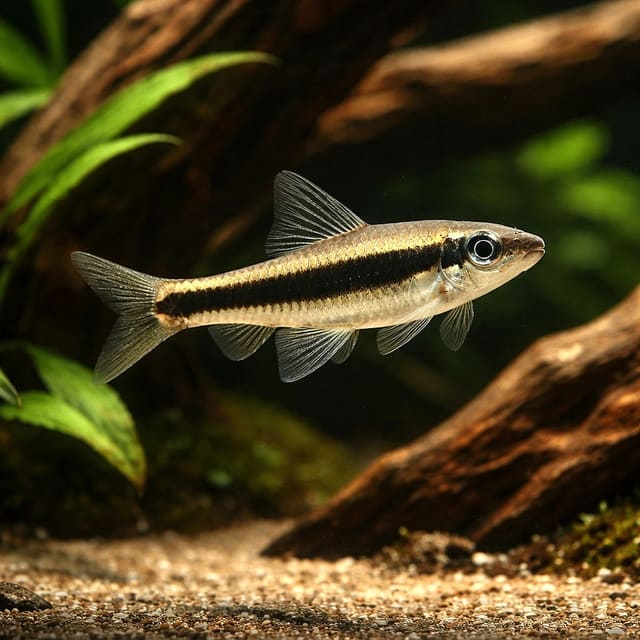
Several fish with a dark stripe down the side are sold under similar names, and some behave very differently in a community tank. Knowing the key features lets you check your group once the fish have settled and their colours have come through.
One fish often mixed up with the Siamese algae eater is the flying fox, Epalzeorhynchos kalopterus. Seriously Fish says the simplest way to identify it is its white-edged, red and black fins, together with two pairs of barbels. The difference matters for more than looks. The same source describes the flying fox as growing increasingly territorial with age and attacking similar-looking fish, including Crossocheilus. A flying fox and a group of Siamese algae eaters are not a good mix.
When the fish have settled, watch them resting on a leaf or rock, which is when they are easiest to see clearly, and run through a simple check:
Young fish do not always show every feature clearly, so give your group a few weeks in good conditions before judging. If something does not look right to you, send us a clear photo and we will talk it through.
Seriously Fish gives the range of C. langei as Borneo, Peninsular Malaysia, southern and western Thailand and possibly southern Myanmar, with a type locality of Palembang in Sumatra. FishBase lists Malaysia and Sumatra in Indonesia. Wikipedia, writing about the Siamese algae eater in general, describes mainland South-East Asia including the Chao Phraya and Mekong basins and the Malay Peninsula. Put together, these are fish of the streams and rivers of tropical South-East Asia.
Seriously Fish describes C. langei in flowing streams and tributaries with beds of boulders, pebbles, gravel and sand, often where driftwood or tree roots lie in the water. FishBase's account of the closely related C. oblongus is similar: usually hill streams or near rapids, in clear, fast-flowing water, feeding on periphyton and phytoplankton. Periphyton is the living film of algae and microorganisms that coats every stone and branch in a stream, and grazing it is what these fish are built for.
Their year is not static. Wikipedia notes that the fish also use flooded forest during the rainy season, and Seriously Fish describes seasonal migrations, with fish moving into deeper, more turbid water at certain times of year. Members of the genus are also known to make seasonal migrations to breed.
Three things follow directly from the wild habitat. These fish need moving, well-oxygenated water; they need clean water, because a fast stream carries waste away constantly; and they need hard surfaces to graze and rest on. Everything in the setup and water sections below comes back to those three points.
It is easy to buy these fish for a tank that is too small, because they are small when you buy them. A group of ten needs planning for the adults they will become, not the youngsters that arrive.
Seriously Fish recommends an aquarium with a base of 150 × 45 cm for a group, which holds around 300 litres. Length matters more than height: these are active, fast swimmers, and a long tank gives the group room to move and the lower-ranking fish room to get out of the way. If you are growing the group on in something smaller for a short while, have the larger tank planned and budgeted before you buy, because ten fish can reach adult size within a couple of years.
A group that arrives at around 3 cm will not need the full adult tank on day one, but it will need it sooner than many people expect. Wikipedia notes that these fish can reach about 15 cm within two years. If you start them in a smaller, mature aquarium, treat it as a nursery with an end date, and move the group before the fish crowd it rather than after. Moving the whole group together keeps the pecking order intact; splitting it, or leaving two or three behind, recreates exactly the small-group problem Seriously Fish warns about. Growth also means waste. Ten fish of 3 cm and ten fish of 12 cm put very different loads on a filter, so increase maintenance as they grow rather than waiting for a test kit to tell you the filter has fallen behind.
Seriously Fish describes the species as needing a high level of dissolved oxygen and decent water movement, and suggests external filters, powerheads or similar to provide it. For a tank of this size it gives two filters rated around 610 to 760 litres per hour each, with two powerheads of around 610 to 1,065 litres per hour, as a guide. You do not need to recreate a torrent, but the water should move visibly across the whole tank, with some calmer spots behind rocks and wood.
Seriously Fish suggests a stream-style layout: a substrate of mixed rocks and gravel with some large water-worn boulders, plus driftwood. Wikipedia adds a useful detail: these fish cannot hover in midwater for long and like to rest on driftwood, rocks and plants sturdy enough to take their weight. Give them plenty of these resting spots, spread through the tank, so the whole group is not competing for the same ledge.
Hardy plants that grow attached to rock and wood suit this kind of tank. Seriously Fish mentions Microsorum, Bolbitis and Anubias, which can be tied to rocks and wood and give the fish leaves to rest on. Wikipedia notes that they are effective in heavily planted tanks with strong lighting.
Wikipedia is direct about this: the lid of the tank should be closed properly, with no large gap for the fish to jump through. With ten active fish in the tank, any opening is a risk.
Siamese algae eaters are not fussy about the exact chemistry of their water within sensible limits, but they are fussy about its cleanliness. Seriously Fish describes C. langei as intolerant of the build-up of organic waste and in need of spotless water at all times.
| Parameter | Our recommendation | What the sources say |
|---|---|---|
| Temperature | 22 to 26 °C | Seriously Fish 20 to 26 °C; Wikipedia 24 to 26 °C |
| pH | 6.0 to 7.5 | Seriously Fish 6.0 to 7.5 for C. langei; Wikipedia 6.5 to 8.0 |
| General hardness | 5 to 15 °dGH | Seriously Fish 1 to 15; Wikipedia 5 to 20 |
| Flow | Strong, with calmer resting spots | High oxygen and decent water movement (Seriously Fish) |
The sources overlap rather than match exactly. Seriously Fish's figures are specific to C. langei, while Wikipedia's are for the Siamese algae eater in general. We recommend 22 to 26 °C, which sits inside the Seriously Fish range and suits most tropical community fish; there is no need to run the tank at the cool end. For hardness we suggest the band where both sources agree, 5 to 15 °dGH. If your water sits a little outside these figures, stability matters more than chasing an exact number.
Ten fish of 15 cm produce a lot of waste, and they come from water that is constantly being replaced. That means:
Strong flow helps too. It carries waste to the filter and keeps oxygen high, which suits these fish far better than a still, heavily stocked tank.
The reason most people buy Siamese algae eaters is their appetite for algae, and they do earn that reputation. But the full picture is a little more nuanced, and getting the diet right is the difference between a group that keeps grazing for years and one that turns into pellet-chasers.
Seriously Fish describes them as aufwuchs grazers, feeding on algae, diatoms and other phytoplankton scraped from surfaces. FishBase describes the related C. oblongus as microphagous, feeding on periphyton and phytoplankton.
Black brush algae, also called black beard algae, is a red alga that few aquarium fish will touch. Wikipedia describes the Siamese algae eater as the only known fish to eat red algae of this kind, and Seriously Fish calls C. langei, in the broad sense, the most efficient consumer of it. There is an important catch, though. Seriously Fish notes that only young, soft growth is eaten and that the fish should be added before an outbreak takes hold. A group of ten will help keep fresh tufts from establishing; it will not clear tough, long-established growth from a neglected tank.
Wikipedia points out that these are opportunistic feeders that will eat pellets and most other foods, and that the tendency strengthens with age. In practice that means an adult group will happily fill up on prepared food if you let it, and graze less as a result. The answer is not to starve them, but to feed the right things in sensible amounts.
It is worth being realistic about algae control. A group of Siamese algae eaters grazes constantly, and in a tank where algae is kept at a low, steady level they help keep surfaces, leaves and wood clean. What they cannot do is make up for a tank where the light, nutrients and maintenance are out of balance. Algae grows because there is light and food for it; ten grazers slow it down but cannot outrun it indefinitely. Two points from the sources shape how to use them well:
If you are starting with an algae problem, tackle the cause at the same time: check the lighting period, keep up water changes, remove the worst of the old growth by hand, and let the group deal with the regrowth.
Seriously Fish warns against a diet high in protein for this species. The fish cannot metabolise some components efficiently, and regular, prolonged feeding of protein-rich foods can lead to excess fat deposits and even organ degeneration. Use meaty foods sparingly, if at all, and keep the bulk of the diet plant-based. With ten fish competing, scatter food across the tank so lower-ranking fish get their share, and remove any fresh vegetables that are still uneaten after a few hours.
A healthy group of Siamese algae eaters is busy: fish dart across the tank, graze a rock, rest on a leaf, then chase a neighbour off a favourite spot. Wikipedia describes them as active, fast swimmers that will school together in a group, while noting that some individuals may show aggression towards their own kind or related fish, and that territories form as the fish mature.
The chasing you see within the group is normal. Seriously Fish describes a distinct pecking order and notes that the risk lies in keeping too few fish, where one or two weaker individuals take the brunt of it. Ten fish, plenty of resting spots and broken lines of sight from rocks and wood keep the hierarchy spread out. If one fish is being pursued constantly, hiding all the time or losing condition, add more cover before anything else.
Seriously Fish describes C. langei as generally peaceful towards other fish and suggests companions from the same part of the world, naming Botia loaches, Cyclocheilichthys barbs, Devario danios, Rasbora, Garra, Homaloptera hillstream loaches and Syncrossus loaches. The common thread is fish that enjoy the same fast, clean, well-oxygenated water. Check each species you are considering on its own merits, because adult size and temperament vary within those groups. Choose companions that suit an adult group of fish around 15 cm long; tiny, delicate species and very slow swimmers are better kept in a different kind of tank.
People often look for an algae eater for a small betta tank. A group of ten fish that grow to about 15 cm and need around 300 litres of moving water is not the answer to that question, and we would not sell this group for a small tank of any kind.
Wikipedia states that Siamese algae eaters can live for over ten years in optimal conditions. That is a figure for well-kept fish, not a guarantee, but it does tell you that a group of ten is a long-term commitment. Plan the tank, the filtration and the companions with a decade in mind.
Three things matter most for this species, all covered above:
Get to know what normal looks like in your group: constant movement, grazing, short chases, resting on leaves and wood, and a crisp dark stripe that may fade briefly when the fish spar. A fish that stops feeding, hangs at the surface, breathes fast, stays hidden for days or shows ragged fins needs a closer look. Test the water first; it is usually where the answer lies. Act quickly with ten fish in one tank, because a problem that affects one is likely to affect others.
Ten new fish at once is a big step for any aquarium's filter and existing residents. If your tank already holds other fish, make sure it has the spare filtration for the extra load, and test daily for the first week or two after the group goes in. Rearranging some of the rocks and wood just before adding them can help, because it breaks up any territories the existing fish have claimed and gives everyone a fresh start. Feed lightly at first and increase gradually as the filter catches up.
Seriously Fish notes that sexually mature females are normally thicker-bodied than males, but that young fish cannot be sexed reliably by external characters. Breeding is not thought to have happened in home aquariums. The young fish widely available in the trade are assumed to be farmed with the use of hormones, and members of the genus are known to make seasonal breeding migrations in the wild. Buy this group for grazing and activity, not as a breeding project.
Have the aquarium ready before the parcel comes: filter running, water tested and the temperature already set. Someone must be at the delivery address to receive live fish, and we ask every customer to read our delivery and live-arrival information before ordering. Ten new fish are a big addition to any tank, so check that your filter is mature and has spare capacity for them.
Fish travel in oxygen-filled bags packed in insulated packaging, with heat packs when conditions call for them, via a tracked courier licensed to carry live animals. We email you the confirmed delivery date and tracking details.
Before you open anything, start a continuous unboxing video while the parcel is still sealed, and keep filming as you open it so the fish are shown in their still-sealed bags. If any fish arrives dead, dying or clearly compromised, email hello@tropicalfishco.co.uk on the day of delivery with your order number and that video. Photographs on their own do not meet the policy. Subject to the guarantee terms, we will replace the affected fish with your next order or refund them.
Expect the group to be skittish for a day or two, with fish keeping to cover, and some chasing as they sort out the new pecking order. Over the first week, watch breathing, appetite and behaviour. Offer small amounts of food from the second day, spread across the tank so every fish has a chance, and keep up your water testing while the filter adjusts to the extra load. Once they have settled and coloured up, it is worth a careful look at each fish against the identification points above: the stripe running into the tail, plain brownish fins and no red or white edging.
These are the references we used for the facts on this page. Where they disagree, the page says so.
No reviews for this item yet. Bought one? Honest reviews only, good or bad.
What customers say about ordering from us
I have a small group of long finned mountain minnows. So was delighted to be able to order ten of this variety to increase the genetics in my tank . The ones I recieved are healthy but it’s to early to give a verdict on wether they are of a long finned type since they are small currently.
Gordon Walker · 23 Sept 2026
100% success travel and "installation". Pleased with quality of purchase. The Siamese fighter a bit "shy" so have not yet seen him at his best yet but looking good. Happy customer. GG
George E Garratt · 21 Sept 2026
Reviews of our shop, collected by Judge.me, an independent third-party review collector. Newest first.