Moderate
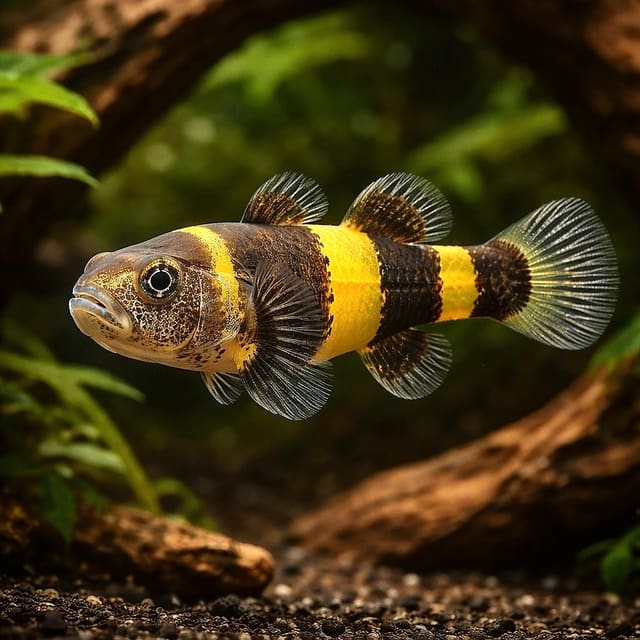
Golden Band Bumblebee Goby (Brachygobius sp.)
24–27°C · pH 7.5–8.5
£5.99

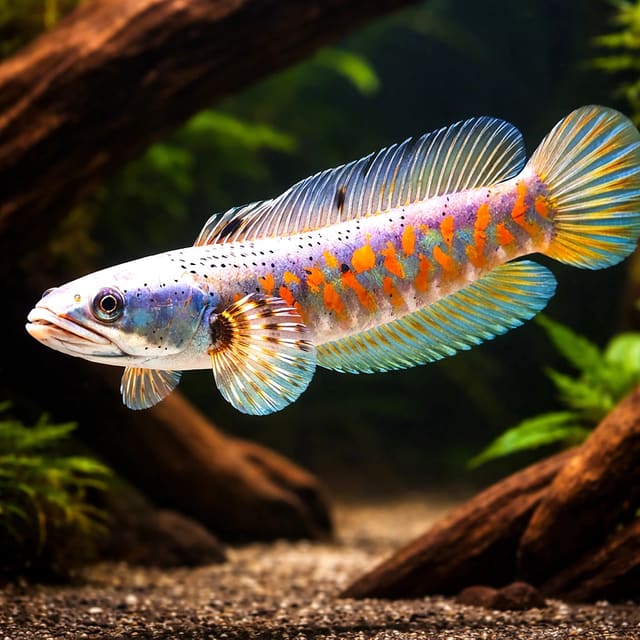
The Peacock Gudgeon (Tateurndina ocellicauda) is a freshwater eleotrid from eastern Papua New Guinea that reaches 7.5 cm. Seriously Fish gives about 41 litres for a couple of adult pairs; keep 22–26°C, and use pH 6.5–7.0 and 5–7 dGH to stay within FishBase’s recorded upper limits and Seriously Fish’s aquarium range. Sold individually in dispatch sizes from 3-3.5 cm to 3.5-4 cm.
Adult size is the maximum length this species reaches at full maturity (scientific sources). The livestock you receive will be younger and smaller — pick a size above for the actual shipping size. Product-photo provenance and any image-specific limitations are stated on the listing.
Tateurndina ocellicauda
Save when buying multiple fish. Each quantity is one fish; sex and pair formation are not guaranteed unless the selected variant explicitly states them.
The Peacock Gudgeon (Tateurndina ocellicauda) is a freshwater eleotrid from eastern Papua New Guinea that reaches 7.5 cm. Seriously Fish gives about 41 litres for a couple of adult pairs; keep 22–26°C, and use pH 6.5–7.0 and 5–7 dGH to stay within FishBase’s recorded upper limits and Seriously Fish’s aquarium range. Sold individually in dispatch sizes from 3-3.5 cm to 3.5-4 cm.
Adult size is the maximum length this species reaches at full maturity (scientific sources). The livestock you receive will be younger and smaller — pick a size above for the actual shipping size. Product-photo provenance and any image-specific limitations are stated on the listing.
Maintain these water conditions for optimal health and vibrant colors
The Peacock Gudgeon (Tateurndina ocellicauda) is a small freshwater member of the Eleotridae family from eastern Papua New Guinea. It suits a keeper who can provide a covered, planted aquarium with plenty of shelter, clean water and gentle flow. FishBase records a maximum length of 7.5 cm and describes the wild fish inhabiting rivers, ponds and rainforest streams.
Despite the alternative trade name Peacock Goby, this fish is an eleotrid rather than a true goby. That distinction does not change the practical goal: create a sheltered lower region where it can move between plants, wood and hiding places without being exposed to strong current. Its modest adult length makes it physically compact, but aquarium footprint, cover and the behaviour of its companions matter more than the length figure alone.
In nature, FishBase describes schools hovering over the bottom. In an aquarium, Seriously Fish says the species can be kept in small groups and is suitable for many communities of small, peaceful fish. Individuals will squabble with their own kind, although these encounters are almost always limited to displaying and flaring. This combination of social interest and mild territorial behaviour makes thoughtful use of space important.
Plan for the adult fish from the start. A layout that works for a newly arrived 3-3.5 cm fish must still offer useful cover, swimming room and manageable social spacing when it approaches 7.5 cm. Choose this species for a calm planted community, not merely because its dispatch size looks small.
Use a tank with a base of at least 45 × 30 cm as the practical planning reference. Seriously Fish gives this footprint and about 41 litres as suitable for a couple of adult pairs. Treat both dimensions and volume as part of the decision: the footprint gives room for separate covered areas, while the water volume supports the complete layout and filtration.
| Suits | Not suited to |
|---|---|
| Covered planted aquariums with bogwood and hiding places | Open-topped aquariums or covers with gaps |
| Gentle-flow freshwater setups | Setups exposing the fish to a lot of flow |
| Small peaceful community fish | Territorial communities without enough space |
| Small Peacock Gudgeon groups with room to display | Bare layouts with little usable cover |
| 22–26°C, pH 6.5–7.0 and 5–7 dGH | Water outside the planned aquarium range |
Cover is functional rather than decorative. Seriously Fish reports that Peacock Gudgeons move around more often when they have floating vegetation, dense planting, bogwood and plentiful hiding places. In a bare aquarium they tend to huddle around the limited cover and move much less. A well-furnished tank therefore makes normal movement easier to observe while giving each fish places to withdraw.
Keep the lid secure and close every gap around the tank cover because this species is described as a good jumper. Make that check before the fish arrives, including openings around equipment. The finished setup should combine sheltered lower areas, plants and open routes between them without turning the aquarium into a high-flow environment.
One purchase supplies one Peacock Gudgeon. Use the live size selector to choose either 3-3.5 cm or 3.5-4 cm. These labels describe the fish’s dispatch size and let you plan around the animal you will receive. The size you select is the size supplied, not the adult size.
FishBase records a maximum adult length of 7.5 cm, so calculate space, cover and companion choices around that figure rather than the selected dispatch grade. A 3-3.5 cm fish is not a permanently three-centimetre fish, and choosing 3.5-4 cm does not alter its adult aquarium requirements. Both grades need the same water range, secure cover and long-term layout.
Sex is guaranteed only when the selected option explicitly states male or female. This Peacock Gudgeon listing has no sex-guaranteed option. Plan the aquarium without relying on a particular sex or sex ratio, and do not use colour or the gallery scenes to predict the fish supplied.
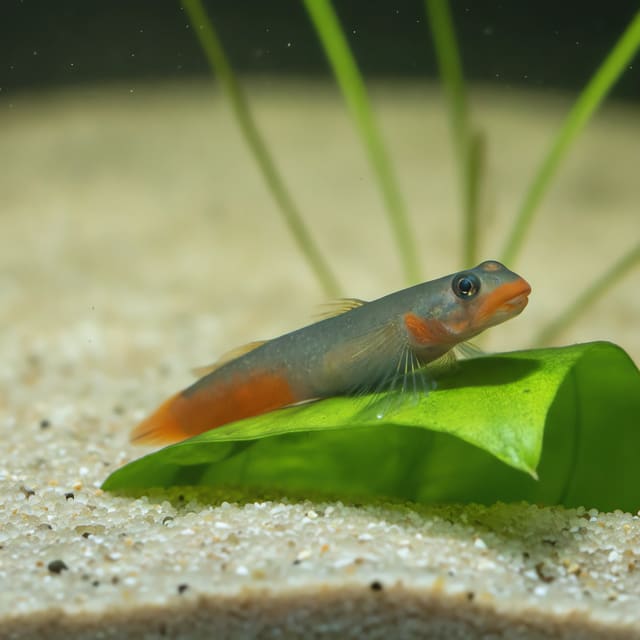
Some gallery images have been digitally enhanced to improve image quality. They show the listed type of animal rather than guaranteeing the exact markings of the individual supplied, so natural colour and pattern can vary. Use the gallery to understand the species’ general form and markings, while treating each live fish as an individual.
If you are comparing similarly shaped aquarium fish, you can also browse the loaches and oddballs collection. Compare care requirements and adult needs rather than assuming that fish with similar common names share the same husbandry.
Plan for a Peacock Gudgeon reaching 7.5 cm. FishBase gives 7.5 cm total length as the recorded maximum, while Seriously Fish uses 75 mm standard length in its aquarium profile. Use 7.5 cm consistently as the adult planning figure and leave enough room for the complete body, normal turning, movement between covered areas and social displays.
Seriously Fish pairs that adult length with a 45 × 30 cm aquarium base and a volume of about 41 litres, described as fine for a couple of adult pairs. That wording makes the dimensions useful together: do not substitute a tall but narrow container merely because its nominal volume is similar. This bottom-associated fish benefits from usable base area where wood, plants and separate hiding places can be arranged.
The species may look like a nano-fish at dispatch, but its long-term requirement is determined by adult size and behaviour. Recheck the plan whenever more fish are proposed. A layout suitable for Peacock Gudgeons alone may need more room once tetras, rasboras, Corydoras catfish or another territorial species are included.
Provide a dark substrate, floating vegetation, bogwood, dense planting and plenty of hiding places. Seriously Fish recommends this combination because Peacock Gudgeons prefer abundant cover and tend to show themselves more often when they feel secure. Their shelter should form a connected layout rather than a single isolated cave surrounded by bare space.
| Feature | Purpose |
|---|---|
| Dark substrate | Supports the sheltered setting recommended for the species |
| Floating vegetation | Adds overhead cover |
| Bogwood | Creates solid visual structure and hiding areas |
| Dense planting | Provides cover around movement routes |
| Several hiding places | Gives group members more than one retreat |
| Tight tank cover | Closes escape gaps for a fish described as a good jumper |
Arrange the wood and plants so the fish can hover near the bottom, pass between sheltered areas and withdraw from another gudgeon’s display. The profile describes same-species disputes as mostly displaying and flaring, so a layout with several visual boundaries gives each fish somewhere else to move. Do not depend on one feature to serve the whole group.
Use the fish’s behaviour to judge whether the cover is effective. Seriously Fish reports that Peacock Gudgeons in bare tanks usually huddle around whatever cover they can find and move around much less. If every fish remains pressed around one piece of wood or one plant cluster, improve the distribution of shelter rather than removing the feature they are using.
Inspect the cover from above before adding the fish. Close gaps around filter pipes, cables and lid sections, as well as the obvious open areas. A decorative hood is useful only when it forms an effective barrier. Repeat that check after moving equipment or carrying out work near the lid.
The result should feel structured but navigable: shaded areas, solid retreats and dense planting joined by short open routes. That design reflects the species’ preference for cover without forcing it to remain hidden in a single corner.
Keep the aquarium at 22–26°C. FishBase records the same 22–26°C range for the species in nature, and Seriously Fish gives 22–26°C for aquarium care. For the remaining values, use pH 6.5–7.0 and hardness of 5–7 dGH. Those narrower targets stay within FishBase’s recorded upper limits of pH 7.0 and 7 dH as well as the Seriously Fish aquarium ranges of pH 6.5–7.5 and 5–10 dGH.
Measure your water rather than choosing a target by description alone. “Soft” and “slightly acidic” are useful summaries, but the numerical range decides whether the aquarium fits. Our aquarium water chemistry guide explains the values to measure, and the water matcher lets you compare those measurements with the planned range.
For a roughly 41-litre aquarium in a room around 20°C, Seriously Fish estimates that about a 50 W heater is needed to hold 22–26°C. Treat the room-temperature assumption as part of that estimate. The required heater output may not match that example if the room conditions or aquarium volume differ.
Prepare the aquarium and establish its filtration before livestock arrives. Our first tropical tank guide can help organise that preparation. The practical goal is a well-set-up aquarium whose measured values already fall within the planned range, rather than trying to reshape unsuitable water around a newly arrived fish.
Use a well-set-up and maintained biological filter, but do not expose Peacock Gudgeons to a lot of flow. Seriously Fish says they like very clean water yet do poorly when the current is strong. The filter therefore has two linked jobs: process waste effectively and return water in a way that preserves calmer areas around the fish’s cover.
For an aquarium of about 41 litres, the species profile gives a turnover of four to five times the tank volume each hour and a corresponding filter rating of about 165–205 litres per hour. The calculation is straightforward: four turnovers of 41 litres equal about 164 litres per hour, while five equal about 205 litres per hour. The published equipment range rounds the lower result to 165 litres per hour.
The RSPCA explains why filtration is essential for aquarium fish: fish release toxic ammonia, and a working biological filter supports bacteria that convert ammonia to nitrite and then nitrate. That is broad aquarium-welfare guidance. For this species, combine biological filtration with the lower-flow preference described by Seriously Fish.
Do not judge the system from filter rating alone. A nominally suitable filter can still create an unsuitable high-current zone if all of its return is concentrated across the fish’s preferred area. Equally, weakening filtration until waste processing is inadequate would miss the clean-water requirement. Set the aquarium up so effective filtration and calm shelter exist together.
Base the menu on small live and frozen foods such as bloodworm, daphnia and brine shrimp. Seriously Fish says Peacock Gudgeons usually accept dried food but strongly prefer small live and frozen items. The same profile associates this diet with better colour and faster development of spawning condition, so the preferred foods should be central to the feeding plan rather than an afterthought.
| Food type | How to use it |
|---|---|
| Small live foods | Use suitable items such as daphnia or brine shrimp |
| Small frozen foods | Offer bloodworm, daphnia or brine shrimp in a size the fish can take |
| Quality dried food | Use as an accepted part of a varied menu |
| Freeze-dried foods | Bloodworm and daphnia are named options in the species profile |
Match the physical food size to this small-mouthed fish. The named foods are all relatively small aquarium feeds, which fits the profile’s repeated emphasis on small live and frozen items. When choosing a dried product, select one that the fish can take readily rather than relying on a format too large for it to handle.
Watch every member of a group at feeding time. Peacock Gudgeons spend much of their activity around the lower part of the aquarium, and companions must not prevent them from reaching the offered food. If one fish consistently misses the meal, change where the food is presented or reassess the community rather than assuming that food entering the aquarium means every fish has eaten.
Use acceptance as feedback without reducing the menu to dried food alone. A fish taking a dried product demonstrates that the format is usable, while the species profile still gives a clear preference for live and frozen foods. Keep the menu varied across the named food types.
No feeding frequency is assigned here. Set the amount and timing to the aquarium’s established routine while keeping the species’ preferred small live and frozen foods at the centre of the plan. Observe intake directly and keep uneaten food from becoming the basis of the feeding schedule.
Expect Peacock Gudgeons to spend activity around the lower part of the aquarium and to use the cover you provide. FishBase describes wild schools hovering over the bottom, while Seriously Fish reports that well-covered aquarium fish are out and about more often. Use those patterns as a practical reference for checking the relationship between layout, flow and social space.
Do not interpret colour alone as a guarantee of sex. Seriously Fish describes differences that can occur in mature males and females, but the offer does not guarantee either sex. Aquarium condition, maturity and individual variation can also affect appearance, so use behaviour to evaluate the environment rather than to promise a particular sex.
Review one practical factor at a time: shelter distribution, current, lid security, companion behaviour or access to food. This keeps the response tied to something you can inspect. For example, a fish remaining close to one wood feature in a bare tank points first to the cover arrangement described by the species profile.
A successful layout allows the fish to choose between visibility and retreat. The aim is not to force constant display; it is to provide enough security that movement through the aquarium can occur naturally while every individual retains access to shelter.
Have the covered, filtered aquarium ready at 22–26°C, pH 6.5–7.0 and 5–7 dGH before the parcel arrives. Check that the lid gaps are closed and that the intended release area is not exposed to a lot of flow.
Follow the Tropical Fish Co delivery and Live Arrival Guarantee policy in this order:
Film every delivery from the sealed parcel onward. The continuous sequence preserves the view required for a Live Arrival Guarantee claim: sealed parcel, opening and fish still in the bag. Do not wait to begin recording until after the box has been opened.
If a Live Arrival Guarantee claim is needed, contact us on the day the fish arrives with the order number and the short continuous unboxing video. The policy explains the applicable requirements and resolution process.
After release, retain the setup already prepared for the species: secure cover, several hiding places, gentle flow and suitable water. Do not use the arrival process as a reason to alter the planned temperature or chemistry. The dispatch grade changes the size received, not the long-term care range.
Keep Peacock Gudgeons with small, peaceful fish whose water and space requirements fit the same aquarium. Seriously Fish specifically names Popondetta species rainbowfishes, tetras, rasboras and Corydoras catfish as suitable kinds. These examples define the intended community style; they are not permission to mix every member of those groups without checking its adult needs.
For a straightforward community, begin with the named peaceful kinds and compare the exact species before mixing them. “Tetra”, “rasbora” and “Corydoras” are useful categories, but the individual species’ adult size, behaviour and water needs still decide whether it passes the screen.
Treat shrimp, snails and other invertebrates as case-by-case choices. Their compatibility needs a stocking assessment that considers the exact animal, its size, the gudgeon’s access to food and the available cover. Ask us for that assessment before combining animals outside the named peaceful fish groups.
Do not treat a shared country of origin or similar body shape as compatibility by itself. Popondetta species rainbowfishes are highlighted as Papua New Guinea examples, but the practical checks remain water, adult needs, temperament and space. A community succeeds when every animal passes those checks together.
Expect some territorial behaviour between Peacock Gudgeons. Seriously Fish describes the species as a little territorial with its own kind and says their squabbles are almost always restricted to displaying and flaring. Small groups can be kept without problems when their aquarium provides suitable space and cover.
Use several hiding places rather than one contested cave. Dense planting, bogwood and separated retreats give a displaying fish somewhere to hold position while another fish can move away. This is especially important in the lower region where the species naturally hovers and where much of its aquarium activity occurs.
| Plan | Decision |
|---|---|
| Small Peacock Gudgeon group | Provide several shelters and watch access to each one |
| Couple of adult pairs | Use the stated 45 × 30 cm base and about 41 litres as the planning reference |
| Gudgeons with tetras or rasboras | Check the exact companions against water, adult size and temperament |
| Gudgeons with Corydoras catfish | Retain enough lower-area routes and feeding access for both kinds |
| Gudgeons with dwarf cichlids | Provide enough additional space for the other territorial species |
Do not label every display as damaging aggression. Flaring between gudgeons is part of the behaviour described for this species. The practical threshold is whether every fish can leave the interaction, reach cover and continue feeding. A layout with one retreat offers fewer choices than one with planting and wood distributed across the base.
Equally, do not assume the species’ generally peaceful community suitability removes the need for observation. Check how the exact individuals use shelter and food after any change in stocking. If a new territorial companion controls the covered lower area, reassess the space and combination rather than treating the common community label as a guarantee.
The compatibility rule is concise: choose small peaceful companions, verify shared water requirements, preserve feeding access and provide extra room whenever another territorial fish is involved.
FishBase records a maximum length of 7.5 cm total length. Plan the aquarium around that adult figure rather than the 3-3.5 cm or 3.5-4 cm dispatch grades.
Use a 45 × 30 cm base and about 41 litres as the stated planning size for a couple of adult pairs. Add enough bogwood, plants and hiding places to divide the lower area.
This fish can be kept in a small group. Seriously Fish says about 41 litres with a 45 × 30 cm base is fine for a couple of adult pairs, with squabbles almost always limited to displaying and flaring.
It suits a prepared keeper who can maintain 22–26°C, pH 6.5–7.0 and 5–7 dGH, provide a covered planted aquarium with gentle flow, and feed small live and frozen foods.
Feed small live and frozen foods such as bloodworm, daphnia and brine shrimp as the main menu. It usually accepts quality dried food, and freeze-dried bloodworm or daphnia can add variety.
Keep it at 22–26°C. Use pH 6.5–7.0 and 5–7 dGH to stay within FishBase’s recorded upper limits and Seriously Fish’s aquarium range.
It is a little territorial with its own kind, but its squabbles are almost always limited to displaying and flaring. Keep it with small peaceful fish and provide several covered retreats.
Suitable fish named by Seriously Fish include Popondetta species rainbowfishes, tetras, rasboras and Corydoras catfish. Provide extra space with another territorial species such as a dwarf cichlid.
Tropical Fish Co hand-bags the fish in pure oxygen and uses an insulated box, with a heat pack when the weather calls for it. Someone must receive the parcel; start a continuous video while it is sealed, open it the same day, show the fish inside the sealed bag, float the bag for 20–30 minutes and release the fish without pouring bag water into the aquarium.
No reviews for this item yet. Bought one? Honest reviews only, good or bad.
What customers say about ordering from us
I have a small group of long finned mountain minnows. So was delighted to be able to order ten of this variety to increase the genetics in my tank . The ones I recieved are healthy but it’s to early to give a verdict on wether they are of a long finned type since they are small currently.
Gordon Walker · 23 Sept 2026
100% success travel and "installation". Pleased with quality of purchase. The Siamese fighter a bit "shy" so have not yet seen him at his best yet but looking good. Happy customer. GG
George E Garratt · 21 Sept 2026
Reviews of our shop, collected by Judge.me, an independent third-party review collector. Newest first.