Moderate
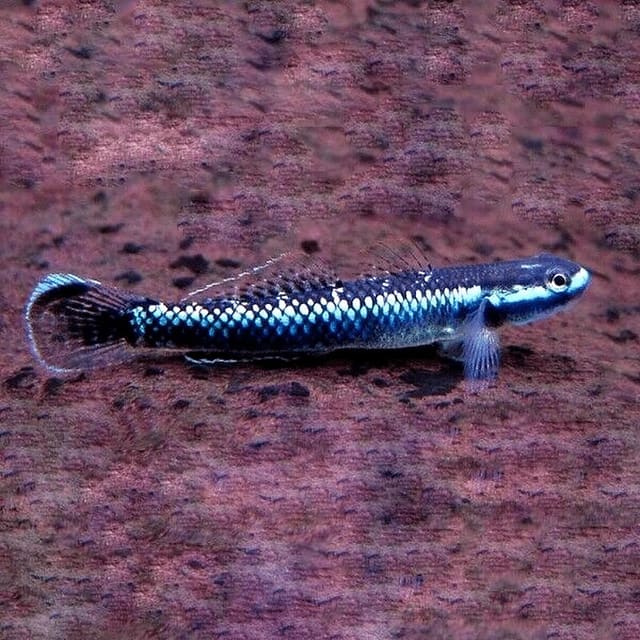
Blue Neon Goby (Stiphodon sp. undio blue)
22–26°C · pH 6.5–7.5 · 54L
£10.99

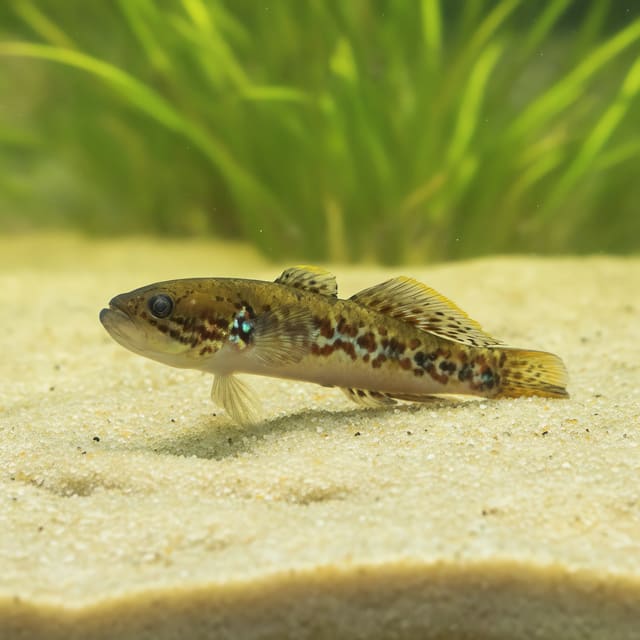
The Desert Goby Gold (Chlamydogobius eremius) is a freshwater goby from South Australia that reaches 6 cm. It suits keepers prepared to provide a structured aquarium of about 41 litres with a 45 × 30 cm base; the overlap of FishBase's recorded environment, the Seriously Fish species profile and OATA's goby and blenny guidance gives routine care at 24–27°C, pH 7.5–8.0 and 9–18 dGH. Sold individually as one live fish per purchase.
Adult size is the maximum length this species reaches at full maturity (scientific sources). The livestock you receive will be younger and smaller. Product-photo provenance and any image-specific limitations are stated on the listing.
Chlamydogobius eremius
The Desert Goby Gold (Chlamydogobius eremius) is a freshwater goby from South Australia that reaches 6 cm. It suits keepers prepared to provide a structured aquarium of about 41 litres with a 45 × 30 cm base; the overlap of FishBase's recorded environment, the Seriously Fish species profile and OATA's goby and blenny guidance gives routine care at 24–27°C, pH 7.5–8.0 and 9–18 dGH. Sold individually as one live fish per purchase.
Adult size is the maximum length this species reaches at full maturity (scientific sources). The livestock you receive will be younger and smaller. Product-photo provenance and any image-specific limitations are stated on the listing.
Maintain these water conditions for optimal health and vibrant colors
The Desert Goby Gold (Chlamydogobius eremius) is a freshwater, bottom-living goby in the family Gobiidae from South Australia, reaching 6 cm total length. It suits an aquarist who can provide mineral-rich water, gentle filtration and a structured base with several secure retreats. Despite its compact body, it is not an ideal community fish: water chemistry, floor space and territorial behaviour matter more than open-water swimming room.
FishBase records the 6 cm maximum and describes wild fish around pools and streams associated with artesian springs and bores. They use shaded places around plants or rocks and feed on insects, crustaceans, filamentous algae and detritus. Those natural conditions explain the value of cover, varied food and a mineral-rich aquarium, but routine care should remain stable rather than imitate wild environmental extremes.
Keep routine aquarium water at 24–27°C, pH 7.5–8.0 and 9–18 dGH. This is the overlap between FishBase's recorded environment, the Seriously Fish species profile and OATA's group guidance for freshwater gobies and blennies. Seriously Fish gives a base of 45 × 30 cm and about 41 litres as sufficient for a small group. Treat the base dimensions as the first space test because caves and territorial boundaries must fit at substrate level.
| Suits | Not suited to |
|---|---|
| Mineral-rich freshwater at the stated values | Soft, acidic water outside the routine range |
| A 45 × 30 cm base or similar with caves | An unstructured base without secure retreats |
| A species-focused aquarium | A standard community aquarium |
| If companions are wanted, robust but peaceful upper-water fish sharing the same water | Fish requiring different water conditions |
The name “gold” is an aquarium trade label. Seriously Fish notes that “gold desert goby” appears to refer to the natural form rather than a separately established colour form, so plan care around Chlamydogobius eremius itself.
One purchase supplies one live Desert Goby Gold. The sold unit is one animal, even where a gallery scene contains two fish. Plan the aquarium around the species' 6 cm adult length and its need for usable bottom territory rather than treating the fish's appearance on arrival as its final space requirement.
Sex is guaranteed only when the selected option explicitly states male or female. This Desert Goby Gold listing has no sex-guaranteed option.
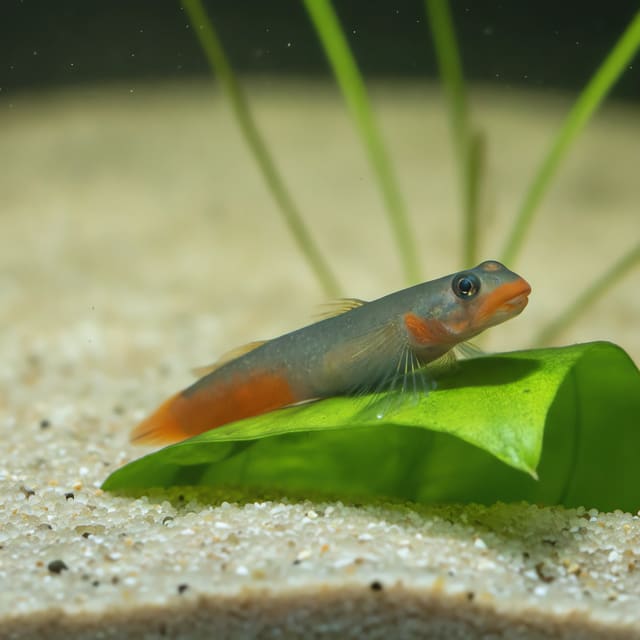
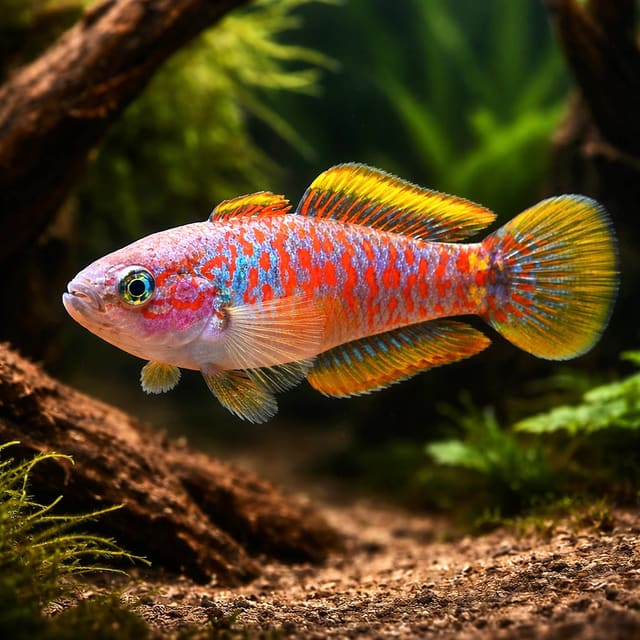
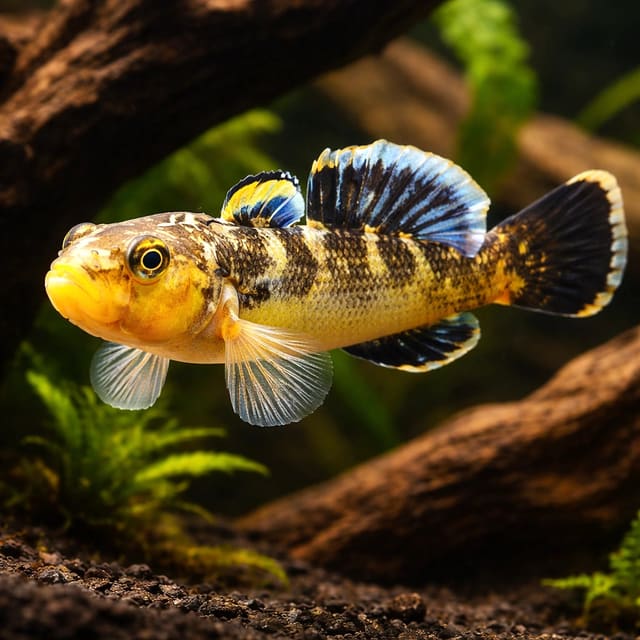
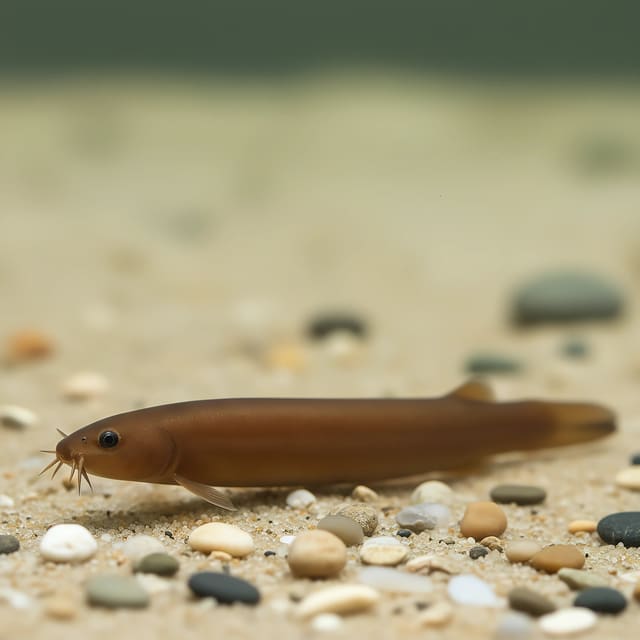
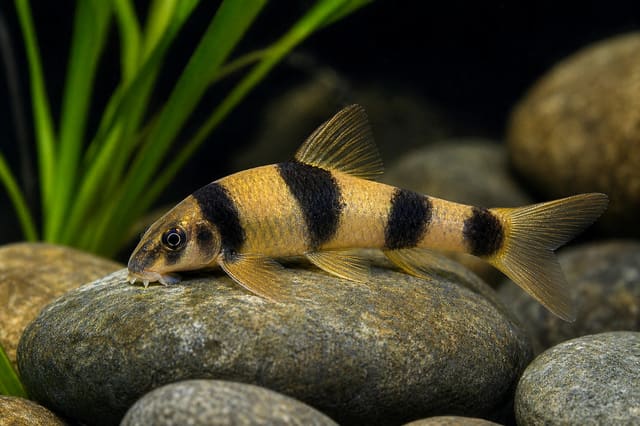
Some gallery images are representative, based on reference photographs of this species, and none shows the exact animal supplied, so colours can look slightly different from the live animal.
A 41-litre aquarium with the stated base can meet the species reference when it is mature, filtered and deliberately structured. More volume can improve stability, but it does not replace the need for suitable water or a cave network. Equally, a tall aquarium with little bottom area should not be treated as equivalent simply because its litre figure is similar.
This is an oddball goby for a planned aquarium rather than an impulse addition. You can browse the loaches and oddballs collection when comparing other bottom-oriented fish, but assess each animal on its own water, food and social requirements rather than assuming members of a retail collection can share a tank.
Start with a 45 × 30 cm base and about 41 litres for a small group, then organise that footprint into several usable retreats. Seriously Fish considers those dimensions, or a similar base, sufficient for a small group. The same footprint gives one fish room to choose a resting place without forcing it into constant contact with open-water activity.
Use sand or fine-grade gravel. Seriously Fish rates sand as ideal, and OATA advises fine gravel or sand for freshwater gobies to prevent injuries to their sensitive skin. If local water is soft, Seriously Fish suggests that coral sand or gravel may be required to help maintain pH and hardness. Measure the resulting water rather than assuming a mineral substrate has produced the right values.
Build rocky structures or use terracotta pipes and plant pots to form a network of crevices and caves. Spread entrances across the footprint instead of concentrating every refuge in one pile. Males defend spawning sites aggressively, so a fish being displaced from one cave must have another sheltered route available without crossing the centre of the defended area.
Mature the biological filter before the goby enters the aquarium. Adding livestock before enough beneficial bacteria are established can allow ammonia and nitrite to rise as waste and feeding increase. Our first tropical aquarium guide helps organise preparation and maturation before livestock arrives.
Complete the hardscape before the fish is introduced rather than repeatedly rebuilding its retreat network. Later adjustments should solve a clear problem, such as one fish blocking every entrance or waste collecting where it cannot be siphoned. A useful layout gives the goby cover while still allowing the aquarist to inspect, feed and clean the aquarium effectively.
Keep the aquarium at 24–27°C, pH 7.5–8.0 and 9–18 dGH. These values sit inside every named range used for routine planning: FishBase records 10–35°C, pH 7.0–8.0 and 9–19 dH for the species' environment; Seriously Fish recommends 20–28°C, pH 7.0–8.5 and 5–20 dGH; OATA gives 24–27°C, pH 7.5–8.5 and 8–18 dGH for freshwater gobies and blennies.
Hold everyday care inside this narrower window. This fish is associated with naturally changeable habitats, but tolerance of environmental extremes is not an instruction to produce abrupt aquarium swings. Stable readings inside the routine window make feeding, compatibility and health observations easier to interpret.
| Reading | Action |
|---|---|
| 24–27°C | Maintain the temperature and check it during weekly testing. |
| pH 7.5–8.0 | Keep replacement water close to the established aquarium. |
| 9–18 dGH | Retain sufficient mineral content for this hard-water plan. |
| Ammonia or nitrite above zero | Test the system, reduce the waste load and restore biological filtration. |
| Nitrate approaching 50 mg/l | Use maintenance and partial water changes to keep it below that ceiling. |
Use our water chemistry guide to understand the purpose of each reading, then compare measured values with the routine range using the water matcher. A single matching value is not enough: temperature, pH and hardness must work together.
OATA also advises zero ammonia, zero nitrite and nitrate not exceeding 50 mg/l. Those waste readings describe filter performance and maintenance rather than the mineral character of the water. Test them alongside pH and hardness so that clean water is not confused with chemically suitable water, or vice versa.
Provide reliable biological filtration without blasting the aquarium base. Seriously Fish recommends gentle movement and gives a filter rating of 80–125 litres per hour for an aquarium of about 41 litres. Position the return so water circulates through the aquarium while the goby can rest near the substrate and enter caves without fighting a concentrated jet.
The RSPCA explains why a mature biological filter is essential: fish waste releases toxic ammonia, bacteria convert it to nitrite, and another bacterial stage converts nitrite to the safer nitrate. A clear-looking aquarium can still contain harmful dissolved waste, so visual clarity never replaces testing.
This routine follows OATA's freshwater goby and blenny advice. The 25% change is a regular maintenance action, not a reason to wait for waste readings to deteriorate. If ammonia or nitrite appears, investigate the biological load, filter function and uneaten food immediately instead of relying on the next scheduled change.
A useful current moves water without pinning food behind décor or making every resting place turbulent. If the goby is repeatedly displaced from the same exposed area, redirect the concentrated flow while retaining overall circulation. If debris settles throughout inaccessible caves, adjust the layout or return direction so routine siphoning can reach the waste.
Do not replace all filter media during ordinary cleaning. Preserving the bacterial population helps keep waste conversion stable, especially after feeding or when a small group increases the biological load. Add fish gradually so the filter bacteria can respond to each increase in waste production.
Following OATA's guidance for freshwater gobies and blennies, feed once daily, offering only what the fish consume within a few minutes. Base the diet on small meaty frozen foods such as daphnia, plankton and brine shrimp, then rotate suitable dried food and regular plant matter. Remove uneaten food before it breaks down and adds ammonia to the aquarium.
FishBase records wild Desert Gobies eating insects, crustaceans, filamentous algae and detritus. Seriously Fish describes the species as an opportunistic omnivore that accepts most dried foods in captivity, while recommending small live or frozen invertebrates such as Artemia, Daphnia and bloodworm for colour and condition. It also recommends greenstuffs regularly because the species has a long, coiled intestine associated with consuming algae and other herbivorous material.
| Food | How to use it |
|---|---|
| Daphnia, plankton or brine shrimp | Use as small meaty staples that fit the recorded invertebrate diet. |
| Artemia or bloodworm | Rotate live, frozen or suitable freeze-dried forms for variety. |
| Quality dried food | Offer a small portion the goby recognises and reaches promptly. |
| Greenstuffs | Include regularly to represent the plant component of its omnivorous diet. |
| Naturally occurring algae and detritus | Treat as background foraging, not a substitute for controlled meals. |
Watch every individual during the feeding window. A goby that lives close to the base can lose food to faster fish above it, so compatibility includes feeding access as well as temperament. Place food where the goby can reach it without dropping excess into deep caves. In a group, use more than one feeding point if a territorial fish blocks the first.
This species is described as a voracious eater, making portion control important. Keep the daily amount within the few-minute rule, vary ingredients across meals and use water testing to catch the effect of waste before it becomes a health problem.
Prepare the mature, filtered aquarium and its caves before the parcel arrives. This allows the fish to move into measured water and reach cover without a last-minute rebuild.
Complete these water-quality and equipment checks before the parcel arrives:
Read our delivery and Live Arrival Guarantee policy before arrival day. The fish is hand-bagged in pure oxygen and placed in an insulated poly box, with a heat pack added when weather calls for one. Packing supports the journey; the prepared aquarium and measured acclimatisation steps support the transfer into permanent care.
OATA advises watching swimming, colour, breathing, temperament, body condition and feeding response. A newly introduced goby may use cover, but a fish that cannot leave shelter because another individual guards the route needs another retreat or a separation plan. Any change in appetite, breathing or swimming calls for immediate water testing.
Check for damaged fins or scales, white spots, fluffy growths, abnormal body condition and a marked change in aggression. Begin with ammonia, nitrite, nitrate, temperature and pH because a water problem can affect every animal. If concerning changes continue after the water and equipment are checked, contact us for health guidance.
Treat cave defence as a management signal, especially when males enter spawning condition. Seriously Fish warns that males may attack and even kill other Desert Gobies, with risk increasing in smaller aquaria. Sufficient cover is therefore essential whenever more than one individual shares the base.
| What you see | What to do |
|---|---|
| A fish rests near one cave but others still feed and shelter | Continue observing access to food and retreats. |
| One fish repeatedly drives another from every cave | Add a genuinely separate retreat or separate the fish. |
| A subdominant fish remains exposed and misses meals | Intervene before loss of condition develops. |
| A male intensifies defence around a crevice | Treat the area as a spawning territory and monitor all other fish closely. |
Wild Desert Gobies use shaded places around plants and rocks, while aquarium guidance recommends a network of crevices and caves. Cover must therefore do more than decorate the tank. It should allow a fish to break sight, leave a defended area and reach another shelter without passing directly through the aggressor's position.
The species deposits eggs in crevices or caves, and the male defends them aggressively until hatching. Courtship includes jerky body movements and flaring of the dorsal and anal fins. Once eggs are deposited on the roof of the spawning site, the female is ejected and is best moved to another aquarium for her own safety. That sequence explains why apparently settled fish can become difficult to manage when a cave changes from a resting place into a defended nest.
Colour alone is not a dependable reading of immediate social behaviour. Seriously Fish notes that males can change colour and may resemble females when newly introduced, stressed or in the presence of a dominant male. Base intervention on what each fish can access—food, shelter and safe floor space—rather than waiting for a particular colour pattern.
Use mineral-rich freshwater as the straightforward routine setup. Seriously Fish states that Desert Gobies survive and breed in pure freshwater provided it is not too soft or acidic. Hold pH at 7.5–8.0 and general hardness at 9–18 dGH, then use measured maintenance to keep those values stable.
The same profile says marine salt may be added at around one teaspoon per litre if an aquarist deliberately chooses that approach. Salt is optional, not a substitute for correct pH, hardness, filtration or maintenance. Every other inhabitant must suit the same conditions, so decide on freshwater or a salted setup before choosing companions.
In soft-water areas, coral sand or gravel may be required to maintain pH and hardness. Its effect depends on the starting water and aquarium, so test the tank after setup and during routine maintenance. Aim for the stated pH and dGH values rather than adding a fixed amount of mineral material without checking the result.
FishBase reports field and laboratory observations showing that Desert Gobies can withstand wide ranges of temperature, salinity and pH and very low dissolved oxygen. Those observations help explain the species' resilience in its Australian habitat. Aquarium care remains centred on a stable routine, clean water and reliable oxygenation through filtration and circulation.
In most cases, keep Desert Goby Gold in a species-only aquarium; if you do want companions, choose only robust but peaceful fish that use the upper water and share the same conditions. Seriously Fish describes it as not an ideal community fish. Compatibility begins with 24–27°C, pH 7.5–8.0 and 9–18 dGH, then narrows further by behaviour, swimming level and feeding access.
Passing one test does not compensate for failing another. A peaceful fish that requires softer or more acidic water is not a match. A hard-water fish that continually occupies caves or takes every bottom-level meal also fails the plan. Use the complete screening rule rather than choosing companions from a broad “community fish” label.
| Potential plan | Decision |
|---|---|
| Species-focused aquarium | The clearest route for controlling food, caves and water. |
| Typical community mix | Avoid in most cases; only consider screened upper-water fish that meet every care requirement. |
| Robust, peaceful upper-water fish at matching values | Consider after checking aquarium space and feeding access. |
| Fish needing different chemistry | Avoid mixing because one species would live outside its range. |
| Another animal competing for the same caves | Use caution and assess whether separate territories can exist. |
Compatibility with snails, shrimp and other invertebrates should be assessed individually rather than assumed from the goby's size. The recorded wild diet includes crustaceans, so do not treat a small crustacean as automatically outside the feeding response. Before adding any other species, check it against all four tests with your aquarium dimensions, measured water values and full livestock list in front of you.
A small group can use a 45 × 30 cm base of about 41 litres, but every individual must retain access to shelter and food. Keeping one fish is the simpler social plan. With a group, the aquarist must be ready to separate an aggressor or targeted fish if the cave network stops working as intended.
Provide several caves with entrances facing different directions and break long sight lines with plants, rocks or wood. A pile containing several openings can still function as one defended location if every entrance sits within the same male's view. Distributed retreats create a better chance for subdominant or non-breeding fish to withdraw.
Seriously Fish highlights spawning-condition males as the main intraspecific risk, especially in smaller aquaria. Watch behaviour rather than relying on a fixed expectation that a previously calm group will remain unchanged. Courtship, cave guarding and exclusion can develop after the fish have settled.
If one fish persistently loses access, adding another ornament beside the defended cave may not solve the problem. Create a separate visual zone or move the targeted fish to another suitable aquarium. Intervention should occur before repeated attacks become injury or missed meals become loss of condition.
Do not build a group around an assumed male-to-female ratio because sex is not part of this offer. Instead, build flexibility into the aquarium: multiple shelters, observable feeding points and a practical separation route. This approach responds to the behaviour the fish actually show while preserving the same temperature, pH, hardness and maintenance standards for every individual.
Desert Goby Gold reaches 6 cm. FishBase records this as a maximum total length, so plan the aquarium around 6 cm rather than the fish's appearance on arrival.
Seriously Fish gives a 45 × 30 cm base and about 41 litres as sufficient for a small group. Prioritise usable floor area, caves and separate retreats.
Keep Desert Goby Gold alone or as a carefully observed small group. A 45 × 30 cm base of about 41 litres can house a small group, provided every fish retains shelter and feeding access.
Desert Goby Gold suits a keeper prepared to test mineral-rich water, mature the filter, structure the base and manage male aggression. It is not an ideal community fish and in most cases is best kept in a species-only aquarium.
Desert Goby Gold is an omnivore. Feed small meaty frozen foods such as daphnia, plankton or brine shrimp, rotate suitable dried foods and include greenstuffs regularly, once daily within a few minutes.
Keep it at 24–27°C, pH 7.5–8.0 and 9–18 dGH. This routine range is the overlap of FishBase's recorded environment, the Seriously Fish species profile and OATA's goby and blenny guidance.
Males may attack and even kill other Desert Gobies when in spawning condition. The main concern is cave-centred territorial aggression, so provide several retreats and separate fish if one is persistently excluded.
In most cases, keep it in a species-only aquarium, because it is not an ideal community fish. If you do want companions, choose only robust but peaceful fish that occupy the upper water and share 24–27°C, pH 7.5–8.0 and 9–18 dGH.
Tropical Fish Co hand-bags it in pure oxygen and packs it in an insulated poly box, adding a heat pack when weather calls for one. Make sure someone is at the delivery address to receive it. Start a continuous unboxing video before opening the parcel, showing it still sealed, opening it in one take and showing the fish still inside the sealed bag. Float the bag for 20–30 minutes, then release the fish without pouring bag water into the aquarium.
No reviews for this item yet. Bought one? Honest reviews only, good or bad.
What customers say about ordering from us
I have a small group of long finned mountain minnows. So was delighted to be able to order ten of this variety to increase the genetics in my tank . The ones I recieved are healthy but it’s to early to give a verdict on wether they are of a long finned type since they are small currently.
Gordon Walker · 23 Sept 2026
100% success travel and "installation". Pleased with quality of purchase. The Siamese fighter a bit "shy" so have not yet seen him at his best yet but looking good. Happy customer. GG
George E Garratt · 21 Sept 2026
Reviews of our shop, collected by Judge.me, an independent third-party review collector. Newest first.