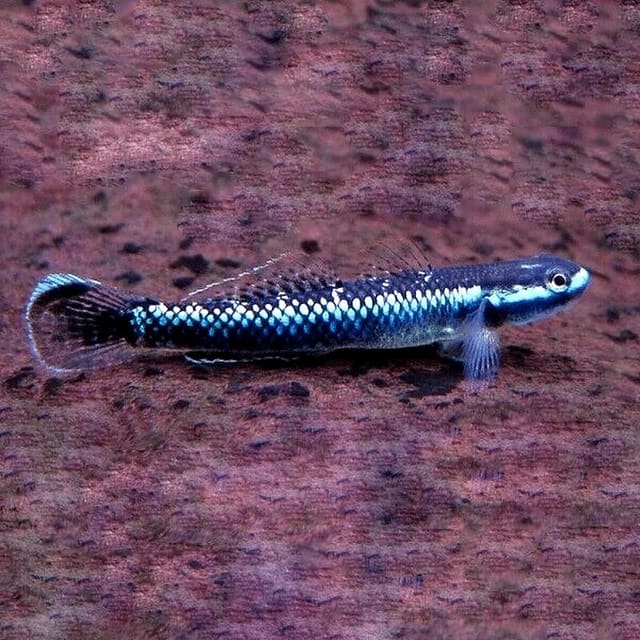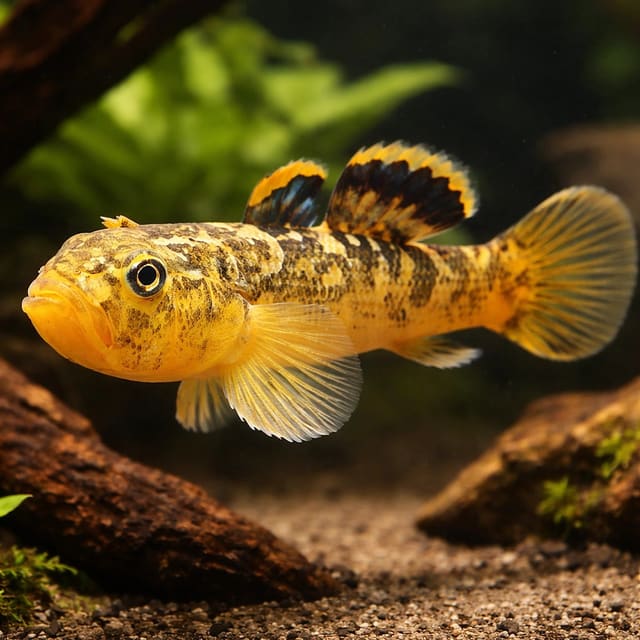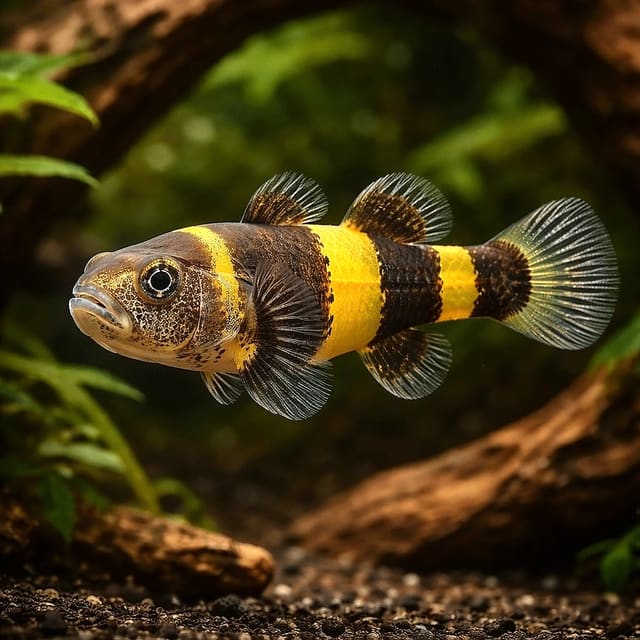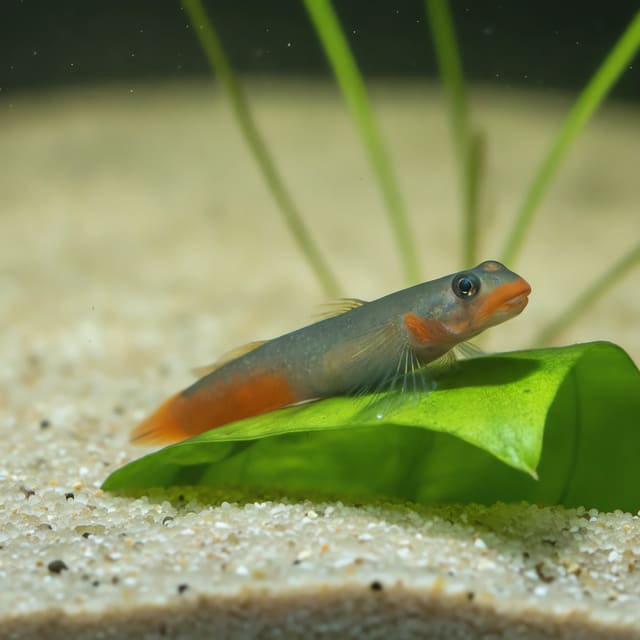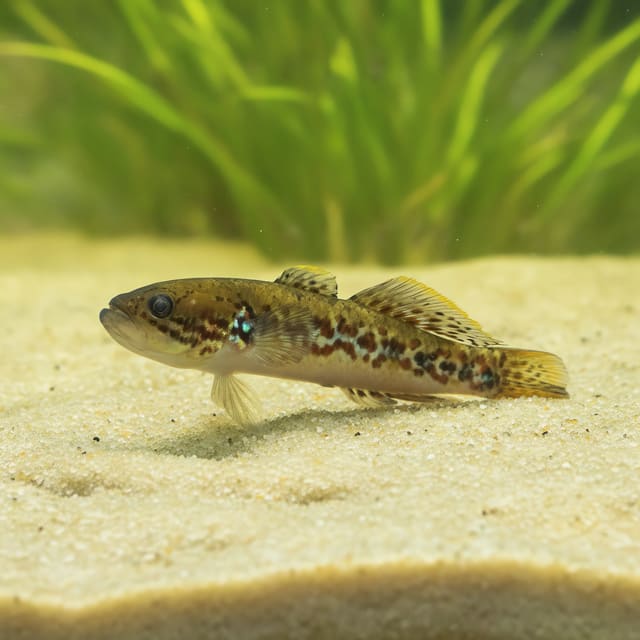
Purple spotted gudgeon (Mogurnda adspersa)
16–20°C · pH 7–7.5 · 108L
£9.99
The Atlantic mudskipper, Periophthalmus barbarus, is an amphibious West African fish that spends much of its time out of the water. It needs brackish water at about SG 1.005 and 25-30°C, a land area, warm humid air and a tight lid. Each unit is one fish; sex and size are not specified.
Adult size is the maximum length this species reaches at full maturity (scientific sources). The livestock you receive will be younger and smaller. Product-photo provenance and any image-specific limitations are stated on the listing.
Periophthalmus barbarus
The Atlantic mudskipper, Periophthalmus barbarus, is an amphibious West African fish that spends much of its time out of the water. It needs brackish water at about SG 1.005 and 25-30°C, a land area, warm humid air and a tight lid. Each unit is one fish; sex and size are not specified.
Adult size is the maximum length this species reaches at full maturity (scientific sources). The livestock you receive will be younger and smaller. Product-photo provenance and any image-specific limitations are stated on the listing.
Maintain these water conditions for optimal health and vibrant colors
The Atlantic mudskipper is one of the strangest animals we offer, and one of the most entertaining to keep when the set-up is right. It is a fish that climbs out of the water, props itself up on its front fins, breathes air and hunts insects and crabs across wet mud. FishBase files it under the mudskipper family Oxudercidae, and Seriously Fish counts fifteen species in the genus Periophthalmus, of which this is the one most commonly seen in the aquarium hobby.
This listing used to carry the name Periophthalmus papilio, a name Bloch and Schneider gave to a mudskipper in 1801. FishBase now treats that name as a synonym of Periophthalmus barbarus, which Linnaeus described in 1766, and Wikipedia's account of the species lists it among the synonyms too. Both sources use the common name Atlantic mudskipper, so that is the name we use here. The fish has not changed; only the label has been brought up to date.
This is not a freshwater community fish, and it will not live in an ordinary tropical aquarium. Seriously Fish calls it primarily a brackish animal and asks for marine salt to be added until the water reaches a specific gravity of around 1.005. The set-up must also have exposed land, warm and very humid air above the water, and a tightly fitting lid. Put a mudskipper in a fully flooded freshwater tank with tetras and you are setting it up to fail. The good news is that once those conditions are in place, Seriously Fish describes the species as very hardy and easier to keep than many sources suggest.
Each unit on this listing is one mudskipper. The listing has a single option and does not state a sex or a size, so we do not promise either. How many you order matters a great deal with this fish. Seriously Fish suggests buying a single specimen if space is limited and keeping a group of five or more only in a large tank, because males are intensely territorial with each other. Two or three in a modest tank is the arrangement most likely to go wrong. The section on behaviour explains why.
It suits a keeper who wants a dedicated brackish set-up with a beach, who is happy feeding live and frozen food, and who will enjoy watching an animal with real personality. Seriously Fish describes mudskippers as entertaining, curious and intelligent, and says they can learn to recognise the person who feeds them. It does not suit anyone looking for a fish to drop into an existing freshwater tank.
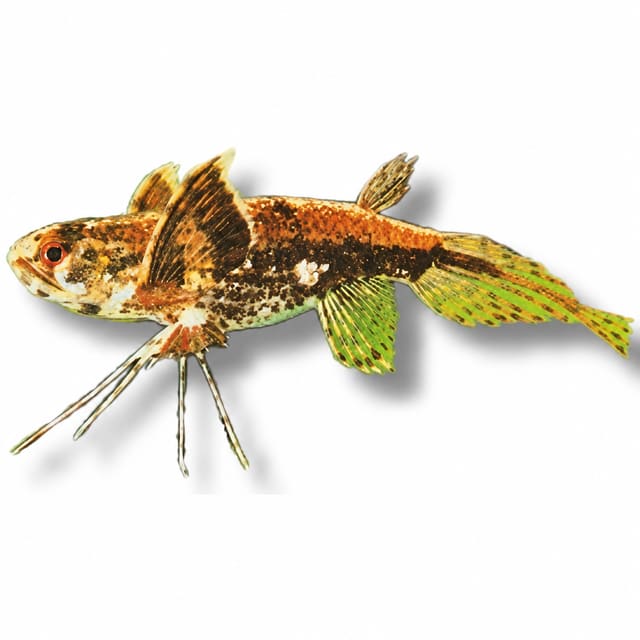
Even people who have never kept fish tend to recognise a mudskipper: eyes perched high on the head like a frog's, and a habit of sitting half out of the water. FishBase gives a fuller description of the live colouring of this species:
FishBase also counts 11 to 15 spines in the first dorsal fin. The spiny first dorsal with its blue band is one of the fins you will see raised and lowered in displays, so it is worth getting to know.
Seriously Fish describes the eyes as set high on the head, giving the fish 360-degree vision and what it calls a peculiar, froglike expression. You will often see a mudskipper roll its eyes back into their sockets or wipe them with a pectoral fin. That is not a sign of irritation; it is how the fish keeps its eyes moist out of water.
On land a mudskipper moves in two ways, according to Seriously Fish. It “crutches” along on its pectoral fins, and it “skips” with its tail, which fits the common name nicely. FishBase describes the wild fish skipping or walking on sand or mud in search of food.
This is the clever part. FishBase calls the species a facultative air-breather and an amphibious one. Seriously Fish explains the mechanics. As a mudskipper leaves the water it closes its gill covers and inflates the chamber behind the gills, trapping a reservoir of water and oxygen that it uses to breathe on land. It also notes that almost half of terrestrial breathing in mudskippers takes place through specially adapted surfaces on the fins and body, and that their gills are, physiologically, better suited to breathing air than water. Wikipedia describes the same two systems: water stored in the gill chambers, and breathing through the skin.
All of this has a practical consequence. A fish that breathes partly through its skin needs that skin kept moist, and a fish that spends long spells out of the water needs somewhere dry enough to climb onto. Wikipedia goes as far as saying Atlantic mudskippers spend most of the day on land. That is why a land area and warm, humid air are not optional extras in the tank. They are part of how the animal breathes.
The Atlantic mudskipper lives along the coast of West Africa. FishBase gives its range as Senegal to Angola, including most offshore islands, and Seriously Fish describes it as occurring along most of the West African coastline from Mauritania south to Angola. Reports from further afield, including Asia and Australia, need confirmation according to FishBase, and Seriously Fish considers them probably misidentifications.
FishBase describes the species on muddy ground and in the brackish waters of estuaries, lagoons and mangrove swamps. It is occasionally found in fresh water, but always close to the shore. FishBase lists it as amphidromous and records it from marine, brackish and fresh water, and Seriously Fish sums this up: although it has been recorded in both fresh and full marine conditions, it is primarily a brackish animal. That is the line to remember when you set up the tank.
Seriously Fish places it mainly in estuarine mangrove swamps, living on and around mudflats at the water's edge. Some populations live in strongly tidal areas, where the flats are only exposed at low tide. There the fish come out to forage while the mud is uncovered and retreat underwater into their burrows as the water rises.
FishBase records that the species spawns in burrows, and Seriously Fish says males dig deep, turreted shafts in the mud, up to a metre down, where mating and care of the young take place. Wikipedia gives burrow depths of up to 1.5 metres, with air pockets inside, and describes a mudskipper building a wall of mud around its territory. The exact depth varies between sources, but the picture is the same: each fish holds a patch of mudflat and defends it.
FishBase gives a temperature range of 25-30°C, which matches the aquarium range on Seriously Fish. Adults feed mainly on the arthropods of the mud surface, such as crabs and insects, and FishBase notes that white mangrove (Avicennia nitida) also appears in their diet.
FishBase records an IUCN Red List assessment of Least Concern, made in 2019, and Wikipedia gives the same status. FishBase also notes that the species is used in local subsistence fisheries as well as the aquarium trade.
Seriously Fish puts the minimum at a tank of 120 × 30 × 30 cm, about 110 litres, and calls even that just about acceptable for a single fish. For a group of five or more it asks for a large tank, with enough room for every fish to develop a territory. Because the animal lives along the waterline, floor area matters far more than height. A long, shallow tank with a big footprint gives you room for a proper beach and a stretch of water, and that is what the fish will use.
Seriously Fish is clear that the set-up must have exposed land. It suggests a bank or beach of sand or mudflat mud, or partially submerged bogwood. In practice the simplest designs are:
Whatever you build, the fish must be able to choose between water and land at all times. Give it shallow margins it can rest in with its body half-submerged, and enough open water to retreat into.
Seriously Fish says the air above the water must be very humid and at the same temperature as the water. That means a tightly fitting lid, which it calls a prerequisite, and which also stops the fish climbing out of the aquarium. Mudskippers that can climb onto bogwood can climb out of an open tank. Close any gaps around cables and pipework, and keep the lid on except while you work. A cover that traps heat and moisture is what keeps the fish's skin and eyes from drying.
A heater in the water warms the air above it as long as the lid holds the warmth in. Put a thermometer in the water and another in the air space if you can, and compare the two: if the air is much cooler than the water, the lid is losing too much heat.
Seriously Fish suggests plants that tolerate brackish water, such as Rhizophora mangrove or Java fern (Microsorum pteropus), and says plastic plants are also suitable. Mangrove seedlings rooted in the beach give a fair copy of the fish's wild home. Keep the decoration simple enough that you can see every fish and reach every corner for cleaning.
Seriously Fish calls mudskippers greedy, messy fish and asks for an efficient filter. With a reduced water volume, waste builds up faster than in a deep tank, so choose a filter that works at low water levels and has good biological capacity. Canister filters with the intake and outlet placed in the water section, or internal filters designed for shallow water, both work.
Getting the water right is the single biggest difference between a mudskipper that thrives and one that slowly fades. The figures below are the ones we use on this listing.
| Parameter | Target | Source |
|---|---|---|
| Salinity | Specific gravity around 1.005 | Seriously Fish |
| Temperature | 25-30°C | FishBase and Seriously Fish agree |
| pH | 7.0-8.5 | Seriously Fish |
| Hardness | 10-25 dGH | Seriously Fish |
| Air above the water | Very humid, same temperature as the water | Seriously Fish |
Seriously Fish advises adding marine salt until the water reaches a specific gravity of around 1.005, and says any of the commercial marine salt mixes is fine. Use a marine salt mix, as Seriously Fish advises, rather than table salt or the “tonic” salt sold for freshwater fish. Measure with a hydrometer or a refractometer; the reading is what matters, not how many spoonfuls went in.
Mix salt into new water in a bucket before it goes into the tank, never by tipping it straight in with the fish present. Prepare every batch of change water to the same specific gravity as the aquarium, so that water changes do not jolt the salinity up and down.
Water evaporates but salt does not. When the level drops between water changes, top up with dechlorinated fresh water, not salt water, or the specific gravity will creep upwards week by week. A mark on the glass at the correct water level makes this easy.
FishBase gives 25-30°C for the species, and Seriously Fish gives the same aquarium range. Somewhere in the middle of that range is a sensible everyday setting. Remember that the air matters as well as the water: the fish spends long periods out of the water, so a warm tank under cold, dry room air is not good enough.
Brackish set-ups still run on the same nitrogen cycle as any aquarium. OATA, the UK ornamental fish trade association, recommends testing at least once a week for ammonia, nitrite, nitrate and pH, with ammonia and nitrite at zero, and making partial water changes of up to 25% a week with dechlorinated water at the right temperature. Add a specific gravity check to that weekly routine. OATA treats a new tank as matured once ammonia and nitrite have fallen to zero and stay there, and that is the point at which a mudskipper should go in, not before.
Because FishBase lists freshwater records, it is tempting to read this as a freshwater fish. It is not. Those records are occasional finds close to the shore. Seriously Fish's advice for the aquarium is brackish water, and that is what we recommend. If you want a fish for a heated freshwater community tank, choose something else.
In the wild the Atlantic mudskipper is a hunter of small animals on the mud. FishBase says adults feed chiefly on arthropods of the mud surface, such as crabs and insects, with white mangrove also in the diet. Seriously Fish describes it as feeding chiefly on crabs, insects and other invertebrates, but surprisingly adaptable in captivity.
According to Seriously Fish, a captive mudskipper will accept live worms, crickets, flies, mealworms, beetles, small fish, crustaceans and frozen food such as bloodworm or Artemia, and even flake. Wikipedia gives a very similar list.
Seriously Fish recommends a basic diet of frozen food with regular live supplements, and that is the routine we would follow:
Seriously Fish does not recommend feeding dried food, because it can swell in the fish's stomach and cause bloating. Wikipedia makes a similar point. Even if your mudskipper takes flake readily, keep frozen and live food as the main diet.
Feed small amounts that are eaten straight away, and remove anything left on the beach or the bottom; uneaten food fouls a shallow tank quickly. If you keep more than one fish, feed in several places at once so a dominant fish cannot guard the only meal. Seriously Fish notes that mudskippers are intelligent enough to recognise their feeders, and some learn to take food from the hand, which is a good way to make sure every fish gets its share.
| Food | Role | Notes |
|---|---|---|
| Frozen bloodworm, Artemia | Main diet | Thaw first; feed in water or on land |
| Live crickets, flies, mealworms, worms | Regular extras | Size to the fish; remove escapees |
| Small crustaceans | Occasional extra | Close to the wild diet |
| Dried flake and pellets | Avoid as a staple | Can swell and cause bloating |
Mudskippers are full of character, and much of that character is territorial. Seriously Fish describes the Atlantic mudskipper as highly territorial with its own kind, and males as incredibly territorial with one another. It warns that a hyper-dominant male will systematically eliminate any other mudskipper in the tank if conditions are cramped. That is the single most important thing to know before choosing how many to buy.
Seriously Fish's advice is to buy a single specimen if space is limited. In a large tank, a group of five or more can be kept, and keeping several helps to spread the territorial activity, but only if there is room for every fish to develop a territory. In practice that means:
Because this listing does not specify sex, and Seriously Fish notes that males are the more aggressive and territorial sex, you cannot pick a peaceful pair by ordering two.
Seriously Fish describes a warning display called flagging, in which the dorsal fins are raised and lowered rapidly. You will see it when one fish warns another off its patch. A certain amount of flagging and posturing is normal; what you are watching for is one fish being chased off every perch, kept out of the water or prevented from feeding.
Seriously Fish says the species should not be kept with small fish, as they may be eaten. It suggests that in a well-designed, large set-up it can live with other brackish species such as four-eyed fish (Anableps), archerfish (Toxotes), monos (Monodactylus), scats (Scatophagus), Arius catfish and other gobies, but adds that a species tank is preferable in most cases. We agree. Those tank mates are specialist brackish fish with needs of their own, so research each one thoroughly before mixing them with a mudskipper.
For all the territorial drama, this is a fish people grow fond of. Seriously Fish describes mudskippers as entertaining, curious and intelligent, and notes that they can recognise their feeders. Expect a fish that learns who feeds it, watches you with those raised eyes and makes its claim on the best perch obvious.
Most problems with mudskippers trace back to the set-up rather than to disease: water that is too fresh, air that is too cold or dry, no proper land area, or too many fish for the space.
OATA's general signs of a healthy fish are clear, bright eyes, undamaged fins, intact scales, no ulcers or bumps, normal swimming and steady breathing. For a mudskipper, add moist skin, an active interest in food, and regular trips between the water and the land. A fish that never leaves the water, or one that never goes back into it, is telling you something about the conditions.
Seriously Fish explains that much of a mudskipper's breathing on land happens through the skin and fins, and that the fish keeps its eyes moist by rolling them and wiping them with a fin. If the air above the water is cool or dry, both are under strain. Check the lid first, then the air temperature against the water temperature.
Seriously Fish warns that dried food can swell in the stomach and cause bloating. A swollen belly after a meal of flake or pellets is a reason to go back to frozen and live food.
Torn fins, a fish that is kept off every perch, or one hiding in a corner of the water all day usually mean territorial pressure. Seriously Fish's warning that a dominant male can eliminate other mudskippers in cramped conditions is meant seriously. Add more perches and visual barriers, give the tank more land, or separate the fish before the injuries become serious.
Seriously Fish notes that the lid also prevents the fish from climbing out. A mudskipper found on the floor has usually found a gap around a cable or a lid left ajar. Check the lid every time you finish working on the tank.
If anything looks wrong, test the water first: ammonia, nitrite, nitrate, pH and specific gravity. OATA's guidance is zero ammonia and nitrite. A reduced water volume means problems build up quickly, so a partial change with water mixed to the right specific gravity and temperature is usually the first step.
If you are adding a mudskipper to an existing brackish set-up with other fish, a separate quarantine tank is worth having. It must offer the same things as the main tank, including somewhere to climb out of the water, warm humid air and the same salinity.
If you are hoping to breed mudskippers, be realistic. Seriously Fish states that P. barbarus has not been bred in captivity, even in public aquaria.
Seriously Fish says that outside the spawning season the sexes look identical. They can be sexed by examining the genital papilla, which is broader in females. Males develop much brighter colouring in spawning condition, though Seriously Fish adds that this change is most unlikely to happen in an aquarium. The easiest way to sex them, it says, is by behaviour: males are noticeably more aggressive and territorial than females. Wikipedia gives sizes at sexual maturity of 10.2 cm for females and 10.8 cm for males.
FishBase says the species spawns in burrows and is probably a multiple spawner. Seriously Fish describes the process: males dig deep, turreted shafts in the mud, up to a metre deep, where mating and brood care take place. The eggs are laid in the deepest chamber of the pit, and the female guards the young once they hatch. Wikipedia gives burrow depths of up to 1.5 metres, with air pockets, and records the main spawning months for males as February to May and for females as March to May.
Seriously Fish's view is that the natural environment of these fish is so complex it is near impossible to recreate, so captive breeding is unlikely in the foreseeable future. A metre-deep tidal mud burrow with air pockets is simply not something a home aquarium can offer. Buy a mudskipper for the pleasure of keeping it, not with plans to raise young.
Please read our delivery and live-arrival information before ordering. Your mudskipper travels in an oxygen-filled bag inside insulated packaging, with heat packs when conditions call for them, carried by a tracked courier licensed to transport live animals. You will receive the confirmed delivery date and tracking by email.
Begin a continuous video while the parcel is still sealed, then open it in that same recording and show the fish inside its unopened bag. If the fish arrives dead, dying or clearly compromised, email hello@tropicalfishco.co.uk on the day of delivery, quoting your order number and attaching the video. Photos alone are not enough to meet the policy. We will then replace the fish with your next order or refund it, subject to the guarantee terms.
Keep the lights low on the first day and watch the fish's breathing, appetite and behaviour over the first week. It may spend a while in the water or tucked against the decoration before it starts exploring the beach. Offer a small frozen or live meal the next day and see whether it feeds. Check the lid, the water temperature, the air temperature and the specific gravity daily for the first few days, and keep up weekly testing from then on.
The facts in this guide come from these sources:
No reviews for this item yet. Bought one? Honest reviews only, good or bad.
What customers say about ordering from us
Easy website plenty of info on fish your buying great to pick a time slot
TRACEY DURRANT · 7 Oct 2026
Got some lovely fish thank you
Kevin Mackie · 7 Oct 2026
Reviews of our shop, collected by Judge.me, an independent third-party review collector. Newest first.