−15%
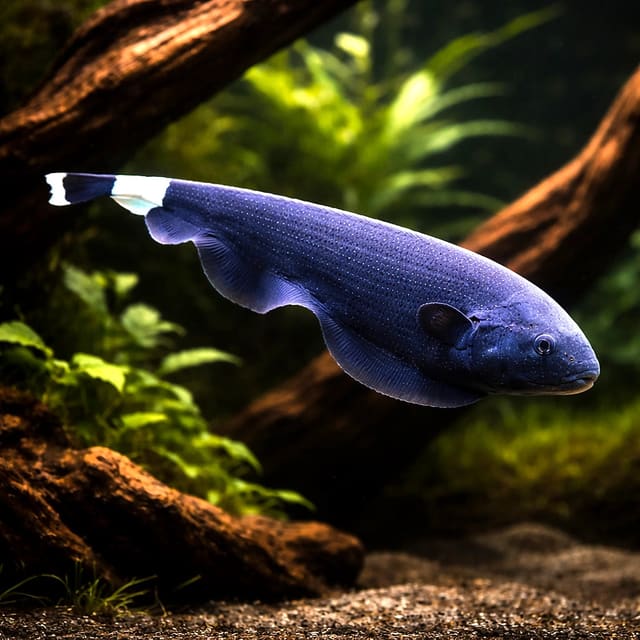
Black Ghost Knifefish (Apteronotus albifrons)
£20.39£23.99
Photo coming soon
The size, price and care details on this page are for this listing.
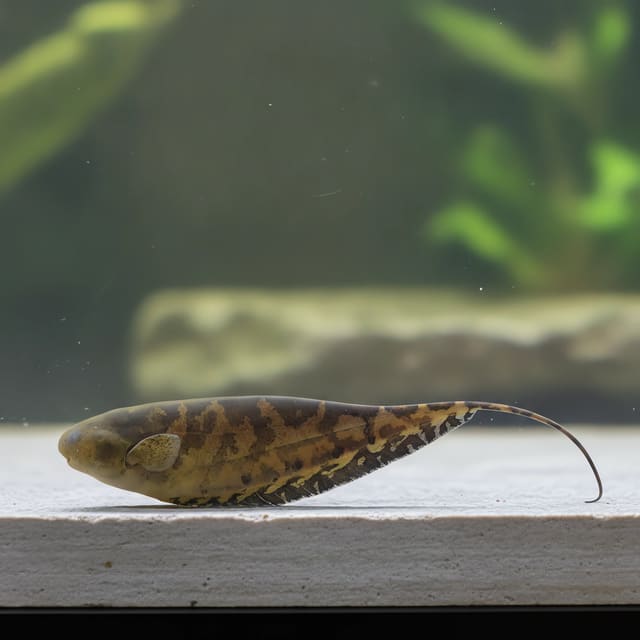
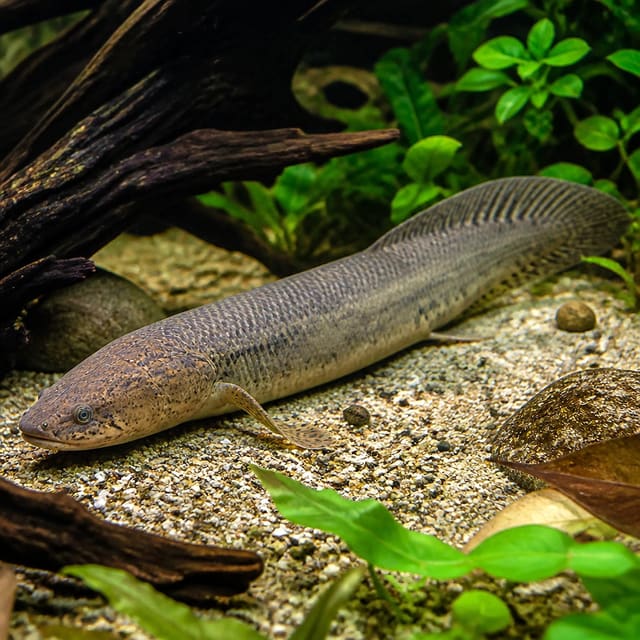
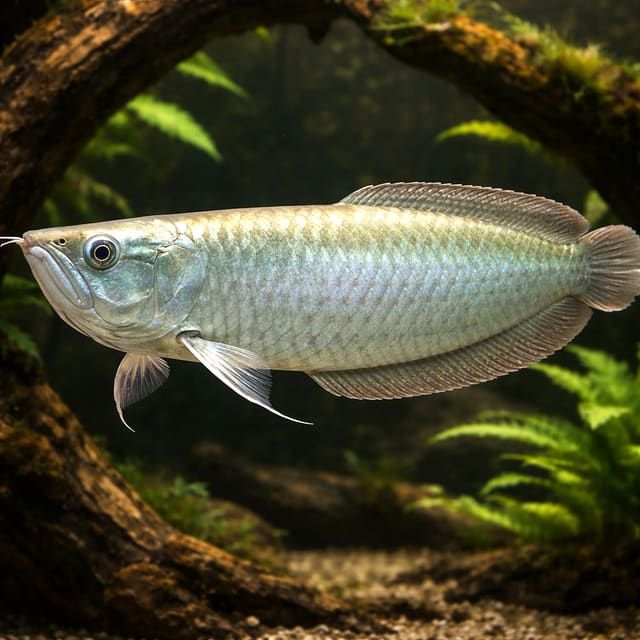
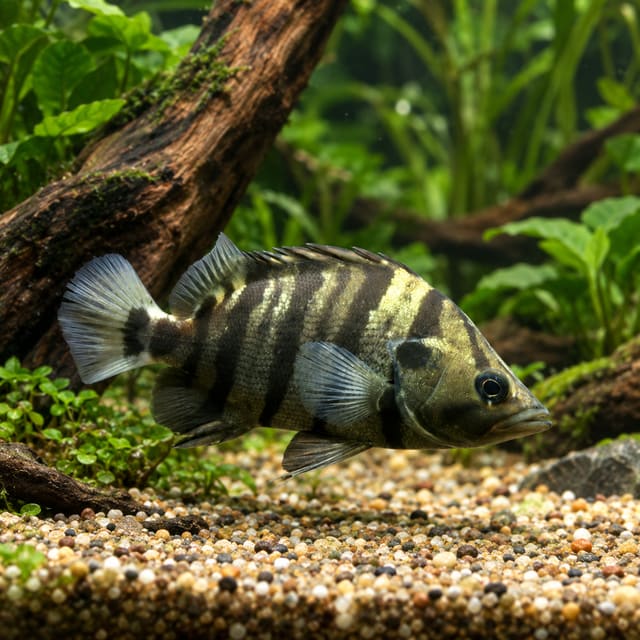
The Arowana Knifefish (Papyrocranus afer) is a freshwater featherback from West African river basins that reaches 80 cm. It suits advanced keepers planning solitary housing and a 210 × 90 cm base; the FishBase and Seriously Fish temperature and hardness overlaps are 24–28°C and 10–15 dGH, with pH 6.5–7.5. Sold individually as one live fish.
Adult size is the maximum length this species reaches at full maturity (scientific sources). The livestock you receive will be younger and smaller. Product-photo provenance and any image-specific limitations are stated on the listing.
Papyrocranus afer
The Arowana Knifefish (Papyrocranus afer) is a freshwater featherback from West African river basins that reaches 80 cm. It suits advanced keepers planning solitary housing and a 210 × 90 cm base; the FishBase and Seriously Fish temperature and hardness overlaps are 24–28°C and 10–15 dGH, with pH 6.5–7.5. Sold individually as one live fish.
Adult size is the maximum length this species reaches at full maturity (scientific sources). The livestock you receive will be younger and smaller. Product-photo provenance and any image-specific limitations are stated on the listing.
Maintain these water conditions for optimal health and vibrant colors
The Arowana Knifefish (Papyrocranus afer) is a freshwater, demersal featherback in the family Notopteridae. It comes from West African river systems and reaches 80 cm, making it an advanced choice for an experienced keeper with room for an exceptionally large aquarium. FishBase records it from the Niger basin and most coastal river basins from Senegal and Gambia eastwards to the Cross and Sanaga basins; it is absent from the Volta basin.
Also called the Reticulate knifefish, this species has the long underside fin associated with notopterid knifefishes: its anal and caudal fins are fused into one undulating fin. It is an obligate air-breather and prefers calm, densely vegetated water in nature. Its preference for calm, densely vegetated water points towards a quiet, sheltered aquarium layout rather than an exposed, high-current display.
FishBase records a maximum of 80 cm total length and lists the species as Least Concern on the IUCN Red List. Seriously Fish also uses an 80 cm adult planning figure and recommends a 210 × 90 cm aquarium base, with a volume of about 1,701 litres for a fully grown specimen. This adult scale, combined with territorial behaviour, is the central decision to make before choosing the fish.
This is an advanced fish because its adult space, filtration and compatibility requirements leave little margin for an improvised setup. Plan to keep one specimen, provide a mature biological filter and maintain the aquarium at 24–28°C. That temperature is the overlap between FishBase and Seriously Fish; pH 6.5–7.5 and hardness of 10–15 dGH also sit within both species-level ranges.
| Suits | Not suited to |
|---|---|
| Experienced keepers planning for an 80 cm fish | A first aquarium or an unplanned future upgrade |
| A 210 × 90 cm base and about 1,701 litres when fully grown | Aquaria that cannot meet the adult footprint |
| Solitary housing with careful observation | Groups of adult knifefish |
| Dim areas, dense planting, wood and minimal water movement | Bright, exposed or strong-flow layouts |
| Carefully screened, very robust companions | Much smaller fish or ordinary mixed communities |
OATA places knifefish among very large fish often called tankbusters and warns that an off-the-shelf aquarium is unlikely to meet their long-term needs. The commitment includes weekly water testing and changes, appropriately sized food, substantial filtration and a plan for solitary housing if any companion is attacked.
If this scale is more than your aquarium can support, compare the adult size of fish in our centrepiece fish collection before choosing an alternative. Treat that collection as a way to compare alternatives, not as a compatibility list for this knifefish.
One purchase supplies one live Arowana Knifefish. The dispatch grade is 15–20 cm, which describes the fish at dispatch and not its adult limit. Plan the aquarium around the recorded 80 cm adult size from the outset, including the full base dimensions and mature filtration needed for a much larger animal.
Sex is guaranteed only when the selected option explicitly states male or female. This Arowana Knifefish listing has no sex-guaranteed option.
Do not use colour, pattern strength or body size to assign sex. Seriously Fish lists sexual dimorphism as unknown, so the practical plan is the same for every fish: prepare for one territorial adult, use the same adult footprint and screen any proposed companion by robustness rather than an assumed sex.
Expect the 15–20 cm fish to grow on towards the 80 cm adult size. The adult plan remains a 210 × 90 cm base, about 1,701 litres, calm water and solitary housing.
A smaller growing-on aquarium can be used while the young fish develops, but the permanent adult commitment must already be firm. Track growth against the available space and move the fish before it outgrows that temporary system rather than waiting until movement, filtration or maintenance becomes restricted.
Provide an aquarium with a base of at least 210 × 90 cm and a volume of about 1,701 litres for a fully grown specimen. Seriously Fish calculates that volume from an aquarium measuring 210 × 90 × 90 cm. The base dimensions matter alongside litres because they define the horizontal area in which this long-bodied fish can move and establish its space.
A nominally high-volume aquarium with a narrow base does not match the stated footprint. Compare both measurements: a tank passes the first planning check only when it reaches the 210 cm length and 90 cm width as well as providing the stated adult volume.
A proposed aquarium measuring 240 cm long but only 70 cm front to back exceeds the recommended length while missing the stated 90 cm width. Extra length does not cancel that shortfall. In the same way, a deep aquarium that reaches about 1,701 litres but has less than a 210 × 90 cm base does not match the recommended adult arrangement.
Measure the usable interior after allowing for permanent structures and equipment. If large roots divide the base into narrow channels, revise their position so the fish retains a broad route through the aquarium. This check links the stated footprint to the space the animal can actually use rather than relying only on the aquarium’s advertised exterior volume.
OATA notes that indoor heated ponds can be constructed for very large fish. Any such plan still has to maintain this species at 24–28°C, pH 6.5–7.5 and 10–15 dGH while providing minimal water movement, reliable filtration and secure access for weekly maintenance. A young fish can be grown on in a smaller aquarium first, but many very large fish grow quickly, so make sure you can provide the permanent adult system before you buy.
Create a dimly lit aquarium with areas of dense planting, pieces of driftwood and twisted roots. Seriously Fish calls that arrangement ideal and says water movement should be minimal, while FishBase records a preference for calm water with dense vegetation in nature. The aim is a large aquarium that combines open room for an 80 cm fish with sheltered areas instead of one uninterrupted, brightly exposed space.
Review the finished layout from the fish’s scale. A decoration that looks modest beside a 210 cm aquarium may still divide the usable base or create a narrow passage. Keep planting, wood and roots stable and arranged so the adult footprint remains practical.
The fused anal and caudal fin runs along the underside and produces the characteristic undulating movement of this featherback. Allowing a broad, uncluttered route through the structured layout supports that body form without abandoning the dense cover recommended for the species.
Trace a continuous route across the aquarium and identify any point where wood, roots or equipment force the fish through a confined gap. Move those obstacles before introduction. Then check where the filter returns create visible water movement and redirect them if one part of the aquarium has become a forceful current.
Use shelter as defined areas rather than filling every part of the base. A practical arrangement leaves planted and shaded zones for retreat while preserving a wide path between them. When plants grow or wood is repositioned, repeat the route check instead of assuming the original balance remains intact.
Recheck the arrangement whenever plants or roots are moved during maintenance. The decision is not between cover and swimming room: provide both by concentrating shelter into defined zones and retaining a continuous open route across the large base.
Keep the aquarium at 24–28°C, pH 6.5–7.5 and 10–15 dGH. These figures are the overlap between FishBase’s recorded environment and the aquarium range from Seriously Fish.
| Reading | Action |
|---|---|
| 24–28°C | Keep the temperature within this routine range |
| Below 24°C or above 28°C | Bring the aquarium into range before introduction |
| pH 6.5–7.5 | Maintain the aquarium within these limits |
| Outside pH 6.5–7.5 | Correct the setup before adding the fish |
| 10–15 dGH | Use this as the hardness range |
Measure the aquarium rather than relying on a water supplier’s general figures or a previous test. Our water chemistry guide explains what the main readings mean, and the water matcher helps compare your measured values with the stated range.
Do not treat the upper FishBase environmental temperature of 30°C as the routine aquarium target. The 24–28°C overlap fits both named temperature ranges and keeps the day-to-day instruction consistent. A reading of 29°C, for example, is above that routine target even though it falls within FishBase’s wider environmental range.
An aquarium at 26°C passes the temperature check, but it is not ready if its pH is 8.0 or its hardness is 8 dGH. Each value has to fall within its own stated range. A reading of 26°C, pH 7.0 and 12 dGH meets all three routine targets and can move to the nitrogen-waste check.
Repeat measurements rather than making an introduction decision from a single old result. Test the water that the fish will enter, record the result and compare each number with the table. If one value falls outside its range, adjust the system and test again before adding the fish.
Temperature, pH and hardness are only part of the water check. Ammonia and nitrite must both remain at zero mg per litre, and nitrate must not exceed 20 mg per litre above the normal tap-water level. Test before introduction and continue testing every week.
Use a well-established biological filter and keep ammonia and nitrite at zero mg per litre. OATA’s very-large-fish sheet gives broad group guidance of zero ammonia, zero nitrite and nitrate no more than 20 mg per litre above the normal tap-water level. Test at least weekly because even small amounts of ammonia and nitrite can stress these fish.
The RSPCA explains that fish release toxic ammonia and that a working biological filter houses bacteria which convert it first to nitrite and then to the safer nitrate. This is why an apparently clear aquarium is not enough: filtration performance is judged by measured waste levels, not appearance alone.
OATA notes that several large aquarium filters or even a pond filter may be needed for very large fish because they produce substantial solid waste. Match filtration capacity to the 1,701-litre adult system while arranging outlets to preserve the minimal water movement recommended for this species.
If ammonia or nitrite appears above zero, check for a blocked or disrupted filter and remove uneaten food and accessible solid waste. Test again as the system responds and continue the partial-change routine. Do not use clear water, normal appetite or ordinary swimming as substitutes for the chemical reading.
Watch nitrate in relation to the normal tap-water level. The OATA limit is no more than 20 mg per litre above that baseline, so record both values when making the comparison. Keeping a dated weekly log makes a rising pattern visible before it becomes the aquarium’s normal condition.
If a test shows ammonia or nitrite above zero, treat that result as a water-quality problem requiring action rather than waiting for visible symptoms. Check the filter, feeding amount and recent stocking changes, restore zero readings and keep testing as the biological filter responds.
Feed a varied selection of appropriately sized meaty foods once a day, offering only what the fish can consume within a few minutes. Seriously Fish recommends foods including lancefish, prawns, chopped mussel and earthworms; some specimens will also accept carnivore pellets. The once-a-day, few-minutes limit is OATA guidance for very large fish.
| Food | How to use it |
|---|---|
| Lancefish | Include as one of the meaty foods in rotation |
| Prawns | Offer in pieces suited to the fish’s current size |
| Chopped mussel | Use as another frozen or prepared meaty choice |
| Earthworms | Add variety to the carnivorous menu |
| Carnivore pellets | Use only when the individual accepts them |
Some fish accepting pellets does not make pellet feeding certain for every specimen. Begin with the named meaty foods and observe which items are taken. Keep the overall menu varied rather than allowing one accepted item to become the entire diet.
Control each portion by time. If food remains after a few minutes, reduce the amount at the next feeding. OATA warns that overfeeding lets uneaten food build up and break down, releasing toxic waste into the water.
Use the few-minute limit as the end point for each meal. If pieces remain after that period, remove what you can and offer less at the next daily feeding. If everything is consumed, keep observing the fish’s body condition and the weekly water results rather than automatically increasing the amount.
Introduce one accepted food into a rotation with the other named meaty choices. A fish that takes prawns readily but ignores pellets can still receive variety through lancefish, chopped mussel and earthworms. Pellet acceptance is an individual response, not a requirement for a complete feeding plan.
Choose pieces the fish can consume rather than scattering food intended for small community fish. The feeding decision should match the animal’s carnivorous diet and current mouth size while staying within the few-minute limit. Continue weekly water testing so feeding remains aligned with the filter’s ability to process waste.
Finish and mature the aquarium before the fish arrives. The biological filter must already be processing waste, the 210 × 90 cm adult footprint must be planned, and temperature, pH and hardness must be inside the stated ranges. Our first tropical aquarium guide covers preparing and maturing a filtered system before livestock is introduced.
OATA advises increasing aquarium populations slowly because beneficial bacteria need to respond whenever fish numbers and feeding increase. Avoid combining this introduction with several other new fish. The biological load from a large carnivorous species deserves its own observation period.
Proceed only when every checklist item passes on the same prepared system. For example, correct temperature and pH do not offset measurable ammonia, and a mature filter does not replace a firm plan for the 210 × 90 cm adult system. A failed item means wait, correct that part of the setup and repeat the check.
Set aside the foods, test equipment and water conditioner needed for the first week before the parcel is received. This lets daily feeding, weekly testing and the first partial water change start on schedule.
A zero ammonia reading does not replace the other checks. A system at the wrong temperature or outside pH or hardness limits still needs adjustment, and the permanent 210 × 90 cm adult system must be in place before the fish outgrows a smaller growing-on aquarium. Work through the checklist as separate decisions and complete every item before introducing the fish.
Be at the delivery address to receive the parcel because live fish cannot be left unattended. Follow the Tropical Fish Co delivery and Live Arrival Guarantee policy in this order:
For a Live Arrival Guarantee claim, contact us on the day the fish arrives with the order number and continuous unboxing video.
Use the first week to establish the individual’s normal swimming, colour, breathing, hiding and feeding patterns. OATA advises watching for hanging at the surface, sitting on the bottom, erratic swimming, a darker or paler colour, faster or slower gill movement, unusual hiding, a change in aggression or loss of interest in food.
Inspect the eyes, fins, scales and body condition. Clear bright eyes, undamaged fins, intact scales and the absence of ulcerations, bumps, white spots or fluffy growths are the healthy reference points named by OATA. If behaviour, breathing, appearance or appetite changes, test the water first, including ammonia and nitrite.
Keep the routine consistent from the first day: feed once daily within the few-minute limit, test water at least weekly and carry out a 25% partial water change at least once every week. Record the fish’s response to foods and any behaviour around companions. A change in aggression is a compatibility warning, while reduced appetite can also direct attention back to water quality.
Keep one Arowana Knifefish as the default adult arrangement. Seriously Fish describes the species as aggressive and recommends a single specimen in its own aquarium. Young fish can be kept in a group, but territorial behaviour increases as they mature, particularly towards other knifefish and also towards fish an individual takes a dislike to.
Do not use peaceful behaviour in a younger group as the basis for the permanent adult plan. The adult arrangement has to account for increasing territoriality and the possibility that an individual will attack a fish it previously tolerated.
Solitary housing is not a lesser outcome for this fish; it is the arrangement specifically recommended around its adult behaviour. It also simplifies feeding, removes competition for sheltered areas and prevents a compatibility experiment from defining the welfare of another animal.
A young fish sharing space without conflict has not settled the adult compatibility decision. Review the arrangement as it grows and treat increased chasing, aggression or hiding as a reason to separate fish. The backup plan must be a complete filtered system, not a temporary container that cannot maintain the same water conditions.
Separate the question of space from the question of temperament. Meeting the 210 × 90 cm base recommendation provides the adult footprint for this specimen, but it does not make another knifefish, a much smaller fish or an uncertain large companion safe.
If the aquarium is being designed as a display around one large fish, make that decision before adding other livestock. The 210 × 90 cm footprint gives this specimen its adult space; it does not make a shared aquarium peaceful.
Only consider a companion that is very robust, not much smaller and not another knifefish. Seriously Fish suggests that a large loricariid such as Acanthicus adonis may be considered, but the primary recommendation remains one Arowana Knifefish in its own aquarium.
| Proposed companion | Decision |
|---|---|
| Much smaller fish | Avoid |
| Another knifefish | Avoid because adult territoriality is strongest towards knifefish |
| Arowana species | Do not assume compatibility; both coexistence and attacks are reported |
| Large loricariid such as Acanthicus adonis | May be considered, with solitary housing ready |
| Another large fish | Consider only if it is very robust; individual reactions remain uncertain |
Observe temperament rather than assuming that aquarium volume makes two fish compatible. OATA identifies a change in aggression or hiding as a warning sign, and Seriously Fish reports that this species may attack large fish as well as other knifefish.
Prepare the separate filtered system before placing an uncertain companion with this fish. If chasing, attacks, increased hiding or a change in aggression appears, separate the animals. Do not reinterpret repeated conflict as an adjustment period when solitary housing is the primary recommendation.
A large loricariid such as Acanthicus adonis is a qualified example, not a universal match. It still has to be very robust and not much smaller, and the knifefish’s individual reaction remains decisive. Arowana species remain uncertain because both coexistence and attacks are reported.
If chasing or attacks begin, return to solitary housing. Do not wait for repeated conflict to establish a pattern when the recommended arrangement is already a single specimen. The backup aquarium or separation plan must be capable of meeting the same temperature, water-quality and filtration requirements.
No universal community list fits this territorial species. The practical rule is narrow: solitary housing first; avoid much smaller fish and other knifefish; treat arowana species as uncertain; and regard a large loricariid such as Acanthicus adonis only as a qualified possibility.
It reaches 80 cm. FishBase records 80 cm total length, so plan the aquarium around that adult figure rather than the dispatch measurement.
A fully grown specimen needs a base of at least 210 × 90 cm and about 1,701 litres, according to Seriously Fish.
Keep one. Seriously Fish recommends a single specimen because territorial behaviour increases with maturity, particularly towards other knifefish.
This is an advanced fish for experienced keepers because it reaches 80 cm, needs an exceptionally large aquarium and is aggressive.
Feed appropriately sized lancefish, prawns, chopped mussel, earthworms and accepted carnivore pellets once daily, limited to what it eats within a few minutes.
Keep it at 24–28°C, pH 6.5–7.5 and 10–15 dGH; these ranges are the overlap between FishBase and Seriously Fish.
It is aggressive and becomes increasingly territorial as it matures. Treat attacks as the decisive risk and keep it singly rather than relying on it as a community fish.
Solitary housing is safest; consider only very robust fish, such as a large loricariid like Acanthicus adonis, and avoid much smaller fish and other knifefish.
Tropical Fish Co’s policy says live fish are hand-bagged in pure oxygen, placed in an insulated box with a heat pack when weather calls for it, and carried by a licensed live-animal courier. Someone must receive the parcel; film it continuously from the sealed box through opening, showing the fish still in its sealed bag, then float the bag for 20–30 minutes before releasing the fish.
No reviews for this item yet. Bought one? Honest reviews only, good or bad.
What customers say about ordering from us
Easy website plenty of info on fish your buying great to pick a time slot
TRACEY DURRANT · 7 Oct 2026
Got some lovely fish thank you
Kevin Mackie · 7 Oct 2026
Reviews of our shop, collected by Judge.me, an independent third-party review collector. Newest first.