Advanced
Datnioides polota
£47.99
One live barred tigerfish, Datnioides polota: an estuary predator that reaches 30 cm SL. It wants a tank at least 180 x 60 cm, hard alkaline water with some marine salt, meaty foods two or three times a week as an adult, and companions too big to swallow. Not a community fish.
Adult size is the maximum length this species reaches at full maturity (scientific sources). The livestock you receive will be younger and smaller. Product-photo provenance and any image-specific limitations are stated on the listing.
Datnioides polota
One live barred tigerfish, Datnioides polota: an estuary predator that reaches 30 cm SL. It wants a tank at least 180 x 60 cm, hard alkaline water with some marine salt, meaty foods two or three times a week as an adult, and companions too big to swallow. Not a community fish.
Adult size is the maximum length this species reaches at full maturity (scientific sources). The livestock you receive will be younger and smaller. Product-photo provenance and any image-specific limitations are stated on the listing.
Maintain these water conditions for optimal health and vibrant colors
The barred tigerfish, Datnioides polota, is a heavily barred predator from the estuaries, mangrove creeks and lower rivers of southern Asia. It belongs to the family Lobotidae, the small group made up of the tripletails and the tiger perches. In shops and on forums you will hear it called the silver tigerfish, silver tiger perch, silver datnoid, four-barred tigerfish or four-banded tripletail, and FishBase lists it as the four-barred tigerperch. All of those names point at one animal. When you are comparing listings, trust the scientific name over any of the nicknames.
This listing is for one live barred tigerfish. There are no size or quantity options on it, so what arrives is a single fish at our dispatch size. That dispatch size is not the adult size. FishBase gives a maximum of 30 cm standard length, which is measured from the snout to the base of the tail, so a fish of that length looks bigger again once you add the tail fin. The same source gives a common length of 18 cm. Every decision about the tank, the filter and the company it keeps should be made around that grown fish, not the one in the bag.
I will be straight about who this fish suits. It is not a community fish and it is not a beginner's fish. It eats other fish, it does best with some marine salt in its water, it needs a tank with a base of at least 180 by 60 cm, and newly imported fish have a reputation for sulking and refusing food. Seriously Fish describes it as an efficient predator with highly protrusible mouthparts, meaning the jaws shoot forward to engulf prey. For a keeper with the room and the patience, it is one of the most striking predators you can house at home, and a single well-settled adult in a large, quiet tank makes a real centrepiece.
You may see the same species traded as Datnioides quadrifasciatus. Seriously Fish explains that quadrifasciatus is a junior primary homonym, so the name polota takes precedence, and FishBase uses Datnioides polota (Hamilton, 1822) as the accepted name. We also have a separate Datnioides polota listing whose web address still carries the older quadrifasciatus spelling, so look at both if you are weighing up what is available. Despite the shared nickname, this fish has nothing to do with the African tigerfish (Hydrocynus vittatus). FishBase places that one in Alestidae, the African tetra family, and it lives in the rivers and lakes of Africa. The two are unrelated and need completely different set-ups.
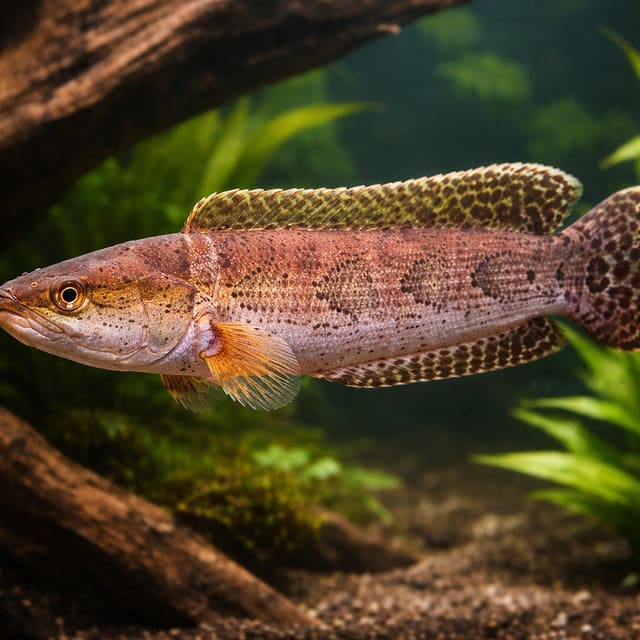
The first thing to look at is the head profile. FishBase describes the predorsal profile as strongly concave: the line running from the snout back to the start of the dorsal fin dips inwards before it climbs to the back. It is the first feature FishBase gives in its short description of the species, and once you have seen it, it is a useful shape to remember.
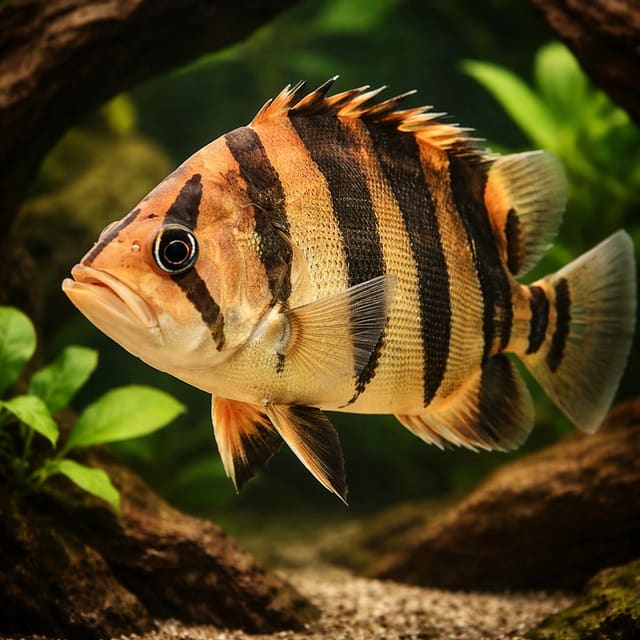
Next come the bars. Wikipedia describes up to seven broad, dark vertical bars, sometimes with thinner, incomplete bars between them, and notes that the colouring varies considerably from fish to fish. FishBase puts it the same way: up to seven full bars, sometimes with one to four partial bars between them. Seriously Fish calls the pattern highly variable. In practice that means two healthy barred tigerfish side by side can look noticeably different, and a fish with a broken or extra half-bar is within the normal range for the species.
The fins have a spiny front and a soft rear. FishBase and Wikipedia both give the dorsal fin as 12 spines followed by 13 or 14 soft rays, and the anal fin as 3 spines followed by 8 or 9 soft rays. Those spines are worth knowing about when you net the fish: lift it in a soft, generous net and let it swim out rather than shaking it free, so the spines do not tangle in the mesh.
The genus holds several barred species, and imported fish are not always labelled carefully. Seriously Fish gives the clearest comparison we have found. The most useful single feature is the scales: D. polota has large scales, about 40 to 60 along the lateral series, while D. microlepis, D. pulcher and D. undecimradiatus have small scales, about 70 to 100. You cannot count scales on a live fish in a bag, but once a fish is settled you may be able to judge whether the scales look coarse or fine. Seriously Fish also lists 20 to 23 gill rakers in D. polota against 15 to 17 in D. campbelli, and 9 branched anal-fin rays, which are features for a specimen in the hand rather than a fish in a tank.
| Species | Bar pattern (Seriously Fish) | Scales along the lateral series |
|---|---|---|
| Datnioides polota | Up to 7 dark bars, often with 1 to 4 smaller bars between them; highly variable | About 40 to 60 (large scales) |
| Datnioides microlepis | 6 to 7 wide bars | About 70 to 100 |
| Datnioides pulcher | 4 to 5 wide bars | About 70 to 100 |
| Datnioides undecimradiatus | 4 thin bars | About 70 to 100 |
| Datnioides campbelli | 4 to 6 wide bars with diffuse edges | Separated from polota by gill rakers (15 to 17 against 20 to 23) |
One more point that catches people out. Seriously Fish notes that freshly imported fish often show darkened colouring with indistinct bars. A new arrival that looks dull and smudged is usually a stressed fish rather than the wrong fish, and the pattern normally sharpens as it settles, eats and learns its surroundings.
FishBase sums up the habitat in one line: this fish lives in brackish water at the mouths of large rivers and in coastal lagoons, and also in freshwater lakes and rivers above the reach of the tide. It is classed as benthopelagic, which means it lives and feeds near the bottom as well as in open midwater rather than hugging either the surface or the substrate. The species is tropical, recorded between roughly 22 degrees north and 10 degrees south.
Seriously Fish leans further towards the salty end of that picture. Its account says the fish mostly inhabits brackish places such as estuaries, mangroves, coastal lagoons, irrigation canals and the lower reaches of rivers, and is only occasionally recorded in fresh water above the tidal limit. That difference in emphasis matters for the aquarium, and it is why we recommend some marine salt in the water rather than a plain freshwater set-up. More on that in the water section below.
FishBase gives the distribution as India to Indonesia and New Guinea. Wikipedia describes much the same spread, from eastern India and Bangladesh east through Indochina and Indonesia to New Guinea. Seriously Fish lists confirmed records from India, Bangladesh, Myanmar, Thailand, Vietnam, Malaysia, Singapore and Indonesia, and does not name New Guinea in its list. Our care sheet keeps the broader "southern Asia and New Guinea" wording that FishBase and Wikipedia support, but if you are reading up on where your fish came from, that small disagreement between sources is worth knowing about.
Across that range the barred tigerfish is mainly a food fish. FishBase lists its importance as commercial fisheries and notes that it is marketed fresh, while Wikipedia says it is caught for food and only occasionally appears in the aquarium trade. So in the hobby it is an occasional fish rather than a regular one.
The species is listed as Least Concern by the IUCN, with FishBase recording an assessment from August 2019. FishBase also rates its resilience as high, with a minimum population doubling time of less than 15 months, and its vulnerability to fishing as low to moderate. None of that changes how you keep one, but it is reassuring background for anyone who wants to know that buying this fish is not putting pressure on a threatened animal.
What the habitat does tell you is the kind of place the fish is built for. Tidal river mouths, lagoons and mangroves are places where the water shifts between fresher and saltier with the tide and the rains, where tangled roots and fallen branches give cover, and where the fish finds the small fish, prawns and crabs it feeds on. Recreate the cover, the hard and slightly salty water and the meaty diet, and you are giving the fish what its body expects.
The two main references give slightly different temperature ranges, and both are useful. FishBase gives 22 to 26 °C for the species. Seriously Fish, writing as an aquarium care guide, gives a wider 20 to 28 °C. Our care sheet uses the FishBase 22 to 26 °C as the target band, and the wider Seriously Fish figures suggest that a short drift a degree or two outside it, during a warm spell for example, is not a crisis. Pick a temperature in the middle of the target band and hold it there.
| Parameter | Target | Source |
|---|---|---|
| Temperature | 22 to 26 °C (aquarium tolerance 20 to 28 °C) | FishBase; Seriously Fish |
| pH | 7.5 to 9.0 | Seriously Fish |
| General hardness | 15 to 30 °dGH | Seriously Fish |
| Salt | Marine salt to at least 10 to 20% of seawater strength | Seriously Fish |
Seriously Fish describes adding marine salt to at least 10 to 20% of seawater strength as highly recommended for this species. Average ocean water has a salinity of about 3.5%, or 35 grams of salt per litre (35 parts per thousand), according to Wikipedia's seawater article. Ten to twenty per cent of that works out at roughly 3.5 to 7 parts per thousand, or about 3.5 to 7 grams of dissolved marine salt in every litre. A refractometer that reads in parts per thousand is the easiest way to check it, and it removes the guesswork that comes with cheap floating hydrometers at these low levels.
Use a proper marine salt mix, the same kind reef keepers buy, because it carries the minerals and buffering that suit hard, alkaline water. Dissolve it in the new water in a bucket or mixing vessel first and let it clear before it goes in. Do not tip dry salt into a tank with fish in it.
Salt does not evaporate. When the water level drops between water changes, it is pure water that has gone, so top up with fresh, dechlorinated water only, or the salinity will creep up week by week. When you do a water change, premix the replacement water to the same salinity as the tank. Steady water is what you are after: the fish copes with a range of salt levels in the wild, but in a closed tank you want sudden swings to come from neither direction.
If you are converting an existing freshwater tank, raise the salt level gradually over several water changes rather than in one go, and remember that many plants, snails and freshwater companions will not follow the fish into brackish water. FishBase does record the species in freshwater lakes and rivers above tidal influence, so a fish kept in hard, alkaline fresh water is not living in the wrong element. Seriously Fish's advice to add salt is about doing the job well rather than surviving, and that is the standard we would rather you aim for.
Soft, acidic tap water is the wrong starting point for this fish. Seriously Fish gives pH 7.5 to 9.0 and 15 to 30 °dGH. Many parts of the UK have hard, alkaline tap water that is already close to that, but check yours with a test kit before buying, and if you are on soft water you will need a buffered marine salt and possibly a hardness-raising product to get there. Test pH, ammonia, nitrite and nitrate weekly once the fish is in. A large carnivore produces a lot of waste, and ammonia becomes more toxic as pH rises, so in alkaline water you have even less margin for a filter that is struggling.
Seriously Fish gives a minimum base of 180 by 60 cm for this species. A tank of 180 by 60 by 60 cm holds about 648 litres before you take out the space used by decor and substrate. That is the starting point for one adult, not a target to grow towards. If you buy a small fish today and plan to move it later, have the big tank budgeted and planned rather than hoped for, because a fish heading for 30 cm SL will not stay comfortable in a 120 cm tank.
Seriously Fish gives two ways to keep the species: singly, or as a group of five or more. A group needs a far larger aquarium than a single fish. If you are thinking of a group, plan the system around five full-grown fish and the bioload they produce, and talk to us before you order.
Seriously Fish calls high-capacity external filtration essential because the species produces a lot of waste. In practice that means large canister filters, or a sump on a tank this size, with plenty of biological media and good mechanical pre-filtration you can clean without disturbing the bacteria. Big meaty meals break down quickly, so a filter that copes with a community of small fish may not cope with a single tigerfish eating whole prawns. Pair the filter with regular, generous water changes made up to the same salinity, temperature and hardness as the tank.
For juveniles, Seriously Fish recommends a well-decorated aquarium with driftwood branches or mangrove roots. That echoes the mangrove and estuary habitat described above. Build branching wood into the layout so the fish can sit inside a tangle and look out, and leave a clear stretch of open water along the front where it can patrol.
Adults need less decoration, according to Seriously Fish, but appreciate some surface cover in the form of floating or overhanging vegetation or branches. A few long branches reaching across the top of the tank, or a raft of floating cover at one end, breaks up the light and gives the fish a shaded area to hang beneath. Keep the rest open: a 30 cm fish needs room to turn without scraping decor.
Seriously Fish notes that adults have been known to damage submerged equipment and recommends heater guards. Fit a guard to every heater from the start, or use an inline heater on the filter pipework so nothing hot sits in the tank. Secure any internal pipework and keep cables tidy. A big predator that lunges at food will knock loose anything that is not fixed.
Finally, think about where the tank sits. A quiet room away from constant foot traffic and slamming doors gives a nervous new import the best chance to settle, and it means you will see more natural behaviour once the fish is established.
In the wild, FishBase records the barred tigerfish feeding on fishes, prawns, crabs and some insect larvae. Seriously Fish describes it as an efficient predator that feeds chiefly on smaller fishes and crustaceans. In the aquarium the aim is to cover that diet with clean, meaty foods without relying on live fish.
| Stage | Foods Seriously Fish lists | How often |
|---|---|---|
| Juveniles | Chironomid larvae (bloodworm), small earthworms, chopped prawn | Little and often while the fish is small and growing |
| Adults | Strips of fish flesh, whole prawns, mussels, live river shrimp, earthworms | Two or three times a week is sufficient for older fish |
The two-to-three-times-a-week schedule is given for older fish. A small fish has a lot of growing to do and a small stomach, so we would feed it smaller portions more often, then stretch the gaps as it gains size. Whatever the age, feed what it will take in a few minutes and lift out anything left over, because uneaten prawn and mussel foul the water quickly.
Seriously Fish is clear on both. First, do not use mammalian or bird meat such as beef heart or chicken. Seriously Fish explains that the fish cannot metabolise the fats in these meats properly. Second, do not use feeder fish. They carry a real risk of bringing disease and parasites into the tank, and they add nothing that good seafood and invertebrates cannot provide.
Seriously Fish warns that newly imported fish often refuse food. This is common and not a reason to panic. Keep the lights low, keep people away from the glass, and offer a small amount of something it is likely to recognise, such as bloodworm, a small earthworm or a piece of prawn, then remove it if it is ignored. Earthworms and live river shrimp are both on Seriously Fish's list, and moving food is often more tempting to a hesitant predator than a piece lying still on the bottom. Once the fish is eating confidently, start mixing in strips of fish and mussel so it learns to take a varied menu.
Use a long pair of feeding tongs for larger pieces. It keeps your fingers away from the strike and lets you place food where the fish is sitting, which helps with a shy individual that will not come out to the front yet.
Buy seafood intended for people or frozen fish foods made for aquariums, rinse it, and cut it to a size the fish can swallow. Rotate between prawn, mussel and white fish rather than feeding one item for months. A varied diet of whole invertebrates and fish flesh is the closest you can get to what the species eats in the estuaries.
The barred tigerfish is a predator, and anything small enough to fit in its mouth should be counted as food rather than company. Its wild diet includes fishes, prawns and crabs, so that applies to small fish, shrimp and crabs alike. Size your tank mates against the adult tigerfish, not the one you buy.
Seriously Fish notes that juveniles may form groups but adults are not gregarious, and tend to respond aggressively to their own species and to similarly shaped fishes. Its advice is to keep the species singly or in a group of five or more. The reasoning behind a larger group is the usual one with fish like this: aggression is spread across several individuals instead of one fish taking all of it. Two, three or four adults in an ordinary home tank is exactly the arrangement that advice steers you away from. For most keepers, one fish is the sensible choice.
The same caution applies to other Datnioides and to other deep, vertically barred fish that look like a rival. Seriously Fish does not draw a list, so treat any similarly shaped species as a risk and leave it out.
It is easy to assume a big predator can look after itself, but Seriously Fish says this fish might be intimidated by territorial or otherwise competitive species. A tigerfish pushed away from the food by a pushy, territorial companion is likely to hide and go short of food. Leave out fish that claim and defend territory, and fish that rush the food at every meal.
Seriously Fish says the species can live with similarly sized, non-territorial fish, provided there is enough space. For a tank mate to work in practice, it needs to tick every box:
The salt requirement narrows the list a lot. Many popular large freshwater fish will not follow the tigerfish into brackish water, so check each candidate's own needs before you add it. If you are not sure whether a fish fits, ask us before you buy it.
Expect a fish that makes full use of the cover you give it and takes food with those protrusible jaws. Seriously Fish's notes on stressed imports, which go dark and hold back from food, are a reminder that this is not a fish for a busy, crowded tank. Space, a steady routine and calm companions give it the best chance of settling.
The commonest problems with barred tigerfish come from the first weeks after import and from water quality under a heavy feeder. Seriously Fish describes the import stage frankly: the fish often refuse food and show darkened colouring with indistinct bars. That is stress, and the fix is patience, steady water and quiet surroundings.
If you can, keep a new tigerfish in a separate quarantine tank for its first weeks, set up with the same water as its future home. It lets you watch it closely, feed it without competition, and treat it in isolation if something does show up. Watch its breathing, appetite and behaviour daily. A fish that is breathing hard, clamping its fins, scraping against decor or showing spots or patches on the skin needs a water test first and then advice. Contact us for advice if you are unsure what you are seeing.
Seriously Fish's warning about the waste these fish produce is the most important health point on the page. A big meaty meal can push ammonia up quickly in a tank whose filter is undersized, and in hard, alkaline water ammonia is more harmful than it is in soft, acidic water. Test regularly, change water generously, keep the filter well maintained and remove uneaten food.
Two of the clearest health warnings for this species are about food. Feeder fish carry a real risk of disease and parasites, and mammalian or bird meat such as beef heart and chicken contains fats the fish does not metabolise properly. Both are avoidable. Clean seafood, earthworms and prepared frozen foods give everything it needs.
Adults can damage submerged equipment, according to Seriously Fish, which is why heater guards matter. An unguarded heater is a burn waiting to happen for a fish that crashes around after food. Check sharp edges on decor too, and keep the tank somewhere it will not be startled by sudden movement, because a frightened fish of this size can hurt itself against the glass or hardware.
If you keep the fish in brackish water, the salt level is part of its health routine. Check it every week with the refractometer, top up evaporation with fresh water only, and premix water changes to the tank's salinity. Sudden swings in salt, temperature or pH are more harmful than any one stable value within the recommended range.
A settled barred tigerfish feeds eagerly when food appears, holds its fins open, breathes steadily, and spends time out in the open water rather than pressed into a corner. Its bars sharpen compared with the smudged look of a fresh import. If you see those signs within the first few weeks, the hardest part is behind you.
There is very little to go on here, and we would rather say so than fill the gap with guesswork. Seriously Fish reports that both sexual dimorphism and reproduction in this species remain unreported in the literature. In other words, there is no published way to tell males from females by looking at them, and no documented method for breeding it in an aquarium.
What we do know comes from studies of wild fish. Wikipedia, summarising the research, says the species appears to breed all year round and to spawn in small batches each time, which makes it a partial spawner rather than a fish that releases all its eggs in one short season. FishBase's preliminary estimate of a minimum population doubling time of less than 15 months fits a species that reproduces steadily in the wild.
For a home keeper, that means this listing should be bought as a fish to keep, not a fish to breed. We cannot sex it, nobody can reliably sex it from outside appearance on the evidence available, and putting adults together in the hope of a pair runs straight into the aggression Seriously Fish describes between adults of the same species. If you ever see signs of breeding behaviour in a group you keep, record it carefully: you would be adding something genuinely new to what is known about the species.
Please read our delivery and live-arrival information before you order. The aquarium must be ready before the parcel arrives: filter running and matured, water tested, and temperature matched to the target range. Someone needs to be at the delivery address to receive live animals, because the fish cannot be left on a doorstep. We send the confirmed delivery date and tracking by email.
Your fish travels in an oxygen-filled bag inside insulated packaging, with heat packs when conditions call for them, by a tracked courier licensed to carry live animals.
Start a continuous video on your phone while the parcel is still sealed, and keep recording as you open it in the same take, showing the fish in its still-sealed bag. If the fish has arrived dead, dying or clearly compromised, email hello@tropicalfishco.co.uk on the day of delivery with your order number and that video. Photos on their own do not meet our live-arrival policy. The resolution is a replacement with your next order or a refund for the affected fish, subject to the guarantee terms.
Floating matches temperature only. It does not match pH, hardness or salt. That point matters more with this fish than with most, because if your tank is already brackish, the difference between the bag water and your aquarium could be considerable. If your water differs a lot from ordinary hard tap water, contact us for advice before the fish goes in.
Expect a quiet, dark fish at first. Seriously Fish notes that new imports often refuse food and show darkened colouring with indistinct bars. Offer a small amount of food after a day or two, remove it if it is ignored, and try again the next day. Do not keep adding food to a fish that is not eating, because it will only foul the water. Watch breathing, appetite and behaviour over that first week, test the water daily while the filter adjusts to the new bioload, and keep visitors away from the glass.
Be patient through this stage. Once the fish is eating regularly and its bars have sharpened, the hardest part is behind you. From there, the routine in the sections above, steady water, generous filtration and two or three meaty meals a week for an adult, is what keeps it healthy for the long term.
These are the sources we used for this guide. Each one is worth reading in full if you are planning a brackish predator tank.
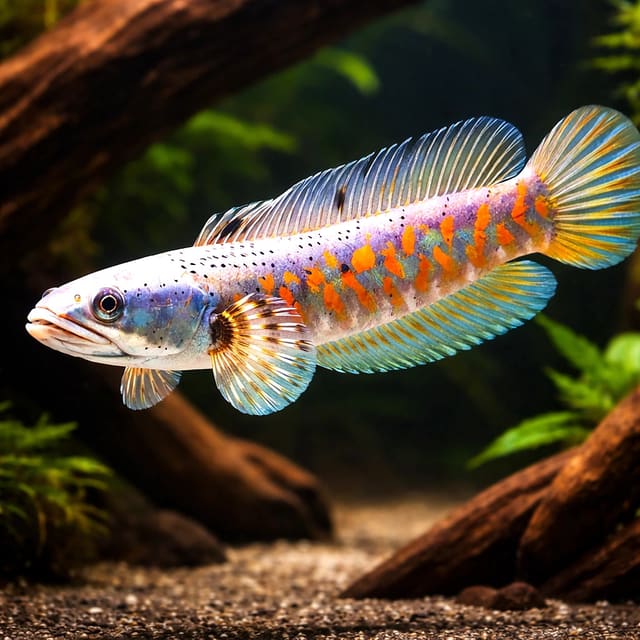
Photo adapted (new background, slight change of angle) from a photo by BEDO (Thailand), CC BY-SA 4.0, via Wikimedia Commons; the adapted photo is shared under the same licence.
No reviews for this item yet. Bought one? Honest reviews only, good or bad.
What customers say about ordering from us
Easy website plenty of info on fish your buying great to pick a time slot
TRACEY DURRANT · 7 Oct 2026
Got some lovely fish thank you
Kevin Mackie · 7 Oct 2026
Reviews of our shop, collected by Judge.me, an independent third-party review collector. Newest first.