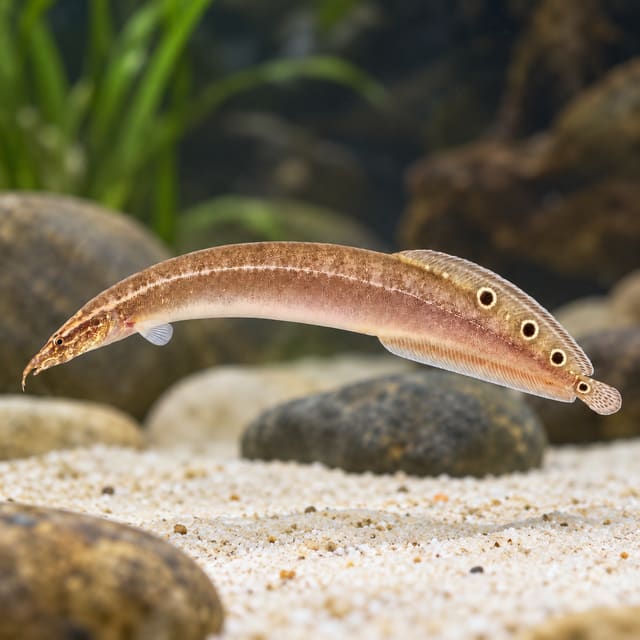
Frecklefin eel (Macrognathus aculeatus)
23–27°C · pH 6.5–7.5
£20.99

A shy South Asian barred spiny eel for mature aquariums with soft sand, secure cover and tankmates too large to swallow.
Adult size is the maximum length this species reaches at full maturity (scientific sources). The livestock you receive will be younger and smaller — pick a size above for the actual shipping size. Product-photo provenance and any image-specific limitations are stated on the listing.
Macrognathus pancalus
Confirm your email, then we’ll send an availability message for this exact item if it returns within 180 days.
This request is only for this product—no newsletter or other promotions. A mail-provider retry may very rarely duplicate the same availability message. Unconfirmed addresses are removed after 48 hours. See our privacy policy.
A shy South Asian barred spiny eel for mature aquariums with soft sand, secure cover and tankmates too large to swallow.
Adult size is the maximum length this species reaches at full maturity (scientific sources). The livestock you receive will be younger and smaller — pick a size above for the actual shipping size. Product-photo provenance and any image-specific limitations are stated on the listing.
Maintain these water conditions for optimal health and vibrant colors
Barred Spiny Eel is best listed as Macrognathus pancalus, a smaller South Asian spiny eel with a secretive, bottom-foraging style. our stock records and older aquarium labels may still use Mastacembelus pancalus, so that name is kept here as a useful trade synonym, but the live product should be anchored to Barred Spiny Eel / Macrognathus pancalus for clearer search and customer understanding.
This is not a tiny 7 cm novelty fish. FishBase records the species at about 18.9 cm total length, and practical UK care pages also plan around an 18 cm adult. It can still be one of the more manageable spiny eels, but it needs a mature aquarium with soft sand, secure cover and tankmates chosen around its nocturnal predator instincts.
| Best for | Experienced keepers wanting a shy, burrowing oddball fish |
|---|---|
| Adult planning size | About 18-19 cm, despite young stock often arriving at 7-8 cm |
| Key setup need | Soft sand, shaded hides, secure lid and gentle open feeding areas |
| Main risk | Small fish and shrimp can be eaten after dark |
Macrognathus pancalus sits in the spiny eel family Mastacembelidae. The older name Mastacembelus pancalus still appears in our stock records and hobby searches, so the listing should mention it naturally without making the old name the headline. Other retail pages may also call it Yellow-fin Spiny Eel or Yellow-tail Spiny Eel.
| Current listing name | Barred Spiny Eel |
|---|---|
| Scientific anchor | Macrognathus pancalus |
| Trade synonym | Mastacembelus pancalus |
| Family | Mastacembelidae, the spiny eels |
FishBase records this species from Pakistan, India and Bangladesh, with reports from Nepal. It is associated with slow, shallow waters, canals, streams, beels, ponds, inundated fields and lowland river habitats. That habitat profile explains why the aquarium should feel sheltered rather than bright and bare.
Build the tank around low stress: a fine sand bed for burrowing, smooth wood or stone caves, plant thickets, leaf litter if it suits the system, and dimmer areas where the eel can rest with only the head showing. Keep decor stable so nothing can collapse if the fish burrows underneath.
Use a mature aquarium of at least 120 litres for the smaller size, with more floor area preferred as it grows. The lid must be tight because spiny eels can push through surprisingly small gaps, especially during settling-in. Filter intakes and overflow gaps should be guarded so a slender fish cannot wedge itself into them.
| Substrate | Soft sand; avoid sharp gravel that can graze the belly and skin |
|---|---|
| Cover | Smooth caves, pipes, roots, plants and shaded resting spots |
| Flow | Clean and well filtered, but not a harsh current across the bottom |
| Lid | Escape-proof, including cable holes and filter gaps |
A stable tropical range is more important than chasing extremes. A practical aquarium target is 23-27 C, pH around neutral to moderately alkaline, and moderate hardness. FishBase records freshwater and brackish occurrence, but this product is best sold as a freshwater aquarium fish unless the keeper already understands brackish systems.
| Temperature | 23-27 C for routine aquarium care |
|---|---|
| pH | About 7.0-8.0, with stability more important than exact value |
| Hardness | Moderate hardness is suitable; avoid sudden swings |
| Maintenance | Clean water, gentle bottom flow and regular substrate-safe upkeep |
Barred Spiny Eel is a carnivorous bottom feeder. Offer frozen or live bloodworm, blackworm, mosquito larvae, brine shrimp, daphnia, chopped earthworm, mysis for larger specimens and suitably sized sinking carnivore foods once accepted. Newly arrived spiny eels may ignore dry foods, so do not rely on flakes as the main diet.
Many individuals feed best after the main lights dim. Use feeding tongs or a predictable feeding spot if community fish steal food too quickly. A settled eel should have a rounded but not bloated body; a pinched profile usually means it is being outcompeted or is not accepting the offered food.
This species is better described as a peaceful predator than an aggressive display fish. It usually ignores suitable tankmates, but small fish, young shrimp and tiny bottom dwellers can become food. Choose calm medium fish that do not harass the eel and do not consume every sinking food before it has a chance to feed.
Avoid nippy, rough or highly territorial tankmates. Also avoid very sharp decor, exposed heater cages and unstable rock piles. If keeping more than one spiny eel, use a much larger aquarium with multiple hides and clear visual breaks.
Expect this fish to hide during the day, especially soon after arrival. That is normal. It may bury in sand, rest under wood or emerge mostly at dusk. A bare tank makes the fish feel exposed and usually gives customers a worse experience, so the product page should set expectations before purchase.
Once settled, the appeal is subtle: the eel searches through the substrate, investigates caves and appears for feeding routines. It is not a constant front-glass swimmer, and that should be framed honestly so it reaches the right keeper.
This product has multiple size variants, but the care plan should be based on the adult fish, not the arrival size. A 7-8 cm youngster still needs a long-term home planned around an 18-19 cm spiny eel. Orders are packed for livestock transport and sent with a licensed live-animal courier; eligible orders are covered by the Live Arrival Guarantee.
| Current listed size | Choose the live Shopify size variant shown above the add-to-cart controls |
|---|---|
| Adult planning | Plan around 18-19 cm, not the juvenile sale size |
| Before ordering | Check lid gaps, substrate, hides and tankmate size |
| After arrival | Dim lights, offer cover, and feed small meaty foods once settled |
Older trade material often uses Mastacembelus pancalus. This listing uses Macrognathus pancalus as the current product anchor while retaining the older name as a synonym for clarity.
Yes, it can eat fish or shrimp small enough to swallow, especially at night. Choose tankmates by mouth size and feeding speed, not only by temperament labels.
Soft sand is strongly recommended because the fish burrows and rests on the bottom. Sharp gravel can damage the skin and belly.
Hiding is normal for a spiny eel. Provide dim cover and feed near dusk so the fish can settle into a predictable routine.
No reviews for this item yet. Bought one? Honest reviews only, good or bad.
What customers say about ordering from us
I have a small group of long finned mountain minnows. So was delighted to be able to order ten of this variety to increase the genetics in my tank . The ones I recieved are healthy but it’s to early to give a verdict on wether they are of a long finned type since they are small currently.
Gordon Walker · 23 Sept 2026
100% success travel and "installation". Pleased with quality of purchase. The Siamese fighter a bit "shy" so have not yet seen him at his best yet but looking good. Happy customer. GG
George E Garratt · 21 Sept 2026
Reviews of our shop, collected by Judge.me, an independent third-party review collector. Newest first.