Advanced
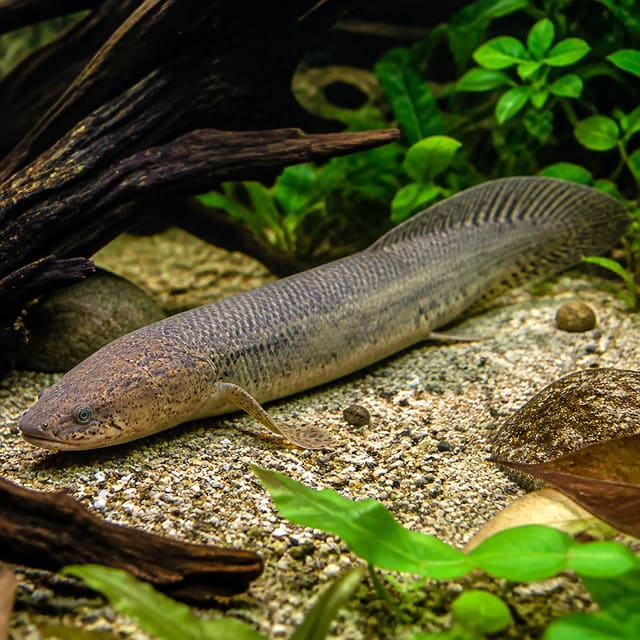
Eastern Bottlenose Mormyrid (Mormyrus longirostris)
£35.99

Black Ghost Knifefish (Apteronotus albifrons) is a nocturnal South American micropredator with a recorded adult length of 50 cm TL. One purchase supplies one live fish; choose from 4 - 5 cm, 5 - 6 cm, 7 - 8 cm and 10 cm dispatch sizes. Plan a large mature aquarium with suitable cover, maintained filtration and a carefully assessed community.
Apteronotus albifrons
Black Ghost Knifefish (Apteronotus albifrons) is a nocturnal South American micropredator with a recorded adult length of 50 cm TL. One purchase supplies one live fish; choose from 4 - 5 cm, 5 - 6 cm, 7 - 8 cm and 10 cm dispatch sizes. Plan a large mature aquarium with suitable cover, maintained filtration and a carefully assessed community.
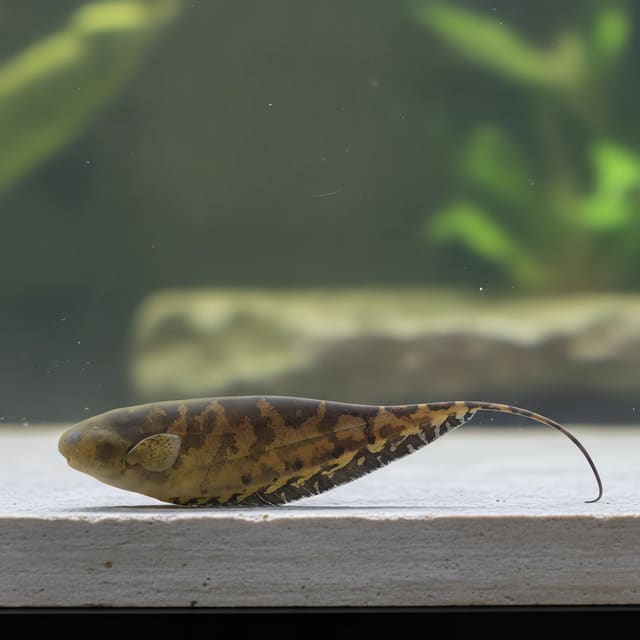
Black Ghost Knifefish (Apteronotus albifrons) is a South American freshwater fish with a striking dark body, white tail markings and a long, rippling fin underneath. One purchase supplies one live fish of the selected size. The size choices are 4 - 5 cm, 5 - 6 cm, 7 - 8 cm and 10 cm. The size you select is the size supplied, not the adult size. Sex is guaranteed only when the selected option explicitly states male or female. This Black Ghost Knifefish listing has no sex-guaranteed option.
A juvenile can look delicate and compact, but FishBase records a maximum adult length of 50 cm total length for male or unsexed specimens. Total length includes the tail. The appeal of that flowing silhouette comes with a substantial accommodation commitment: plan the adult aquarium before buying, and make sure its dimensions leave room for the fish as well as the furnishings and any companions.
This is a knifefish in the family Apteronotidae, not an eel. FishBase places it in South America from Venezuela to the Paraguay and Paraná rivers, including the Amazon Basin of Peru. It describes a nocturnal micropredator of insect larvae, associated with rapidly flowing creeks over sandy bottoms. Its weak electrical organ and receptors are part of its natural sensory system. They are not a reason to treat it as a novelty that can be fitted into any community.
The movements are a large part of its attraction. Undulation of the elongated underside fin gives the fish a distinctive way of travelling, quite different from the obvious tail strokes of many familiar aquarium fish. Its mainly dark colouring and pale tail rings make a simple outline recognisable. Look for opportunities to observe that behaviour without designing a bare, brightly exposed display solely for visibility.
Aquarium Co-Op's practical care guide recommends 120- or 180-US-gallon adult accommodation, rather than treating a 55- or 75-US-gallon aquarium as a lifelong home. It also emphasises low lighting, appropriate shelters and careful feeding. The precise aquarium must be assessed for the adult fish and complete community; a sale-size juvenile does not establish that a small tank will remain sufficient.
A suitable keeper can provide a mature large aquarium, stable water, a place to retreat and meals that the fish actually receives. Feeding competition matters: adding food for everyone is not enough if faster fish take it all. Very small companions are also a poor choice around a growing micropredator. Choose the community to support the fish's adult needs rather than buying first and trying to solve the space problem later.
| Decision | What to prepare |
|---|---|
| Adult accommodation | A large, mature aquarium with usable dimensions and service access. |
| Layout | Low light, size-appropriate hides and unobstructed movement between them. |
| Feeding | Suitable meaty foods and a way to confirm this individual eats. |
| Community | Similar-sized calm companions, with no small prey or persistent food competitors. |
| Long-term care | Testing, water changes, maintained filtration and room for adult growth. |
For a broader view of fish with different requirements, the loaches and oddball fish collection is a useful browsing route. Each animal still needs its own stocking assessment. Being sold in the same category does not mean that two species belong together, need the same water or remain similar in size.
The sections below separate the main practical decisions so you can build a workable aquarium plan. Keep the one-fish retail offer and juvenile dispatch sizes distinct from adult husbandry. Natural size, pattern and maturity vary between live fish, and the live selector is the appropriate place to choose the offered size when ordering.
Begin by measuring the aquarium you can provide for the adult fish. A Black Ghost Knifefish reaching the recorded 50 cm total length needs room to move through its surroundings, turn and use cover without the layout becoming a maze of narrow gaps. Consider length and width alongside volume. An impressive litre figure cannot show whether the finished arrangement provides a useful floor plan.
Aquarium Co-Op's species care guide recommends a 120- or 180-US-gallon adult aquarium. Those figures are US gallons, and they should not be confused with imperial gallons. The important buyer decision is the move away from smaller long-term housing: its guide specifically does not treat 55 or 75 US gallons as a lifelong solution. Ask for help assessing the exact dimensions, layout and intended companions before ordering.
OATA's tankbuster sheet provides a broader context for large fish. It describes exceptionally large aquaria, often in excess of 500 litres, and stresses planning for adult size before purchase. That is group-level advice rather than an exact Black Ghost Knifefish minimum. Use it to understand the scale of commitment, while the species-specific planning above and your actual aquarium determine the practical choice.
Make the accommodation plan realistic for the home. Check that the support is appropriate for the filled aquarium and that you can reach the equipment and perform water changes reliably. A large aquarium requires practical service access as well as display space. The fish's care should not depend on a future upgrade whose location, cost and maintenance arrangements have not yet been considered.
Aquarium Co-Op recommends low lighting and size-appropriate hides. Select shelters around the fish's needs rather than simply the current sale size. A retreat should continue to be usable as the fish develops, and the surrounding layout should allow it to move in and out without being forced through cramped passages. Arrange furnishings securely and leave enough access for inspection and cleaning.
Low lighting means you can design for the fish's comfort while observing quietly, rather than expecting it to stay exposed throughout the brightest part of the day. Its nocturnal natural history helps explain why quieter periods are useful for watching movement and feeding. If plants are part of the display, consider their lighting needs alongside the sheltered areas rather than assuming every part of the tank must receive the same intensity.
Place cover so that it works with feeding and maintenance. You should be able to offer food near the fish and see whether it is taken. A completely inaccessible retreat can hide uneaten food as well as the animal, making it harder to assess condition. Useful shelter is compatible with observation; it should not make every routine check a disruptive dismantling job.
Keep routes between shelters clear. A row of large ornaments can consume much of the aquarium's usable space, even when the tank itself is large. Judge the layout from the fish's perspective and from your cleaning routine. The objective is an adult-sized environment with retreats and movement space, not the maximum possible quantity of decorative material.
FishBase records environmental values of 23–28°C, pH 6.0–8.0 and hardness 5–19 dH for the species. These describe recorded environmental conditions rather than proving every point in those ranges is equally suitable as a routine aquarium target. Natural-history data is valuable, but it should not be treated as a complete recipe for stocking, maintenance and companion selection.
For practical aquarium management, Aquarium Co-Op's care guide gives 24–28°C, pH 6.8–7.8 and at least 5 dGH, with no stated upper hardness limit. Keep that source scope with the figures. The absence of an upper value in that guidance is not permission to assume unlimited hardness, and it is not a reason to invent a precise maximum. Assess the water you will actually use and obtain advice if it falls outside a workable plan.
Test your source water and aquarium water before choosing livestock. A common name or geographic origin cannot tell you what comes from your tap. Keep a record of pH and hardness alongside temperature, ammonia, nitrite and nitrate. The aquarium water-chemistry guide explains what those measurements mean and why a single clear-looking sample is not enough to judge safety.
Look for a stable overlap between the intended species rather than trying to maintain one end of a range for one fish and the opposite end for another. A repeatable water-change routine is more useful than frequent corrections made without a measured reason. If you need help comparing readings, the Water Parameter Matcher provides a starting point alongside the complete stocking assessment.
The RSPCA explains that fish release toxic ammonia and that a working biological filter allows beneficial organisms to convert it to nitrite and then nitrate. Both ammonia and nitrite are harmful. OATA's large-fish guidance requires zero ammonia and zero nitrite. Check those results before introduction and continue monitoring afterwards as the fish and feeding increase the waste load.
A new aquarium is not ready simply because the heater has reached its setting and the water is clear. The filter must have completed an appropriate maturation process, with the result confirmed by testing. Follow the method and product instructions you choose rather than copying a fixed waiting period from another aquarium. Mechanical operation and biological readiness are separate questions.
The guide to setting up a tropical aquarium explains the general sequence. Apply that sequence to a large adult fish plan rather than copying a small starter community. The aquarium's dimensions, filter capacity, service access and adult stocking are all part of readiness, along with the water tests.
Increase stocking gradually. OATA warns that adding fish too quickly can leave the nitrifying population unable to cope with the extra waste, producing new tank syndrome. A mature aquarium is not an unlimited allowance to add any number of large fish at once. Think about both the current fish and the meals they need, and use measured water results to evaluate the system's response.
FishBase describes the species as a micropredator of insect larvae. Aquarium Co-Op's practical food examples include worms, bloodworms, brine shrimp and mouth-sized pellets or freeze-dried foods. Offer appropriate portions that the individual can manage, and observe acceptance. A food's presence in a cupboard is not enough; the feeding routine must work for the fish in its actual community.
Introduce variety in a controlled way so you can recognise what is eaten. Keep familiar accepted food available while assessing alternatives. A juvenile's small mouth should influence the size of a portion, while adult growth changes that practical requirement. There is no need to assume that every individual immediately recognises every prepared food or that a single successful meal establishes the whole long-term diet.
Feeding during quieter, dimmer periods can make observation easier for a nocturnal fish. Place food where it is accessible and watch the individual, rather than judging the meal by the fastest fish at the front of the tank. Record appetite and condition together: the amount offered to the aquarium and the amount received by this fish can be very different.
OATA's broad tankbuster advice recommends appropriate food size, limited portions and care not to overfeed, because uneaten food breaks down into waste. Its general once-daily example is not a measured prescription for every juvenile or adult Black Ghost Knifefish. Adjust the routine with competent advice and the fish's condition, keeping water quality and actual consumption in view.
Aquarium Co-Op specifically advises avoiding fast food competitors. If food repeatedly disappears before this fish has access to it, adding more can increase waste without solving the competition. Watch where each animal feeds and whether the Black Ghost Knifefish has a calm opportunity to take suitable food. Persistent failure at mealtimes calls for a community reassessment.
Distinguish hiding from failing to thrive. A nocturnal fish can spend time in cover, but you still need to confirm it eats and maintains condition. Quiet observation around a predictable meal is more useful than repeatedly disturbing its shelter. If appetite changes, combine the observation with temperature and water tests before seeking advice, so that the issue can be assessed with concrete information.
Remove uneaten food where possible and check the surrounding area during normal servicing. Repeated waste accumulation near a hide suggests that the offering or its placement needs adjustment. A good feeding plan supports the fish and the filter together. It should leave you able to say which foods the individual takes, not merely which foods other aquarium fish consume enthusiastically.
OATA's tankbuster sheet strongly recommends a weekly partial water change of 25%, regular testing at least weekly and checks for blocked filters. This is broad large-fish guidance. Use it as a starting framework and assess the actual aquarium's waste load and results. A substantial fish community may require its routine to be reviewed as animals grow and portions change.
OATA specifies nitrate no more than 20 mg per litre above normal tap-water levels for this group. The comparison with source water matters: it is not simply a flat 20 mg-per-litre aquarium figure. Measure the replacement water as well as the tank when assessing the difference, and seek advice if the results or routine are difficult to interpret.
Prepare replacement water with an appropriate conditioner and follow its directions, because chlorine and chloramine can harm the aquarium's biological filter and fish. OATA advises lightly rinsing filter media in water removed during a partial change and says not to run it under the tap. Keep filtration functioning and inspect for accumulated waste or reduced flow without unnecessarily removing the established biological support.
Record tests, maintenance and any significant change in feeding. A short log helps connect a rising waste result with a change in stocking or food, and makes it easier to describe a concern accurately. Water changes, cleaning and observation work together; none should become a substitute for the others simply because the aquarium looks attractive.
OATA recommends monitoring changes in swimming, colour, breathing, appearance, body condition, feeding and temperament. Compare the individual with its own usual pattern. New marks, deteriorating condition or a persistent appetite change deserve attention even if the fish continues to move around the aquarium. A dark-bodied species still needs deliberate observation rather than an occasional glance from across the room.
If concerned, test water quality and contact a competent retailer or aquatic professional with the results, aquarium dimensions, companions, food and timing of the change. That gives a clearer starting point than a symptom name alone. This guide does not provide medication doses or a universal treatment plan; suitable advice depends on the actual problem and aquarium.
Have the mature aquarium and arrival equipment ready before delivery. Be present to receive the parcel, inspect it the same day and follow the current instructions for the shipment. Tropical Fish Co's policy describes gradual acclimatisation, including floating the bag for 20–30 minutes before release, and advises against pouring bag water into the aquarium.
For any Live Arrival Guarantee claim, record a continuous unboxing video beginning with the still-sealed parcel and showing the fish in its sealed bag. Contact the store the same day with the order number and video. These are claim-evidence requirements, separate from the fish's ongoing care. Read the current policy so that you understand both receipt and the conditions of the guarantee.
After introduction, allow access to shelter and observe the interactions and meals as the fish settles. Keep testing while the aquarium responds to the added waste. Check that its hide remains accessible, its movement is unobstructed and its food is not consistently taken by others. The first introduction is the beginning of that assessment, not proof that the combination will remain suitable as every fish grows.
Aquarium Co-Op recommends similar-sized peaceful companions while avoiding small prey and fast food competitors. Those are useful practical tests for any candidate. Check the adult size of every fish, the current size difference, water requirements, activity and feeding behaviour. A peaceful label alone is too broad to show that a combination will work.
A small dispatch-size Black Ghost Knifefish should not set the scale for a lifelong community. It is a growing fish with a recorded adult length of 50 cm TL. A companion that looks proportionate in a temporary juvenile display may become unsuitable as the size balance changes. Think ahead about adult accommodation and what separation would involve if the planned combination fails.
OATA's broad tankbuster guidance also advises avoiding much smaller fish around these large animals. It warns that some members of the wider group are particularly aggressive or predatory. That broad warning should not be turned into a claim that every Black Ghost Knifefish is universally aggressive. It supports a cautious stocking assessment, while the species-specific companion guidance remains the practical reference.
Watch the proposed community at a meal. A fast, active species may consume the available food before a more sheltered fish approaches it. This can happen without visible fighting. Assess whether you can provide a calm feeding opportunity and confirm that the Black Ghost Knifefish eats, rather than relying on all the fish accepting the same packet of food.
A feeding routine that works for one fish may need adjustment when another is added. Observe after every stocking change and keep track of actual consumption. If one animal repeatedly dominates food, more total food may simply produce more waste. Persistent competition is a reason to reconsider the mix, including whether a separate arrangement is needed.
Water overlap also matters. The Aquarium Co-Op husbandry ranges used in the care discussion do not establish that every peaceful fish will share the same conditions. Read the candidate species' guidance independently and compare stable operating conditions, not isolated extremes. The complete adult community should be manageable under one repeatable water and maintenance plan.
Aquarium Co-Op generally advises against keeping multiple Black Ghost Knifefish in ordinary aquaria. Plan for a single fish unless you have obtained a detailed assessment for a genuinely different setup. A larger litre number on its own is not a group-keeping plan, and a gallery showing more than one animal does not define the retail unit or prove that a pair is appropriate.
Adding a second animal should not be the automatic response to hiding or slow feeding. First evaluate shelter, water quality, appetite and food competition. A quiet nocturnal fish needs a suitable environment and observation, rather than an assumption that company will solve every concern. For this offer, one purchase is one fish, and social stocking is a separate husbandry decision.
Different knifefish are not interchangeable either. Their adult dimensions and care may differ, so the shared name does not establish compatible behaviour or common space requirements. Research the exact species before considering any comparison. An alternative to buying a Black Ghost Knifefish is not automatically a fish to add alongside it.
The Arowana Knifefish (Papyrocranus afer) is a separate buying comparison for someone researching knifefish. Read its own adult requirements and offer carefully. The link helps identify a different animal to assess; it makes no claim that the two should share an aquarium or that one is a simple substitute under the same care plan.
Keep the decision focused on what your aquarium and routine can support. If the aim is a small planted community of tiny fish, a large micropredator changes that plan substantially. If the aim is a spacious display centred on one unusual fish, carefully chosen companions may be assessed around its needs. The fish's silhouette should follow suitability, rather than suitability being worked out after purchase.
FishBase records Apteronotus albifrons at 50 cm total length for male or unsexed specimens. Total length includes the tail, and the adult record should guide long-term planning rather than the juvenile purchase size.
Plan a genuinely large adult aquarium with usable length and width, shelter, movement space and maintained filtration. OATA's broad tankbuster guidance describes exceptionally large aquaria, often over 500 litres; that group figure is not an exact species minimum.
Choose the number only after a species-specific assessment of adult accommodation and behaviour. A gallery count is not a stocking recommendation, and a small juvenile display cannot establish the suitability of an adult group.
Its recorded adult size, mature filtration, food management and substantial accommodation require preparation. A keeper should have the adult setup and a repeatable maintenance plan ready before purchase rather than treating it as a small community novelty.
FishBase describes it as a nocturnal micropredator of insect larvae. In an aquarium, choose appropriate foods and confirm the individual receives them, with portions and management assessed for its size and condition.
FishBase records environmental ranges of 23–28°C and pH 6.0–8.0, with hardness 5–19 dH. These are environmental records rather than a complete aquarium target; use species-specific aquarium advice and stable conditions for the full community.
Small prey and very different sizes require care in any large-fish community. OATA advises avoiding much smaller fish for the tankbuster group and notes that some group members are predatory; assess the exact species and individual combination.
Use an exact-species assessment of adult size, water, temperament and food access before choosing companions. Large-fish group guidance alone cannot identify universally safe tank mates, and an alternative knifefish is not a compatibility recommendation.
Tropical Fish Co hand-packs fish in pure oxygen with an insulated poly box and a weather-dependent heat pack, using a licensed live-animal courier. Read the current delivery policy, be present to receive the parcel and inspect it the same day. For a Live Arrival Guarantee claim, contact the store that day with your order number and a continuous video showing the sealed parcel being opened and the fish still in the sealed bag.
FishBase: Apteronotus albifrons supplies the family, South American distribution, 50 cm total-length record and nocturnal micropredatory natural history. Its environmental water values remain environmental records. Black Ghost Knifefish natural-history summary describes the appearance and underside-fin movement.
Aquarium Co-Op's Black Ghost Knifefish care guide provides practical retailer experience for adult tank planning, water, hides, feeding and community assessment. Its usual observed size of 35–45 cm is distinct from FishBase's maximum record; the larger recorded adult length is retained here for planning.
OATA large-fish care supplies broad tankbuster welfare and maintenance advice. Gymnotiformes is an order, rather than a family; this species belongs to Apteronotidae. Stingray anatomy in that group sheet is not Black Ghost Knifefish anatomy.
RSPCA aquarium-environment advice explains biological filtration. For packing, receipt and guarantee conditions, read Tropical Fish Co's delivery policy.
No reviews for this item yet. Bought one? Honest reviews only, good or bad.
What customers say about ordering from us
I have a small group of long finned mountain minnows. So was delighted to be able to order ten of this variety to increase the genetics in my tank . The ones I recieved are healthy but it’s to early to give a verdict on wether they are of a long finned type since they are small currently.
Gordon Walker · 23 Sept 2026
100% success travel and "installation". Pleased with quality of purchase. The Siamese fighter a bit "shy" so have not yet seen him at his best yet but looking good. Happy customer. GG
George E Garratt · 21 Sept 2026
Reviews of our shop, collected by Judge.me, an independent third-party review collector. Newest first.