−13%
Moderate
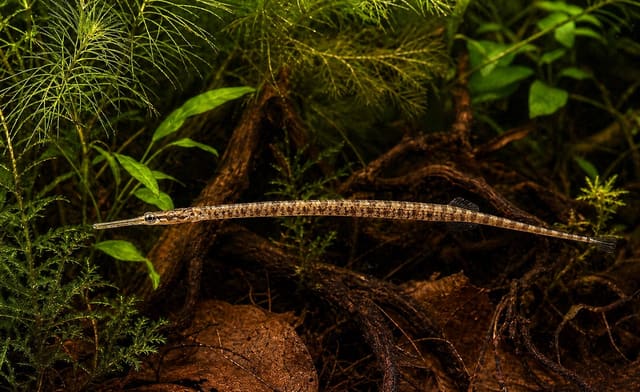
Half-Banded Spiny Eel (Macrognathus circumcinctus)
24–27°C
£17.39£19.99
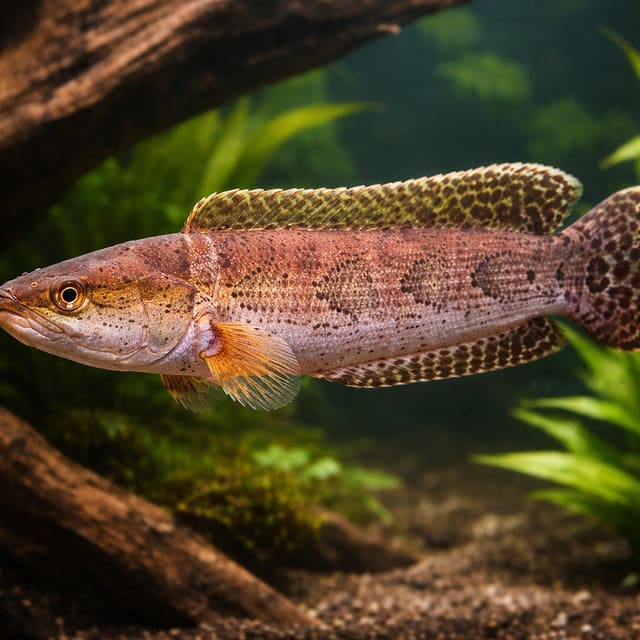
The peacock eel, Macrognathus siamensis, is a burrowing spiny eel from Thailand and the Mekong basin. It commonly reaches about 20 cm and can grow to 30 cm. It needs soft sand, a lid with no gaps and frozen or live meaty foods. This listing is for one eel.
Adult size is the maximum length this species reaches at full maturity (scientific sources). The livestock you receive will be younger and smaller. Product-photo provenance and any image-specific limitations are stated on the listing.
Macrognathus siamensis
The peacock eel, Macrognathus siamensis, is a burrowing spiny eel from Thailand and the Mekong basin. It commonly reaches about 20 cm and can grow to 30 cm. It needs soft sand, a lid with no gaps and frozen or live meaty foods. This listing is for one eel.
Adult size is the maximum length this species reaches at full maturity (scientific sources). The livestock you receive will be younger and smaller. Product-photo provenance and any image-specific limitations are stated on the listing.
Maintain these water conditions for optimal health and vibrant colors
The peacock eel is a spiny eel from the slow, muddy lowland waters of Thailand and the Mekong countries, and it is one of the spiny eels you are most likely to see in a fish shop. Seriously Fish lists it, alongside the fire eel and the tyre-track eel, as one of the more common species available to the hobby. Its scientific name is Macrognathus siamensis, first described by Günther in 1861. This page used to carry the older name Mastacembelus siamensis, which FishBase now lists as a synonym, so if that is the name you searched for, this is the same fish.
Despite the word eel, it sits in the spiny eel family, Mastacembelidae. Wikipedia's account of the family picks out the features that make the group easy to recognise: a long, eel-like body, a series of short, well-separated spines running along the back (which is where the family gets its name), and a long nose appendage carrying two tube-shaped nostrils. On a settled peacock eel that pointed snout is the part you notice first, working through the sand and testing the water for the smell of food.
The name refers to the eye-like spots, or ocelli, along the rear part of the back. FishBase describes 3 to 6 conspicuous ocelli along the base of the soft dorsal fin and notes that they are noticeably larger than in related species. Wikipedia gives a second common name, spotfin spiny eel, which points to the same feature. The spots run where the soft-rayed dorsal fin extends back towards the tail, so they are easiest to see when the eel lies along the front glass or swims out over open sand at feeding time.
If you want to check a fish more closely, FishBase gives a few counts for the species: 13 to 19 short dorsal spines in front of the soft dorsal fin, about 53 soft dorsal rays and about 49 anal fin rays. It also notes that the dorsal, caudal and anal fins are not fused, so the tail fin stays a separate fin rather than merging into one continuous fringe. Nobody counts fin rays on a live eel, but the separate tail and the large eyespots are both visible once the fish has settled and comes out to feed.
| Point | Detail |
|---|---|
| Accepted scientific name | Macrognathus siamensis (Günther, 1861) |
| Family | Mastacembelidae, the spiny eels |
| Common names | Peacock eel, spotfin spiny eel |
| Maximum recorded length | 30 cm standard length (FishBase); about 20 cm is more usual (Wikipedia) |
| Wild range | Mekong, Chao Phraya and Maeklong basins, plus Peninsular and South-east Thailand river systems |
| Working water range | 23 to 26°C, pH 6.5 to 7.5, hardness 5 to 15 °H (see the water section for where these numbers come from) |
| Diet | Carnivore: insect larvae, crustaceans, worms and small fish in the wild |
| Tank footprint we plan around | 120 x 45 cm base, soft sand and a tight lid |
| What one unit is | One peacock eel |
Each unit on this listing is a single peacock eel. There is only one option on the page, with no pack size, sex or size grade attached, so order the number of eels you genuinely intend to keep, and read the tank mates section before you add a second one to the basket. Wikipedia notes that males and females are hard to tell apart from the outside, so we do not offer them as sexed fish and cannot pick a male or a female for you.
FishBase gives the maximum recorded length for Macrognathus siamensis as 30 cm standard length. Standard length is measured from the tip of the snout to the end of the body, where the tail fin starts, so the fish's total length with the tail included is a little more than that figure. Wikipedia adds a useful second number: 20 cm is the more common size. Put those together and the honest planning figure is a fish of around 20 cm that may well go on past 25 cm in a roomy, well-fed aquarium.
That matters because a young spiny eel is a slim fish that looks as if it would fit almost any tank. It will not stay that way. Wikipedia, citing Thai research on breeding and nursing the species, reports that larvae reached about 8 cm within roughly 60 days of hatching. That was in a controlled rearing setting rather than a home aquarium, and we would not treat it as a growth timetable for your tank, but it does show how quickly young spiny eels put on length when food is plentiful.
A peacock eel spends most of its day on or in the bottom. What it needs is floor area: a long run of soft sand to bury into, room to turn without folding itself against the glass, and space to sit under cover away from the busier fish. Tall, narrow tanks waste water volume on height it barely uses.
None of the sources we use publishes a minimum tank size for this exact species. Seriously Fish does publish one for its close relative the zebra spiny eel, Macrognathus zebrinus: a base of 120 x 45 cm for a fish recorded at up to 46 cm standard length. The peacock eel is the smaller of the two, so a 120 x 45 cm footprint is a generous and safe target for an adult, and it is the figure we plan around. A young eel can live in something smaller for a while, but only if you are certain the larger tank will be ready before it outgrows the first one.
We have not found a reliable lifespan for the peacock eel in FishBase, Wikipedia or Seriously Fish, so we are not going to quote one. What we can say is that it is a long-bodied fish that grows to 20 cm or more, so treat it as a fish for years rather than months and buy the equipment with that in mind.
This listing does not carry a size grade. If you need to know roughly how big the current fish are before you order, for example because you are matching it against existing tank mates, email us and ask before placing the order.
FishBase places the peacock eel in the Mekong, Chao Phraya and Maeklong river systems and in the river systems of Peninsular and South-east Thailand. Wikipedia names the countries as Thailand, Cambodia, Laos and Vietnam. It is a freshwater fish of the tropics, and FishBase records it as benthopelagic, which in practice means a fish that lives on and close to the bottom.
The habitat descriptions line up well. Wikipedia describes slow-moving backwaters with sandy or muddy bottoms, such as swamps, canals and ponds. FishBase describes adults living at the bottom of slow-moving or standing water, often buried in silt, sand or fine gravel with only part of the head showing above the substrate. The fish emerges at dusk to forage. FishBase also notes that it enters flooded forest, which links to the wet season, when rivers spill out across the land.
Seriously Fish's habitat notes give a feel for the company it keeps in the wild. In the Tonlé Sap lake and river system in central Cambodia, the peacock eel has been recorded together with rasboras, barbs, loaches, Mystus catfish and another spiny eel, Macrognathus semiocellatus. That is a list of fish found in the same water, not a list of safe tank mates, and the tank mates section below deals with that separately.
FishBase lists the species as commercially important in fisheries and in the aquarium trade, and notes that it is sold fresh in local markets. Wikipedia describes it the same way, as commercially important both as food and as an aquarium fish. The IUCN Red List assessment, carried out in 2011 and published in 2012, lists it as Least Concern.
Wikipedia reports an established introduced population of peacock eels in the Everglades region of Florida, first found in the C-111 canal in 2002 and most likely the result of aquarium fish being released. It is a clear reminder of the rule that applies to every aquarium fish: never release one into a pond, stream, canal or lake. If you can no longer keep your eel, ask a local aquatic shop or club about rehoming it, or contact us for advice.
Most of what goes wrong with spiny eels goes wrong at the set-up stage, so this is the section worth reading twice. The three things that matter most are the substrate, the cover and the shape of the tank.
Wikipedia says the peacock eel needs a soft substrate to burrow into, such as sand, mud or silt. Seriously Fish, writing about the zebra spiny eel, recommends covering the tank bottom with sand to a depth of about 2.5 cm (one inch) and warns against gravel, because sharp edges can damage the eel's skin. FishBase does record wild fish buried in fine gravel as well as silt and sand, but in an aquarium soft, rounded sand is the safe choice. We would treat 2.5 cm as the minimum and go deeper over part of the tank so a larger eel can bury itself fully.
Rinse the sand well before it goes in. Over time a sand bed collects uneaten food, and because this fish is fed meaty foods that rot quickly, it is worth gently stirring the top layer and siphoning the surface when you do water changes.
Seriously Fish suggests using piles of rocks and bogwood to create plenty of sheltered areas, and placing decor directly on the glass base before the sand goes in. That second point is easy to miss. A burrowing eel works its way underneath anything sitting on top of the sand, and a rock that has been undermined can drop onto the fish or crack the glass. Build the hardscape first, check every piece is stable, then pour the sand around it.
Give the eel at least one cave or tunnel it can back into, plus a sand area it can bury into. Short lengths of smooth pipe half-buried in the sand work as well as more natural decor, as long as the edges are smooth.
Seriously Fish recommends dim lighting and no strong currents for the zebra spiny eel, which fits the wild peacock eel's slow backwater habitat. Floating plants are an easy way to soften the light. The same profile notes that live plants rooted in the substrate tend to get uprooted by the digging, so if you want greenery, choose plants that grow attached to wood or rock, or use floating plants, rather than relying on carpeting plants in the sand.
Seriously Fish states that a tightly fitting cover is absolutely essential for the zebra spiny eel, because if these eels can escape, they will. Its fire eel profile adds that a spiny eel can find its way through the smallest of gaps. A fish that ends up on the floor overnight is almost always lost, so before the eel arrives, go round the top of the tank and check:
Fill those gaps with filter foam, aquarium-safe mesh or a cut piece of acrylic. Then make it a habit to check the lid every time you finish maintenance. The most common escape route is the one left open after a water change.
For the same reason, fit a sponge pre-filter over the filter intake. A slim young eel that can squeeze through small gaps can also find its way into an unguarded intake, and the sponge also stops shreds of meaty food being drawn into the filter.
FishBase records the peacock eel as a tropical freshwater fish but does not publish an aquarium temperature, pH or hardness range for it, and the Wikipedia article does not give one either. Seriously Fish has no profile of its own for this species. Rather than invent numbers, we work to the range Seriously Fish gives for its close relative the zebra spiny eel:
Those figures sit comfortably with the wild picture of a lowland tropical fish living in slow, soft-bottomed water. If your tap water tests well outside that pH or hardness range, ask us before ordering rather than trying to chase the numbers with chemicals. A stable value just outside the range is generally safer than one that keeps moving.
OATA, the UK ornamental fish trade association, gives clear water quality guidance in its freshwater care sheet:
OATA also explains why a brand new tank is risky: ammonia and nitrite rise at first and only fall to zero, and stay there, once the filter bacteria have built up. A spiny eel should only go into an aquarium that has finished that process and has been testing at zero ammonia and nitrite for a while.
A peacock eel eats bloodworm, prawn, mussel and similar foods, and it eats them at night, often from a spot you cannot easily see. Any food it misses sinks into the sand and decays, and that load ends up as ammonia. A few habits keep it under control:
A heater with a thermostat set within 23 to 26°C, and a filter that turns the water over without producing a strong current across the sand, is all the equipment this fish needs. If the outlet creates a fast jet, point it at the glass or the surface so the flow along the bottom stays gentle.
In the wild the peacock eel is a bottom-feeding carnivore. FishBase lists its food as benthic insect larvae, crustaceans and worms, and Wikipedia adds small fish to that list. FishBase's estimated trophic level of 3.3 puts it firmly among the meat-eaters. It feeds after dark: FishBase notes that adults emerge at dusk to forage.
Seriously Fish, again writing about the zebra spiny eel, says that while it hunts small fish and aquatic invertebrates in nature, aquarium fish readily accept dead foods such as prawn, cockle, mussel, earthworms and bloodworm. That list is a sensible base for a peacock eel's diet too:
Our sources describe a fish that hunts animal food on the bottom and say nothing about it living on flake or pellets, so we do not promise that it will take dry food. Plan the diet around the frozen and live foods above, and treat anything else as an extra if your eel happens to accept it.
Seriously Fish describes the zebra spiny eel as quite a shy fish and suggests adding food after the lights go out at first. That works for a new peacock eel too. Switch the tank lights off, wait a few minutes, then drop thawed food close to where the eel is buried or hiding. Check with a torch later or first thing in the morning to see whether it has gone.
If your eel becomes bolder and starts coming out when food goes in, you can feed with long aquarium tweezers or tongs at the front of the tank, which makes it much easier to see that this fish is getting its share rather than the tank mates. That is the main feeding risk with a slow bottom-feeder in a community tank: faster fish finish the food before the eel has found it.
None of our sources gives a set feeding schedule for this species, so judge it by the fish. A healthy peacock eel has a gently rounded body behind the head and no sharp, pinched look along the belly. Offer what it clears overnight, adjust the amount by whether there are leftovers, and keep an eye on body shape over the weeks.
Rotating between bloodworm, shellfish and worms gives a more varied diet than any single food, and it also means the eel will not become fixed on one food you might not always be able to get.
A peacock eel is not an aggressive fish towards anything it cannot eat. Seriously Fish describes the zebra spiny eel as peaceful with species it cannot fit into its mouth, and the peacock eel behaves the same way in a community of suitable fish. The catch is in that last part. Wikipedia lists small fish in its wild diet and FishBase lists crustaceans, so any fish small enough to swallow, and any small shrimp, is food rather than a tank mate. Spiny eels hunt at night, when small fish are resting, so a tank that looks peaceful during the day can still lose fish overnight.
Seriously Fish notes that the zebra spiny eel is territorial towards its own kind and that keeping more than one needs a very large tank. Our sources do not give a separate verdict for the peacock eel, so we take the cautious line: keep one in a standard community set-up, and only consider a second if the tank is large, the floor is broken up with several separate hiding places and burial areas, and you can watch both fish feeding.
The useful rule is size, not species. Good companions are peaceful fish that live in the middle and upper parts of the tank, are too large to fit into the eel's mouth now and when the eel is fully grown, and are not so quick at the bottom that the eel never gets fed. Many medium-sized, calm community fish fit that description.
Remember that the eel is growing. A fish that is too large to swallow when a young eel arrives may not be once the eel is 20 cm or more. If you are planning a long-term community, choose companions with the adult eel in mind.
FishBase lists the peacock eel as harmless to humans, and Seriously Fish's fire eel profile describes spiny eel spines as harmless. Its zebra spiny eel profile adds a practical warning that the sharp dorsal spines can puncture human skin, so the sensible approach is to handle these fish carefully rather than to worry about them. The spines also catch in coarse nets. When you need to move the eel, guide it into a soft, fine net or a clear container rather than chasing it round the tank, and never pull it out by hand.
Expect a fish that spends much of the day buried with only the head showing, or tucked under wood, and becomes more active at dusk and after dark, just as FishBase describes the wild fish. If it grows confident enough to come out at feeding time, that is when the eyespots along the back are easiest to see.
Most of the problems keepers run into with spiny eels are predictable, and many of them start before the fish arrives.
Escape is the most common way to lose a spiny eel. As covered above, Seriously Fish describes these fish as able to get through the smallest of gaps, and an eel that leaves the water overnight rarely survives. Check the cover after every maintenance session and after you have moved any equipment. If your eel goes missing, check behind and under the tank as well as in the sand and inside the filter, and look carefully before you assume it has escaped: a buried eel can vanish completely for a day.
Seriously Fish's warning about gravel is worth taking seriously. A fish that buries itself many times a day is constantly rubbing its skin against the substrate, and sharp grains or rough decor can scrape it. Damaged skin can then become infected. Soft sand, smooth decor and a careful check of any caves or pipes for sharp edges prevent most of this.
Because the peacock eel lives in the sand and is fed rich foods, it is right where waste collects. Keep to OATA's guidance of zero ammonia and nitrite, test regularly, and do steady weekly water changes. If something seems wrong, test the water first. It is the quickest check you can make, and water quality is the first thing to rule out.
A newly arrived eel that hides and does not appear at feeding time is normal for the first few days. Feed after lights out, close to where it is hiding, and check whether the food has gone by morning. If an eel has not eaten for longer than a week or two, look for reasons: are tank mates taking the food first, are the water readings right, and is the food small enough and placed where it can find it? A thin, pinched belly behind the head is the sign that the eel has not been getting enough.
Before adding any treatment, find out what you are treating. Check the water, look closely at the fish, and if you are unsure, contact us or a fish health specialist. Follow the dosing instructions of any treatment exactly. A separate quarantine tank, with sand and a lid, is a useful thing to have for any new fish and makes treating a single eel far simpler than dosing a whole community.
This is a short section, because the honest answer is that peacock eels are bought to keep rather than to breed.
Wikipedia notes that males and females are hard to tell apart from the outside. In the wild, the species breeds in the wet season when adjacent forests flood, which matches FishBase's note that it enters flooded forest. Those are big seasonal changes in water level, temperature and food that a home aquarium does not reproduce easily.
The species has been bred under controlled conditions in Thailand. Wikipedia cites research by Saowakoon and colleagues, presented at the 45th Kasetsart University Annual Conference in 2007, on breeding and nursing the fish and on its reproductive biology, and reports that larvae grew to about 8 cm in roughly 60 days after hatching. That is research and hatchery work rather than spawning in a home tank. For comparison, Seriously Fish records its close relative the zebra spiny eel as not yet bred in captivity.
So we do not sell peacock eels as a breeding project, and we would not recommend buying several in the hope of getting a pair. Buy one eel for a tank that suits it, and enjoy it as an unusual, characterful bottom-dweller.
Please read our delivery and live-arrival information before ordering. The short version is below, with the steps that matter most for a spiny eel.
Fish travel in oxygen-filled bags inside insulated packaging, with heat packs when conditions call for them, by a tracked courier licensed to carry live animals. We email you the confirmed delivery date and the tracking details.
Start a continuous unboxing video while the parcel is still sealed, open it in the same take, and show the fish in the still-sealed bag. If a fish arrives dead, dying or clearly compromised, email hello@tropicalfishco.co.uk on the day of delivery with your order number and that video. Photos alone do not meet the policy. The resolution is a replacement with your next order or a refund for the affected fish, subject to the guarantee terms.
Keep the lights low for the first day and watch breathing, appetite and behaviour over the first week. A new peacock eel will usually disappear into the sand or under the wood almost at once, and you may not see much of it for a few days. That is normal behaviour for a fish that spends its days buried in the wild.
From the second evening, offer a small amount of thawed bloodworm after the lights go out, near where it is hiding, and check in the morning whether it has gone. Keep the amounts small until you know it is eating, and remove anything left over. Test the water a couple of times during the first week as well, because a new fish adds to the load on the filter.
Expect it to show itself mainly at dusk and after dark, which is how the wild fish behaves. An eel that is eating, breathing calmly and burying itself normally is settling in well, even if you rarely see it in daylight.
These are the sources we used for the facts on this page. Where a figure comes from a related species rather than the peacock eel itself, we have said so in the text.
No reviews for this item yet. Bought one? Honest reviews only, good or bad.
What customers say about ordering from us
Easy website plenty of info on fish your buying great to pick a time slot
TRACEY DURRANT · 7 Oct 2026
Got some lovely fish thank you
Kevin Mackie · 7 Oct 2026
Reviews of our shop, collected by Judge.me, an independent third-party review collector. Newest first.