−13%
Moderate
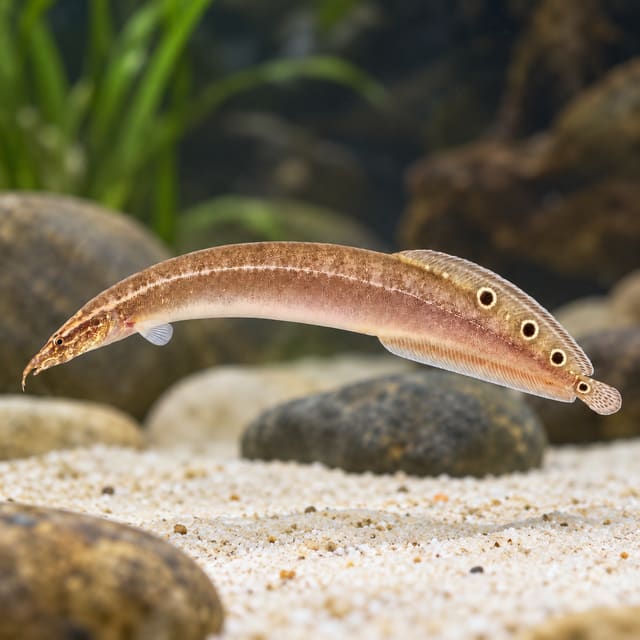
Half-Banded Spiny Eel (Macrognathus circumcinctus)
24–27°C
£17.39£19.99

Frecklefin eel (Macrognathus aculeatus) is a secretive freshwater spiny eel for a mature aquarium with soft sand, secure cover and carefully observed feeding. One live fish per purchase, with five size choices spanning 6–30 cm.
Macrognathus aculeatus
Frecklefin eel (Macrognathus aculeatus) is a secretive freshwater spiny eel for a mature aquarium with soft sand, secure cover and carefully observed feeding. One live fish per purchase, with five size choices spanning 6–30 cm.
Maintain these water conditions for optimal health and vibrant colors
The Frecklefin eel, Macrognathus aculeatus, is a freshwater spiny eel from Southeast Asia. Its long body and searching snout make it an unusual animal to watch around the lower part of an aquarium. Much of its interest comes from how it uses cover: resting out of sight, showing just part of the head above the substrate, then emerging to search for food as the light fades.
Choose this fish for an established aquarium designed around shelter, safe substrate and dependable feeding access. A small animal offered for sale is only the beginning of that commitment. FishBase records a maximum of 38 cm total length for male or unsexed fish; total length includes the tail. That record makes adult space a central part of the buying decision, even when the fish you select is considerably smaller.
One purchase supplies one live fish of the selected size. The size choices are 6–10 cm, 10–12 cm, 13–15 cm, 15–18 cm and 25–30 cm. The size you select is the size supplied, not the adult size. Choose according to the accommodation you have prepared and the other animals already living there. A small fish is not a way to make an unsuitable adult aquarium suitable.
Sex is guaranteed only when the selected option explicitly states male or female. This Frecklefin eel listing has no sex-guaranteed option.
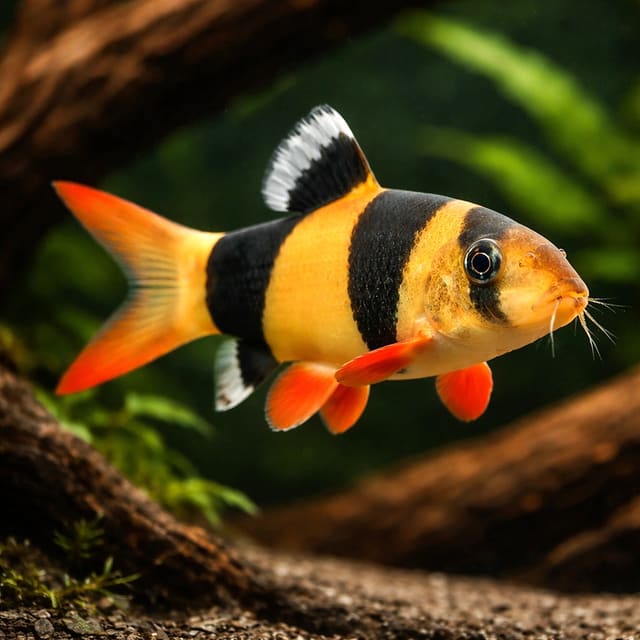
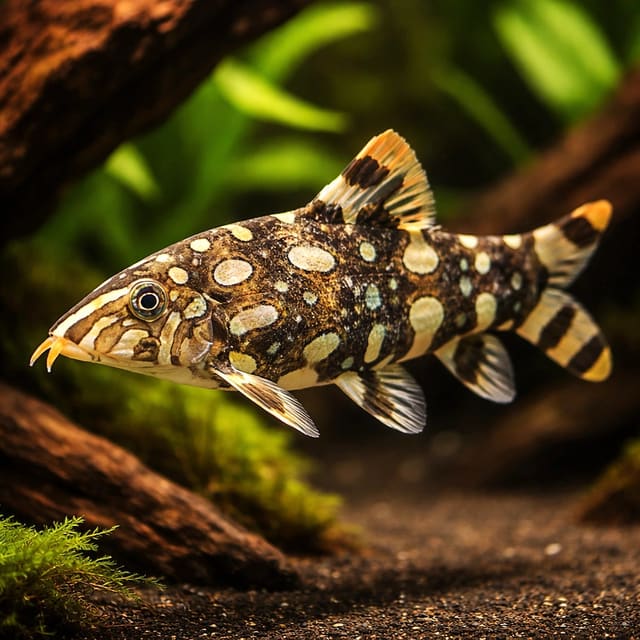
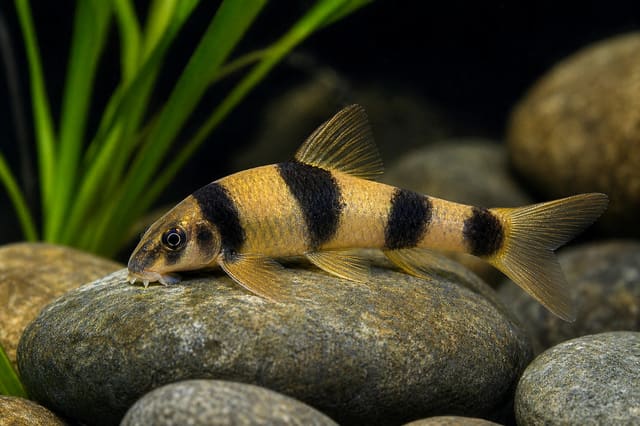
The gallery images are representative of this type of animal rather than photographs of the exact animal supplied, so colours can look slightly different from the live animal.
Two fish shown together in a gallery scene do not make the purchase a pair. Equally, the fact that one purchase supplies one fish should not be taken as a recommendation to keep the species in isolation. Plan the number, adult accommodation and feeding arrangements together, rather than choosing a quantity first and fitting the aquarium around it afterwards.
Frecklefin eels suit patient observation. A fish that uses its shelter during the day may still become active when the room and aquarium are quieter. Design the layout so you can see an entrance to a refuge or a feeding area without having to lift wood every time you want to check the fish. Confidence is easier to assess through regular feeding and normal behaviour than by insisting on a permanently visible display animal.
Soft sand, sheltered resting places and a secure cover are particularly useful features. The fish should be able to use the lower area without encountering sharp decoration or having its routes blocked by other inhabitants. Feeding needs deliberate attention because a shy bottom fish can miss food that is quickly taken by more active animals elsewhere in the aquarium.
This is not a fish for an aquarium stocked around tiny companions. Its quiet behaviour does not remove the possibility of predation on small fish or small invertebrates. Think separately about whether another animal might be eaten, whether it might harass the eel, and whether it might take the food before the eel reaches it. All three questions matter in a peaceful-looking community.
Adult length also changes the way you should judge a layout. Check the space between pieces of wood, the width of sheltered routes and the area available for several fish to feed. An aquarium can contain plenty of water yet offer very little useful floor space after decoration. Plan for the full-grown fish to move and rest comfortably, with the number kept and the rest of the stocking taken into account.
Before you order, have a mature filter, suitable food, a lid that closes around the equipment and a practical routine for observation. If you are comparing unusual bottom fish, browse the loaches and oddballs collection with those requirements in mind. Different species in that collection have different adult sizes and social needs; the category is a starting point for research, not a promise that its occupants can share a tank.
Begin with length and width, then consider the area that will remain usable after the aquarium is furnished. Frecklefin eels need room to move around the lower part of the tank, reach food and withdraw to shelter. The footprint therefore deserves more attention than a litre figure on its own. A high, narrow aquarium and a long, wide aquarium can hold similar volumes while offering very different living space.
Plan around the FishBase record of 38 cm total length, labelled for male or unsexed fish, rather than a small dispatch grade. This does not mean every individual will reach that measurement, but it is a sensible reason to avoid accommodation that depends on the fish staying small. Consider the adult number you intend to keep, the space occupied by other fish and how the whole layout will function when the animals are larger.
There is no single litre minimum offered here as a substitute for that assessment. Before committing to the fish, have the actual dimensions and stocking plan checked. A useful discussion includes the length, width, existing inhabitants, amount of open substrate, number of refuges and whether the tank will house a group. A bare volume leaves too many of those decisions unanswered.
Sketch where the largest structures and feeding areas will sit. Check whether there is a clear route between them and whether a fish entering a refuge has a usable way back out. Also think about your own access: the layout should allow you to remove food and inspect equipment without repeatedly disturbing the eel's preferred shelter. Good accommodation is both usable by the fish and maintainable by the keeper.
Both species care sources describe burrowing and recommend sand. Provide a soft sandy substrate so the fish can use that behaviour, and avoid a floor dominated by sharp or abrasive pieces. A fish partly buried with its head exposed is not necessarily stuck or in trouble. Observe its normal routine before deciding that every period below the surface calls for intervention.
Choose aquarium-safe wood, smooth caves or suitable tubes as additional shelter. Arrange cover in several parts of the lower area rather than putting every refuge into one inaccessible pile. This gives fish a choice of resting places and makes it easier to provide food where each individual can reach it. The best refuge is one that the fish can use comfortably and that you can inspect without a major disturbance.
Support heavy decoration securely before relying on sand around its base. Burrowing can move substrate, so a rock that seems stable when first placed may not remain stable if the sand beneath it shifts. Check for narrow traps between pieces and for rough edges along the routes the fish is likely to use. Reassess those spaces as the animal grows.
Plants can contribute cover and soften the light. Allow for digging when deciding where to place them; an arrangement that depends on every rooted plant remaining untouched may be frustrating. Leave useful open sand and use planting to create shelter around it. If a plant repeatedly comes loose, adjust its position rather than continually rebuilding the same fragile arrangement around a resting fish.
Spiny eels have a strong reputation for finding openings at the top of aquaria. Check the full perimeter of the cover, including corners and the spaces around cables, pipework and filter fittings. A lid that appears closed from the front may still have a gap at the back. The cover needs to remain secure during ordinary use, not only when every cable happens to be sitting in one particular position.
Make closing the feeding opening part of the feeding routine. After maintenance, check the lid again because moving equipment can create a new gap. Keep the area around the aquarium organised so a tool or hose does not inadvertently hold the cover open. These are small practical habits, but they support an essential feature of a spiny eel aquarium.
Access and ventilation still need to follow the aquarium and equipment manufacturers' requirements. The aim is a secure aquarium cover, not an improvised arrangement that interferes with the safe operation of heaters, lights or filtration. Solve awkward cable openings before the animal arrives so that routine care does not depend on balancing a loose object over them.
| Measure | How to use it |
|---|---|
| Temperature | 23–27°C for routine aquarium care |
| pH | 6.5–7.5 |
| General hardness | Check measured source water with a species-informed adviser; do not confuse GH with KH |
| Ammonia and nitrite | Zero before adding fish and throughout normal operation |
| Movement | Gentle circulation with effective filtration |
The routine temperature and pH guidance here follows a UK care profile and sits within the aquarium range given by Aquatic Community. Use a reliable thermometer to check the water itself, rather than assuming a heater dial is an exact reading. Keep conditions steady, and check how replacement water compares with the aquarium before carrying out maintenance.
General hardness and carbonate hardness are different measurements. A figure labelled KH should not be copied into a GH target, even though both may be expressed in degrees. If you are unsure which test you own, read its label and instructions before comparing results. The water chemistry guide can help you organise the main readings and understand what each tells you.
Measure your own source water as well as the aquarium. That makes it easier to understand the effect of water changes and to discuss a consistent routine. Use the water matcher as a comparison aid, then consider adult size, temperament and feeding alongside the numbers. Matching water conditions is necessary for a community, but it does not settle every compatibility question.
FishBase records both freshwater and brackish environments for this species. An environmental record is not, by itself, an instruction to add salt to a freshwater aquarium. Keep the intended aquarium setup consistent and seek advice for the actual water and livestock involved before making a change. Avoid taking isolated figures or habitat labels out of context when planning everyday care.
The aquarium should be biologically mature before livestock is introduced. A pump can move water immediately, but a filter's ability to process waste develops through the bacteria living within it. The RSPCA explains the progression from ammonia to nitrite and then nitrate. Ammonia and nitrite are toxic, so successful filtration needs to be demonstrated by water quality rather than judged only by how clear the aquarium looks.
If the system is new, work through the first tropical tank guide before ordering. Testing the heater, checking for leaks and seeing that the filter runs are important equipment checks. They do not alone establish that the biological filter can handle fish waste. Build the aquarium's readiness first so that arrival does not become a race to make the water safe.
Keep circulation gentle enough for the intended inhabitants while maintaining effective filtration. Arrange outlets and shelter so a resting fish has a calm space, and keep the equipment accessible for routine checks. Debris should not be allowed to accumulate unseen behind every piece of wood. Being a sheltered aquarium does not mean being a neglected one.
Add livestock gradually, as OATA advises generally for freshwater aquaria. An established system has adjusted to its existing waste load, and additional animals and food increase that load. Test after changes and allow the observations to guide the next step. Filling every available space at once makes it harder to tell which part of the new arrangement is causing a problem.
Prepare a suitable invertebrate-based menu before the fish arrives. The care sources describe live or frozen foods as important, with some settled individuals later accepting prepared dry foods. Do not base the first week's plan entirely on an assumption that the fish will take the same flake as the rest of the aquarium. Food being offered and food being eaten are separate things.
Frozen bloodworm, Daphnia, brineshrimp and mosquito larvae are examples in the care guidance. The food should be appropriate to the size of the fish's mouth and delivered where it can find it. Larger pieces may suit larger animals, but check actual ingestion instead of assuming that a food item disappearing behind a log has been swallowed.
Try a quiet feeding period as the aquarium light dims, in keeping with the species' evening activity. Place food near an accessible refuge or feeding area and watch from a little distance. A feeding tube can help deliver a small portion accurately as a practical feeding method. Use it gently, keep it clean and avoid turning feeding into an attempt to force the fish out of cover.
If live food is needed to establish feeding, discuss an appropriate source and transition with an experienced adviser. Aquatic Community describes moving towards frozen food once the fish is feeding confidently. The useful goal is a dependable varied menu that the fish actually accepts. It is not helpful to keep adding rejected food while waiting for the animal to change its mind.
Observe other inhabitants during the same session. A fish can be peaceful yet leave little food for a slower feeder. Feed the community in a way that allows the eel an opportunity to eat, and check the result for each individual if keeping a group. Increasing the total amount without checking distribution can simply overfeed the quickest fish.
Remove uneaten food and adjust the next portion to what you have observed. OATA warns that excess food breaks down and worsens water quality. Keep a brief note of foods accepted, approximate portions and which animal ate. This is particularly useful during settling, when it is easy to remember offering several foods but harder to remember whether a specific fish swallowed any of them.
Learn the fish's preferred shelter, feeding area and usual activity period. That gives you a reference against which to notice change. Repeatedly moving decoration to see a hidden animal can make an already quiet fish more reluctant to emerge. Try observing at a consistent time, with the same modest feeding routine, so the behaviour becomes easier to interpret.
At the same time, do not assume every disappearance or refusal of food is normal. Check temperature, filtration and water quality when behaviour changes. Look for whether the fish can reach food, whether it is being displaced by another animal, and whether its visible condition is changing. Keep observations factual so that useful advice can be given if help is needed.
OATA's general advice is to test water at least weekly, and more often during setup or after adding fish. Record the readings alongside maintenance and feeding observations. A notebook or simple phone note is enough. The purpose is to see patterns, such as a change following a stocking addition, rather than relying on a memory that the water was fine at some point recently.
Plan partial water changes and cleaning around actual test results, aquarium size, stocking and feeding. Prepare replacement water safely and avoid sudden temperature or chemistry changes. Keep the filter functioning and remove food debris without dismantling every refuge. A consistent routine is easier for both the fish and the keeper than alternating long neglect with a large disruptive clean.
Have the aquarium ready, the cover checked and suitable food available before the confirmed delivery day. Tropical Fish Co uses oxygen-filled bags inside an insulated box and a licensed live-animal courier; heat packs are used when conditions call for them. Read the current delivery and Live Arrival Guarantee policy and arrange for someone to receive the parcel in person.
Open and inspect the parcel the same day. For a Live Arrival Guarantee claim, a continuous unboxing video must show the sealed parcel being opened and the fish still in its sealed bag. The recording is claim evidence, so prepare to capture it from the start. If there is a problem, contact the team that day with the order number and the recording.
Follow the supplied acclimatisation guidance and keep handling calm. The store describes floating the bag for 20–30 minutes to help equalise temperature and acclimatising slowly. Do not add transport water to the aquarium. Have the lid ready to close after transfer, and let the fish find shelter without being followed around the tank.
Watch the settled aquarium over the following feeding periods. Check whether the fish finds cover, whether it can feed and whether the existing animals allow it to move. Keep the initial routine simple enough that you can tell what is working. If feeding remains uncertain or behaviour deteriorates, seek advice with water readings and concrete observations rather than making several unrelated changes at once.
Frecklefin eels are described as shy and generally peaceful in aquarium care sources, but an adult can take small fish. Do not use a calm appearance as a guarantee that a much smaller animal will be safe overnight. The same caution applies to small invertebrates that may be treated as food. Select companions with their size relative to the eel in mind throughout growth, not just on introduction day.
Avoid stocking the aquarium around bite-sized fish. A UK care profile specifically warns against fish of neon-tetra size, which is a useful illustration of the risk rather than a universal measurement threshold. Body shape, adult size and the individual situation all matter. There is no need to test that risk with a valued small fish when the community can be planned without it.
The care sources point towards larger, peaceful fish that will not be regarded as food. One profile discusses larger rasboras, gouramis, rainbowfish and suckermouth catfishes as possibilities. Treat those as broad kinds to investigate, not a guarantee about every species bearing one of those names. Adult dimensions, water needs, activity and the aquarium's available space must still agree.
A large companion must also avoid intimidating the eel. Aquatic Community notes that more robust tankmates can pick on this retiring fish. Watch whether a prospective companion is active in a way that continually disturbs the lower area, guards a shelter entrance or intercepts every meal. An animal can create a feeding problem without biting or chasing.
Consider how the tank works over the whole day. A resting place that is quiet during your usual viewing time may become busy during feeding, and food that reaches the bottom may be taken before the eel approaches it. Keep an observation period around the eel's feeding time. That is when you can see whether a theoretically suitable community is functioning in practice.
A UK care profile describes spiny eels as sociable and recommends groups of five or more for this species. That advice carries an accommodation commitment: the aquarium must be designed for several full-grown animals, not simply several small arrivals. The need for usable floor space, shelters and observed feeding applies to each member of the group.
Arrange refuges and feeding points so one part of the aquarium does not contain every desirable resource. A group is easier to assess if you can recognise the individuals and see that each one eats. If one fish becomes less visible, check its access and condition rather than assuming that the activity of the others proves the whole group is thriving.
Do not use the number supplied per purchase to decide social stocking. The retail unit tells you what arrives for each quantity ordered; it does not describe the best adult arrangement. Before choosing a group, work through the complete layout and filtration plan and allow for the larger recorded size. If the aquarium cannot accommodate that plan, choosing a different species is a more workable decision than relying on the eels remaining juvenile.
Review compatibility whenever fish grow, new inhabitants are added or decoration is moved. A shelter that suited smaller fish may become restrictive, while a new feeder may change who gets the meal. Keep enough flexibility in the layout and stocking plan to respond to what you observe. The aim is a community in which every animal can use suitable space and feed reliably.
If an arrangement stops working, identify the specific difficulty first: predation risk, harassment, blocked shelter or food competition. Those problems call for different responses. Adding more decoration may help with a lack of shelter, but it cannot make a small prey fish safe or guarantee that a shy eel can compete with an unsuitable tankmate.
FishBase records a maximum of 38 cm total length for male or unsexed fish. Total length includes the tail. Plan for a substantial adult rather than using the supplied size as its eventual size.
Choose a long, wide aquarium with room for the adult fish, usable sandy floor space and several secure refuges. Have the actual dimensions and full stocking plan assessed; a litre figure alone does not establish that a layout can accommodate these eels.
A UK care profile recommends groups of five or more. That requires accommodation for several full-grown fish, with sufficient shelter and feeding access for every individual. Plan the adult group before deciding how many to buy.
It is better suited to a keeper who can provide a mature aquarium, secure cover and careful feeding observation. A shy fish may miss food in a busy community, so dependable individual feeding matters as much as routine water care.
Offer suitable live or frozen invertebrate foods such as bloodworm, Daphnia, brineshrimp or mosquito larvae. Some settled fish accept dried food, but do not rely on that at first. Feed near shelter during a quiet evening period and check that the fish actually eats.
Routine aquarium conditions are 23–27°C and pH 6.5–7.5. Check the water with a thermometer and suitable tests, keep it stable, and do not confuse carbonate hardness with general hardness.
They are generally described as shy and peaceful, but adults can eat small fish. Quiet behaviour does not remove predation risk. Avoid bite-sized companions and watch for larger or more active fish intimidating the eel or taking all its food.
Larger peaceful fish may be suitable after checking their adult size, water needs and feeding behaviour. Care sources discuss larger rasboras, gouramis, rainbowfish and suckermouth catfishes as possibilities, not universal guarantees. Avoid small prey animals and persistent feeding competition.
Tropical Fish Co packs fish in oxygen-filled bags within an insulated box and uses a licensed live-animal courier, with heat packs when conditions require them. Be present on the confirmed delivery day. A Live Arrival Guarantee claim needs same-day contact and continuous unboxing video showing the sealed parcel being opened and the fish still in its sealed bag.
FishBase: Macrognathus aculeatus provides the species identity and the 38 cm total-length record for male or unsexed fish. The measurement includes the tail; it is a recorded maximum rather than a promise about every individual.
Aquatic Community: lesser spiny eel discusses aquarium care, feeding and companions. Adult-size presentations differ between sources, so the larger FishBase record is used for planning here.
OATA: freshwater aquarium care and RSPCA: fish environment explain general filtration, water quality and maintenance responsibilities. Apply that routine alongside the particular space, shelter and feeding needs of the fish you keep.
No reviews for this item yet. Bought one? Honest reviews only, good or bad.
What customers say about ordering from us
I have a small group of long finned mountain minnows. So was delighted to be able to order ten of this variety to increase the genetics in my tank . The ones I recieved are healthy but it’s to early to give a verdict on wether they are of a long finned type since they are small currently.
Gordon Walker · 23 Sept 2026
100% success travel and "installation". Pleased with quality of purchase. The Siamese fighter a bit "shy" so have not yet seen him at his best yet but looking good. Happy customer. GG
George E Garratt · 21 Sept 2026
Reviews of our shop, collected by Judge.me, an independent third-party review collector. Newest first.