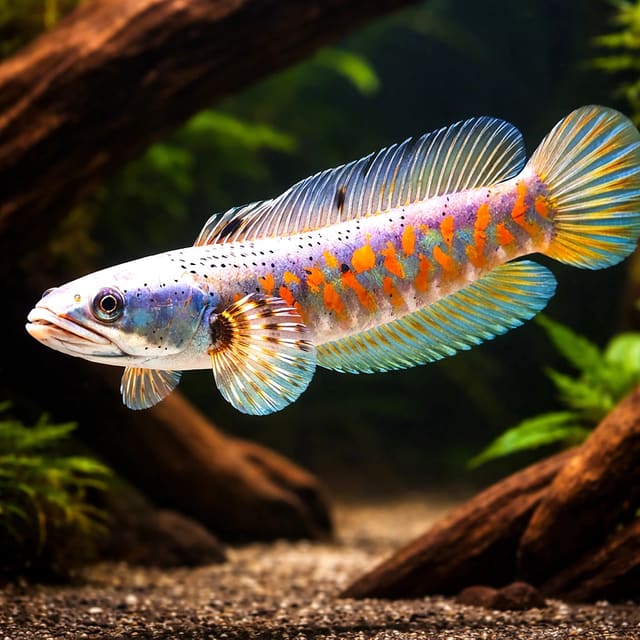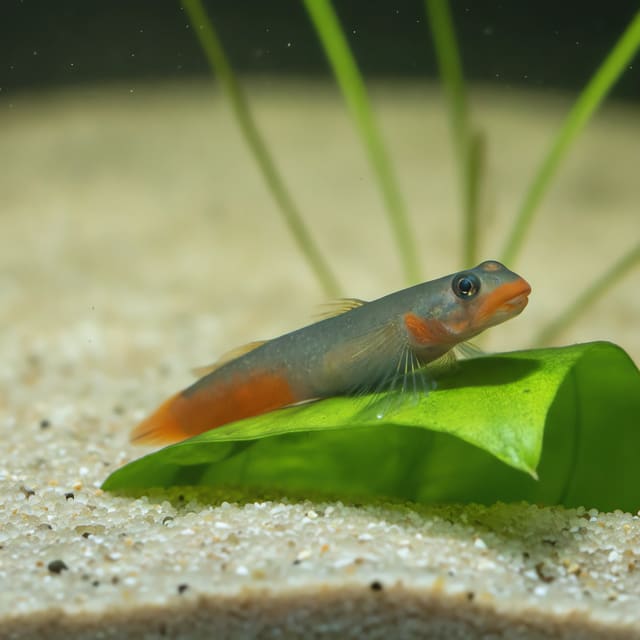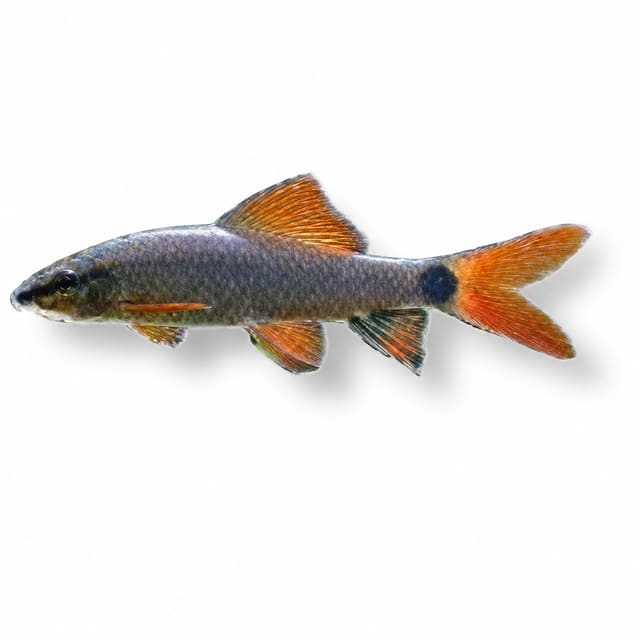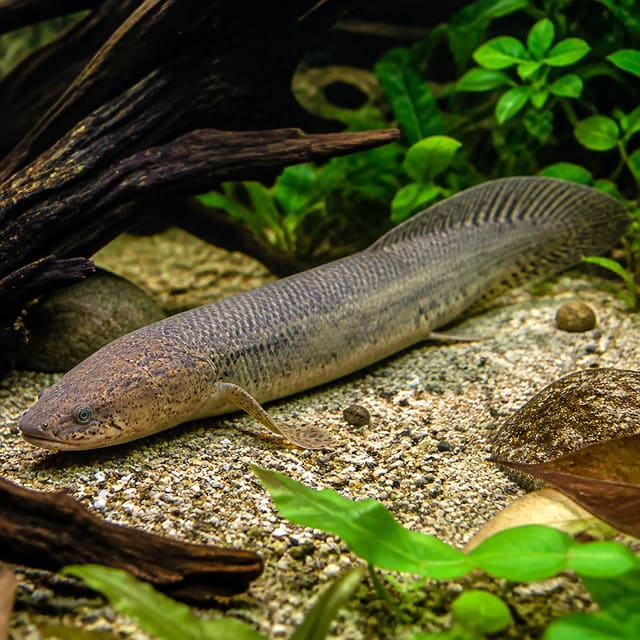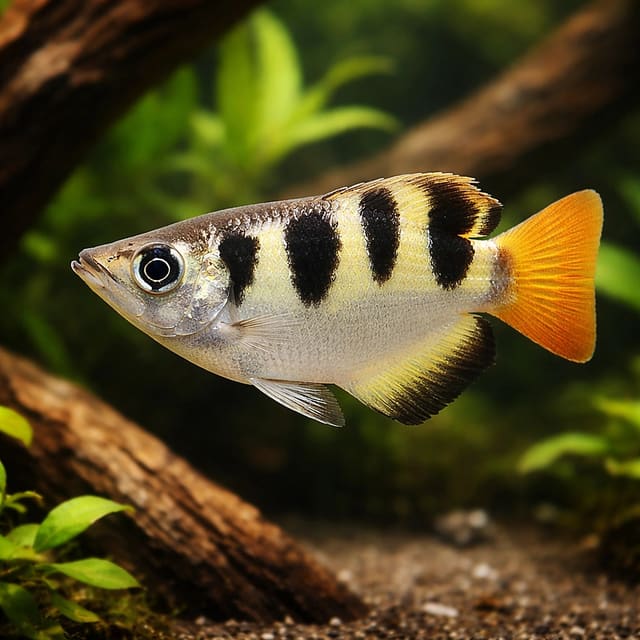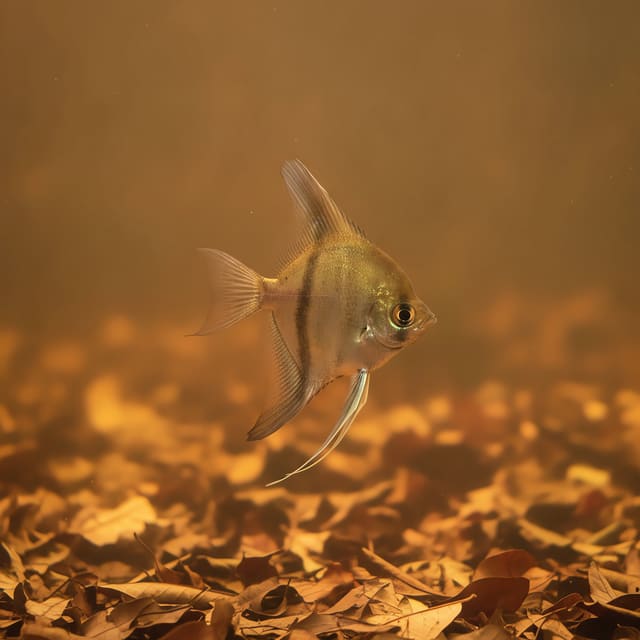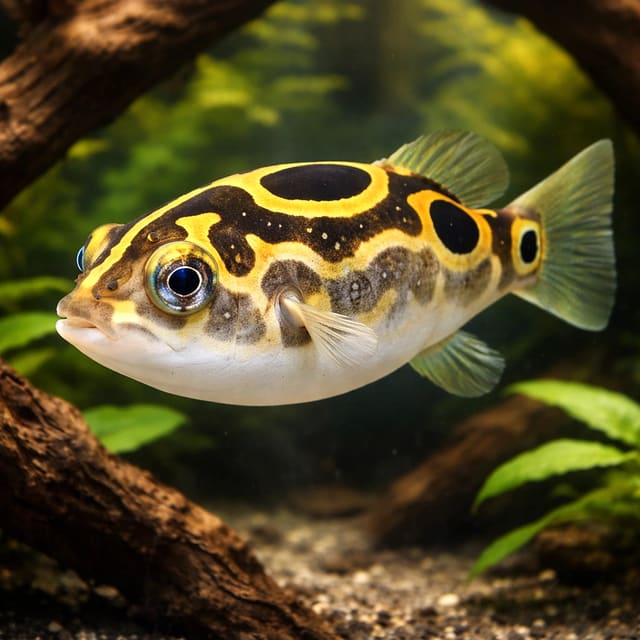
Eyespot pufferfish (Tetraodon biocellatus)
22–26°C · pH 6.5–7.5 · 68L
£14.99

One dwarf puffer, also called the pea puffer (Carinotetraodon travancoricus), sent at 0.5–1 cm or 1–2 cm. Adults reach about 2.5 cm, with 3.5 cm the recorded maximum. It needs a planted species tank at 22–28 °C, small shelled snails plus live or frozen food, and it nips the fins of slow fish.
Adult size is the maximum length this species reaches at full maturity (scientific sources). The livestock you receive will be younger and smaller — pick a size above for the actual shipping size. Product-photo provenance and any image-specific limitations are stated on the listing.
Carinotetraodon travancoricus
Save when buying multiple fish. Each quantity is one fish; sex and pair formation are not guaranteed unless the selected variant explicitly states them.
One dwarf puffer, also called the pea puffer (Carinotetraodon travancoricus), sent at 0.5–1 cm or 1–2 cm. Adults reach about 2.5 cm, with 3.5 cm the recorded maximum. It needs a planted species tank at 22–28 °C, small shelled snails plus live or frozen food, and it nips the fins of slow fish.
Adult size is the maximum length this species reaches at full maturity (scientific sources). The livestock you receive will be younger and smaller — pick a size above for the actual shipping size. Product-photo provenance and any image-specific limitations are stated on the listing.
Maintain these water conditions for optimal health and vibrant colors
The dwarf puffer, Carinotetraodon travancoricus, is the little freshwater pufferfish most people ask for by the name pea puffer. You will also see it labelled Malabar puffer or pygmy puffer, and older books and shop labels still use Tetraodon travancoricus or Monotretus travancoricus. Hora and Nair described it in 1941, and FishBase places it in Tetraodontidae, the pufferfish family. Whatever the label says, it is the same fish: a slow, bright-eyed hunter from south-west India that stays tiny and behaves like a predator.
Each unit on this listing is one fish. You choose the size it is sent at, either 0.5–1 cm or 1–2 cm. Those are lengths at dispatch, so the puffer you unpack still has growing to do. Seriously Fish gives 25 mm standard length for adults, which is about where most aquarium fish end up, and FishBase records a maximum of 3.5 cm total length. If you want more than one, add the number you have room for; the section on temperament explains why the number matters.
The sex is not chosen or promised. The marks that separate males from females belong to mature fish, so at these sizes you are buying youngsters whose sex shows later as they grow.
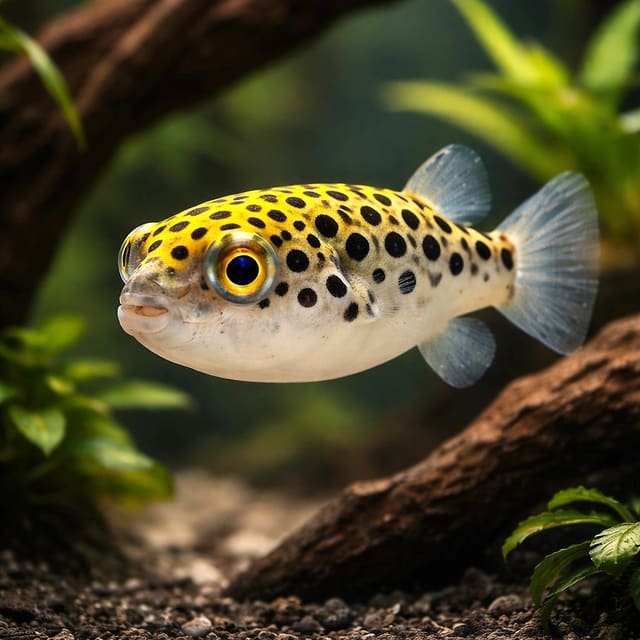
Wikipedia describes the body as greenish-yellow with dark green to brown-black iridescent patches over the flanks and back. Our photos show exactly that: a gold-green fish with dark blotches, a pale yellow underside and clear, yellow-tinted fins. The shape gives it away more than the colour does. It is short and round, with a blunt snout, large eyes, and small dorsal and anal fins set well back near the tail. Wikipedia calls it slow-swimming and bottom-dwelling, and in a planted tank you will mostly see it moving unhurriedly among the stems and close to the substrate.
One identification point is worth knowing. Seriously Fish notes that a second species, Carinotetraodon imitator, looks superficially similar. This listing is for C. travancoricus, and every care figure below refers to that species.
Both sizes are juveniles. The 0.5–1 cm fish are very small indeed, and for the first weeks they need the smallest foods you can get: newly hatched brine shrimp, daphnia and the tiniest snails. The 1–2 cm fish can take chopped frozen bloodworm and slightly larger snails sooner. Neither size can be sexed. If this is your first puffer, the larger size is simply easier to watch and to feed while you learn its habits; if you already keep small live foods going, either size will do.
A dwarf puffer suits someone who wants to set up a small tank around one kind of fish, enjoys watching behaviour, and is happy to keep snails and live or frozen food on hand. It does not suit a busy community tank, a shrimp display, or a keeper who wants every fish in the house to eat the same flake. Getting that decision right before you order matters more than any setting on the heater.
This puffer is endemic to south-west India, in the Western Ghats region. Wikipedia places it in Kerala and the south of Karnataka, with records from the Pamba, Periyar and Chalakudy rivers, Vembanad Lake and the Neyyar Wildlife Sanctuary. Seriously Fish describes it more narrowly as endemic to Kerala. FishBase lists India and classes it as a freshwater, demersal fish, which means it lives near the bottom rather than out in open water.
The habitat descriptions agree with each other. Seriously Fish calls it an exclusively freshwater species of sluggish, heavily vegetated inland waters, and says the species inhabits very still waters in nature. Wikipedia adds beds of gravel and rock beneath the vegetation. FishBase and Wikipedia both give wild water of 22–28 °C with a pH of 7.5–8.3, which is on the alkaline side of neutral.
Buyers sometimes ask whether a pea puffer needs brackish water because it is a puffer. It does not. Wikipedia states that the species is not found in saltwater and that reports to the contrary are based on misidentification. Keep it in ordinary, dechlorinated fresh water with no aquarium salt added.
Wikipedia lists water fleas, rotifers, copepods and seed shrimp, along with aquatic larvae. All of those are tiny animals that move, and that tells you most of what you need to know about feeding in the aquarium. This is a hunter of small live prey, and its natural food is tiny and alive rather than anything resembling flake.
One wild trait surprises people. Wikipedia notes that, unlike many pufferfish, which are mostly solitary, dwarf puffers are found in large shoals, sometimes hundreds strong. That does not make them a peaceful tetra-style shoal in a small glass box, as the temperament section explains, but it does mean that a group is natural for the species when the tank is big enough and well divided.
Taken together, the wild picture gives a clear brief for the aquarium: still water, plenty of plants, a warm and steady temperature, and a supply of small living food. Every recommendation further down comes back to that brief.
The dwarf puffer is assessed as Vulnerable on the IUCN Red List. FishBase gives the assessment date as September 2010, and its own biology note goes further, describing it as probably one of the endangered species. Wikipedia sets out the reasons: damming, clearing of forest for agriculture, pollution from wastewater and, above all, overfishing for the aquarium trade. It also reports estimates that wild numbers fell by 30–40% between 2005 and 2015, with other researchers arguing that the same fall had already happened by 2010.
We sell aquarium fish, so we are not going to pretend the hobby has nothing to do with that. What a buyer can do is make each fish count:
None of this is meant to put you off. It is meant to help you buy one the right way: a planned fish for a planned tank, kept well for years.
| Question | What you want to be able to say |
|---|---|
| Is the tank cycled? | Yes. Ammonia and nitrite read zero, and the filter has been running for weeks, not days. |
| Is it planted? | Yes. Dense plants, moss, some wood and a little floating cover are already in place. |
| Is food ready? | Yes. Frozen daphnia, brine shrimp or bloodworm in the freezer, and a snail culture started. |
| Is the tank for puffers only? | Yes, or any other residents have been chosen with the temperament section in mind. |
| Is there a back-up plan? | Yes. A spare tank or a keeper who can take a fish if two males fall out. |
| Will someone be home on delivery day? | Yes. Live fish have to be received in person. |
Seriously Fish gives the bare minimum for one dwarf puffer as a tank of 30 × 20 × 20 cm, about 12.6 litres. We would rather see 20 litres or more for a single fish. The puffer does not need the swimming room, but a larger volume holds its temperature and water quality more steadily, and meaty food and snail shells put a real load on a very small tank.
For groups, Seriously Fish's rule of thumb is 2–3 gallons of tank volume per puffer, which works out at roughly 8–14 litres each depending on whether US or UK gallons are meant. Treat that as the floor, not the target. Because rival males can fight, how the space is divided matters as much as how many litres the tank holds. A long tank with several planted zones gives each fish somewhere out of sight of the others; a tall, open tank of the same volume does not. For a small group we would start at about 30 litres and plant it heavily from the first day.
Seriously Fish says this puffer fares best in a heavily planted set-up, with twisted roots and branches for cover to reduce aggression, and floating plants to diffuse the light. That matches the wild habitat closely. In practice we would build the tank around:
That last point matters more than it sounds. Thick cover keeps puffers calm, but you still need to watch each fish feed, so leave a clear stage where meals arrive.
Keep the current gentle. Seriously Fish advises keeping water movement to a minimum because of those very still home waters. An air-driven sponge filter suits a small puffer tank well, as does a small internal filter with its outlet turned towards the glass or softened by plants. The aim is clean, well-filtered water without a jet pushing a 2 cm fish around the tank. A cover glass or lid helps hold the temperature steady and cuts evaporation.
A planted tank often grows a few small snails of its own, and for this fish that is welcome. It is also worth running a separate tub or small tank to breed snails, so there is always a supply of small, shell-on snails ready to drop in. Starting that culture a few weeks before your puffer arrives saves a lot of hunting about later.
A typical home for one or two puffers might be a 30–40 litre tank with a sand front, a root running diagonally from back corner to middle, a thicket of stem plants and moss behind it, and a raft of floating plants over one end. Put the heater and filter at the back behind the planting, where the flow is broken up. Feed at the open sand at the front. Cover at the back and food at the front means each fish has somewhere to retreat to, while you can still see every one of them eat.
| Parameter | Aim for | Where the figure comes from |
|---|---|---|
| Temperature | 22–28 °C | The same range in FishBase, Seriously Fish and Wikipedia |
| pH | 6.8–8.0 | Seriously Fish aquarium range; FishBase records 7.5–8.3 for wild water |
| Hardness | 5–25 °H | Seriously Fish |
| Ammonia and nitrite | Zero | Tank fully cycled before the fish arrives |
| Water movement | As little as practical | Seriously Fish: very still water in nature |
The chemistry is forgiving. The range Seriously Fish gives runs from just below neutral to clearly alkaline, with hardness anywhere from soft to quite hard, and the wild readings sit at the alkaline end. So there is a good chance your tap water already falls inside it without any adjustment. Test yours rather than assume, and if it sits within those numbers leave it alone. Steady water does far more good than a perfect figure reached by constant tinkering with buffers and additives.
Temperature is the one to watch. Choose a single setting inside 22–28 °C and hold it there with a reliable heater and a thermometer you can read at a glance. Keep the tank away from draughts, radiators and direct sun so the temperature does not swing between day and night.
Seriously Fish describes puffers as sensitive to deteriorating water conditions and treats regular partial water changes as essential. With this fish the waste comes from its food as much as from the fish itself: bits of bloodworm, uneaten brine shrimp, and snail shells with a little left inside. Lift out leftovers after each feed, siphon the open patch at the front during water changes, and test nitrate as well as ammonia and nitrite.
Use a dechlorinator on all new water and bring it close to tank temperature before it goes in. Small, regular changes are better than large, occasional ones. When the filter needs a clean, rinse the sponge in water taken out of the tank rather than under the tap, so the bacteria that keep the water safe survive.
| Task | How often | Why |
|---|---|---|
| Look at every fish's belly and fins | Daily, at feeding time | Shows who is eating and who is being pushed out |
| Remove leftovers and empty shells | After each feed | Keeps waste out of a small volume of water |
| Partial water change | Weekly | Keeps nitrate and dissolved waste down |
| Test ammonia, nitrite, nitrate | Weekly, more often in the first month | Catches a problem before the fish shows it |
| Top up the snail culture | As needed | Shelled snails are a regular part of the diet |
This is the part of keeping pea puffers that decides whether it works for you. Seriously Fish says the species relishes all kinds of shellfish, as well as worms and other live and frozen foods, and that dried foods are not usually accepted. If your feeding routine is a pinch of flake once a day, this is not the fish for you, and it is better to know that now.
Seriously Fish advises feeding small snails, shell on, regularly, in order to maintain the puffer's sharp teeth. Wikipedia makes the same point from the other direction, noting that it is one of the few aquarium fish that regularly eats small live snails. Match the snails to the fish: the smallest you can find for a 1 cm juvenile, and slightly larger ones as it grows. Take out empty shells and any snail that dies uneaten, because a rotting snail in a small tank fouls the water quickly.
For the rest of the menu, stay with small, meaty items. The wild diet Wikipedia lists translates easily into aquarium foods:
Thaw frozen food in a little tank water first, then offer it with a pipette or tweezers into the same spot each time, so the fish learns where meals arrive. Feed what can be eaten in a few minutes, watch who gets it, and then take out the rest. Several small offerings are easier to keep track of than one large one, and less goes to waste.
Newly arrived puffers can be wary of food they do not recognise. Start with something that moves, such as live daphnia, brine shrimp or a tiny snail. Once the fish is eating confidently, bring in frozen foods one at a time. A rounded belly after a meal is normal. A belly that stays pinched day after day means the fish is not getting enough, and in a group it can mean another puffer is keeping it away from the food.
Wikipedia notes that pea puffers help to control snail numbers, and people do buy them for that reason. Buy one for its own sake instead. When the snails run out the puffer still needs feeding, and a community tank with a snail problem is usually exactly the wrong home for it, for the reasons in the next section.
Seriously Fish puts it plainly: the dwarf puffer is not usually recommended for the community tank, as it tends to nip the fins of slow-moving or long-finned fish. That rules out bettas, fancy guppies and anything else with trailing fins or a slow, drifting way of swimming. For most buyers a species-only tank is our firm recommendation.
Groups are possible and, given the large wild shoals Wikipedia describes, natural for the species. The difficulty is the males. Seriously Fish warns that rival males have been known to fight to the death, and suggests keeping breeding fish as a pair or as one male with several females. Because sexes cannot be chosen at dispatch size, a group bought now is a mix you will only understand as the fish mature. Plan for that from the start:
The sources lean in slightly different directions on keeping one fish alone. Seriously Fish treats a single puffer in a small tank as a sound set-up, while Wikipedia notes that shoaling fish can show stress or weight loss when kept alone or in groups that are too small. Both arrangements have support. A single puffer in a planted tank is the simpler plan for a first-time keeper; a group in a larger, well-divided tank is the more natural one if you are ready to manage the males.
Seriously Fish mentions smaller loricariids, particularly Otocinclus, and some freshwater shrimp as possible tank mates, while making clear that success varies. Wikipedia lists shrimps among the foods dwarf puffers eat in captivity. Put those together and the honest advice is this: never put a puffer in with a shrimp colony you care about, because young and small shrimp are likely to be eaten. Ornamental snails count as food. If you want to try Otocinclus, do it only in a mature, heavily planted tank, and watch both species closely in the first weeks.
If what you really want is a small shoal in a calm community nano tank, a puffer is the wrong choice, and there is no shame in that. Have a look at the dwarf rasbora (Boraras maculatus), the emerald dwarf danio (Danio erythromicron) or the dwarf pencilfish (Nannostomus marginatus). These are ideas for a different tank, not companions for a dwarf puffer, and each listing sets out its own care.
Mature dwarf puffers can be sexed by eye, though not at the sizes we send. Seriously Fish says mature males have a clear dark line running lengthways over much of the underside, which females lack, along with a pattern of closely arranged lines just behind the eye. Wikipedia adds that males are more brightly coloured, with a yellow belly, and may show iridescent blue "eye wrinkle" markings. Females are noticeably rounder in the body, and Wikipedia notes that they tend to be larger than males and may carry more small spots between the larger dark patches.
So if you buy several juveniles, expect to work out who is who over the following months. Note it down as the lines appear; it will help you decide whether the group needs splitting.
Seriously Fish recommends breeding them in pairs or as a harem of one male with several females, which also prevents fights between males. Spawning happens in dense, fine-leaved plants such as Cabomba, Ambulia and mosses. FishBase notes that the eggs are deposited and so hidden in vegetation, and Wikipedia describes them as adhesive, transparent and round, laid in plants or on the substrate among plants.
Numbers are small. Seriously Fish says most spawnings yield ten eggs or fewer. Wikipedia describes a female scattering roughly one to five eggs, with spawning repeated at intervals of one to four days, and the male returning to guard the eggs.
The two sources agree on timing. Eggs hatch in about five days; Wikipedia gives that at 27 °C. Seriously Fish says the fry take two or three days to use up their yolk sac and then need microworm as a first food, moving on to Artemia nauplii and later to frozen bloodworm. Rearing them in a separate small container makes it easier to offer tiny foods often while keeping the water clean.
Breeding is a project, not a requirement. A dwarf puffer that eats well, holds its weight and patrols its patch of planting is a success whether or not it ever spawns.
With a fish this small, daily observation is the most useful health tool you have. Feeding time is the best moment to do it, because every puffer in the tank should come forward and you can look at each one in turn.
Refusing food, a hollow belly, clamped fins, hiding all day, fast breathing near the surface, or one fish constantly chased by another all mean something needs to change. Start with the water. Test ammonia, nitrite and nitrate, check the thermometer, and think back over anything that changed recently. Seriously Fish's warning that puffers are sensitive to deteriorating water applies here: a clean, stable tank fixes more problems than any bottle from a shelf. Then look at the social side, and move a bullied fish before it loses condition. Treat medicines with care and only once you have a likely cause, because guessing with chemicals in a small tank can do more harm than the original problem.
Seriously Fish's advice to feed shelled snails regularly is about keeping the teeth in working order. A puffer fed only soft frozen food misses that, so keep snails in the diet every week for the life of the fish, not just while it is young.
Wikipedia reports that aquarists keep dwarf puffers for about five years. It can inflate, and Wikipedia notes small skin spines that stand up when it does. Wikipedia also records that the species carries tetrodotoxin in the skin glands, liver and ovaries, while FishBase lists it as harmless to humans. Treat it as you would any small pet fish: move it in a net or a cup, never squeeze it, and wash your hands after tank work.
If you already keep fish, a separate small tank for new arrivals is worth having, and with a puffer it doubles as the spare tank for a male that needs moving later. Two or three weeks of watching a new fish eat and behave on its own is time well spent before it joins anything else.
Have the tank ready before you order, not after: filter running and matured, water tested, heater set and the temperature steady. Someone needs to be at the delivery address to take the parcel in, because live animals must be received in person. Please read our delivery and live-arrival information before you order.
Your puffer travels in an oxygen-filled bag inside insulated packaging, with heat packs when the weather calls for them, carried by a tracked courier licensed to carry live animals. We email the confirmed delivery date and the tracking details.
Start a continuous video before you open the box, while it is still sealed, and keep filming in the same take until the fish is visible in its unopened bag. If a fish arrives dead, dying or clearly compromised, email hello@tropicalfishco.co.uk on the day of delivery with your order number and that video. Photos on their own do not meet the policy. The resolution is a replacement with your next order or a refund for the affected fish, subject to the guarantee terms.
Offer a small live meal once the fish has had time to settle, and do not worry if it ignores the first one. Keep hands out of the tank, leave the plants where they are, and add nothing new. Watch breathing, appetite and behaviour each day. A puffer that starts exploring and comes forward when food appears is settling well. If it still has not eaten after a few days, check the water first, then try a live food it is more likely to recognise, such as daphnia or a tiny snail.
These are the sources used for the facts on this page. Where they differ, the text above says so.
No reviews for this item yet. Bought one? Honest reviews only, good or bad.
What customers say about ordering from us
I have a small group of long finned mountain minnows. So was delighted to be able to order ten of this variety to increase the genetics in my tank . The ones I recieved are healthy but it’s to early to give a verdict on wether they are of a long finned type since they are small currently.
Gordon Walker · 23 Sept 2026
100% success travel and "installation". Pleased with quality of purchase. The Siamese fighter a bit "shy" so have not yet seen him at his best yet but looking good. Happy customer. GG
George E Garratt · 21 Sept 2026
Reviews of our shop, collected by Judge.me, an independent third-party review collector. Newest first.